

Sales Intelligence for Sales Reps: What Actually Moves the Needle in 2026
It's Tuesday morning. You've got 47 accounts in your territory, a pipeline review at 2pm, and zero insight into which accounts are actually ready to buy. So you do what every rep does - open the CRM, scroll through stale notes from six months ago, and start guessing.
That's not selling. That's archaeology.
Reps spend roughly 70% of their time on non-selling activities - research, data entry, hunting for a direct dial that actually rings. Sales intelligence for sales reps exists to compress that 70% so you can spend more time in conversations that close. But the gap between "having a tool" and "using it to win deals" is enormous, and we've watched plenty of teams fall into it. Sales data tells you what happened. Intelligence tells you what to do next.
The Short Version
- Sales intelligence = the data and signals that tell you who to call, when to call, and what to say. It's not your CRM - it's the layer that makes your CRM useful.
- The ROI is real: teams using conversation intelligence tools close deals 11 days faster and see 10-point win-rate lifts on deals over $50k. But 60-70% of implementations fail, usually because of bad data, not bad tools.
- Start with verified contact data, add a CRM you'll actually use, layer one intelligence tool on top. Three tools, not ten.
What Is Sales Intelligence?
Sales intelligence is external data layered on top of your CRM to help you prioritize, personalize, and time your outreach. Your CRM tracks what already happened. Intelligence tells you what's about to happen - and who's worth your time right now.
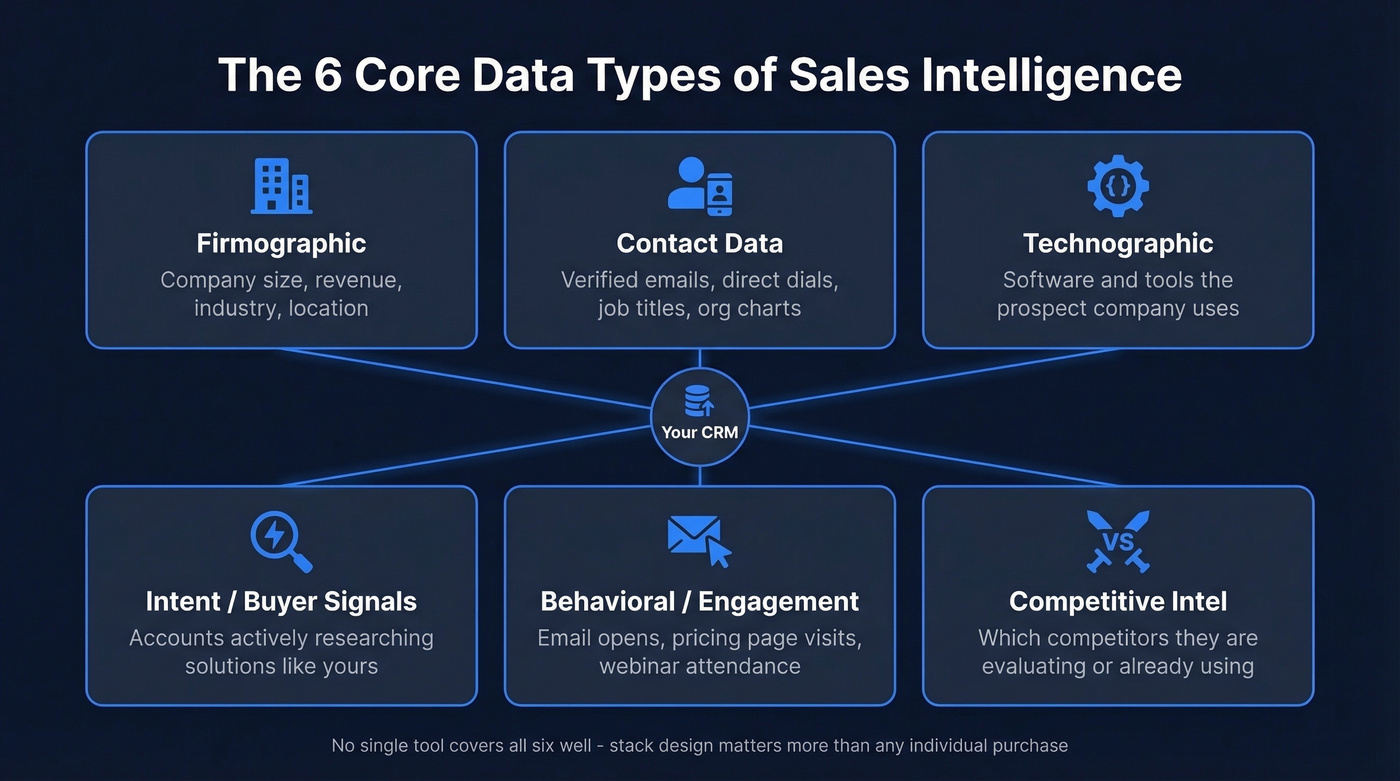
The six core data types:
- Firmographic - company size, revenue, industry, location (firmographic)
- Contact - verified emails, direct dials, job titles, reporting structure (data enrichment)
- Technographic - what software a prospect's company runs
- Intent / buyer signals - which accounts are actively researching solutions like yours (Identifying Buying Signals)
- Behavioral / engagement - who opened your emails, visited your pricing page, attended your webinar
- Competitive - which competitors a prospect is evaluating or already using (Competitive Intelligence Strategy)
No single tool covers all six well. That's why stack design matters more than any individual purchase.
Why the Numbers Matter
Speed kills (in a good way). Deals closed within 50 days show a 47% win rate. Push past 50 days and that drops to 20%. Intelligence compresses cycles by giving reps the context to move faster - who the decision-makers are, what they care about, and whether they're actively in-market.
AI is already changing the math. Among teams using AI SDR tools, 40% save 4-7 hours per week on prospecting. LivePerson cut per-prospect research time from 20 minutes to 2 minutes and saw a 35% lift in engagement rates. That's not incremental - that's a different operating model.
Conversation intelligence moves the needle on big deals. Teams using it close deals 11 days faster on average, with a +10 percentage point win-rate improvement on deals over $50k. When your average deal involves 13 decision-makers, knowing what each stakeholder cares about isn't optional.
Here's the sobering context: the median B2B conversion rate is still just 2.9%, and it takes an average of 4.81 touches to get a single response. Intelligence doesn't magically fix those numbers. It helps you focus those touches on the accounts most likely to convert, with messages that actually resonate.
The bottom line: organizations implementing strategic tool stacks see 43% higher win rates and 37% faster sales cycles vs. fragmented approaches. The tools matter less than how they connect.

This article mentions that 22.5% of B2B data goes stale every year - and that bad data is the #1 reason intelligence implementations fail. Prospeo refreshes every record on a 7-day cycle (industry average: 6 weeks), delivers 98% email accuracy, and gives reps 125M+ verified mobile numbers with a 30% pickup rate. That's the foundation real sales intelligence runs on.
Stop building your pipeline on decaying data. Start with contacts that connect.
A Rep's Daily Workflow
Here's what an intelligence-powered day actually looks like - and how we've seen top-performing reps structure their time.
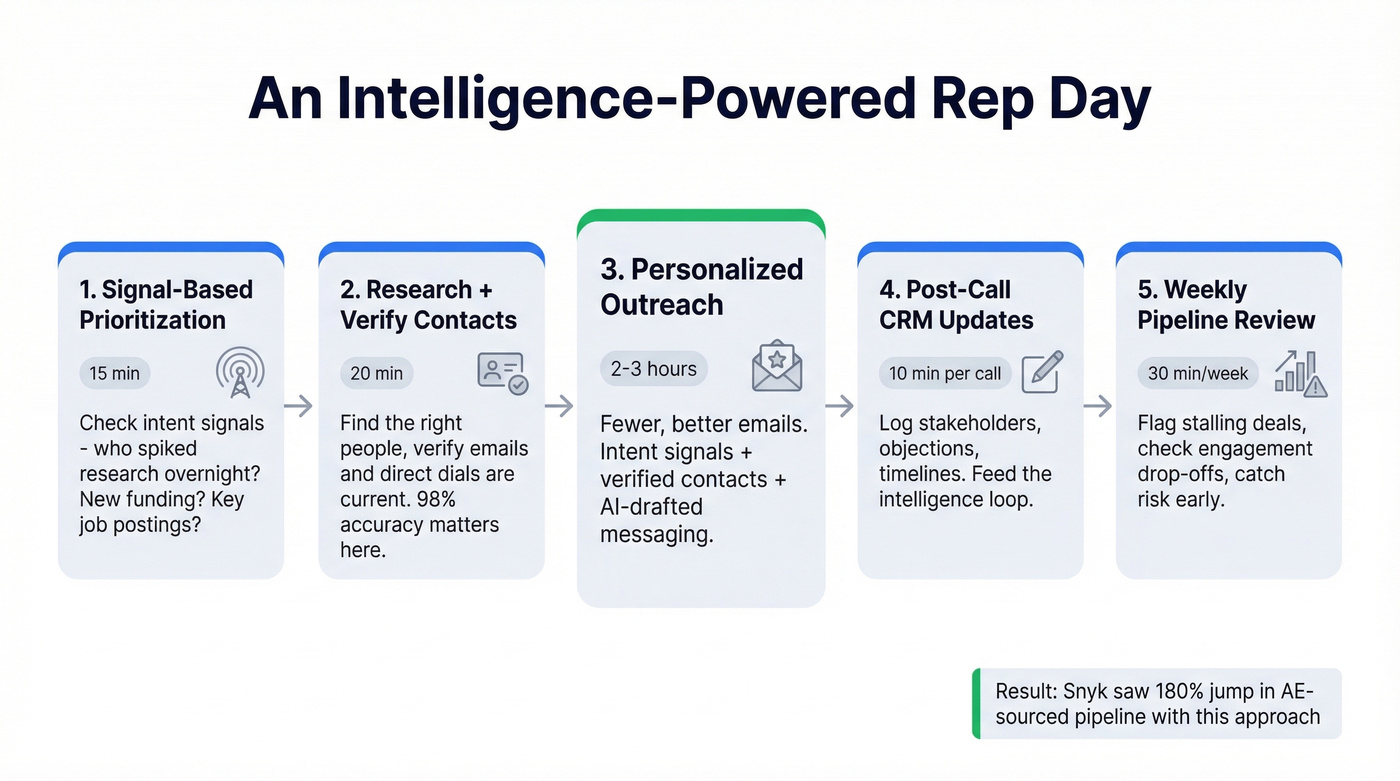
1. Signal-based account prioritization (15 minutes). Before you touch a phone, check your intent signals. Which accounts spiked research activity overnight? Who just got funding? Who posted a job listing for the role that typically buys your product? This replaces the "scroll through my list alphabetically" approach that wastes the first hour of most reps' days.
2. Pre-call research + contact verification (20 minutes). You've got your priority accounts. Now find the right people and make sure the data's current. Verify emails and direct dials before outreach - working with 98% email accuracy and a 7-day refresh cycle means you're reaching people who actually still work there, not someone who left in Q1. (If you need a dedicated verifier, start with an email checker and an email deliverability guide.)
3. Personalized outreach (2-3 hours). This is where intelligence earns its keep. 54% of teams now use AI for personalized outbound emails, and 45% use it for account research. Verified contacts + intent signals + AI-drafted messaging means you're sending fewer, better emails instead of blasting 200 generic templates (Personalized Outreach).
4. Post-call CRM update (10 minutes per call). Every conversation generates intelligence. Log it. Note the stakeholders mentioned, the objections raised, the timeline discussed. This feeds your conversation intelligence tools and keeps the next rep who touches this account from starting at zero.
5. Weekly pipeline review (30 minutes). Pull your deal analytics. Which opportunities are stalling? Where did engagement drop off? Intelligence tools flag deal risk before it becomes a lost deal - but only if you're actually looking at the dashboards (pipeline health).
When Snyk's 50-person AE team adopted this kind of workflow, AE-sourced pipeline jumped 180%. Not because they worked harder, but because they stopped wasting time on dead contacts.
Why Most Implementations Fail
60-70% of sales intelligence implementations fail to deliver promised value. That's not a tools problem. It's a people-and-data problem.
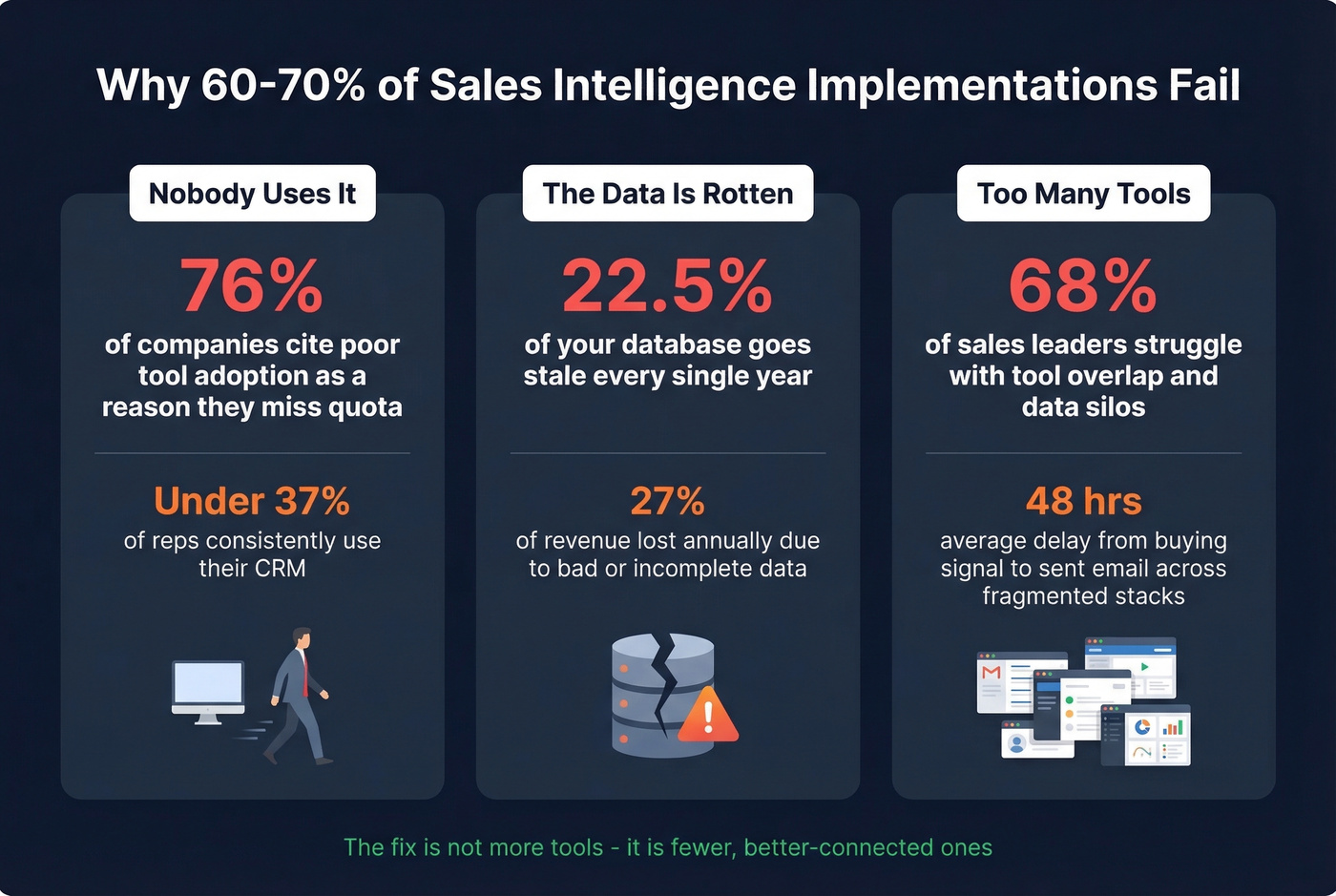
Nobody uses it. 76% of companies cite poor adoption of sales tools as a primary reason they miss quota. Fewer than 37% of reps consistently use their CRM. If reps won't log into the CRM, they're definitely not going to check intent dashboards or run enrichment workflows. The fix isn't training - it's buying tools that fit into workflows reps already follow.
The data is rotten. B2B data decays at 2.1% per month - roughly 22.5% annually. That means nearly a quarter of your database is wrong within a year. 56% of organizations cite data inconsistencies as a major obstacle to hitting sales goals, and U.S. companies lose an estimated 27% of revenue annually due to incomplete or inaccurate customer data. Without reliable sales lead intelligence, reps are making decisions based on fiction.
Too many tools, not enough integration. 68% of sales leaders struggle with tool overlap, data silos, and integration challenges. The typical intelligence stack runs $15k-$100k/year, plus $15k-$40k for engagement tools, plus automation, plus deliverability infrastructure. By the time a buying signal becomes a sent email, 48 hours may pass across multiple systems. That's not intelligence - that's bureaucracy.
Here's the thing: if you're spending more time switching between tabs than talking to prospects, your stack is broken.
Best Tools for Sales Reps in 2026
Here's what's actually worth your time and money.
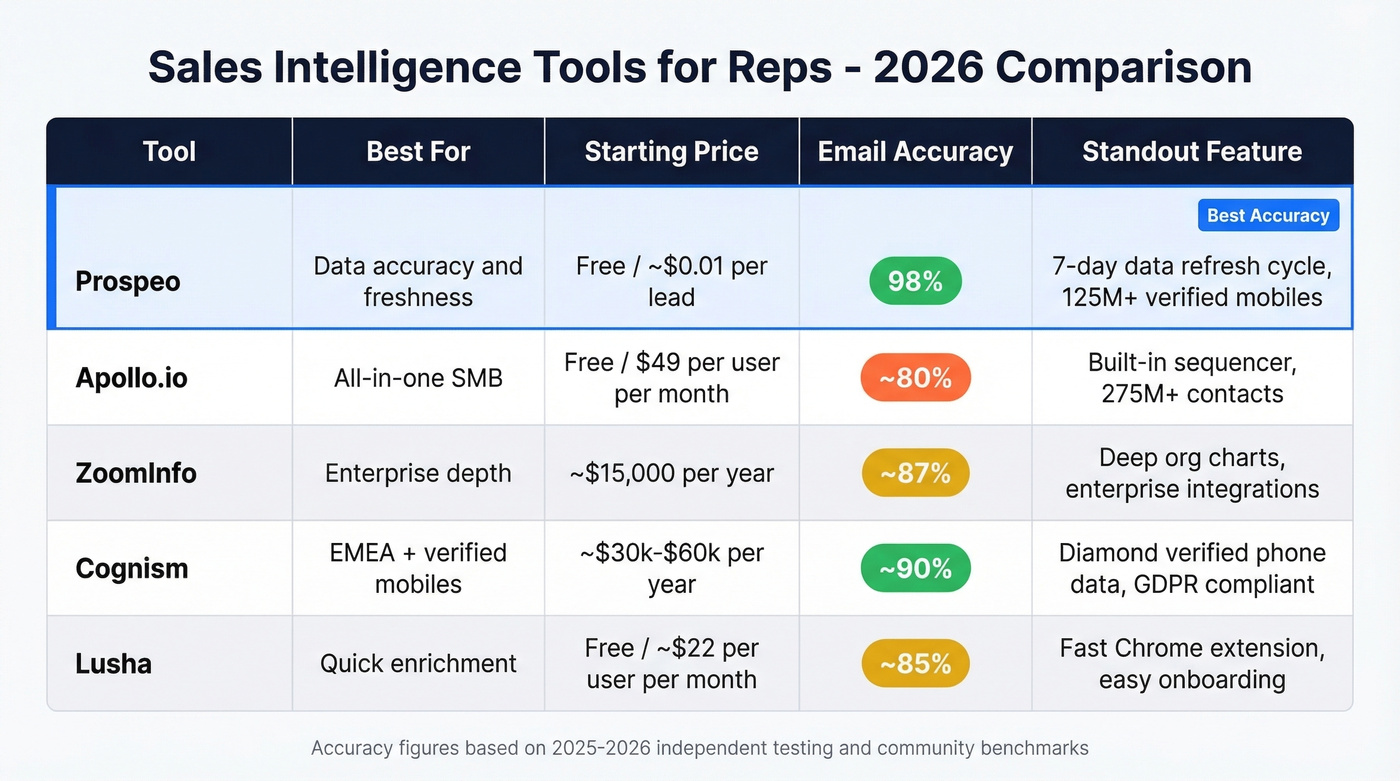
| Tool | Best For | Starting Price | Email Accuracy | G2 Rating |
|---|---|---|---|---|
| Prospeo | Data accuracy + freshness | Free / ~$0.01/lead | 98% | 40K+ Chrome users |
| Apollo.io | All-in-one SMB | Free / $49/user/mo | ~80% | 4.7/5 (9,250) |
| ZoomInfo | Enterprise depth | ~$15,000/yr | ~87% | 4.5/5 (8,875) |
| Cognism | EMEA + verified mobiles | ~$30k-$60k/yr | ~90% | 4.5/5 (1,200) |
| Lusha | Quick enrichment | Free / ~$22/user/mo | ~85% | 4.3/5 (1,566) |
| Sales Navigator | Relationship mapping | $80-$170/mo | N/A | - |
| Gong | Conversation intelligence | Quote-only | N/A | - |
| HubSpot Sales Hub | CRM-native intelligence | Free / $20/seat/mo | N/A | - |
Prospeo
Use this if: You need verified contact data that actually connects - especially emails and direct dials. Best for reps and teams who've been burned by bounces and disconnected numbers.
Skip this if: You need an all-in-one platform with built-in email sequencing. Pair Prospeo with Instantly, Smartlead, or your CRM's outreach tools instead.
Prospeo's database covers 300M+ professional profiles, 143M+ verified emails, and 125M+ verified mobile numbers. Teams using Prospeo book 26% more meetings than ZoomInfo users and 35% more than Apollo users - driven by 98% email accuracy vs. 87% at ZoomInfo and 79% at Apollo. The 30% mobile pickup rate across all regions, compared to 12.5% at ZoomInfo and 11% at Apollo, means direct dials that actually ring.
What sets it apart is the 7-day data refresh cycle. Most providers update every 4-6 weeks. That gap is where bad data lives. The Chrome extension (40K+ users) lets you verify contacts directly from any website or CRM without switching tabs. Add 30+ search filters including buyer intent across 15,000 topics, technographics, job changes, and funding signals - and you're not just finding contacts, you're finding the right contacts at the right time.
Pricing is self-serve and transparent: free tier with 75 emails + 100 Chrome extension credits per month, paid plans at roughly $0.01 per lead. No annual contracts. Integrates with Salesforce, HubSpot, Smartlead, Instantly, Lemlist, Clay, Zapier, Make, Outreach, and Salesloft.

Pair with: Instantly, Smartlead, or your CRM's built-in sequencing for outreach automation.
Apollo.io
Apollo is the obvious starting point for most SMB teams, and for good reason. The database covers 275M+ contacts across 73M companies with 65+ search filters, and the built-in sequencer means you can go from search to sent email without leaving the platform. Free tier, Basic at $49/user/month, Professional at $79, Organization at $119 - all annual billing.
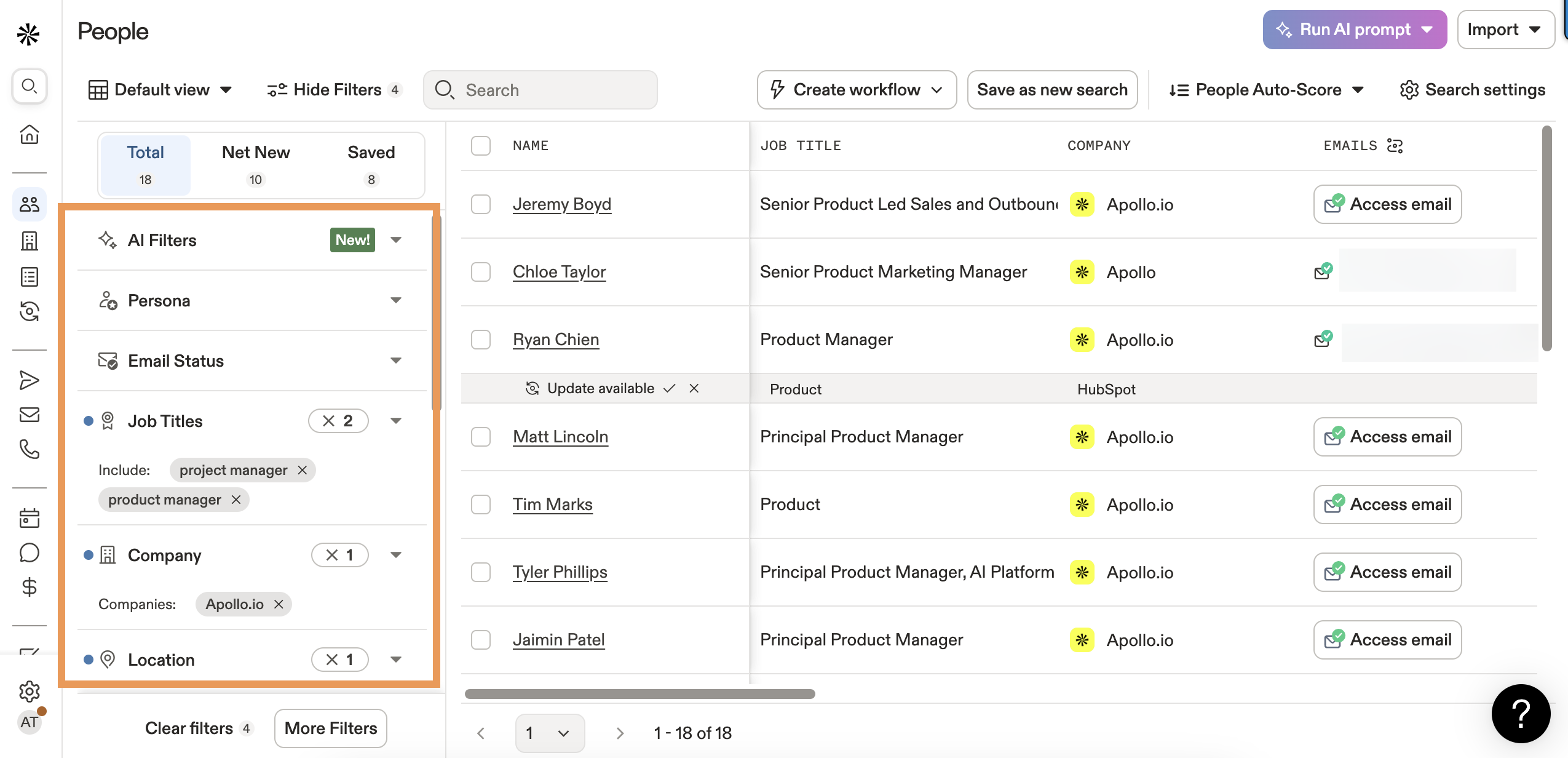
The tradeoff is accuracy. We've seen bounce rates climb noticeably on Apollo data outside the US, and the platform has had breach incidents in 2018 and 2021 that make security-conscious teams nervous. The consensus on r/sales is consistent: great value, but verify before you send. Run Apollo contacts through a dedicated verification tool and you'll be fine.
Best for: US-focused SMB teams wanting prospecting + outreach in one tool. Skip this if: Email deliverability is critical and you're not running a separate verification step.
ZoomInfo
ZoomInfo is still the deepest US database for direct dials and enterprise org charts. But most teams under 20 reps don't need it - and at $15k+/year with annual lock-in, the cost-per-lead math only works at volume.
G2: 4.5/5 across 8,875 reviews. Professional starts around $15,000/year, Advanced at ~$25,000, Elite at ~$40,000 - and real costs often run higher after add-ons, overages, and modules you didn't realize you'd need.
The #1 complaint on review sites? Contract friction. Auto-renewals, cancellation headaches, and the feeling that you're paying for intent, chat, and workflow features you never turn on. Where ZoomInfo wins: US database depth and direct dial coverage. Where it falls short: email accuracy at 87% vs. 98% from top verification tools, data freshness, and cost per lead.
Cognism
Cognism's Diamond Data program is the real differentiator. Human researchers phone-verify mobile numbers - a genuine advantage for EMEA outreach where mobile data is notoriously unreliable. GDPR compliance is baked in, not bolted on. G2: 4.5/5 across 1,200 reviews. Expect mid five-figure annual contracts, which is steep for small teams, but for international sales orgs the verified mobile coverage justifies it.
Best for: European markets and phone-verified international mobiles. Skip this if: You're US-only and price-sensitive.
Lusha
Lusha does one thing well: quick contact enrichment while you're browsing. G2: 4.3/5 across 1,566 reviews. Free plan gives you 40 credits, Pro runs ~$22/user/month, Premium ~$52/user/month. It's not a database - it's a lookup tool. Pair it with a proper intelligence platform for anything beyond ad-hoc enrichment.
LinkedIn Sales Navigator
The best tool for relationship mapping and real-time job title tracking - the data is user-updated, so it catches role changes faster than any third-party database. Core runs $80-$100/month, Advanced $135-$170/month. The critical limitation: it doesn't provide emails or direct dials. You'll need to pair it with a data provider for actual contact information.
Gong
The conversation intelligence leader. Gong analyzes calls, emails, and meetings to surface deal risk, coaching opportunities, and competitive mentions. Pricing is quote-only and typically sold as per-user licenses plus a platform fee. The 11-day faster close stat alone justifies the cost for mid-market and enterprise teams running complex, multi-stakeholder deals.
HubSpot Sales Hub
The path of least resistance if you're already on HubSpot. Free CRM tier, Starter at $20/seat/month, Professional at $100/seat/month, Enterprise at $150/seat/month on annual billing. Add Breeze Intelligence for enrichment: 100 credits at ~$30/month, scaling to 10,000 credits at ~$700/month. It won't match dedicated intelligence platforms on depth, but the native CRM integration means reps actually use it - and adoption beats features every time.
Build Your Stack Without Going Broke
You shouldn't need a 45-minute demo just to find out a tool is out of your budget - yet that's how most enterprise vendors operate. Let's break it down by what you can actually spend.
| Budget | Data Foundation | Intelligence Layer | CRM / Outreach |
|---|---|---|---|
| <$100/mo (solo rep) | Prospeo free tier | Sales Navigator Core | HubSpot free |
| $500-$2k/mo (small team) | Verified data + Apollo or Lusha | Intent signals | HubSpot or Salesforce |
| $5k+/mo (mid-market) | Verified data + ZoomInfo or Cognism | Gong | Salesforce or HubSpot Pro |
Small team ($500-$2,000/month): Move to paid verification plans for higher volume at ~$0.01/lead. Add Apollo for sequencing or Lusha for quick enrichment. This is where most Series A and B companies should land. You don't need ZoomInfo yet.
Mid-market ($5,000+/month): Now you can justify ZoomInfo or Cognism for database depth, Gong for conversation intelligence, and a full CRM implementation. Keep your verification layer in the stack - even ZoomInfo's data benefits from a verification step before you hit send. 72% of enterprise sales orgs prefer platform approaches over point solutions, but the smartest teams still run a dedicated accuracy layer underneath.
Organizations that build strategic stacks see 43% higher win rates vs. teams that buy tools ad hoc. The difference isn't spending more - it's spending intentionally.
Reps using Prospeo's workflow - intent signals, verified contacts, and personalized outreach - book 26% more meetings than ZoomInfo users and 35% more than Apollo users. At $0.01 per email with no contracts, you get enterprise-grade sales intelligence without the enterprise price tag.
Spend your selling hours selling, not hunting for data that actually works.
FAQ
What's the difference between sales intelligence and a CRM?
A CRM stores your interactions and pipeline data. Sales intelligence layers on external signals - verified contacts, intent data, technographics - to tell you who to target next and when they're ready to buy. CRM is the scoreboard; intelligence is the scouting report.
How much does a sales intelligence stack cost?
Solo reps can build a functional stack for under $100/month using free tiers plus Sales Navigator. Small teams typically spend $500-$2,000/month. Enterprise stacks with ZoomInfo or Cognism plus Gong run $5,000-$10,000+/month.
What's the most important data type for reps?
Verified contact data - everything else depends on it. Intent signals and AI insights are worthless if your emails bounce and your phone numbers are disconnected. Start with 98%+ email verification and a weekly data refresh cycle, then layer intent and technographic intelligence on top.
How fast does B2B contact data go stale?
B2B data decays at roughly 2.1% per month - about 22.5% annually. Nearly a quarter of your database is wrong within a year. Look for providers with 7-day refresh cycles rather than the industry-standard 6 weeks to keep outreach hitting live inboxes.
Can a solo rep use these tools without a team license?
Yes. Prospeo offers 75 free verified emails plus 100 Chrome extension credits monthly, HubSpot's CRM is free, and Sales Navigator Core runs $80/month. A solo rep can find verified contacts, enrich accounts, and monitor buying signals for under $100/month - then prove ROI before requesting a team budget.