

Sales Intelligence Reviews: 10 Tools Tested for 2026
The sales intelligence market hit $4.99 billion in 2026, and G2 lists over 420 products in the category. That's not a market - it's a maze. Here's what most sales intelligence reviews won't tell you: you don't need the "best" tool. You need two, maybe three, that fit your workflow and budget.
AI-assisted selling jumped from 24% adoption to 43% in two years, and companies using a dedicated intelligence strategy are 3x more likely to close deals faster. We've run bake-offs, compared accuracy numbers head-to-head, and watched teams burn entire quarters on the wrong platform. These are the 10 worth your time.
Our Picks (TL;DR)
| Pick | Tool | Why |
|---|---|---|
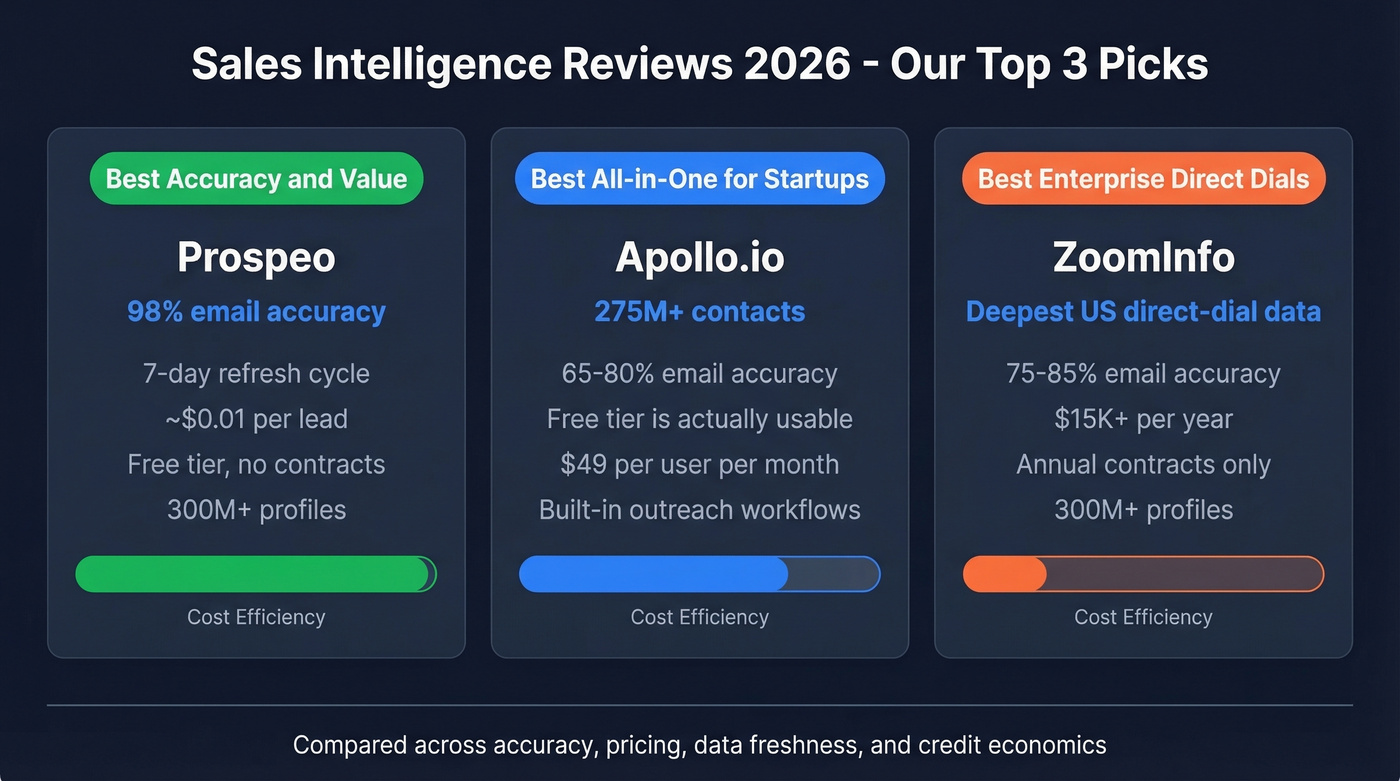
| Best accuracy & value | Prospeo | 98% email accuracy, 7-day refresh, ~$0.01/lead. Free tier, no contracts. |
| Best all-in-one for startups | Apollo.io | Free tier is genuinely usable. $49/user/mo gets 275M+ contacts plus core prospecting workflows. |
| Best enterprise direct dials | ZoomInfo | Deepest US direct-dial coverage. $15K+/yr with painful contracts, but the data is real. |
How We Evaluated
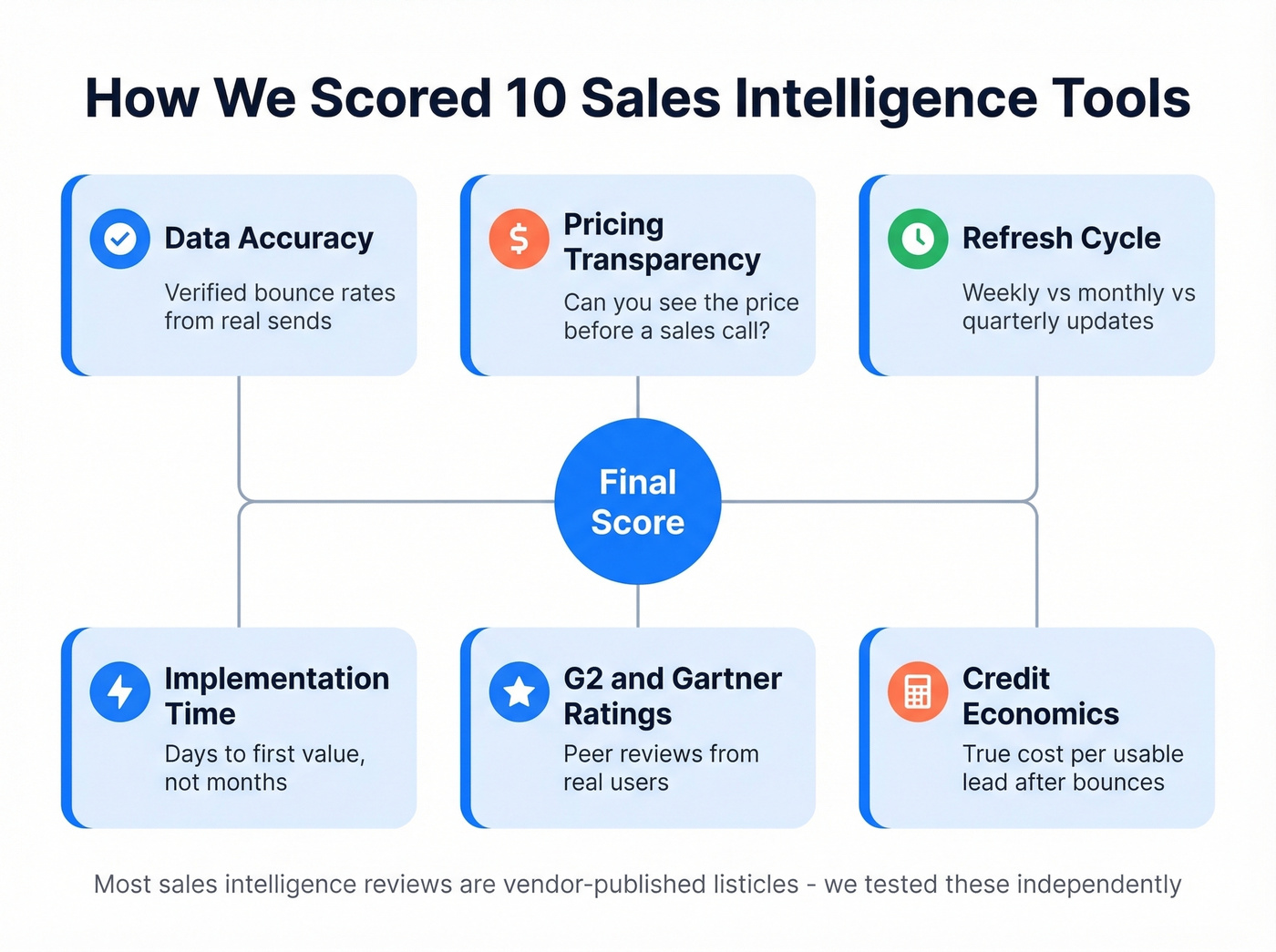
We scored each tool on data accuracy, pricing transparency, refresh cycle, implementation time, G2/Gartner ratings, and credit economics. Most software reviews in this space are vendor-published listicles that rank their own product first. We don't sell a CRM or ABM platform. Our bias is toward data accuracy - and we're upfront about it.
If you're building a broader stack, it helps to compare data enrichment services alongside sales intelligence tools.
Comparison Table
| Tool | G2 | Starting Price | Email Accuracy | Best For |
|---|---|---|---|---|
| Apollo.io | 4.8/5 | Free; $49/user/mo | 65-80% | Startup all-in-one |
| ZoomInfo | 4.4/5 | ~$14,995/yr | 75-85% | Enterprise US data |
| Cognism | 4.6/5 | ~$12,000/yr | 70-80% | EMEA + GDPR |
| 6sense | 4.3/5 | Free; ~$30,000/yr | N/A (intent only) | Enterprise ABM |
| Lusha | 4.3/5 | Free; $29.90/user/mo | 70-80% | Quick lookups |
| Clay | 4.9/5 | $149/mo | Varies by source | RevOps workflows |
| Lead411 | 4.5/5 | $49/mo | 96% | Unlimited data |
| Seamless.AI | 4.2/5 | ~$99-149/user/mo | 70-80% | AI list building |
| UpLead | 4.7/5 | $99/mo | - | SMB prospecting |
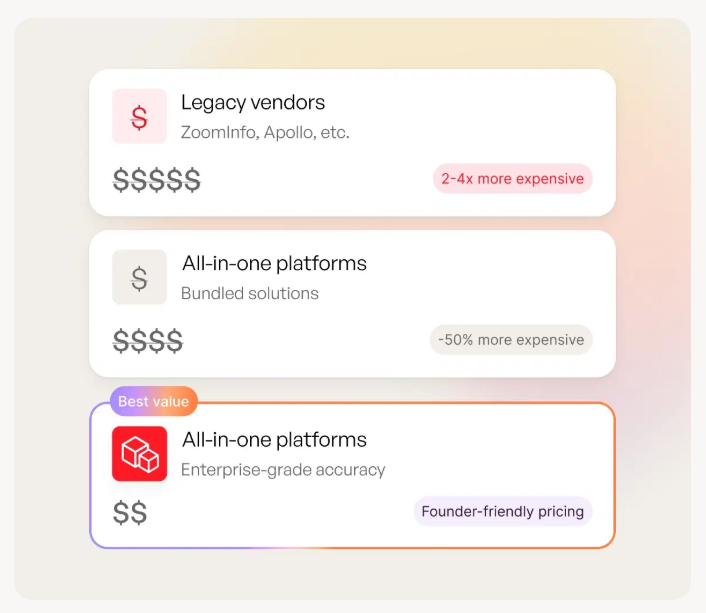

You're comparing sales intelligence tools because bad data is costing you deals. Prospeo delivers 98% email accuracy on a 7-day refresh cycle - not the 6-week industry average that lets 30% of your contacts decay. At ~$0.01/email with no annual contract, it's 90% cheaper than ZoomInfo.
Stop reviewing tools and start booking meetings with data that actually connects.
Top Sales Intelligence Platforms in 2026
Prospeo
Prospeo's database covers 300M+ professional profiles, 143M+ verified emails, and 125M+ verified mobile numbers - all refreshed on a 7-day cycle. That refresh cadence matters more than most buyers realize. B2B contact data decays roughly 30% per year, which means a platform checking records every six weeks is serving you stale data by design.
The accuracy numbers are the headline: 98% email accuracy and a 30% mobile pickup rate across all regions. The 5-step verification process - with catch-all handling, spam-trap removal, and honeypot filtering - is why the gap exists versus competitors sitting at 65-85%. Layer in 30+ search filters with intent data tracking 15,000 Bombora topics, and you've got enterprise-grade targeting at SMB pricing.
If you're comparing verification-first stacks, see our breakdown of Bouncer alternatives and the broader email deliverability impact of bad data.
Real-world proof: Snyk's 50 AEs cut bounce rates from 35% to under 5% and generated 200+ new opportunities per month after switching. The Chrome extension has 40K+ users, and CRM enrichment returns a 92% API match rate across 50+ data points.
Use this if you care about deliverability above all else, want transparent pricing (~$0.01/email, free tier with 75 emails/month), and refuse to sign annual contracts.

Apollo.io
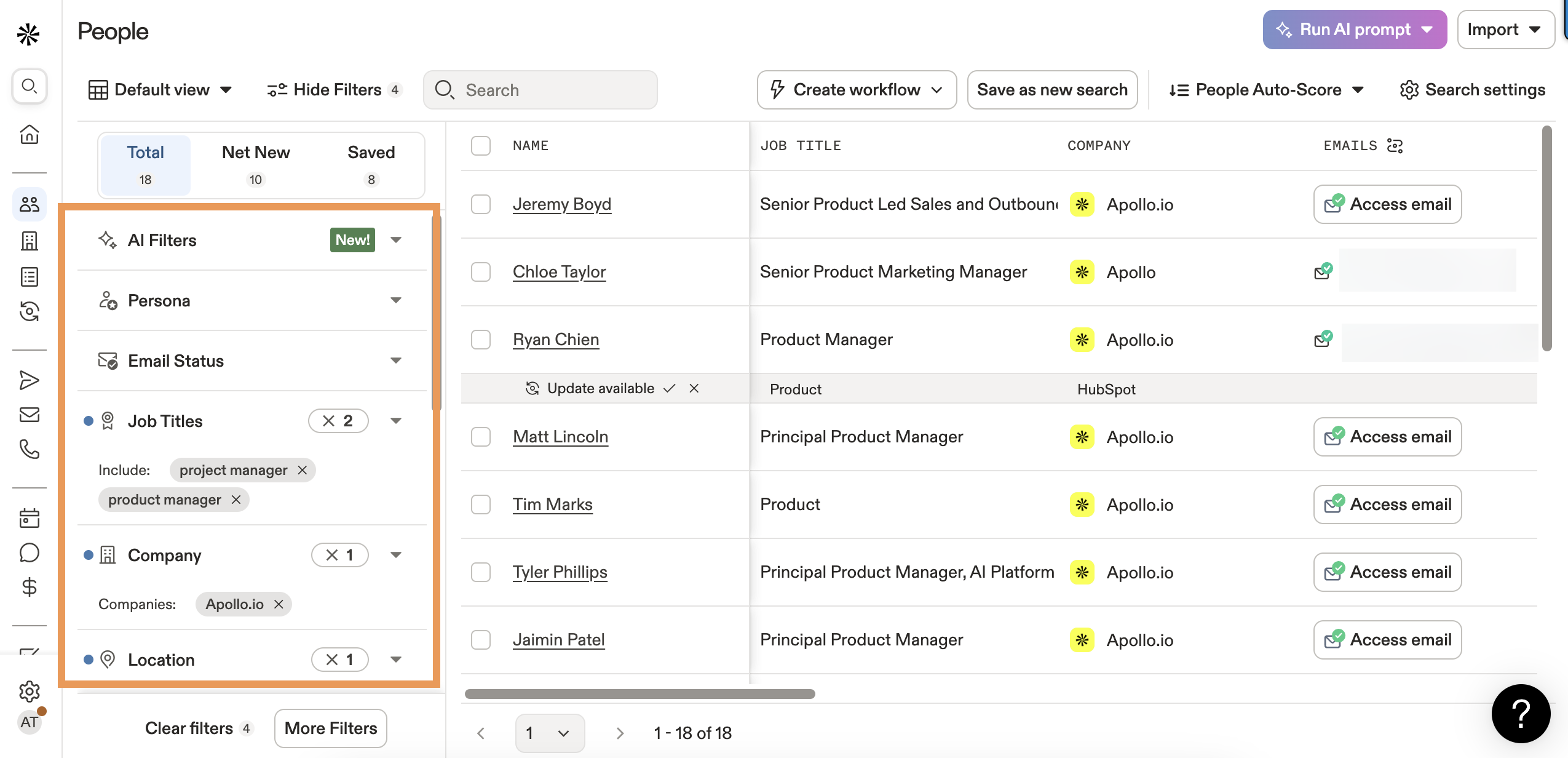
Apollo is the obvious starting point for most startup and SMB teams. The free tier is genuinely usable - not a teaser that forces an upgrade after two searches. Paid plans run $49-$149/user/month, and a Reddit user put it well: the $99/month plan "paid for itself."
The database covers 275M+ contacts across 73M+ companies, with 65+ search filters and built-in outreach workflows on paid plans. G2 gives it a 4.8/5; Gartner Peer Insights rates it 4.2/5 - actually edging out ZoomInfo's 4.1.
Use this if you want prospecting, outreach, and a CRM-lite experience in one platform under $100/month. Skip this if you're sending high-volume outbound outside the US - bounce rates climb noticeably in EMEA and APAC.
If you're still building your outbound motion, pair this with proven sales prospecting techniques before you add more tools.
ZoomInfo
ZoomInfo is the category incumbent: 300M+ professional profiles, 100M+ companies, and the deepest US direct-dial coverage in the market. The consensus on r/sales is pretty consistent - "best data hands down. No other service has had nearly the amount of good quality mobile numbers."
The tradeoff is everything else. Pricing starts at ~$14,995/year for Professional with 5,000 credits and up to 3 users. Advanced runs ~$24,995; Elite hits ~$39,995. Annual contracts only. Multiple Reddit threads flag aggressive auto-renewal clauses and difficulty canceling.
Where ZoomInfo wins: raw US database depth and workflow breadth. Where it falls short: email accuracy (75-85% vs. 98% from verification-first platforms), data freshness on legacy records, and price - about 100x more expensive per lead.
Use this if you're enterprise with $15K+ budget focused on US direct dials. Skip this if you're selling into EMEA or can't stomach annual lock-ins.
Cognism
Cognism is the right call if you're prospecting into Europe and GDPR compliance isn't optional. It checks against 15+ Do-Not-Call lists - more than any competitor - and includes NAM, EMEA, and APAC data in all packages without regional surcharges. Bombora intent data is available as an add-on, and intent-signal campaigns consistently pull 15-25% reply rates versus 3-5% for cold email. UserEvidence increased cold-calling pipeline by 33% after implementing it.
Skip this if you're targeting North American mid-market. Reviews frequently flag inaccurate contact details and limited coverage in that segment. Pricing runs ~$12,000-$30,000/year (quote-only). G2: 4.6/5.
6sense
Let's be honest: 6sense isn't a sales intelligence tool in the way most people mean it. It's an enterprise ABM platform that analyzes 500B+ intent signals and predicts buying stages. That sounds incredible on a demo. In practice, implementation takes months, requires a dedicated RevOps admin, and the "black box" problem is real - a G2 reviewer put it plainly: "It is not the end all be all or the crystal ball. It is directional."
Budget: $30,000-$100,000+/year. A free Community plan exists with 50 credits, but it's a taste test, not a meal.
Skip this if you need person-level contact data. 6sense identifies companies, not individuals.
If you're evaluating this category, it helps to understand account-based selling best practices and how intent fits into your pipeline.
Lusha
Lusha looks cheap until you do the credit math. Pro costs $29.90/user/month with 250 credits - but a phone number costs 10 credits. That's 25 phone numbers per month. The "unlimited" Scale plan? Capterra users report a ~2,000 contact/month fair-use cap. A free tier gives you 70 credits/month for light testing.
Use this if you mostly need emails (1 credit each) and do light phone prospecting. Phone-heavy teams will hit the wall within a month. G2: 4.3/5.
Clay
Clay earns its 4.9/5 on G2 - the highest rating on this list - because it solves a different problem entirely. It's not a database. It's an orchestration layer that runs waterfall enrichment across dozens of data providers, so you're pulling the best record from multiple sources instead of trusting one. Starting at $149/month, Clay is built for RevOps teams who want custom enrichment workflows. Implementation takes 2-4 weeks, but the payoff is data coverage no single provider matches alone.
For a deeper cost/workflow breakdown, see our guide to Clay list building.
Lead411
Lead411 starts at $49/month with a free 7-day trial and offers unlimited data access on higher tiers - a rarity in this space. They report 96% email deliverability and integrate Bombora intent data. G2: 4.5/5. Worth testing if credit-based pricing drives you crazy.
Seamless.AI
AI-powered search engine for B2B contacts. Pricing runs ~$99-149/user/month. The 4.2/5 G2 rating suggests it hasn't caught up to the leaders yet, but it's on the radar for teams wanting AI-driven list building.
UpLead
Solid SMB alternative to ZoomInfo at $99/month with email verification built in. G2: 4.7/5. If you're a small team that wants clean data without the ZoomInfo price tag or contract headaches, UpLead deserves a trial.
If you're optimizing for clean lists, it’s also worth tracking your email bounce rate as you test providers.
What You'll Actually Pay
Poor data quality costs organizations an average of £11.91M per year. The question isn't whether to invest - it's whether you're overpaying for data that's already stale.
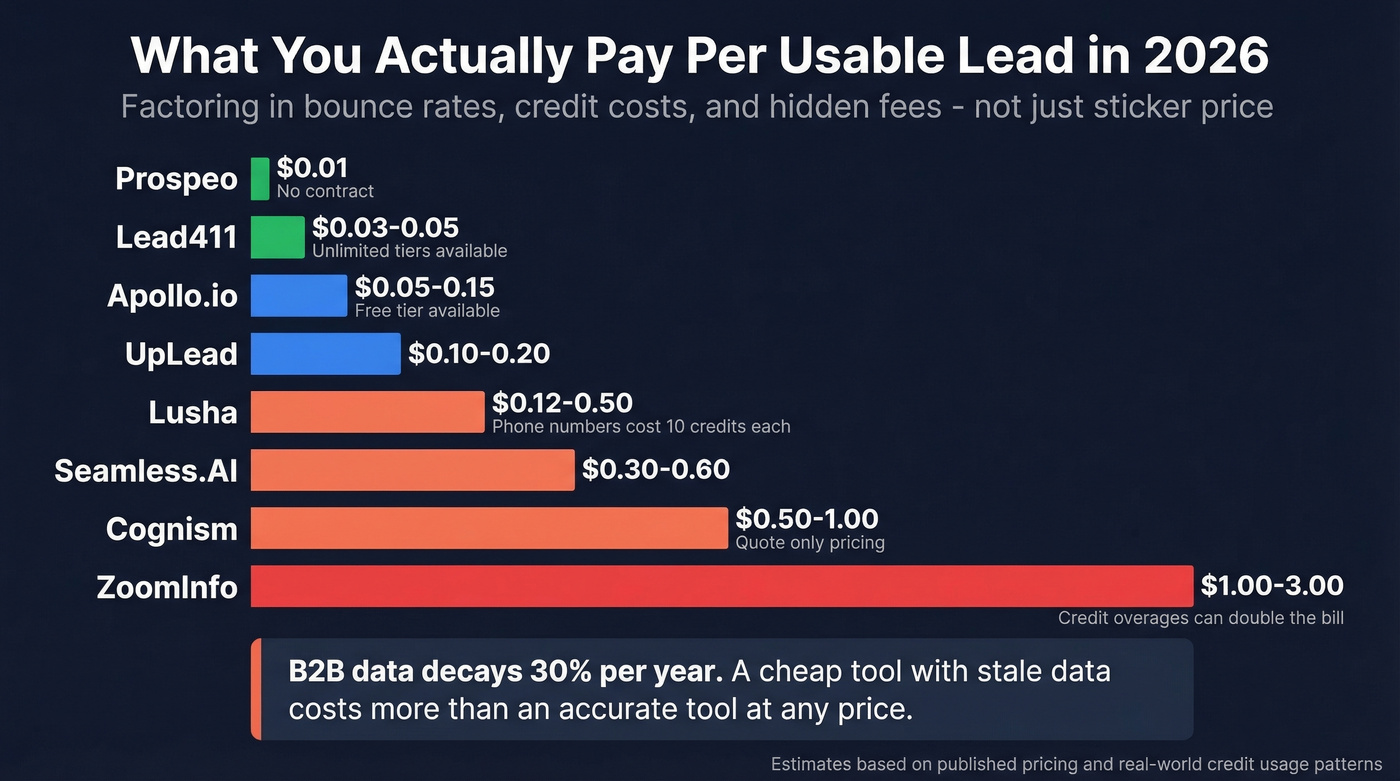
ZoomInfo's listed tiers are just the starting point. Credit overages, seat expansions, and module add-ons routinely double the bill. Lusha's credit structure means a phone-heavy team burns through "250 credits" in a single afternoon. And 6sense's multi-year contracts lock you into $30K-$100K+ commitments before you've validated the intent data works for your ICP.
B2B contact data decays roughly 30% per year, which means a third of your database is wrong by next January. Platforms with weekly refresh cycles keep records current; those refreshing every 4-6 weeks are serving you contacts who've already moved on. In our experience, transparent pricing models - where you can see the cost before talking to sales - are the ones that respect your time and budget.
If you're trying to reduce waste across the funnel, start by tightening your lead generation workflow and measuring the right lead generation metrics.
Every sales intelligence review comes down to the same question: will the data bounce? Snyk's 50 AEs dropped bounce rates from 35% to under 5% and generated 200+ opportunities per month with Prospeo. 143M+ verified emails, 125M+ verified mobiles, 30+ filters with Bombora intent - no demo required.
See why 15,000+ companies stopped switching between tools.
Which Tool Fits Your Team
Solo founders and bootstrapped teams should start with a free tier - Prospeo's 75 emails/month or Apollo's free plan will cover early prospecting without spending a dollar.
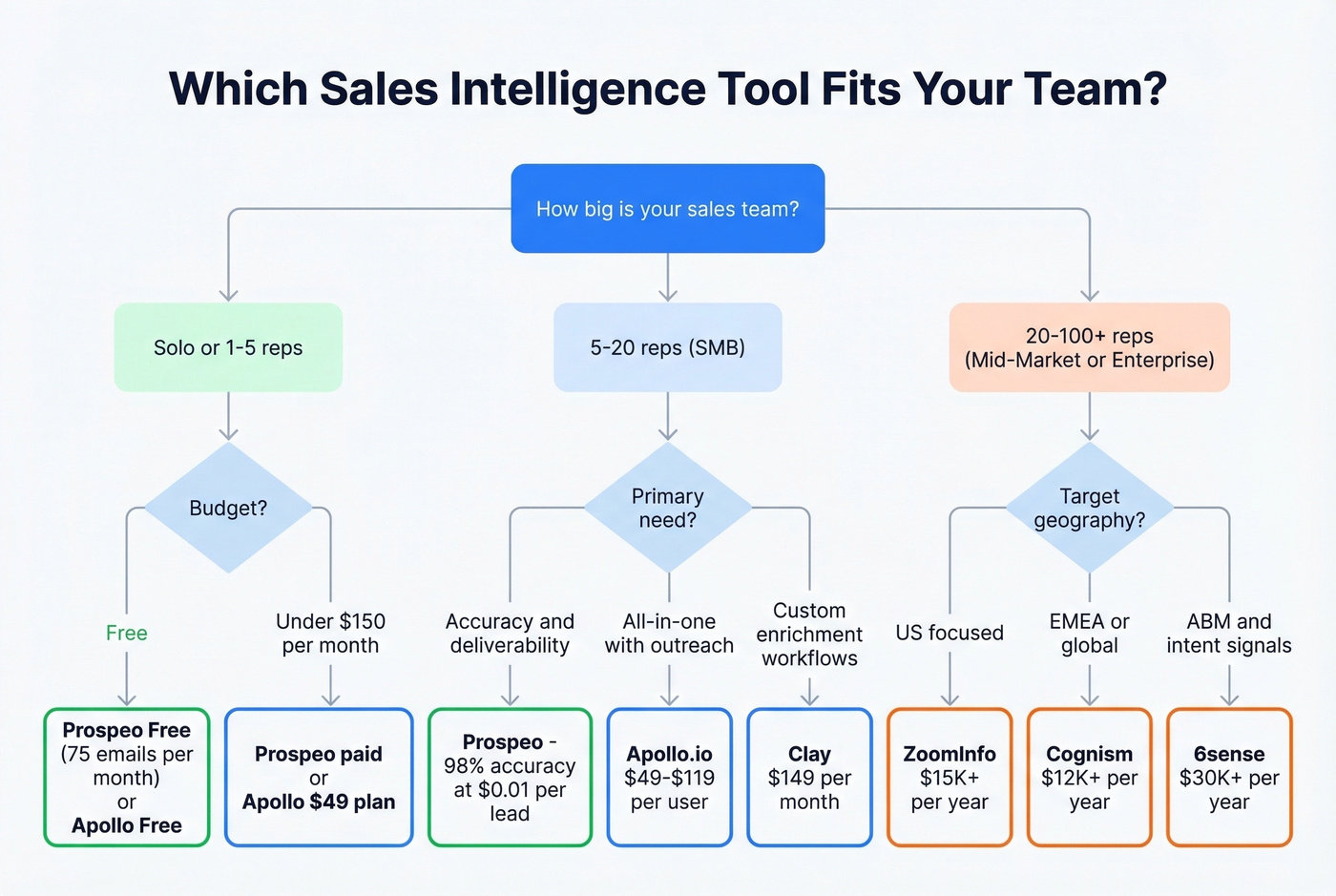
SMBs with 5-20 reps get the best balance of cost and coverage from paid plans in the $49-$149/month range. We've seen teams at this size waste months evaluating enterprise tools they don't need - pick one, test it for 30 days, and move on.
Mid-market teams with 20-100 reps face the ZoomInfo-vs-Cognism decision, and it comes down to geography: US-focused teams benefit from ZoomInfo's direct-dial depth, while EMEA-heavy teams need Cognism's GDPR infrastructure. Enterprise orgs with 100+ reps typically stack a primary database with a verification layer to catch the 15-25% of records any single provider gets wrong.
For RevOps teams running custom enrichment workflows, Clay's orchestration layer paired with a high-accuracy source for email verification is the strongest combo we've tested. Across every segment, the takeaway from these sales intelligence reviews stays the same: accuracy and refresh cadence matter more than database size.
FAQ
What's the most accurate sales intelligence tool?
Prospeo leads with 98% email accuracy and a 30% mobile pickup rate, verified through a proprietary 5-step process. ZoomInfo follows at 75-85% for US data; Apollo trails at 65-80%. No single provider nails 100% - stacking a verification layer on top of any database is the safest play.
Is ZoomInfo worth $15K+ per year?
For enterprise teams needing deep US direct-dial coverage with 100+ reps, yes. For teams under 20 reps or still defining their ICP, alternatives like Prospeo and Apollo deliver 80-90% of the value at 5-10% of the cost - without annual lock-ins or credit overages.
Do I need more than one tool?
Most outbound teams need a primary data source and a verification layer. Stacking two complementary tools - say, a broad database plus a high-accuracy email verifier - covers the majority of use cases. Consolidating everything into one platform usually means mediocre data across the board.
How fast does B2B contact data decay?
About 30% of contact records become outdated per year due to job changes, acquisitions, and phone rotations. Platforms with weekly refresh cycles stay current. Those refreshing every 4-6 weeks are serving contacts who've already moved on.