

Sales-Led Go-to-Market Strategy: The 2026 Operating Manual
For every GTM launch that works, roughly four fail. And at any given moment, 95% of your potential buyers aren't in-market. A sales-led go-to-market strategy has to find the 5% who are ready, reach them with accurate data, and run a process tight enough to close before the deal slips. After years of PLG hype, sales-led is having a resurgence - because complex B2B deals still need humans.
The short version: ACV above $25K, product requires onboarding, 5+ stakeholders involved? Sales-led is your motion. Targets: 3×-5× pipeline coverage, 20%+ win rate, reps spending 60%+ of their time selling. Everything below is the operating manual.
What Is a Sales-Led GTM Strategy?
A sales-led GTM strategy means your sales team owns the buyer journey - from first outreach to signed contract - typically before the prospect touches the product. Reps qualify, educate, demo, negotiate, and close. In product-led growth, the product drives acquisition: users sign up, try it, and convert themselves.
The nuance most people miss: 50-80% of a buyer's decision-making happens before a rep gets involved. Even in a sales-led motion, marketing does the heavy lifting early. Your reps close - they don't create awareness from scratch.
Is Sales-Led Right for You?
61% of B2B buyers [prefer rep-free purchasing](https://www.gartner.com/en/newsroom/press-releases/2025-06-25-gartner-sales-survey-finds-61-percent-of-b2b-buyers-prefer-a-rep-free-buying-experience). If your product is simple, low-cost, and self-serve, forcing buyers through a sales process kills conversion.
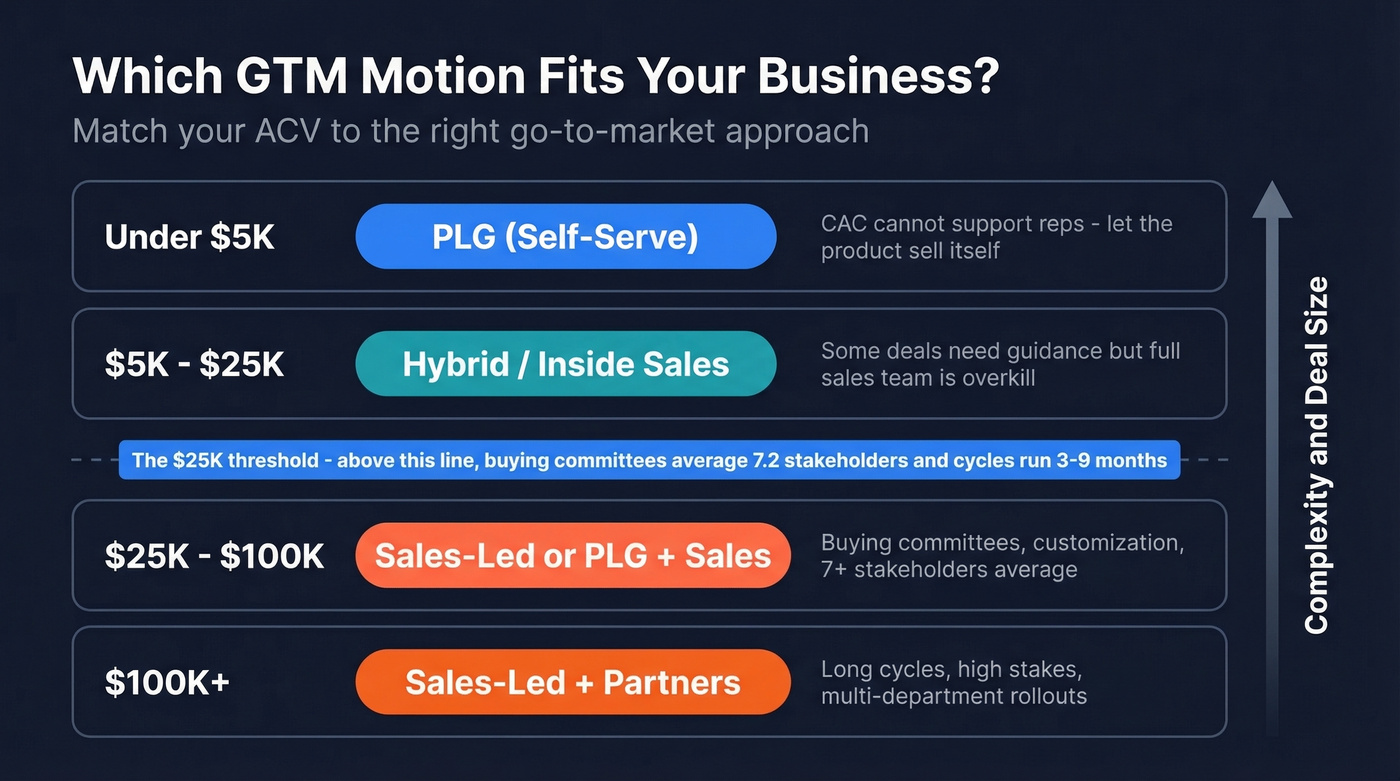
The decision comes down to deal size:
| ACV Range | Recommended Motion | Why |
|---|---|---|
| Under $5K | PLG (self-serve) | CAC can't support reps |
| $5K-$25K | Hybrid / inside sales | Some deals need guidance |
| $25K-$100K | Sales-led or PLG+sales | Committees, customization |
| $100K+ | Sales-led + partners | Long cycles, high stakes |
Above $25K, buying committees average 7.2 stakeholders and evaluation cycles run 3-9 months. You can't self-serve your way through a 7-person committee. If your CAC payback period stretches beyond 18 months, the economics are usually broken regardless of motion.
2026 Sales-Led Benchmarks
Pin these to a wall. Your board will ask about them.
| Metric | Enterprise | Mid-Market | SMB |
|---|---|---|---|
| Pipeline coverage | 3×-5× | 2.5×-4× | 2×-3× |
| Win rate | 20-25% | 25-35% | 30-40% |
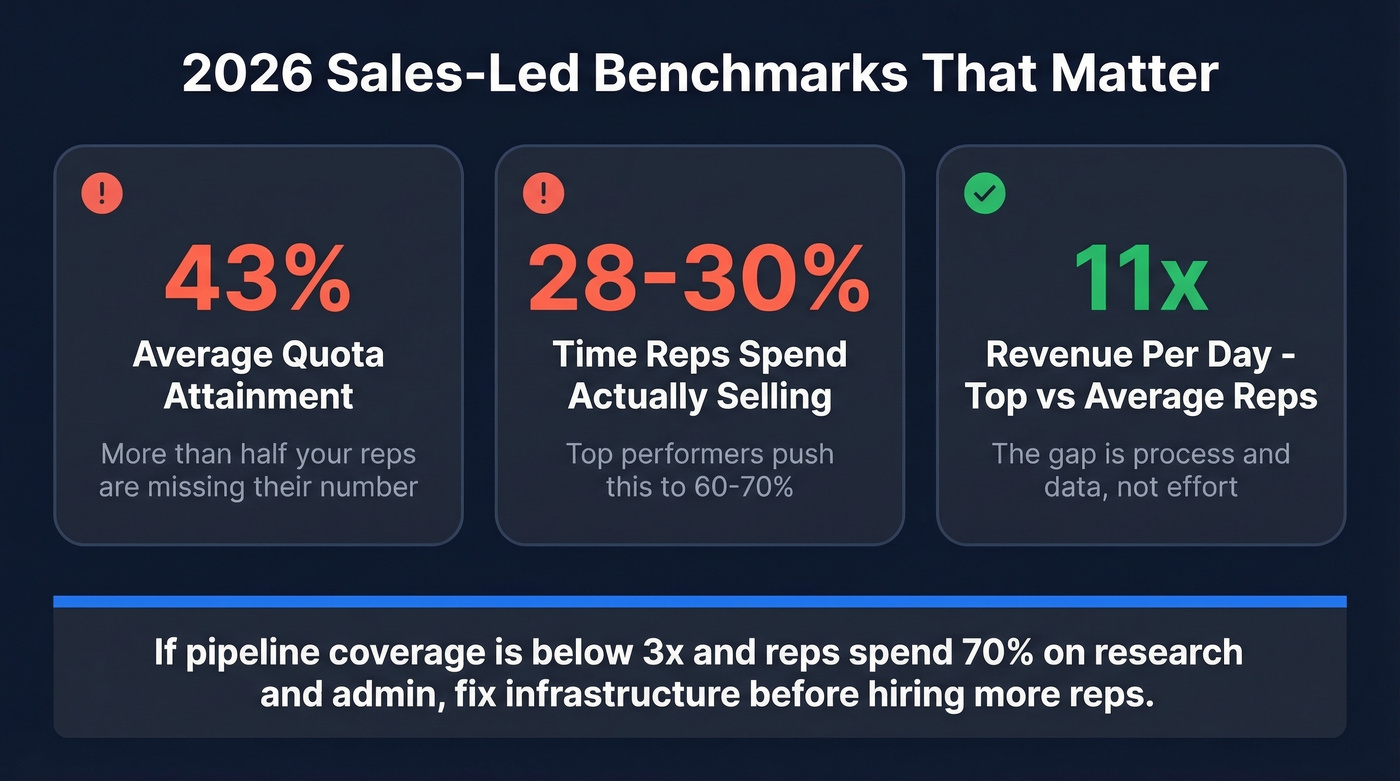
The broader data is sobering:
- Average quota attainment: 43%. More than half your reps are missing number.
- Reps spend 28-30% of their time actually selling. Top performers push that to 60-70%.
- Top sellers close deals 3× faster and generate 11× more revenue per day than average reps. The gap isn't effort - it's process and data.
If your pipeline coverage is below 3× and reps spend 70% of their day on research and admin, the math doesn't work. Fix the infrastructure before you hire more reps.

If reps hit quota only 43% of the time and spend 70% of their day on research, the bottleneck isn't headcount - it's infrastructure. Prospeo gives your sales-led GTM engine 300M+ profiles, 98% email accuracy, and a 7-day refresh cycle so reps spend time closing, not chasing bad data.
Triple pipeline coverage without hiring a single new rep.
How to Build the Engine
1. ICP and qualification. Start with a tight ideal customer profile - industry, headcount, tech stack, budget authority. BANT is common for simpler transactional deals. MEDDIC is widely used in enterprise. RevOps should own the qualification criteria, not individual reps - consistency matters more than any single framework.
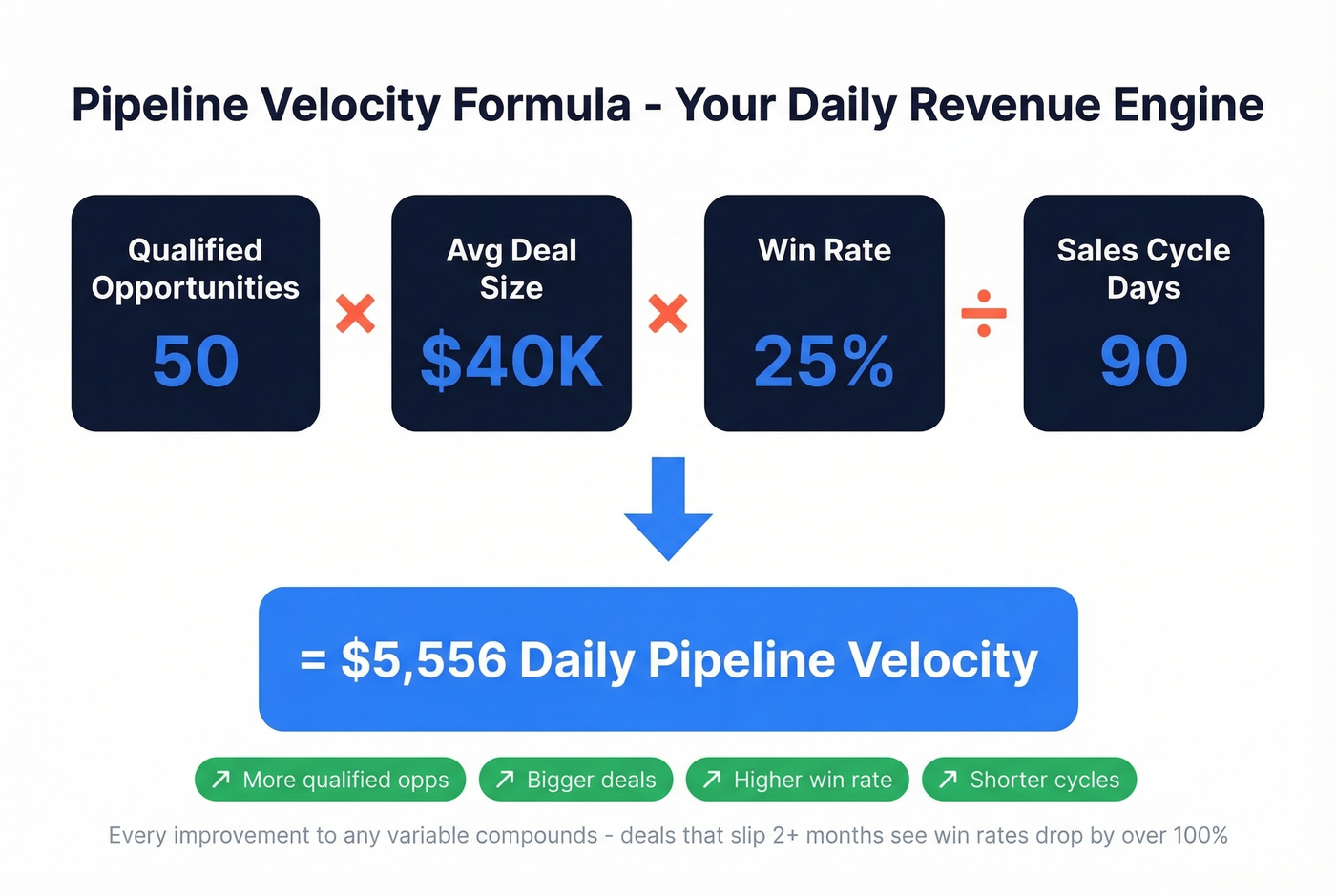
2. Pipeline velocity. Every sales leader should know this formula:
(Opportunities × Avg Deal Size × Win Rate) ÷ Sales Cycle Days
Fifty qualified opps, $40K average deal, 25% win rate, 90-day cycle = $5,556 daily pipeline velocity. Every improvement to any variable compounds. And deals that slip more than two months see win rates drop by over 100% - speed isn't optional.
3. Conversion targets and cadence. For mid-market, aim for MQL→SQL at 25-35%, SQL→Opportunity at 50%+, and win rates above 20%. If your MQL→SQL rate is below 20%, the problem is lead quality, not sales execution. Contact inbound demo requests within 15 minutes. Follow up 5-7 times over 10 days. Run weekly revenue standups and monthly GTM QBRs.
4. Outbound infrastructure. Your reps need a CRM, a sequencer (Outreach or Salesloft), and verified contact data. The 15-minute SLA on inbound is one of the highest-ROI changes most sales orgs can make. If you’re standardizing your stack, start with implementing a sales engagement platform.
The Data Foundation
If reps spend 28-30% of their time selling, 70% goes to research, data entry, and chasing bounced emails. Any sales-led go-to-market strategy lives or dies on data quality.
Consider what happened at Snyk. Their 50 AEs each spent 4-6 hours a week prospecting, with bounce rates running 35-40%. After implementing Prospeo's verified data - 143M+ verified emails at 98% accuracy, refreshed every 7 days instead of the industry's typical 6-week cycle - bounces dropped under 5%, AE-sourced pipeline jumped 180%, and the team generated 200+ new opportunities per month. That's not a marginal improvement; it's a different business.
When only 5% of buyers are ready at any given time, intent signals are the difference between smart outreach and spray-and-pray. Layer intent data on top of verified contacts and your reps stop guessing which accounts to prioritize. (If you need a scoring model, use a simple lead scoring framework.)

Snyk's 50 AEs went from 35-40% bounce rates to under 5% and added 200+ opportunities per month. When your sales-led GTM depends on reaching the 5% of buyers who are in-market, intent data layered on 143M+ verified emails at ~$0.01 each is how you stop guessing and start closing.
Stop funding bounced emails - only pay for contacts that connect.
When Sales-Led Fails
One product owner on r/ProductManagement shared a brutal example: their flagship product had 6 clients, 15 users, and $6K ARR - all gated through sales. No self-serve meant zero user behavior data and no feedback loop. Sales-led gatekeeping was starving the product of the learning it needed.
The r/sales community has a recurring complaint too: most "GTM strategies" are just "sell harder" wrapped in acronyms. Strategy decks that don't change daily execution are theater.
Hot take: the most common failure isn't bad strategy - it's scaling headcount before fixing infrastructure. Adding 10 reps to a broken data stack means 10 more people wasting 70% of their time. We've watched teams triple pipeline coverage just by fixing data quality, without hiring a single new rep. If you’re diagnosing gaps, start with the most common sales pipeline challenges.
Sales-Led vs. Hybrid Motions
Slack and Zoom started product-led, then layered sales to capture enterprise accounts needing procurement, security reviews, and org-wide rollouts. The product created demand; sales captured the big contracts.
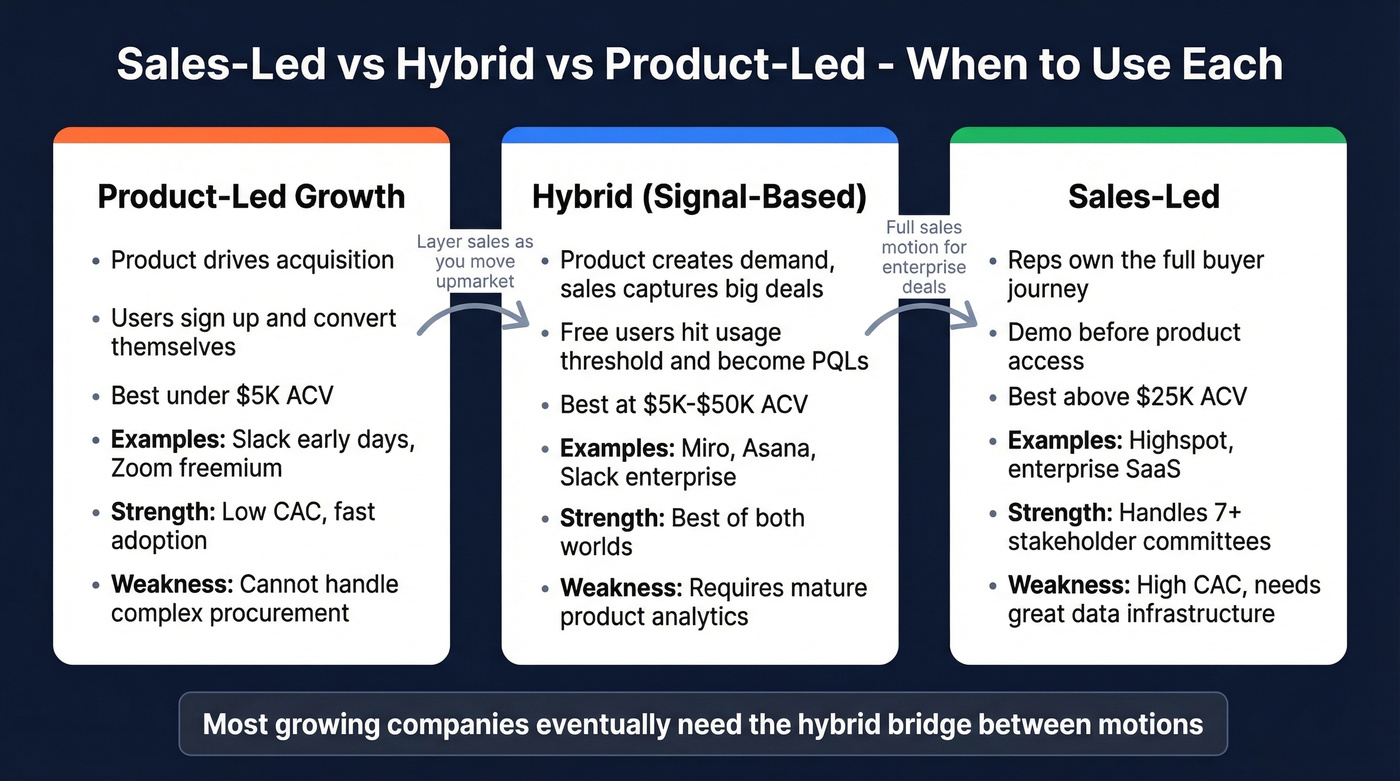
Highspot's experience shows the flip side. A PLG competitor had traction in a regional department, but when the enterprise-wide evaluation kicked in - RevOps requirements, integrations, enablement - Highspot's sales-led approach won because it addressed the full buying committee's concerns. Their success illustrates why a well-executed sales-led GTM strategy consistently outperforms self-serve motions in complex, multi-stakeholder deals.
The modern middle ground is signal-based warm outbound. Companies like Miro and Asana use product usage signals to trigger AE outreach. A free user hits a usage threshold and becomes a product-qualified lead. It's the bridge between motions that most growing companies eventually need. To operationalize this, borrow from identifying buying signals and intent based segmentation.
FAQ
What's the minimum ACV for a sales-led approach?
Most B2B companies find sales-led works above $25K ACV, where buying committees average 7+ stakeholders and buyers expect a consultative process. Below $5K, the unit economics rarely support rep-assisted selling.
How does sales-led differ from product-led growth?
In a sales-led model, reps guide the buyer from first touch to close - typically before the prospect uses the product. In PLG, the product drives acquisition and users convert themselves. Deals above $25K with 5+ stakeholders almost always require the sales-led approach.
What tools do sales-led teams need?
At minimum: a CRM (Salesforce or HubSpot), a sales engagement platform (Outreach or Salesloft), and a verified contact data provider like Prospeo for accurate emails and direct dials. Intent data layered on top helps reps prioritize the 5% of accounts actively in-market.
Can you combine sales-led and product-led?
Yes - hybrid is increasingly common. Companies like Slack and Zoom use PLG for self-serve adoption, then layer sales teams to capture enterprise contracts above $25K. The key is using product usage signals to trigger rep outreach at the right moment.