

Sales Objections and Responses: The Data-Backed Playbook for 2026
It's 2:47 PM. Your SDR is mid-call, alt-tabbing to a Google Doc titled "Objection Cheat Sheet v3 FINAL (2).docx" while a prospect says, "We're actually pretty happy with what we have." By the time they find the right script, the moment's gone.
Here's the thing: sales objections and responses aren't harder in 2026 because buyers have new concerns. They're harder because 96% of prospects research your product before they ever talk to you, and [73% actively avoid sellers](https://www.salesforce.com/sales/state-of-sales/sales-statistics/) who send irrelevant outreach. Your buyers are more informed, more skeptical, and less patient. This article covers the most common objections and the answers that actually work - backed by data from 67,149 real sales calls, not recycled platitudes.
If You Read Nothing Else
Take these three things:
- Pause before you respond. Gong's analysis of 67,149 sales calls found that top reps pause after hearing an objection. Low performers interrupt or pounce. That pause is the single highest-leverage behavior change you can make.
- Learn the label. Chris Voss's labeling technique - "It sounds like..." - handles virtually any objection by surfacing the real concern. Master this one move and you'll outperform reps who memorize 50 scripts.
- Half your objections are brush-offs. The first objection is rarely the real one. If you're solving for "it's too expensive" when the actual issue is "I don't trust this will work," you're fighting the wrong battle.
What 67,149 Sales Calls Reveal
Gong Labs analyzed 67,149 sales meetings from a database of over 5 million recorded calls. The findings aren't about what to say - they're about how to behave.
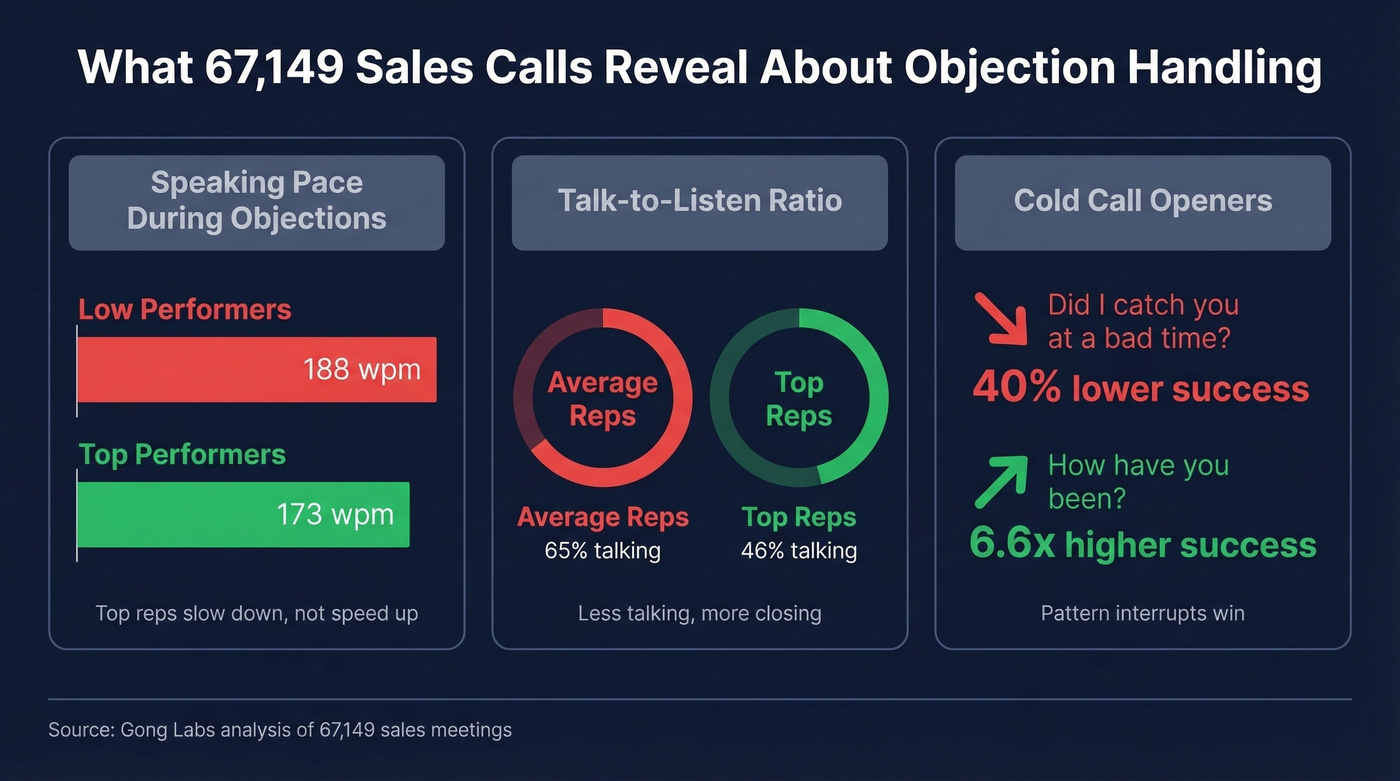
The average speaking pace in sales conversations is 173 words per minute. Low performers speed up to 188 wpm when they hit an objection, rushing through their rebuttal like they're afraid the prospect will hang up. Top reps maintain pace or decelerate. We've seen this pattern in every team we've worked with - the reps who slow down close more.
The talk-to-listen ratio tells a similar story. Top performers spend about [46% of the conversation](https://www.gong.io/blog/elements-of-effective-sales-conversations) talking. Average reps? North of 65%. That's not a conversation - that's a monologue with occasional interruptions. And 88% of customers say the experience a rep provides matters as much as the product itself, per Salesforce's State of Sales report. Rushing through a rebuttal destroys that experience.
One stat should change how you open cold calls: asking "Did I catch you at a bad time?" drops your chance of booking a meeting by 40%. Meanwhile, "How have you been?" - a pattern interrupt that sounds like you already know the person - correlates with a 6.6x higher success rate. The objection-handling game starts before the objection.
The data is clear. Objection handling isn't a vocabulary problem. It's a behavioral one.
The 5 Types of Sales Objections
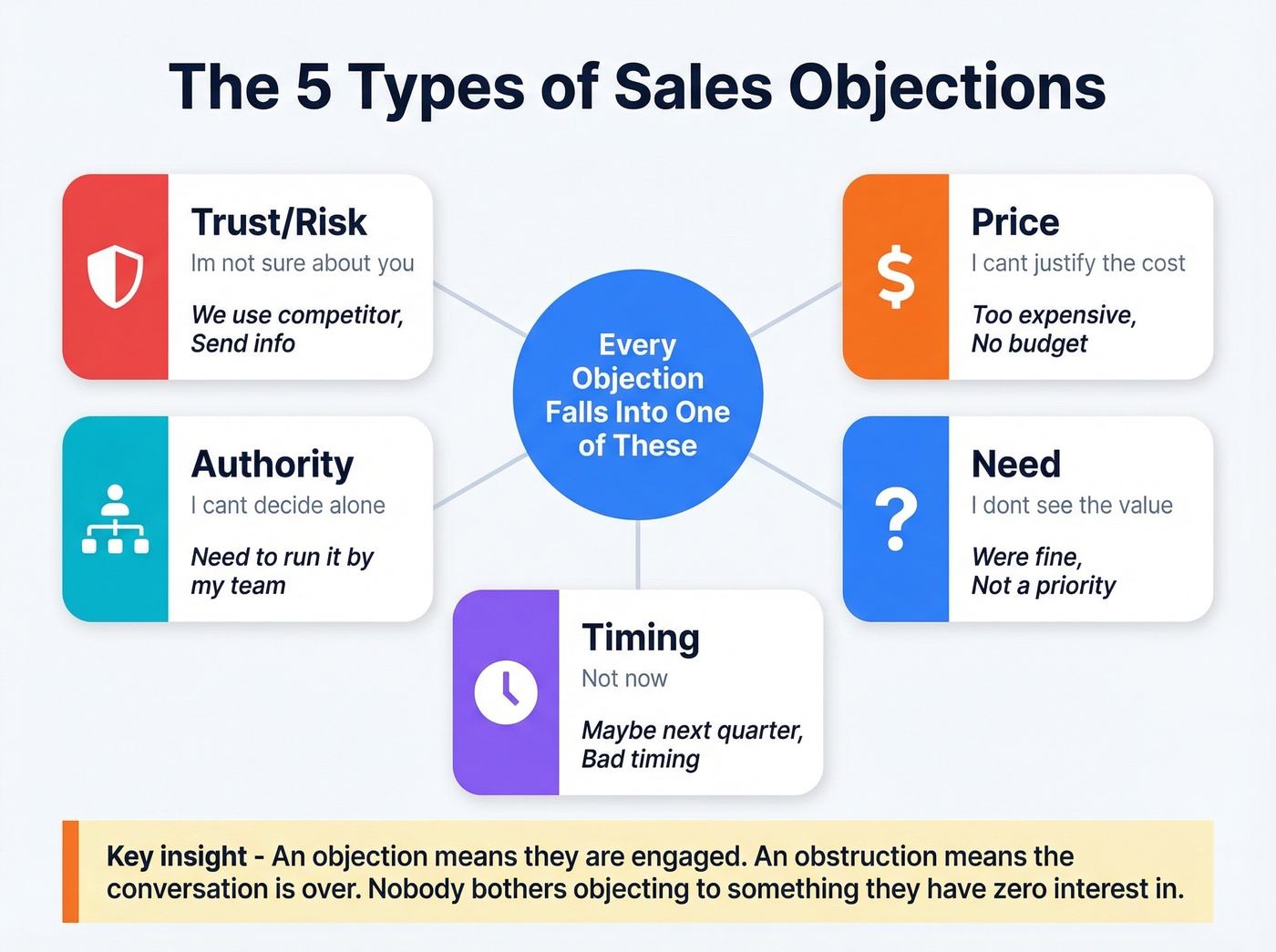
Every objection falls into one of five buckets. Some teams use BANT (Budget, Authority, Need, Timing) to categorize them. We've added Trust/Risk as a fifth because it's the category that kills the most deals silently.
| Type | What It Means | Signal Phrase |
|---|---|---|
| Price | "I can't justify the cost" | "Too expensive," "No budget" |
| Need | "I don't see the value" | "We're fine," "Not a priority" |
| Timing | "Not now" | "Maybe next quarter," "Bad timing" |
| Authority | "I can't decide alone" | "Need to run it by my team" |
| Trust/Risk | "I'm not sure about you" | "We use [competitor]," "Send info" |
One critical distinction: an objection is different from an obstruction. An objection means the prospect is engaged enough to push back. An obstruction - "Take me off your list" - means the conversation is over. Nobody bothers objecting to something they have zero interest in.
20 Common Objections and Rebuttals
Price and Budget Objections
"It's too expensive." They haven't connected price to value - or they're testing whether you'll fold.
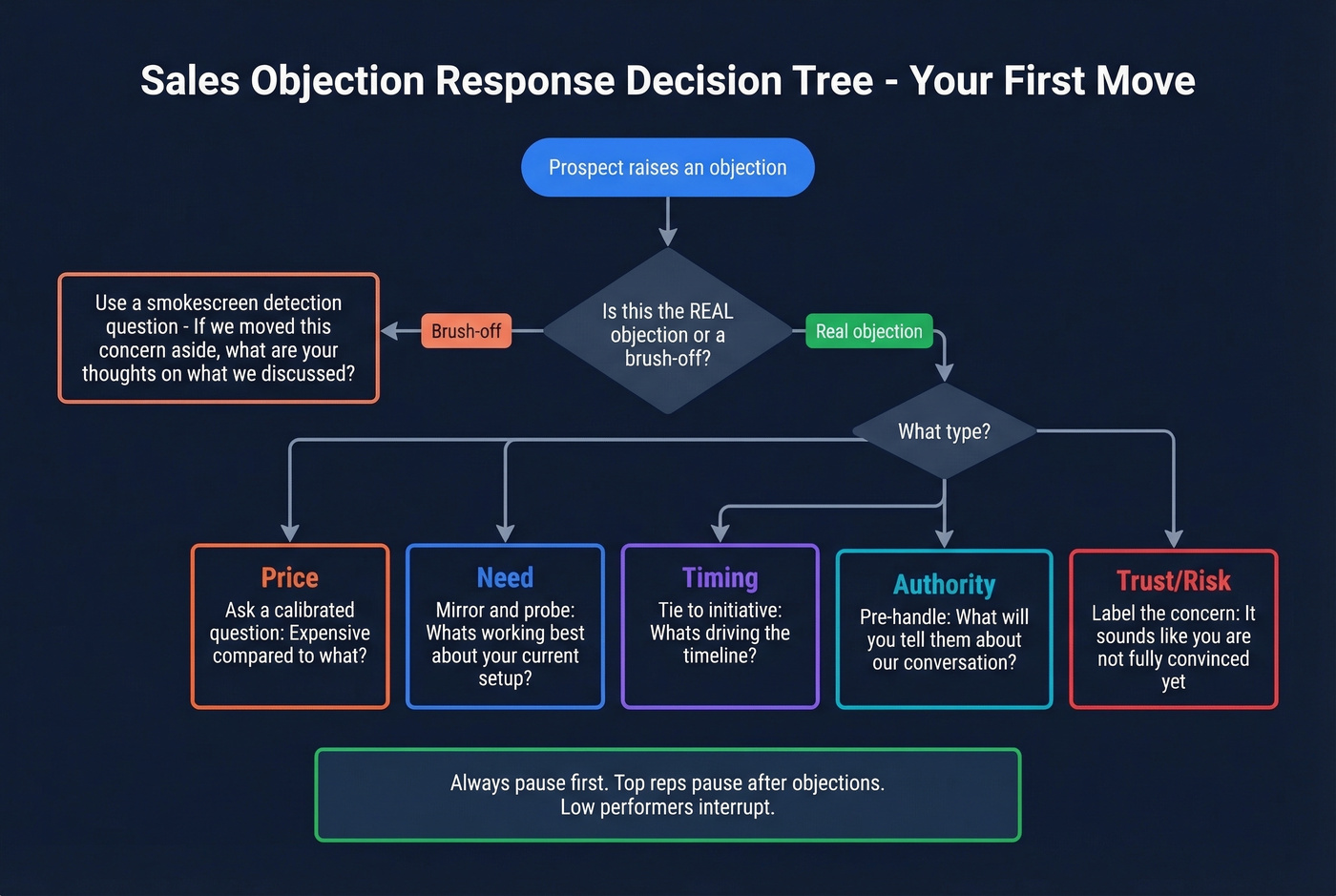
"That's fair. Let me ask - expensive compared to what? The cost of not solving [specific problem], or another solution you're evaluating?"
The "compared to what?" one-liner forces specificity. Don't offer a discount. The moment you drop price without being asked, you've told the prospect your product isn't worth what you quoted. For the Chris Voss approach, try the label: "It sounds like the value just isn't there for you." That triggers a correction - the prospect will often clarify what's actually bothering them.
"We don't have budget for this." Either it's true, or you haven't found the right champion.
"When you mention budget, are we talking zero flexibility, or is this about where to prioritize spend this quarter?"
This diagnostic question separates real budget constraints from prioritization problems. In SaaS, budget can come from multiple places - a champion's discretionary spend, replacement budget from a failing tool, or add-on funding tied to a winning initiative.
"Your competitor is cheaper" / "Can you give us a discount?" These two objections are cousins. For the cheaper competitor: "They might be. What's included in their quote? I want to make sure we're comparing the same scope." For the discount request - which actually signals they're interested enough to negotiate - lead with commitment, not concession: "I can look at that. What would need to be true for you to move forward this month if we found the right number?" (If you want a deeper negotiation framework, use an anchor intentionally.)
Need and Relevance Objections
"We're happy with our current solution." This is the hardest objection to crack because it's often true.
"That's great - I wouldn't want you to switch something that's working. What's working best about it? And is there anything you wish it did differently?"
The only way through this one is finding a specific pain their current vendor doesn't address. If there isn't one, move on. Not every prospect is a deal. Stop trying to convince happy customers they're unhappy.
"I don't see how this applies to us." Your outreach wasn't relevant enough. Own it.
"That's on me. [Company] caught my attention because [specific trigger: hiring signal, funding round, tech stack change]. Teams in that situation usually struggle with [specific problem]. Is that on your radar?" (This is where personalized outreach wins.)
"We tried something like this before and it didn't work." They're burned and risk-averse. Skip the label here - this needs a direct, honest response.
"What specifically went wrong? I'd rather understand what failed than pretend it didn't happen." Acknowledge the scar tissue, then differentiate on the specific failure point.
"We can build this in-house." Their engineering team thinks they can. They're usually wrong about the total cost.
"You absolutely could. The question is whether you should. When teams build internally, the 3-year total cost - including engineering time, maintenance, and opportunity cost - usually runs 3-5x the subscription."
Timing Objections
"Not right now - maybe next quarter." You're not tied to an active initiative. Label it: "It seems like the timing feels off." Then probe: "What's driving the timeline? Is there a specific initiative kicking off next quarter, or is this more of a 'we're too busy right now' situation?"
SaaS buying is initiative-driven. Companies can't overhaul every function every year. If you're not attached to a live initiative, you're the odd one out.
"We're in the middle of another project" / "Call me back in six months." Close relatives. For the active project: "What would need to wrap up before this becomes a priority?" For the six-month callback - which is almost always a brush-off: "Happy to. What specifically would change between now and then that would make this relevant?" If they can't answer, it's a polite no.
Authority and Decision-Maker Objections
"I need to talk to my team." They might not be the decision-maker, or they're stalling. Chris Voss's label works here: "It sounds like you're not fully sold yet." If they push back on that, follow with the calibrated question from the Black Swan Group playbook: "What specifically are you going to tell them about our conversation?" This reveals whether they're actually bought in and arms them with talking points for the internal sell.
"My boss would never approve this" / "You need to talk to [other department]." Both are authority deflections. For the skeptical boss: "What do you think they'd be most skeptical about? If we address that upfront, it makes the conversation easier for you." For the department redirect: "Would you be open to making an intro, or would it be better if I reached out directly and mentioned our conversation?"
Trust, Risk, and Competitor Objections
"We already use [competitor]." "Good - that means you already see the value in solving this problem. What's working well with them? And what, if anything, isn't?" Don't trash the competitor. Let the prospect do the complaining.
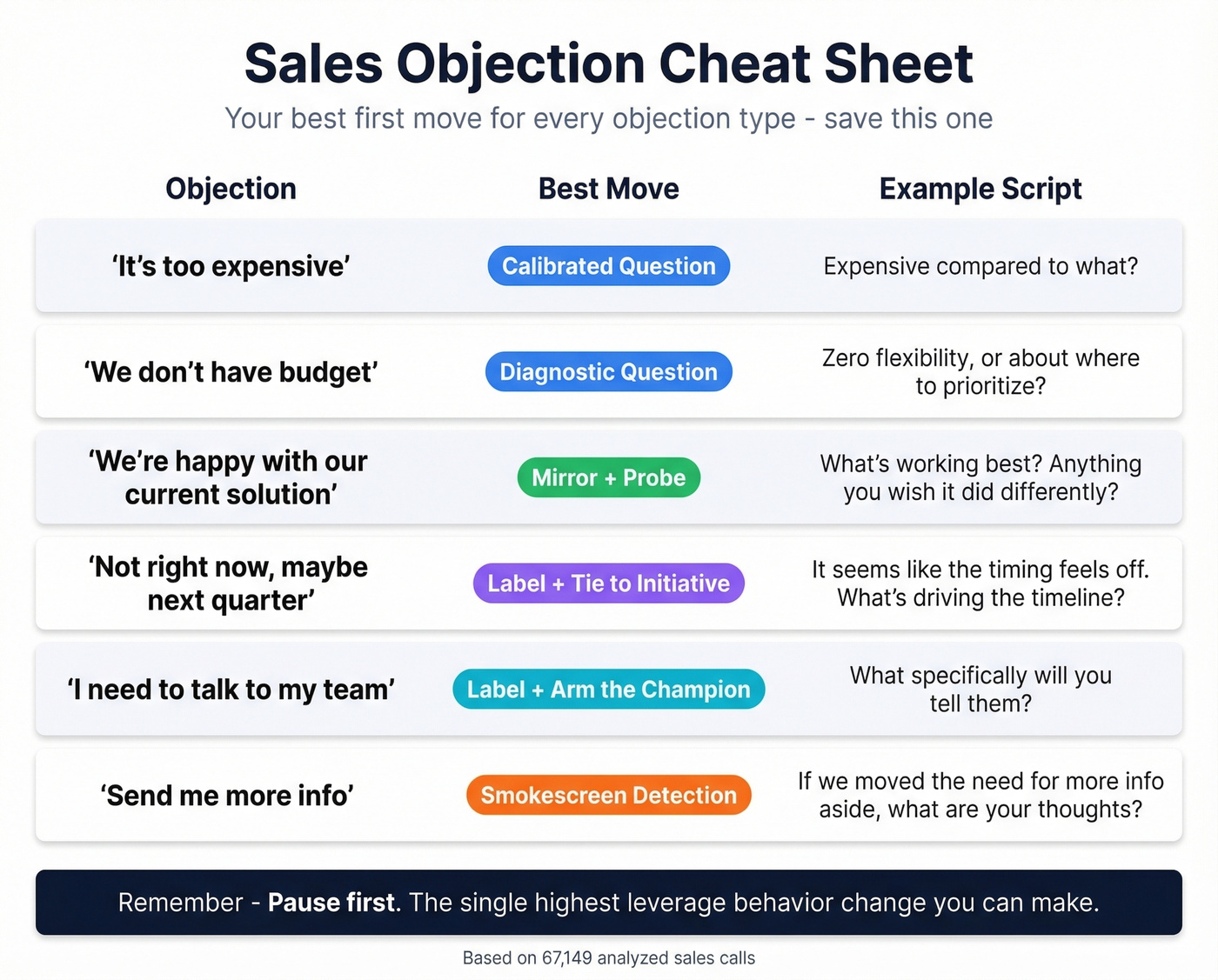
"Send me more info." A lot of the time, this is a smokescreen to end the call. The smokescreen detection question cuts through it: "Absolutely. So I send you the right thing - if we moved the need for more info out of the equation, what are your thoughts on what we discussed?"
"I've never heard of your company." "That's fair - we're not the biggest name in the space. We work with [2-3 recognizable customers]. Would a quick case study from [similar company] be helpful?" Name-drop your best customers early.
"What if it doesn't work?" "Let's define what 'working' looks like for you. If we agree on those metrics upfront, we can build a pilot around them." (A tight sales POC can de-risk this fast.)
"We're locked into a contract." "When does it renew? I'd rather start the conversation now so you have a real comparison when that date comes."
"We don't have the bandwidth for implementation." This is a real concern that kills deals late in the pipeline. "What does your team's capacity look like right now? Most of our customers dedicate about [X hours/week] during onboarding. We handle the heavy lifting on [specific implementation steps]." Quantifying the actual time commitment defuses the vague fear.
| Objection Type | Best First Move |
|---|---|
| Price | Calibrated question |
| Need | Mirror + probe for specific pain |
| Timing | Tie to an active initiative |
| Authority | Pre-handle the internal sell |
| Trust/Risk | Label the concern, offer proof |

The best objection is the one you never hear. When your data connects you to verified decision-makers - not gatekeepers - you skip "I need to run it by my team" entirely. Prospeo gives you 98% accurate emails and 125M+ verified mobile numbers with a 30% pickup rate.
Kill the authority objection before the call even starts.
Handling Objections Over Email
Written objections play by different rules. You don't have tone of voice, pacing, or the ability to pause meaningfully. Every word carries more weight.
The biggest mistake in email objection handling is hedging. Words like "maybe," "just," "only if," and "but" signal uncertainty. Compare:
❌ "I understand, but maybe we could look at a smaller package that might work within your budget?"
✅ "Totally get it. Quick question - if budget weren't a factor, would this solve a real problem for your team? If yes, there are a few creative ways to structure this. If not, I'd rather not waste your time."
The smokescreen detection question works even better in email because the prospect has time to think honestly. Keep email responses to three to five sentences. The goal isn't to overcome the objection in the email - it's to earn the next conversation. Build response templates, sure, but the best ones feel conversational rather than scripted. Adapt the language to each prospect's specific concern, or you'll sound like every other automated follow-up in their inbox. (If you need ready-to-send copy, use these sales follow-up templates.)
Labels, Mirrors, and Pre-Handling
Three techniques separate competent reps from elite ones.
Labels are Chris Voss's signature move. Start with "It sounds like..." and name the emotion or concern you're sensing. The power of a label is that it forces the prospect to either confirm or correct you - either way, you learn the real issue. Use labels when the prospect is vague, emotional, or holding something back. Skip them when the objection is straightforward and factual. "Your product doesn't integrate with Workday" needs a technical answer, not emotional labeling.
Mirrors are even simpler. Repeat the last 2-3 words of what the prospect said, with a slight upward inflection. Prospect: "We just don't think the timing works." You: "The timing doesn't work?" Then silence. Gong's research shows top reps ask significantly more follow-up questions than average performers. Mirrors are the lowest-effort way to generate those questions. (For more, see discovery questions.)
Pre-handling is the most underused technique. Richard Harris recommends this before the prospect even raises an objection: "When you take this back to your team, who's typically the most skeptical person, and what might they be skeptical about?" This surfaces objections before they become roadblocks. In our experience, pre-handling is the single hardest technique to train because it requires reps to invite objections rather than avoid them. But the reps who master it close at a different level entirely.
One behavioral note from Gong: never ask "why." "Why don't you think the timing works?" triggers defensiveness. Replace it with "what" or "how" - "What's driving the timeline?" gets the same information without the confrontational edge.
5 Objection-Handling Mistakes That Kill Deals
1. Treating the first objection as the real objection. First objections are often "quick exits" - the prospect grabs the nearest excuse. Before you solve for price, ask: "Are we talking zero flexibility, or is this about where to prioritize spend?" The real objection is usually one layer deeper.
2. Rushing to respond. "Too expensive" can mask concerns about durability, fit, or long-term value. If you jump straight to justifying price, you're solving the wrong problem. Pause. Ask. Then respond.
3. Getting defensive. The moment you argue, you've lost. Resistance increases when you push back. Acknowledge the concern, then redirect. Never debate.
4. Offering discounts too soon. Leading with a discount devalues your product and erodes margins. Start with ROI and value. Discounts are a closing tool, not an opening move.

5. Calling the wrong person entirely. This is the mistake nobody talks about. When 73% of B2B buyers avoid irrelevant outreach, a huge chunk of the "objections" you're hearing aren't objections at all - they're the natural response of someone who was never the right prospect. 57% of sales professionals say the sales cycle is getting longer, and calling the wrong person is one reason why. Verify your contact data before every campaign. (A clean ideal customer profile helps prevent this upstream.)
The Objection You Can Prevent
Here's my hot take: the best reps don't need better rebuttals memorized. They need better data.
When you're calling a verified direct dial instead of a switchboard, the conversation starts differently. When your email lands in the inbox of the actual decision-maker - not their predecessor who left six months ago - you skip the "who are you?" and "not my department" pushback entirely. The consensus on r/sales backs this up: threads about objection handling almost always circle back to "are you even talking to the right person?"

We've seen teams cut their objection rate in half just by fixing their contact data. Prospeo's database covers 300M+ professional profiles with 98% email accuracy and 125M+ verified mobile numbers with a 30% pickup rate. The 7-day data refresh cycle means you're not calling numbers that went stale last quarter. Layer in buyer intent signals across 15,000 topics, and you're reaching prospects who are actively evaluating solutions - not people who'll brush you off before you finish your opener. (If you’re rebuilding your outbound motion, start with these sales prospecting techniques.)
"We're happy with what we have" hits different when your outreach is irrelevant. Prospeo's 30+ filters - buyer intent, technographics, job changes, funding signals - let you lead with the exact trigger that makes prospects lean in instead of pushing back.
Stop fighting objections you created with bad targeting.
That SDR from the intro? They don't need the cheat sheet anymore. They need the pause, the label, and the right prospect. Master those three things, and most sales objections and responses take care of themselves.
FAQ
What's the best framework for handling objections?
LAER (Listen, Acknowledge, Explore, Respond) gives reliable structure for most B2B conversations. For advanced situations, Chris Voss's labels and mirrors surface the real concern faster than any scripted framework.
How many times should you follow up after an objection?
Three to five touches across phone and email over two weeks. After that, you're chasing, not selling. Space follow-ups 2-3 business days apart and add new value each time - don't just "circle back."
Which objection is hardest to overcome?
"We're happy with our current solution" - because it's often true. Find a specific pain their vendor doesn't address, or nurture and revisit when their contract renews. If there's genuinely no gap, let it go.
Can better prospecting data reduce the objections you face?
Yes. Reaching verified decision-makers with relevant context eliminates "who are you?" and "not my department" pushback entirely. Teams like Snyk cut bounce rates from 35% to under 5% and grew AE-sourced pipeline 180% after switching to verified contact data.