

Sales Operations: What It Is, Why It Matters, and How to Build It Right
Sellers spend about 30% of their time actually selling. The other 70% disappears into CRM updates, call prep, comp disputes, manual quote generation, and hunting for collateral that should be two clicks away. Sales operations exists to fix that ratio - and companies that invest in it see 28% higher revenue growth than those that don't.
What Is Sales Operations?
The function traces back to J. Patrick Kelly at Xerox in the 1970s. Kelly's insight was simple: salespeople shouldn't be doing administrative work that a dedicated operations team could handle better and faster. The original mandate was territory planning, comp administration, and quota setting - freeing reps to do what they were hired for.
That mandate has expanded dramatically. Modern sales ops owns the entire operational backbone of a sales organization: CRM governance, pipeline analytics, forecasting models, tech stack management, territory design, and increasingly, data strategy. It's the connective tissue between leadership's strategy and what reps actually experience day-to-day.
Here's the thing: 82% of sales professionals now consider this function critical to business growth. The role grew 38% between 2018 and 2020 alone. This isn't a nice-to-have anymore - it's infrastructure. The teams that treat it as an afterthought are the same ones wondering why their forecasts are off by 30% every quarter.
The Short Version
If you're pressed for time, here's what matters most:
- Start with data quality and CRM governance. Every other initiative - forecasting, territory planning, pipeline models - depends on clean contact data. [70% of sales orgs](https://www.bain.com/about/media-center/press-releases/20252/70-of-companies-struggle-to-integrate-their-sales-plays-into-crm-and-revenue-technologies-finds-bain - company-survey/) don't have a data strategy. Don't be one of them.
- Hire your first ops person at ~$5M ARR. That's roughly when you hit 10+ reps and the complexity outpaces what a founder or sales leader can manage on the side. Don't wait until forecasting is already broken.
- You don't need RevOps until $10M+ ARR. A strong ops function solves 80% of your problems before that. The cross-functional alignment RevOps promises is only valuable once you actually have mature marketing and CS functions to align.
Why Sales Ops Matters
The numbers make the case better than any argument.
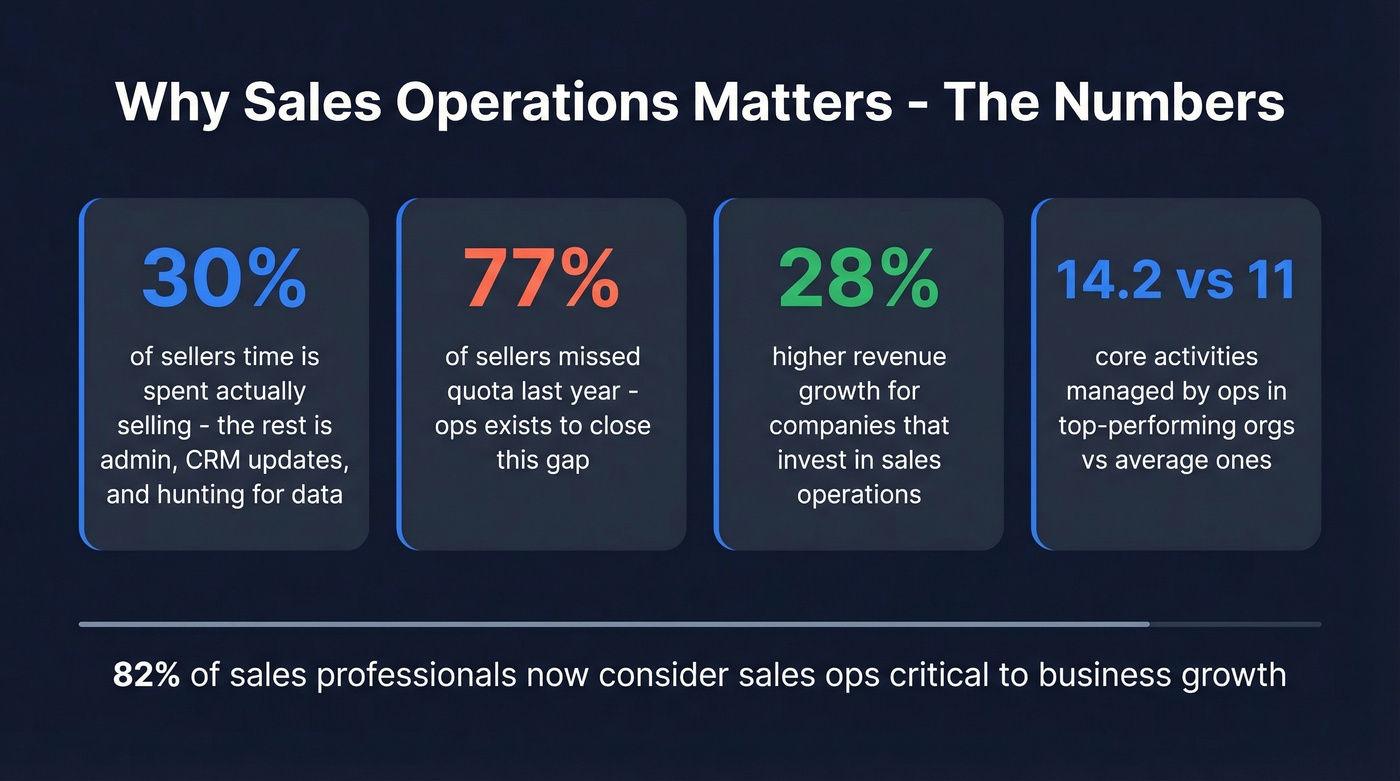
Korn Ferry's research found that sellers spend roughly 30% of their time selling, with call planning alone consuming 20% of their week. That means your highest-paid employees are spending most of their time on work that doesn't directly generate revenue - searching for prospect data, toggling between disconnected tools, resolving crediting exceptions. Ops exists to reclaim that time and redirect it toward quota-carrying activities.
The performance gap is stark. Highest-performing organizations involve sales ops in 14.2 of 21 core activities, compared to just 11 for average performers. That delta - three additional activities where ops has a seat at the table - correlates directly with quota attainment, forecast accuracy, and rep productivity.
77% of sellers missed quota last year. 82% of professionals consider the ops function absolutely critical to growth. The disconnect between "everyone agrees this matters" and "most teams still underinvest" is where the opportunity lives. If your competitors are running lean on ops while you're building it right, you're buying a structural advantage that compounds every quarter.
Core Roles and Responsibilities
Sales ops covers a lot of ground, but not all responsibilities carry equal weight. In our experience, four areas drive 80% of the impact. The scope keeps growing, too: ops teams now dedicate 68% of their time to non-sales functions - up from 39% in 2019 - which explains why the role has expanded far beyond its original Xerox-era mandate.
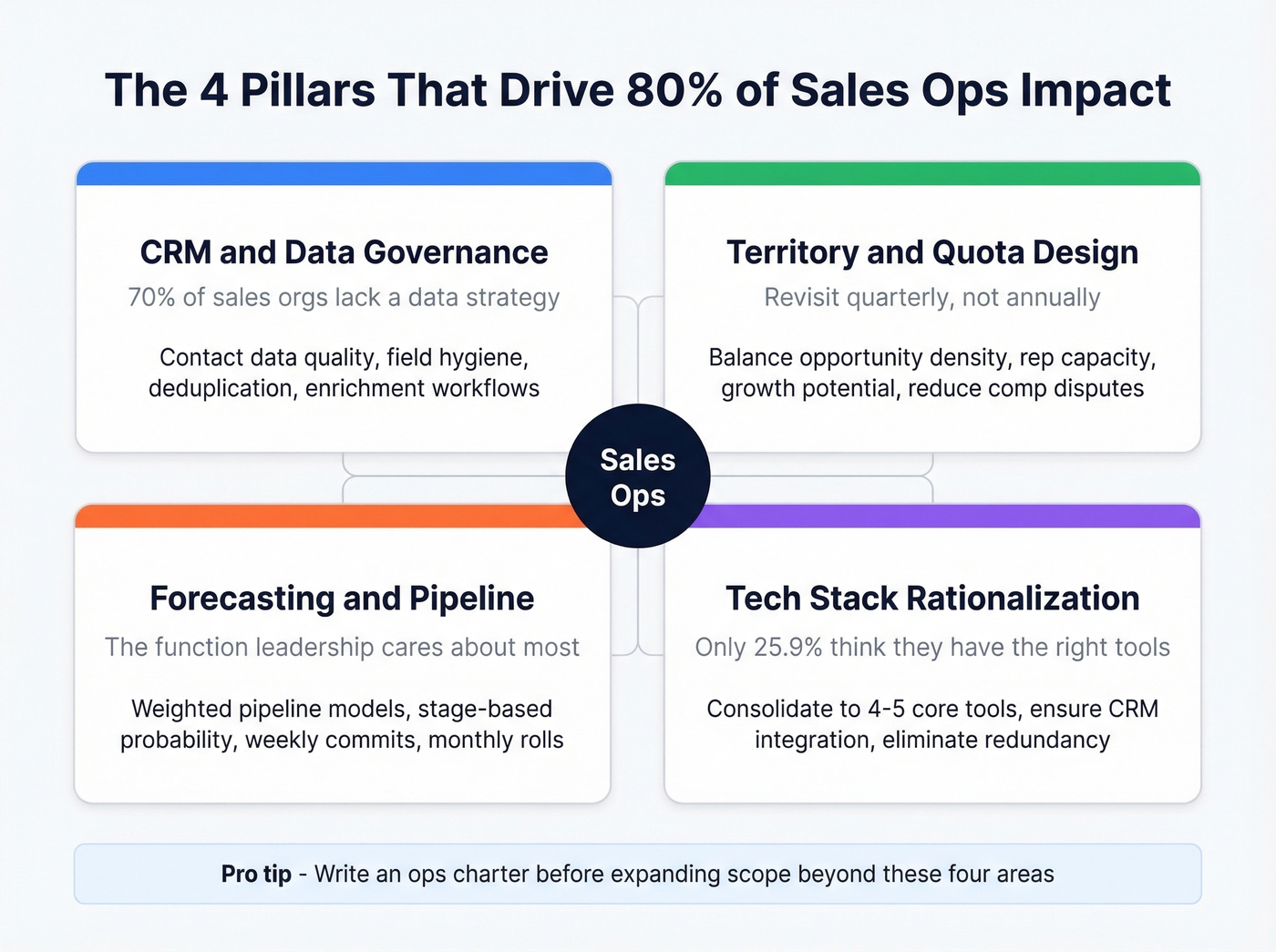
Territory and quota design is where ops earns its strategic credibility. Bad territories create comp disputes, rep attrition, and coverage gaps. Good territory models balance opportunity density, rep capacity, and growth potential - and they get revisited quarterly, not annually.
Forecasting and pipeline management is the function leadership cares about most. Ops owns the methodology - weighted pipeline, stage-based probability, AI-assisted - the cadence of weekly commits and monthly rolls, and the accountability layer that keeps managers honest about what's real in their pipeline. (If you want a deeper tool-by-tool breakdown, see forecasting models.)
Tech stack rationalization rounds out the core four. The average sales org runs 10 technology tools and plans to add more. Only 25.9% think they have the right tools, and just 28.4% have integrated those tools with their CRM. Ops should be consolidating, not accumulating. We've seen teams running 15+ tools where 4-5 well-integrated ones would outperform the entire stack.
Beyond these four, ops handles comp administration, onboarding program design, enablement coordination, and process documentation. But if you're building from scratch, nail the first four before expanding scope. (For a practical framework, use sales process optimization as your baseline.)
One thing worth codifying early: an ops charter. Write a one-page document that defines your team's mission, the activities you own versus support, and how success gets measured. Something as simple as "We exist to maximize revenue per rep by owning data quality, territory design, forecasting accuracy, and tech stack performance" gives your team a filter for saying no to the random requests that will inevitably pile up.
How to Structure Your Team
Centralized Model
One hub team serving the entire sales organization. This works well for companies under $10M ARR where consistency matters more than speed. You get uniform processes, clean data governance, and a single source of truth. The tradeoff: as the org scales and segments multiply, a centralized team becomes a bottleneck.
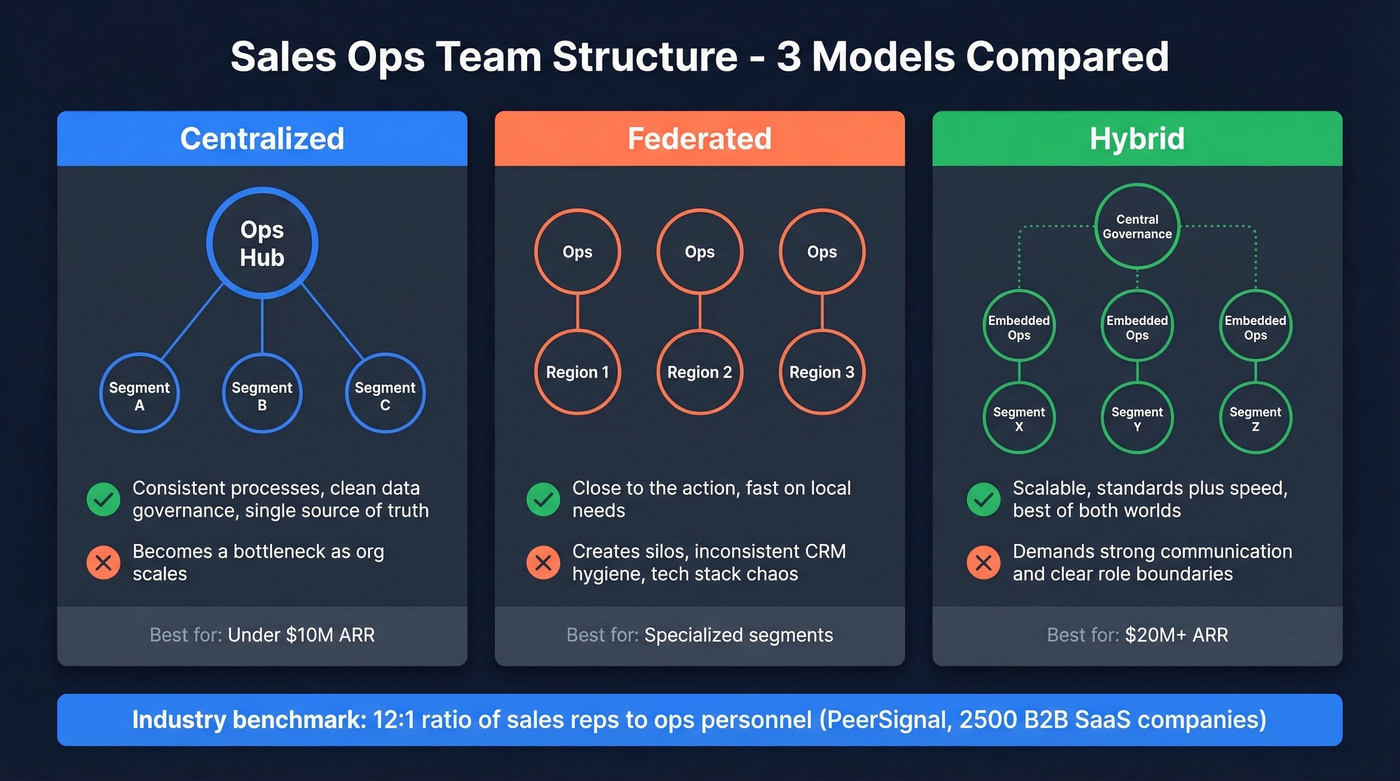
Federated Model
Embedded ops people aligned to specific regions, segments, or business units. They're close to the action and can move fast on local needs. The risk is real, though - federated models create silos. You end up with three different territory methodologies, inconsistent CRM hygiene standards, and a tech stack that looks like it was assembled by committee. Because it was.
Hybrid Model
Central governance with embedded specialists. A core team sets standards, owns the tech stack, and maintains data quality while embedded ops people handle segment-specific execution within those guardrails. This is the most scalable approach, but it demands strong communication and clear role boundaries. Most companies above $20M ARR land here eventually.
When to Hire
PeerSignal's analysis of 2,500 B2B SaaS companies found a 12:1 ratio of sales reps to ops personnel. Here's a rough ARR-based roadmap:
- ~$5M ARR (10+ reps): First ops hire - an analyst who owns CRM hygiene, basic reporting, and process documentation.
- ~$15M ARR: Ops manager who can architect systems and optimize processes. (For role scope and expectations, compare against a typical Sales Ops Manager track.)
- ~$30M+ ARR: Director or VP who sits in strategy discussions with the CRO and owns the full operational roadmap.
Career Path and Salary Benchmarks
The career ladder runs Analyst to Manager to Director to VP, with each level shifting from execution to strategy. Analysts live in the CRM and dashboards. Managers own process design and system architecture. Directors and VPs align ops priorities with revenue strategy and report directly to the CRO. (If you're mapping the adjacent org design, see RevOps Manager.)
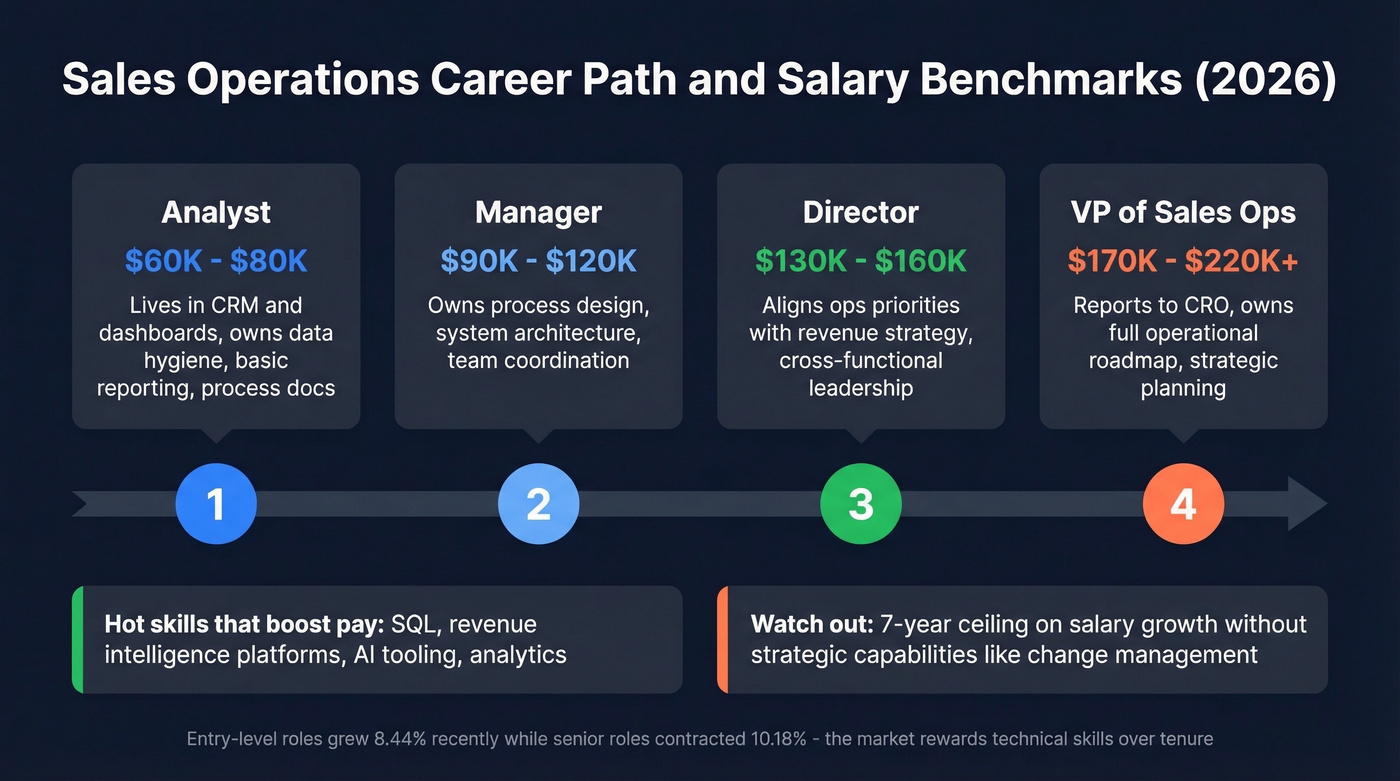
Salary ranges look roughly like this: entry-level analysts earn $60K-$80K, managers $90K-$120K, directors $130K-$160K, and VPs $170K-$220K+. One practitioner on r/SalesOperations shared that they're making $100K plus a 15% bonus as an Assistant Sales Operations Manager - which tracks with the mid-range for that level.
The interesting trend is salary compression. Entry-level roles saw 8.44% growth recently, while senior roles contracted by 10.18%. The market is rewarding technical competencies - SQL, revenue intelligence platforms, AI tooling, analytics - over raw tenure. There's a "seven-year ceiling" where additional experience yields diminishing salary returns unless you've stacked strategic capabilities like cross-functional collaboration and change management.
Geographic shifts matter too. Phoenix saw a 33.94% jump in median ops salary, while Houston dropped 30.58%. Remote work has fragmented the coastal premium that used to define comp bands. And despite the role's growth, 49% of ops professionals don't feel valued as much as other sales team members. That's a retention problem hiding in plain sight.

70% of sales orgs don't have a data strategy. Prospeo gives your ops team 300M+ profiles with 98% email accuracy, 7-day refresh cycles, and 30+ filters - so forecasting, territory planning, and pipeline models start from data you can trust.
Stop building your ops stack on stale, unverified data.
Sales Ops vs. RevOps
| Dimension | Sales Ops | RevOps |
|---|---|---|
| Scope | Sales team only | Sales + Marketing + CS |
| Customer impact | Through close | Full lifecycle |
| Revenue approach | Pipeline and deals | Acquisition + retention |
| Core metrics | Win rate, quota | Revenue growth, LTV |
| Typical stage | Pre-$10M ARR | $10M-$100M+ ARR |
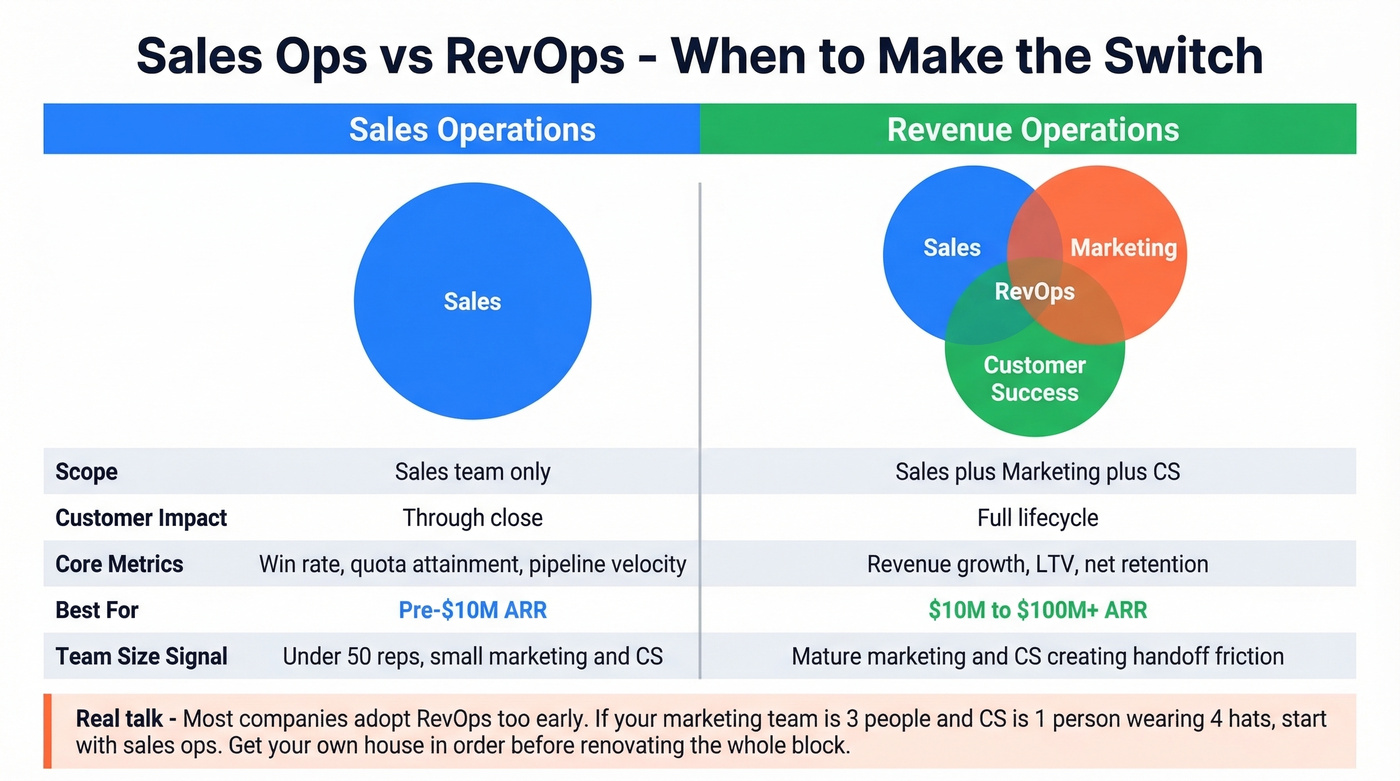
Gartner predicted that by 2026, 75% of the highest-growth companies would adopt a RevOps model - and the shift is well underway. That's a compelling stat, but it doesn't mean every company needs RevOps right now.
Real talk: RevOps makes sense when you have mature marketing and customer success functions that are creating genuine handoff friction. If your marketing team is three people and CS is one person wearing four hats, "unifying the revenue lifecycle" is a solution to a problem you don't have yet. McKinsey's scaling research identifies $10M-$100M ARR as the critical evaluation window for this transition.
Let's be honest - most companies adopt RevOps too early. They rebrand their ops person as "Head of RevOps," hand them marketing and CS alignment responsibilities with zero additional headcount, and wonder why nothing improves. If your average deal size is under $25K and you have fewer than 50 reps, a strong sales ops function will outperform a premature RevOps reorg every time. Get your own house in order before trying to renovate the whole block.
Start with ops. Get your CRM clean, your territories balanced, your forecasting accurate, and your tech stack rationalized. When cross-functional misalignment starts costing you deals - not before - that's when RevOps earns its budget.
The Sales Ops Tech Stack
Organizations with unified revenue operations tools grow up to 19% faster. But "unified" is the key word. The average sales org runs 10 tools, and most of them aren't talking to each other. Only 28.4% have integrated their sales applications with their CRM. That's not a tech stack - it's a junk drawer.
Our recommendation: consolidate to 4-5 core tools that integrate natively. Here's what the stack should look like:
| Category | Tool(s) | Price Range |
|---|---|---|
| CRM | Salesforce, HubSpot, Pipedrive | $25-$300/user/mo |
| Revenue Intelligence | Gong, Clari | $50-$150/user/mo |
| Sales Engagement | Outreach, Salesloft | $100-$150/user/mo |
| Enablement | Highspot | $40-$80/user/mo |
| Comp Management | Xactly, CaptivateIQ | $30-$60/user/mo |
| Data and Enrichment | Prospeo | Free tier; ~$0.01/email |
| Workflow Automation | Clay | Free tier; $149-$800/mo |
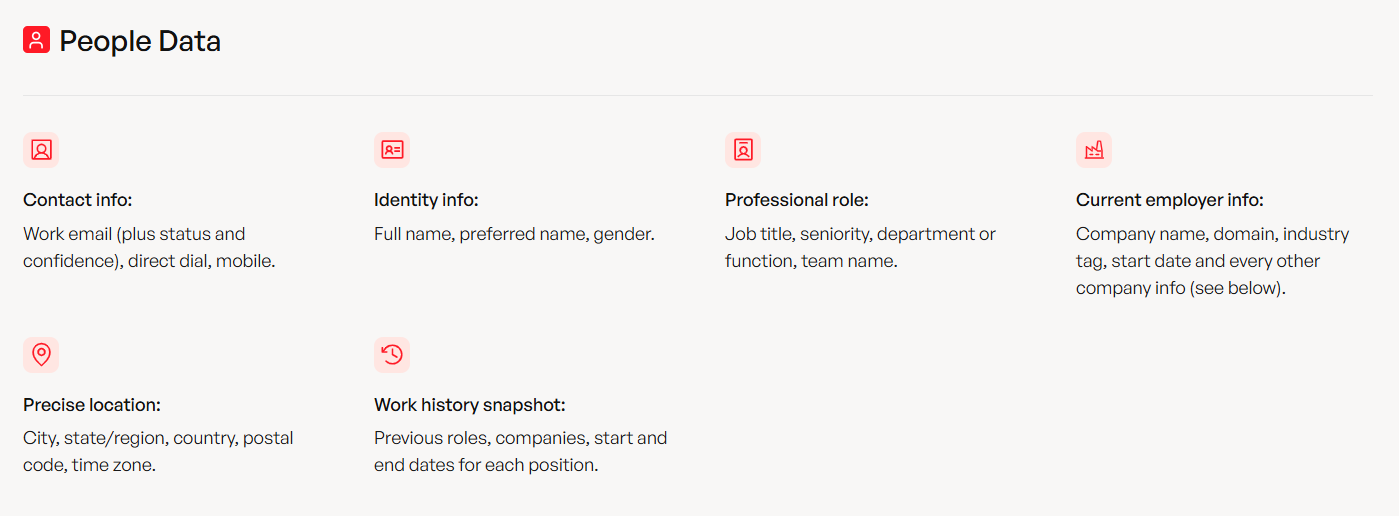
Sales operations teams own data quality, but 70% of orgs lack a data strategy. Prospeo's database covers 300M+ professional profiles with 98% email accuracy and a 7-day refresh cycle - compared to the 6-week industry average most competitors run on. CRM enrichment returns 50+ data points per contact, with an 83% enrichment match rate and a 92% API match rate, plus native Salesforce and HubSpot integrations that push clean data directly into your records. At roughly $0.01 per email with a free tier to start, it pays for itself fast. The first time your outbound sequence doesn't bounce 20% of its list, you'll understand why. (If you're evaluating vendors, start with data enrichment services.)
Skip this category if you're under 5 reps and doing manual prospecting - but the moment you're running any kind of outbound at scale, data enrichment isn't optional.
KPIs and Benchmarks
You can't improve what you don't measure. These are the metrics every ops team should track, with benchmark ranges based on typical B2B SaaS performance:
| KPI | Formula | Healthy Range |
|---|---|---|
| Quota Attainment | Revenue / quota | 60-70% of reps hitting |
| Win Rate | Won / total opps | 20-30% (B2B SaaS) |
| Sales Cycle | Days opp-to-close | 30-90 days (mid-market) |
| Forecast Accuracy | Actual / forecast | +/-10% = strong |
| Pipeline Coverage | Pipeline / quota | 3-4x minimum |
| Ramp Time | Days hire-to-quota | 3-6 months |
| CRM Adoption | % reps logging activity | 85%+ = healthy |
These are estimated industry benchmarks - your numbers will vary by segment, deal size, and sales motion. The point isn't to hit every range perfectly. It's to have a baseline, track trends, and catch degradation before it shows up in revenue. (For a KPI-first view, use sales operations metrics as a checklist.)
Five Mistakes That Kill Productivity
1. No data ownership. If nobody owns data quality, nobody maintains it. Assign a data steward - even if it's your first ops hire wearing multiple hats. Build your foundation on verified, regularly refreshed contact data. Stale records poison every downstream process, from forecasting to territory models.
2. Buried in admin and comp disputes. If your ops team spends half their time resolving commission complaints and crediting exceptions, they aren't doing ops work. Automate comp administration with tools like Xactly or CaptivateIQ and free your team for strategic work.
3. Excluded from strategy discussions. The function works best when it has direct access to CRO-level strategy. When ops is treated as a support function rather than a strategic partner, you get misaligned processes and reactive firefighting instead of proactive optimization. We've watched this play out at multiple mid-market companies - the ops team builds great dashboards that nobody in leadership looks at because they weren't in the room when priorities were set. (This is also where sales leadership habits make or break ops impact.)
4. No documentation. Institutional knowledge lives in people's heads until they leave. Build a playbook that covers your forecasting methodology, territory rules, CRM conventions, and escalation paths. Update it quarterly.
5. Shadow resources instead of root-cause fixes. When something breaks, the temptation is to throw a body at it. Resist. Build ops as a center of excellence that solves problems systemically - through process, automation, and tooling - not by adding headcount to patch symptoms.
Your ops team manages 10+ tools so reps can spend more time selling. Prospeo integrates natively with Salesforce, HubSpot, and outbound platforms - enriching your CRM with 50+ data points per contact at a 92% match rate.
Give your sales ops team one fewer bottleneck to manage.
AI and the Future of Sales Operations
The adoption numbers are hard to ignore. 87% of organizations now use some form of AI, and 54% already deploy AI agents across the sales cycle. Those agents cut research time by 34% and content creation time by 36%. Top-performing teams are 1.7x more likely to use AI agents than underperformers. (For a practical shortlist, see generative AI sales tools.)
Gartner expects 35% of CROs will have dedicated GenAI operations teams by the end of 2026. 73% of sales professionals say AI helps them pull insights from data they otherwise wouldn't find - anomaly detection in pipeline, predictive lead scoring, automated forecast adjustments. Yet 66.2% of orgs still haven't adopted analytics and AI-based tools, which means early adopters have a massive head start.
The most interesting shift is the convergence of "GTM engineer" work into ops. In one widely shared practitioner take, a year ago, serious outbound required someone who could build Clay workflows - waterfall enrichment, conditional logic, multi-provider stitching. Companies were paying $100K-$130K for that skillset. Now tools like Clay's Sculptor let an SDR describe an ICP in natural language and get a working enrichment workflow in 20 minutes. (If you're building this muscle, start with Clay list building.)
What does that mean for ops teams? The workflow-building portion of GTM engineering is collapsing back into the function. The systems architecture work - integrations, data plumbing, CRM governance - remains. Professionals who develop AI fluency and systems thinking will own an expanding mandate. Those who stay purely in spreadsheet-and-CRM mode will find their scope shrinking fast.
The data quality imperative isn't going away, either. 74% of organizations prioritize data cleansing and integration, and high performers focus on it at a 79% rate versus 54% for underperformers. AI is only as good as the data it trains on. Clean your pipes first.
Sales Operations FAQ
What does a sales ops person do day-to-day?
Sales operations is the function responsible for making a sales org run efficiently so reps can focus on selling. Day-to-day work includes CRM administration, pipeline reporting, territory adjustments, comp dispute resolution, forecasting updates, and tech stack management. Analysts spend more time in data; directors spend more time in strategy meetings. Highest-performing teams involve ops in 14+ of 21 core activities.
What's the average salary in 2026?
Entry-level analysts earn $60K-$80K; managers $90K-$120K; directors $130K-$160K; VPs $170K-$220K+. The market rewards technical skills like SQL, AI tooling, and revenue intelligence over raw tenure - entry-level salaries grew 8.44% recently while senior salaries contracted 10.18%.
When should a company hire its first ops person?
Around $5M ARR or when you have 10+ reps. Before that, a founder or sales leader can handle basic CRM hygiene and reporting. After that threshold, the complexity of territories, comp plans, and pipeline management demands a dedicated hire - waiting longer means fixing broken processes instead of building good ones.
What tools do sales ops teams actually need?
At minimum: a CRM like Salesforce or HubSpot, a data enrichment platform for contact accuracy and CRM hygiene, and a BI or reporting layer. Add comp management and revenue intelligence as you scale past 20 reps. Consolidate to 4-5 integrated tools rather than accumulating 10+ disconnected ones.
How is sales ops different from RevOps?
Sales ops focuses exclusively on sales execution - pipeline, territory, comp, CRM governance. RevOps spans sales, marketing, and customer success under a unified revenue model. Most companies should start with ops and evaluate the RevOps transition between $10M and $100M ARR, once cross-functional handoff friction is actually costing deals.