

Sales Pipeline Examples You Can Actually Copy
It's Thursday at 4 PM. Your VP pings you: "Can you pull up the pipeline for tomorrow's forecast call?" You open the CRM, stare at a wall of deal names with no probabilities, no weighted values, and three stages labeled "In Progress." You're not forecasting - you're guessing.
Most articles about sales pipeline examples give you definitions, not numbers. Below are four complete pipelines with deal names, dollar amounts, stage probabilities, and weighted forecasts. Pick the one closest to your business, copy the structure, and customize the numbers.
What Is a Sales Pipeline?
A sales pipeline is a visual map of every active deal and where it sits in your sales process - from first touch to closed-won or closed-lost. It's not the same as a funnel. A pipeline tracks individual deals through stages, giving you an operational view. A funnel measures aggregate conversion rates between stages, giving you the math view. Same data, different lens.
Most B2B pipelines run five to seven stages. Fewer and you can't see where deals stall. More and reps stop updating the CRM. Each stage should map to a specific rep action, not just a deal status - your pipeline is a to-do list, not a scoreboard.
If you've got fewer than about 10 active deals, a spreadsheet works fine. Once you're past that, deal updates start falling through the cracks and you need a CRM. Don't over-tool early - start by reviewing a few examples of a CRM to see what “good” looks like.
Four Pipelines With Real Numbers
B2B SaaS Pipeline
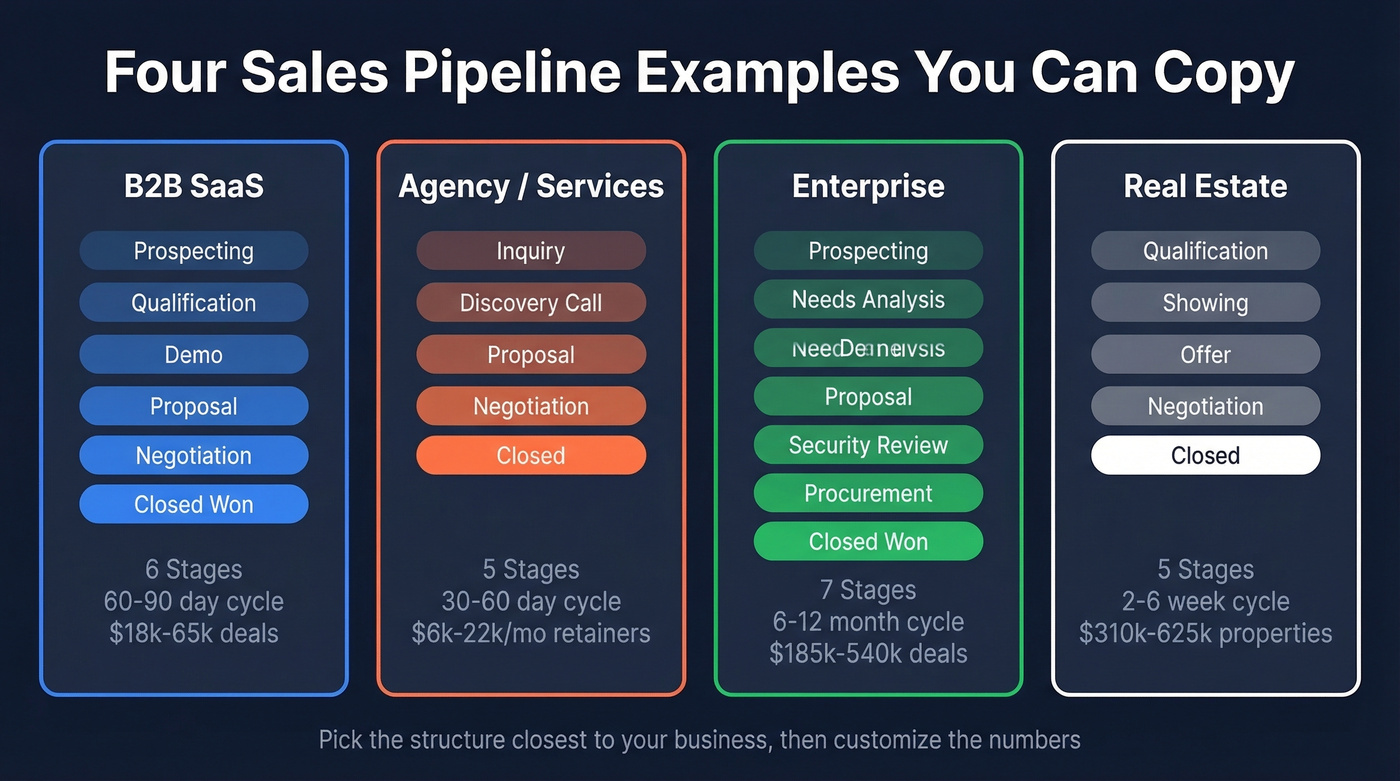
This is the most common structure we see across the teams we work with. Six stages, each gated by a clear action the rep must complete before moving the deal forward. The stage-to-stage conversion benchmarks for B2B SaaS run roughly Lead-to-MQL 39%, MQL-to-SQL 38%, and SQL-to-Closed 37% - so expect significant drop-off at every transition. That's normal.
| Deal | Contact | Stage | Amount | Prob. | Weighted | Close | Next Step |
|---|---|---|---|---|---|---|---|
| Acme Corp | J. Rivera, VP Sales | Proposal | $42,000 | 60% | $25,200 | Mar 15 | Send SOW |
| Bolt.io | S. Chen, CRO | Demo | $28,000 | 30% | $8,400 | Apr 2 | Schedule demo 2 |
| CloudNine | M. Patel, Dir Ops | Negotiation | $65,000 | 80% | $52,000 | Feb 28 | Legal review |
| DataStack | K. Olsen, VP Eng | Qualification | $18,000 | 15% | $2,700 | Apr 20 | Confirm budget |
| Envoy HR | T. Brooks, CEO | Prospecting | $35,000 | 5% | $1,750 | May 10 | First call |
| Finch AI | R. Gupta, Head Rev | Closed Won | $51,000 | 100% | $51,000 | Feb 10 | Handoff to CS |
Unweighted total: $239,000. Weighted forecast: $141,050. That gap is the whole point of weighted pipeline - it tells you what you'll likely close, not what you hope to close.
If you want to tighten this pipeline fast, start with better sales prospecting techniques and a consistent lead scoring model so “Qualification” means the same thing for every rep.
Agency / Consultative Services
Here's the thing about agency pipelines: they bloat. One agency owner on r/agency shared their pipeline with stages like "Never Replied to Book Meeting," "Meh Call," and "Great Call" - and openly called it overkill. That's 10+ micro-stages when five would do the job.
Before (bloated): Lead Interested - Info Request - Meeting Request - Never Replied - Meeting Booked - Missed Call - Meh Call - Great Call - Proposal Sent - Won - Lost
After (clean): Inquiry - Discovery Call - Proposal - Negotiation - Closed
| Deal | Contact | Stage | Amount | Prob. | Weighted | Close | Next Step |
|---|---|---|---|---|---|---|---|
| Greenfield Mfg | D. Walsh, CMO | Proposal | $15,000/mo | 60% | $9,000 | Mar 5 | Revise scope |
| Luxe Hotels | A. Kim, Dir Mktg | Discovery Call | $8,500/mo | 20% | $1,700 | Apr 1 | Send case study |
| Peak Fitness | J. Morales, Owner | Negotiation | $6,000/mo | 75% | $4,500 | Feb 25 | Finalize terms |
| Solis Energy | P. Novak, VP BD | Inquiry | $22,000/mo | 5% | $1,100 | May 15 | Qualify budget |
If your pipeline has stages that describe emotions ("Meh Call"), collapse them. Stages describe actions, not feelings. When deals go quiet, use a few proven sales follow-up templates to keep momentum without adding more stages.
Enterprise Pipeline
Enterprise deals need more stages because more people touch the deal. You're not just selling to a buyer - you're navigating procurement, security, and legal. Enterprise teams typically run 3-5x pipeline coverage because big deals slip and stall far more often than SMB deals, and a single lost deal can crater your quarter.
| Deal | Contact | Stage | Amount | Prob. | Weighted | Close | Next Step |
|---|---|---|---|---|---|---|---|
| GlobalBank | C. Reyes, CISO | Security Review | $320,000 | 40% | $128,000 | Jun 30 | Submit SOC 2 docs |
| Meridian Health | L. Tanaka, CTO | Needs Analysis | $185,000 | 20% | $37,000 | Jul 15 | Map integrations |
| Atlas Logistics | F. Okafor, SVP Ops | Procurement | $540,000 | 70% | $378,000 | May 1 | MSA redline |
Stages here include Needs Analysis, Security Review, and Procurement - none of which exist in a typical SMB pipeline. If you're selling six-figure deals with 6+ month cycles, you need these stages or you'll lose visibility into why deals stall. For more on this motion, see our guide to enterprise B2B sales.
Real Estate Pipeline
Real estate pipelines are shorter and simpler. Cycles run weeks, not months, and the stages map to physical actions - showings, offers, inspections. Stage names adapted from Salytix reflect this.
| Deal | Contact | Stage | Amount | Prob. | Weighted | Close | Next Step |
|---|---|---|---|---|---|---|---|
| 42 Oak Lane | M. & J. Torres | Offer | $485,000 | 70% | $339,500 | Mar 10 | Inspection |
| 118 Elm St | R. Chandra | Showing | $310,000 | 25% | $77,500 | Apr 5 | Second showing |
| 7 Pine Ct | S. Williams | Negotiation | $625,000 | 80% | $500,000 | Feb 28 | Counter-offer |
| 205 River Rd | K. Abrams | Qualification | $420,000 | 10% | $42,000 | May 1 | Pre-approval |
No "Discovery Call" or "Security Review" here. The deal moves when someone walks through a door or signs a document.
How to Forecast With Weighted Pipeline
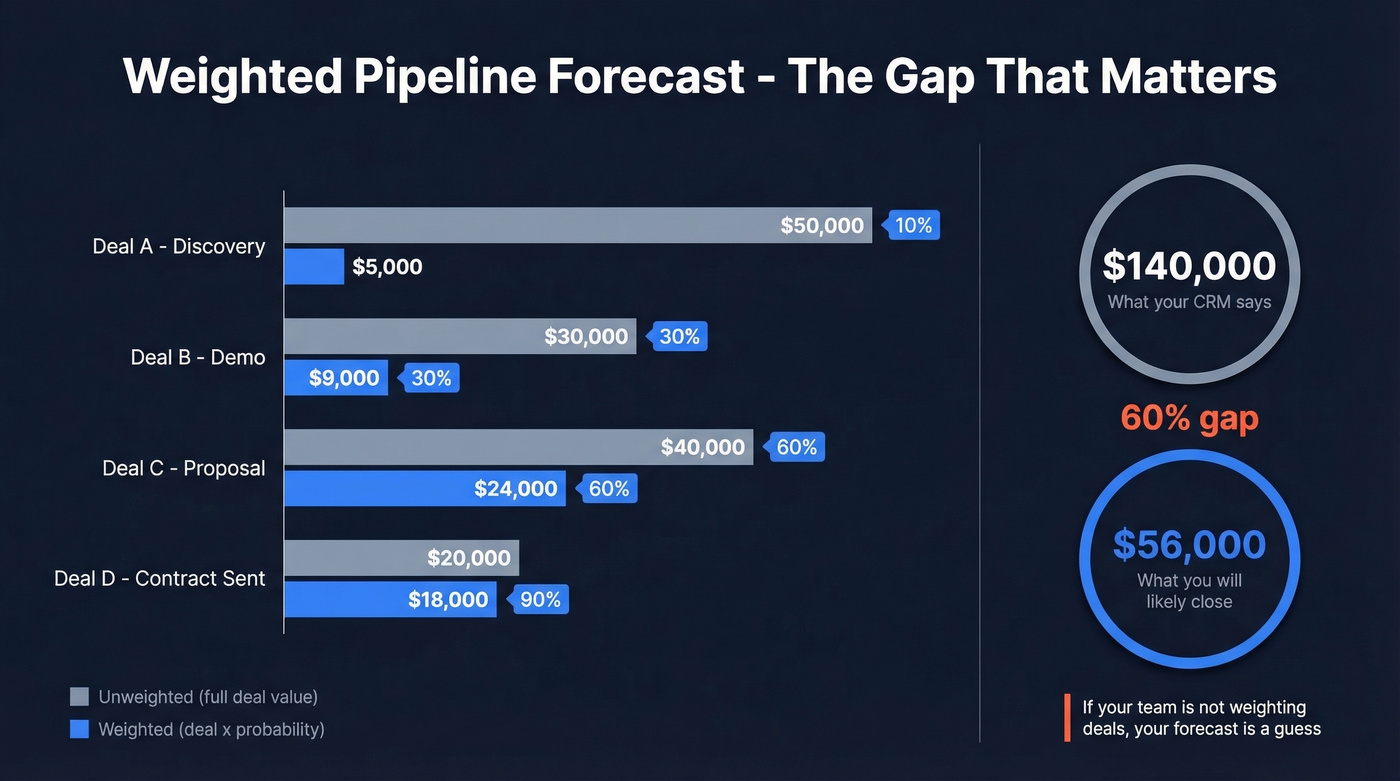
The formula is simple: Weighted Value = Deal Amount x Stage Probability. Sum the weighted values and you've got your forecast. Here's a worked example from Forecastio:
| Deal | Stage | Value | Probability | Weighted |
|---|---|---|---|---|
| Deal A | Discovery | $50,000 | 10% | $5,000 |
| Deal B | Demo | $30,000 | 30% | $9,000 |
| Deal C | Proposal | $40,000 | 60% | $24,000 |
| Deal D | Contract Sent | $20,000 | 90% | $18,000 |
| Total | $140,000 | $56,000 |
Your CRM says $140k. Your forecast says $56k. That's a 60% gap - the difference between a confident board meeting and a panic-driven end-of-quarter push. If your team isn't weighting deals, your forecast is a guess. If you need tooling help, compare a few sales forecasting solutions before you commit.
How Much Pipeline Do You Need?
The formula: Pipeline Coverage = Total Pipeline Value / Quota.
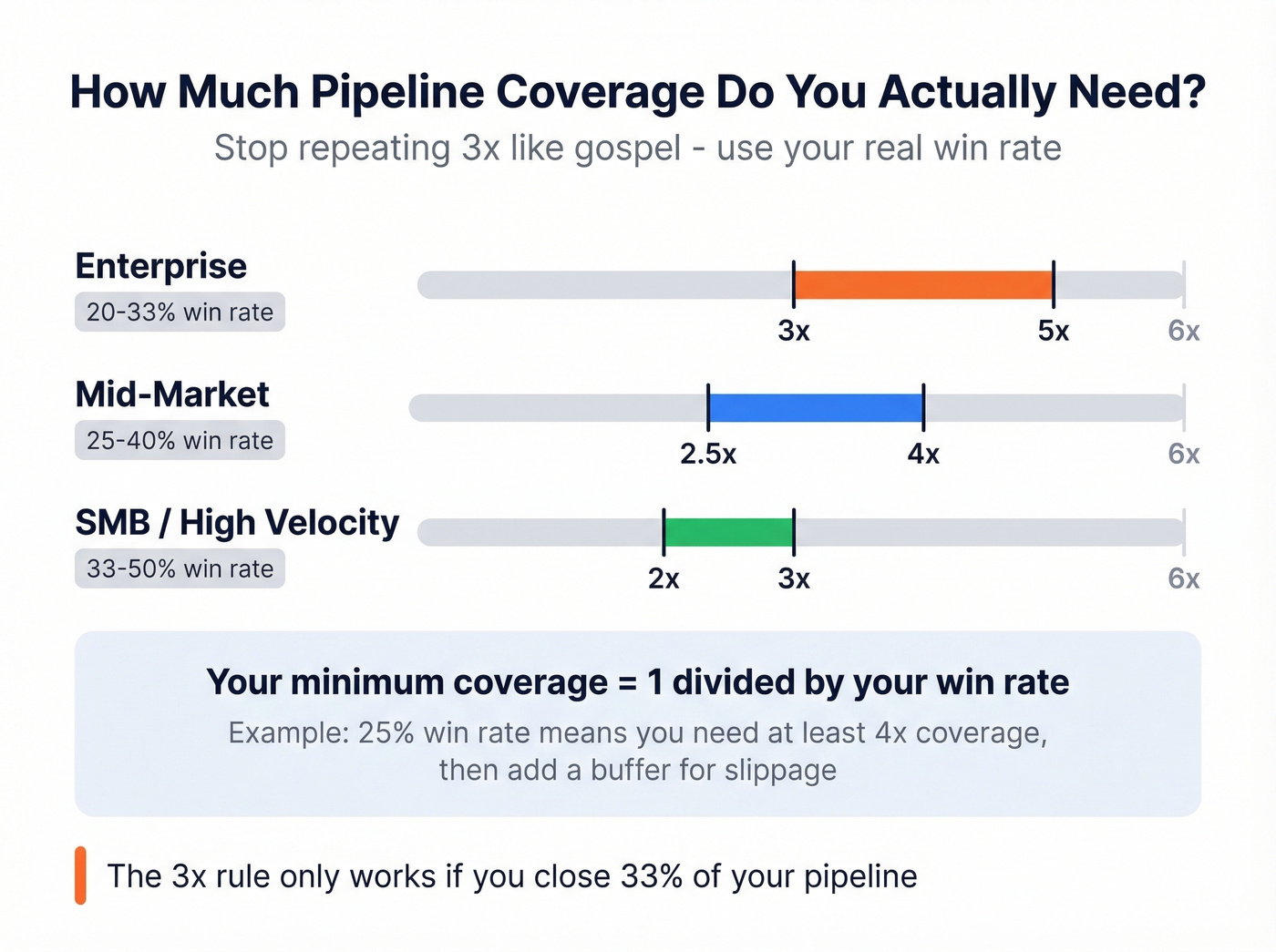
Everyone repeats "3x coverage" like it's gospel. It isn't. The right number depends on your win rate. If you close 20% of qualified pipeline, you need 5x coverage just to break even. If you close 33%, 3x works. The "3x rule" is lazy math that ignores your actual close rate.
Here's what the segment-specific data from Outreach actually shows:
| Segment | Coverage Range | Implied Win Rate |
|---|---|---|
| Enterprise | 3-5x | 20-33% |
| Mid-Market | 2.5-4x | 25-40% |
| High-Velocity SMB | 2-3x | 33-50% |
Start with your historical win rate. Divide 1 by that number. That's your minimum coverage. Then add a buffer for slippage - deals that push to next quarter, go dark, or get killed by procurement.

A pipeline full of dead contacts isn't a pipeline - it's a graveyard. Prospeo gives you 300M+ profiles with 98% email accuracy and 125M+ verified mobiles, so every deal card in your CRM connects to a real buyer.
Stop forecasting on contacts that bounce. Start with verified data.
Pipeline Velocity
This is the metric most teams ignore, and it's more useful than coverage. Pipeline velocity measures how fast revenue moves through your pipeline:
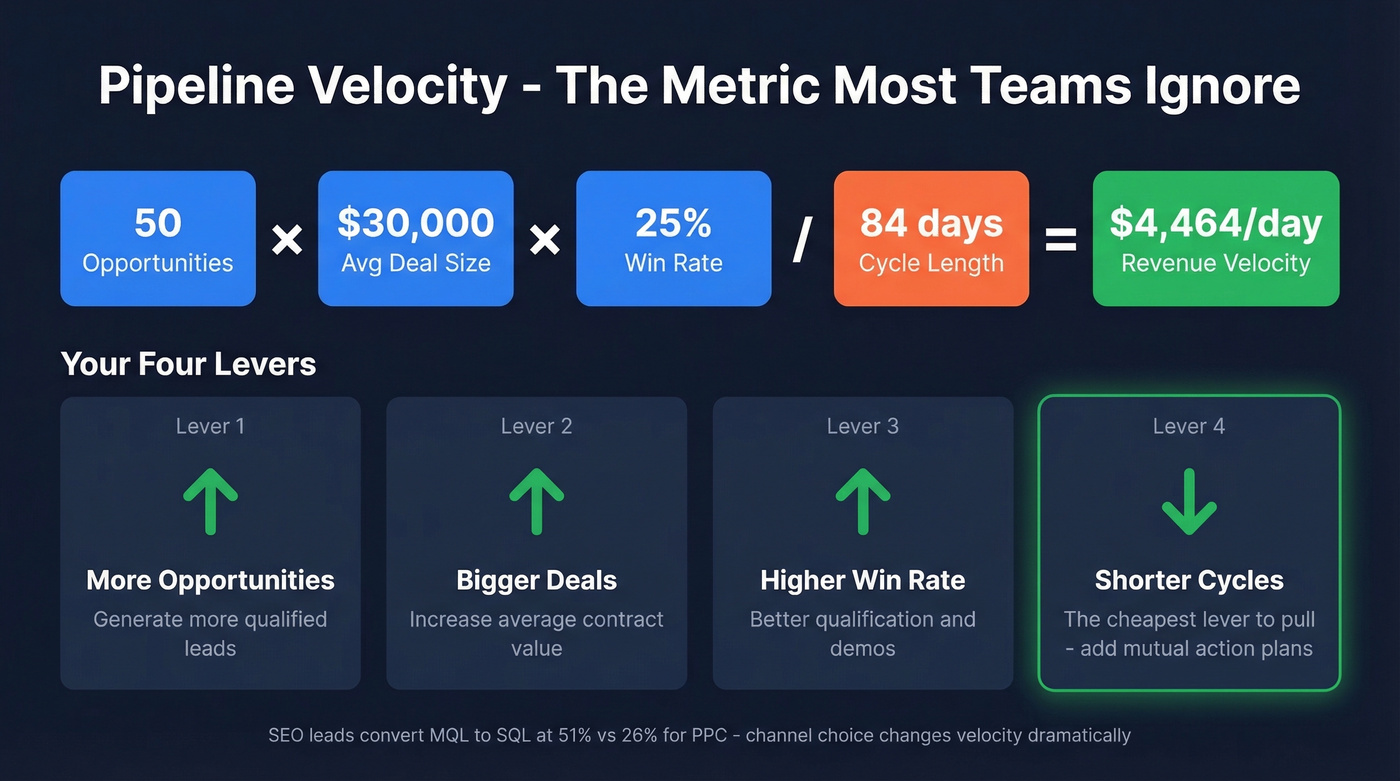
(Opportunities x Avg Deal Value x Win Rate) / Sales Cycle Length = Velocity
Running the numbers with SaaS benchmarks - 50 opportunities, $30k average deal, 25% win rate, 84-day median cycle:
(50 x $30,000 x 0.25) / 84 = $4,464/day
That's your daily revenue velocity. You've got four levers to improve it: more opportunities, bigger deals, higher win rate, or shorter cycles. Most teams obsess over the first two and ignore cycle length entirely. We've seen teams shave 15-20 days off their cycle just by adding a mutual action plan to the proposal stage. It's the cheapest lever to pull.
Channel matters too. SEO-sourced leads convert MQL-to-SQL at 51% versus 26% for PPC. Same pipeline, wildly different velocity depending on where the lead came from. If you want to build that channel, start with a system for SEO sales leads.
Common Pipeline Mistakes
Too many stages. Remember the agency pipeline with "Meh Call" as a stage? Five to seven stages covers virtually every B2B motion. Each stage needs a clear exit criterion - a specific action that moves the deal forward, not a subjective judgment call.
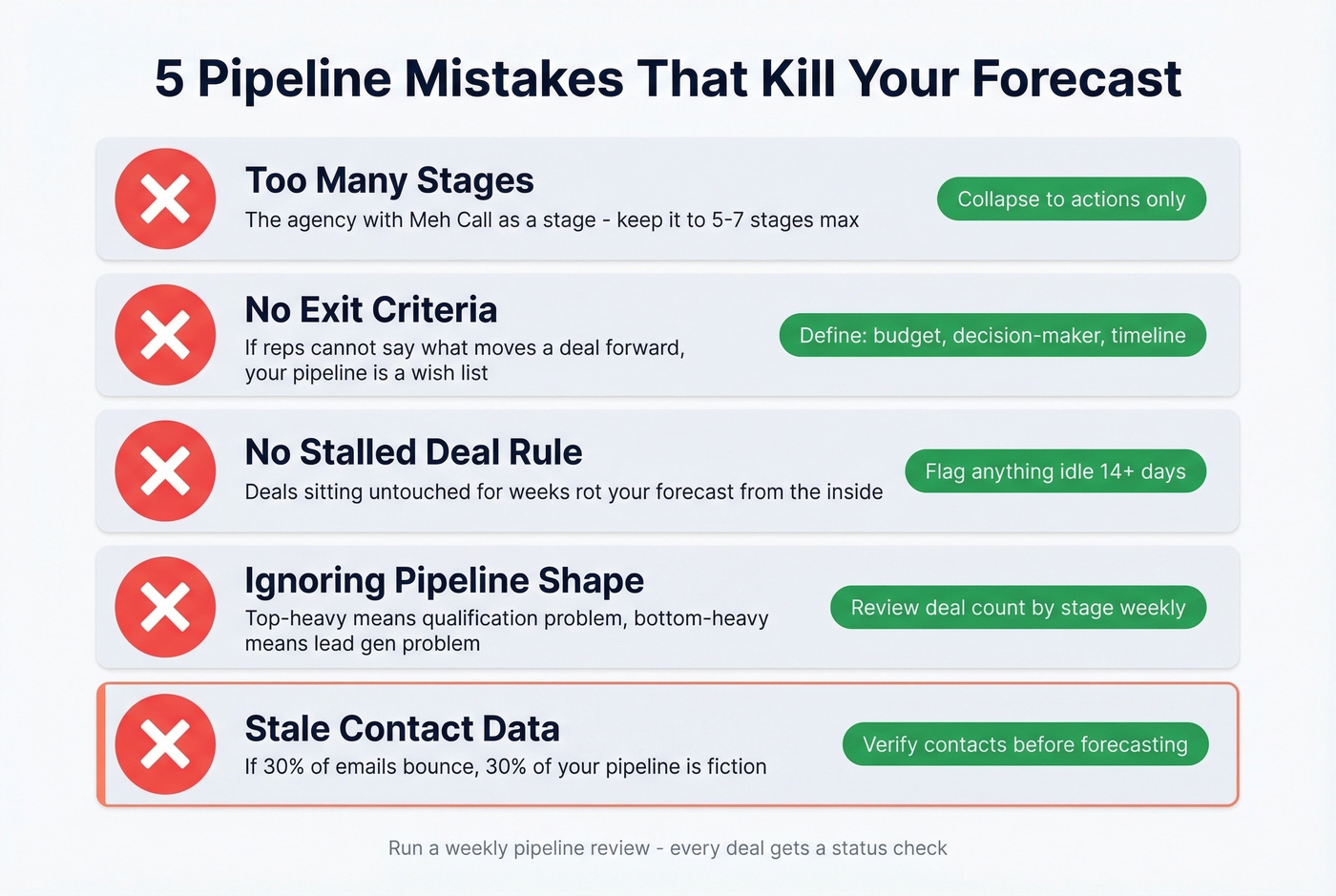
No exit criteria. If reps can't articulate what moves a deal from Qualification to Demo, your pipeline is a wish list. Define it: "Budget confirmed, decision-maker identified, timeline under 90 days." That's an exit criterion.
No stalled-deal rule. Any deal that hasn't moved in 14 days needs a review. Either re-engage or remove it.
Ignoring pipeline shape. If your pipeline is top-heavy - lots of early-stage deals, few in negotiation - you have a qualification problem. Reps are filling the top but not advancing anything. If it's bottom-heavy, you have a lead gen problem. A sales pipeline diagram that maps deal count by stage makes this imbalance immediately visible. Look at the shape, not just the total dollar value.
Stale contact data inflating the pipeline. Look, if 30% of your emails bounce, 30% of your pipeline is fiction. You're forecasting revenue against contacts who'll never see your proposal. I've watched teams celebrate a "$2M pipeline" that was really $1.4M of reachable deals and $600k of dead email addresses. If this sounds familiar, you’re dealing with classic sales pipeline challenges.
Keeping Your Pipeline Accurate
Run a weekly pipeline review. Every deal gets a status check: has it moved? Is the contact still valid? Is the timeline realistic? Deals that haven't moved in 14 days get flagged for re-engagement or removal. And don't confuse pipeline reviews (how do we move these deals?) with forecast reviews (what will we land this quarter?). They're different meetings with different goals.
The deeper issue is contact data quality. Your pipeline forecast is only as accurate as the contact data behind it. If email addresses are stale or phone numbers are wrong, you're building forecasts on ghost leads. Prospeo verifies emails in real time with 98% accuracy on a 7-day refresh cycle - compared to the 6-week industry average. Snyk's sales team cut their bounce rate from 35-40% to under 5% after switching their data source, and AE-sourced pipeline jumped 180%. If you’re cleaning lists, start with email bounce rate basics and then evaluate data enrichment services to keep records fresh.

Weighted forecasts mean nothing if your prospecting stage is full of stale data. Prospeo refreshes every 7 days - not 6 weeks - so the contacts entering your pipeline are current, verified, and reachable at $0.01 per email.
Your pipeline coverage starts with contacts that actually pick up the phone.
Stop Reading. Build One.
You now have four complete sales pipeline examples with real numbers. Pick the one closest to your business, open a spreadsheet or your CRM, and enter your active deals with stages, amounts, and probabilities. You can optimize stage names and exit criteria later. The worst pipeline is the one that only exists in your head.
Thirty minutes of setup today saves you from guessing on tomorrow's forecast call.
Let's be honest: if your average deal size is under five figures, you don't need seven stages, a coverage model, and a velocity calculator. You need five stages, clean contact data, and a 14-day stall rule. Everything else is optimization theater until you're consistently closing 20+ deals a month.
FAQ
What's the difference between a sales pipeline and a sales funnel?
A pipeline tracks individual deals through stages - it's your operational view of who's buying and where they are in the process. A funnel measures aggregate conversion rates between stages - it's the math view. Same underlying data, different lens. Most teams need both: the pipeline to manage deals, the funnel to diagnose where you're losing them.
How many stages should a pipeline have?
Five to seven for most B2B businesses. Fewer and you lose visibility into where deals stall. More and reps stop updating the CRM - they'll skip stages or leave deals parked in the wrong one. Each stage needs a clear exit criterion: a specific action, not a feeling, that moves the deal forward.
How do I keep pipeline data from going stale?
Verify contact data on a recurring schedule - bounced emails and disconnected numbers silently inflate your forecast. Pair that with a 14-day stall rule to remove or re-engage dead deals weekly. Tools like Prospeo refresh records every 7 days and maintain 98% email accuracy, so deals stay tied to reachable contacts.
What does a filled-in pipeline actually look like?
Scroll up to the four examples - each one has deal names, contacts, dollar amounts, probabilities, and weighted forecasts filled in. A real pipeline isn't a list of company names. It's a table where every row has a next step, a close date, and a weighted value. If any of those columns are blank, the deal isn't being managed - it's being hoped for.