

15 Sales Pipeline Management Best Practices That Actually Move the Needle
$2.3M in pipeline. $500K quota. Zero confidence any of it's real. That's the state of most sales pipelines - bloated with zombie deals, propped up by outdated contacts, and managed by reps who are mostly reactive. A semiconductor sales manager on Reddit put it bluntly: his pipeline was inflated by about 60%, with wrong dollar values, outdated info, and wrong close dates. Leadership couldn't set proper quotas because nobody trusted the numbers. Solid sales pipeline management best practices would have caught this before it spiraled.
He's not alone. 63% of sales managers say their organization does a poor job managing its pipeline. Another enterprise AE described juggling around 40 deals and being unable to keep track of everything - even with HubSpot and Gong in the stack.
Here's the thing: effective pipeline management is a discipline problem, not a tool problem. The CRM doesn't fix anything if the operating system behind it is broken. These 15 practices are the operating system.
Fix Three Things This Quarter
If you only change three things, everything else is optimization:
- Implement lead scoring so reps stop chasing dead leads. 68% of high-performing marketers already use it as a primary revenue driver.
- Run weekly 1:1 pipeline reviews - not teamwide status meetings. Thirty minutes, focused on deal health.
Companies with a defined sales process grow revenue 18% faster. Those that actively optimize their pipeline grow 28% faster. The gap between "having a process" and "running a process" is where the money lives.
Why Most Pipelines Are Broken
Most pipeline advice tells you to add more process. The real problem is you have too many deals, not too few.
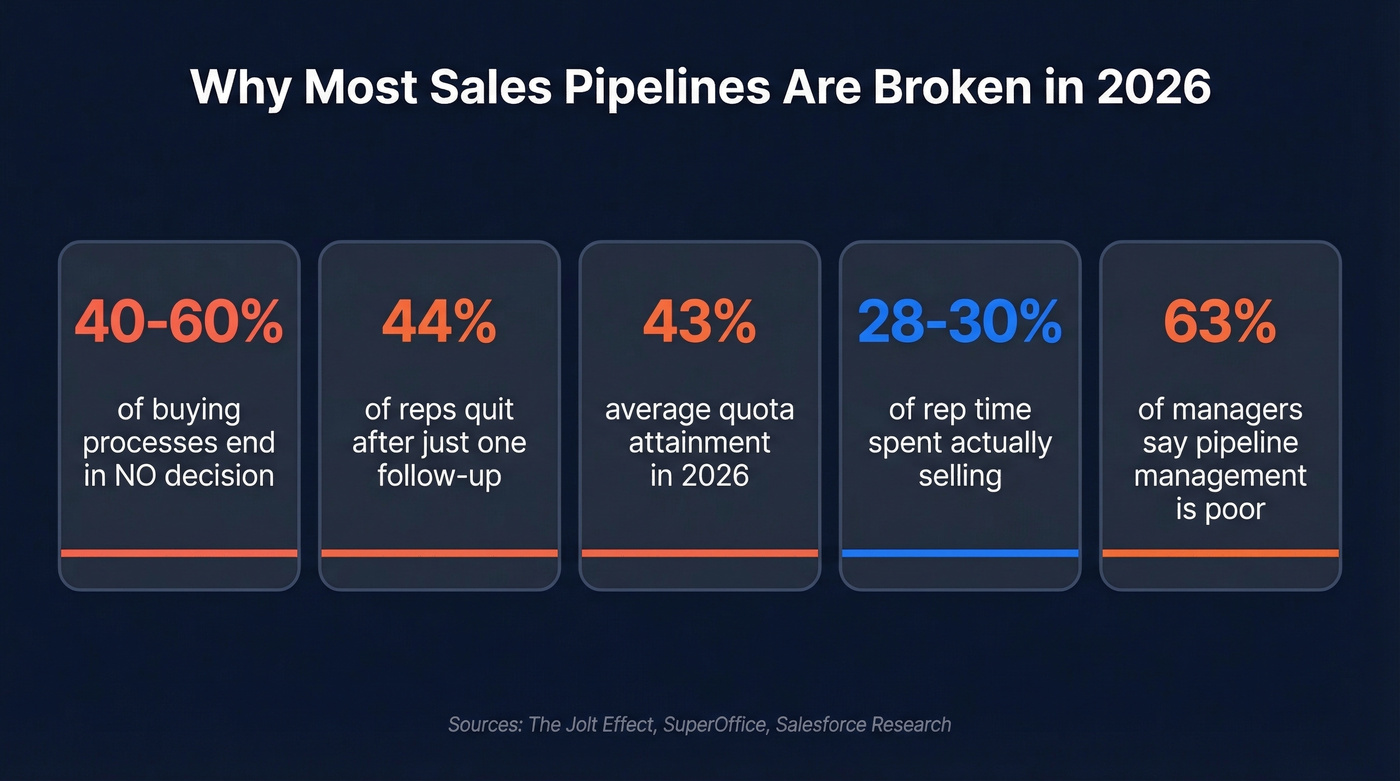
Research from The Jolt Effect found that 40-60% of buying processes end with no decision at all - and roughly 60% of those stall due to buyer indecision, not competitive loss. Your pipeline isn't full of opportunities. It's full of maybes that will never convert.
Meanwhile, 44% of salespeople give up after a single follow-up. The deals that do have momentum get starved of attention because reps are spread across too many zombie opportunities. Reps spend only 28-30% of their time actually selling - high-performing teams push that to 60-70% by automating admin, but most orgs aren't even close.
The downstream effects compound fast. Average quota attainment sits at just 43% in 2026, and broken pipelines are a major reason why. 27% of reps say long sales cycles are the biggest barrier to hitting quota. But cycles aren't long because deals are complex - they're long because nobody killed the stalled ones, nobody followed up on the real ones, and the data underneath it all is stale.
If your pipeline coverage is above 5x and your win rate is below 20%, you don't have a pipeline problem. You have a graveyard problem. The practices below are designed to fix that - starting with aggressive disqualification, not more top-of-funnel volume.

Stale data is the #1 silent killer of sales pipelines. When 40-60% of deals already end in no decision, you can't afford to waste rep time on bounced emails and wrong numbers. Prospeo refreshes 300M+ profiles every 7 days - not every 6 weeks - so the contacts in your pipeline are always current.
Fix your pipeline data before your next pipeline review.
15 Practices for a Healthier Pipeline
1. Define Stages With Exit Criteria
A typical sales pipeline includes seven phases: Prospecting, Lead qualification, Sales call, Proposal, Negotiation, Contract signing, and Post-purchase. That's a starting point, not a system. A functional pipeline has 5-7 stages aligned to the buyer's journey, and each stage has an exit criterion - a specific buyer action that must happen before a deal advances.
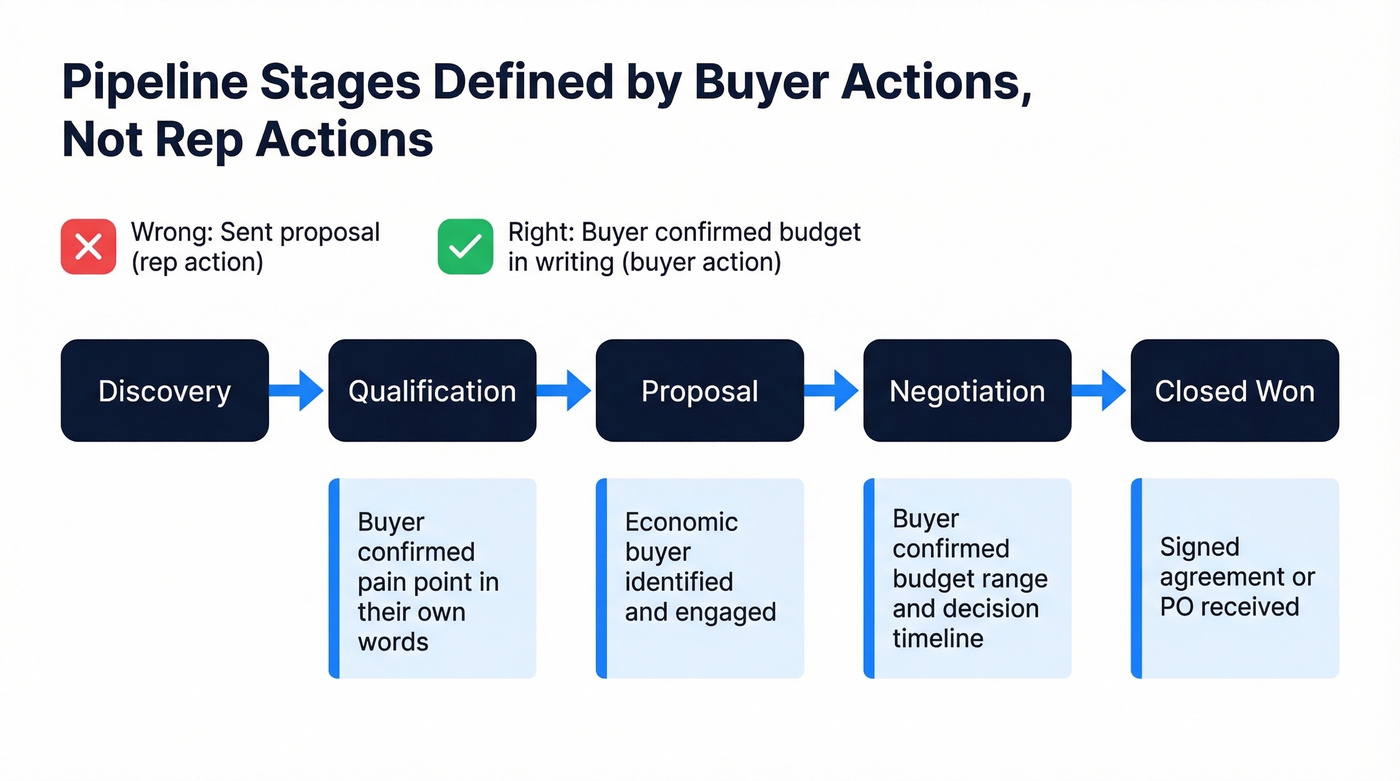
The key distinction: stages are defined by what the buyer does, not what the rep does. "Sent proposal" isn't an exit criterion. "Buyer confirmed budget and timeline in writing" is. Without exit criteria, deals drift forward based on rep optimism, and your pipeline becomes fiction.
Exit criteria that actually work:
- Discovery to Qualification: Buyer confirmed pain point in their own words
- Qualification to Proposal: Economic buyer identified and engaged
- Proposal to Negotiation: Buyer confirmed budget range and decision timeline
- Negotiation to Closed Won: Signed agreement or PO received
2. Standardize for Repeatability
A defined, repeatable sales pipeline isn't bureaucracy - it's a multiplier. Companies with a standardized sales process grow revenue 18% faster than those winging it. The process doesn't need to be rigid, but every rep should be running the same playbook for stage definitions, qualification criteria, and handoff points.
The biggest risk of no standardization? You can't diagnose problems. If every rep runs a different process, you can't tell whether a bottleneck is a market issue, a messaging issue, or a rep issue.
3. Prospect Every Single Day
Block 30 minutes every morning for prospecting and one hour for cold calling. Deals close after the 5th or 6th follow-up - but 44% of reps quit after one touch. Daily prospecting is the only way to keep the top of your pipeline from drying up while you work mid-funnel deals.
Skip this if you have a fully staffed SDR team feeding you qualified meetings. Even then, adding 5-10 new prospects daily keeps you from going hungry next quarter.
When adding prospects, verify contact data in real time. Prospeo's Chrome extension pulls verified emails and mobile numbers from any professional profile or company website in one click - so you're not wasting prospecting time on dead addresses.
4. Implement Lead Scoring
70% of leads are lost from poor sales follow-up. Lead scoring fixes the prioritization problem by giving every lead a number that reflects how likely they are to buy.
Start simple:
| Action | Points |
|---|---|
| Pricing page visit | +15 |
| Contact form submit | +20 |
| Webinar attendance | +30 |
| Demo request | +40 |
| Unsubscribe | -15 |
Set thresholds: score above 50 = MQL, score above 70 = immediate sales alert. Most leads cluster in the 41-60 range, and fewer than 10% ever hit 81+. The goal isn't perfection - it's making sure your best leads get touched first.
In our experience, teams that implement even basic scoring see a 15-20% improvement in sales follow-up speed within the first quarter. If you're not scoring, you're guessing.
5. Qualify Ruthlessly
Every deal in your pipeline should pass a qualification framework. BANT works for transactional sales. MEDDPICC is better for enterprise deals where buying committees average 7.2 stakeholders.
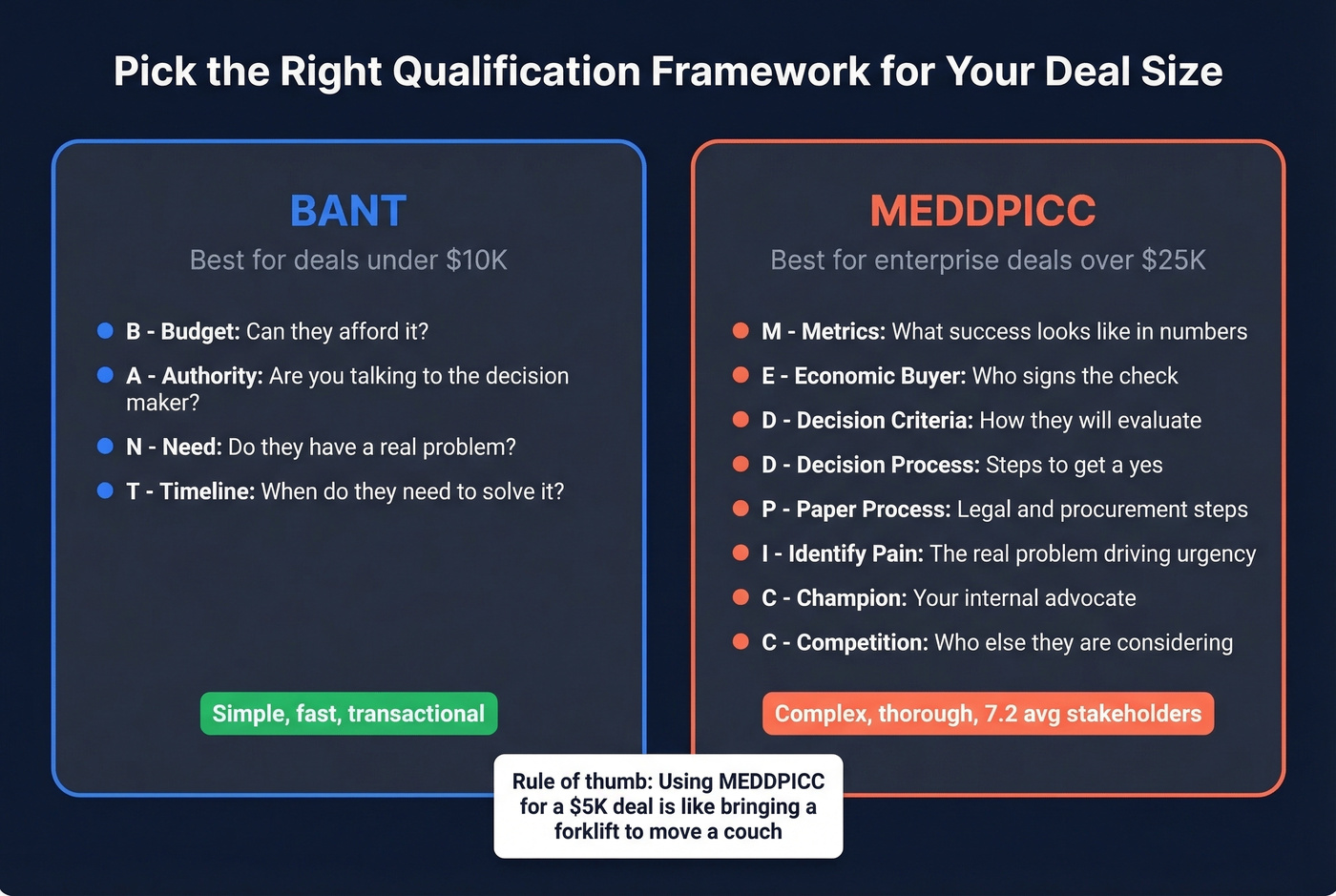
The uncomfortable truth: aggressive disqualification feels like you're shrinking your pipeline. You are. That's the point. A smaller pipeline of real deals beats a bloated pipeline of maybes every single time. If your average deal size is under $10K, BANT is plenty. MEDDPICC for a $5K deal is like bringing a forklift to move a couch.
6. Kill Zombie Deals
If 40-60% of buying processes end in no decision, your pipeline is full of deals that were never going to close. Here's the diagnostic: look at the average age of your won deals versus your lost deals. A common win-rate analysis shows the average age of deals won is about twice the average age of deals lost. If a deal has been sitting at the same stage for 30+ days with no clear next step, it's a zombie.
The coverage ratio test works too. If your pipeline coverage is above 5x your quota, you almost certainly have a graveyard. Kill the zombies, and your win rate, forecast accuracy, and rep focus all improve overnight.
In manufacturing with 12-month cycles, the 30-day stall rule becomes a 90-day stall rule. Adjust the threshold to your segment, but never skip the purge.
7. Build a Follow-Up System
It takes more than 8 touches to close a deal. 44% of reps quit after one. The math is brutal.
A structured cadence beats ad-hoc reminders every time. Set follow-up sequences by deal stage, automate the reminders, and make "next step + date" a required field on every opportunity. We've seen teams double their close rates just by enforcing a follow-up system - no new leads, no new tools, just discipline. This is one of the simplest changes to implement, yet it delivers some of the biggest returns. If you need a starting point, steal a few follow-up sequences and adapt them by stage.
8. Calculate Pipeline Velocity
Pipeline velocity tells you how much revenue moves through your pipeline per day. It's the single best health metric for a sales org.
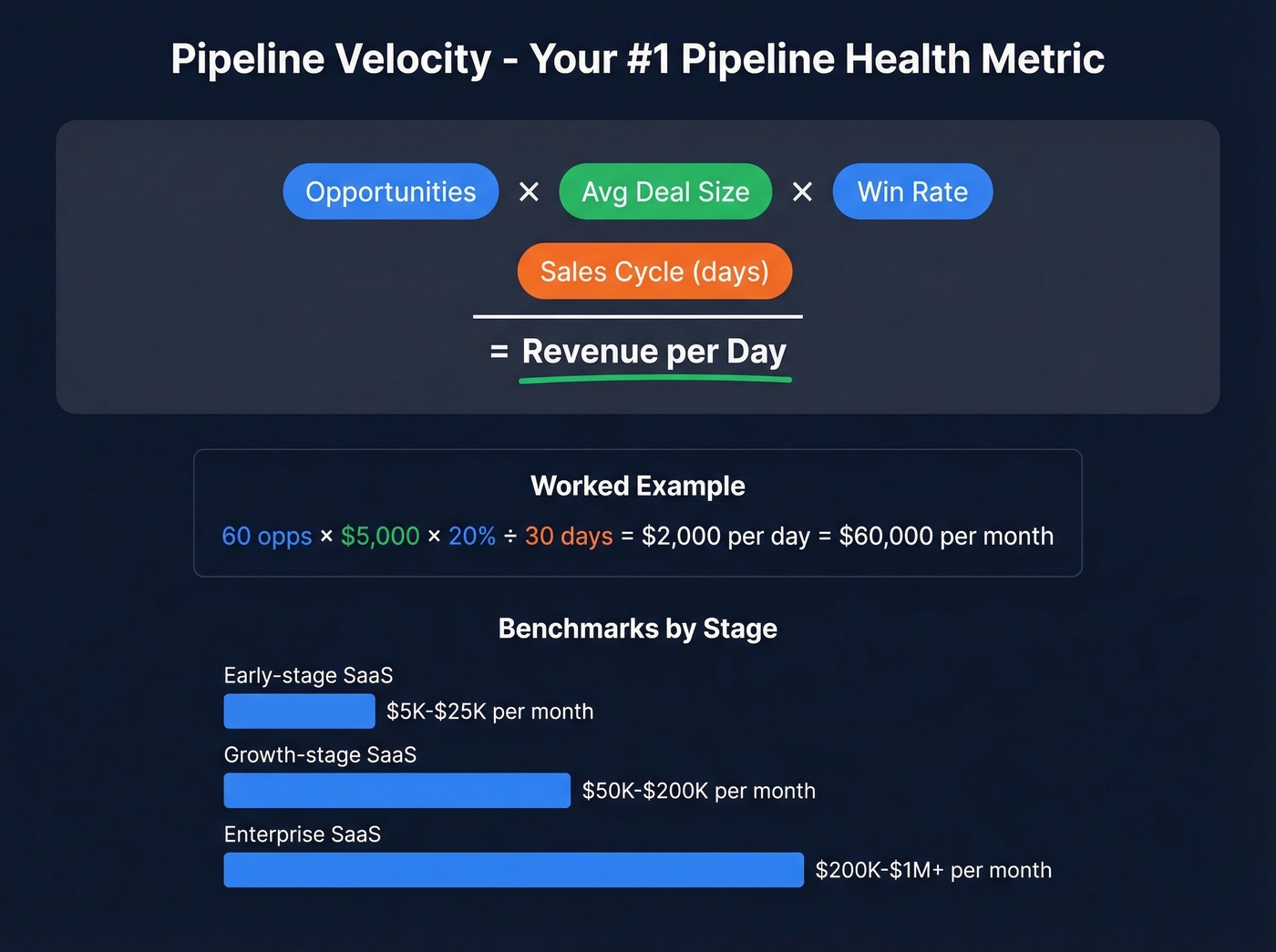
Formula: (Opportunities x Avg deal size x Win rate) / Avg sales cycle in days
Worked example: (60 opportunities x $5,000 x 20%) / 30 days = $2,000/day = $60,000/month
Every lever matters. Shorten the cycle by 5 days, and velocity jumps. Increase win rate by 3 points, and velocity jumps. The power is in knowing which lever to pull.
Velocity benchmarks by company stage:
| Company Stage | Monthly Velocity |
|---|---|
| Early-stage SaaS | $5K-$25K |
| Growth-stage SaaS | $50K-$200K |
| Enterprise SaaS | $200K-$1M+ |
Sales cycle length by ACV:
| ACV | Typical Cycle |
|---|---|
| Under $2K | ~14 days |
| $2K-$5K | ~30 days |
| $5K-$25K | ~90 days |
| $25K-$100K | ~90-180 days |
| $100K+ | ~3-9 months |
If your velocity is below the benchmarks for your stage, one of the four inputs is broken. The formula tells you which one.
For more precise forecasting, use weighted pipeline - multiply each deal's value by its stage probability before summing. A $50K deal at the proposal stage with a 40% historical close rate counts as $20K in weighted pipeline, not $50K. This single adjustment eliminates most of the optimism bias that wrecks forecasts. (If you're evaluating tools, compare a few sales forecasting solutions before you buy.)
9. Know Your Coverage Ratio
Coverage ratio answers a simple question: do you have enough pipeline to hit quota?
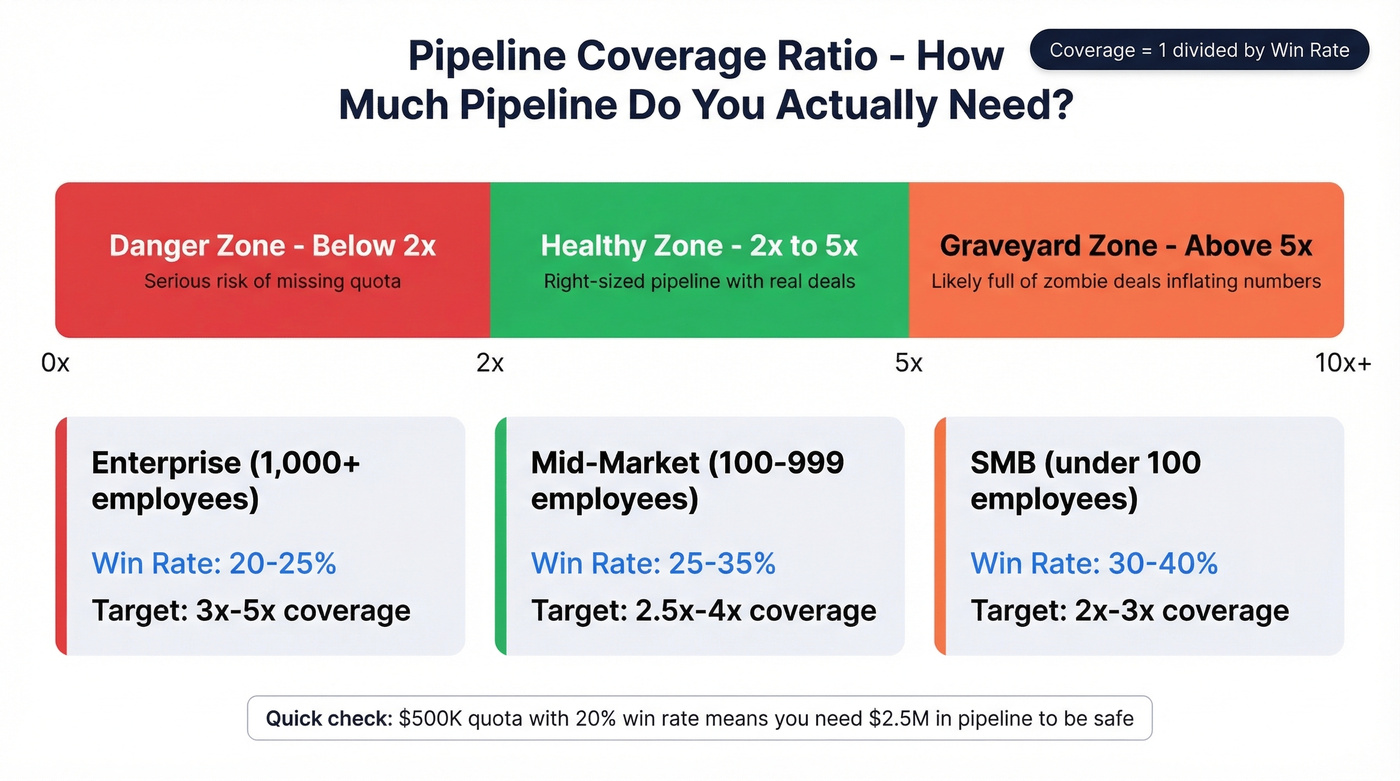
Coverage = 1 / Win Rate.
| Segment | Win Rate | Target Coverage |
|---|---|---|
| Enterprise (1,000+) | 20-25% | 3x-5x |
| Mid-Market (100-999) | 25-35% | 2.5x-4x |
| SMB (<100) | 30-40% | 2x-3x |
Below 2x coverage, you're at serious risk of missing quota. Above 5x, you're likely carrying zombie deals that inflate the number without contributing revenue.
10. Run 1:1 Pipeline Reviews
Cancel your teamwide pipeline review. Salesforce recommends keeping reviews 1:1 between manager and rep - 30 minutes max, weekly or biweekly. Teamwide reviews where 12 reps take turns reading CRM notes are theater, not management.
Use the 5-pillar framework for every review:
- Qualification - are these deals real?
- Coverage - enough pipeline to hit the number?
- Next steps - does every deal have a clear buyer action + date?
- Forecast accuracy - challenge slipping close dates
- Sales execution - are reps driving the right conversations?
Any deal that hasn't advanced in 30 days with no clear next step gets reassessed or removed. No exceptions.
11. Keep Your CRM Clean
That semiconductor manager with the 60% inflated pipeline? His problem wasn't strategy - it was data hygiene. Wrong dollar values, outdated contacts, and stale close dates made the entire pipeline useless for forecasting.
The fix is boring but essential: remove deals that haven't progressed in 2-3x your average sales cycle, update stages based on actual buyer engagement rather than rep optimism, and run hygiene checks weekly. We've audited pipelines where 40% of contacts had bounced emails - the reps had no idea. A clean CRM isn't a nice-to-have; it's the foundation every other practice depends on. If you're rethinking your stack, start with the basics of contact management software.
12. Start With Accurate Contact Data
Bad contact data is the silent killer of pipeline health. Bounced emails inflate activity metrics. Wrong phone numbers waste rep time. Outdated contacts create phantom pipeline - deals that look real but can't actually be worked.
Verify emails and phone numbers before they enter your CRM. Prospeo gives you 300M+ professional profiles, 143M+ verified emails, and 125M+ verified mobile numbers - with 98% email accuracy and a 7-day refresh cycle - so your follow-ups reach real people, not dead inboxes. The free tier gives you 75 emails + 100 Chrome extension credits per month with no credit card required. (If you’re comparing vendors, see what to look for in data enrichment services.)
13. Use AI Where It Matters
Almost 80% of sales teams report a positive impact from AI on pipeline generation. But here's the gap: 86% use AI for content creation, while only 32% use it for predictive analytics like lead scoring. That's a massive missed opportunity.
The highest-impact AI applications for pipeline management are behavioral lead scoring, AI-powered forecasting, conversation intelligence for deal analysis, and stalled-deal flagging. Writing emails faster is nice; knowing which deals are about to die is worth far more.
Teams relying on gut and spreadsheets see forecasting errors of 20-30%. AI-powered forecasting closes that gap, and it's the single fastest way to improve forecast accuracy without changing anything else about your process. The tool categories that matter most: your CRM as the system of record, conversation intelligence like Gong or Chorus, data verification for contact accuracy, and AI forecasting platforms like Clari or BoostUp. If you want the underlying concepts, start with predictive analytics in sales.
14. Align Sales and Marketing
If sales and marketing don't agree on what an MQL, SQL, and SAL mean, you'll have phantom pipeline. Marketing will celebrate lead volume. Sales will complain about lead quality. And the pipeline will be full of "opportunities" that never had a chance.
Here's how this breaks in practice: if marketing defines an MQL as "downloaded a whitepaper," but sales expects an MQL to have confirmed budget and timeline, every handoff creates friction. Reps waste time qualifying leads that marketing already counted as wins. The pipeline inflates with deals that were never real. Get both teams in a room, define each stage with specific criteria, write it down, and review it quarterly. This isn't a one-time exercise - it's an ongoing alignment practice that prevents the most common source of pipeline inflation. (If you need a shared language, align on your funnel metrics first.)
15. Coach to Leading Indicators
Most sales managers coach to outcomes: revenue, win rate, quota attainment. These are lagging indicators - by the time they're bad, it's too late. Brooks Group recommends coaching to activities instead: discovery calls booked, proposals sent, stakeholder meetings held, next steps confirmed.
Leading indicators predict lagging results. If a rep's discovery call volume drops, their pipeline will thin out in 60-90 days. Catch it now, and you can fix it before the quarter is lost. For example, if a rep's discovery-call-to-proposal ratio drops from 40% to 25%, that's a skill gap you can coach before it shows up in the quarterly number. Track the ratios between stages, not just the volume at each stage. If you need ideas for what to track, use these sales activities examples as a baseline.
Benchmarks Worth Bookmarking
Numbers without context are useless. Here are the benchmarks that actually help you diagnose pipeline problems.
Stage Conversion by Industry
| Industry | Lead to MQL | MQL to SQL | SQL to Opp | SQL to Closed |
|---|---|---|---|---|
| B2B SaaS | 39% | 38% | 42% | 37% |
| Manufacturing | 26% | 41% | 46% | 51% |
| Financial Svcs | 29% | 38% | 49% | 53% |
| Construction | 17% | 37% | 50% | 54% |
Based on First Page Sage benchmarks from anonymized client data through 2025 - the most recent published dataset available.
SaaS Funnel Quick Reference
| Metric | Benchmark |
|---|---|
| Lead-to-customer | 2-5% |
| Biggest bottleneck | MQL to SQL (15-21%) |
| Median sales cycle | 84 days |
| Typical win rate | 20-30% |
| Pipeline velocity | $743-$2,456/day |
If your MQL-to-SQL conversion is below 15%, your qualification criteria are broken - not your pipeline. That's where most SaaS funnels leak the hardest, and it's almost always a definition problem between sales and marketing.
Common Pipeline Mistakes to Avoid
You can follow all 15 practices and still fail if you're making these structural errors.
Inconsistent prospecting creates feast-or-famine pipeline. Daily habits beat monthly blitzes every time. The reps who never have a bad quarter are the ones who prospect when they don't need to. If you need a system, borrow a few sales prospecting techniques and standardize them across the team.
Poor qualification is the #1 source of inflated forecasts. Letting unqualified deals into the pipeline to pad coverage numbers feels productive in the moment and devastating at quarter-end.
Letting leads go cold kills deals faster than competition does. A lead that goes untouched for 48 hours is already cooling. After a week, it's ice.
Keeping stagnant deals throws off every metric you track. Stale opportunities make you believe you have more pipeline than you do. Review and purge weekly.
Denial that deals are dead is the hardest habit to break. The Jolt Effect research is clear - most of your "pending" deals have already decided not to decide. The 3x-5x coverage target can actually incentivize keeping zombie deals alive. Fight that instinct.
Relying on teamwide reviews wastes everyone's time. Switch to 1:1s.
Treating CRM as strategy is the most expensive mistake. Your CRM is infrastructure, not a strategy. A perfectly maintained Salesforce instance with no follow-up system, no scoring, and no review cadence is just an expensive spreadsheet. Building a profitable pipeline requires the discipline behind the tool, not just the tool itself.
Daily prospecting only works if you're reaching real people. Reps who prospect with bad data burn 30 minutes a day on bounces and voicemails to disconnected numbers. Prospeo delivers 98% email accuracy and 125M+ verified mobiles with a 30% pickup rate - at $0.01 per email, no contract required.
Spend your prospecting block selling, not chasing dead leads.
FAQ
What's the difference between a sales pipeline and a sales funnel?
A sales pipeline tracks the seller's active deals organized by stage, showing where each opportunity sits and what action comes next. A sales funnel is marketing's view of lead volume narrowing through qualification stages. Pipeline measures deal progression; funnel measures conversion rates across the entire audience.
How often should you review your pipeline?
Run 1:1 pipeline reviews with each rep weekly or biweekly, capped at 30 minutes. Use a monthly team review for trend analysis only - not deal-by-deal status updates. Cancel any teamwide meeting where reps take turns reading CRM notes; that's a time sink, not a review.
What's a healthy pipeline coverage ratio?
A healthy coverage ratio is 3x-5x quota, calculated as 1 divided by win rate. A 25% win rate means you need 4x coverage. Below 2x, you're at serious risk of missing your number. Above 5x, your pipeline is likely bloated with zombie deals that inflate the metric without contributing revenue.
How do you calculate pipeline velocity?
Pipeline velocity = (Opportunities x Avg deal size x Win rate) / Avg sales cycle in days. Early-stage SaaS companies typically target $5K-$25K per month; growth-stage teams aim for $50K-$200K. Track it monthly to spot trends before they hit your forecast.
How does bad contact data affect pipeline health?
Bad contact data creates phantom pipeline - deals that look active but can't be worked because emails bounce and phone numbers are wrong. Verifying data before it enters your CRM prevents stale contacts from poisoning your pipeline and inflating forecasts. Tools with high accuracy rates and frequent refresh cycles make the biggest difference here.