

Best Sales Pitch Creators in 2026: Tools, Frameworks, and Prompts That Work
You paste your product details into a sales pitch creator, hit "Create," and get back: "In today's fast-paced business landscape, our game-changing solution revolutionizes..." You close the tab. 84% of reps missed quota last year, and AI tools that save reps up to 2 hours a day won't help if every pitch sounds like it was written by the same intern. What actually works: a solid framework, a well-crafted prompt, and - the part nobody talks about - accurate prospect data so your pitch reaches a real person.
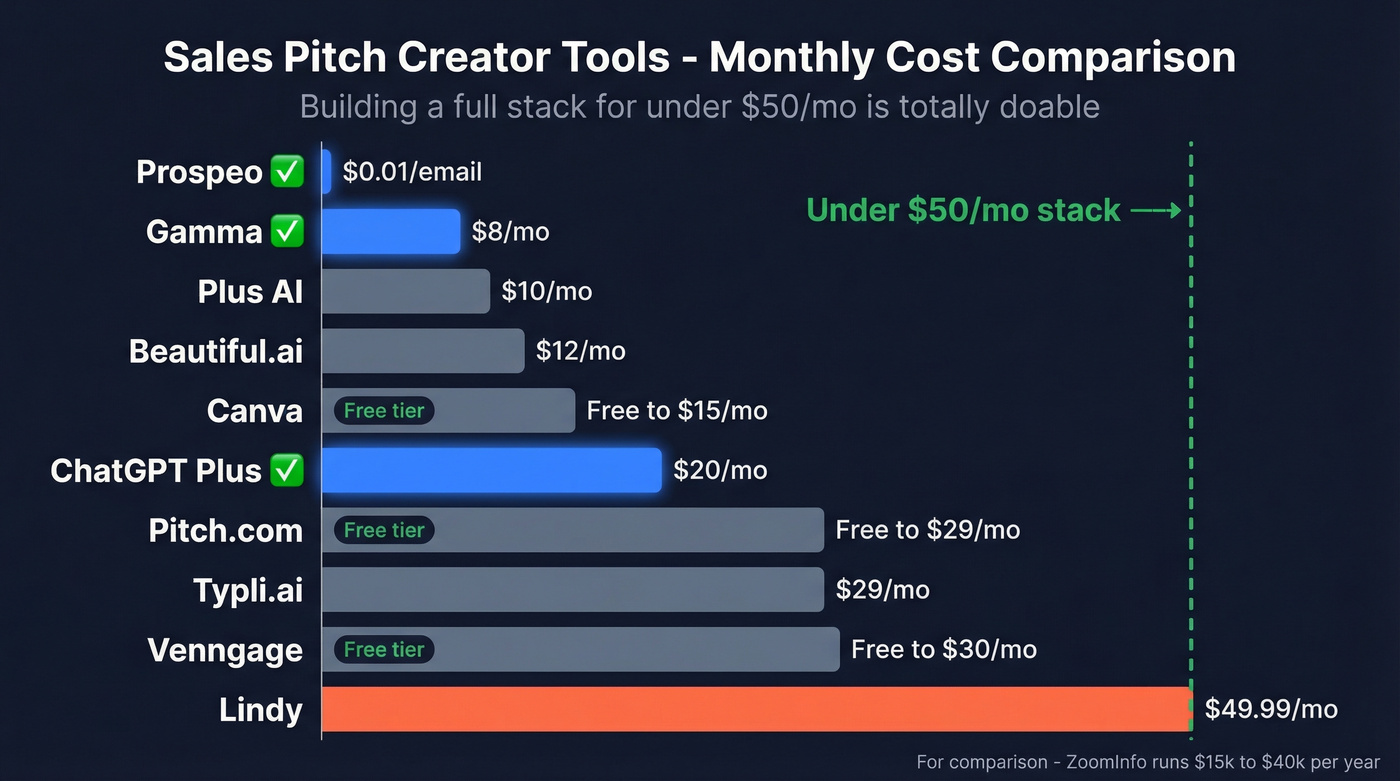
You don't need a single tool. You need a system. Let's build one for under $50/month.
Top Picks at a Glance
| Pick | Best For | Price |
|---|---|---|
| Prospeo | Verified prospect data | ~$0.01/email, free tier |
| ChatGPT Plus | Writing pitches with custom prompts | $20/mo |
| Gamma | AI-generated pitch decks | From $8/mo |
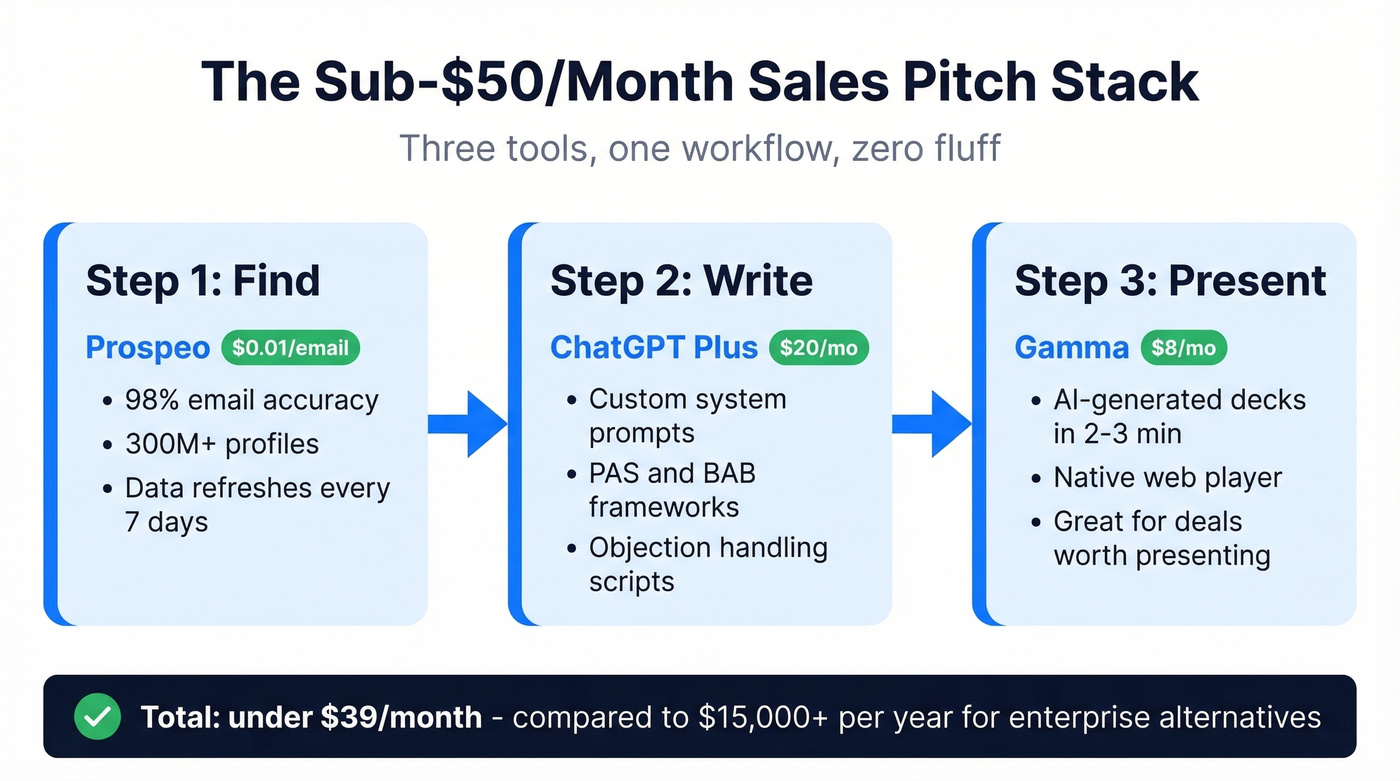
Stack all three and you're under $50/month with verified contacts, a writing engine, and a deck builder. For context, ZoomInfo typically runs $15k-$40k/year depending on seats and modules.
What Makes a Sales Pitch Work
A sales pitch is roughly 200 words - a short, focused message that explains how you solve a specific problem for a specific person. Buyers spend just 17% of their buying time meeting suppliers. Your pitch has to earn its place in that sliver.
If you’re building a repeatable outbound motion, pair this with proven sales prospecting techniques so your pitch hits the right people, not just more people.
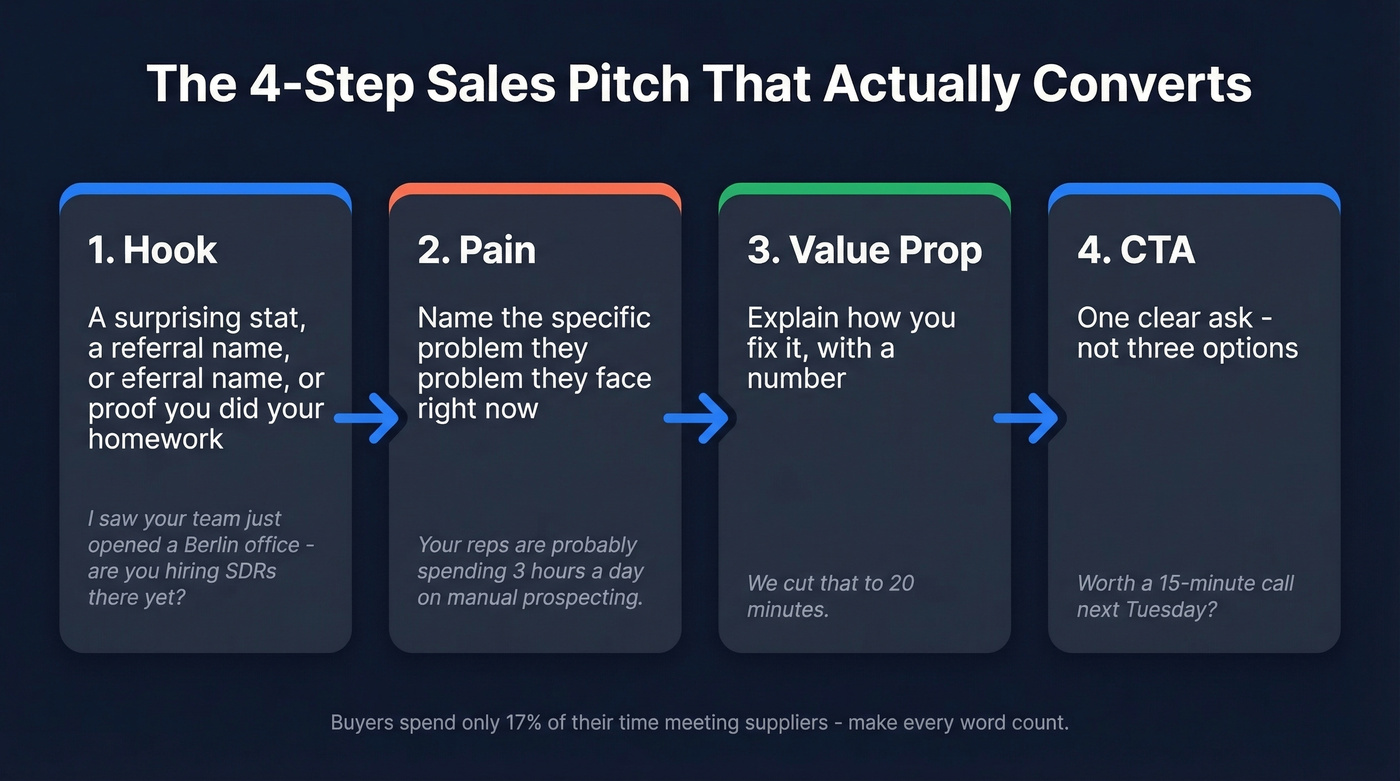
The structure that consistently converts follows four steps:
- Hook - a surprising stat, a referral name, or a question that proves you've done homework. "I saw your team just opened a Berlin office - are you hiring SDRs there yet?" beats "I'd love to introduce our platform."
- Pain - name the specific problem. Not "many companies struggle with..." but "your reps are probably spending 3 hours a day on manual prospecting."
- Value prop - explain how you fix it, with a number. "We cut that to 20 minutes" is stronger than "we streamline your workflow."
- CTA - one clear ask. A 15-minute call, a free trial, a reply. Not three options.
Pick Your Framework First
Before you touch any tool, pick a framework. The tool generates words. The framework makes those words persuasive.
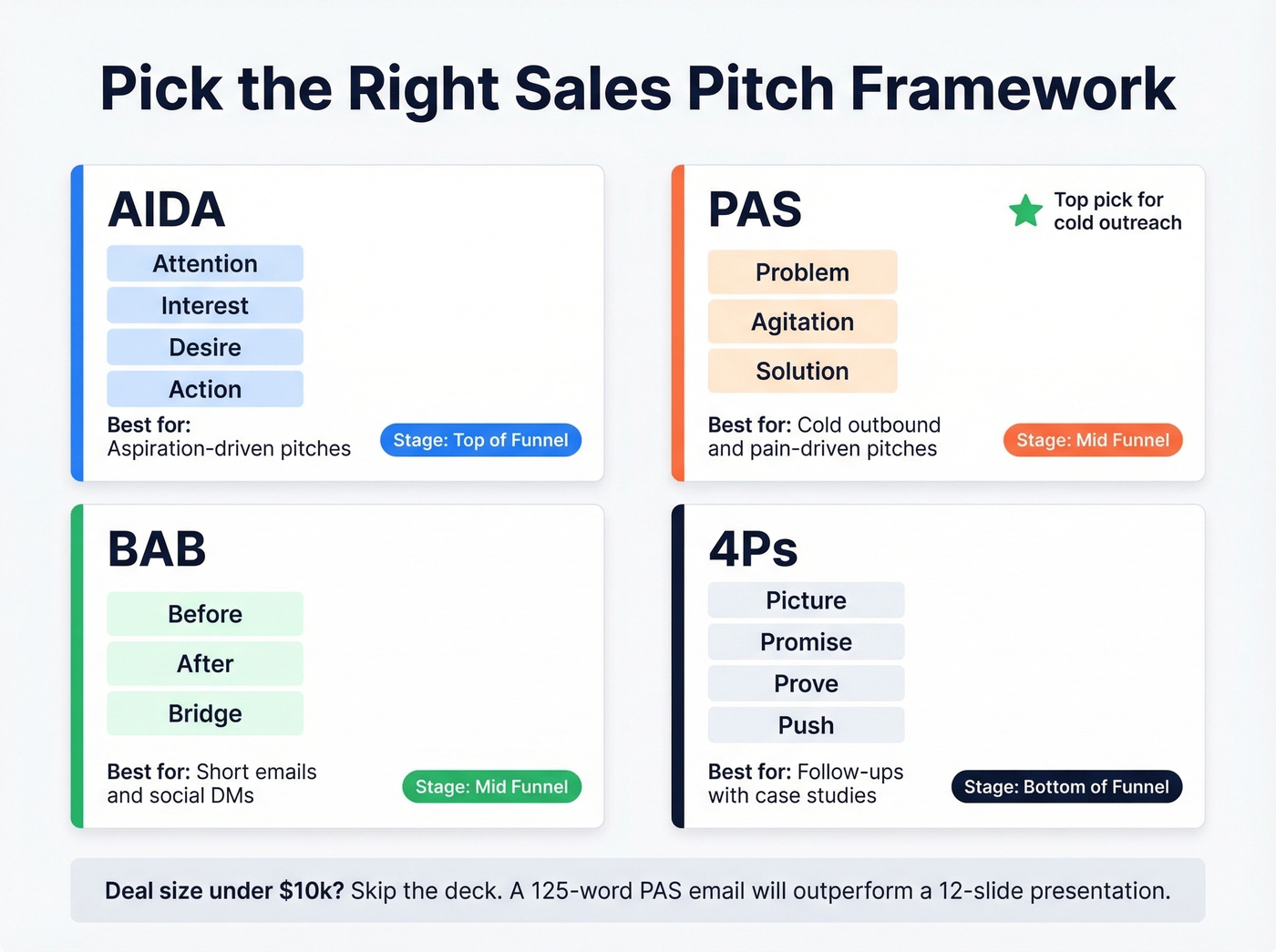
| Framework | Structure | Best For | Funnel Stage |
|---|---|---|---|
| AIDA) | Attention -> Interest -> Desire -> Action | Aspiration-driven pitches | TOFU |
| PAS | Problem -> Agitation -> Solution | Pain-driven pitches | MOFU |
| BAB | Before -> After -> Bridge | Short-form (email, social) | MOFU |
| 4Ps | Picture -> Promise -> Prove -> Push | Case-study-heavy pitches | BOFU |
AIDA paints a picture of what's possible. PAS pokes the wound, then offers the bandage. For cold outbound, PAS outperforms because you're interrupting someone who didn't ask to hear from you. Pain gets attention faster than aspiration.
BAB is ideal for short emails because it's compressed storytelling. "Before: your reps spend 4 hours building lists. After: they spend 20 minutes. Bridge: here's how." That's a complete pitch in three sentences.
The 4Ps framework shines when you have proof. If you've got case studies, ROI numbers, or named logos, 4Ps lets you lead with credibility. Use it for follow-up pitches and proposals, not cold opens.
Here's the thing: if your average deal size is under $10k, skip the fancy deck tools entirely. A tight 125-word email built on PAS will outperform a 12-slide presentation every time. Decks are for deals worth presenting. Most outbound isn't.
One angle worth considering: pulling CRM merge fields directly into your prompts. Salesforce popularized the "Why Change / Why Now / Why Us" framework for exactly this reason - when your pitch references real pipeline data, it stops sounding like a template. (If you need a refresher on CRM basics, here are real examples of a CRM.)
10 Best Sales Pitch Creator Tools
Prospeo
Use this if: you need verified emails and direct dials before running pitch campaigns - because the best pitch in the world fails when it hits a dead inbox.
If you’re comparing providers, start with a quick scan of the best data enrichment services so you know what “good data” actually includes (emails, phones, firmographics, refresh rates, and verification).
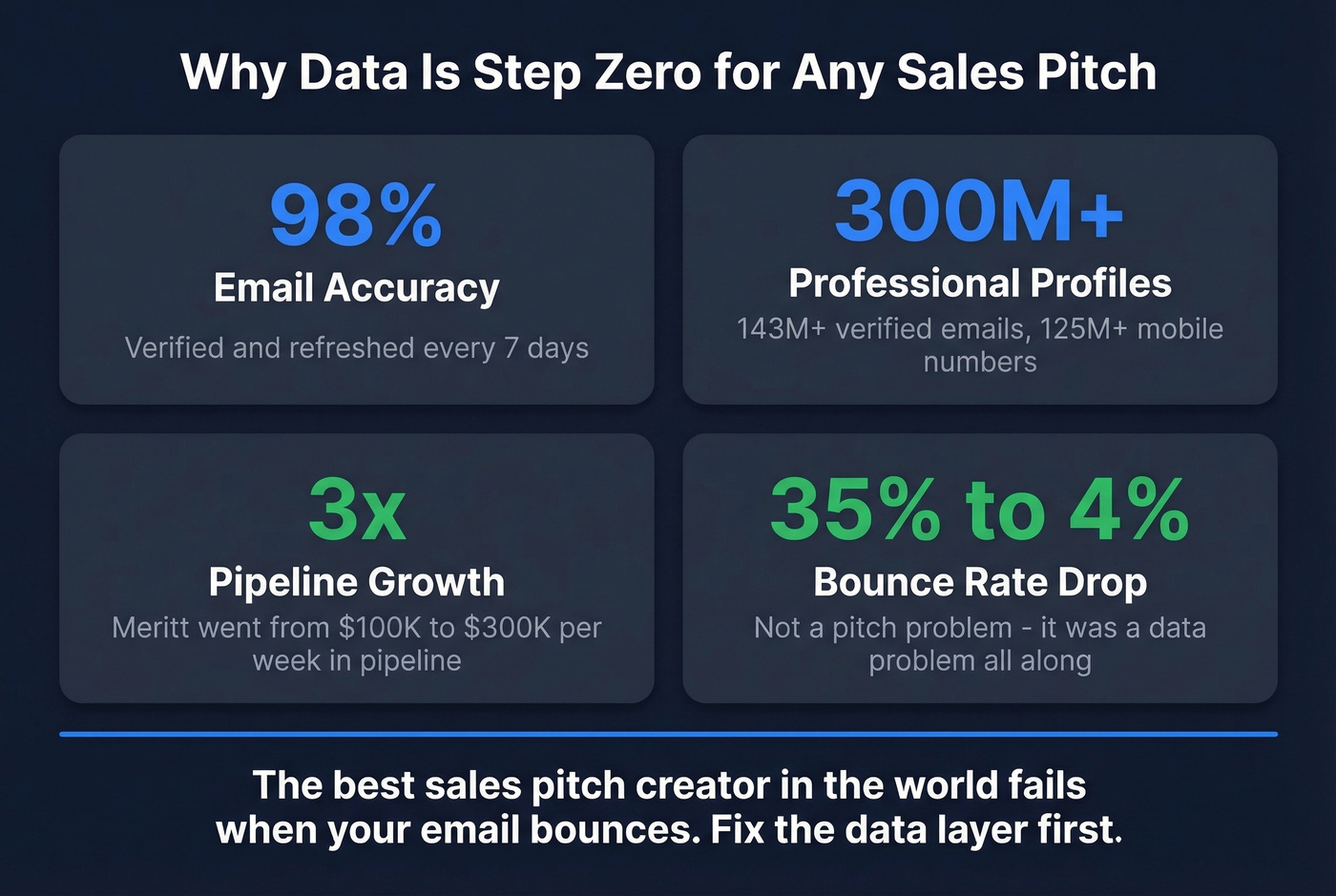
Prospeo is Step Zero. It's not a pitch writer or a deck builder. It's the data layer that makes every other tool on this list actually work. The platform covers 300M+ professional profiles with 98% email accuracy, 143M+ verified emails, and 125M+ verified mobile numbers that hit a 30% pickup rate. Data refreshes every 7 days, which matters when you're pitching decision-makers who change roles frequently.
The Chrome extension (40,000+ users) pulls verified emails, job titles, and company data from professional profiles, company websites, and CRMs in one click. At roughly $0.01 per email, it's a fraction of what you'd pay for enterprise data providers - and the accuracy is higher. The free tier gives you 75 emails + 100 Chrome extension credits per month, enough to test the workflow before committing.
We've seen teams triple their pipeline just by fixing their data layer. Meritt went from $100K to $300K/week in pipeline after switching, with bounce rates dropping from 35% to under 4%. That's not a pitch problem - that's a data problem that was masquerading as one.
If you’re actively managing deliverability, it’s also worth tracking your email bounce rate so you can spot list issues before they tank campaigns.
Skip this if: you already have a clean, verified prospect list and just need help with the writing.
ChatGPT / Claude
ChatGPT with a structured prompt outperformed every dedicated pitch generator we tried. One Reddit user tested 14 different sales pitch tools and hit the same wall - overused phrases, obvious templates, poor persona adaptation. Their solution? Go back to ChatGPT with better prompts. After 47 iterations, they landed on a prompt structure that beat every dedicated tool.
ChatGPT Plus at $20/month beats most dedicated pitch generators because you control the system prompt, the framework, and the data inputs. OpenAI publishes an official sales prompt pack covering cold outreach, objection rebuttals, and battlecards. Claude is equally strong for longer-form pitches and tends to produce less "AI-sounding" prose out of the box. The prompt templates below work with either.
If you want more tool options in this category, see our roundup of AI for sales emails.
Skip this if: you need visual pitch decks, not text. LLMs write words, not slides.
Gamma
We've built dozens of decks in Gamma, and the in-browser experience is genuinely flawless. You describe your pitch, pick a style, and get a presentation-ready deck in 2-3 minutes. With 70M users and a $2.1B valuation, it's one of the biggest AI deck tools for a reason - Tome raised $81M for a similar product and shut down its presentation tool entirely.
If decks are a core part of your motion, you’ll get more mileage by pairing this with strong sales deck storytelling so the slides support the pitch instead of replacing it.
Pricing starts at $8/month, and the free tier is generous enough to test with real prospects. The main caveat: PowerPoint exports need cleanup. Fonts shift, layouts break, aspect ratios get weird. If you're presenting through Gamma's native player, everything looks sharp. If your prospect demands a .pptx file, budget 10-15 minutes for manual fixes.
Skip this if: your company mandates PowerPoint templates with strict brand guidelines.
Lindy
The most ambitious multi-channel pitch tool on this list. Lindy generates pitches across email, phone scripts, and presentations, then exports to PowerPoint, Google Slides, or PDF. It positions itself as an AI agent builder - describe what you want, connect your apps, and let it run.
Lindy claims an 80% boost in sales productivity and can save 5-10 hours per week by reducing pitch writing from hours to minutes. Hundreds of integrations, too. But the pricing gives me pause: Plus runs $49.99/month, Pro is $59.99/month. That's steep when ChatGPT handles the text portion for $20. Reddit threads also flag non-refundable plans and limited human support. Unless you specifically need the multi-channel automation, the value math doesn't add up.
Beautiful.ai
If your prospect expects a polished .pptx file, Beautiful.ai is the safer bet over Gamma. The design automation is strong - slides snap into clean layouts automatically, and exports hold up better when opened in PowerPoint. Pro runs $12/month on annual billing. There's also a single-presentation option at $45 for one-off needs. The trade-off: team pricing jumps to $40/user/month, and AI generation capabilities are narrower than Gamma's. Beautiful.ai is a design tool that happens to have AI, not an AI tool that happens to design.
Pitch.com
Most pitch tools stop caring about your deck the moment you export it. Pitch.com keeps going. Its analytics track when someone opens a deck and which slides they actually read - so you know what resonated and what got skipped. Pricing runs Free-$29/month. AI generation is less polished than Gamma's, but if you want to know what happens after you send the deck, nothing else comes close.
Typli.ai
Budget text pitch generator at $29/month. Rated 4.5/5 on SoftwareAdvice across 28 reviews. Output quality is serviceable for first drafts, but you'll rewrite heavily. Think of it as a starting-point machine, not a finished-product machine.
Canva
Free to $15/month. Canva's AI pitch features exist but they're basic - more template-filling than intelligent generation. If your team already uses Canva for design work, the pitch templates are a convenient add-on. Don't switch to Canva specifically for pitches.
Plus AI
Google Slides add-on starting at $10/month. If your team lives in Google Workspace and refuses to leave, Plus AI is the path of least resistance. Generation quality is mid-tier, but the native Slides integration means zero learning curve.
Venngage
Free tier available. Venngage's pitch generator focuses on visual templates and infographic-style pitches - useful when your pitch needs to be a one-pager or a leave-behind PDF rather than a slide deck.
Honorable Mention: Video Pitches
Vidyard and Loom deserve a nod here. Video pitches are increasingly common for mid-funnel follow-ups. Both tools let you record personalized video messages with screen sharing. They aren't AI pitch generators in the traditional sense, but if you're only sending text and slides, you're leaving a channel on the table. (If you want a tighter playbook for this channel, see Loom video cold email.)

The best sales pitch creator in the world won't save you if your email bounces. Prospeo delivers 98% email accuracy across 300M+ profiles - refreshed every 7 days so you're always pitching current decision-makers, not ghost inboxes.
Fix your data layer first. The pitch writes itself after that.
Pricing Comparison
| Tool | Starting Price | Free Tier | Best For |
|---|---|---|---|
| Prospeo | ~$0.01/email | Yes (75 emails + 100 extension credits/mo) | Verified prospect data |
| ChatGPT Plus | $20/mo | Yes (limited) | Text pitch writing |
| Gamma | $8/mo | Yes | AI pitch decks |
| Lindy | $49.99/mo | 7-day trial | Multi-channel pitches |
| Beautiful.ai | $12/mo (annual) | No | Design-forward decks |
| Pitch.com | Free-$29/mo | Yes | Post-send analytics |
| Typli.ai | $29/mo | No | Budget text pitches |
| Canva | Free-$15/mo | Yes | Familiar UI, basic AI |
| Plus AI | $10/mo | No | Google Slides users |
| Venngage | Free-$30/mo | Yes | Visual templates |
How to Avoid Sounding Like AI
The consensus on r/sales and r/AIWritingHub is clear: dedicated pitch generators produce the same robotic output because they're all built on the same LLMs with the same generic system prompts. The difference is what you feed them.
Start with a forbidden word list. Ban "game-changing," "innovative," "synergy," and "streamline" from every prompt. These words are AI fingerprints, and your prospect's spam filter - both mental and literal - catches them instantly.
Ground your prompts in real conversation data. Mine Reddit AMAs in your prospect's industry, read customer support transcripts, pull quotes from earnings calls. Feed that language into your prompt as context. The AI mirrors what you give it - give it corporate fluff and you get corporate fluff back.
Apply the 17-word test: can you explain your core offer in 17 words or fewer? If not, the AI can't either. And here's a weird one from that 47-iteration Reddit experiment - leaving one minor, intentional typo in your pitch actually improved response rates. Humans don't write perfectly. Robots do.
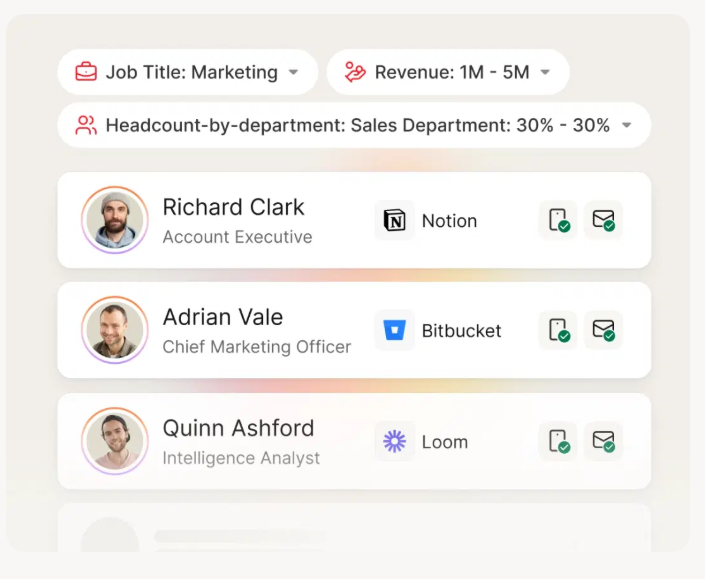
The data backs this up: pitches referencing exact tools or events from a prospect's profile got 3x the reply rate of generic versions. That means personalization isn't a nice-to-have - it's the single biggest factor in whether you get a reply or get archived. Pulling verified job titles, company size, and tech stack from your data provider turns "Dear Decision Maker" into "Hey Sarah, I noticed your engineering team grew 40% last quarter." That specificity is what separates a pitch that converts from one that doesn't exist.
If you’re scaling outbound, make sure your personalization is paired with safe sending practices from our email deliverability guide.
Copy-Paste Prompt Templates
These three prompts work in ChatGPT, Claude, or any LLM. Swap the bracketed fields with real prospect data from your CRM or data provider and iterate from there. OpenAI's official sales prompt pack has additional templates worth bookmarking.
Prompt 1: Cold Email Pitch (PAS Framework)
You are a 30-year sales veteran specializing in [industry]. Write a cold email pitch under 125 words at a grade-5 reading level. Use the "noticed-impact-question" framework:
- Open with something specific you noticed about [prospect name]'s company: [insert detail]
- Connect it to a measurable impact your product delivers: [insert stat/case study]
- End with one curiosity-driven question (not a meeting request)

Forbidden words: game-changing, revolutionize, leverage, synergy, innovative, cutting-edge, solution.

Tone: conversational, like a peer texting a colleague. No formal greetings.
Prompt 2: Objection Rebuttal
I sell [product] to [persona] at [company type]. The most common objection I hear is: "[paste exact objection]." Write 3 rebuttal variations under 75 words each. Each must: acknowledge the concern without apologizing, reframe with a specific data point, and end with a question that moves the conversation forward. No bullet points - write as natural speech.
Prompt 3: 5-Touch Sequence Design
Design a 5-touch outbound sequence for [persona] at [company type]. Each touch must have a different goal:
1. Pattern interrupt (earn the open)
2. Value-first (teach something useful)
3. Social proof (name a relevant case study or stat)
4. Objection handling (preempt their biggest concern: [insert concern])
5. Breakup (create urgency without desperation)
Keep each touch under 100 words. Vary the format: email, voicemail script, email, email, email. Include subject lines.
Mistakes That Kill Your Pitch
Apologizing at the start. "Sorry to bother you" or "I know you're busy" signals you don't believe your own message is worth reading. Cut it.
Reading from the screen. If you're presenting live and reading your slides word-for-word, you've lost the room. Slides are scaffolding, not a script.
Data-dumping. Fifteen stats in three paragraphs overwhelms the prospect. Pick the one number that matters most and build around it.
Features over benefits. "We have AI-powered analytics" means nothing. "You'll know which deals are stalling before your reps do" means everything.
Sounding desperate. "Just checking in" and "Would love to connect" are the sales equivalent of "please like me." Make an assertion, not a plea. (If you need alternatives, here’s how to say just checking in professionally.)
Sending to unverified emails. Look - your pitch doesn't exist if it bounces. Verify before you send, every single time.
Meritt tripled their pipeline from $100K to $300K/week and cut bounce rates from 35% to under 4%. That wasn't a pitch problem - it was a data problem. Stack Prospeo's verified contacts with your pitch framework for under $50/mo total.
Stop perfecting pitches that land in dead inboxes.
FAQ
What's the best free sales pitch creator?
ChatGPT's free tier paired with a PAS or AIDA prompt framework handles text pitches better than most paid generators. For decks, Gamma's free plan lets you build presentation-ready slides. For the data layer, Prospeo's free tier covers 75 emails/month so your pitches reach verified inboxes.
Can AI write a pitch worth sending?
Yes, but only with a framework and real prospect data. Out-of-the-box generators produce generic output that sounds like every other cold email. Feed PAS structure plus specific personalization details - job title, company news, tech stack - and the output jumps from ignorable to reply-worthy.
What's the best AI tool for pitch decks?
Gamma leads with 70M users, $8/month pricing, and 2-3 minute deck generation. Beautiful.ai wins on cleaner PowerPoint exports. Pitch.com is best when you need post-send analytics to see which slides prospects actually viewed.
How long should a sales pitch be?
Keep email pitches around 125-200 words and decks to 8-12 slides. Shorter and more specific always outperforms longer and generic. If you can't explain your value in 17 words, adding more slides won't save you.
Do I need a dedicated tool or can I just use ChatGPT?
ChatGPT with a strong prompt beats most dedicated pitch tools. Set a framework, enforce strict word limits, and feed in verified prospect data. The prompt templates above are a proven starting point - one Reddit user tested 14 tools and came back to ChatGPT after 47 iterations.