

Sales Process Training: Why 85% Fails and How to Build One That Sticks
Your VP of Sales just approved a $20K budget for sales process training. Three months after the workshop, your team's 22% win rate hasn't moved. Only 17% of companies say their training programs are truly effective, and 85-90% of training has no lasting impact after 120 days.
The money isn't wasted because the content is bad. It's wasted because companies treat training as an event instead of a system.
Here's the thing: before you buy any methodology, you need to map your sales process stages, budget for 60-90 days of reinforcement instead of a one-day workshop, and fix your prospecting data - because the best-trained reps still fail when 35% of their emails bounce.
Sales Process vs. Methodology
Most guides jumble process and methodology into one bucket. That's like confusing the route with the running shoes. Your sales process is the sequence of stages a deal moves through - prospecting, qualification, discovery, demo, proposal, negotiation, close. Your sales methodology is how reps execute within each stage. Process answers "what happens next." Methodology answers "how do we do it well."
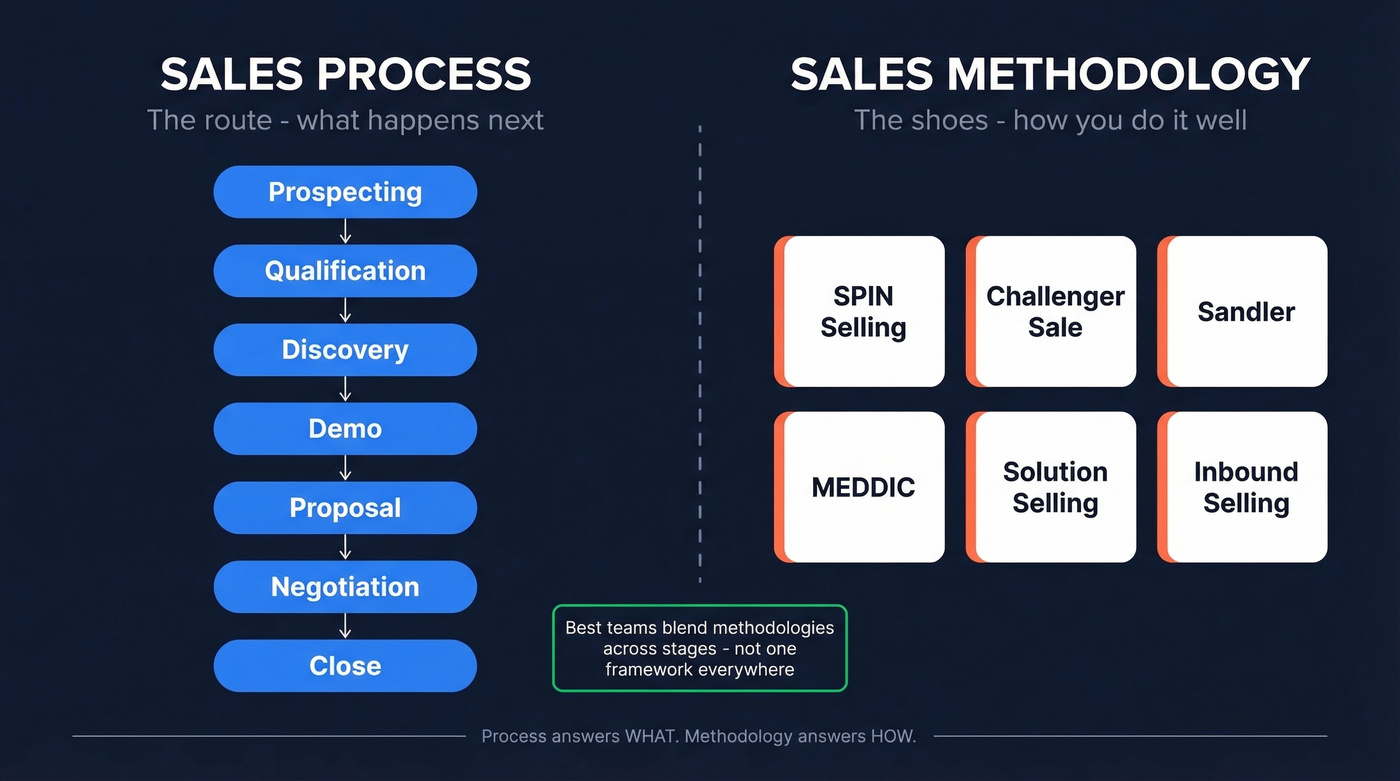
The best teams blend methodologies across stages rather than forcing one framework everywhere. Use MEDDIC for qualification, SPIN for discovery, Challenger for the demo. One widely-cited benchmark from Korn Ferry ties defined methodology adoption to a 15% rise in win rates and a 21% increase in quota attainment - but only when the methodology maps cleanly onto process stages.
| Dimension | Sales Process | Sales Methodology |
|---|---|---|
| Defines | Stages & sequence | Execution approach |
| Example | Prospect → Qualify → Close | SPIN, Challenger, Sandler |
| Changes when | Market or product shifts | Team skill gaps shift |
| Owned by | RevOps / leadership | Enablement / frontline |
The 7 Stages Every Team Needs
Every B2B sales process is a variation on the same skeleton. The details change by industry and deal complexity, but the stages don't.
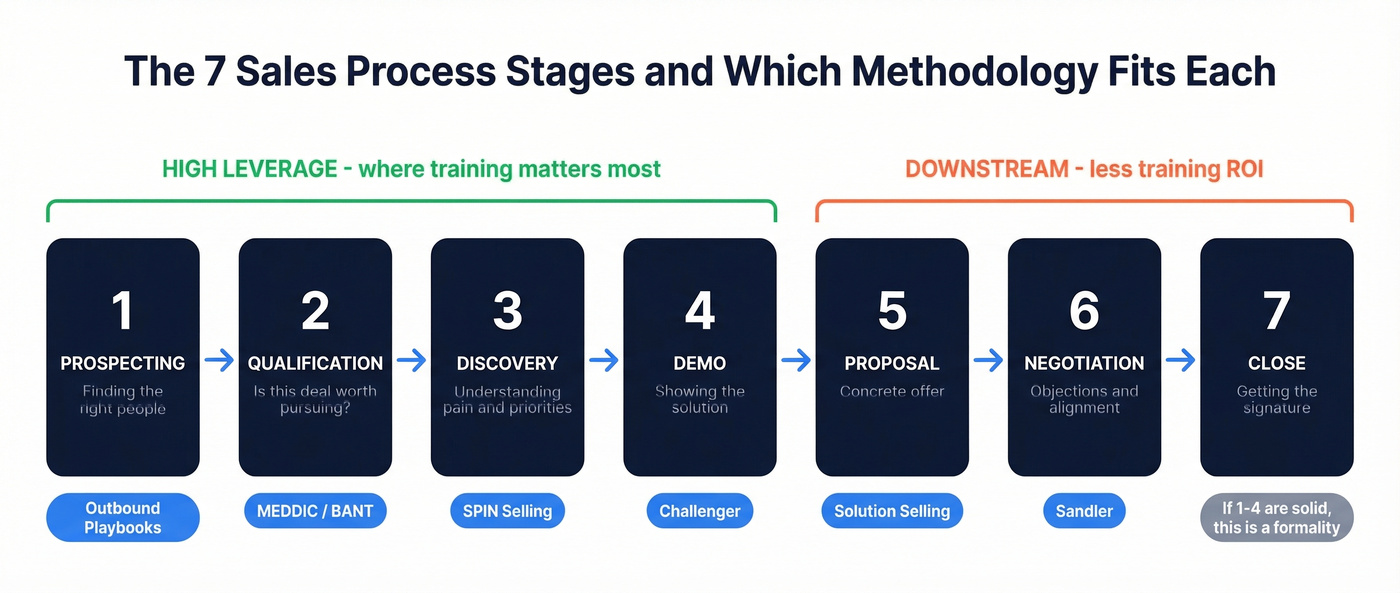
1. Prospecting. Finding and reaching the right people. This is the #1 skill covered in training - 56% of programs prioritize it. Methodology fit: Inbound Selling for marketing-led orgs, structured outbound playbooks for everyone else. (If you need a refresher, start with these sales prospecting techniques.)
2. Qualification. Determining whether a prospect is worth pursuing. MEDDIC and BANT live here. If your reps can't articulate why a deal is qualified beyond "they seemed interested," this stage needs work.
3. Discovery. Understanding the prospect's pain, priorities, and decision process. SPIN Selling dominates - Situation, Problem, Implication, Need-Payoff questions in sequence.
4. Demo / Presentation. Showing how your product solves their specific problem. Challenger's "Teach, Tailor, Take Control" framework shines here, especially for complex enterprise deals.
5. Proposal. Translating the conversation into a concrete offer. Solution Selling works well when packaging around defined pain points.
6. Negotiation. Handling objections, pricing discussions, and stakeholder alignment. Sandler's approach - where the seller controls the process, not the buyer - is effective here.
7. Close. Getting the signature. Stages 5-7 get less training attention because they're downstream of the real leverage points. If stages 1-4 are solid, closing is a formality. If they're not, no closing technique saves you. (For a stage-by-stage breakdown, see these steps to close a sale.)
How to Choose the Right Program
Before you evaluate a single vendor, answer four questions honestly.
What's your deal complexity? A team selling $5K SaaS subscriptions needs a different methodology than one selling $500K enterprise contracts. Sandler works beautifully for transactional-to-mid-complexity B2B. Challenger is built for multi-stakeholder enterprise deals. Picking the wrong one is worse than picking none.
How big is your team? A 5-person startup can run online courses. A 50-person org needs custom workshops with live coaching and a sales enablement platform like Highspot or Seismic to house and deliver content over time.
What's your real budget? Not the aspirational number - the approved one. Training ranges from free (HubSpot Academy) to $75K+ for multi-month enterprise engagements.
72% of sales leaders say training fails because it's one-size-fits-all. If your team is remote-first, don't buy a program that requires three days in a hotel ballroom. And if your team spans a wide range of experience levels, check whether the program offers role-specific tracks - a one-size approach will bore your veterans and overwhelm your new hires.
Sales Methodologies Compared
| Methodology | Research Base | Best For | Deal Complexity | Core Concept |
|---|---|---|---|---|
| SPIN Selling | 35K calls, 12 yrs | Consultative / mid-enterprise | Mid-High | Question sequencing |
| Challenger Sale | CEB, 6,000 reps | Complex enterprise | High | Teach, Tailor, Take Control |
| Sandler | Decades of practitioner use | Full-cycle B2B | Low-Mid | Buyer-seller equality |
| MEDDIC/MEDDPICC | PTC origin story | Enterprise qualification | High | Deal qualification rigor |
| Solution Selling | Bosworth, 1980s | Mid-market, defined pain | Mid | Pain-based packaging |
| Inbound Selling | HubSpot ecosystem | Marketing-led orgs | Low-Mid | Buyer journey alignment |
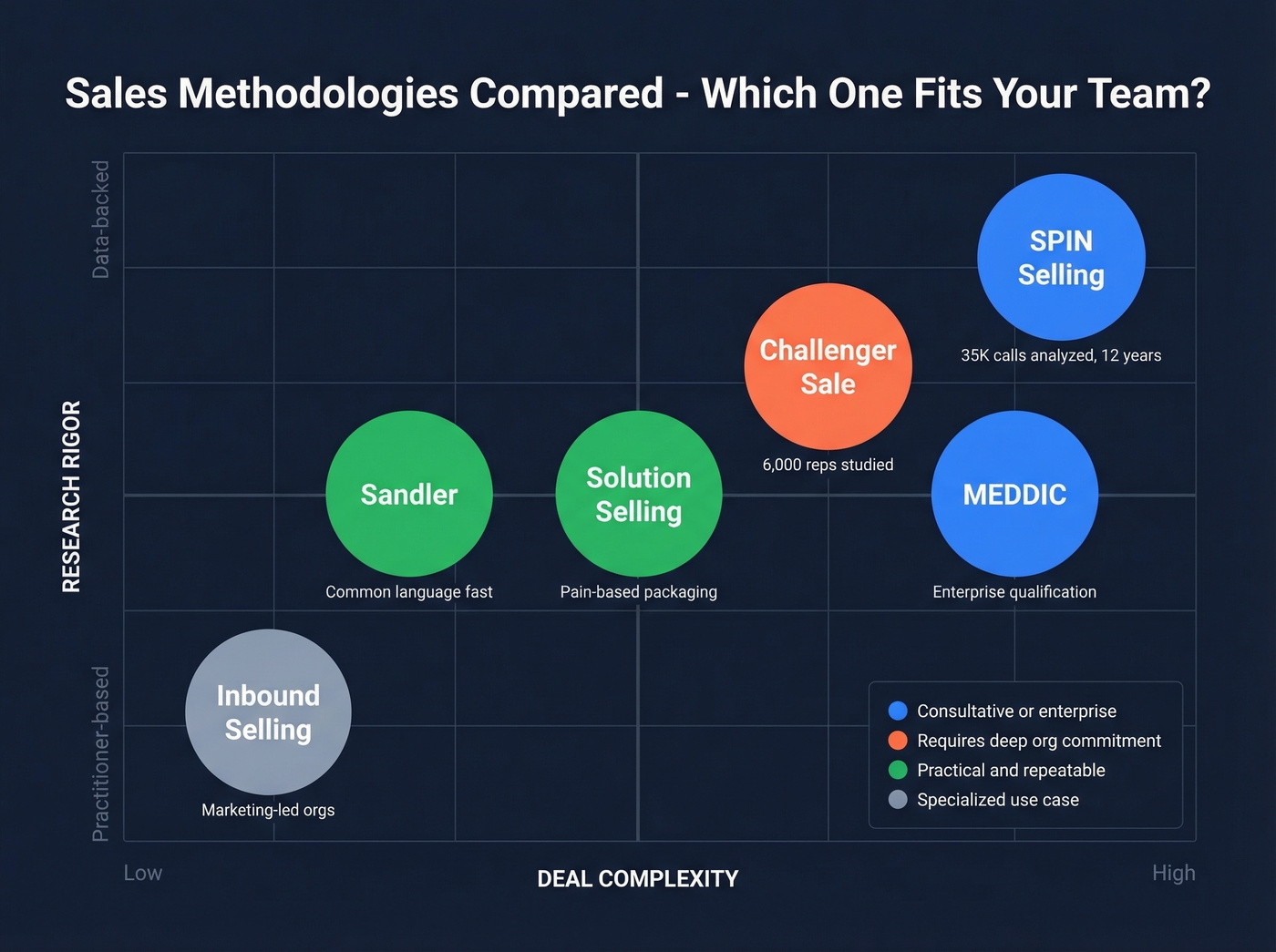
SPIN Selling has the strongest research foundation - 35,000+ sales calls analyzed across 20+ countries over 12 years. We'd recommend it first for teams where discovery quality determines win rates.
Challenger is the enterprise heavyweight. Xerox reported a 17% increase in sales and $65M in contract value after implementing it. That said, it requires deep organizational commitment. The consensus in online sales communities is that Challenger transforms organizations that go all-in but creates confusion in teams that half-deploy it.
Sandler is the most practical for teams that need a common language fast. It's rated 4.2/5 on Gartner Peer Insights, with users praising the repeatable framework and interactive sessions. Delivery quality varies by provider - interview your local Sandler coach before committing.

Your reps just nailed SPIN discovery and Challenger demos - then 35% of their follow-up emails bounce. No methodology survives bad data. Prospeo delivers 98% email accuracy with a 7-day refresh cycle, so every trained rep actually reaches the prospect they qualified.
Stop training reps to sell into a void. Give them emails that land.
Top Training Programs in 2026
The fact that most training providers won't publish pricing tells you everything about their sales process - and it's not the one they're teaching you.
Sandler Training
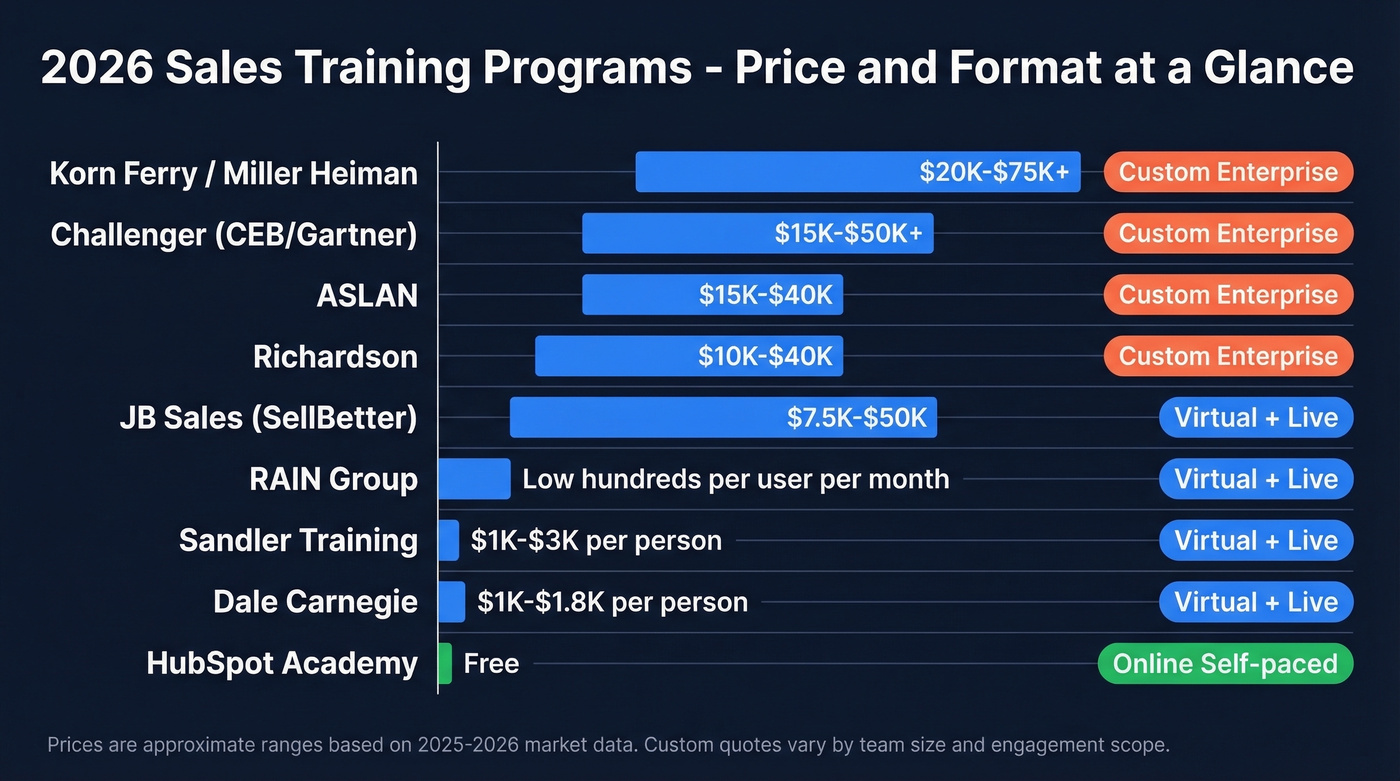
Sandler's strength is creating a shared selling language across your entire org. The weekly reinforcement model - workbooks, videos, ongoing coaching - is exactly what the research says works. Best for teams that'll invest in 6+ months of reinforcement. Gets stretched thin for complex enterprise deals with 8+ stakeholders. $1,000-$3,000 per participant for in-person programs, with subscription options for ongoing content.
Challenger (CEB/Gartner)
This isn't an off-the-shelf program - it's a custom engagement that rewires how your team sells. We've seen it work spectacularly in organizations that commit fully and fall flat in teams that treat it as a workshop. Best fit is complex, multi-stakeholder deals where you can support a real rollout with manager coaching, deal coaching, and reinforcement. $15,000-$50,000+ for team workshops; plan for 3-6 months of implementation.
RAIN Group
A solid option for teams that want structured methodology training without a massive enablement buildout. Online training and virtual programs land in the low-hundreds per user per month range, with custom workshops priced separately. Best for teams of 5-15 reps. Skip this if you need hands-on, customized facilitation - that's not their sweet spot.
JB Sales (SellBetter)
Practical, tactical sales skills - not abstract frameworks. Particularly strong for SDR and AE teams running outbound sequences. Virtual-first, which works well for distributed teams. $7,500 for 15 reps, scaling up to larger workshop and membership packages.
Dale Carnegie
The gold standard for interpersonal skills - but it's a communication training program that happens to be useful for salespeople, not a program built around selling stages. If your reps struggle with confidence or executive presence, excellent. If they need a qualification framework, look elsewhere. $1,000-$1,800 per participant.
Korn Ferry / Miller Heiman
Enterprise-grade programs for organizations selling seven-figure deals with long cycles. Thorough training, heavy implementation, pricing to match. The right choice for large sales orgs with dedicated enablement teams and playbook infrastructure. $20,000-$75,000+ for multi-month engagements.
Richardson
Custom-built training for mid-to-large enterprises. Their Connected Selling approach ties training to specific sales stages and buyer behaviors. $10,000-$40,000 for a workshop series.
HubSpot Academy
Free and solid for inbound fundamentals. A strong starting point for early-stage, marketing-led teams. Won't replace a real methodology program for complex B2B.
ASLAN
"Other-centered selling" - training reps to lead with the buyer's perspective. Works well for teams selling into resistant or skeptical buyers. $15,000-$40,000 for custom enterprise engagements.
| Provider | Price Range | Format |
|---|---|---|
| Sandler | $1K-$3K/person | In-person + virtual |
| Challenger | $15K-$50K+ | Custom workshops |
| RAIN Group | Low-hundreds/user/month + custom | Virtual + live |
| JB Sales | $7.5K-$50K | Virtual + live |
| Dale Carnegie | $1K-$1.8K/person | In-person + virtual |
| Korn Ferry | $20K-$75K+ | Enterprise engagements |
| Richardson | $10K-$40K | Custom workshops |
| HubSpot Academy | Free | Online self-paced |
| ASLAN | $15K-$40K | Custom enterprise |
Why Training Fails - And the Reinforcement Fix
84% of what's learned in training is forgotten within three months without reinforcement. Meanwhile, 55% of leaders say their training is effective but delivers limited results - a polite way of saying it didn't move the needle. That's not a training quality problem. It's a design problem.
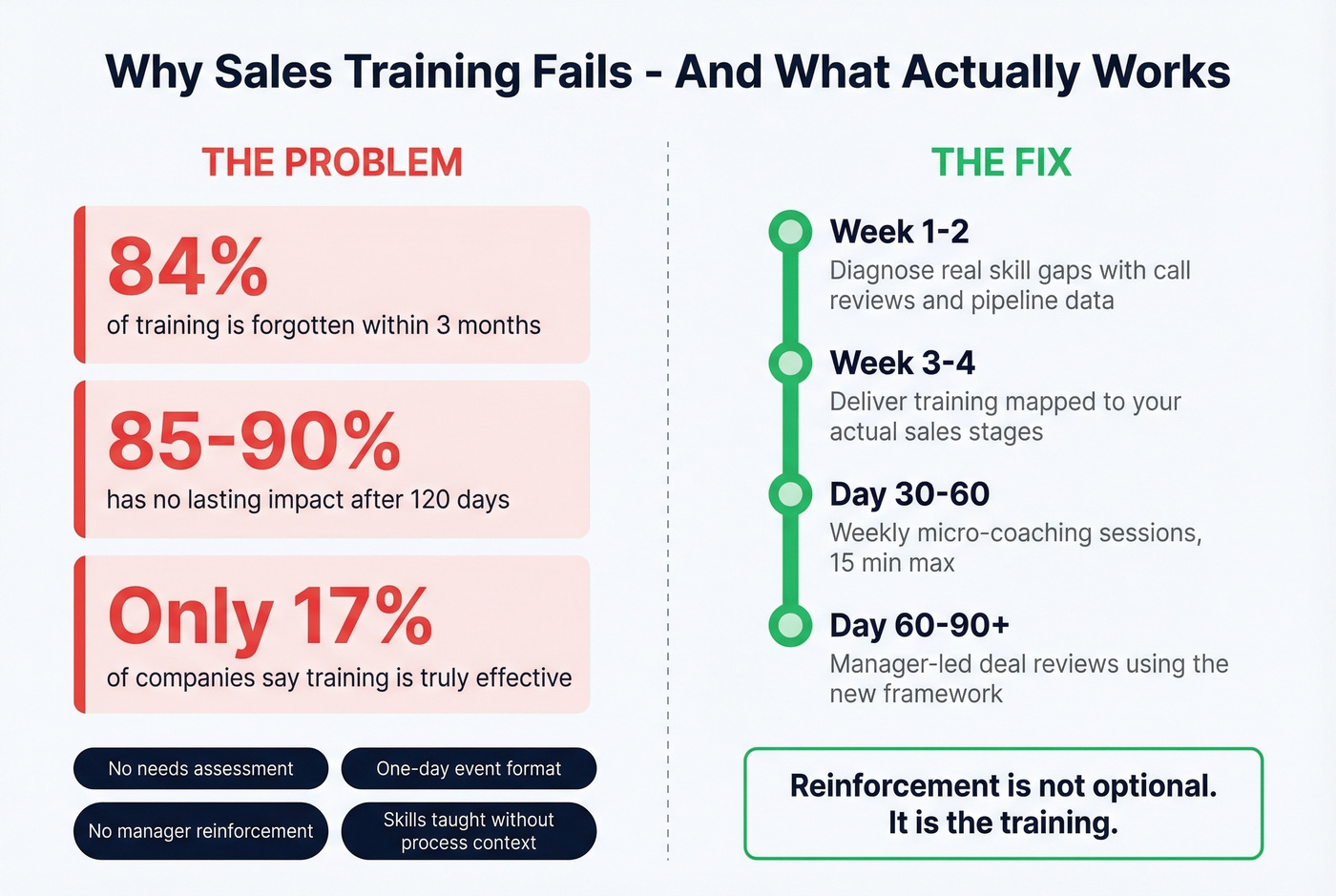
Stop buying more training. Start building a reinforcement system.
The failure taxonomy, drawn from RAIN Group's analysis and what we've seen across dozens of implementations:
- No needs assessment. Training is bought based on vendor marketing, not diagnosed gaps.
- Skills-only focus. Programs teach techniques but ignore the process and knowledge required to apply them.
- One-and-done delivery. A two-day workshop with no follow-up is an expensive team-building event.
- No manager involvement. Managers should coach within 48 hours of training. Most never do.
- Generic content. 72% of leaders say training fails because it doesn't account for role differences.
- Outdated material. 62% cite outdated content as the biggest barrier to effectiveness.
- No measurement. If you can't measure behavior change, you can't reinforce it.
The fix is a 60-90 day reinforcement window. Weekly micro-coaching sessions. Role-play practice tied to real deals in your pipeline. Manager ride-alongs with structured feedback. One organization that redesigned their program around reinforcement saw average deal size increase 28% and sales cycles shorten by 15 days within 90 days.
Even perfectly reinforced prospecting training fails if reps are working with data that bounces at 35%+. Your methodology can be flawless, but if the emails don't land, the training never gets a chance to work. (Start by tracking your email bounce rate and fixing the root cause.)
Measuring Training ROI
Most organizations measure training with a post-workshop survey. That tells you almost nothing.
The Kirkpatrick framework has four levels: Reaction (did they like it?), Learning (did they retain it?), Behavior (did they change how they sell?), and Results (did revenue move?). Most orgs stop at Levels 1-2. The Phillips ROI Model adds a fifth level that converts results into dollar value - which is what your CFO actually cares about. Only 33% of sales leaders use assessments to measure training ROI. Two-thirds are flying blind.
| Lead Indicators | Lag Indicators |
|---|---|
| Course completion rates | Conversion rates by stage |
| Knowledge quiz scores | Deal velocity (days) |
| Role-play evaluation scores | Pipeline quality ($ per opp) |
| CRM activity volume | Revenue per rep |
| Manager coaching frequency | Win rate change |
Track lead indicators weekly during the 60-90 day reinforcement window. Lag indicators need 90-180 days to show meaningful movement. Modern platforms using xAPI and learning record stores can track granular behavioral data beyond simple completions - for example, correlating specific training module completion with stage-by-stage conversion improvements.
But don't let tooling complexity delay measurement. A spreadsheet tracking five lead indicators beats a sophisticated LMS that nobody configures. (If you want benchmarks, start with sales conversion rate and pipeline health.)
AI, Tools, and Data Quality
AI-Powered Role-Play
Role-play has always been the highest-impact training activity. Sellers who practice through role-play before live calls see 20-45% higher win rates. The problem was always logistics - scheduling, awkwardness, inconsistent feedback.
AI removes that barrier. 43% of revenue enablement leaders now use AI-powered role-play tools. Platforms like Allego, Mindtickle, and Gong offer AI simulations that provide instant, consistent feedback at scale. A rep can practice a discovery call at 10pm on a Tuesday and get scored feedback before morning. That's the reinforcement infrastructure that makes the 60-90 day window actually work.
The Data Quality Problem
Let's be honest: if your average deal size is under $15K, you probably don't need a $50K training program. But every team, regardless of contract value, needs clean prospecting data.
Picture this. Your new SDR finished onboarding two weeks ago. She memorized the SPIN framework, passed the quiz, and started prospecting. Her first 200 emails bounced at 38%. The training worked - the data didn't.
56% of training programs cover prospecting as the #1 skill, but almost none address the data infrastructure that makes prospecting possible. In our experience, this is the single biggest blind spot in sales enablement. Tools like Prospeo close that gap with 98% email accuracy and a 7-day data refresh cycle, so newly trained reps start prospecting with data that actually works. GreyScout cut rep ramp time from 8-10 weeks to 4 weeks directly because new reps weren't wasting their first month fighting bad contact data. (If you're evaluating vendors, compare options in our guide to data enrichment services.)
When your prospecting data is clean, training compounds instead of evaporating.
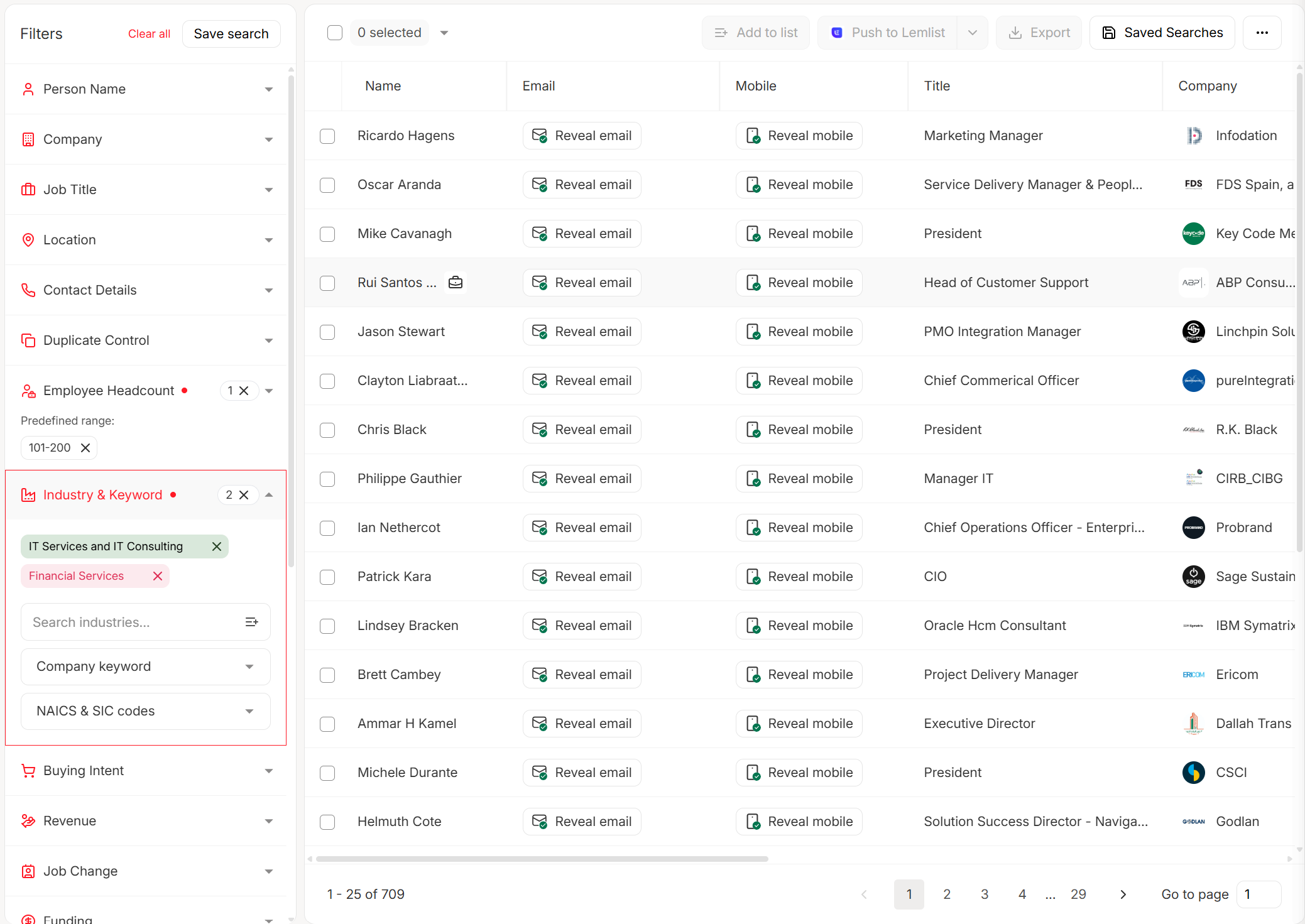
Stage 1 of every sales process is prospecting - and 56% of training programs prioritize it. But no workshop teaches reps to manufacture verified contact data. Prospeo's 300M+ profiles with 30+ filters let trained reps skip list-building and spend those 4-6 hours actually selling.
Cut prospecting from hours to minutes so training actually converts to pipeline.
FAQ
What's the difference between process training and skills training?
Process training teaches the stages a deal moves through and the methodology for each stage. Skills training sharpens specific capabilities like objection handling or negotiation. Process training should come first - it gives reps the map. Skills training fills in execution gaps once the framework is in place.
How long does training take to show results?
Expect 60-90 days with consistent reinforcement before lag indicators move. Without reinforcement, 84% of content is forgotten within three months. Lead indicators like role-play scores and CRM activity should improve in 2-4 weeks; revenue impact needs a full quarter.
What's the best free program to start with?
HubSpot Academy for inbound fundamentals and Coursera for methodology overviews from business schools. Neither replaces a paid program for complex B2B, but they're strong foundations for teams under 10 reps with limited budgets.
How do I know if my team needs better methodology or better data?
Look at where deals stall. If win rates drop after discovery calls, it's methodology - reps aren't uncovering real pain. If emails bounce above 10% and calls don't connect, it's data. Fix the data side first since it takes days, not months, and then you can isolate whether the real gap is execution or infrastructure.
Can small teams afford quality training?
Yes. RAIN Group offers online options in the low-hundreds per user per month range. JB Sales runs $7,500 for 15 reps. HubSpot Academy is free. You don't need a $50K enterprise engagement - you need the right methodology for your deal complexity and a 60-90 day reinforcement plan.