

Your Sales Reps Don't Need a Pep Talk. They Need These 6 Systems.
52% of sales leaders rate their team's engagement as "very low." Only 21% of B2B reps are fully engaged. Meanwhile, 70% of sales staff say burnout - not laziness - stands between them and high performance.
Those numbers aren't a motivation problem. They're a systems problem. Pep talks and pizza parties don't fix broken infrastructure.
The Quick Version
- Replace pipeline inspection with pipeline coaching. Reviewing numbers isn't coaching. Changing behaviors is. (If you need a structure, use a pipeline review template.)
- Audit your data quality. Reps dialing dead numbers lose confidence before the first call. Prospeo verifies emails at 98% accuracy and refreshes every 7 days - it's the fastest morale fix most teams overlook. If you're troubleshooting bounces, start with a bounce checker.
- Remove commission caps. If your best reps hit a ceiling, they'll coast or leave. Benchmarks help - see the average SaaS commission rate.
Motivation is a system, not a speech.
Why Most Motivation Tactics Fail
Most sales motivation advice treats symptoms. A rep's numbers dip, so you run a contest. Energy drops, so you bring in a speaker. Band-aids on structural wounds. (More on this systems-first approach: motivation for sales.)
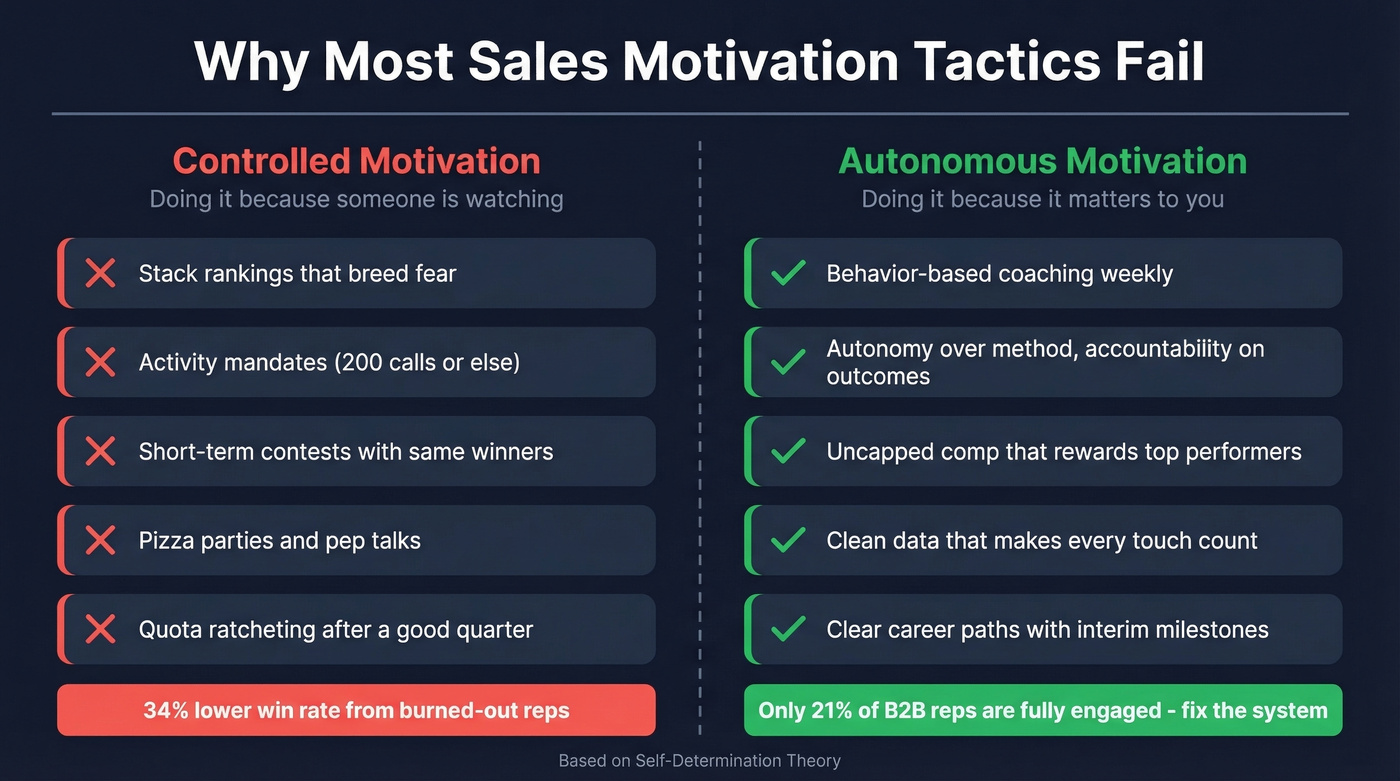
Self-Determination Theory - one of the most validated frameworks in motivation psychology - draws a hard line between autonomous motivation (doing something because it matters to you) and controlled motivation (doing something because someone's watching). Contests, stack rankings, and activity mandates all fall into the controlled bucket. They work for a week. Then they don't. That's not a character flaw; it's what happens when extrinsic drivers do all the heavy lifting. Understanding how to motivate sales reps starts with recognizing this distinction.
The downstream cost is measurable. Burned-out reps show a 34% lower win rate and spend 21% more time on non-revenue tasks. You're not just losing energy - you're losing pipeline.

Bad data kills rep motivation before any coaching framework can save it. When 35% of emails bounce, confidence craters and burnout spikes. Prospeo delivers 98% email accuracy with a 7-day refresh cycle - so every dial and every send feels worth making.
Stop bleeding morale to bounced emails. Start with data reps actually trust.
6 Systems That Actually Drive Rep Performance
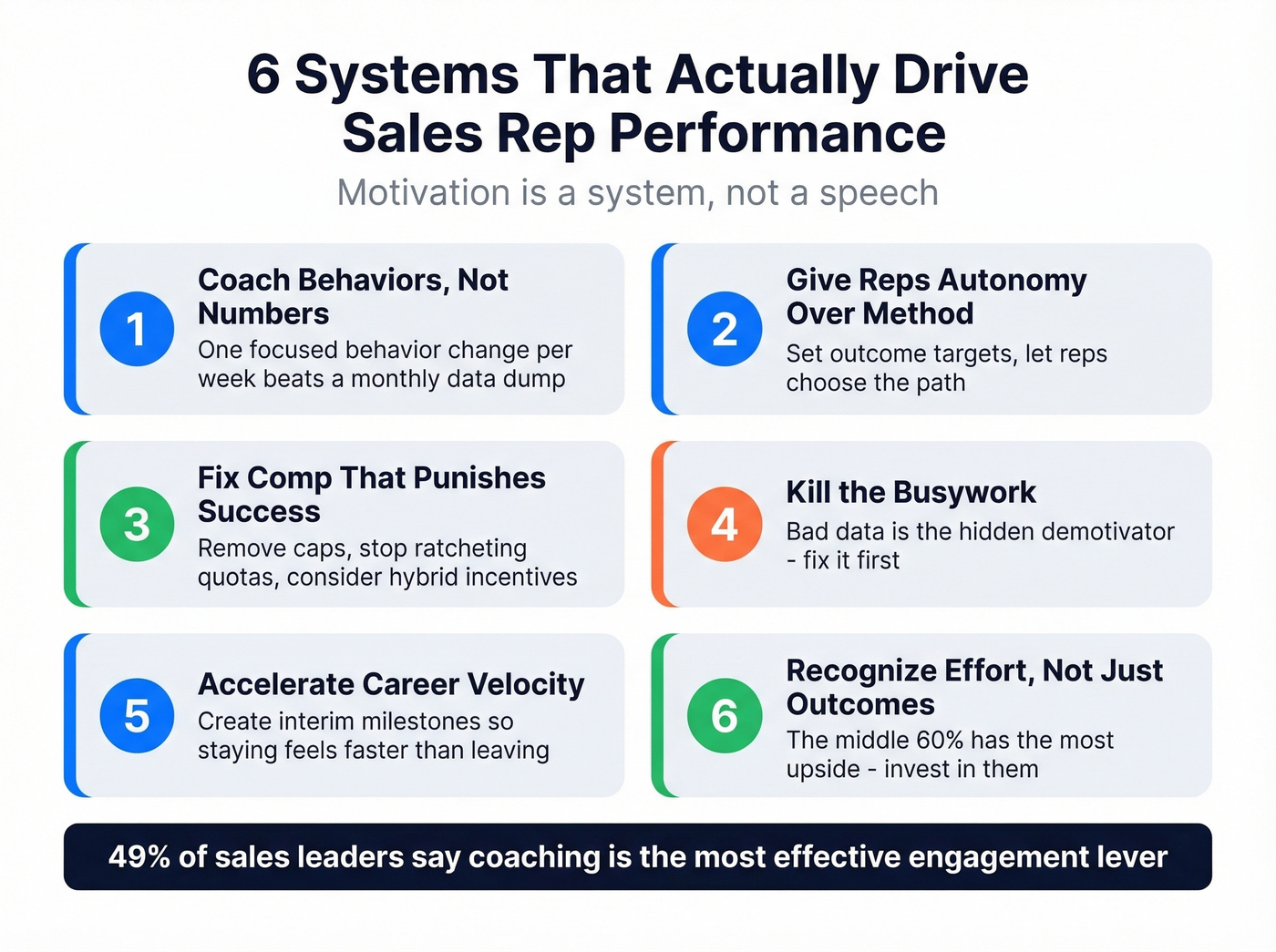
1. Coach Behaviors, Not Numbers
Use this if: Your managers spend 1:1s reviewing dashboards and asking "when's this closing?" (This is a common gap in sales leadership.)
Skip this if: Your managers already diagnose funnel-stage failures and assign specific skill work each week.
I've watched managers spend entire 1:1s staring at pipeline dashboards and calling it coaching. It's not. When a deal's stuck mid-funnel, the question isn't "what's the next step?" - it's "have you multi-threaded into the economic buyer, or are you single-threaded into a champion who can't sign?" 49% of sales leaders say coaching is the most effective engagement lever. One focused behavior change per week beats a monthly data dump every time. (If you want a tactical framework, see how to coach salespeople.)
2. Give Reps Autonomy Over Method
Activity metrics without outcome accountability are theater. Two hundred cold calls that produce zero meetings isn't hustle - it's waste. If you're unsure what to track, use these sales activity metrics.
SDT's autonomy pillar is simple: people perform better when they control how they work, even if the what is non-negotiable. Set outcome targets. Let reps choose the path. The rep who books 15 meetings from 40 thoughtful touches is more valuable than the one who dials 200 numbers and books 3.
3. Fix Comp That Punishes Success
Commission caps and quota ratcheting are the two fastest ways to kill top-performer drive. Caps tell your best reps to stop selling. Ratcheting tells them that crushing quota this quarter just means a harder number next quarter - so why bother?
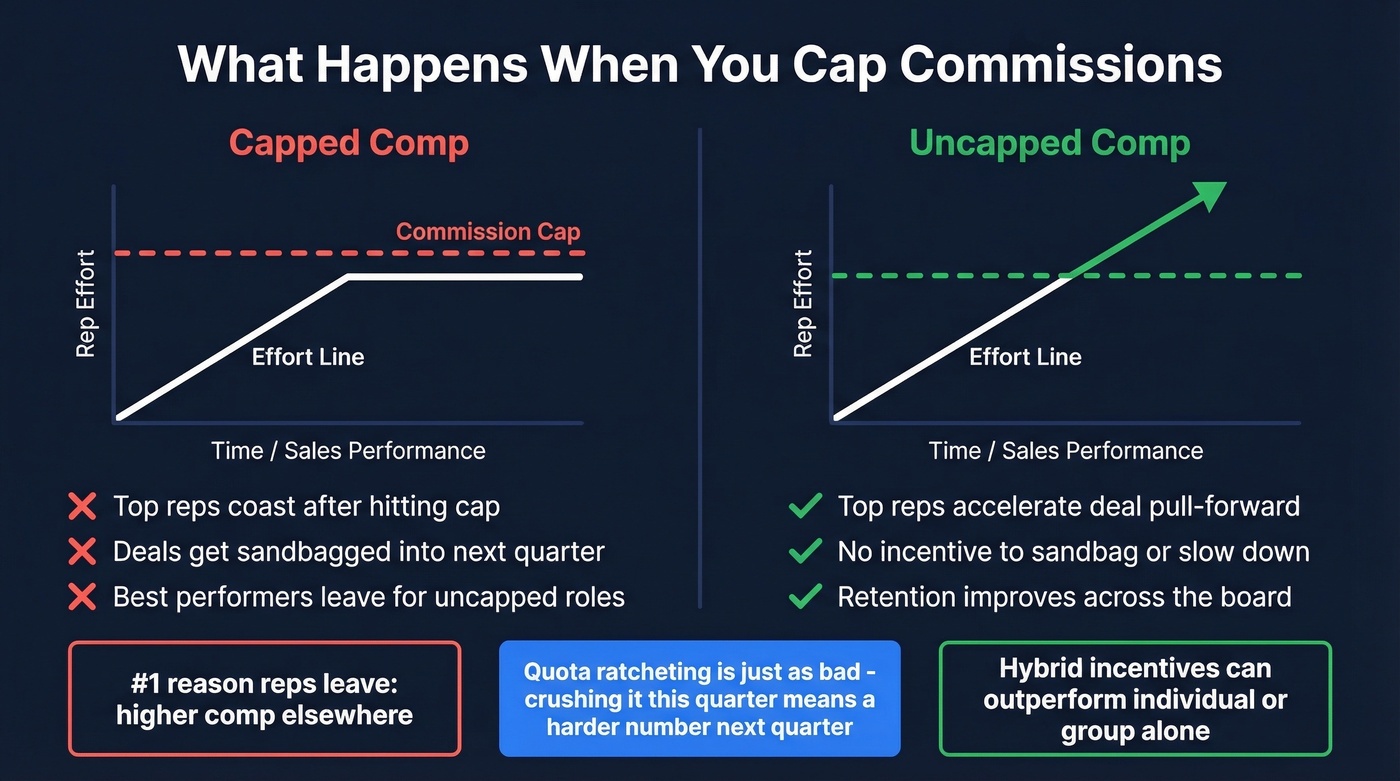
HBR's research on compensation design found managers spend disproportionate time handling pay complaints - a signal that comp structure, not individual willpower, is the root issue. Research from the Journal of Marketing adds nuance: weaker brands often benefit more from group incentives, while stronger brands tend to see better results from individual ones. A hybrid can beat either alone in some cases. Most teams default to individual without thinking about this at all. And the #1 reason reps leave? Higher compensation elsewhere. Remove caps. Watch your best people accelerate deal pull-forward instead of sandbagging into next quarter. (For incentive math and structures, see how to incentivize sales reps.)
4. Kill the Busywork
Larger tech stacks and heavier automation can create unexpected stress and disengagement - the opposite of what they're supposed to do. (This is where CRM productivity often breaks down.)
Here's the thing: the hidden demotivator most managers miss is bad prospect data. When reps dial disconnected numbers and watch emails bounce, they lose momentum before the day starts. We've seen this across dozens of outbound teams - confidence erodes call by call. Keeping reps engaged is nearly impossible when their tools feed them garbage.
GreyScout switched to Prospeo and dropped their bounce rate from 38% to under 4%. Rep ramp time fell from 8-10 weeks to 4 weeks. When every email lands and every phone number is live, reps stop dreading outreach and start booking meetings. (If you're trying to cut ramp time, use this framework to ramp sales reps faster.)

5. Accelerate Career Velocity
The industry average for a promotion in sales is three years. For a hungry SDR, that feels like a lifetime. (Map the path explicitly with SDR job progression.)
It's why so many reps job-hop for title bumps instead of growing internally. Create interim milestones: territory upgrades, scope expansions, mentorship roles. Make "stay and grow" feel faster than "leave and restart." Clear growth paths sustain engagement far longer than any quarterly contest ever will.
6. Recognize Effort, Not Just Outcomes
Team motivation is collective energy - when one rep mentors a struggling teammate or writes a sequence that outperforms the template, that energy lifts the whole floor. Call out those moments publicly. Outcomes matter, but effort-based recognition builds the culture that sustains outcomes over time.
Let's be honest about something most sales leaders get wrong: they over-invest in motivating top performers and under-invest in the middle 60%. That middle tier has the most upside. If your contest prize goes to the same rep every month, you're actively demoralizing the people who could move the needle most. That's where the real revenue growth hides.
What Not to Do
- Assume everyone works like you did. Your path isn't their path. Build structure instead of projecting your style.
- Overvalue activity without outcomes. Three hundred dials producing 2 meetings? The problem is targeting, messaging, or data quality - not effort.
- Delay necessary firings. Coaching has a shelf life. If a rep isn't improving after focused intervention, keeping them hurts the team's energy.
- Let negativity spread unchecked. One vocal cynic poisons a floor faster than any bad quarter.
The Monday Playbook for a Struggling Rep
When a rep's in a slump, don't start with a motivational speech. Start with a diagnostic. (If you want a deeper diagnostic, see how to get out of a sales slump.)
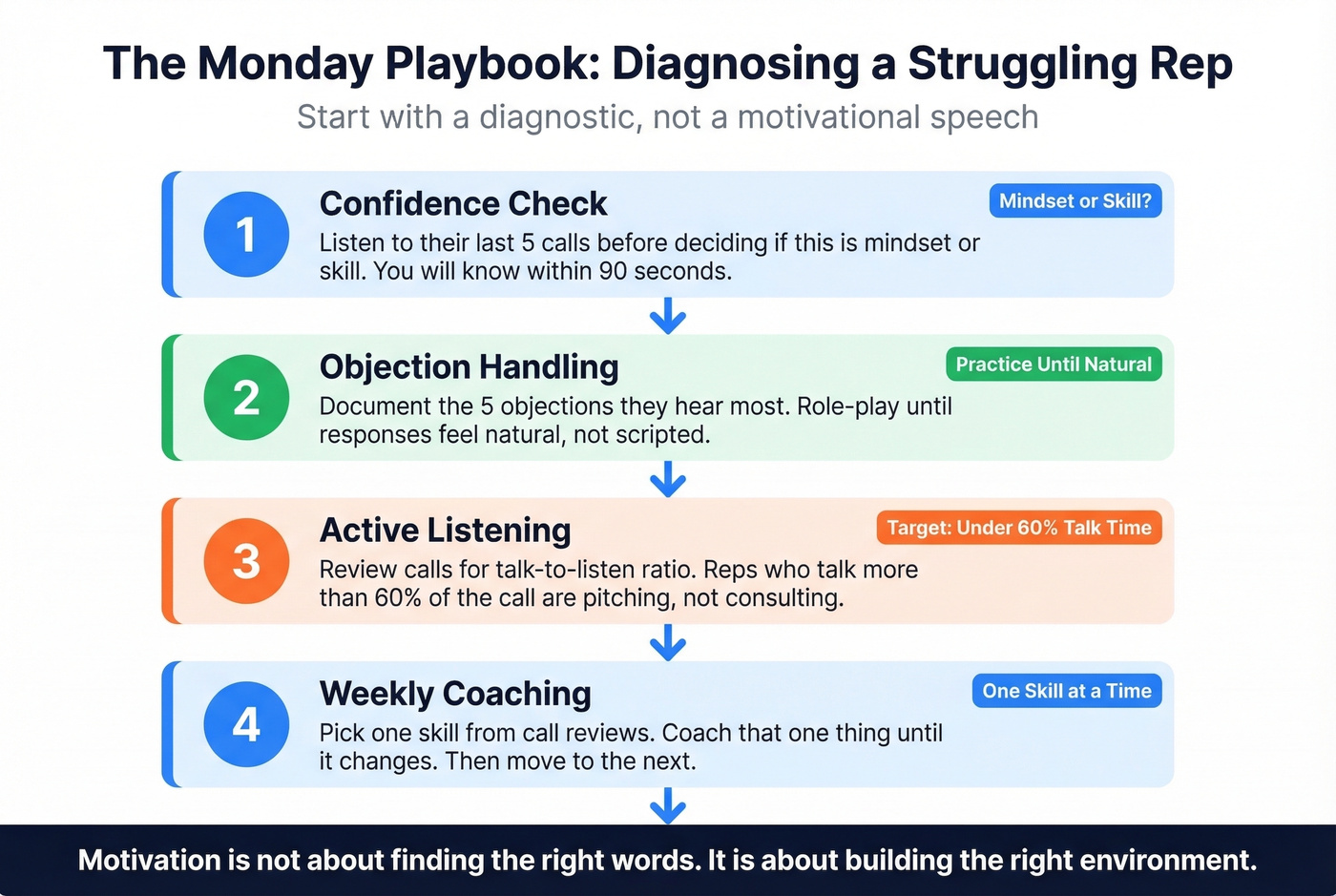
Confidence check. Listen to their last 5 calls before deciding if this is mindset or skill. You'll know within 90 seconds which one it is.
Objection handling. Document the 5 objections they hear most. Role-play until responses feel natural - not scripted, natural.
Active listening. Review calls for talk-to-listen ratio. Are they consulting or pitching? Reps who talk more than 60% of the call are almost always pitching, and it shows in their close rates.
Weekly coaching. Pick one skill from call reviews. Coach that one thing until it changes. Then move to the next.
Sales rep motivation isn't about finding the right words. It's about building the right environment - accurate data, fair comp, real coaching, and a career worth staying for.
GreyScout cut rep ramp time from 10 weeks to 4 and dropped bounce rates from 38% to under 4% - just by switching their data source. When reps connect on the first try, motivation takes care of itself. Prospeo gives your team 300M+ verified profiles at $0.01 per email.
The fastest way to motivate reps is to make every touch count.
FAQ
How do you motivate a sales rep who has lost confidence?
Start with a diagnostic, not a pep talk. Give them verified prospect data so calls actually connect, review their best recent calls to rebuild self-belief, and coach one specific skill per week. Confidence returns from stacking small wins - a live phone number, a booked meeting, a handled objection.
Do sales contests actually work long-term?
Rarely. Most contests reward reps who were already winning, which demoralizes the middle 60% with the most upside. If you run one, match incentive design to your brand strength: weaker brands often get more lift from group incentives, while stronger brands do better with individual rewards.
What's the biggest hidden demotivator for reps?
Bad prospect data. When reps dial disconnected numbers and send emails that bounce, they lose momentum and start doubting their lists, their process, and themselves. We've seen teams cut bounce rates from 35%+ to under 4% just by switching to a verified data source with a weekly refresh cycle - and rep confidence rebounds almost immediately.
How often should managers coach their reps?
Weekly minimum - but coach behaviors, not numbers. Pipeline inspection isn't coaching. Identify the specific skill causing a funnel-stage failure and work on that one thing until it changes. 49% of sales leaders say coaching is the single most effective engagement lever.