

How to Build a Sales Routine That Actually Moves Pipeline
It's 10:30 AM and you haven't made a single outbound call. You've answered 14 emails, sat through a "quick sync" that ran 40 minutes, and updated three opportunity stages in Salesforce. You've been busy. You haven't been selling.
Salesforce reports reps spend just 30% of their week on revenue-generating activities - roughly two hours a day of actual selling buried under admin, internal meetings, and CRM busywork. The "ideal sales day" doesn't exist. But a structured sales routine that protects your selling time? That's real, and it's the difference between hitting quota and wondering where the month went.
The Three Non-Negotiables
Before we get into the hour-by-hour breakdown, here's what every effective daily sales routine shares:
A prospecting power hour. Sixty to ninety minutes of uninterrupted outbound before anything else derails your morning.
A pipeline review before email. Know your priorities before the inbox sets them for you. The moment you open Gmail first, someone else's agenda runs your day.
Clean data as the foundation. Your routine is theater if your emails bounce and your phone numbers are dead. We've watched reps burn their entire morning calling disconnected lines - that's not a time management problem, it's a data problem. (If you’re tightening your list quality, start with data enrichment and verification.)
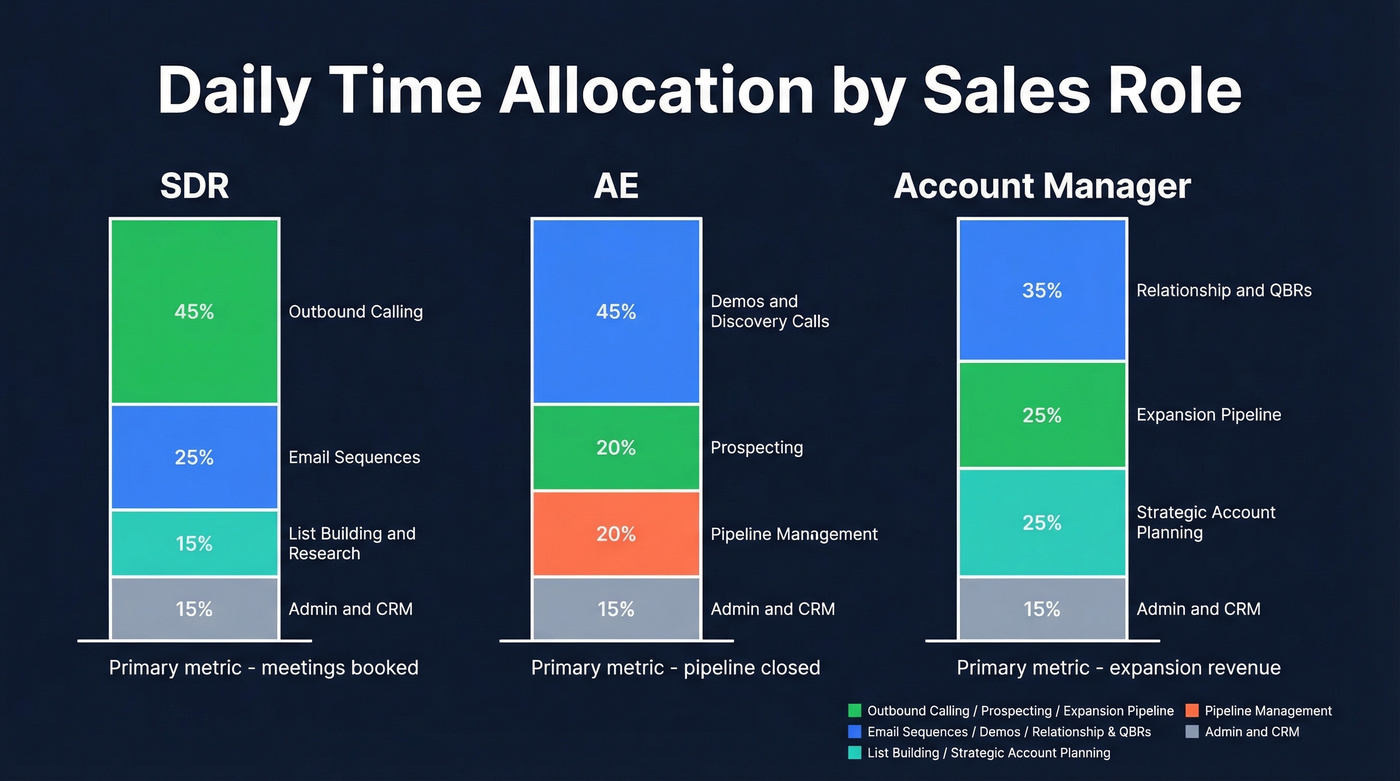
Your role matters too. An SDR's daily schedule looks nothing like an AE's, and an Account Manager's calendar is a different animal entirely.
Why Structure Changes Everything
Average quota attainment sits at 43.14%. Only 24.3% of salespeople exceed their annual number. Over the past two years, quotas rose 37% while attainment rates actually dropped. The math is brutal.
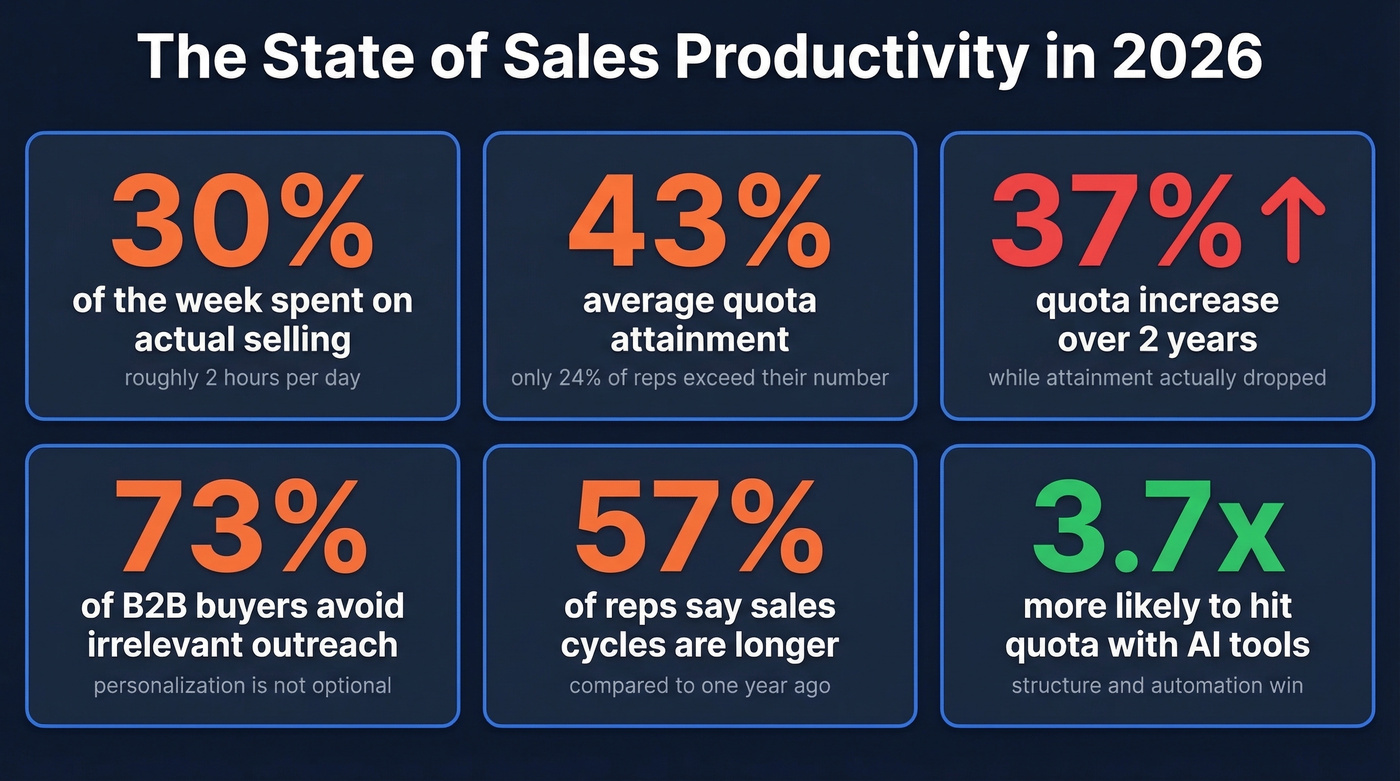
Reps are being asked to do more with the same number of hours, and most of those hours aren't even spent selling. Meanwhile, 73% of B2B buyers actively avoid sellers who send irrelevant outreach, and 57% of reps report longer sales cycles than a year ago. Pipeline management discipline isn't a nice-to-have - it's survival. (If you’re seeing slippage, these sales pipeline challenges are usually the root cause.)
Here's what gives us hope: sellers using AI-powered tools are 3.7x more likely to meet quota. Not because AI is magic, but because it eliminates the admin drag that kills momentum. A structured daily routine does the same thing. It forces you to spend your best hours on activities that generate revenue and batches everything else into defined windows where it can't do damage.
The Hour-by-Hour Template
| Time Block | Activity | Duration |
|---|---|---|
| 8:00-8:30 AM | Pipeline review + goal setting | 30 min |
| 8:30-10:00 AM | Prospecting power hour | 90 min |
| 10:00-12:00 PM | Scheduled calls + demos | 2 hrs |
| 12:00-12:30 PM | Lunch + CRM updates | 30 min |
| 12:30-3:30 PM | Demos + follow-ups | 3 hrs |
| 3:30-4:00 PM | Email batch + admin | 30 min |
| 4:30-5:00 PM | End-of-day prep | 30 min |
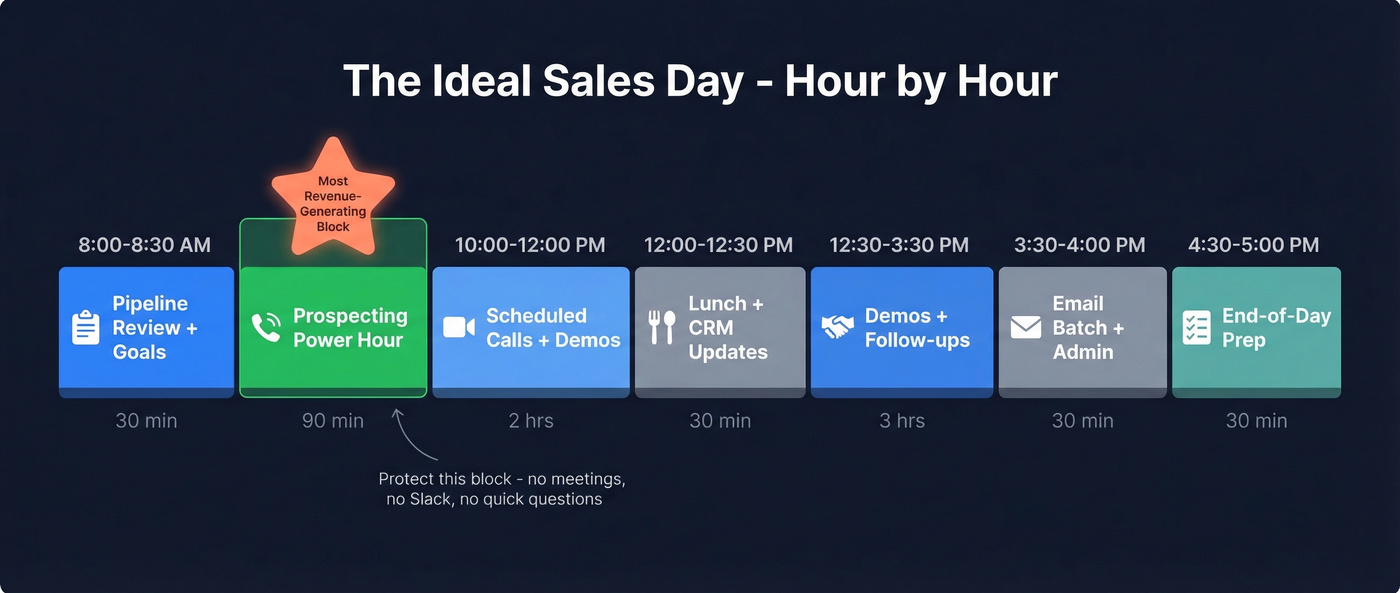
This isn't a commandment. Adjust it for your timezone, your buyer's timezone, and your deal cycle. But the principles underneath don't change.
The First 30 Minutes
Don't open email. Don't open Slack.
Spend 10-15 minutes reviewing your pipeline and call list. Set three micro-goals for the day - concrete ones like "30 cold calls before noon," "10 follow-up emails by 2 PM," and "book 3 discovery meetings." This single habit gives every morning a clear direction before distractions creep in. Top performers spend 18% more time updating their CRM than average reps, and 82% of them always research prospects before reaching out. That morning review is where both habits live. (Need ideas for what to track? Start with sales activities examples.)
The Prospecting Power Hour
This is the most revenue-generating block of your day. Protect it like a meeting with your biggest customer - because it is.
Dedicate 60-90 minutes to pure outbound: cold calls, personalized emails, follow-ups on warm leads. No meetings. No Slack. No "quick questions." If you're dialing manually, expect about 10-20 dials an hour. With a power dialer, you can push that to 80-90. (If you’re rebuilding your outbound motion, these sales prospecting techniques help.)
But here's what actually happens when your data is bad: you burn your best block on dead contacts. Before your calling block, run your list through a verification tool like Prospeo. With 98% email accuracy and a 7-day data refresh cycle, teams using Prospeo have cut bounce rates to under 5% - which protects your domain reputation and keeps your outbound blocks productive instead of frustrating. (More on benchmarks and fixes: email bounce rate.)
Meetings, Demos, and Follow-Ups
Late morning and afternoon are your meeting windows. Batch your follow-ups into 2-3 defined windows rather than reacting to every notification in real time. Check email at 10:00 AM, 1:00 PM, and 3:30 PM. That's it. (If you want plug-and-play copy, use these sales follow-up templates.)
Reactive email checking is one of the biggest time thieves in sales. It feels productive but generates almost zero pipeline.
When a deal is close to closing, break your time blocks. A hot prospect on the phone beats 10 cold dials every time.
End-of-Day Prep
Update your CRM while conversations are fresh. Review the day's metrics against your morning goals. Prep tomorrow's call list so you can hit the ground running at 8 AM without a 30-minute ramp-up. And leave at least an hour unscheduled each day for fires - back-to-back calendars burn you out by Wednesday. (If forecasting is where deals go to die, consider a lightweight sales forecasting solution.)

Your prospecting power hour is the most valuable block of your day - don't waste it on bounced emails and disconnected numbers. Prospeo's 7-day data refresh and 98% email accuracy mean every dial and every send counts. Teams using Prospeo cut bounce rates from 35%+ to under 4%.
Start every morning with a list you can actually trust.
Your Routine by Role: SDR vs AE vs AM
Instead of obsessing over a perfect schedule, think in terms of emphasis. SDRs live in outbound and list work. AEs live in meetings, demos, and deal work with a smaller but protected prospecting block. Account Managers live in account planning, renewals, and expansion - outbound is minimal. (If you’re building your toolkit, start with the core SDR tools.)
SDR Daily Routine
It's 8:35 AM. You've got your coffee, your headset, and a list of 50 names. By 10:00 AM, you need dials logged and at least 2 conversations that could turn into meetings.
That's the SDR life - two calling blocks, one morning and one afternoon, with email sequences running in between. You're measured on pipeline created and meetings set, so every hour that isn't generating conversations is a wasted hour. Use gaps between blocks to sit with product and marketing teams. The SDRs who understand the product deeply book better meetings, and it shows in their conversion rates downstream.
AE Daily Routine
Small schedule shifts can change outcomes fast. Move your calling block earlier, protect it from internal meetings, and you'll usually see better connect rates.
AEs typically spend 4-5 hours per day on the phone - demos, discovery calls, negotiation conversations. Layer in 1-2 hours of researching and prospecting new accounts. The balance shifts depending on where you are in the quarter: early quarter is heavier on prospecting, late quarter is heavier on closing. Pipeline management isn't optional. Review your forecast daily, not weekly - the reps who wait until Friday's pipeline call to discover a deal slipped are always scrambling.
Account Manager Daily Routine
Unlike SDRs and AEs, your job isn't about filling the top of the funnel. It's about expanding what's already there.
Mornings should focus on relationship maintenance and expansion pipeline review. QBR prep, upsell conversations, and cross-sell mapping take the place of cold calls. Block time weekly for strategic account plans - the AMs who wing it consistently leave expansion revenue on the table. Skip this role section if you're purely hunting net-new business; the SDR and AE frameworks above are your playbook.
Build Your Sales Stack Without Bloat
Browse r/sales for five minutes and you'll see the same complaint: "I have 15 tools open and I still can't find a direct dial." Modern AEs juggle 15+ apps in their daily workflow. That's not a badge of honor - it's a productivity tax.
| Category | Tool | Approx. Price |
|---|---|---|
| CRM | Salesforce / HubSpot | $25-300/user/mo |
| Data & Verification | Prospeo | Free tier; ~$0.01/email |
| Prospecting | Apollo.io | Free tier; from $49/user/mo |
| Enterprise Data | ZoomInfo | $15K-40K+/yr |
| Sequencing | Instantly / Lemlist | Paid plans vary |
| Social Selling | LinkedIn Sales Navigator | ~$100/user/mo |
| Note-taking | Sybill / Otter | Paid plans vary |
Start with the CRM as your foundation. Your data source is the next layer. (If you’re comparing vendors, see data enrichment services.)

Let's be honest: if your average deal size is under $10K, you almost certainly don't need ZoomInfo-level data. A 5-person team paying $30K+ a year for an enterprise platform and only using the search bar is lighting money on fire. Audit ruthlessly. Kill anything that doesn't directly contribute to pipeline or save measurable time.
For teams spending 2+ hours daily on prospect research, consider outsourcing list-building to a VA on Upwork for $5-10/hr. Your time is better spent on the phone.
Five Routine Killers (and How to Fix Them)
1. Treating every opportunity as equal. The deal that's been "almost closed" for 90 days is dead. Stop giving it your best hours. Qualify and rank your pipeline weekly - we use a simple red/yellow/green system that takes 15 minutes and saves hours of wasted effort. (If you want a tighter system, track pipeline health weekly.)
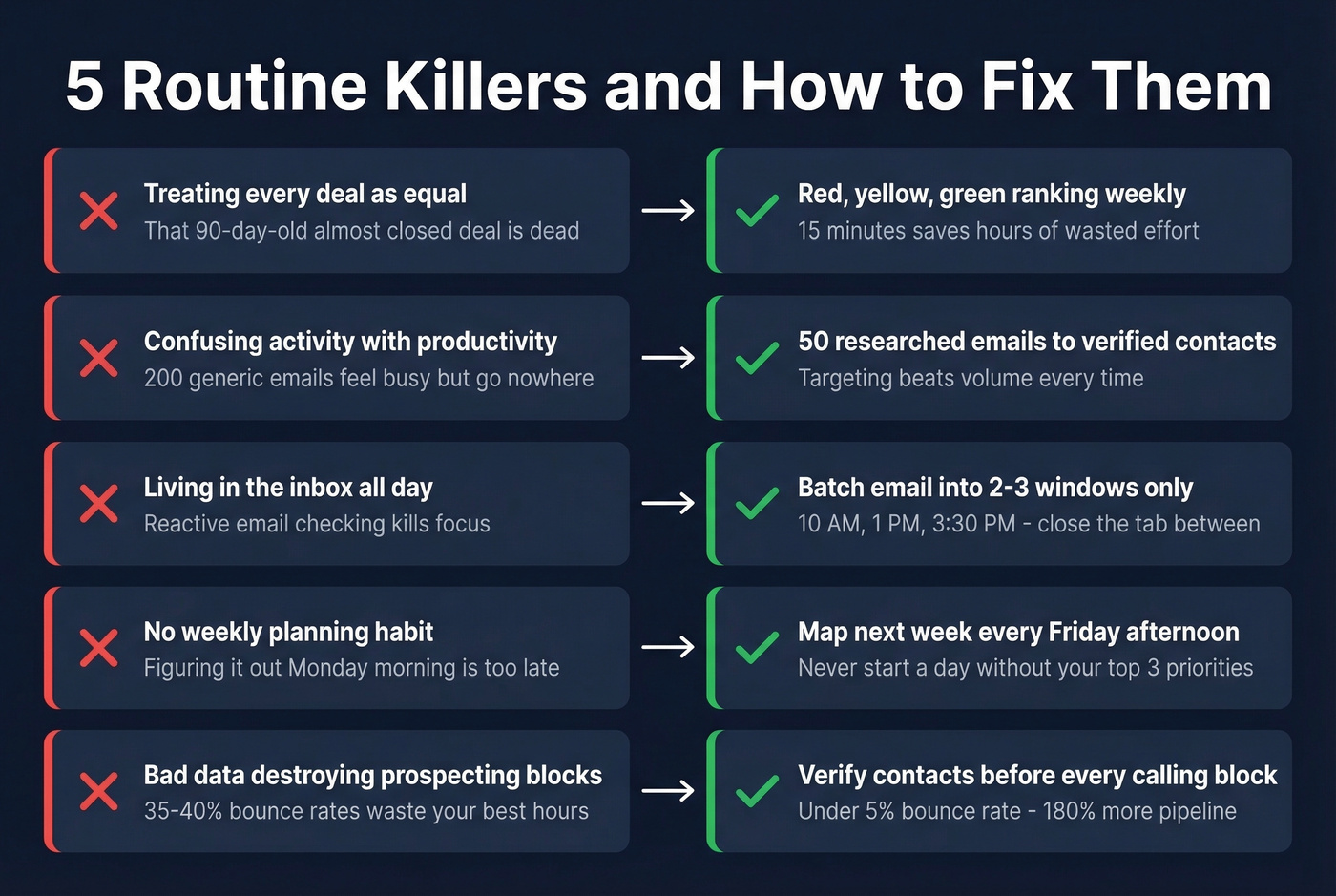
2. Confusing activity with productivity. Sending 200 emails feels productive. Sending 50 well-researched emails to verified contacts that actually land in inboxes is productive. The difference isn't effort - it's targeting.
3. Living in the inbox. Batch email into 2-3 defined windows. Between those windows, close the tab. This one habit alone can reclaim an hour a day.
4. Failing to plan the week. Map next week on Friday afternoon. Reps who plan on Friday outperform reps who "figure it out Monday morning" every single time. One of the best sales day tips you'll ever get: never start a day without knowing your top three priorities.
5. Bad data destroying your prospecting block. When Snyk's 50 AEs were prospecting 4-6 hours per week, their bounce rate sat at 35-40%. After switching to verified data, that dropped to under 5% - and AE-sourced pipeline jumped 180% with 200+ new opportunities per month. Bad data doesn't just waste time; it trains reps to distrust their own outbound process.
Reps spend 2 hours a day selling. If half that time goes to bad numbers and dead emails, you're down to one hour. Prospeo gives you 125M+ verified mobiles with a 30% pickup rate and 143M+ verified emails - so your routine actually produces pipeline instead of frustration.
Fix your data and your daily routine fixes itself.
Reverse-Engineer Your Daily Activity Targets
Most reps set activity goals by gut feel. Do the math instead.
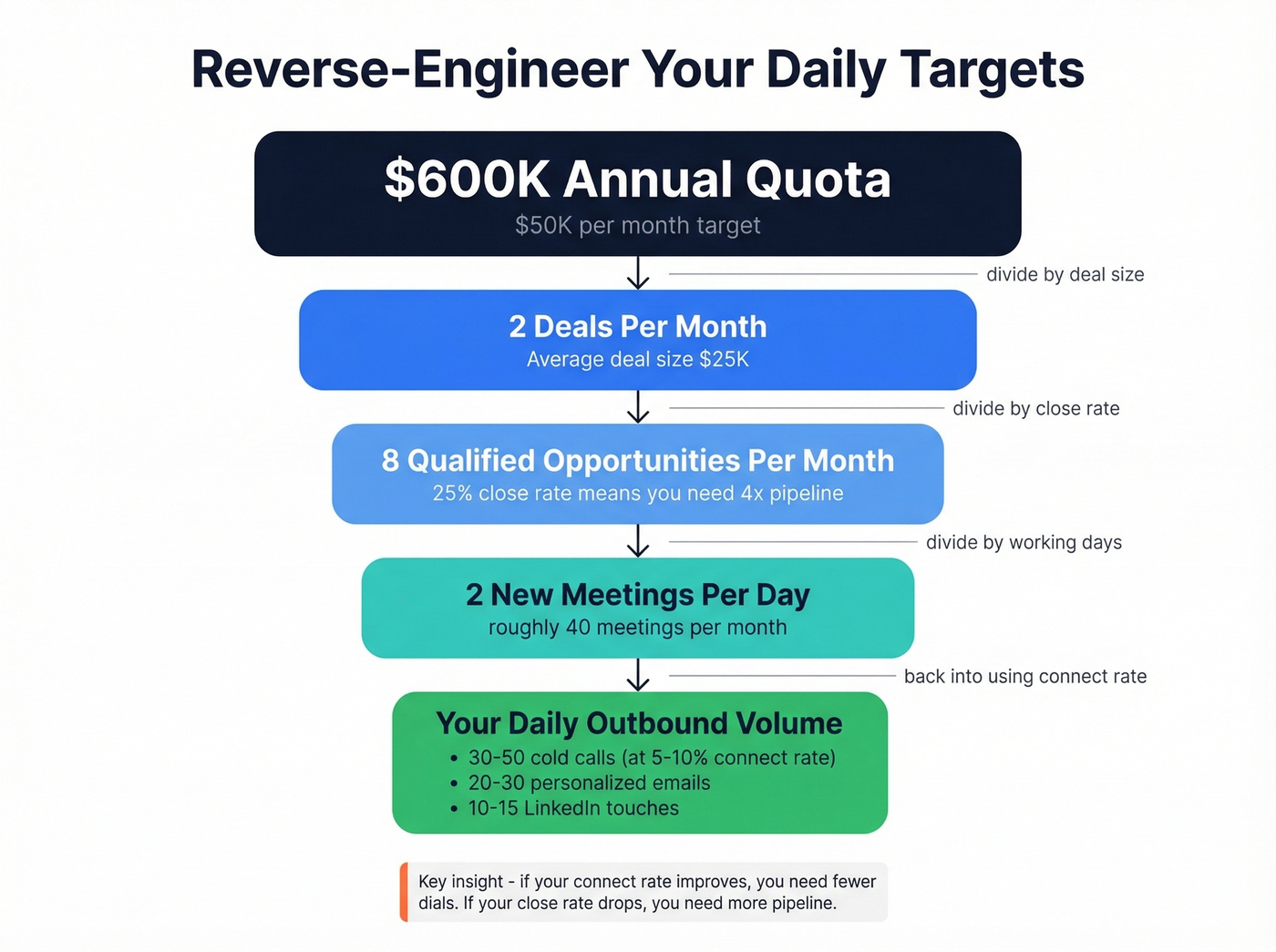
Say your annual quota is $600K - that's $50K per month. If your average deal is $25K and your close rate is 25%, you need 8 qualified opportunities per month, which works out to roughly 2 new meetings per day. From there, back into your daily outbound volume using your own funnel metrics: connect rate, meeting rate, and close rate. If your connect rate improves, you need fewer dials. If your close rate drops, you need more pipeline.
Your sales routine adapts to the math, not the other way around. Recalculate monthly. The reps who treat their activity targets as fixed numbers all year are the same ones who panic in Q4.
FAQ
How long until a new routine feels automatic?
Most reps need 3-4 weeks of consistent execution before a schedule feels natural. Stick with the same time blocks for a full month before tweaking. Changing your structure every week guarantees nothing sticks.
What's the best time for cold calls?
Late morning (10:00-11:30 AM) and mid-afternoon (2:00-4:00 PM) are the most reliable windows for B2B calling. Your timezone relative to your buyer's matters more than any universal rule - test both blocks and track connect rates for two weeks before deciding.
How do I stop admin from eating selling time?
Batch CRM updates into two 15-minute windows - after lunch and end of day. Automate repetitive tasks with native CRM workflows or Zapier. Enrichment APIs that auto-fill contact records can cut manual research from hours to minutes per week, which is where most of the admin bloat actually lives.