

How to Get Out of a Sales Slump: A Data-Backed Recovery Guide
You're staring at a pipeline that looks like a ghost town. The board shows your name near the bottom, and the reps around you seem to be closing just fine. Meanwhile, you're doing the math on what a zero-commission month does to rent.
A sales slump isn't just a professional problem - it's a financial and psychological one that compounds daily.
The short version: diagnose whether it's an effort, conversion, or targeting problem using conversion-per-100-activities math. Fix your inputs first - activity volume, data quality, list targeting - before worrying about mindset. Then follow a structured 30/60/90-day recovery plan. Slumps end when the mechanics improve, not when you "believe harder."
What a Slump Actually Feels Like
The AE version: you open your CRM on Monday morning and the pipeline is a wasteland. Deals you thought were progressing have gone dark. Your forecast looks like fiction, and your manager's starting to ask questions with a tone that didn't exist two months ago.
The SDR version is different but equally brutal. You've sent 400 emails this week and booked zero meetings. Your call connect rate has cratered. You're starting to wonder if your phone number is flagged.
Both versions share the same undercurrent - commission stress. As one rep put it on r/sales: "I'm on straight commissions so when you're not selling you're not getting paid." Add the social comparison dynamic - watching peers close while you spiral - and the downturn becomes self-reinforcing.
It's Not a Mindset Problem
Most recovery advice is motivational fluff. "Believe in yourself." "Visualize success." That's not a recovery plan. That's a poster in a dentist's office.
Research tells a different story. A study from Aston University found that knowledge structure variables explain 50.2% of the variance in sales performance. Not attitude. Not hustle. Structured knowledge - how well you understand your product, your market, and your process.
Here's the thing: as one r/sales thread argued, "there is no such thing as a sales slump" - just the law of averages catching up. A run of bad leads or bad timing can create a temporary drought that has nothing to do with your ability. The point isn't to dismiss the pain. It's to stop treating a mechanics problem like a character flaw.
Fix your activity volume, your targeting, your data quality, and your deal management. The confidence follows. The reverse almost never works.
Why Selling Is Harder in 2026
Your slump might not be entirely your fault. The selling environment has gotten measurably harder.
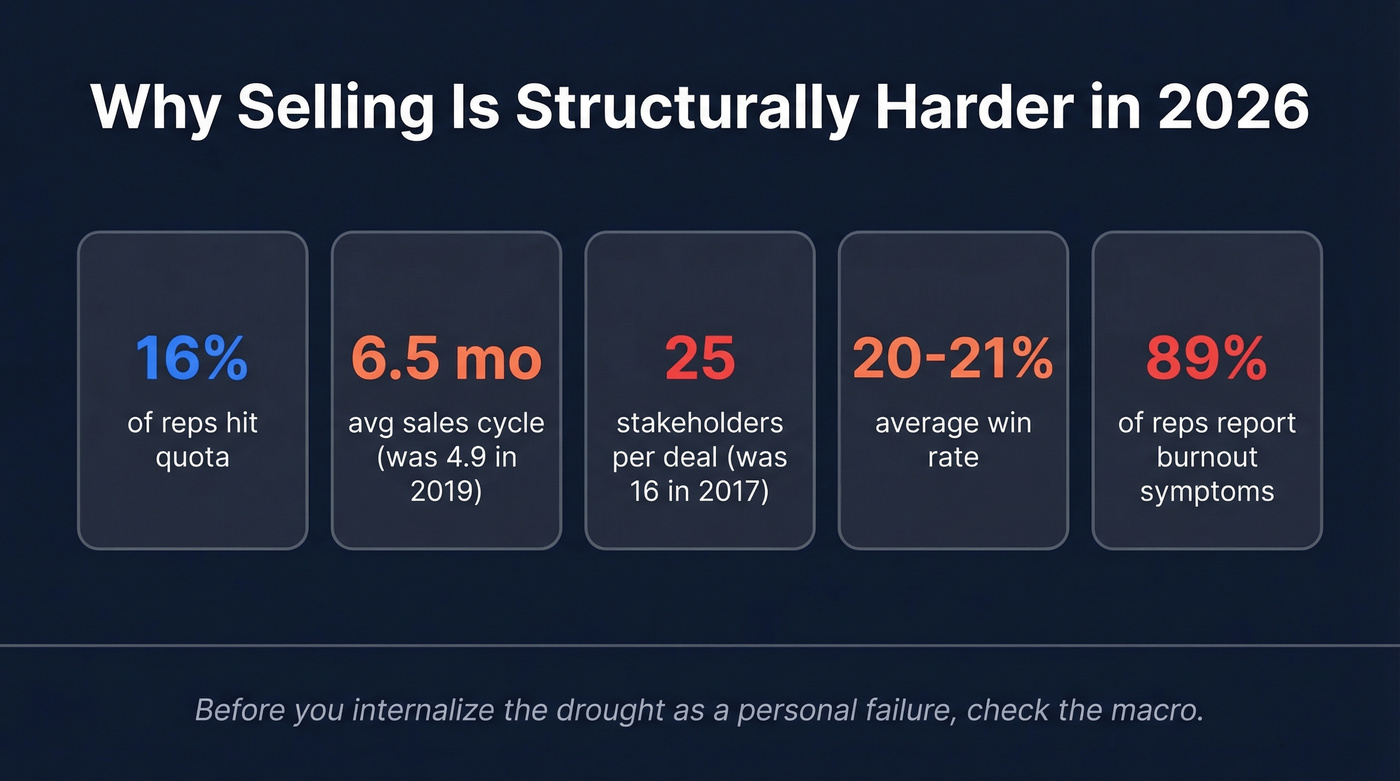
Only 16% of reps hit quota in recent benchmarks. The average B2B sales cycle now runs 6.5 months, up from 4.9 months in 2019. Buying committees have ballooned to 25 stakeholders, up from 16 in 2017. And 57% of sales professionals say cycles are still getting longer, while reps spend only 28-30% of their week actually selling and 89% report at least one burnout symptom.
Let's be honest: a 25% win rate in 2026 is above average. Before you internalize the drought as a personal failure, check the macro. The market is structurally harder than it was three years ago. That doesn't excuse poor performance, but it means your expectations need recalibrating.
Diagnose Your Slump With Numbers
Stop guessing. Start measuring. The fastest way to diagnose a sales slump is the conversion-per-100-activities formula.
Take your weekly output - say, 180 calls + 110 emails + 30 social touches = 320 total activities. If those produce 4 meetings, your conversion rate is 1.25%. Now you have a number to work with instead of a feeling.
If you want to go deeper than meetings booked, track funnel metrics by stage so you can see exactly where the leak starts.
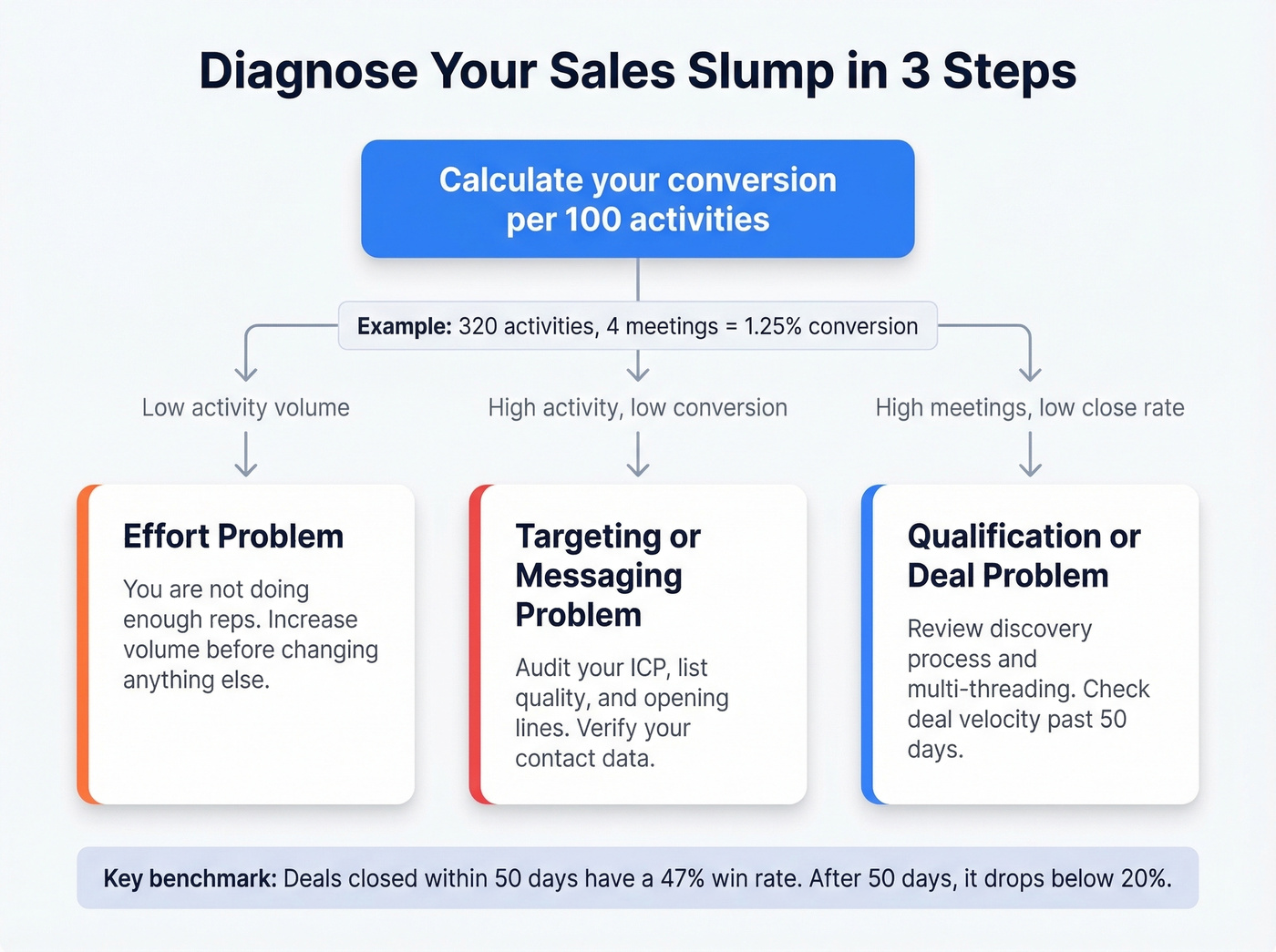
Three diagnostic branches emerge:
- Low activity volume = effort problem. You're not doing enough reps. Increase volume before changing anything else (use a clear list of sales activities so you’re not “busy,” you’re effective).
- High activity + low conversion = messaging or targeting problem. Audit your ICP, your list quality, and your opening lines (start with an ideal customer profile you can actually score).
- High meetings + low close rate = qualification or deal management problem. Look at your discovery process and multi-threading (tighten your sales qualification so weak deals don’t clog the pipe).
A benchmark that should sharpen your focus: opportunities closed within 50 days show a 47% win rate. After 50 days, that drops below 20%. If your deals are dragging past that threshold, the problem isn't closing skill - it's pipeline velocity.
Run a pipeline coverage check too. If you need $200K in closed revenue this quarter and your pipeline is $400K at a 20% win rate, you're already short. You need $1M in pipeline. Most reps in a dry spell don't have a closing problem. They have a math problem.
If you’re not already tracking it, make pipeline health a weekly habit, not a quarterly surprise.

You just did the pipeline math. If bad data is inflating your activity numbers while tanking your conversions, the diagnosis is clear. Prospeo's 98% email accuracy and 7-day refresh cycle eliminated this exact problem for Snyk's 50 AEs - bounce rates dropped from 35% to under 5%, and pipeline jumped 180%.
Stop diagnosing a data problem as a skills problem.
The 8 Root Causes
1. Activity drop-off. The most common and most fixable cause. Reps who had a strong quarter ease off prospecting, and the drought hits 60-90 days later. Jeb Blount's principle holds: an empty pipeline is the #1 cause of sales failure.
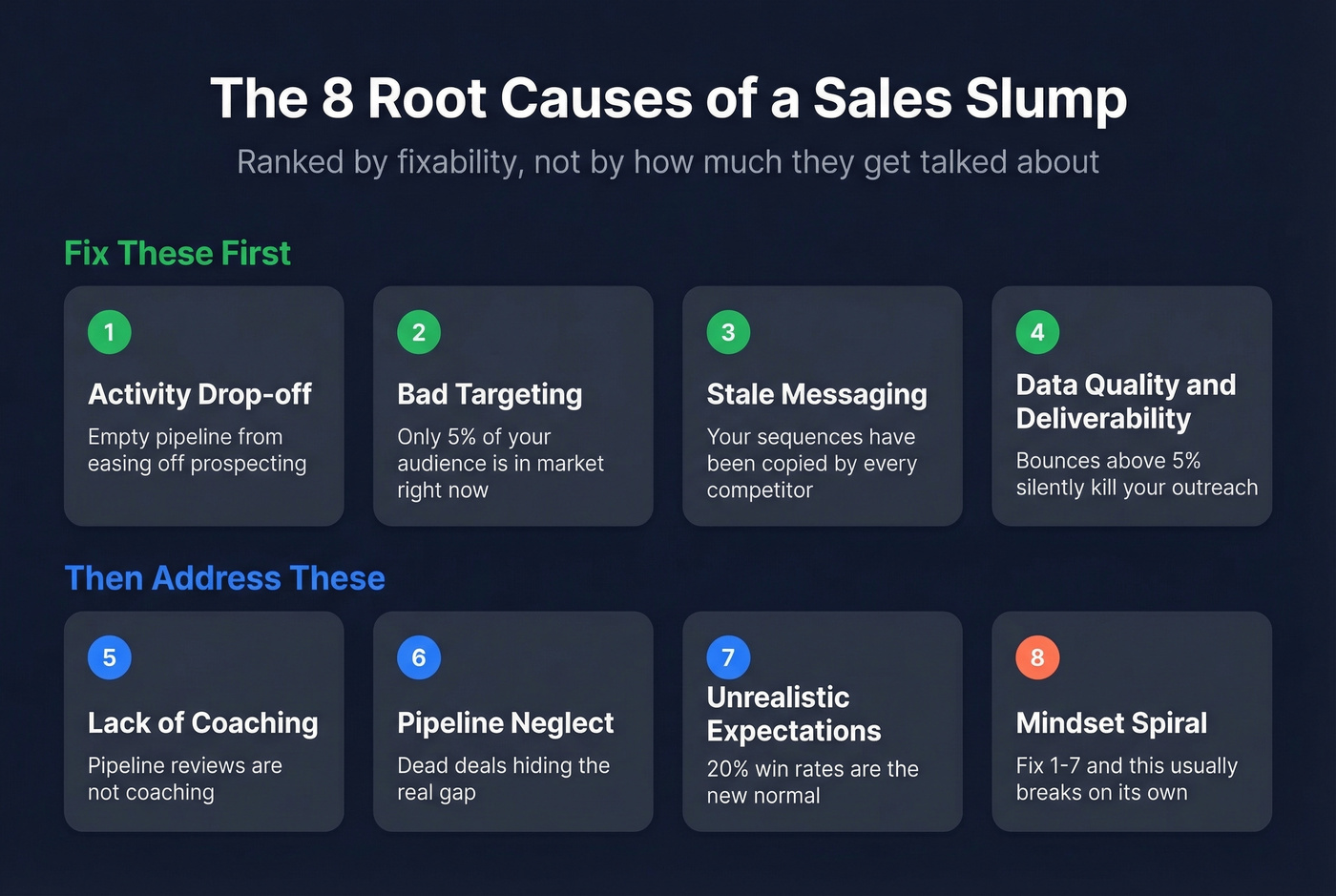
2. Bad targeting. You're reaching out to people who were never going to buy. Only about 5% of your target audience is actively in market at any given time. If your list isn't tightly filtered, you're burning activity on the 95% who aren't ready.
3. Stale messaging. The email sequence that worked six months ago has been copied by every competitor in your space. Refresh your angles, test new subject lines, and personalize beyond "{first_name}, I noticed your company..." (keep a swipe file of email subject lines so you can iterate faster).
4. Data quality and deliverability issues. This one's a silent killer. Bounce rates around 5% are a red flag - they hurt deliverability and domain reputation, which means fewer emails land in inboxes, which means fewer replies, even when your messaging is strong. We've seen this pattern repeatedly: a rep thinks their copy is the problem when it's actually their data. Fixing it means verifying every contact before outreach. Prospeo's 98% email accuracy and 7-day refresh cycle address this directly - when Snyk's 50-person AE team switched, bounce rates dropped from 35-40% to under 5%, and AE-sourced pipeline jumped 180%. (If you want the mechanics, start with an email deliverability guide.)
5. Lack of coaching. Reps with a coach are 75% more likely to hit their targets. Most reps in a performance dip aren't getting coached - they're getting pipeline-reviewed. There's a difference.
6. Pipeline neglect. Dead deals sitting in "negotiation" for 90 days. Contacts who've gone dark but haven't been moved to lost. A bloated pipeline creates false confidence and hides the real gap (these are classic sales pipeline challenges).
7. Unrealistic expectations. With win rates at 20-21% and cycles averaging 6.5 months, expecting to close 40% of your pipeline in 30 days isn't ambitious - it's delusional.
8. The mindset spiral. Stress leads to desperation. Prospects sense desperation. Fewer deals close. More stress. But notice it's #8, not #1. Fix causes 1-7 and the spiral usually breaks on its own.
Role-Specific Recovery Playbooks
SDR/BDR Recovery
Start with activity volume. Use the same conversion-per-100 framework from above: 180 calls + 110 emails + 30 social touches = 320 total outbound activities. Adjust based on your actual conversion math.
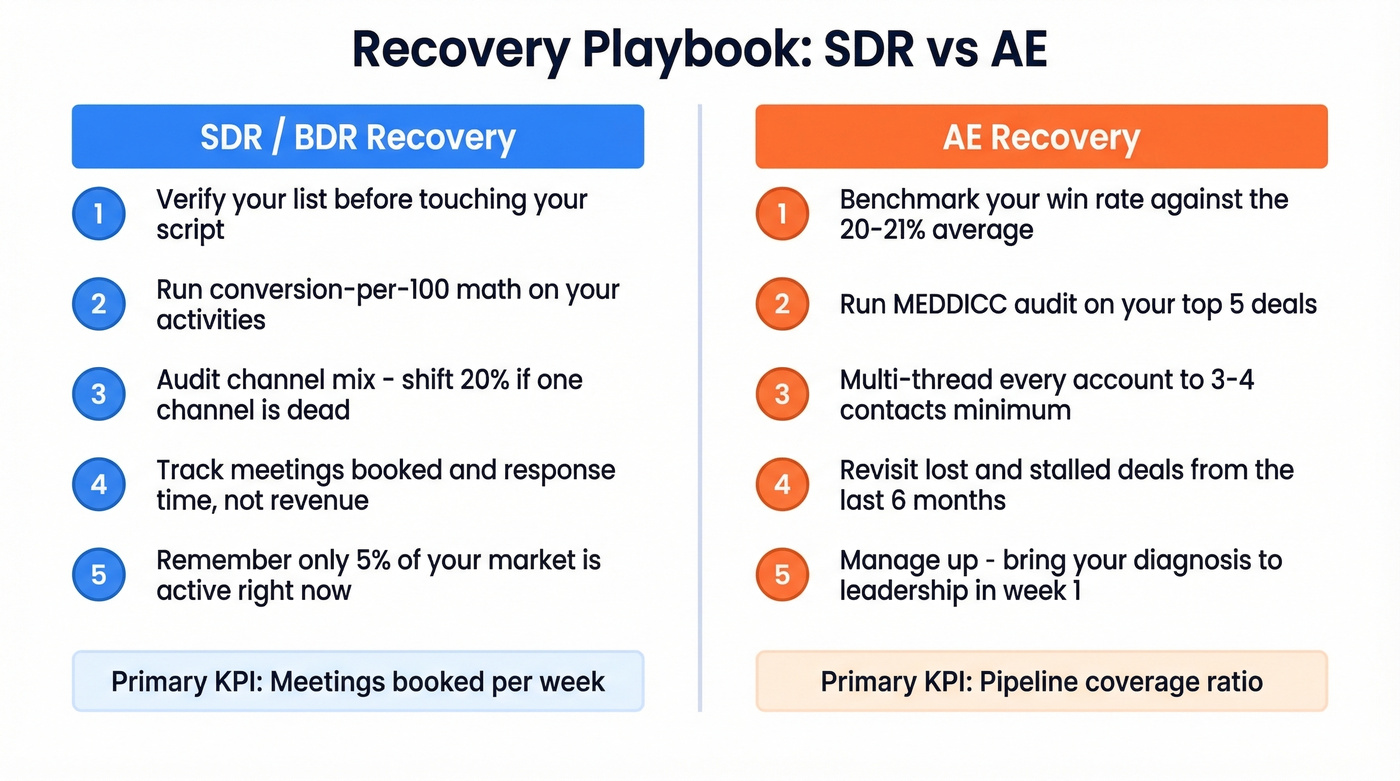
Before you touch your script, verify your list. Bad data is the fastest way to waste activity - verify every email before you send. Run a channel mix audit: if 90% of your activity is cold email and your reply rate is 1%, shift 20% of that effort to phone or social. Track meetings booked and lead response time as your recovery KPIs, not revenue. You don't control revenue yet. You control inputs.
Only about 5% of your target audience is actively in market. Volume and targeting precision matter more than any single email template (build your system around proven sales prospecting techniques, not random hustle).
AE Recovery
Benchmark your win rate against the 20-21% market average. If you're at 15%, you have a real problem. At 18%, you're probably experiencing normal variance in a tough market.
Run a deal qualification audit using MEDDICC. For every deal in your pipeline: do you have a champion? Do you know the decision process? Have you identified the economic buyer? If you can't answer these for your top 5 deals, that's your problem right there.
Multi-thread aggressively. With buying committees averaging 25 stakeholders, single-threaded deals are dead deals walking. Map every account to at least 3-4 contacts across different functions. And don't forget your graveyard - revisit lost and stalled deals from the last 6 months. A "not now" from Q1 might be a "let's talk" in Q3.
One thing most slump advice ignores: managing up. If you're an AE in a downturn, your manager already knows. Get ahead of the conversation. Come with your diagnostic numbers, your root cause hypothesis, and your 30-day recovery plan. In our experience, the reps who recover fastest are the ones who own the narrative with leadership in week one, not week four. Framing the conversation as "here's what I've diagnosed and here's my fix" is infinitely better than waiting for the PIP conversation.
For Managers: Coaching Through It
The Reddit consensus on sales management is brutal but accurate: most managers of 8+ reps can realistically coach 2-3 per week, and even those sessions devolve into pipeline reviews. The player-coach trap means your struggling reps - the ones who need coaching most - often get the least attention.
Start with early warning signals. Pipeline health, win-rate patterns, and forecast accuracy tell you who's slipping before they tell you. Pay special attention to top performers who "go quiet" - they're often the last to ask for help and the most expensive to lose.
The lightweight fix that actually works: pick one behavior per rep per month. Not five. One. Run group call reviews so coaching scales beyond your 1:1 capacity. Use stage-level pipeline data to prioritize which reps need attention most urgently. I've watched managers try to coach everyone equally and end up coaching no one effectively.
Skip this approach if you're managing fewer than 4 reps - at that size, you can afford deeper 1:1 coaching and should take advantage of it.
Your 30/60/90-Day Recovery Plan
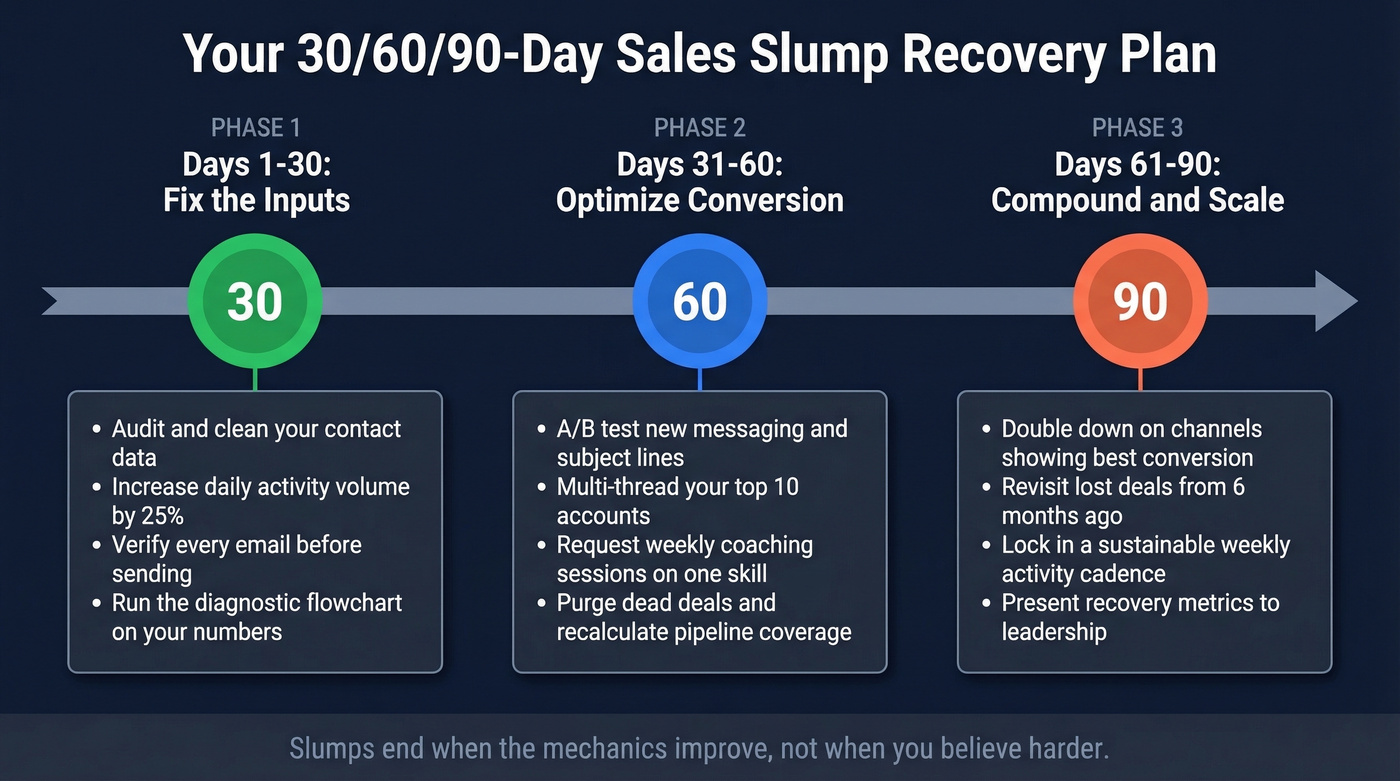
Sales pros using structured planning strategies are 4x more likely to achieve their objectives. Here's a framework you can start today.
| Phase | Focus | Key Actions |
|---|---|---|
| Days 1-30 | Diagnose + Rebuild | Run conversion-per-100 math; audit data quality; clean lists; rebuild activity volume; identify root cause |
| Days 31-60 | Refine + Test | Adjust targeting; A/B test messaging; implement coaching feedback; multi-thread top deals |
| Days 61-90 | Optimize + Sustain | Track conversion improvements; build pipeline habits; set new baselines; protect prospecting blocks |
Days 1-30 are about honesty. Pull your numbers, run the diagnostic, and accept what they tell you. If your data quality is the problem, fix it before you write a single new email. This is the phase where we've seen the most reps stall - they want to skip straight to "test new messaging" without fixing the foundation underneath it.
Days 31-60 are about iteration. You've rebuilt volume - now improve quality. Test new subject lines, try different call openers, adjust your ICP filters. This is also when coaching feedback starts compounding if you're getting it.
Days 61-90 are about sustainability. Block prospecting time on your calendar like it's a customer meeting. Track your conversion-per-100 weekly. Make pipeline health a leading indicator, not a lagging surprise.
Real talk: most slumps don't end with a single breakthrough deal. They end with a gradual return to baseline, driven by consistent inputs over 30-60 days. The recovery is boring. That's how you know it's working.
Root cause #2 - bad targeting - kills more pipelines than bad closing. Prospeo's 30+ filters including buyer intent, technographics, headcount growth, and funding signals let you reach the 5% actually in market. At $0.01 per email, rebuilding a clean, targeted list costs less than one lost deal.
End the slump by fixing your inputs, not your attitude.
FAQ
How long do sales slumps last?
Most reps experience 1-2 down months per year. With a structured recovery plan, expect 30-60 days to see measurable improvement. Without one, slumps can stretch 3-6 months - especially in longer B2B cycles now averaging 6.5 months. The key variable is how quickly you diagnose the root cause and fix your inputs.
What's the #1 cause of a sales slump?
Pipeline neglect from paused prospecting. When reps stop outbound during busy closing periods, the drought hits 60-90 days later. Activity consistency - not motivation - prevents most downturns before they start. Aim for at least 300 weekly activities regardless of how full your pipeline feels.
Can bad data cause a sales slump?
Yes - it's one of the most underdiagnosed causes. Bounce rates above 5% damage domain reputation and tank deliverability, meaning fewer emails reach inboxes even when messaging is strong. Verifying contacts before outreach and using a provider with frequent data refreshes keeps this problem from silently killing your numbers.
How do you recover from a slump fast?
Focus on mechanics, not motivation. Run your conversion-per-100 diagnostic, identify whether the bottleneck is activity volume, targeting, or deal management, and attack that single root cause for 30 days. Reps who follow a structured recovery plan - fixing inputs before worrying about mindset - typically see measurable improvement within the first month.