

Best Sales Software in 2026: 15 Tools That Actually Deserve Your Budget
A RevOps lead we know ran a stack audit last quarter. Seven pieces of sales software for prospecting, CRM, tracking, outreach, and call recording. His summary: "Half my morning is spent syncing data between tabs and making sure automation didn't break." He wasn't exaggerating. Salesforce's own research shows reps spend just 28% of their week actually selling. The rest is admin, tool-wrangling, and data entry.
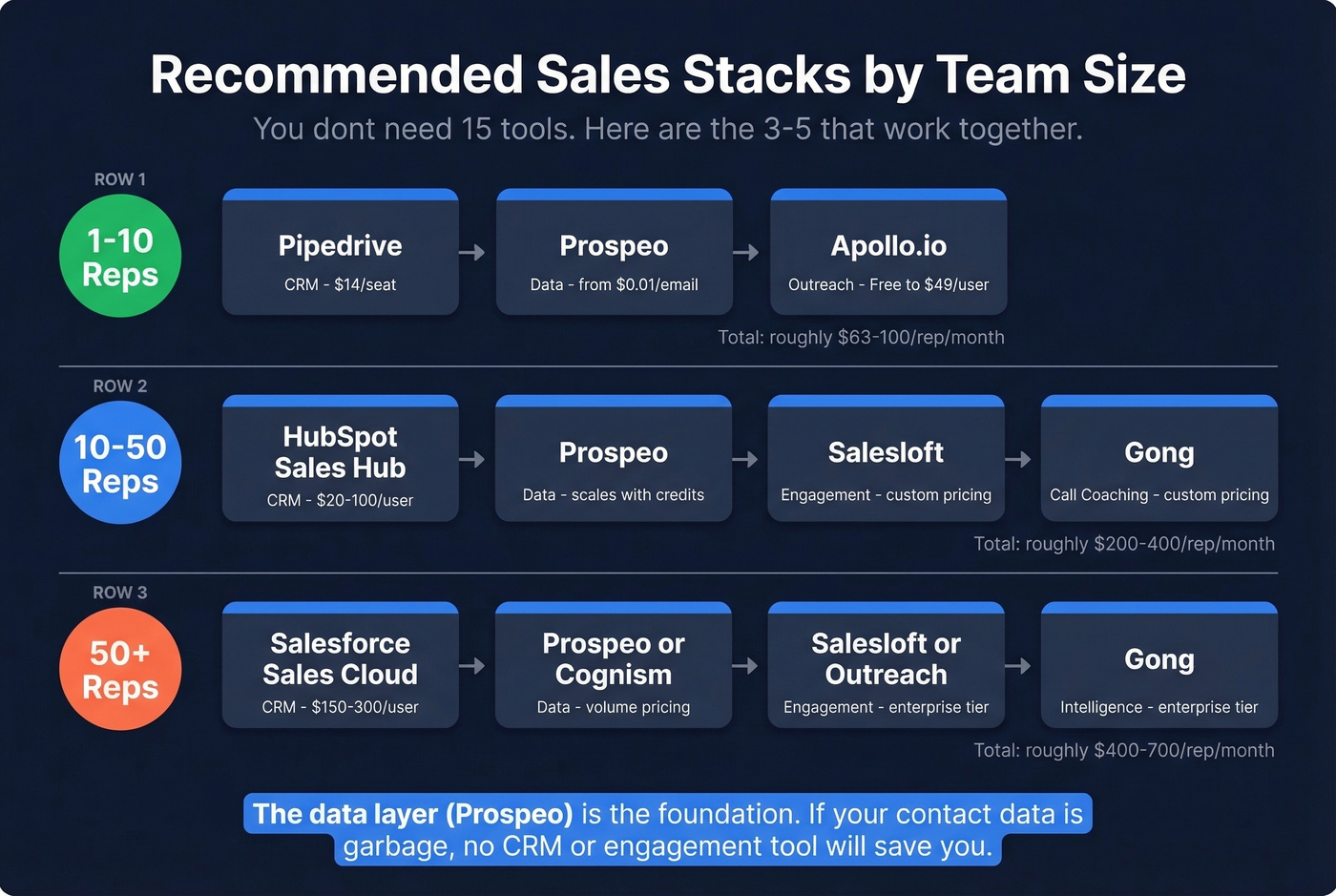
The market hit $31.26 billion in 2025 and is growing at a 14.86% CAGR, projected to reach $71.83 billion by 2031. That's a lot of vendors fighting for your budget. Most "best of" guides list every tool they can find because more tools means more affiliate links. We did something different: 15 tools organized by what you actually need, with real pricing, honest opinions, and recommended stacks by team size.
You don't need 15 tools. You need three to five that work together.
Our Top Picks (TL;DR)
If you're short on time, here's where we'd start for each use case. G2's 2026 Best Sales Software list informed some of these picks, but we weighted real-world usability and pricing transparency just as heavily.
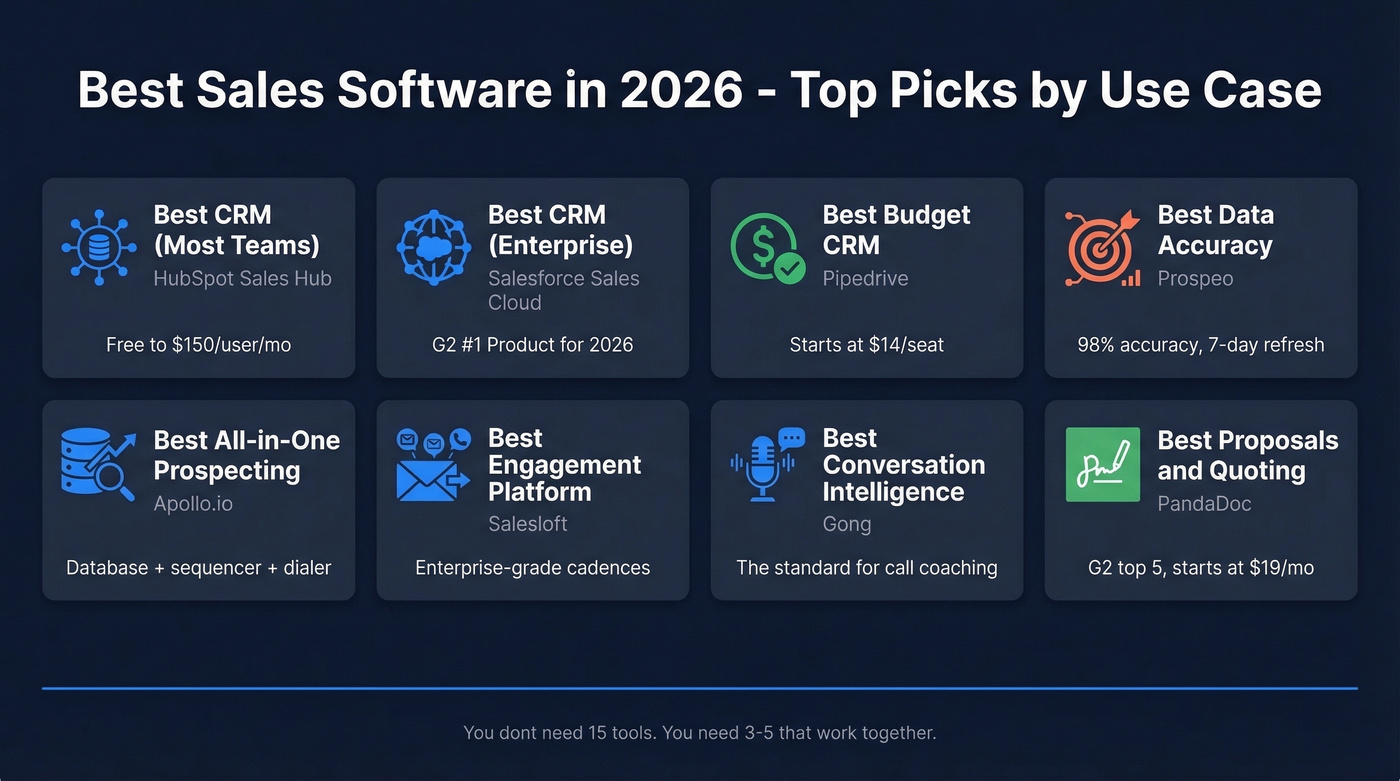
| Use Case | Pick | Why |
|---|---|---|
| Best CRM (most teams) | HubSpot Sales Hub | Free to $150/user/mo, works well up to ~50 reps |
| Best CRM (enterprise) | Salesforce Sales Cloud | G2's #1 product for 2026, deepest customization |
| Best budget CRM | Pipedrive | Starts at $14/seat, dead simple |
| Best data & email accuracy | Prospeo | 98% accuracy, 7-day refresh |
| Best all-in-one prospecting | Apollo.io | Database + sequencer + dialer |
| Best engagement platform | Salesloft | Enterprise-grade cadences |
| Best conversation intelligence | Gong | The standard for call coaching |
| Best proposals & quoting | PandaDoc | G2 top 5, starts at $19/mo |
The AI Reality Check
Every sales tool now markets itself as "AI-powered." Let's be precise about what that actually means. Gartner predicts 40% of enterprise apps will feature task-specific AI agents by end of 2026, up from less than 5% in 2025. That's a massive jump, and it's created a wave of what Gartner explicitly calls "agentwashing." As G2's VP of Research put it, "AI now stands for Always Included."
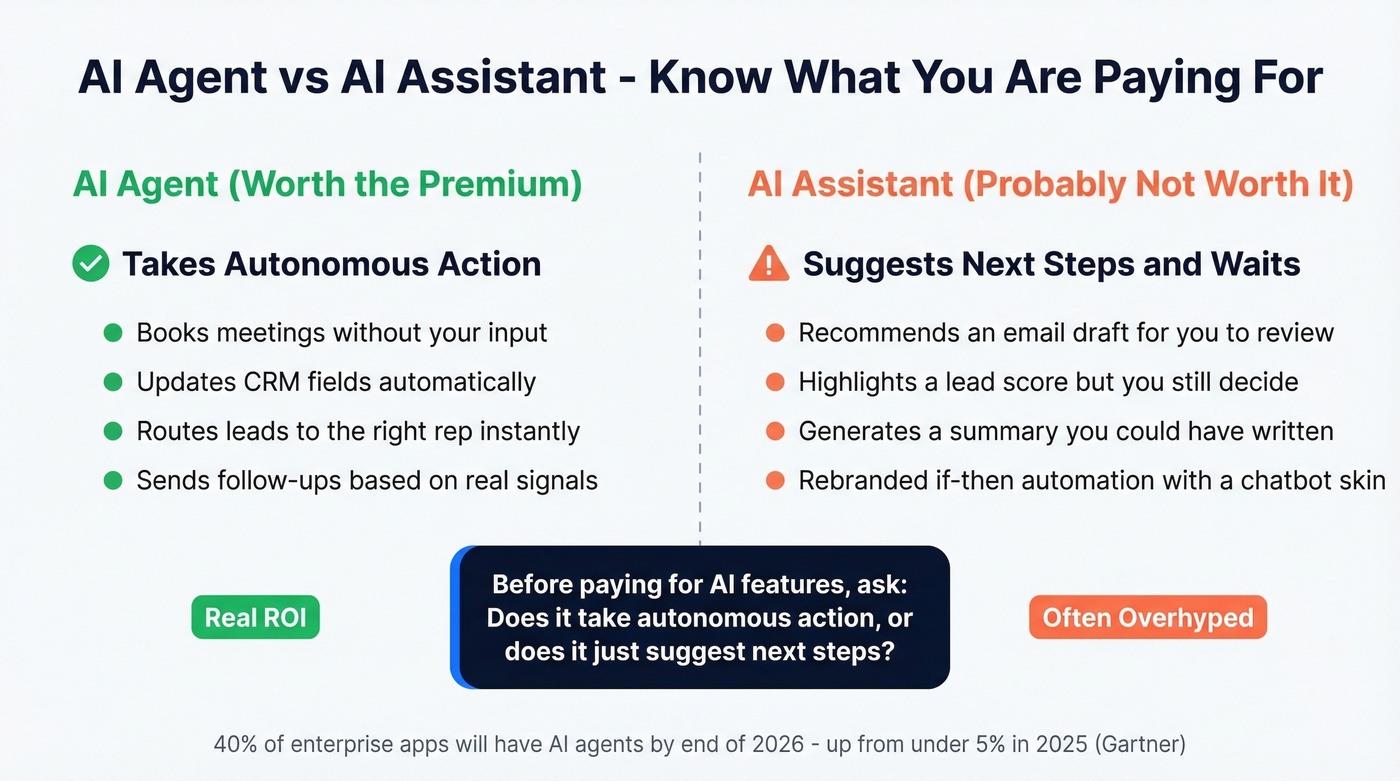
Here's the distinction that matters. An AI agent takes autonomous action: it books the meeting, updates the CRM, routes the lead. An AI assistant suggests a next step and waits for you to click. Half the "AI agents" in today's tools are rebranded if-then automations with a chatbot skin.
Before you pay a premium for AI features, ask one question: does it take autonomous action, or does it just suggest next steps? The answer changes whether it's worth the upcharge. The AI-specific segment is growing at 23.85% CAGR, which means vendors have every incentive to slap "AI" on features that don't deserve the label.
Best Sales Software in 2026
CRM & Pipeline Management
HubSpot Sales Hub
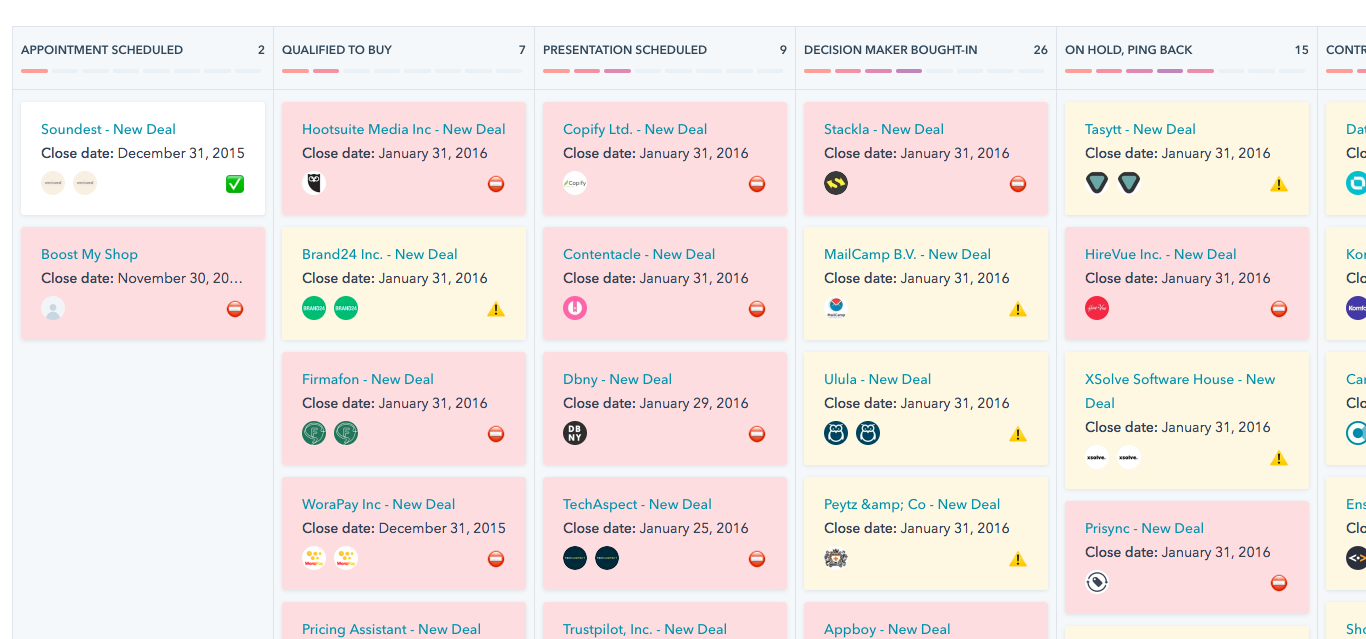
Use this if you're a team under 50 reps that wants user-friendly tools you can actually set up without a dedicated admin. HubSpot earned a G2 2026 Top 5 Best Sales Software Products spot, and it's deserved. The free CRM is a real product with contact management, deal tracking, and basic reporting. Not a bait-and-switch trial. (If you’re comparing options, see more examples of a CRM.)
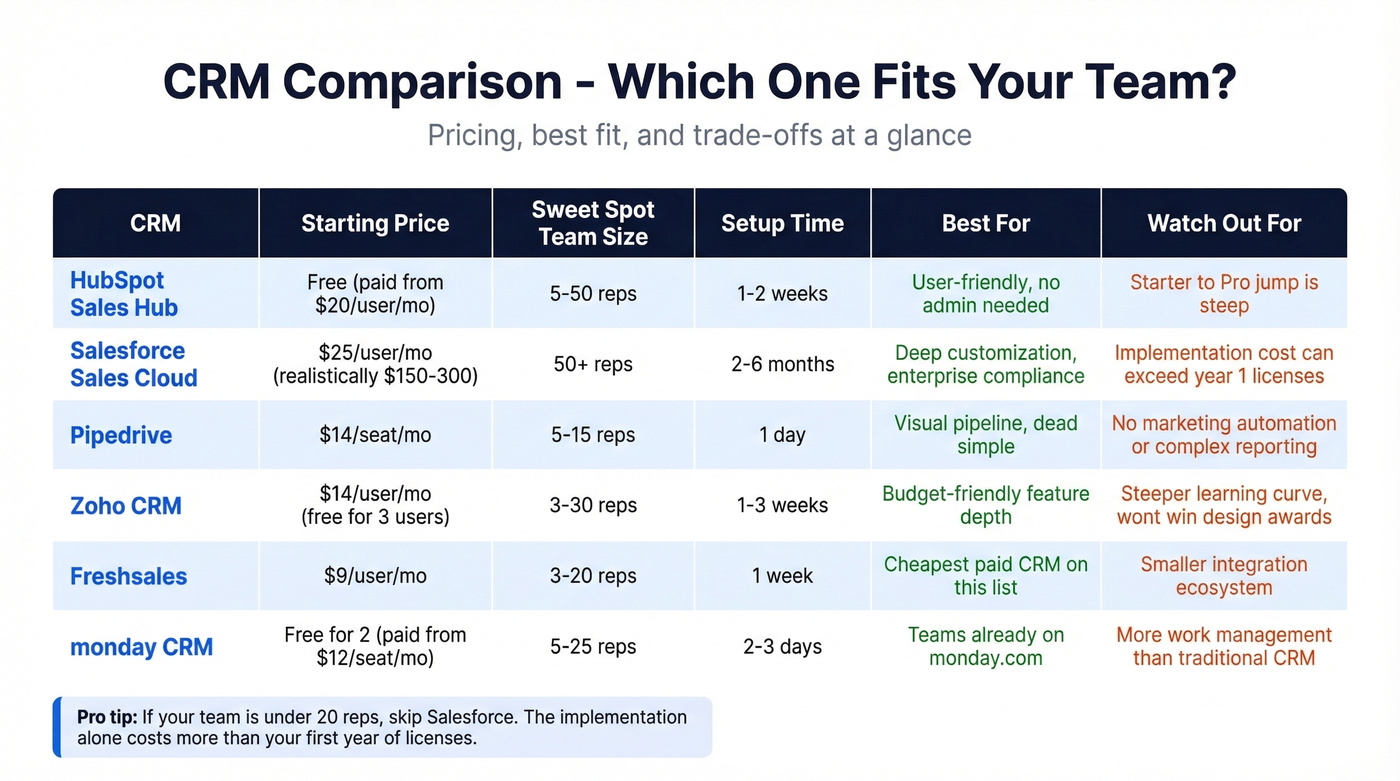
Skip this if you need deep customization, complex approval workflows, or you're already embedded in the Salesforce ecosystem. HubSpot's enterprise tier ($150/user/month + $3,500 onboarding) starts approaching Salesforce pricing without Salesforce's flexibility.
Pricing: Free / Starter $20/user/month / Professional $100/user/month (+ $1,500 onboarding) / Enterprise $150/user/month (+ $3,500 onboarding). The jump from Starter to Pro is steep - make sure you actually need the automation features before upgrading.
Salesforce Sales Cloud
Salesforce is the CRM you grow into, not the one you start with. G2's 2026 Best Sales Software Products list ranks Salesforce Sales Cloud #1, and no enterprise CRM comes close on customization depth. For teams of 50+ reps that need complex permissions, deep integrations, and enterprise compliance requirements, this is the answer. (If you want the cost breakdown, see our guide to Salesforce pricing.)
But we've seen startups buy Salesforce because it felt "serious" and then spend six months configuring fields nobody uses. If you're under 20 reps, the implementation alone will take months and cost more than your first year of licenses. That's money better spent on tools your team will actually adopt.
Pricing starts at $25/user/month for Starter, but most teams land at $150-300/user/month once you add Enterprise edition, CPQ, inbox integration, and the inevitable consulting hours.
Pipedrive
The best CRM under $50/seat, full stop. Pipedrive's visual pipeline is intuitive enough that most teams are running within a day. No implementation consultant, no six-week rollout.
The trade-off is scope. You won't get marketing automation, complex reporting, or enterprise-grade permissions. Pipedrive is built for salespeople, not a platform. That's exactly why it works for small teams of 5-15 reps.
Pricing: Lite $14 / Growth $39 / Premium $59 / Ultimate $79 per seat/month on annual billing. Free 14-day trial, no credit card. Add-ons like LeadBooster start at $32.50/month if you want built-in prospecting. The Growth plan at $39/seat hits the sweet spot for most teams.
Zoho CRM
Zoho is the quiet workhorse for budget-conscious teams. Standard starts at $14/user/month, Professional $23, Enterprise $40, and Ultimate $52, with a free plan for up to 3 users. It won't win design awards, but the feature depth at these price points is hard to beat - especially if you're already in the Zoho ecosystem for email, projects, or support. The learning curve is steeper than Pipedrive, but the ceiling is considerably higher.
Freshsales
The cheapest paid CRM on this list at $9/user/month for the Growth plan. Pro runs $39/month, Enterprise $59. It's a solid pick for teams that want CRM plus basic engagement in one tool without Apollo's complexity. The trade-off: a smaller integration ecosystem than HubSpot or Salesforce.
monday CRM
monday CRM makes sense if your team already lives in monday.com for project management. Free for 2 users, then Basic $12 / Standard $17 / Pro $28 per seat/month on annual billing. It's more of a visual work-management layer than a traditional CRM - great for pipeline visibility, less great for complex workflows.
Sales Intelligence & Contact Data
Here's the thing: if your average deal size is under $10K, you probably don't need ZoomInfo-level data spend. But you absolutely need accurate data. A $49/month tool with 98% email accuracy will outperform a $3,000/month tool with 87% accuracy every single time. The math isn't close. (If you’re evaluating vendors, start with these data enrichment services.)
Prospeo
If your contact data is garbage, no CRM or engagement tool will save you. This is the most underrated buying criterion in any sales stack.
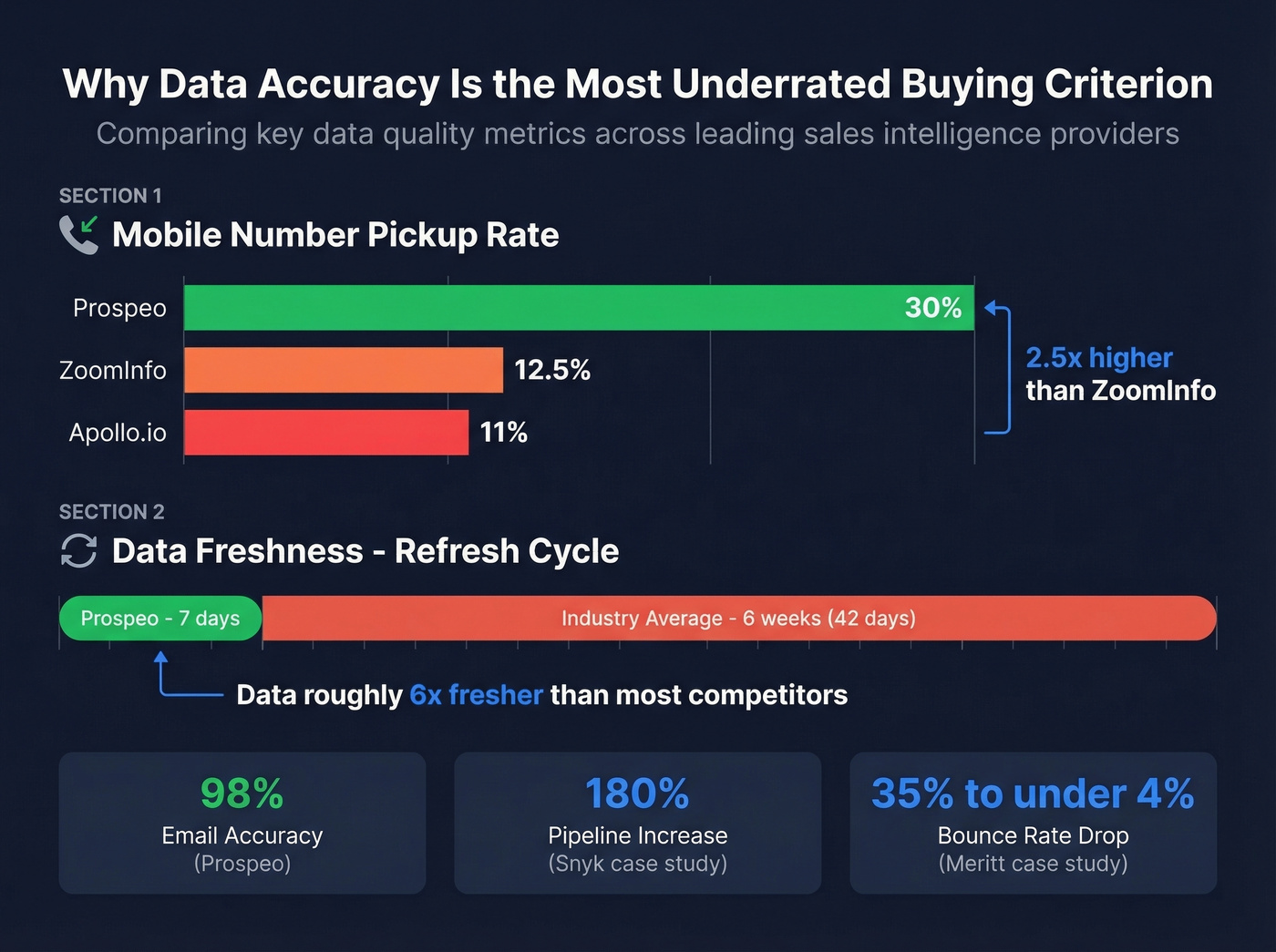
Prospeo's database covers 300M+ professional profiles, 143M+ verified emails, and 125M+ verified mobile numbers. The 98% email accuracy rate comes from a proprietary 5-step verification process with catch-all handling, spam-trap removal, and honeypot filtering. Mobile numbers carry a 30% pickup rate across all regions - 2.5x ZoomInfo's 12.5% and nearly 3x Apollo's 11%. (If you’re building lists, see our sales prospecting techniques.)

The 7-day data refresh cycle is the real differentiator. Industry average is six weeks. That means data roughly 6x fresher than most competitors, which directly impacts bounce rates and deliverability. Snyk's team of 50 AEs saw bounce rates drop from 35% to under 5% after switching, with AE-sourced pipeline up 180%. Meritt tripled pipeline from $100K to $300K per week, with bounce rates dropping from 35% to under 4%. (Related: email bounce rate benchmarks and fixes.)
Search filters go deep: 30+ options including buyer intent powered by 15,000 Bombora topics, technographics, job changes, headcount growth, funding signals, and department-level headcount. The Chrome extension has 40,000+ users and works across company websites, professional profiles, and CRMs. CRM enrichment returns 50+ data points per contact at a 92% API match rate. Teams using Prospeo book 26% more meetings than ZoomInfo users and 35% more than Apollo users.
Native integrations cover Salesforce, HubSpot, Salesloft, Outreach, Clay, Zapier, and Make, so it slots into whatever stack you're already running.
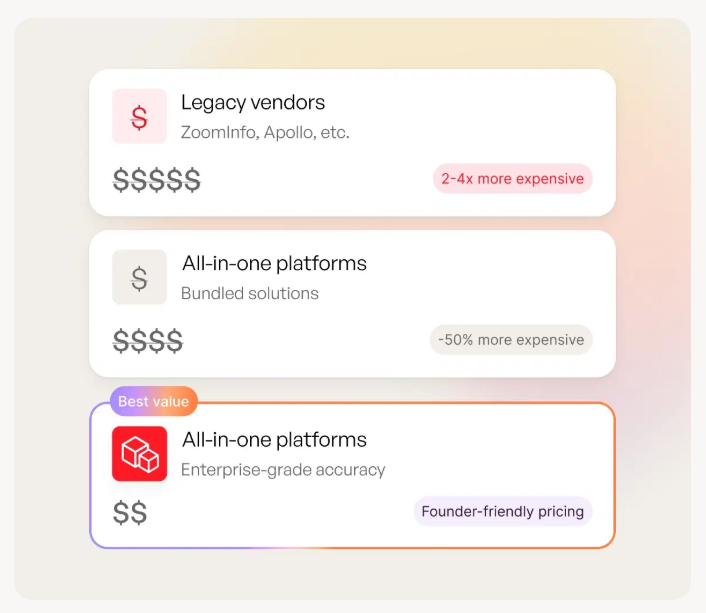
Pricing: free tier gives you 75 verified emails + 100 Chrome extension credits per month. Paid plans run about $0.01 per email with no contracts and no sales calls required - roughly 90% cheaper than ZoomInfo on a per-lead basis.

You just read that reps spend 72% of their week not selling. Bad data makes it worse - every bounce, every wrong number, every outdated contact is time your stack can't give back. Prospeo feeds your CRM and outreach tools with 98% accurate emails and 125M+ verified mobiles, refreshed every 7 days.
Fix the data layer and every tool in your stack performs better.
Cognism
Cognism is the go-to for European data. Phone-verified mobile numbers are its calling card, and GDPR compliance is baked in rather than bolted on. Expect to pay $1,000-3,000/month for small teams; pricing isn't public, so you'll talk to sales. If your outbound is heavily EMEA-focused, Cognism deserves a trial.
LinkedIn Sales Navigator
Sales Navigator is a research tool, not a data export tool. Important distinction. Core is $79.99/month on annual billing, Advanced is $139.99/month, and Advanced Plus is custom starting at $1,600/year per seat. It's excellent for account mapping and finding the right people, but you'll need a separate tool to actually get their contact information and reach them outside the platform.
Sales Engagement & Outbound
Apollo.io
Apollo is the Swiss Army knife of outbound: database, sequencing, and a dialer in one platform. For teams that don't want to manage three separate tools, it's the obvious starting point. The free plan is functional enough for real testing. (If you’re shopping by role, start with these SDR tools.)
The catch is accuracy. Apollo's email accuracy runs lower than dedicated data providers, and the credit-based model means your real cost is 20-30% above sticker price once you start revealing mobile numbers and exporting at volume. If deliverability is your top priority, pair Apollo's sequencing with a dedicated data source rather than relying on Apollo for both.
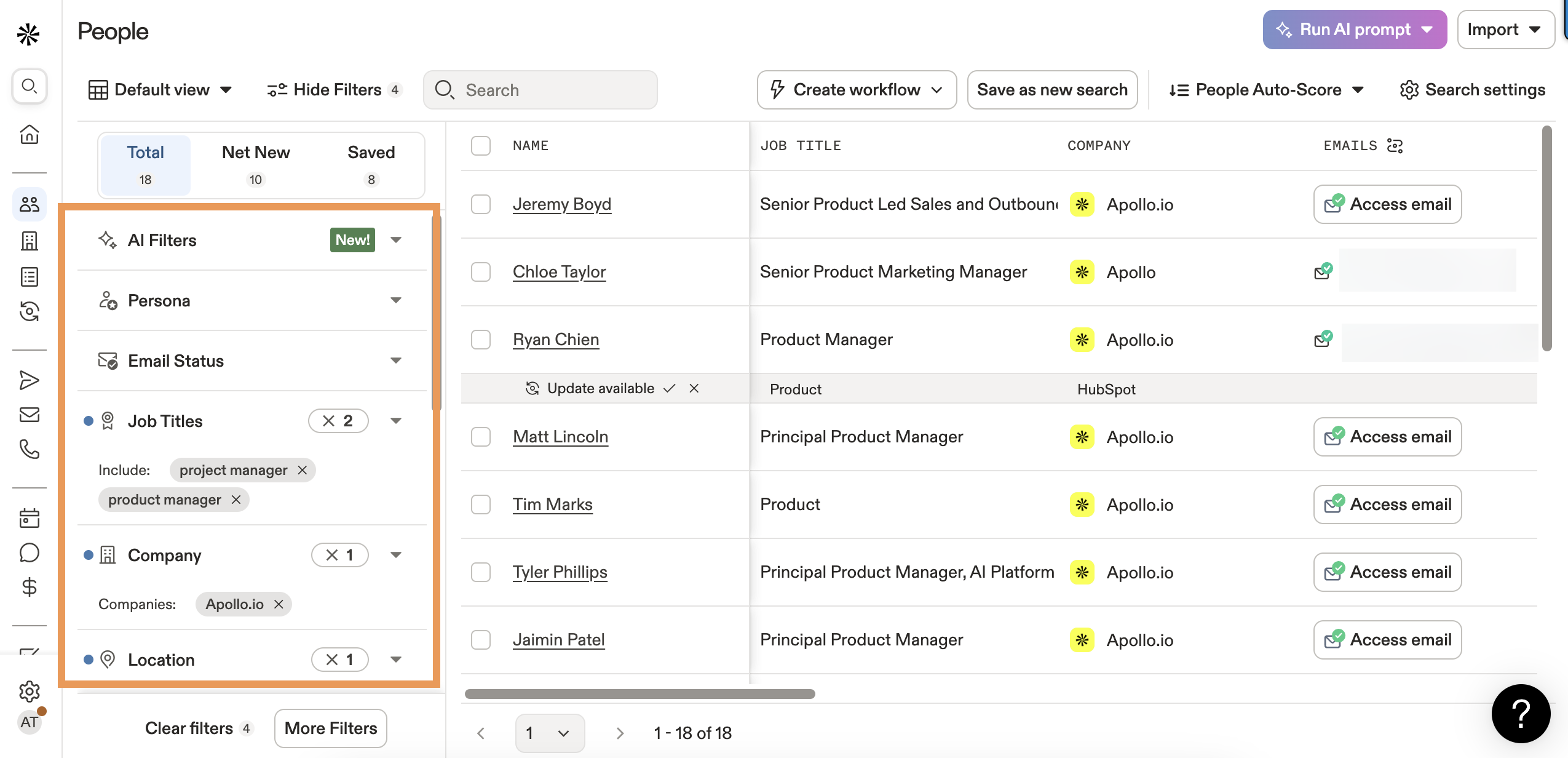
Pricing: Free / Basic $49/user/month / Professional $79/user/month / Organization $119/user/month, all annual. Organization requires minimum 3 users. Monthly billing adds ~20-25% on top. Budget for credit overages - mobile number reveals eat credits fast, and advanced filters are gated to higher tiers.
SalesLoft
Salesloft is the enterprise engagement platform: cadences, analytics, deal intelligence, and AI-assisted workflows. It's powerful. It's also frustratingly opaque on pricing. The fact that Salesloft doesn't publish pricing on their pricing page is a choice. You're selling to salespeople. They know what you're doing. (If you’re rolling out a platform like this, read our guide to implementing a sales engagement platform.)
List price runs ~$180/user/month for the Advanced plan, though teams typically negotiate 35-45% off. Expect $100-125/user/month after negotiation. The dialer is an add-on at roughly $7,500/year for 25 users, and a 25-seat deployment with calling often lands around $60-75K/year. It's worth it for teams running complex, multi-touch enterprise sequences. For everyone else, Apollo or a CRM's built-in sequencing will get you 80% of the way there.
Conversation Intelligence & Closing
Gong
Gong is the standard for call recording and conversation intelligence. Every enterprise AE stack we've seen includes Gong or a Gong competitor, and Gong usually wins. It captures calls, surfaces coaching insights, and gives managers visibility into what's actually happening on calls versus what reps report in Salesforce.
Pricing runs $100-150/user/month for mid-market teams, with enterprise contracts landing $30-50K+/year. Not cheap, but the ROI case is straightforward: if Gong helps your team close even one extra deal per quarter, it pays for itself.
PandaDoc
PandaDoc earned a G2 top 5 spot for 2026, which surprises people who think of it as "just" a proposal tool. It handles proposals, quotes, contracts, and e-signatures in one workflow. Pricing starts at $19/user/month on annual billing. For teams where the bottleneck is getting deals signed rather than finding them, PandaDoc is the right investment. (If you want the full process, see the steps to close a sale.)
Clay
Clay is the data orchestration layer for signal-based prospecting. It pulls from 75+ data providers, lets you build enrichment workflows visually, and feeds clean data into your sequencer. Free tier available, paid plans from $149/month. It's not a replacement for a CRM or a database - it's the glue between them. Reddit's r/sales crowd consistently names it as a top lead gen pick.
Consensus
Consensus made G2's 2026 top 5 as a demo automation and buyer enablement platform. It lets prospects watch interactive product demos on their own time, which shortens sales cycles for complex products. Expect $500-2,000/month based on similar buyer enablement platforms. Worth evaluating if multiple stakeholders need to see the product before your champion can push the deal forward.
The article math is simple: a $0.01/email tool with 98% accuracy outperforms a $1/lead tool at 87%. Prospeo gives you 300M+ profiles, 30+ search filters including buyer intent and technographics, and native integrations with HubSpot, Salesforce, Salesloft, and every sequencer on this list. No contracts, no sales calls.
Build your sales stack on data that actually connects you to buyers.
Pricing at a Glance
Every tool in one table. Where a vendor hides pricing, we've estimated based on community data and negotiation benchmarks.
| Tool | Category | Starting Price (Annual) | Free Tier? | Model |
|---|---|---|---|---|
| HubSpot Sales Hub | CRM | $20/user/mo | Yes | Per-seat |
| Salesforce Sales Cloud | CRM | $25/user/mo | No | Per-seat + add-ons |
| Pipedrive | CRM | $14/seat/mo | 14-day trial | Per-seat |
| Zoho CRM | CRM | $14/user/mo | Yes (3 users) | Per-seat |
| Freshsales | CRM | $9/user/mo | Yes | Per-seat |
| monday CRM | CRM | $12/seat/mo | Yes (2 users) | Per-seat |
| Prospeo | Data & Intelligence | Free / ~$0.01/email | Yes (75 emails/mo) | Credit-based |
| Cognism | Data & Intelligence | ~$1,000/mo | No | Custom |
| Sales Navigator | Research | $79.99/mo | No | Per-seat |
| Apollo.io | Engagement + Data | $49/user/mo | Yes | Per-seat + credits |
| Salesloft | Engagement | ~$100-125/user/mo | No | Custom |
| Gong | Conversation Intel | ~$100/user/mo | No | Per-seat |
| PandaDoc | Proposals & Closing | $19/user/mo | Yes (eSign only) | Per-seat |
| Clay | Data Orchestration | $149/mo | Yes | Credit-based |
| Consensus | Demo Automation | ~$500-2,000/mo | No | Custom |
What a Real Sales Stack Looks Like
One enterprise AE on Reddit shared their full stack: Salesforce + Outreach + Gong + Sales Navigator + Dooly. That's five tools before you count data providers - a $50K+/year commitment per rep when you add it all up.
Every stack needs a verified data source. Without one, your CRM fills with stale contacts, your sequences bounce, and your domain reputation tanks. (If you’re starting from $0, these free lead generation tools are worth testing.)

How to Choose the Right Tools
Start with your biggest bottleneck, not the shiniest feature. Every tool purchase should map to one of three decision axes.
Team size determines complexity tolerance. Under 10 reps? You need tools that work out of the box. Over 50? You need platforms that handle permissions, territories, and custom objects without breaking.
Budget is more than sticker price. A $49/month tool with a credit system that costs $200/month in practice is a $200/month tool. Factor in onboarding fees, add-ons like Salesloft's dialer, and the admin hours to maintain integrations. In our experience, the biggest cost driver isn't any single tool - it's the overages and onboarding fees that weren't in the original quote.
Primary pain point should drive your first purchase. Can't see your pipeline clearly? Start with a CRM. Have pipeline visibility but can't fill it? Start with a data tool. Reps are booking meetings but losing deals? Invest in conversation intelligence. Emails bouncing and domain reputation tanking? Fix data quality before anything else. (If deliverability is a priority, start with this email deliverability guide.)
For enterprise buyers: build your requirements checklist before you demo anything. SOC 2, ISO 27001, and GDPR compliance are baseline. ERP and marketing automation integrations are non-negotiable. Mobile-first access and offline capability matter if you have field reps. Get these on paper first. It'll cut your shortlist in half before you sit through a single demo.
FAQ
What is sales software?
Sales software is any tool that helps you find prospects, manage deals, engage buyers, or close revenue. The four main categories are CRM (pipeline management), sales intelligence (contact data and enrichment), engagement platforms (sequencing and outreach), and conversation intelligence (call recording and coaching). Most teams need at least one tool from each category.
How much does a full sales stack cost?
Most mid-market teams spend $50-150/user/month across their full stack. Entry-level setups like Pipedrive + Prospeo + PandaDoc run under $100/user/month, while enterprise deployments with Salesforce, Salesloft, and Gong can exceed $300/user/month before add-ons and onboarding fees.
Which free tools are worth starting with?
HubSpot's free CRM is the most full-featured option for pipeline management. Prospeo's free tier includes 75 verified emails and 100 Chrome extension credits monthly - enough to test data quality on real campaigns. Zoho CRM is free for up to 3 users. Apollo's free plan includes basic search and limited credits.
Do I need a CRM and a separate prospecting tool?
Yes, for most teams. CRMs manage your pipeline; prospecting tools find the people to put in it. Apollo combines both, but dedicated tools typically outperform all-in-ones at scale. Pairing a strong CRM with a dedicated data platform gives you better pipeline management and better data than any single tool trying to do everything.
What does "AI-powered" actually mean in 2026?
Ask whether the feature takes autonomous action (an agent) or just suggests next steps (an assistant). True AI agents book meetings, update CRM fields, and route leads without human intervention. Most "AI-powered" features today are still assistants - helpful, but not the autonomous revolution vendors imply. Gartner calls this gap "agentwashing."