

The Sales Software Stack You Actually Need in 2026
A RevOps lead we know ran a stack audit last quarter. Fourteen tools. $2,800 per rep per month. Three hadn't been logged into since onboarding. If your sales software stack feels like it's slowing the team down instead of speeding it up, the stack itself is the problem.
84% of reps missed quota last year. Reps spend 60% of their time on non-selling tasks. And 29% of sales pros say reducing their tech stack would make them more efficient. You don't need 15 tools that don't talk to each other. You need 5-7 that do.
Our Picks (TL;DR)
If we were building a sales tool stack from scratch for a 5-person team:
| Layer | Tool | Why |
|---|---|---|
| CRM | HubSpot | Free tier, live in a day |
| Data | Prospeo | 98% email accuracy, free tier |
| Engagement | Outreach or Salesloft | Sequencing + analytics |
| Call intel | Gong | Recording + coaching |
| Scheduling | Chili Piper | Speed-to-lead routing |
Five tools. Typically $150-$400/rep/month at SMB tier, depending on seats and add-ons.
The 7 Layers Every Stack Needs
CRM
Use HubSpot if you're under 50 reps and want pipeline visibility this week. The free CRM is genuinely usable, and paid Sales Hub starts around $20/user/month.
Skip HubSpot if you need complex CPQ, territory management, or multi-entity reporting. You'll end up on Salesforce - $165/user/month+ and worth it at scale, but plan for months of implementation and a dedicated admin.
Data & Enrichment
This layer makes or breaks everything downstream. Your sequencer, AI tools, and forecasting all run on contact data quality. Bad data burns domain reputation, tanks deliverability, and makes reps distrust the entire stack. We've seen teams rebuild trust in their tooling just by fixing this one layer. (If you want a broader vendor landscape, start with data enrichment options.)
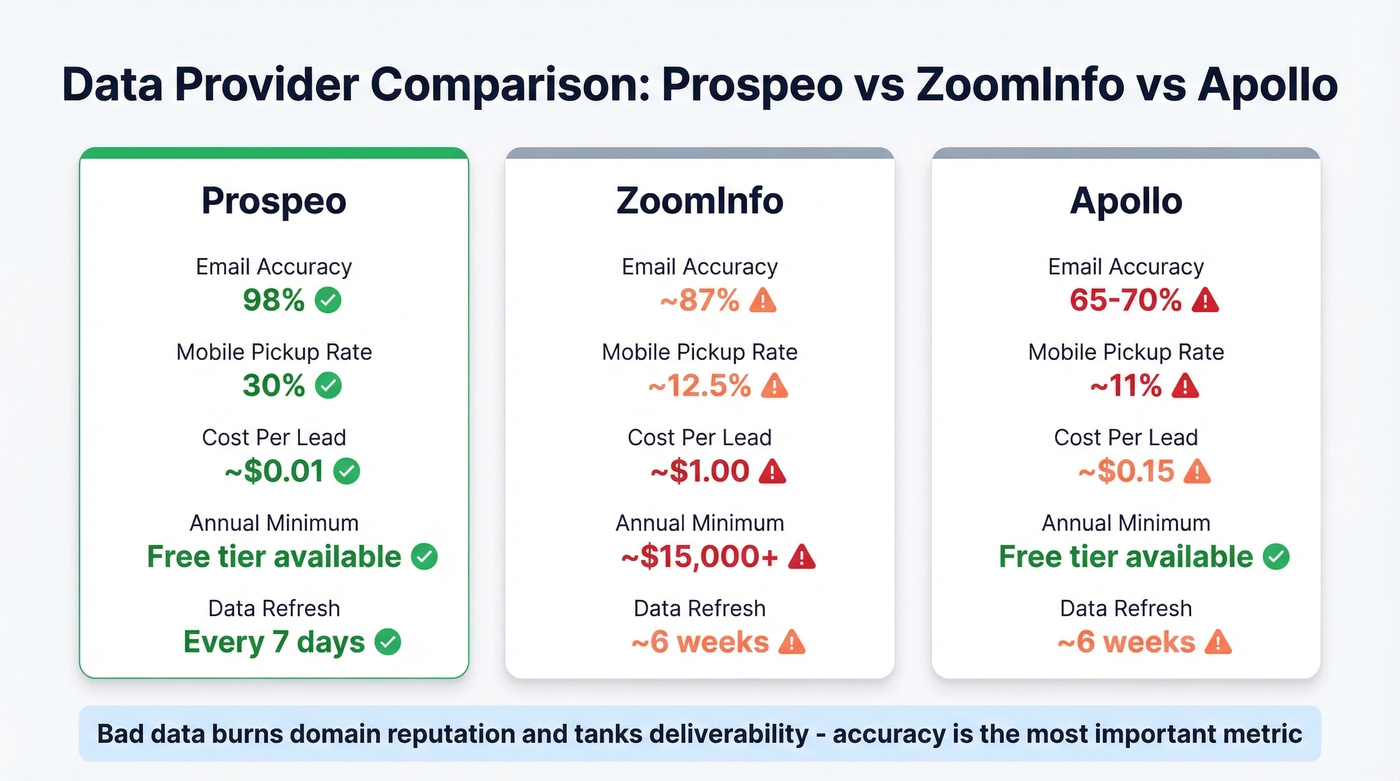
Prospeo covers 300M+ professional profiles with 143M+ verified emails at 98% accuracy and 125M+ verified mobile numbers. That mobile coverage delivers a 30% pickup rate across all regions, versus 12.5% at ZoomInfo and 11% at Apollo. Data refreshes every 7 days where the industry average is 6 weeks. One customer cut bounce rates from 35% to under 4% and tripled weekly pipeline from $100K to $300K/week. At roughly $0.01 per lead, it's a fraction of what you'd pay for ZoomInfo.

Here's the thing about ZoomInfo: the consensus on r/sales is that pricing is "insane for small teams" - $15k+/year with auto-renewal and cancellation-window clauses that catch people off guard. Apollo is the budget alternative at $49-$119/user/month, but community-reported email accuracy runs 65-70% and bounce rates climb fast outside the US. (If you're troubleshooting bounces, see email bounce rate benchmarks and fixes.) Apollo also had data breach incidents in 2018 and 2021, which is worth knowing if your security team asks questions.
| Provider | Email accuracy | Mobile pickup | Cost/lead | Annual min |
|---|---|---|---|---|
| Prospeo | 98% | 30% | ~$0.01 | Free tier |
| ZoomInfo | ~87% | ~12.5% | ~$1.00 | ~$15k |
| Apollo | ~65-70% | ~11% | ~$0.15 | Free tier |

Your sequencer, call intel, and forecasting tools all depend on one thing: data quality. Prospeo delivers 98% email accuracy, 125M+ verified mobiles with a 30% pickup rate, and refreshes every 7 days - not every 6 weeks. One team tripled pipeline from $100K to $300K/week after switching.
Fix the data layer and the rest of your stack actually works.
Sales Engagement
Outreach and Salesloft both typically run $100-$200/seat/month on enterprise contracts. Outreach edges ahead on workflow complexity and A/B testing. Salesloft is cleaner for teams that want less configuration overhead. Honestly, pick either - the data feeding your sequences matters more than which sequencer you choose. (If you're implementing this layer, use a simple sequence management standard so reps don't freestyle.)
Conversation Intelligence
We've watched enterprise AEs go from spending 30+ minutes after every call on notes to dictating a quick summary and moving on. That time adds up fast. Gong records, transcribes, and surfaces deal risk signals automatically, often landing around $100-$150/user/month. It's not cheap, but if your AEs run more than 5 calls a week, it pays for itself in coaching data alone.

Scheduling & Routing
Chili Piper starts at $45/user/month and solves the "lead sits in a queue for 3 hours" problem. Up to 50% of sales go to the first vendor to respond - this is a quick win with real revenue impact. Default ($500/month) is the heavier option for teams that need workflow orchestration baked into routing.
Forecasting
Clari is the enterprise standard for pipeline inspection. Expect $1,000-$3,000/month. Skip it under 20 reps - HubSpot or Salesforce reporting covers the basics just fine. Add Clari when your CRO starts asking "why did that deal slip?" on a weekly basis and nobody has a good answer. (If you're comparing options, see sales forecasting solutions.)
AI & Automation
Let's be honest: most teams should buy fewer AI tools, not more. Sellers who partner with AI are 3.7x more likely to meet quota, but 76% of enterprises experienced negative outcomes from disconnected AI tools. The economics of AI SDR platforms ($500-$2,000/month versus $75k-$139k/year for a human SDR) are hard to ignore, but the implementation reality is messier than vendors admit. Start with one use case. Prove ROI over 3-6 months. Then expand. (For a practical shortlist, see generative AI sales tools.)
What a Sales Stack Costs
| Layer | Tool | Starting price |
|---|---|---|
| CRM | HubSpot | Free-~$20/user/mo |
| Data | Prospeo | ~$0.01/lead, free tier |
| Engagement | Outreach | ~$100-$200/seat/mo |
| Call intel | Gong | ~$100-$150/user/mo |
| Scheduling | Chili Piper | $45/user/mo |
| Forecasting | Clari | ~$1k-$3k/mo |
| AI/automation | Varies | $500-$2k/mo |
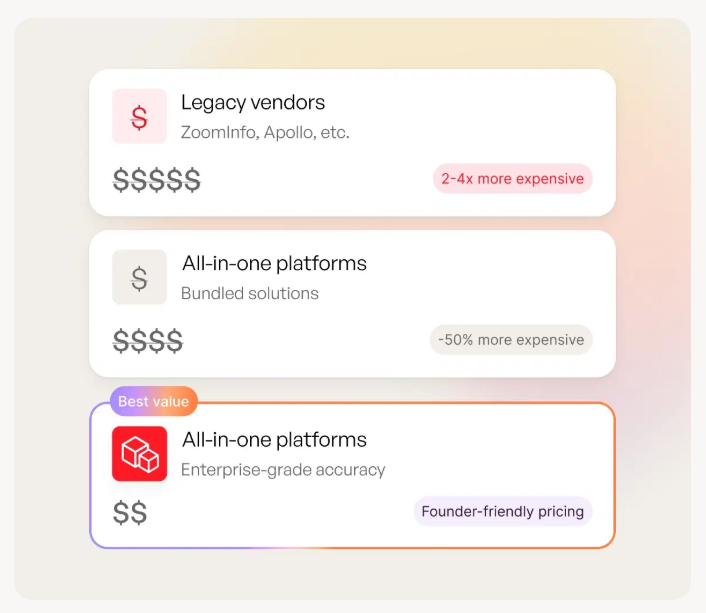
SMB teams land at $150-$400/rep/month. Mid-market runs $400-$900. Enterprise stacks with intent data, forecasting, and conversation intelligence push $900-$2,000+. The biggest variable is always the data layer - ZoomInfo alone can eat half your budget. (To sanity-check your numbers, compare against sales pipeline benchmarks.)
ZoomInfo can eat half your sales stack budget at $15K+/year. Prospeo gives you 300M+ profiles, 30+ search filters with intent data, and native integrations with HubSpot, Salesforce, Outreach, and Salesloft - at roughly $0.01 per lead. No contracts. No sales calls.
Cut your data costs by 90% without cutting accuracy.
Building Your Stack by Team Size
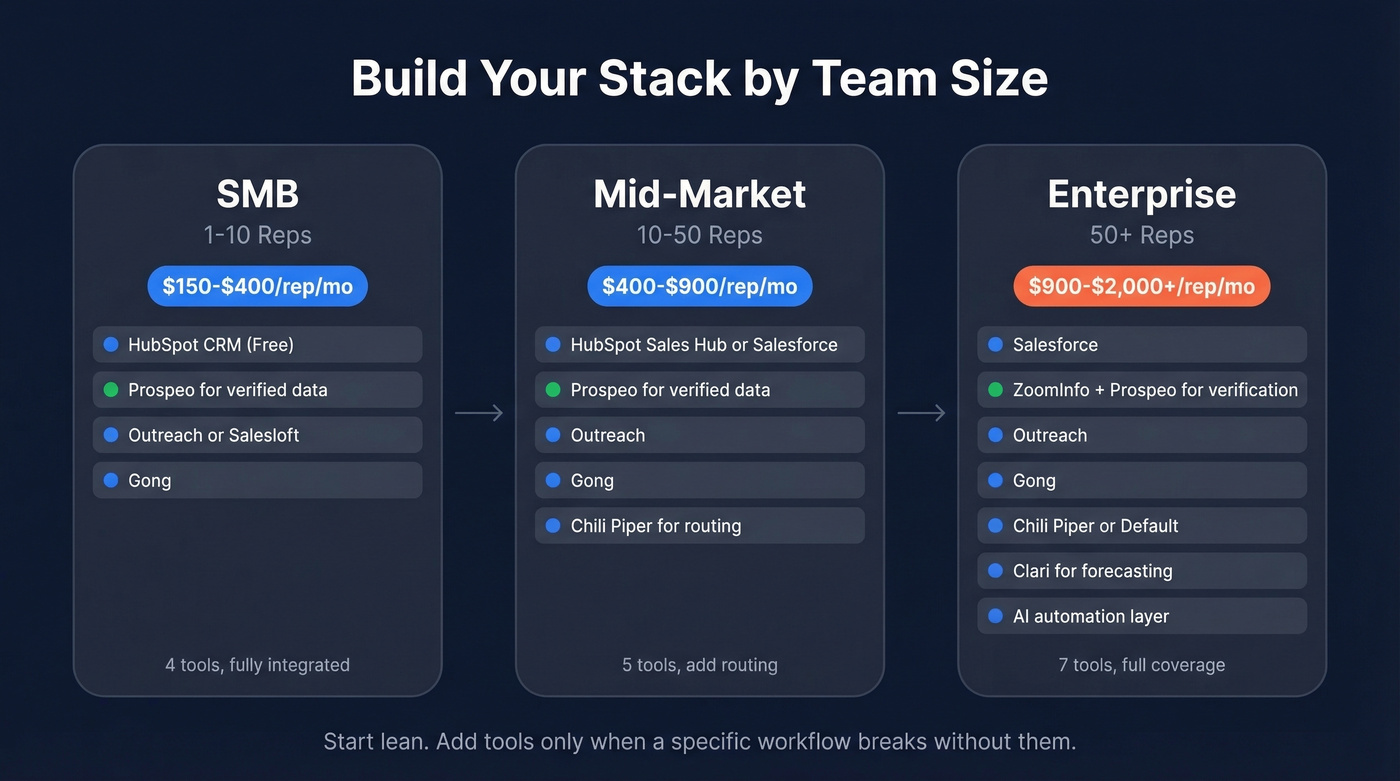
SMB (1-10 Reps)
$150-$400/rep/month. HubSpot CRM (free) + a verified data layer + Outreach or Salesloft + Gong. A UK sales leader on r/sales recommended Lusha ($22-$52/user/month) + HubSpot + Apollo as a starting point, but the accuracy trade-offs at Lusha (60-65%) and Apollo (65-70%) mean you're burning domain reputation to save a few dollars. That's a bad trade. (If you're bootstrapping, start with free lead generation tools before committing to annual contracts.)
Mid-Market (10-50 Reps)
$400-$900/rep/month. HubSpot Sales Hub or Salesforce + the same data layer + Outreach + Gong + Chili Piper. Adding scheduling and routing reflects the complexity of managing pipeline across multiple territories - without it, leads fall through cracks that nobody notices until the end-of-quarter review. (This is where lead generation workflow discipline starts to matter.)
Enterprise (50+ Reps)
$900-$2,000+/rep/month. Salesforce + ZoomInfo for intent and firmographics + a verification layer for email and mobile accuracy + Outreach + Gong + Clari + Default. One enterprise AE on Reddit shared their actual stack: Salesforce + Outreach + Gong + Dooly, plus Sales Navigator. Solid foundation. Add forecasting and data quality tools as you scale past 50 reps.
Common Stack Mistakes
Buying the all-in-one dream. Consolidation sounds smart until the "all-in-one" tool does three things okay and two things terribly. We've seen this play out repeatedly with teams that consolidate onto a single platform and then quietly re-buy point solutions six months later.
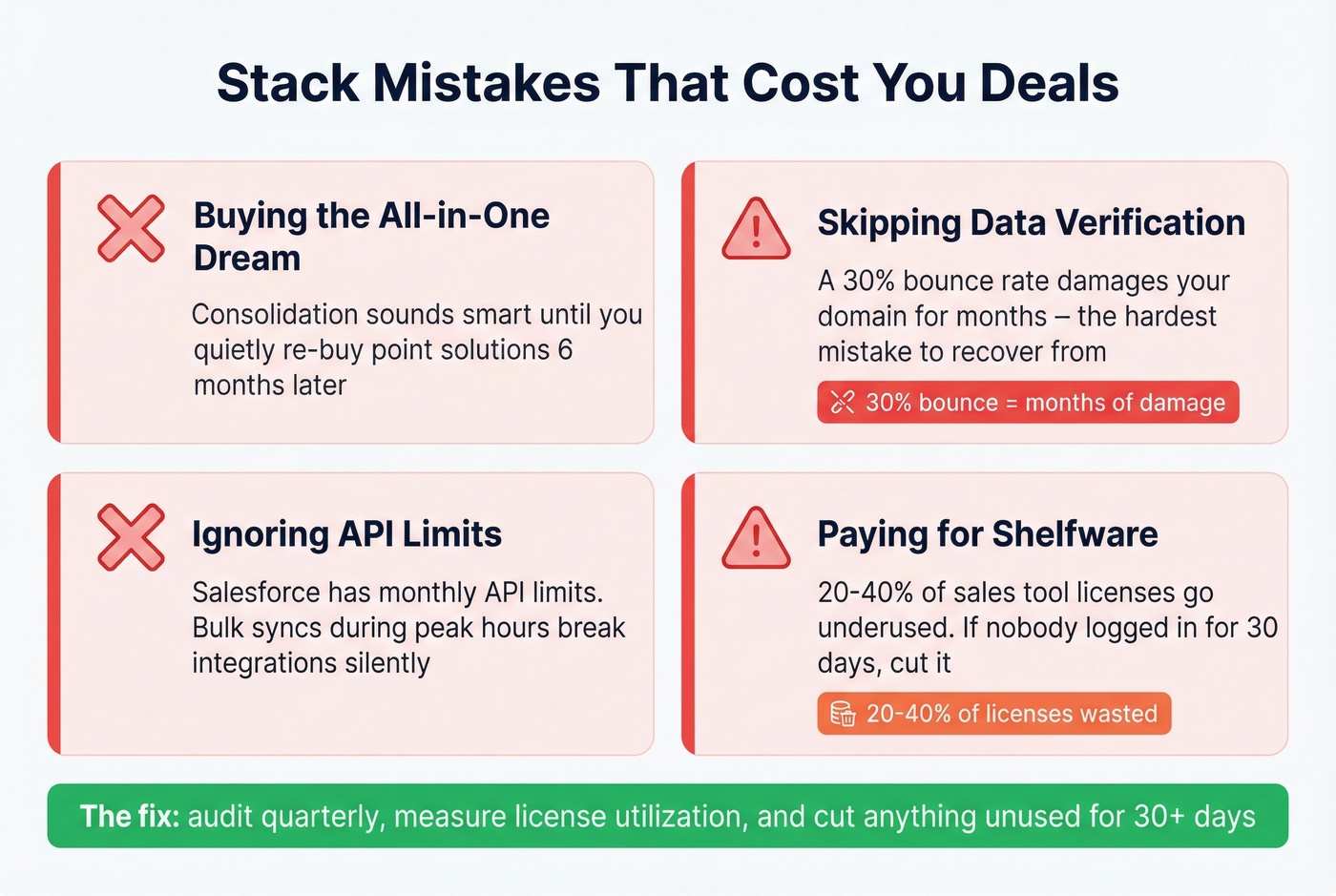
Skipping data verification. A 30% bounce rate doesn't just waste sends - it damages your domain for months. This is the mistake that's hardest to recover from. (If deliverability is already slipping, start with an email deliverability guide.)
Ignoring API limits. Salesforce has monthly API limits. Syncing too many fields or running bulk updates during peak hours breaks integrations silently, and your team won't know until pipeline data goes stale.
Paying for shelfware. 20-40% of sales tool licenses go underused. If a tool hasn't been logged into in 30 days, cut it. No exceptions.
How to Measure Stack ROI
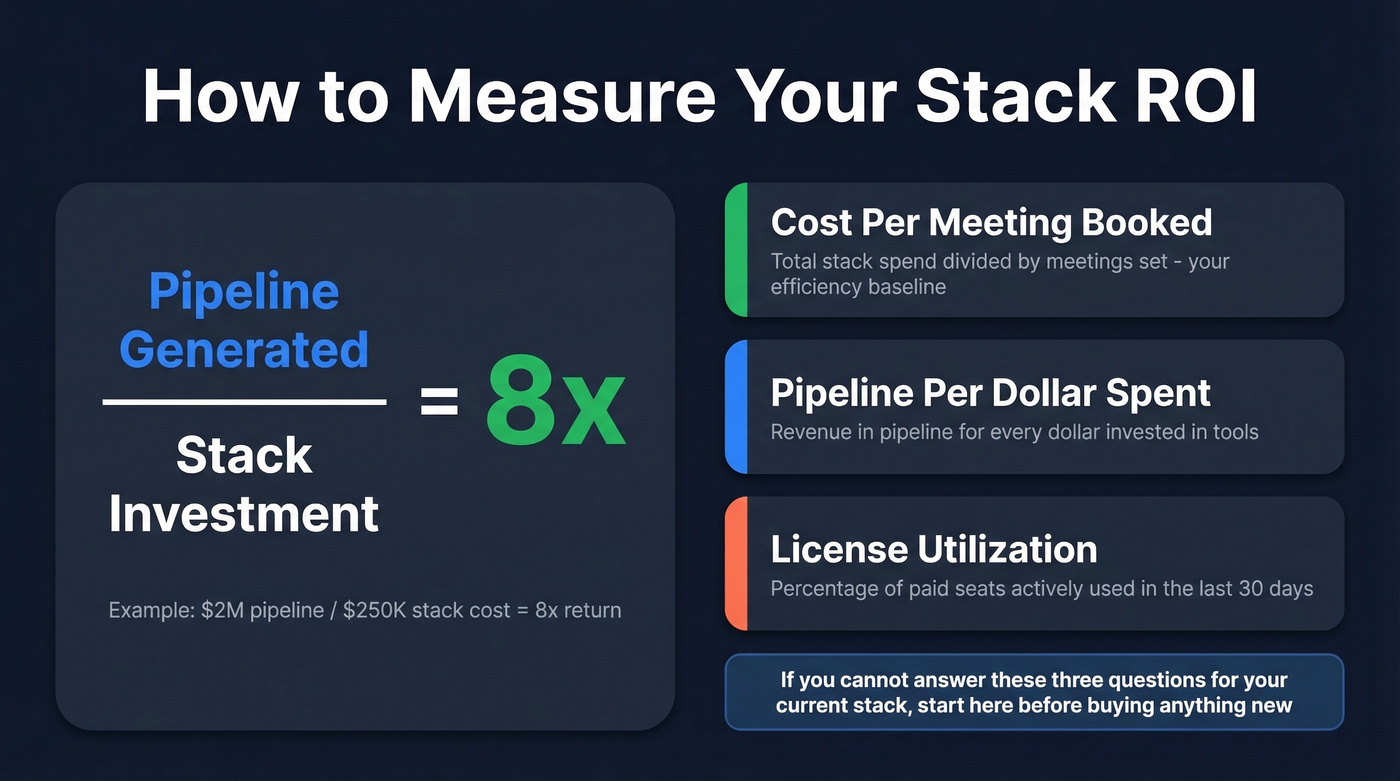
Pipeline Generated / Stack Investment. If your stack costs $250k/year and generates $2M in pipeline, that's 8x. Track three metrics: cost per meeting booked, pipeline per dollar spent, and license utilization. If you can't answer those for your current sales software stack, start there before adding new tools. Buying more software won't fix a measurement problem. (For the KPI set most teams miss, see sales operations metrics.)
FAQ
How many tools belong in a sales stack?
Five to seven, deeply integrated. Anything beyond that creates more context-switching than value. Over ten tools means you're paying for shelfware and fragmenting data across systems that don't sync.
What three tools should I buy first?
A CRM (HubSpot free tier), a verified data provider, and a sequencing platform like Outreach. Those three cover finding prospects, storing deals, and running outreach at scale.
What's the most important layer?
Data and enrichment. Every other tool runs on contact data quality. A 98% accurate email list converts fundamentally differently than a 65% accurate one - the gap compounds across every downstream metric from reply rates to closed revenue.
How much does a stack cost per rep?
SMB teams spend $150-$400/rep/month. Mid-market runs $400-$900. Enterprise pushes $900-$2,000+. The biggest cost variable is your data provider.
Can I build a stack for free?
Partially. HubSpot CRM is free, and providers like Prospeo offer free tiers with verified data. You'll outgrow them with real outbound volume, but they're enough to validate your workflow before committing budget.