

80+ Sales Statistics That Actually Matter in 2026
You've seen the sales statistics roundups. "80% of sales require 5 follow-ups." "Only 2% of cold calls result in appointments." Half these numbers trace back to studies from 2012 - or worse, to blog posts citing other blog posts citing a dead link. The stat-laundering problem in sales content is real, and most teams are benchmarking against ghosts.
We pulled every number here from primary research - no recycled blog-to-blog citations. Where a stat is older but still widely cited, we flag it. Where we're estimating, we say so. If you need data-backed benchmarks to guide your 2026 strategy, this is the list.
Quick Takeaways
If you're building a slide deck and need three numbers:
- Deals closed within 50 days hit a 47% win rate. After that threshold, win rate drops to about 20-21%.
- Reps spend 60% of their time on non-selling tasks. Admin, data entry, searching for contacts, and internal meetings are eating your pipeline.
- 94% of B2B buyers now use LLMs during their buying process. Your prospects are researching with AI before they ever talk to a rep.
Win Rates & Sales Performance
Win rates are the stat everyone wants and nobody agrees on. Here's what the freshest data shows.
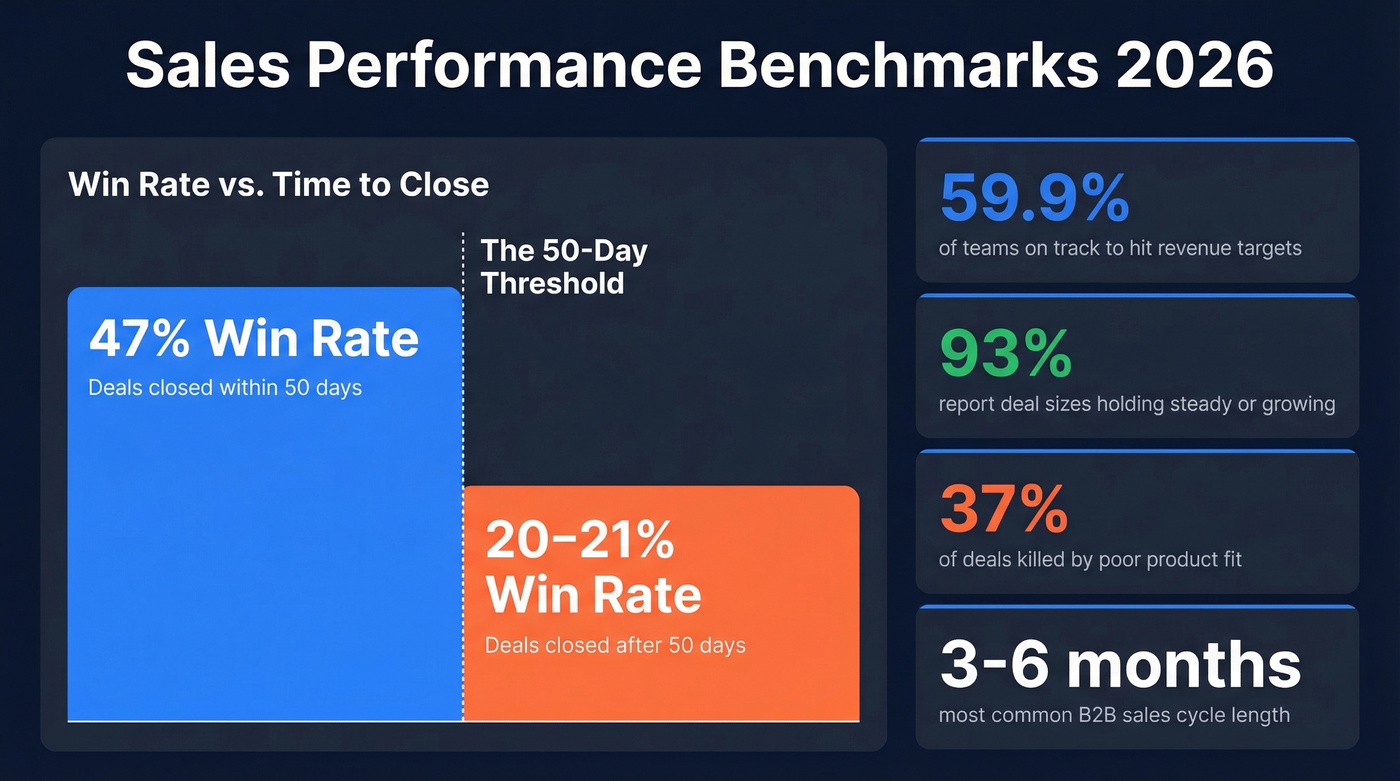
Opportunities closed within 50 days show a 47% win rate. After that window, win rate drops to around 20% or lower. Time-to-close is one of the strongest predictors of whether a deal lands.
Overall win rates trended downward in 2025. The largest bracket of teams now falls into the 21-25% range, down from 31-40% the year prior.
59.9% of sales teams are on track to meet or surpass revenue targets - which means 40% aren't. That's a lot of missed plans.
91% of teams report win rates that are stable or improving. Sounds contradictory to the downward trend, but it makes sense: survivors are optimizing while weaker teams churn out.
93% say average deal sizes are holding steady or growing. Fewer deals, bigger checks. That's the 2026 pattern.
ARR is the #1 success metric, cited by 42% of sales leaders. Profit margin (30%), customer conversion rate (29%), and win rate (28%) round out the top four.
Top deal-killers: no product fit at 37% and poor value for money at 35%. Not "bad sales process" - bad targeting. The deal was lost before the demo started.
34% of revenue teams report an average sales cycle of 1-2 full quarters, making 3-6 months the most common bracket for B2B deals.
Velocity matters more than volume. Teams that compress cycles and disqualify bad-fit deals early win at nearly double the rate of everyone else.
Prospecting & Cold Calling
Cold calling isn't dead, but the math is brutal without targeting.
The average salesperson generates 1 appointment per 209 cold calls. This number has circulated for years - it's older, but it's a useful baseline for untargeted dials.
Speed-to-lead remains one of the most reliable advantages in sales. The first vendor to respond wins 30-50% of deals.
73% of B2B buyers actively avoid sellers who send irrelevant outreach. Personalization isn't a nice-to-have. It's table stakes for getting a response.
68% of sales teams report lead quality improved year-over-year. Better data, better targeting, better intent signals - the tooling is catching up to the problem.
Up to 40% of a rep's time can go to searching for someone to call. That's not selling. That's Googling.
Reps who use intent data to prioritize outreach consistently outperform clock-based calling schedules. The "best time to call" is when the buyer is actively researching - not Tuesday at 10am.
Cold calling works when it's warm. Intent signals, verified contact data, and fast response times turn a 1-in-209 game into something far more productive.
Cold Email & Outreach Benchmarks
Cold email is the most measurable outbound channel, and the Instantly 2026 benchmark report gives us the clearest picture of what "good" looks like right now.
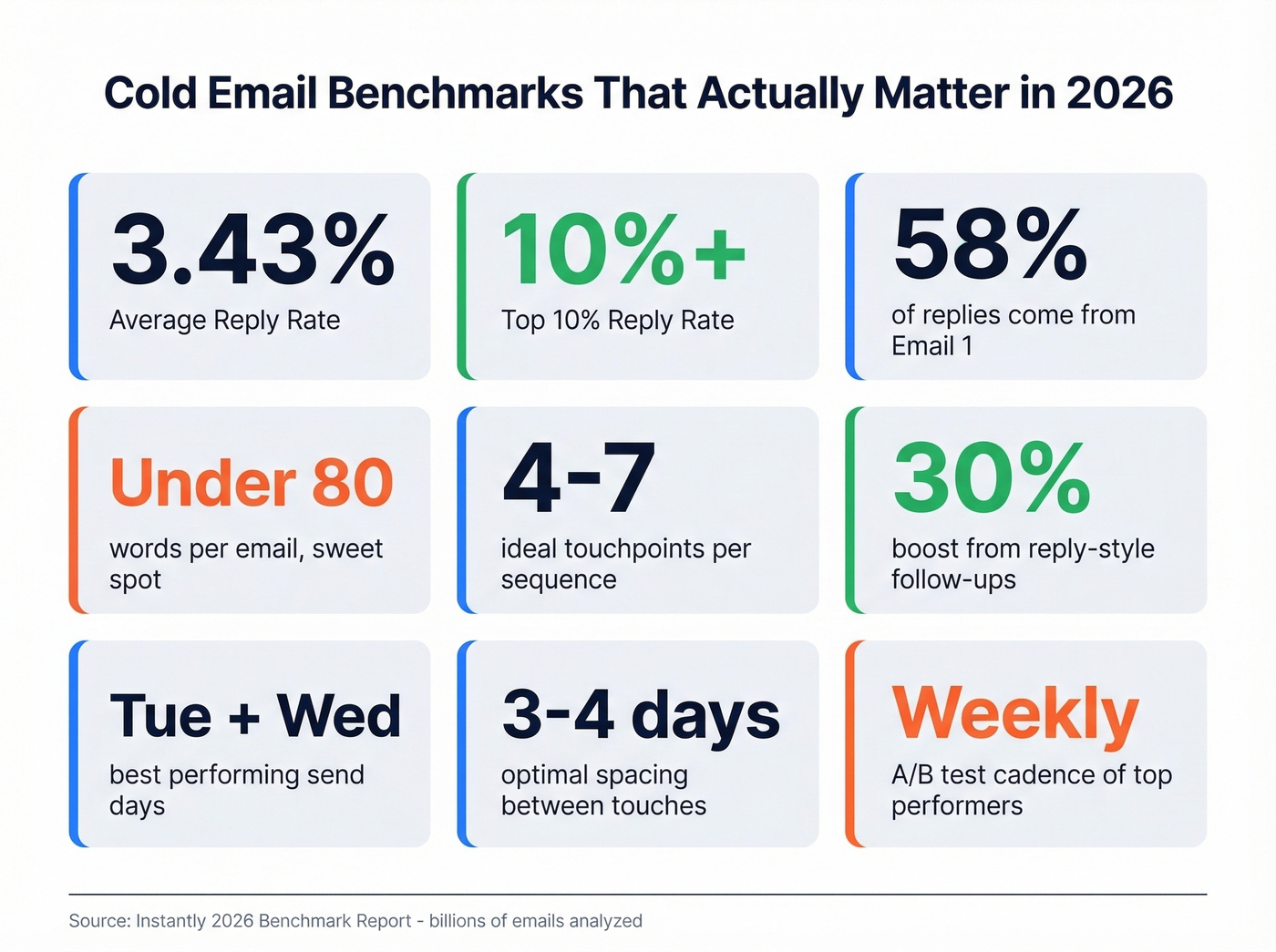
Average cold email reply rate: 3.43%. That's across billions of sends. If you're hitting 3.5%, you're average. Not bad - average.
Elite campaigns (top 10%) exceed a 10% reply rate. Top quartile hits 5.5%. The gap between average and great is enormous.
58% of all replies come from the first email. Your step-1 copy matters more than your entire follow-up sequence.
Best-performing days: Tuesday and Wednesday, with Wednesday slightly ahead. Monday and Friday are the worst.
Emails under 80 words perform best. Brevity wins. Every time.
The sweet spot for sequence length is 4-7 touchpoints. Beyond 7, diminishing returns kick in unless each touch adds genuinely new value.
Reply-style follow-ups outperform formal follow-ups by about 30%. "Hey, did you see my last note?" beats a re-pitched value prop.
Spacing touches 3-4 days apart is optimal. Tighter than that feels aggressive; wider loses momentum.
A/B testing weekly is a common trait among top-performing campaigns. The best senders treat every week as an experiment.
Field Note - One Operator's Results
A cold email operator on r/Entrepreneur shared a detailed breakdown of their optimization journey. Reply rate went from 3% to 6% after fixing infrastructure, cleaning their list, and shortening emails from 141 words to under 56. Bounce rate dropped from 11% to under 2%. Sending window: Tuesday-Thursday, 8-11am. Result: 16 qualified leads per month on a ~$420/month stack - about $26 per qualified lead from cold email alone.
Every stat in this section is downstream of data quality. A 3.43% reply rate assumes your emails actually land. If your bounce rate is 11%, you're not even in the game.
B2B Buyer Behavior in 2026
This is the most important shift happening in sales right now, and most teams haven't caught up.
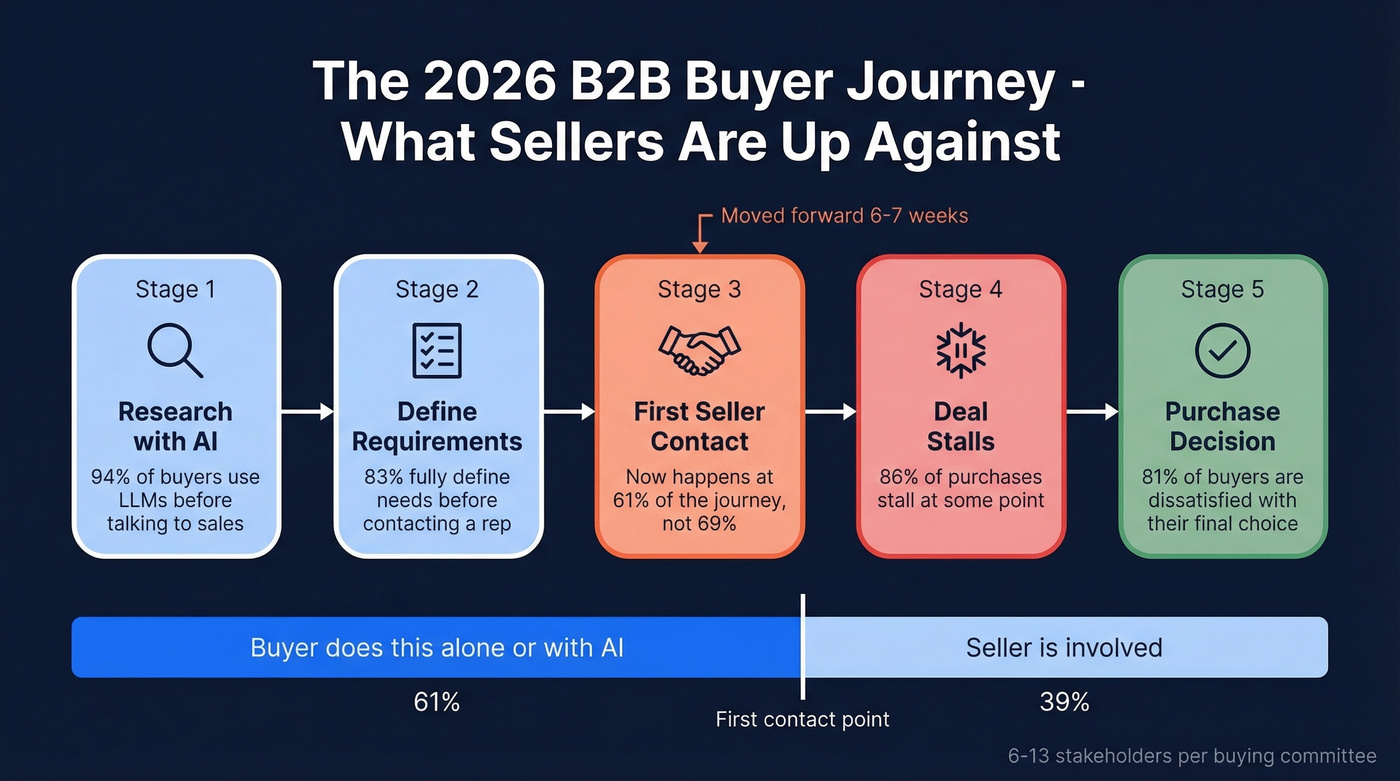
The average B2B sales cycle dropped from 11.3 months in 2024 to 10.1 months in 2025 - and the reason is economic pressure, not efficiency gains. 62% of buyers say financial pressures pushed them to engage sellers earlier than planned, and 49% say economic conditions directly shortened their buying cycles. The point of first contact moved from 69% of the buyer journey to 61%, pulling outreach forward by 6-7 weeks. Buyers aren't waiting around anymore.
But "engaging earlier" doesn't mean "less prepared." 83% of buyers mostly or fully define their purchase requirements before speaking with sales. By the time you get the meeting, the shortlist is already built. Only 19% of customers trust salespeople - which means your credibility is on trial from the first interaction.
The AI layer makes this even more dramatic. 94% of B2B buyers use LLMs during their buying process - they're asking ChatGPT, Perplexity, and Claude about your product before they ask you. 89% of buyers purchase solutions that include AI features, so AI isn't just a sales tool, it's a buying criterion. And 72% of buyers encountered Google AI Overviews during research, with 90% clicking through to at least one cited source. AI Overviews aren't killing clicks - they're reshaping which clicks happen.
86% of B2B purchases stall at some point. Deals don't die - they freeze.
And 81% of buyers report being dissatisfied with the provider they ultimately chose. That's staggering. Most deals are won by default, not by excellence. Buying committees typically run 6-13 stakeholders depending on deal size and complexity, and every unstaked stakeholder is a potential veto.
The pattern is clear: buyers are more informed, more AI-assisted, and more likely to stall than ever. Sellers who show up with generic pitches to a committee that's already 61% through their journey are playing catch-up from the first call.

Every cold email stat above is downstream of data quality. A 3.43% reply rate assumes your emails actually land. Prospeo's 98% email accuracy and under-4% bounce rates mean your outreach hits inboxes - not spam folders. At $0.01 per email, bad data is no longer an excuse.
Fix your bounce rate before you optimize your copy.
AI Adoption & Impact
56% of sales professionals now use AI daily. Those daily users are twice as likely to exceed their targets. HubSpot tracked AI adoption among reps rising from 24% in 2023 to 43% in 2024. Gartner found that reps who partner with AI tools are 3.7x more likely to meet quota.
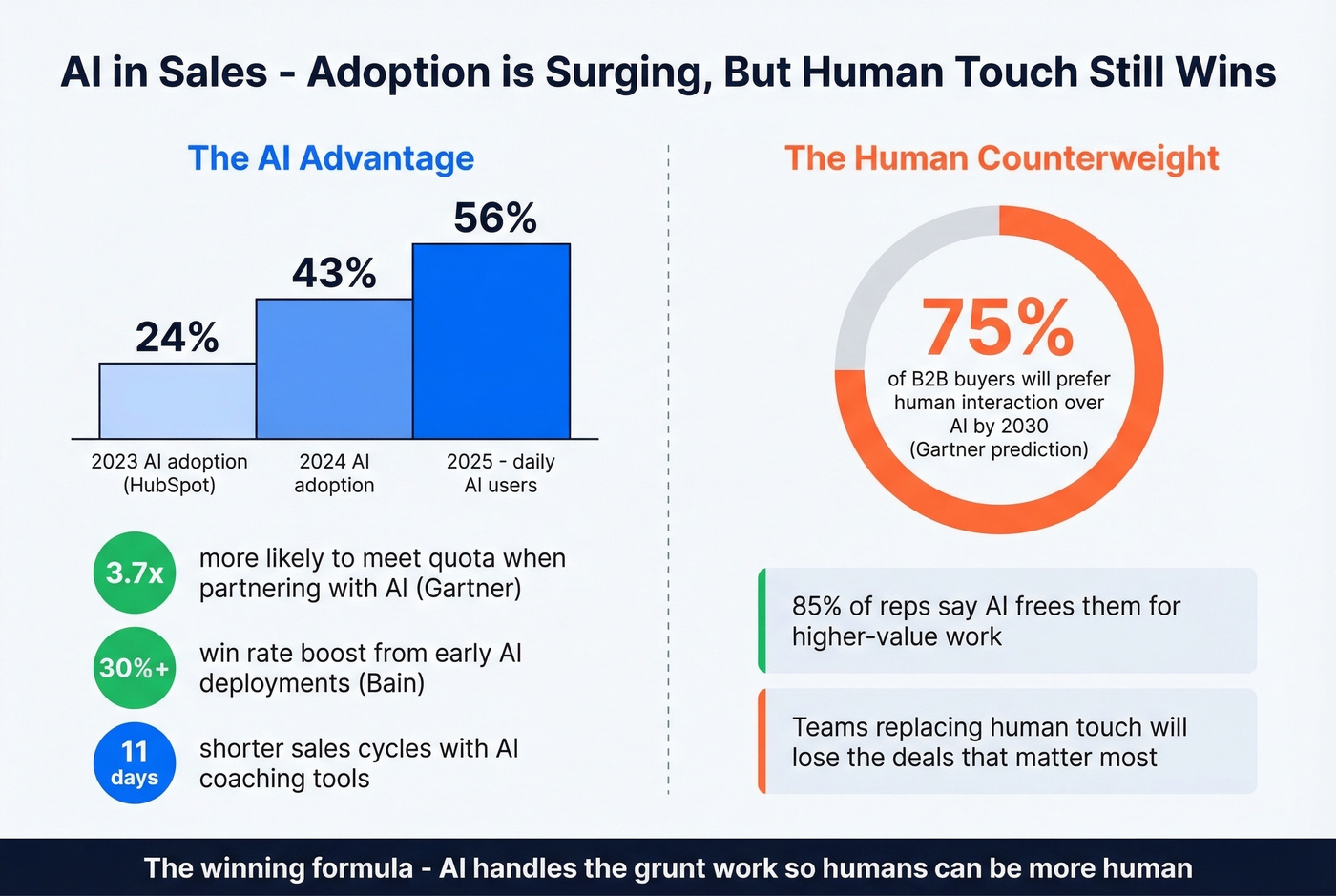
The impact on pipeline is measurable. Bain's 2025 research showed early AI deployments boosted win rates by 30% or more. Outreach's Kaia coaching assistant shaves 11 days off sales cycles on average, and for deals over $50K, Kaia users see up to a 10 percentage-point win-rate lift. 45% of teams are already running a hybrid AI-SDR model where AI handles initial research and personalization while humans run the conversations.
85% of reps say AI frees them to focus on higher-value work. That's not replacing the rep - that's removing the grunt work so they can actually sell.
Here's the contrarian data point that matters most. Gartner predicts that by 2030, 75% of B2B buyers will prefer sales experiences that prioritize human interaction over AI. The pendulum will swing back. AI handles the grunt work so humans can be more human, not less. Teams that use AI to eliminate admin and amplify empathy will win. Teams that use AI to replace the human touch will lose the deals that matter most.
Productivity & Data Quality
Here's the thing: every productivity stat in this article traces back to the same root cause. Bad data.
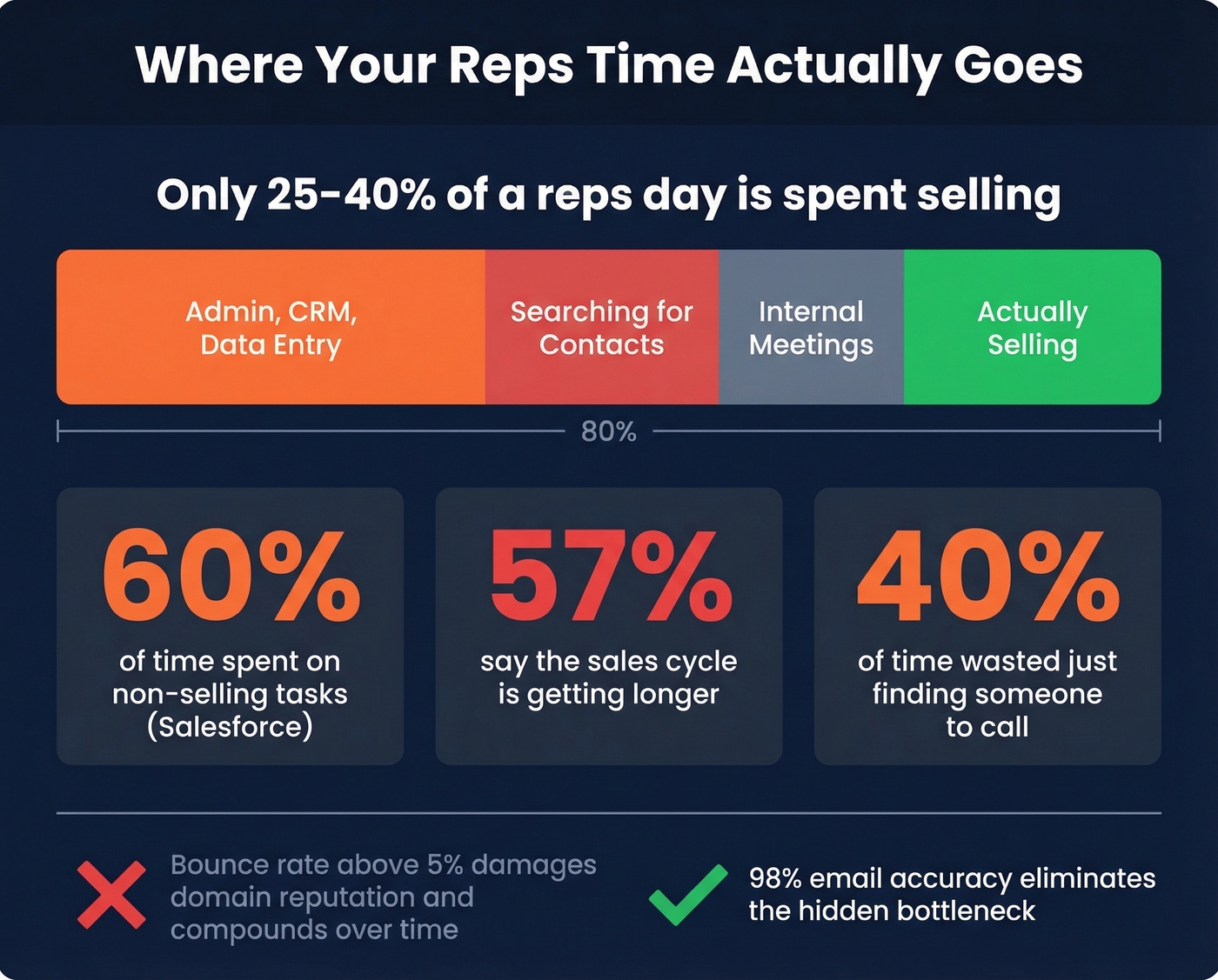
Reps spend 60% of their time on non-selling tasks. Bain's 2025 research puts the direct selling number even lower - about 25% of working hours. 57% of sales professionals say the sales cycle is getting longer. And up to 40% of a rep's time goes to searching for someone to call.
Not selling. Not building relationships. Searching.
The hidden multiplier behind all of this is contact data quality. When your bounce rate is 11%, your outreach stats will never improve regardless of how good your copy is. Bounce rates above 5% damage domain reputation, tank deliverability, and create a compounding problem where every subsequent campaign performs worse. (If you want the mechanics and benchmarks, see our guide to bounce rates.)
We've seen this pattern repeatedly: teams optimize their messaging, their cadence, their subject lines - and nothing moves because 15% of their emails never reach an inbox. No amount of conversion rate optimization matters if the leads feeding your funnel have bad contact info.

The fix isn't better copy. It's better data. Prospeo's database covers 300M+ professional profiles with 98% email accuracy, refreshed every 7 days - compared to an industry norm of ~6-week refresh cycles and accuracy rates in the low 80s. (If you're evaluating vendors, start with these data enrichment services.)
The difference shows up immediately in campaign performance. Snyk's outbound team dropped their bounce rate from 35-40% to under 5% after switching data providers, and AE-sourced pipeline jumped 180%. Meritt tripled their pipeline from $100K to $300K per week. Stack Optimize maintains 94%+ deliverability and under 3% bounce across all their clients - zero domain flags.
| Metric | Industry Average | With Verified Data |
|---|---|---|
| Email bounce rate | 8-15% | Under 3% |
| Data refresh cycle | 6 weeks | 7 days |
| Email accuracy | ~80s% | 98% |
| Time searching contacts | Up to 40% of rep time | Dramatically lower with 30+ filters + Chrome extension |
| Domain reputation risk | High | Low |
Fix the data first. Everything else gets easier after that.
Follow-Up Persistence
Follow-up persistence is the single most actionable lever in this entire article. It costs nothing to implement and almost nobody does it well. (If you need copy you can deploy today, use these sales follow-up templates.)
Here's the uncomfortable math: 80% of sales require 5 or more follow-ups to close (this stat has circulated for years and the original source is murky, but every modern cadence study backs the principle), yet 44% of reps give up after one follow-up. One. Nearly half your team is abandoning deals that statistically need four more touches.
Let's be honest - this isn't a motivation problem. It's a systems problem. We've watched this gap widen over the past two years. The teams that build automated multi-touch sequences mixing email, phone, and social touches consistently outperform teams relying on individual rep discipline. (More on building repeatable outbound in our guide to sales prospecting techniques.)
| Touch | Channel | Timing | Purpose |
|---|---|---|---|
| 1 | Day 0 | Value prop, under 80 words | |
| 2 | Email (reply-style) | Day 3 | Quick bump |
| 3 | Phone | Day 5 | Voice adds a new dimension |
| 4 | Social touch | Day 8 | Engage their content or connect |
| 5 | Day 12 | New angle or case study | |
| 6 | Phone + voicemail | Day 16 | Reference previous touches |
| 7 | Breakup email | Day 21 | Permission to close the loop |
The 58% of replies that come from the first email get all the attention. But that means 42% come from follow-ups - and if you're only sending one email, you're leaving almost half your potential replies on the table. Most reps quit too early. Don't be most reps.
Social Selling & Social Proof
LinkedIn outreach continues to outperform cold email on raw response rates, though the volume ceiling is much lower.
| Metric | LinkedIn DM | Cold Email |
|---|---|---|
| Average response rate | 10.3% | 3.43% |
| Top-performer response rate | Up to 16.86% | 10%+ |
| Volume ceiling | A few dozen to ~100 connection requests/week | Thousands/day |
| Personalization signal | Profile visible, mutual connections | Subject line, copy |
| Best use case | Multi-threading buying committees | Scale outbound |
Connection request approval rate sits at 29.61% - about 3 in 10 people accept, which means your profile and headline are doing heavy lifting before your message ever lands.
Buying committees average 6.3 stakeholders. Social selling lets you multi-thread across a committee in ways that email can't - you can see who's connected to whom and map the org chart in real time. Mutual connections, shared endorsements, and visible customer logos on your profile all build credibility before you type a word. Letting your network and customer results speak louder than your pitch is the highest-leverage play on the platform.
The consensus on r/sales is that LinkedIn works best as a complement to email, not a replacement. The highest-performing outbound teams run both channels in parallel. For deals under $15K, you probably don't need a LinkedIn automation tool - the volume math doesn't justify it. Above $25K ACV, multi-threading on LinkedIn becomes essential.
Training & Onboarding
Ramp time is getting longer, and the cost of a bad hire is getting steeper.
Average SaaS ramp time hit 5.7 months in 2025, up 32% from 4.3 months in 2020. Products are more complex, buying committees are bigger, and new reps need more time to become productive. Enterprise B2B ramp runs 9-12 months. Mid-market: 4-6 months. SMB: 1-3 months. SDR-specific ramp averages 3.2 months.
20% of new sales hires leave within their first 90 days - one in five, before they've even finished ramping. The cost to fully ramp a new rep is estimated at 3x their base salary when you factor in training, lost productivity, and management time. For a rep earning $75K base, that's $225K before they're contributing. (If you're building onboarding structure, use a 30-60-90 day plan.)
45% of sales leaders expect to expand their teams this year, which means a lot of new reps hitting the ramp curve simultaneously. Companies that invest in ongoing sales training build more consistent performance, but reinforcement beats one-time boot camps every time. GreyScout cut rep ramp time from 8-10 weeks to 4 weeks by giving new hires access to verified contact data from day one - removing the "where do I find prospects?" bottleneck that slows down every new rep.
The ramp problem isn't going away. But teams that eliminate data friction from the onboarding process get productive reps in half the time.
The Stat That Ties It All Together
Every section in this article points to the same three levers: velocity, data quality, and follow-up persistence.
Speed wins deals - 47% win rate inside 50 days versus ~20-21% outside it. Clean data makes speed possible - you can't move fast when up to 40% of your time goes to finding someone to call and 11% of your emails bounce. And persistence closes the gap - 44% of reps quit after one follow-up while the data says you need five.
Here's my hot take on the "best time to call" stats that dominate every roundup: intent-based timing beats clock-based timing every time. Tuesday at 10am doesn't matter if the buyer isn't in-market. A Thursday at 3pm call to someone who just downloaded a competitor comparison guide matters a lot. If your team is still scheduling dials by time-of-day instead of buying signals, you're optimizing the wrong variable. (If you're building an intent motion, start with identifying buying signals.)
The question every team should be asking isn't "how do we close more deals" - it's "how do we remove friction from every stage of the funnel so deals close themselves faster." Across every data set we reviewed, the answer starts with clean data and disciplined follow-up. Social proof can boost close rates at every stage too - case studies, logos, and peer validation reduce the trust gap that stalls 86% of B2B deals. (To pressure-test your funnel end-to-end, use an AIDA sales funnel framework.)
These sales statistics all point to the same conclusion: fix your data first. Everything else gets easier after that.
Up to 40% of a rep's time goes to searching for someone to call. Prospeo's 30+ search filters - including buyer intent across 15,000 topics - turn that dead time into live conversations. 125M+ verified mobiles with a 30% pickup rate.
Stop Googling prospects. Start reaching them.
FAQ
What's the average B2B win rate in 2026?
The market average sits around 21-25%, while top-performing teams hit 40%+ by compressing sales cycles and disqualifying bad-fit deals early. Deals closed within 50 days win at nearly double the average rate - speed is the strongest predictor of outcome.
How many follow-ups does it take to close a sale?
Most sales require 5+ follow-ups, and the optimal email sequence is 4-7 touchpoints per Instantly's 2026 data. Despite this, 44% of reps stop after a single follow-up - leaving almost half their potential replies on the table.
What percentage of time do reps spend actually selling?
Only 25-40% depending on the study. Salesforce reports 60% of rep time goes to non-selling tasks like admin and contact searching. Bain puts direct selling at about 25% of working hours.
How is AI changing sales performance?
Daily AI users are 2x more likely to exceed targets, and AI-partnered reps are 3.7x more likely to hit quota. But by 2030, Gartner predicts 75% of B2B buyers will prefer human interaction - the winning formula is AI-augmented humans, not AI-replaced ones.
How does contact data quality affect outbound results?
Bounce rates above 5% damage domain reputation and compound deliverability problems across every subsequent campaign. Teams switching to verified data with 98% accuracy see bounce rates drop below 3% and pipeline increases of 140-180%.