

The Data-Backed Sales Strategy Guide for 2026
A RevOps lead we work with pulled up her company's sales strategy doc last quarter. It was 14 pages of mission statements, persona descriptions, and channel preferences - and zero numbers. No target win rate. No pipeline coverage ratio. No cost per qualified opportunity. She had a manifesto, not a strategy.
72% of B2B transactions are still rep-led, per a Gartner survey of 632 buyers. The human sales motion isn't dying - it's getting more expensive to run badly. A real sales strategy in 2026 comes down to three numbers: your target win rate by segment, your required pipeline coverage ratio, and your cost per qualified opportunity. If you can fill those in, you have a strategy. If you can't, you have a wishlist.
What Is a Sales Strategy?
It isn't a plan. A plan is quotas, territories, timelines, and activity targets. A strategy sits above that - it defines who you sell to, how you position against alternatives, which channels you invest in, and what "winning" looks like at each stage of the funnel. The simplest definition: a repeatable framework for converting a defined audience into revenue, backed by measurable benchmarks.
Most strategy docs fail because they're frameworks without benchmarks. They'll say "we're doing account-based selling" without defining what pipeline coverage ratio makes ABM viable, or "we're going upmarket" without acknowledging that enterprise win rates drop to ~15% and cycles stretch to 18 months. A widely cited benchmark is that B2B buyers complete about 70% of their journey before talking to sales. Your approach needs to account for that invisible majority of the buying process - not just the part your reps can see.
None of this works if sales and marketing aren't aligned on what a qualified lead actually looks like. The teams that treat lead definitions as a shared contract - not a marketing-only decision - consistently outperform those that don't.
A framework without numbers is a philosophy. Let's add the numbers.
Why Most Sales Strategies Fail
The failures we see aren't usually strategic - they're diagnostic. Teams don't know where deals are dying, so they can't fix the right stage.
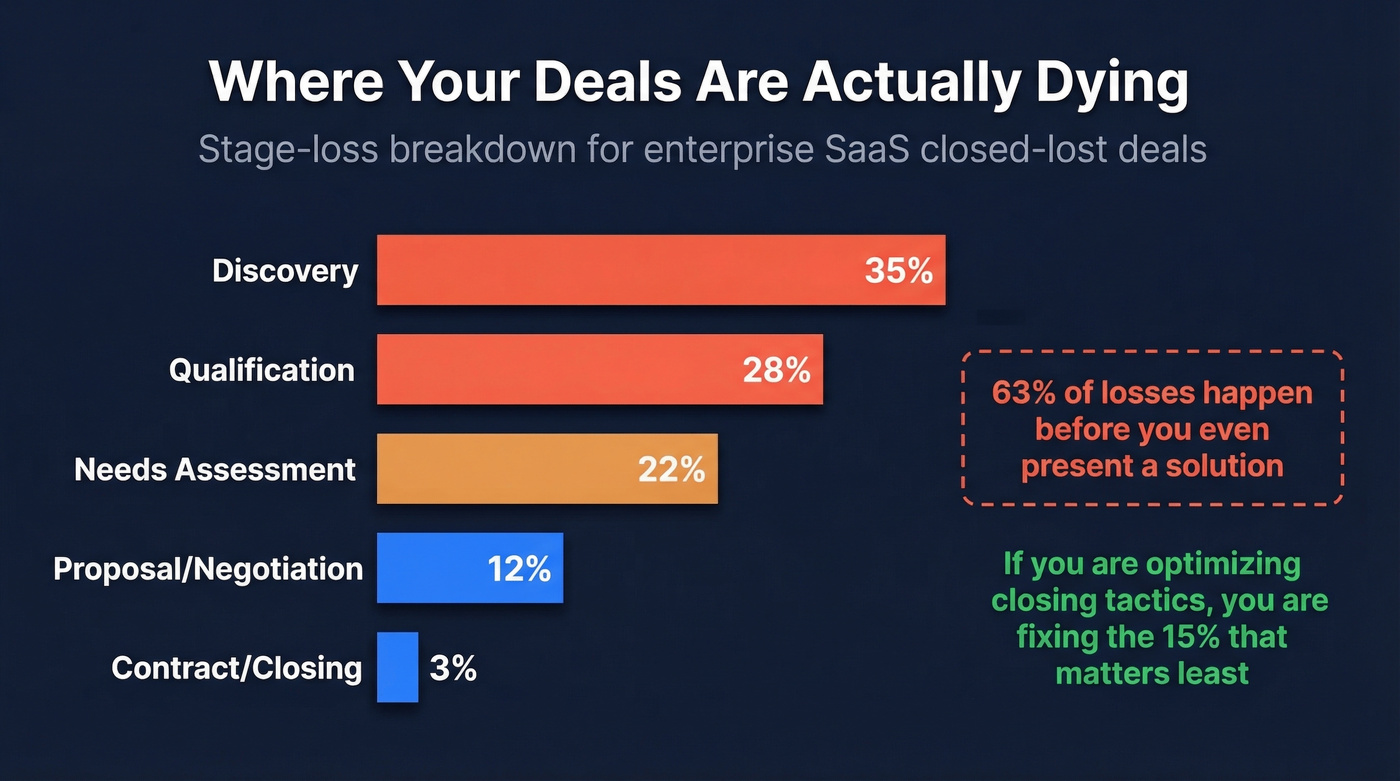
Here's the stage-loss breakdown for enterprise SaaS closed-lost deals: 35% die at Discovery, 28% at Qualification, 22% at Needs Assessment, 12% at Proposal/Negotiation, and just 3% at Contract/Closing. Over 60% of your losses happen before you've even presented a solution. If your selling strategy is focused on closing techniques and negotiation tactics, you're optimizing the 15% that matters least.
The call-level data tells the same story. Top sales reps let prospects speak 57% of the time. Average reps talk through the entire discovery call, then wonder why the prospect ghosts after the demo. It's not a closing problem - it's a listening problem.
A mid-sized SaaS company (pseudonym "Collabio") ran a 90-day pilot restructuring their approach around these diagnostics. They stopped optimizing outbound volume and started fixing their discovery-to-qualification handoff. SQLs went up 46%, CAC dropped 28%, and they saw double-digit conversion growth from product-led acquisition. The lesson isn't that their old approach was wrong - it was aimed at the wrong stage.
Here's the thing: most sales teams would see a bigger revenue lift from recording and reviewing their discovery calls than from buying any new tool. Fix the stage where deals actually die before you optimize anything downstream.
Benchmarks Nobody Else Gives You
Every article on this topic tells you to set goals. None of them tell you what realistic goals look like. If you want to build a successful selling motion, you need to anchor it to real numbers - not aspirational ones.
Win Rates by Segment
| Metric | Benchmark |
|---|---|
| Overall win rate | ~21% |
| Qualified opps only | ~29% |
| Enterprise (>$100K ACV) | ~15% |
| "No decision" share | 40-60% of pipeline |
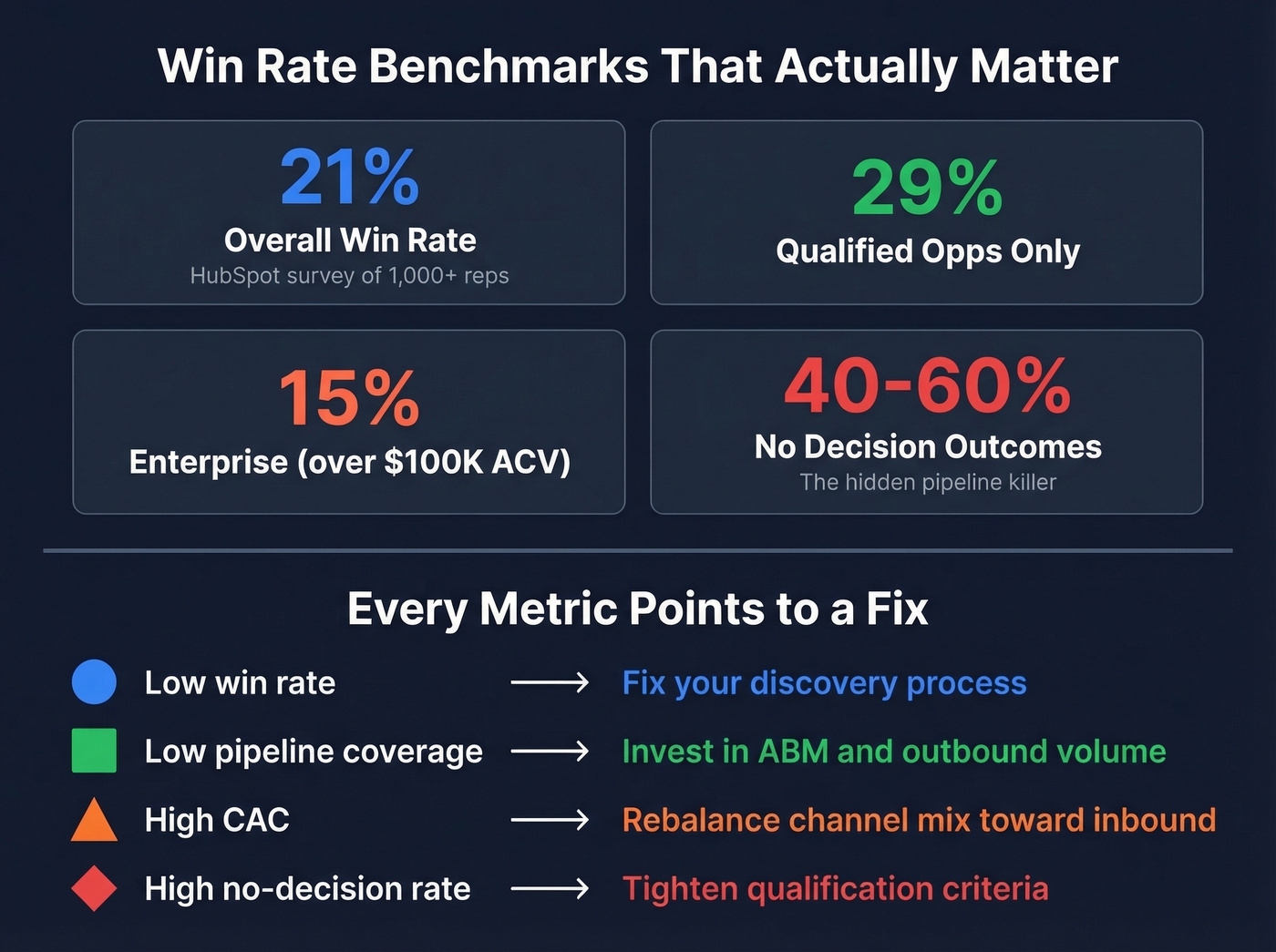
That 21% average comes from a HubSpot survey of 1,000+ reps. But the number that matters most is the one nobody talks about: "no decision" outcomes represent 40-60% of enterprise pipeline. When you exclude them, your win rate inflates by 10-15 points. Make sure you're measuring the same thing quarter over quarter.
Multi-threading makes a massive difference. Engaging 3+ contacts at a target account produces 2.4x higher close rates - and 3.1x for enterprise deals. Speed matters too: deals closing within 50 days show a 47% win rate vs. roughly 20% beyond that threshold.
KPI-to-strategy mapping worth pinning to your wall: Low win rate? Fix your discovery process. Low pipeline coverage? Invest in ABM and outbound volume. High CAC? Rebalance your channel mix toward inbound. High "no decision" rate? Tighten qualification criteria. Every metric points to a specific strategic lever. Stop treating them as abstract scorecards.
Funnel Conversion by Industry
| Industry | Lead-MQL | MQL-SQL | SQL-Opp | SQL-Closed |
|---|---|---|---|---|
| B2B SaaS | 39% | 38% | 42% | 37% |
| Cybersecurity | 24% | 40% | 43% | 46% |
| Financial Services | 29% | 38% | 49% | 53% |
| Real Estate | 27% | 33% | 40% | 53% |
Data from FirstPageSage's funnel benchmark report, covering anonymized client data from 2017-2025. The diagnostic value here is pinpointing your bottleneck stage. If your Lead-MQL conversion is 15% in B2B SaaS when the benchmark is 39%, your problem isn't sales - it's marketing qualification criteria or lead source quality.
Pipeline Coverage Math
The standard heuristic is 3-5x pipeline coverage, but that range is too wide to be useful. Here's how to sharpen it:
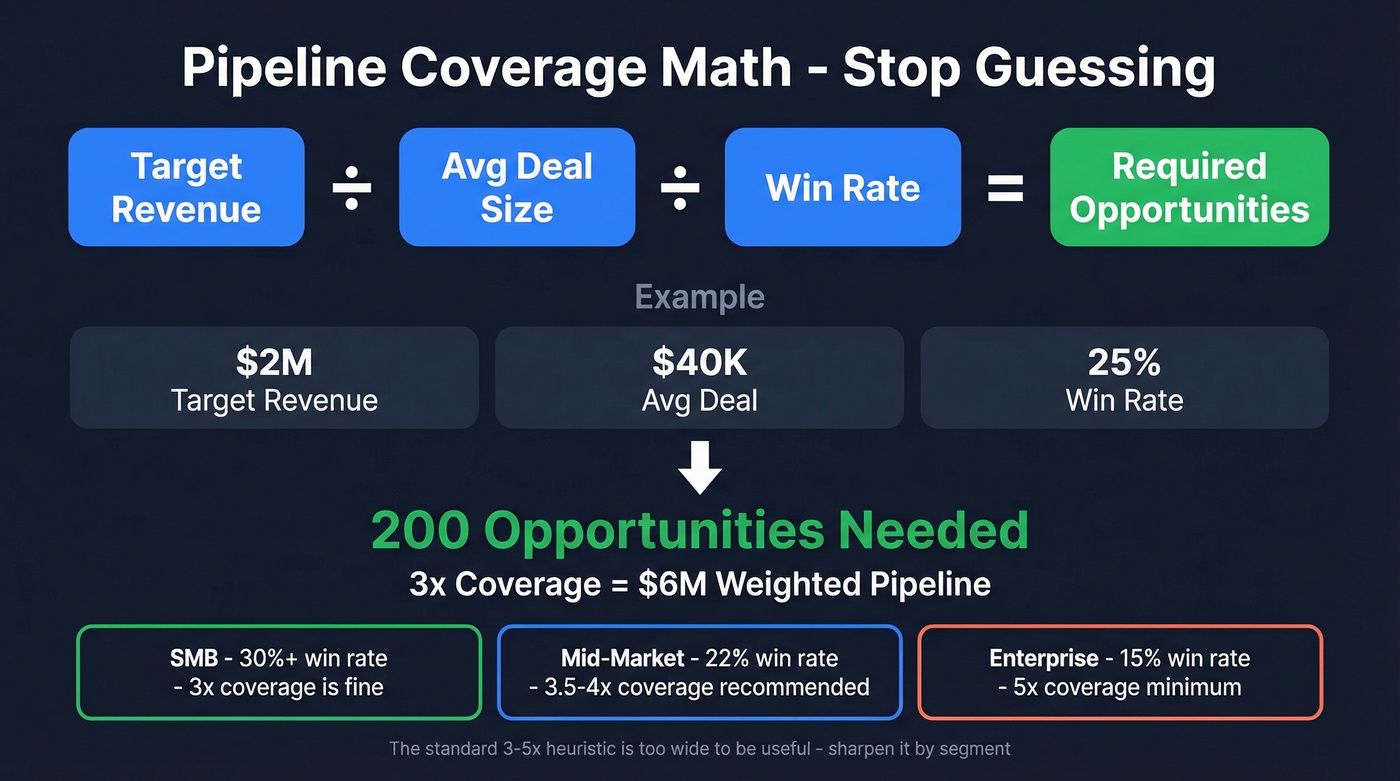
Required opportunities = Target revenue / Average deal size / Win rate
If you're targeting $2M in new revenue with $40K average deals and a 25% win rate, you need 200 opportunities in pipeline. At a 3x coverage ratio, you'd want $6M in weighted pipeline at any given time. Enterprise teams with 15% win rates need closer to 5x. SMB teams with 30%+ win rates can operate at 3x.
How to Build a Sales Strategy by Segment
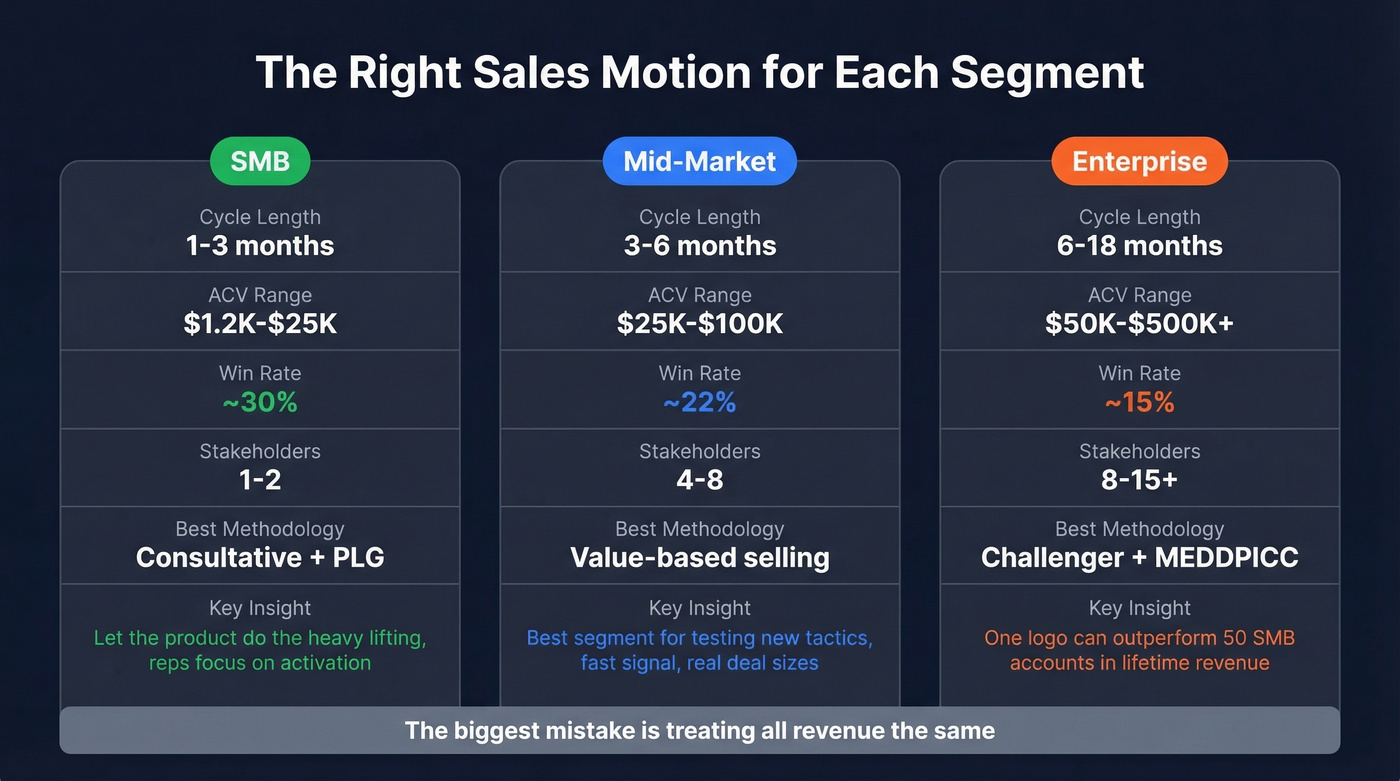
The biggest mistake is treating all revenue the same. A $5K SMB deal and a $200K enterprise contract require fundamentally different motions, economics, and patience.
| Segment | Cycle Length | ACV Range | Win Rate | Stakeholders | Best Methodology |
|---|---|---|---|---|---|
| SMB | 1-3 months | $1.2K-$25K | ~30% | 1-2 | Consultative + PLG |
| Mid-Market | 3-6 months | $25K-$100K | ~22% | 4-8 | Value-based selling |
| Enterprise | 6-18 months | $50K-$500K+ | ~15% | 8-15+ | Challenger + MEDDPICC |
SMB (Under 100 Employees)
SMB sales cycles typically run 1-3 months, sometimes as fast as 1-4 weeks in certain SaaS motions, with ACVs ranging $1,200-$25,000. Fewer stakeholders means faster decisions, but it also means smaller budgets and higher churn risk. Reduce friction with trials, monthly billing, and money-back guarantees. CAC payback should land in the 6-12 month range - if it's longer, your unit economics don't work at this price point.
The best methodology here pairs consultative selling with product-led growth. Let the product do the heavy lifting on education; let reps focus on activation and expansion.
Mid-Market ($50M-$1B Revenue)
Mid-market is where account-based targeting starts paying off. Cycles run 3-6 months, deal sizes justify real discovery processes, and there are enough stakeholders - typically 4-8 - to require multi-threading without the 18-month procurement gauntlet of enterprise. This segment rewards value-based selling: connecting your solution to specific business outcomes rather than feature comparisons.
Mid-market is also the sweet spot for testing creative tactics. Cycles are short enough to get signal within a quarter, but deal sizes are large enough that improvements actually move the revenue needle. If you're experimenting with a new methodology or channel, run the pilot here first.
Enterprise (1,000+ Employees)
Enterprise sales cycles of 6-18 months are normal. Win rates hover around 15%. ACVs range $50K-$500K+. You'll navigate multiple stakeholders, customization requirements, and procurement processes that feel designed to kill deals.
So why bother? Net revenue retention of 120-150% makes the long cycle worthwhile. One enterprise logo can generate more lifetime revenue than 50 SMB accounts. Challenger selling combined with rigorous MEDDPICC qualification is the methodology fit - you need to know your champion, your economic buyer, and your decision criteria before you invest serious resources. Skip this segment entirely if you don't have at least two experienced enterprise reps and the patience for 6+ month payback cycles.

You just saw that 35% of deals die at discovery and multi-threading 3+ contacts delivers 2.4x higher close rates. Prospeo gives you 300M+ profiles with 30+ filters - buyer intent, job changes, headcount growth - so you reach every stakeholder, not just one.
Fix your pipeline coverage ratio with data that refreshes every 7 days.
Inbound vs. Outbound vs. Hybrid
The data here is lopsided but misleading. Inbound leads convert at 14.6% vs. 1.7% for outbound, and inbound costs roughly 60% less per lead. If you stopped reading there, you'd go all-in on inbound. Don't.
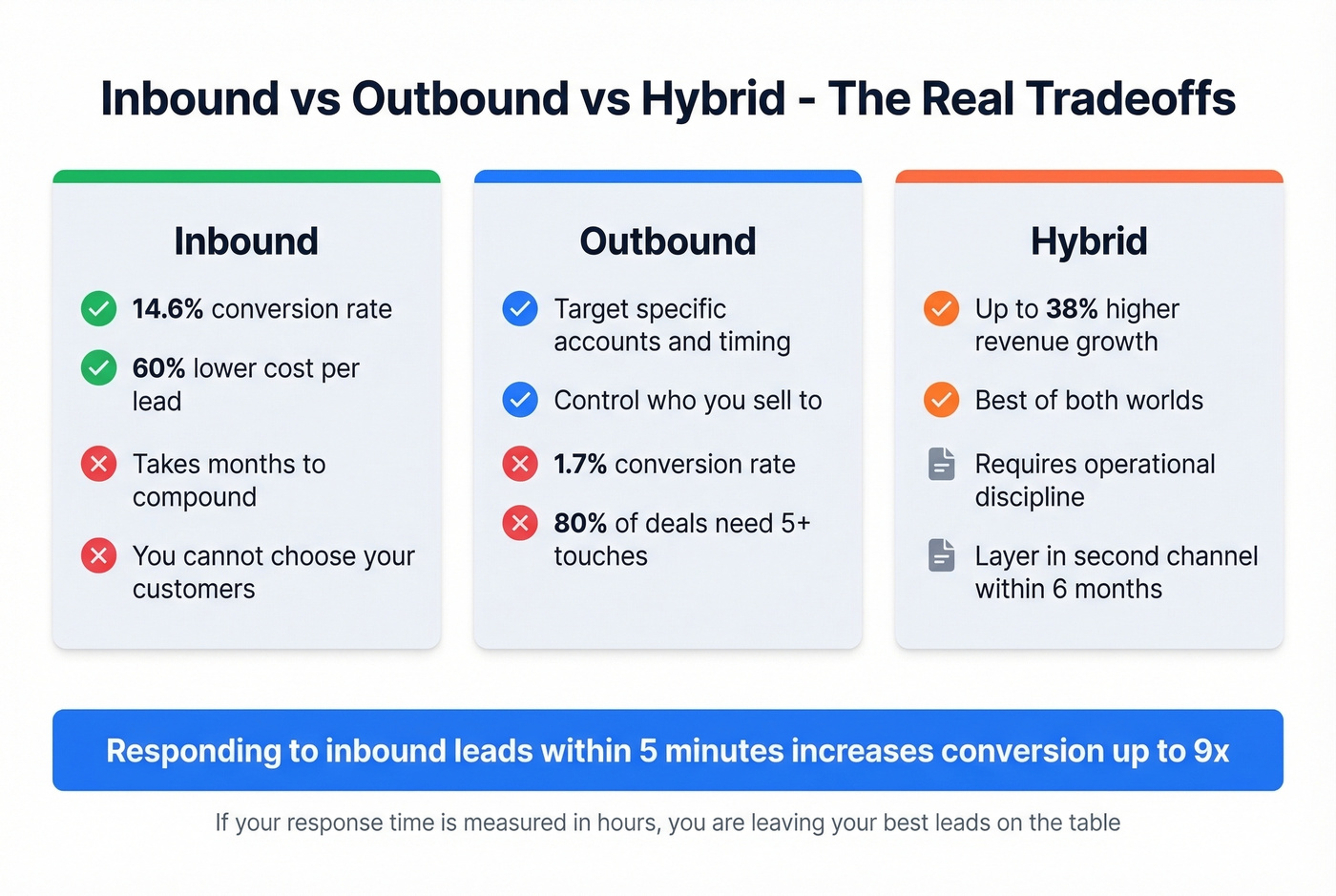
Inbound takes months to compound. It favors established brands with content engines. And it doesn't let you choose your customers - you get whoever shows up. Outbound lets you target specific accounts, specific personas, and specific timing signals. The tradeoff is that 80% of outbound deals require 5+ touches, and multichannel sequences yield 40%+ better engagement than single-channel approaches.
The real answer is hybrid. Teams running both inbound and outbound see up to 38% higher revenue growth. The operational key is speed: contacting an inbound lead within 5 minutes increases conversion up to 9x. That's not a typo. If your inbound response time is measured in hours, you're leaving the highest-converting leads on the table.
For teams under 50 people, start with whichever channel matches your current resources, then layer in the other within 6 months. Trying to launch both simultaneously with a skeleton crew leads to doing both badly.
Modern Tactics That Work in 2026
The consensus on r/sales is that the old playbooks are stale but the new ones aren't fully proven yet. Here's what's generating real pipeline right now.
Narrow ABM + Verified Data
The spray-and-pray era is dead. What's replacing it: narrow ABM lists built with enrichment tools, paired with personalized Loom "mini-audits" instead of generic cold pitches. Enriched and verified data yields 3.2x better response rates vs. basic contact data. Tools like Prospeo let you build targeted lists with 30+ filters - buyer intent, technographics, job change signals, headcount growth - and verify every email before it enters your sequence. The difference between a 35% bounce rate and a sub-4% bounce rate isn't incremental. It's the difference between a functioning outbound motion and a domain reputation disaster.
Signal-Based Outbound
Job changes, funding events, and tech stack shifts are the new cold call triggers. When someone just got promoted to VP of Sales at a company that raised a Series B last month, your outreach isn't cold - it's contextual. The 60-second inbound response threshold applies here too: responding to a buying signal within a minute yields 90%+ conversion increases vs. the 5-minute standard. This approach turns timing into a competitive advantage.
Founder-Led Content
Two posts per week on professional networks plus fast DMs generates decent meetings. We've seen founders book 5-10 meetings per month this way. Another pattern from early-stage founders: embedding a tiny shareable utility inside the product as a free acquisition loop. Best used as a pipeline supplement, not a primary channel.
Enterprise Omnichannel
Voicemails, emails, and professional network invites are the baseline enterprise sequence. The Reddit consensus from enterprise reps is that cold calling still has the highest close rate when you actually reach someone - the problem is reaching them. Omnichannel sequences exist because no single channel reliably gets through. The reps who are winning combine all three with tight personalization and signal-based timing.
AI in Your 2026 Sales Strategy
The Hybrid AI + Human Model
70% of B2B sales orgs now use AI for prospecting, outreach, or qualification. Adoption jumped 52% in 2025 alone. But here's the number that matters: pure AI replacement plateaus at 8-10% conversion. Hybrid AI + human models deliver 4-7x better results.
The operating model generating the best results right now has AI processing 5,000+ mid-market prospects per month - scoring, sequencing, and qualifying - while three senior SDRs focus exclusively on 100 high-value enterprise accounts with full personalization. One enterprise SaaS company running this model reported 180% pipeline growth with 40% lower total SDR cost. AI handles volume. Humans handle complexity.
Where AI Actually Helps
The practical use cases delivering ROI right now: call analysis that flags talk-time ratios and objection patterns, lead scoring that prioritizes accounts showing buying signals, next-step recommendations based on deal stage, forecasting that reduces the gap between what reps report and what actually closes, and CRM enrichment that keeps contact data current without manual effort.
CloudTalk tested AI across nearly 8,000 leads and interviewed 15 industry leaders on 2026 use cases. The consistent finding: start with one quick win - usually call analysis or lead scoring - integrate it into existing workflows, and train reps on how to use the output. The teams that fail with AI buy five tools simultaneously and create a stack nobody uses. Per Salesforce's State of Sales data, tool sprawl remains one of the top productivity killers for sales orgs. Good execution treats AI as infrastructure, not magic.
The Sales Tech Stack That Matters
Your strategy is only as good as the infrastructure executing it. Here's what actually matters, with opinionated picks.
CRM: Salesforce (~$25-$330/user/mo) if you need enterprise-grade customization. HubSpot (free CRM; Sales Hub from ~$20/user/mo, scaling by tier) if you want faster time-to-value. Don't overthink this - pick one and configure it well (or compare examples of a CRM before you commit).
Data & Enrichment: Your CRM is only as good as the data inside it. Prospeo covers 300M+ professional profiles with 98% email accuracy and a 7-day data refresh cycle - compared to the 6-week industry average. It integrates natively with Salesforce, HubSpot, and outreach platforms like Lemlist, Instantly, and Outreach. One customer saw pipeline jump from $100K to $300K per week after switching, with bounce rates dropping from 35% to under 4%. The free tier gives you 75 emails per month at roughly $0.01/email on paid plans, with no contracts. For comparison, ZoomInfo typically runs $15-40K/year with 87% email accuracy, and Apollo offers a free tier with paid plans from ~$49-99/user/mo at 79% accuracy. The accuracy gap matters more than the price gap - bad data poisons every downstream metric. If you're evaluating vendors, start with these data enrichment services.

Outreach/Sequencing: Outreach or Salesloft (~$100-200/user/mo). Both are mature. Pick based on which your team has used before - switching costs are real. If you're building the rest of your stack, see our ranked list of SDR tools.
Enrichment/Workflow: Clay (from ~$149/mo) for complex multi-step enrichment workflows. Pairs well with any data source for building custom prospecting automations. (If you're doing list ops at scale, this Clay list building workflow is a solid baseline.)
Intent Data: Standalone Bombora contracts typically run $25-50K/year. Prospeo includes Bombora intent data natively across 15,000 topics, which saves you a separate subscription.
High CAC and low win rates almost always trace back to bad contact data. Prospeo delivers 98% email accuracy and 125M+ verified mobile numbers with a 30% pickup rate - at $0.01 per email. Teams using Prospeo book 26% more meetings than ZoomInfo users.
Stop losing deals to bounced emails and wrong numbers.
Keeping Your Strategy Sharp
Building a strategy is an ongoing process, not a one-time document. A few ways to keep iterating:
- Subscribe to podcasts like 30 Minutes to President's Club and The Sales Hacker Podcast - they cover real techniques from practitioners, not theorists.
- Review your stage-loss data monthly. Winning approaches evolve as your market and buyer behavior shift.
- Use customer reviews as a feedback loop. Both your own and your competitors' reviews reveal objection patterns and positioning gaps you won't find in CRM data alone.
- Benchmark quarterly against the funnel conversion data in this guide. If a metric moves more than 5 points in either direction, investigate before you react. If you need a tighter diagnostic set, track pipeline health alongside win rate and coverage.
FAQ
What's the difference between a sales strategy and a sales plan?
A strategy defines who you sell to, how you position, and which channels you invest in. A plan operationalizes it with quotas, territories, and activity targets. Think of the strategy as the "why and who," and the plan as the "how and when."
What's a good win rate for B2B sales?
The average is ~21% across all opportunities, ~29% for qualified opps, and ~15% for enterprise deals above $100K ACV. Always exclude "no decision" outcomes when benchmarking - they inflate your numbers by 10-15 points.
How long should a B2B sales cycle be?
SMB cycles run 1-3 months (as fast as 1-4 weeks in some SaaS motions), mid-market is 3-6 months, and enterprise is 6-18 months. Deals closing within 50 days show a 47% win rate vs. ~20% beyond that threshold.
Should I focus on inbound or outbound?
Both. Inbound converts at 14.6% vs. 1.7% for outbound, but hybrid teams see up to 38% higher revenue growth. Start with whichever matches your current resources, then layer in the other within two quarters.
What free tools help execute a B2B sales strategy?
Prospeo's free tier (75 verified emails/month) handles prospecting data, HubSpot offers a free CRM, and Apollo has a limited free plan. For most teams, verified contact data is the highest-leverage free tool - bad emails poison every downstream metric.