

Sales Subject Lines That Work - What 5.5 Million Emails Actually Show
A rep on r/b2bmarketing tested 20+ subject lines across 1,000+ emails, three warmed domains, 25 sends per day per account. Open rate: 2%. That's not a copywriting problem - it's a deliverability or targeting problem wearing a subject-line mask.
Before you hunt for sales subject lines that work, figure out whether the subject line is actually what's broken.
Quick Rules From 5.5M Emails
Three rules from a [5.5-million-email study by Belkins]: ask a question (46% open rate), keep it to 2-4 words (46% open rate), and use real personalization (46% open rate vs 35% without).
If your open rate is below 15%, stop rewriting subject lines. Your list or deliverability is the problem.
What "Good" Actually Looks Like
Most teams obsess over open rates when reply rate is the metric that matters. [Instantly's 2026 benchmark report] puts the average cold email reply rate at 3.43%. Top-quartile campaigns hit 5.5%+, and elite performers exceed 10.7%.
For context, ActiveCampaign's analysis shows a [39.26% average open rate] - but that's permission-based marketing email. Comparing cold outreach to newsletter benchmarks is a recipe for disappointment. Healthy cold campaigns run 25-45% opens. But opens don't close deals. Replies do.
| Metric | Average | Top Quartile | Elite (Top 10%) |
|---|---|---|---|
| Reply rate | 3.43% | 5.5%+ | 10.7%+ |
What the Data Reveals
The dataset covers 5.5 million cold emails sent between January and December 2024. The findings are specific enough to build a playbook around.
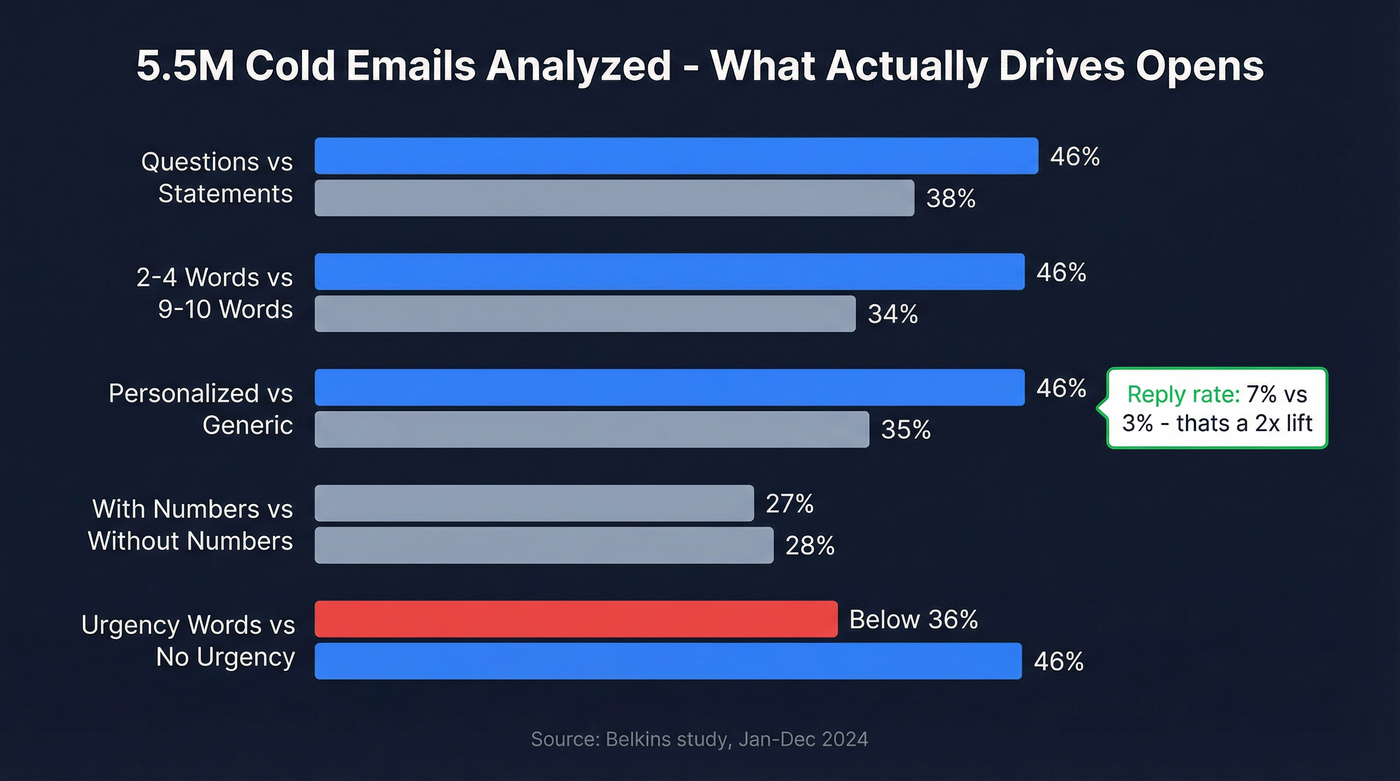
Questions win. Subject lines framed as questions averaged a 46% open rate. They create a micro-commitment - the reader's brain starts answering before they decide to open.
Shorter is better. The 2-4 word sweet spot hit 46% opens. Performance drops after seven words (39%), and by nine or ten words you're at 34-35%.
Personalization works. Personalized subject lines averaged 46% opens versus 35% without, and reply rates jumped from 3% to 7%. That's not a marginal improvement - it's the difference between a campaign that generates pipeline and one that generates nothing. If you want more data-backed options, see these cold email subject line examples.
Numbers don't help. Subject lines with numbers opened at 27% versus 28% without. So much for the "use a stat in your subject line" advice.
Jargon and urgency kill engagement. Marketing buzzwords, generic greetings like "Hello, friend," and urgency words like "now" or "ASAP" pushed open rates below 36%. Your prospect's spam filter - both the technical one and the mental one - flags these on sight. If you're diagnosing inboxing issues, use this email deliverability guide.
The 33-Character Rule
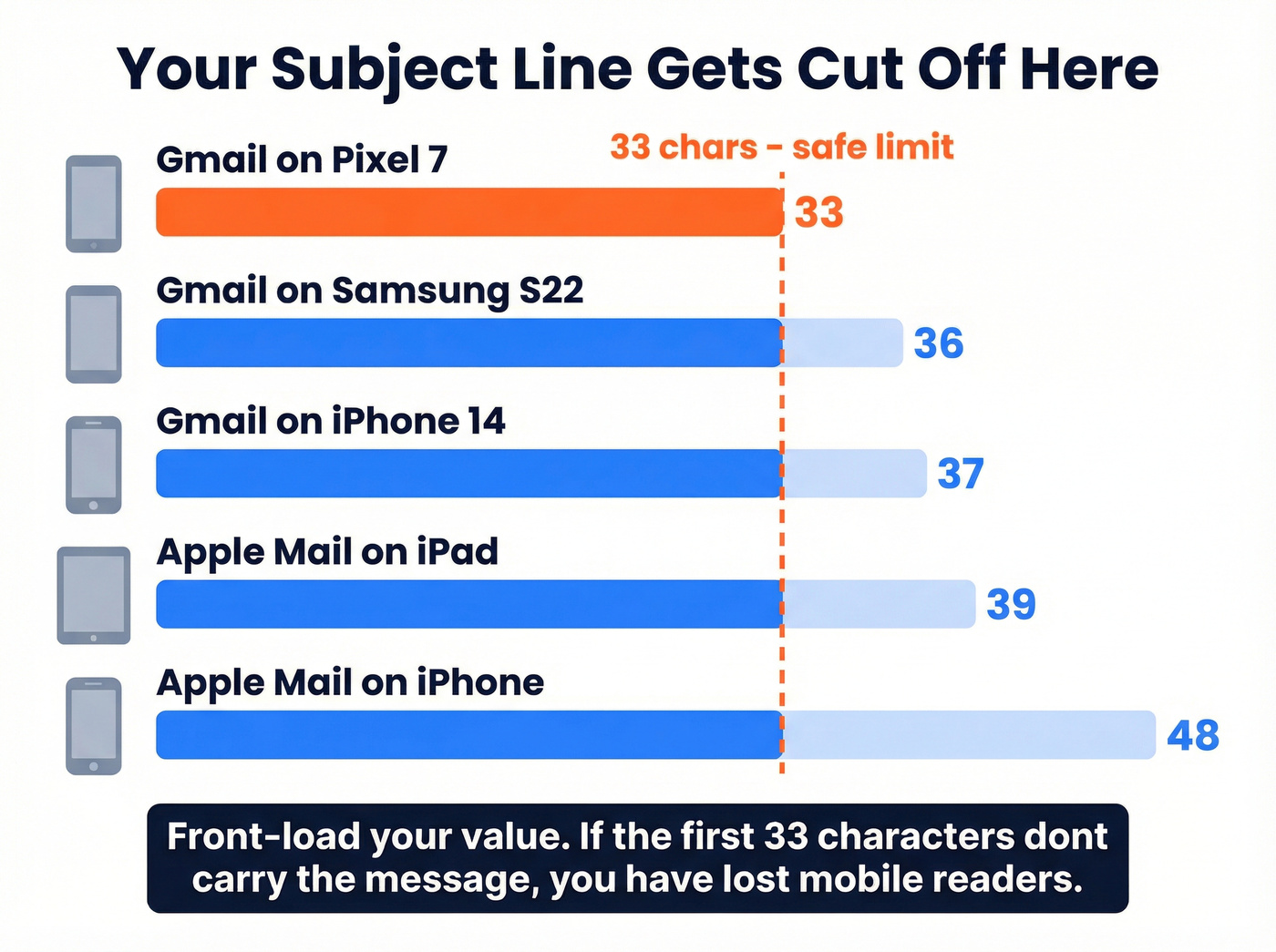
Your subject line doesn't matter if it gets truncated before the reader sees the point. EmailTooltester tested display limits across major devices, and the numbers are tighter than most people realize. (If you're also testing preview text, this email preview text A/B testing guide helps.)
| Device / Client | Max Characters |
|---|---|
| Gmail (Pixel 7) | 33 |
| Gmail (Samsung S22) | 36 |
| Gmail (iPhone 14) | 37 |
| Apple Mail (iPhone) | 48 |
| Apple Mail (iPad) | 39 |
The universal safe limit: 33 characters for the subject line, 37 for the preheader. Front-load your value. If the first 33 characters don't carry the message, you've lost mobile readers - and that's most of your audience.

Personalized subject lines hit 46% opens - but only if they reach real inboxes. A 30% bounce rate kills your domain before anyone reads your copy. Prospeo verifies emails at 98% accuracy with a 7-day refresh cycle, so every personalized subject line you craft actually lands.
Fix your data before you rewrite another subject line.
The Personalization Myth
{{first_name}} tokens don't work anymore. A [2023 replication study in Marketing Letters] tried to reproduce the classic finding that first-name personalization lifts opens - and couldn't. No measurable effect on open rates or click-through rates.
Surname personalization did show a positive effect, probably because it's unexpected enough to signal "this isn't a mass blast."
Here's the thing: the big takeaway from the 5.5-million-email dataset is simpler than any of this. Personalization beats non-personalization, 46% vs 35% opens and 7% vs 3% replies. If you want personalization that actually feels human, mention the company, a relevant initiative, or a specific pain point - not a merge tag. For a deeper playbook, see personalized outreach.
Proven Examples by Use Case
Every example below ties to a specific finding from the data.
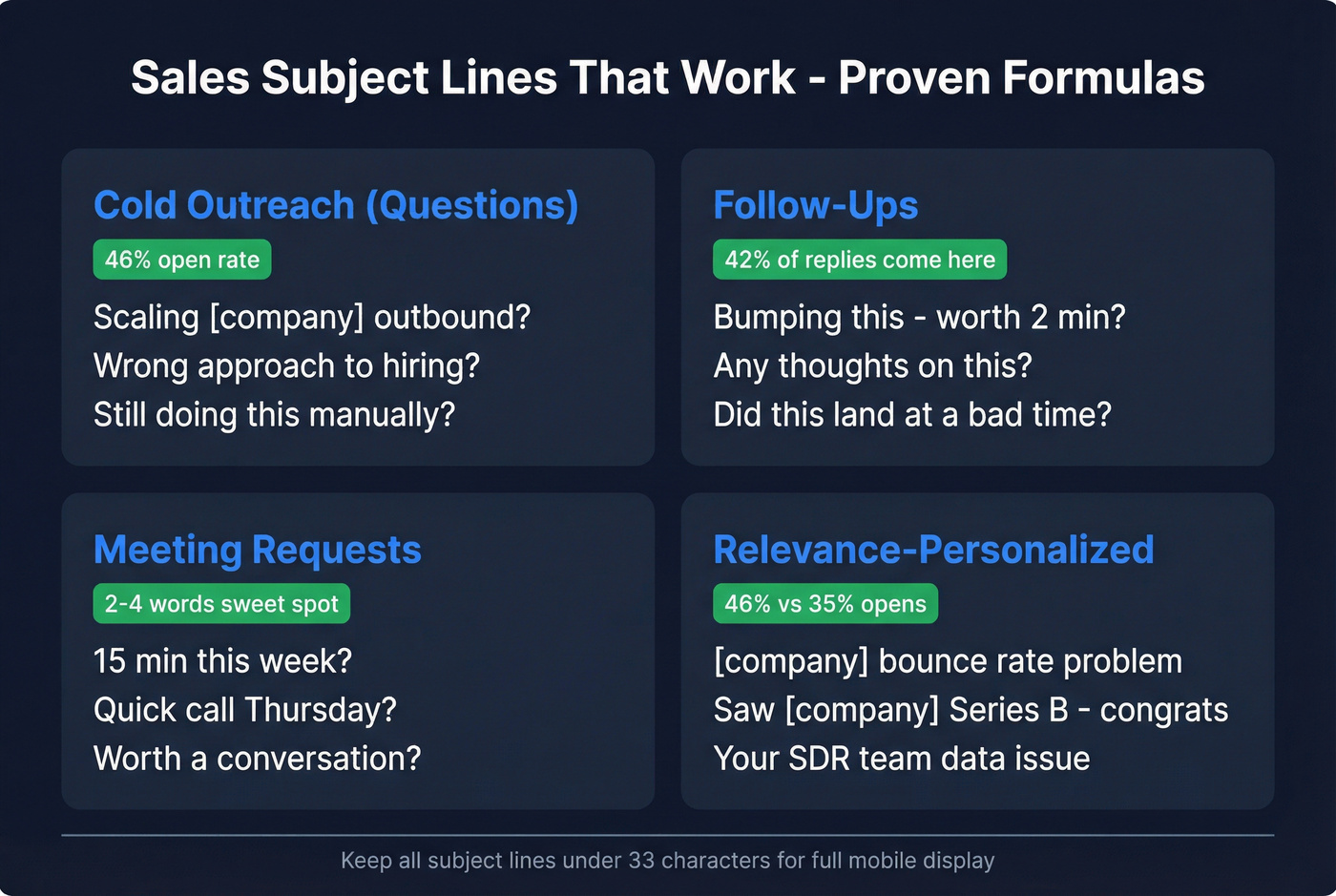
Cold Outreach (Questions)
Questions hit 46% open rates. Keep them under four words where possible.
- "Scaling {{company}} outbound?"
- "Wrong approach to hiring?"
- "{{company}}'s pipeline stalled?"
- "Still doing this manually?"
Follow-Ups
58% of replies come from Step 1, but 42% come from follow-ups - so don't skip them. Casual, colleague-tone follow-ups outperform formal ones by about 30%. Send these on Tuesday or Wednesday; Instantly's benchmark data shows those are peak engagement days. If you need ready-to-send copy, use these sales follow-up templates.
- "Bumping this - worth 2 min?"
- "Any thoughts on this?"
- "Circling back on {{company}}"
- "Did this land at a bad time?"
Meeting Requests
Direct and short. The 2-4 word sweet spot applies here more than anywhere. You can also pair these with stronger email wording to schedule a meeting.
- "15 min this week?"
- "Quick call Thursday?"
- "Worth a conversation?"
Relevance-Personalized
These drive the 46% vs 35% personalization gap. Let's look at the difference between lazy and effective personalization:
| Lazy (Low Open Rate) | Effective (High Open Rate) |
|---|---|
| "Hi {{first_name}}, quick question" | "{{company}}'s bounce rate problem" |
| "Checking in, {{first_name}}" | "Saw {{company}}'s Series B - congrats" |
| "Following up" | "Your SDR team's data issue" |
| "Great connecting!" | "Re: {{company}}'s expansion into EMEA" |
The left column signals a template. The right column signals relevance. Done well, personalization is an 11-percentage-point open rate lift - the difference between forgettable outreach and subject lines that actually get opened.
Mistakes That Kill Opens
- Front-load value in the first 33 characters
- Never use fake "Re:" or "Fwd:" prefixes - it violates CAN-SPAM and destroys trust
- Write like a colleague, not a marketer
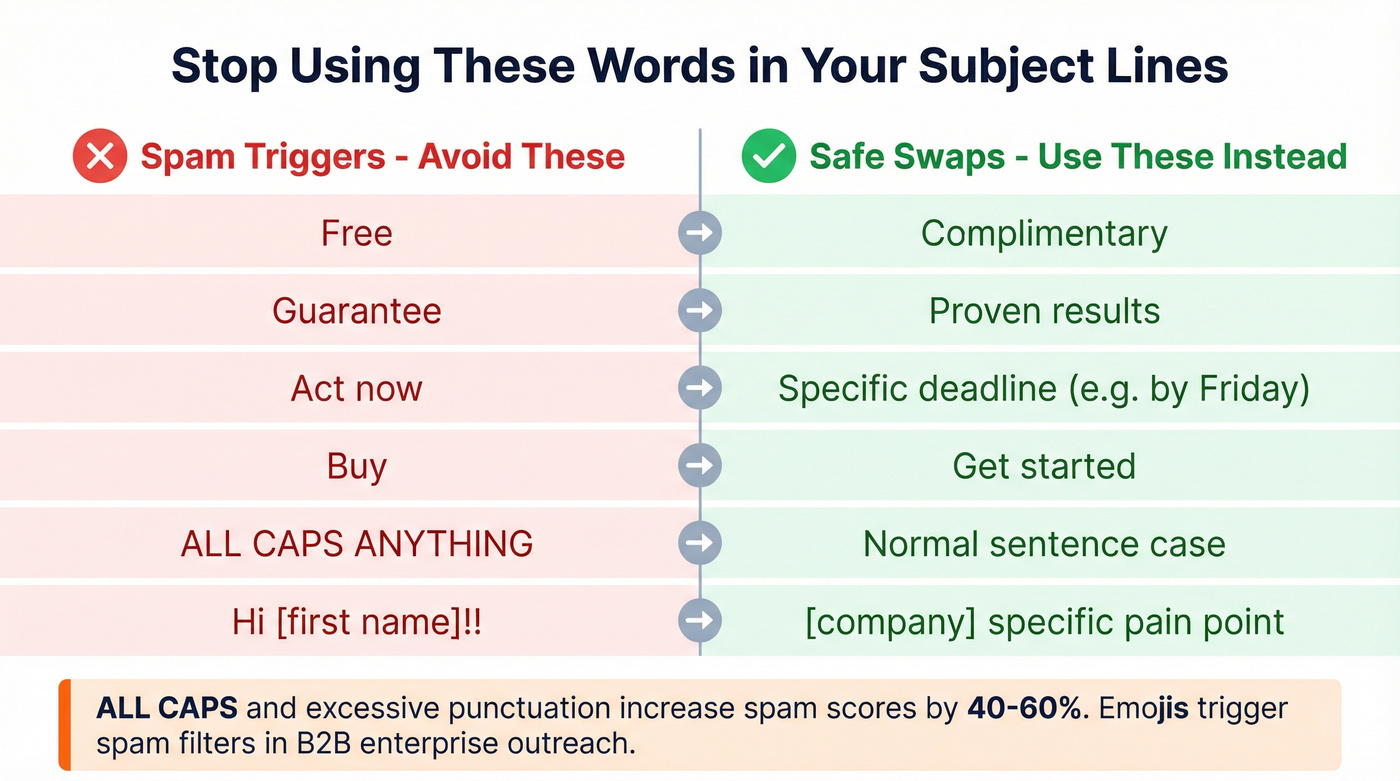
- Skip ALL CAPS and excessive punctuation - they increase spam scores by 40-60%
- Avoid emojis in enterprise outreach; they can work for SMB but trigger spam filters in B2B
- Swap spam-trigger words: "Free" becomes "Complimentary," "Guarantee" becomes "Proven results," "Act now" becomes a specific deadline, "Buy" becomes "Get started" (and run a quick email spam checker before you scale)
We've seen this pattern hundreds of times: teams rewrite subject lines obsessively when the real problem is a 30% bounce rate torching their domain reputation. If a third of your list is invalid, no subject line will save you. Clean the list first. In our experience, fixing data quality resolves "subject line problems" about 70% of the time. Prospeo's 98% email accuracy and 7-day data refresh cycle handle this - verify before you send, not after your domain lands on a blocklist. If you're troubleshooting, start with email bounce rate benchmarks and fixes.

How to Actually Test
Change one variable per test - length, tone, question vs statement. Send to 250+ contacts per variant and measure positive reply rate, not opens. Keep email bodies under 80 words; shorter emails consistently outperform longer ones in cold outreach. For a full workflow, follow this B2B cold email sequence guide.
Run a full send cycle before declaring a winner. Instantly's Growth plan ($47/mo) supports up to 26 A/B variants with auto-pausing of losers, which is useful if you're running volume. Skip this step if you're sending fewer than 500 emails per month - you won't have enough data for statistical significance, and you'll end up chasing noise.
Testing is the only reliable way to find effective cold email subject lines in your specific market. No blog post - including this one - can replace it.
The data is clear: relevance-personalized subject lines drive 7% reply rates vs 3% without. But writing '{{company}}'s pipeline stalled?' requires knowing who to send it to. Prospeo gives you 30+ filters - buyer intent, job changes, headcount growth - so your personalization is backed by real signals, not guesswork.
Stop personalizing emails to people who will never buy.
FAQ
What's a good open rate for cold sales emails?
Healthy cold outreach sees 25-45% opens, but reply rate matters more. Average cold reply rate is 3.43%; top performers exceed 5.5%; elite campaigns break 10.7%.
How long should a sales email subject line be?
Two to four words hit 46% open rates across 5.5 million emails. Stay under 33 characters so the full line displays on every major mobile device without truncation.
Does personalization still improve subject line performance?
Yes - but company-level and pain-point personalization, not first-name merge tags. Personalized subject lines hit 46% opens versus 35% without, and reply rates more than doubled from 3% to 7%.
How do I fix low open rates after testing multiple subject lines?
Check data quality first. If more than 10% of your emails bounce, your sender reputation is already damaged. Verify your list before rewriting copy - the problem is almost always upstream of the subject line.