

The Best Sales Support Software in 2026 (With Pricing)
A RevOps lead we know ran a stack audit last quarter. Twelve tools across the sales org. Reps were using three of them - and still losing deals because nobody followed up after sending a quote. The problem wasn't missing features. It was missing focus.
The customer service software market hit $10.95B in 2025 and is forecast to reach $26.3B by 2030. That's a lot of tools competing for your budget and a lot of overlap between them. Here are the ones that actually move pipeline, sorted by what they do, what they cost, and whether your team will bother using them.
Our Picks (TL;DR)
| Use case | Tool | Starting price | Why this one |
|---|---|---|---|
| Verified data & prospecting | Prospeo | Free (75 emails/mo) | 98% accuracy, 7-day refresh |
| CRM + pipeline hygiene | HubSpot Sales Hub | Free | Low friction; scales well |
| Outbound calling + SMS | Close | $9/seat/mo (annual) | Built-in dialer, clear pricing |
| Visual pipeline for SMBs | Pipedrive | $14/user/mo | Activity-based, dead simple |
| Budget suite play | Freshsales | Free (3 users) | AI + sequences at $9/user/mo |
| Sales-to-service handoff | Zendesk Sell | $19/mo | Unified sales + service context |
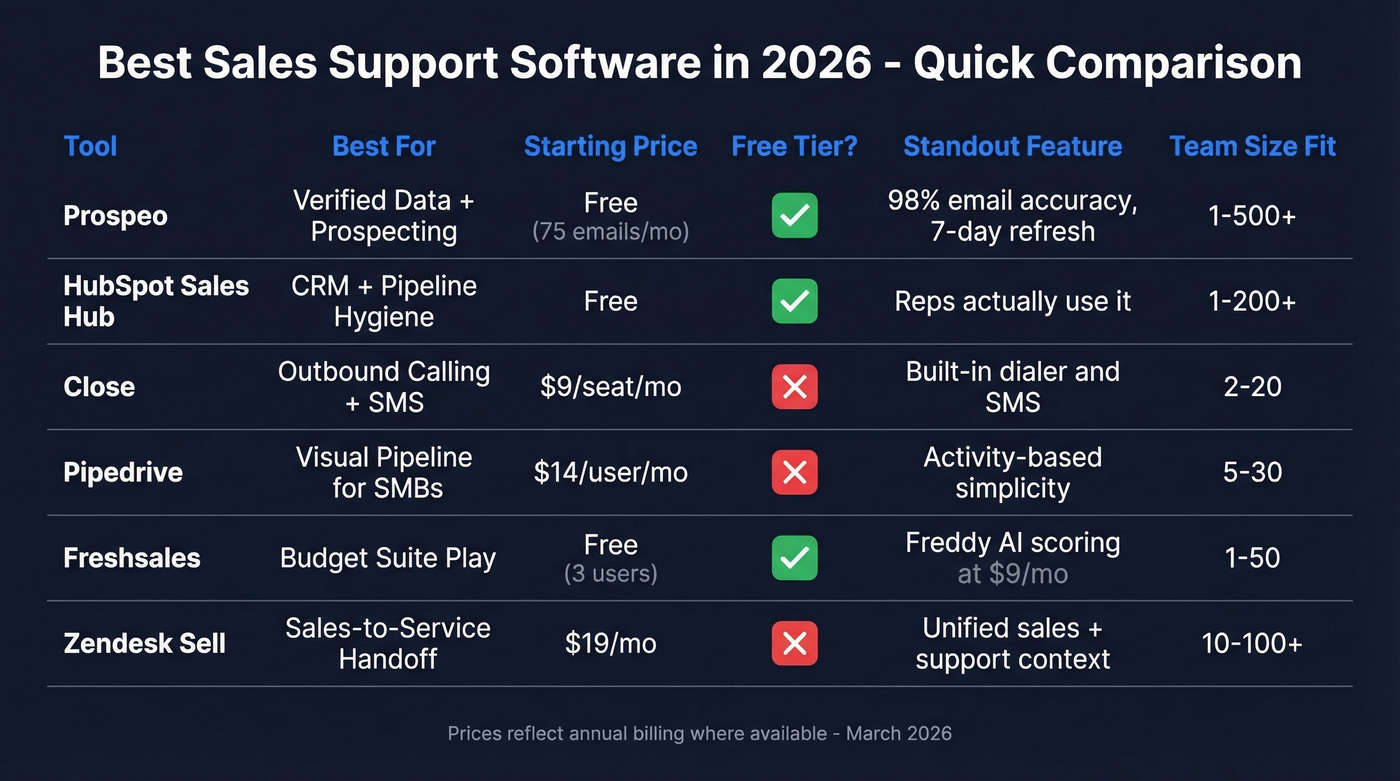
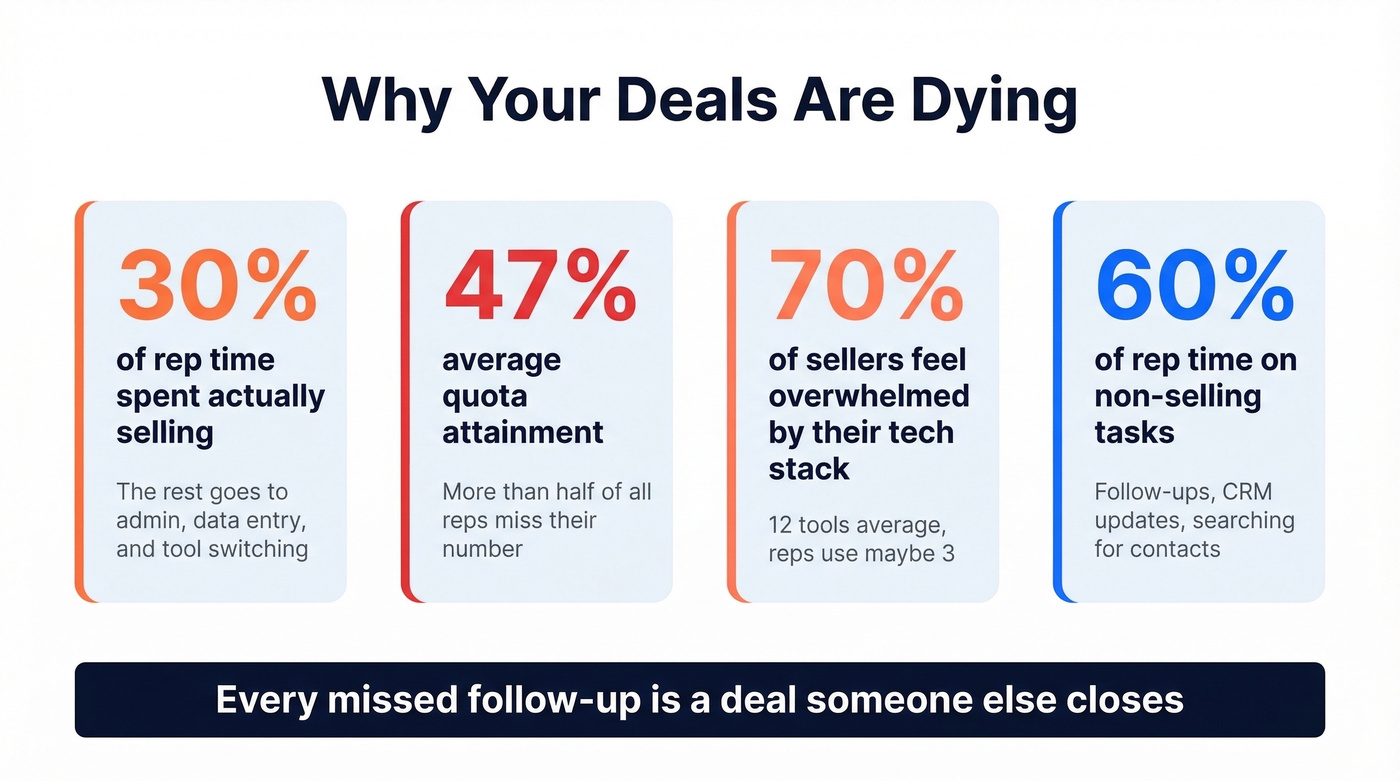
Sales reps spend 60% of their time on non-selling tasks. The right two or three tools from this list will reclaim more selling hours than any single enterprise platform ever could.
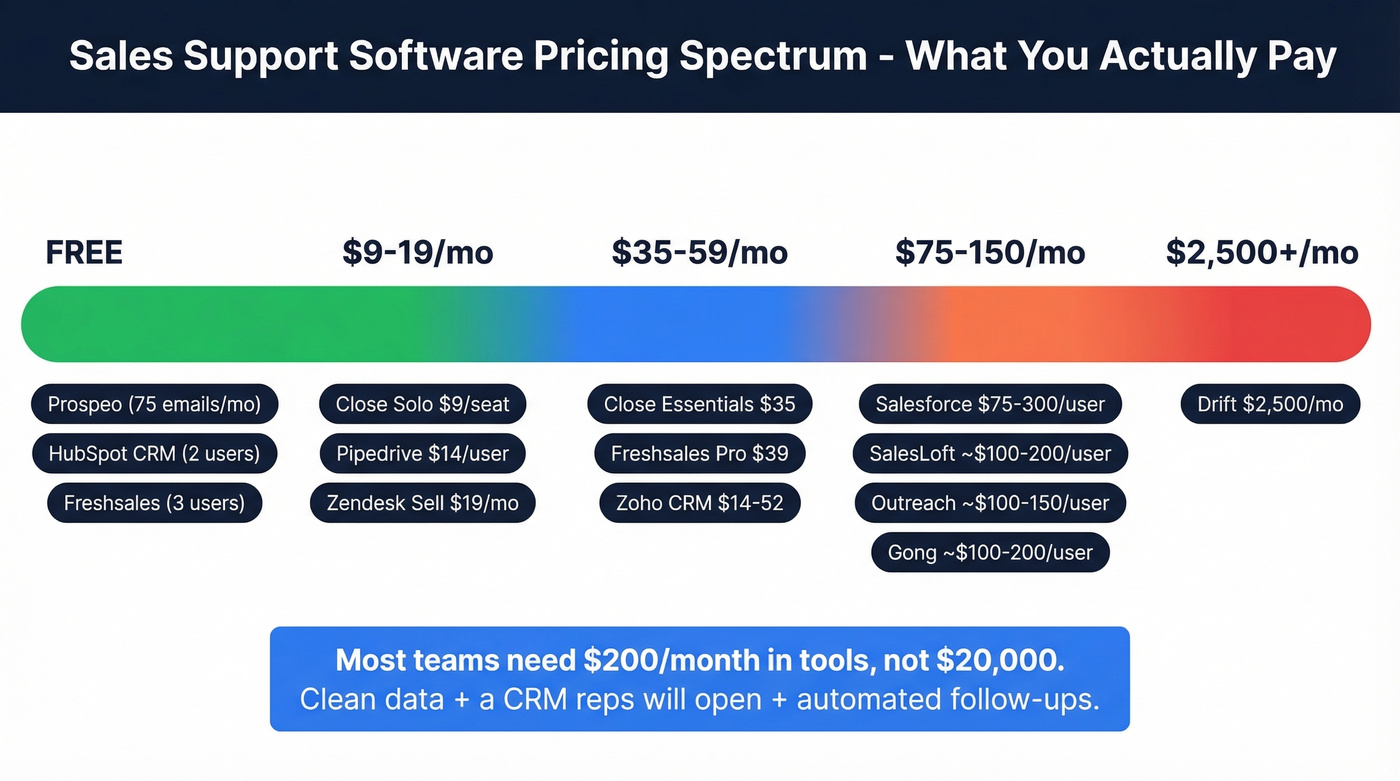
Here's the thing: most teams don't need a $150/seat platform. They need clean data, a CRM reps will actually open, and automated follow-ups. That's a $200/month problem, not a $20,000/month one.
Why Deals Slip
Most deals don't die because a competitor won. They die in the gap between "sent the proposal" and "followed up."
A post on r/sales nails this perfectly. A rep describes their workflow: inbound lead comes in, they build a detailed quote, email it over, and then - nothing. No follow-up sequence. No automated nudge. The deal dies in the inbox. Their ask was simple: something that auto-sends "any questions?" so leads don't get buried. That's not a feature gap. It's a workflow gap, and it's everywhere.
Today's sellers spend only 30% of their time actually selling. Average quota attainment sits at 47%. Nearly 70% of salespeople say they're overwhelmed by their tech stack. The rest of the time goes to data entry, searching for contact info, switching between tools, and manually tracking follow-ups in spreadsheets.
Every missed follow-up is a deal that someone else closes. The fix isn't buying more tools - it's buying the right ones and making sure reps actually use them. Your sales support tools should solve three things:
- Follow-up automation - so deals don't die in silence after a quote goes out
- Data accuracy - so reps aren't wasting calls on bad numbers and bounced emails
- Pipeline visibility - so managers spot stuck deals before they're lost
If your current stack doesn't nail all three, you're leaking revenue.
What "Sales Support" Actually Means
It's a broad label, and vendors love to blur the lines. This category reduces rep admin load and prevents deal slippage - spanning follow-up automation, data access, quoting, proposals, and handoffs. It's the connective tissue between your CRM and your revenue.
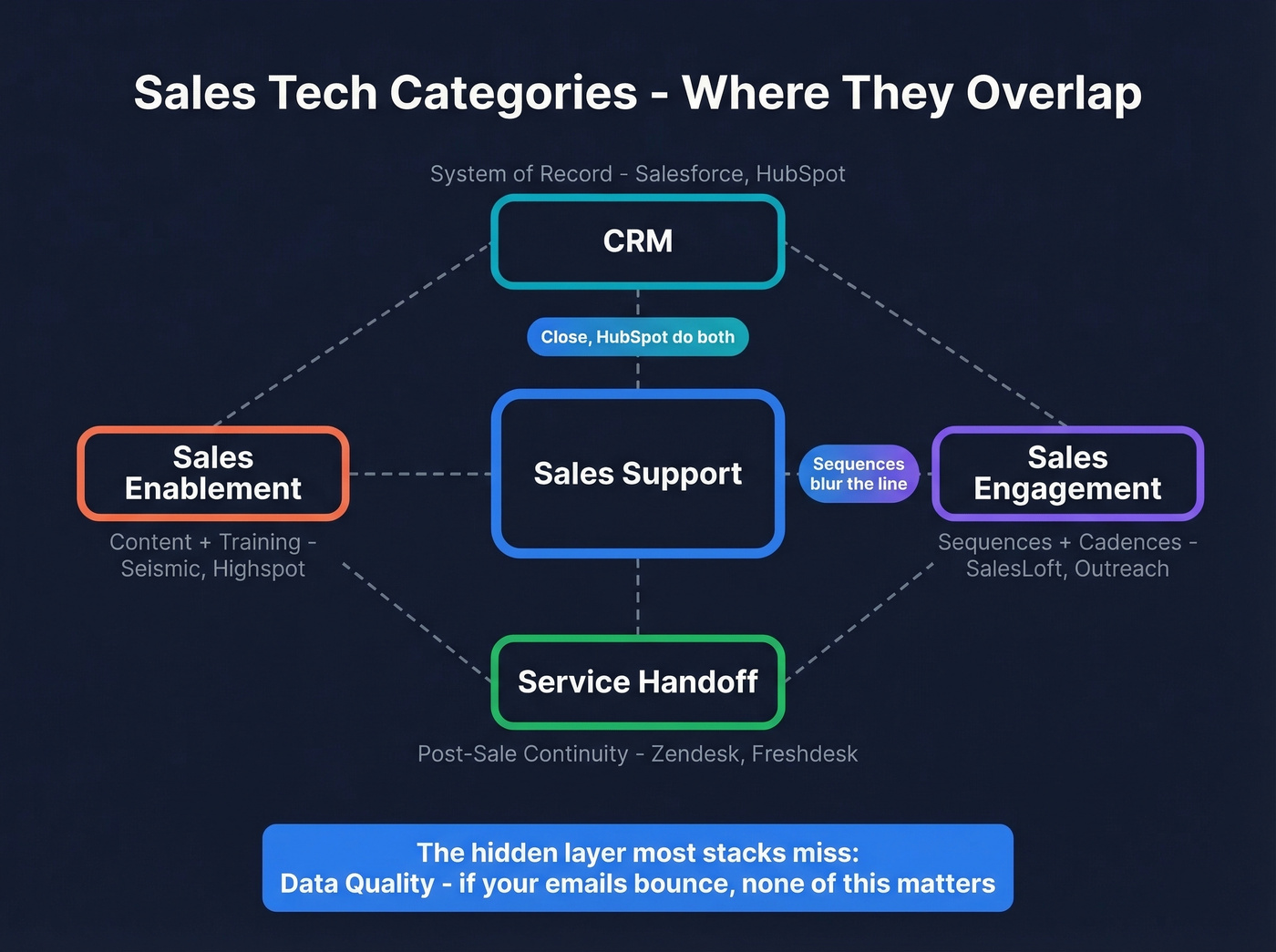
| Category | Primary goal | Primary users | Examples |
|---|---|---|---|
| CRM | System of record | Whole org | Salesforce, HubSpot |
| Sales support | Reduce admin, prevent slippage | Reps + managers | Close, Aligned |
| Sales enablement | Content + training | Enablement team | Seismic, Highspot |
| Sales engagement | Sequence + cadence execution | SDRs/BDRs | Salesloft, Outreach |
| Service handoff | Post-sale continuity | CS + support | Zendesk, Freshdesk |
The overlap is real. A CRM with built-in sequences like Close or HubSpot doubles as sales engagement. A data platform doubles as prospecting infrastructure. The boundaries aren't clean - what matters is covering the gaps, not matching vendor categories.
Data quality is the hidden layer most stacks miss. You can automate every follow-up and build the prettiest pipeline dashboard, but if your emails bounce, none of it matters. (If you want a deeper breakdown of vendors, see our guide to data enrichment services.)
Best Tools Compared
Prospeo
Prospeo is the data accuracy layer that makes everything else in your stack work. It covers 300M+ professional profiles with 143M+ verified emails and 125M+ verified mobile numbers, all refreshed on a 7-day cycle versus the 6-week industry average. The numbers speak for themselves: 98% email accuracy, 30% mobile pickup rate, and a 92% API match rate for enrichment workflows.
If you're comparing providers, start with what you actually need: lead enrichment vs verification vs full databases.
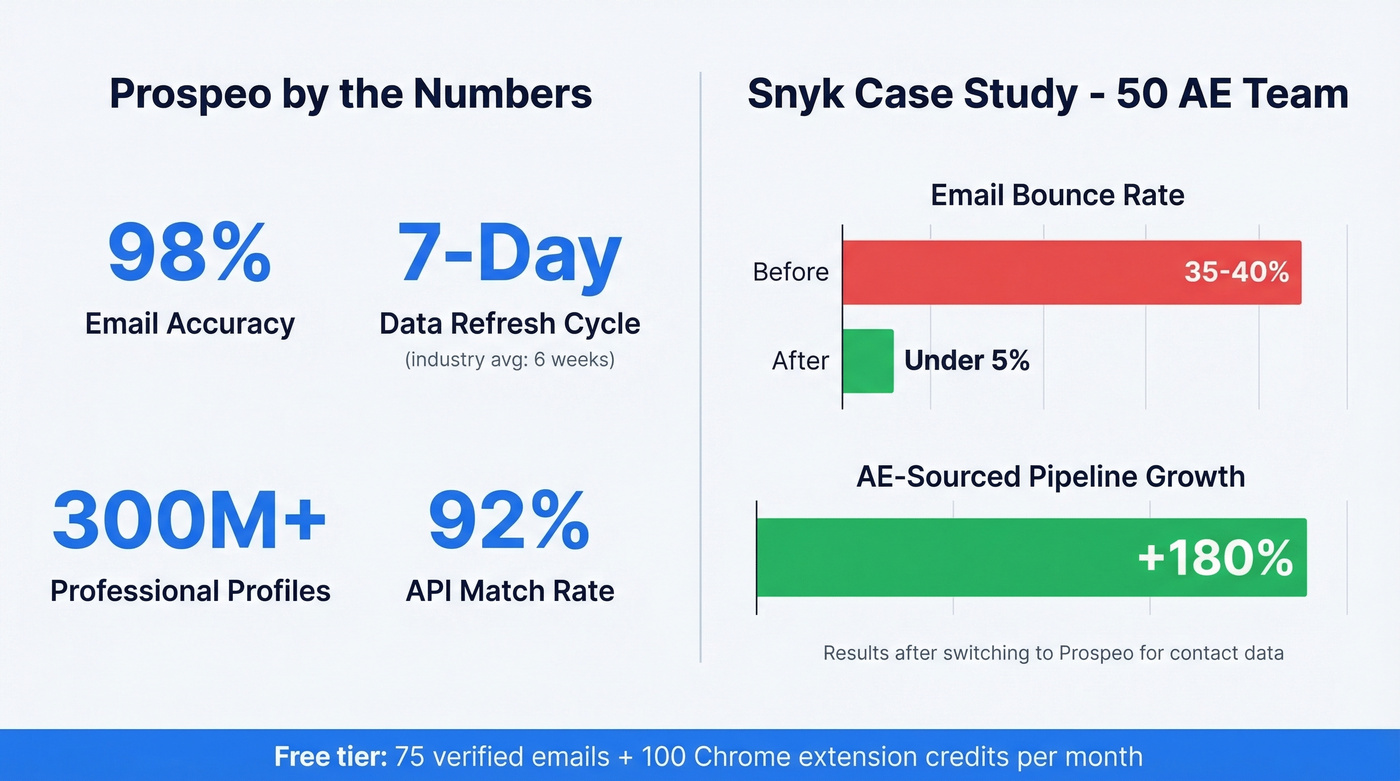
We've seen the impact firsthand. Snyk's 50-person AE team went from 35-40% bounce rates to under 5% after switching, and their AE-sourced pipeline jumped 180%. That's not a marginal improvement - that's a different business.

The platform includes 30+ search filters with buyer intent powered by Bombora across 15,000 topics, plus technographics, job changes, headcount growth, and funding signals. The Chrome extension works on company websites, professional profiles, and inside your CRM. (If you're building lists from scratch, our sales prospecting techniques guide pairs well with this.)
Pricing is transparent. The free tier gives you 75 verified emails and 100 Chrome extension credits per month. Paid plans run about $0.01 per email, 10 credits per mobile number. No annual contracts required. Native integrations cover Salesforce, HubSpot, Smartlead, Instantly, Lemlist, Clay, Zapier, and Make. If deliverability is a pain point, fix the root cause with an email deliverability guide before scaling volume.

60% of rep time goes to non-selling tasks - and bad data makes it worse. Prospeo's 7-day refresh cycle and 98% email accuracy mean your follow-up sequences actually land. Snyk cut bounce rates from 35% to under 5% and grew AE-sourced pipeline 180%.
Stop automating follow-ups to emails that bounce.
HubSpot Sales Hub
HubSpot is the CRM that reps actually use. That sounds like a low bar, but adoption is the single biggest failure mode in sales tech. The r/CRM consensus is clear: most CRMs don't fail because they're missing features - they fail because no one wants to use them. HubSpot's UI is clean enough that reps don't revolt. (If you're still evaluating options, here are more examples of a CRM with real pricing.)
The tradeoff: you'll outgrow the free tier fast. Paid tiers start at $15/seat/month for Starter, then $50 for Professional, and $75 for Enterprise. Document tracking for sales teams is available at the Professional tier, letting reps see exactly when a prospect opens a proposal or pricing sheet. The free CRM has no expiration date and includes up to two users, which makes it a genuine starting point rather than a glorified demo.
Close
Close is built for teams that live on the phone. Native dialer, SMS, and call recording come standard across plans. The built-in SMS capabilities - sequences triggered alongside email cadences - mean reps can run multichannel outreach without bolting on a separate texting tool. If you're formalizing your motion, a lightweight cold calling system helps keep calling + follow-up consistent.
Use this if you're running outbound-heavy sales with 2-20 reps and you want calling, email, and pipeline in one place. Annual pricing: Solo $9/seat, Essentials $35, Growth $99, Scale $139. Monthly runs higher across the board. Add-ons are clear - premium phone numbers at $19/line, Call Assistant at $50/mo plus $0.02/min.
Skip this if you need deep marketing automation or enterprise-grade reporting. Close is a sales tool, not a GTM platform. That's its strength.

Pipedrive
Pipedrive is the visual pipeline CRM that small teams love. Everything revolves around activities - calls to make, emails to send, meetings to book - rather than data fields to fill. (If you want to standardize what “good” looks like, use these sales activities examples to build rep checklists.) Pricing runs $14-$79/user/mo on annual billing with a 14-day free trial. No permanent free plan. For teams of 5-30 reps who need simplicity over configurability, Pipedrive consistently wins.
Freshsales
For SMBs that want AI-powered contact scoring and email sequences without enterprise prices, Freshsales is worth a serious look. Its Freddy AI handles lead scoring, next-best-action suggestions, and deal insights automatically. Free plan for up to 3 users, Growth at $9/user/mo includes 1 CPQ license, Pro at $39 adds Freddy AI, Enterprise tops at $59/user/mo. A 21-day free trial with no credit card makes it easy to test.
Skip this if you need deep third-party integrations. Freshsales works best inside the Freshworks ecosystem.
Zendesk Sell
Zendesk Sell exists for unified sales-to-service context. Reps see open tickets. Support sees deal stage. Nobody asks the customer to repeat themselves. Pricing starts at $19/mo for Sell Team, scaling to $55, $115, and $169. Not the cheapest CRM, but the value is in the handoff - especially for teams where post-sale experience directly affects expansion revenue. (For handoff messaging, steal a few lines from these handoff email templates.)
Monday.com CRM
The configurable option for RevOps teams who want custom workflows and cross-team visibility. Free for 2 seats, then $9-$19/seat/mo with annual billing saving about 18%. Enterprise pricing is custom. It's a work OS with CRM templates - a feature for teams who want control, a bug for teams who want opinionated defaults.
Salesforce Sales Cloud
The enterprise standard: process rigor, customization depth, thousands of integrations. But it's overkill for teams under 50 reps without dedicated admin resources. Implementation starts around $25,000, and per-user costs often land between $75-$300/mo. We've seen teams spend six months configuring Salesforce before a single rep logs a deal. (If you're budgeting, see our breakdown of Salesforce pricing.)
Zoho CRM
Free for 3 users, paid plans from $14-$52/user/mo. The budget-friendly suite play, especially if you're already in Zoho's ecosystem. Solid for pipeline management and basic automation. Won't wow you with AI, won't break the budget.
SalesLoft
Doesn't publish pricing - expect $100-$200/user/mo on annual contracts. The pricing opacity signals enterprise bias. If you're under 50 reps, the procurement process alone will eat a quarter.
Outreach
Enterprise engagement and governance. Custom pricing, typically $100-$150/user/mo for mid-market. Best for orgs with 50+ reps needing sequence management and compliance controls at scale.
Gong
Conversation intelligence, not a CRM. Records calls, flags deal risk, coaches reps. Typically $100-$200/user/mo with annual minimums. A layer on top of your stack, not a replacement for one.
Aligned
Digital sales rooms with mutual action plans and engagement signals - you see exactly which stakeholders opened what and when. Gartner projects 80% of B2B sales will occur digitally by 2026, which makes interactive deal rooms essential for complex, multi-stakeholder sales. Free tier available; paid plans start around $40-$80/user/mo.
Loom
Async video for follow-ups and handoffs. Free plan available, paid from $12.50/user/mo. Record a 2-minute walkthrough instead of writing a 500-word email. Surprisingly effective for post-demo recaps.
Overloop
Outbound automation starting at $58/user/mo. Sequences, email tracking, and multichannel steps without enterprise procurement cycles.
Drift
Enterprise conversational marketing starting at $2,500/mo. Chat, AI bots, and real-time routing for inbound leads. Not for lean budgets.
You don't need a $150/seat platform. You need clean data feeding your CRM. Prospeo enriches contacts with 50+ data points at a 92% match rate - for about $0.01 per email. Native integrations with HubSpot, Salesforce, Close, and Clay mean zero workflow disruption.
Plug verified data into your stack in under five minutes.
Pricing at a Glance
| Tool | Free plan | Starting price | Top tier | Trial |
|---|---|---|---|---|
| Prospeo | Yes (75 emails) | ~$0.01/email | Usage-based | Yes |
| HubSpot | Yes | $15/seat/mo | $75/seat/mo | Yes |
| Close | No | $9/seat/mo | $139/seat/mo | Yes |
| Pipedrive | No | $14/user/mo | $79/user/mo | 14-day |
| Freshsales | Yes (3 users) | $9/user/mo | $59/user/mo | 21-day |
| Zendesk Sell | No | $19/mo | $169/mo | Yes |
| Monday CRM | Yes (2 seats) | $9/seat/mo | Custom | Yes |
| Salesforce | No | ~$75/user/mo | ~$300/user/mo | 30-day |
| Zoho CRM | Yes (3 users) | $14/user/mo | $52/user/mo | Yes |
| Salesloft | No | ~$100/user/mo | ~$200/user/mo | No |
| Outreach | No | ~$100/user/mo | ~$150/user/mo | No |
| Gong | No | ~$100/user/mo | ~$200/user/mo | No |
| Aligned | Yes | ~$40/user/mo | ~$80/user/mo | Yes |
| Loom | Yes | $12.50/user/mo | $12.50/user/mo | Yes |
| Overloop | No | $58/user/mo | $58/user/mo | No |
| Drift | No | $2,500/mo | Custom | No |
Three takeaways from this table:
Free tiers are real. HubSpot, Freshsales, Zoho, Monday, and Aligned all offer genuinely usable free plans. Start there before committing budget.
"Contact sales" is a pricing red flag for SMBs. Salesloft, Outreach, and Gong don't publish pricing because their floor is $100+/user/mo. If that's not in your budget, don't waste time on demos.
Per-credit vs per-seat matters. Credit-based models mean you pay for what you use. Per-seat tools charge whether a rep logs in or not.
AI That Actually Matters
94% of sales leaders with AI agents say they're essential for meeting business demands. But 51% cite data security concerns halting AI initiatives, and another 51% say tech silos delay or limit what AI can do.
| AI type | Who benefits | Examples |
|---|---|---|
| Rep-facing AI | Individual sellers | Email drafting, call summaries, next-step suggestions |
| Manager-facing AI | Sales leaders | Deal risk scoring, forecast accuracy, coaching insights |
| Data-layer AI | Whole org | Contact scoring, intent signals, enrichment |
The prerequisite for all three is clean data. The pattern we see repeatedly: teams buy AI-powered tools, feed them dirty data, and wonder why the predictions are garbage. 74% of sales teams with AI are prioritizing data hygiene to support it - which tells you most teams learned this lesson the hard way.
AI scoring models are only as good as the contact data underneath them. If 30% of your emails are invalid and your phone numbers are 6 months stale, no amount of machine learning fixes the output. A 7-day refresh cycle and 98% email accuracy aren't just data quality metrics - they're AI readiness metrics. Any tool that layers AI on top of stale data is giving you confident-sounding bad advice. (If you're automating outreach, pair clean data with AI sales follow-up workflows.)

How to Choose Fast
Don't run a 6-month evaluation. Here's a framework that takes two weeks.
Week 1: Define the bottleneck. Not "we need a CRM." What specific deals are you losing, and why? If it's follow-up, you need automation. If it's bad contact data, you need verification. If it's pipeline visibility, you need a CRM your team will actually use.
Week 2: Trial two tools, max. Import real data. Run a real workflow. See if reps complain or comply.
Four mistakes that kill the process:
- Buying for features, not adoption. Pick the tool your reps will actually open every morning, not the one with the longest feature list. In our experience, the "best" tool on paper is often the worst in practice because nobody logs in.
- The cheap plan trap. A $9/mo plan that excludes sequences, automation, and reporting isn't cheap - it's a demo. Ask what the tool costs in six months when you need the features that matter.
- Skipping data verification. Every bad record you push into a new CRM is a follow-up that bounces and a data point that poisons your reporting. Clean the list first. (Use these email bounce rate benchmarks to sanity-check your list quality.)
- Over-buying for "future needs." You don't need Salesforce because you might have 200 reps someday. Buy for the team you have now.
Simple Stack Recipes
You don't need 12 tools. You need two or three that work together.
The Starter Stack (~$200/mo) is for teams of 1-5 reps building outbound from scratch. Prospeo on the free tier for verified data, HubSpot CRM for pipeline and follow-ups on the free tier, and Loom for async video follow-ups. Total cost: under $200/mo even on paid tiers. This covers prospecting, pipeline management, and follow-up - the three things that actually close deals. (If you need copy to plug into those sequences, use these sales follow-up templates.)
The Growth Stack (~$500-$1,500/mo) works for teams of 5-20 reps with dedicated outbound and inbound motions. Verified contacts flowing into Close at the Growth tier for CRM, dialer, and sequences. Add Gong when you have enough call volume to make coaching insights worthwhile.
The Enterprise Stack ($3,000+/mo) is for teams of 20+ reps with RevOps support. API-driven data enrichment and intent signals feeding Salesforce as the system of record, Outreach or Salesloft for engagement and governance, and Aligned for complex deal rooms. Let's be honest - this stack requires admin resources and a 3-6 month implementation timeline. If you don't have a dedicated RevOps person, start with the Growth stack and scale up.
FAQ
What is sales support software?
Sales support software reduces rep admin work and prevents deals from stalling. It covers follow-up automation, data verification, proposals, and handoffs - the full operational stack between your CRM and closed revenue.
What's the minimum stack for a small team?
Three components: verified contact data, a CRM for pipeline tracking, and automated follow-ups. A free data verification tier plus HubSpot's free CRM covers the first two at zero cost. Add any sequencing tool and you're running a complete outbound motion for under $200/mo.
How do I stop deals dying after a quote?
Set up automated follow-up sequences that trigger after a proposal is sent. The simplest version: a 3-email sequence at day 2, day 5, and day 10 after the quote goes out. Most CRMs and engagement tools support this natively.
Why does data quality matter for sales AI?
Bad data poisons everything downstream - bounced emails tank domain reputation, and AI scoring models trained on dirty records produce unreliable predictions. Fixing data quality first with weekly refresh cycles and 98%+ accuracy makes every other tool in your stack perform better.
The Bottom Line
Two or three sales support software tools that your reps actually use will always outperform twelve tools that collect dust. Start with the bottleneck, trial for two weeks, and build from there.