

How to Structure a Sales Support Team: Ratios and Roles for 2026
Your CRO just told you to build out the support structure for a team that's doubled in six months. You've got budget for two or three hires. Where do you start?
Not with a workflow model. The right sales support team structure isn't about choosing Island vs. Assembly Line vs. Pod - it's about which support roles you staff and when. Sales Ops teams now spend 68% of their time on non-sales functions, up from 39% in 2019. If your AEs are updating CRM records, chasing contract redlines, researching leads, and handling customer follow-ups, you don't have a sales team. You have expensive admins.
The Quick Version
- The workflow model is a 30-minute decision. Island, Assembly Line, or Pod - pick one based on team size and move on.
- Your first non-quota hire should always be Sales Ops. Every time. No exceptions.
- Use the ratios below to plan headcount by ACV and growth stage instead of guessing.
Here's the thing: most teams agonize over workflow models for weeks and then wing it on staffing ratios. That's backwards. The model is a container. The support roles are the engine.
Three Workflow Models (Compressed)
| Model | Team Size | Best For | Watch Out For |
|---|---|---|---|
| Island | 1-10 reps | Early stage, simple sale | No specialization, hard to scale |
| Assembly Line | 10-20 reps | Mid-stage, repeatable motion | Handoff friction between SDR/AE/CS |
| Pod | 20+ reps | Complex sale, ABM | Expensive, needs strong ops layer |
Pick the model that matches your current headcount. Then spend your real planning energy on the six roles below.
Six Roles That Drive Quota Attainment
Sales Operations
Hire this person first. Always.
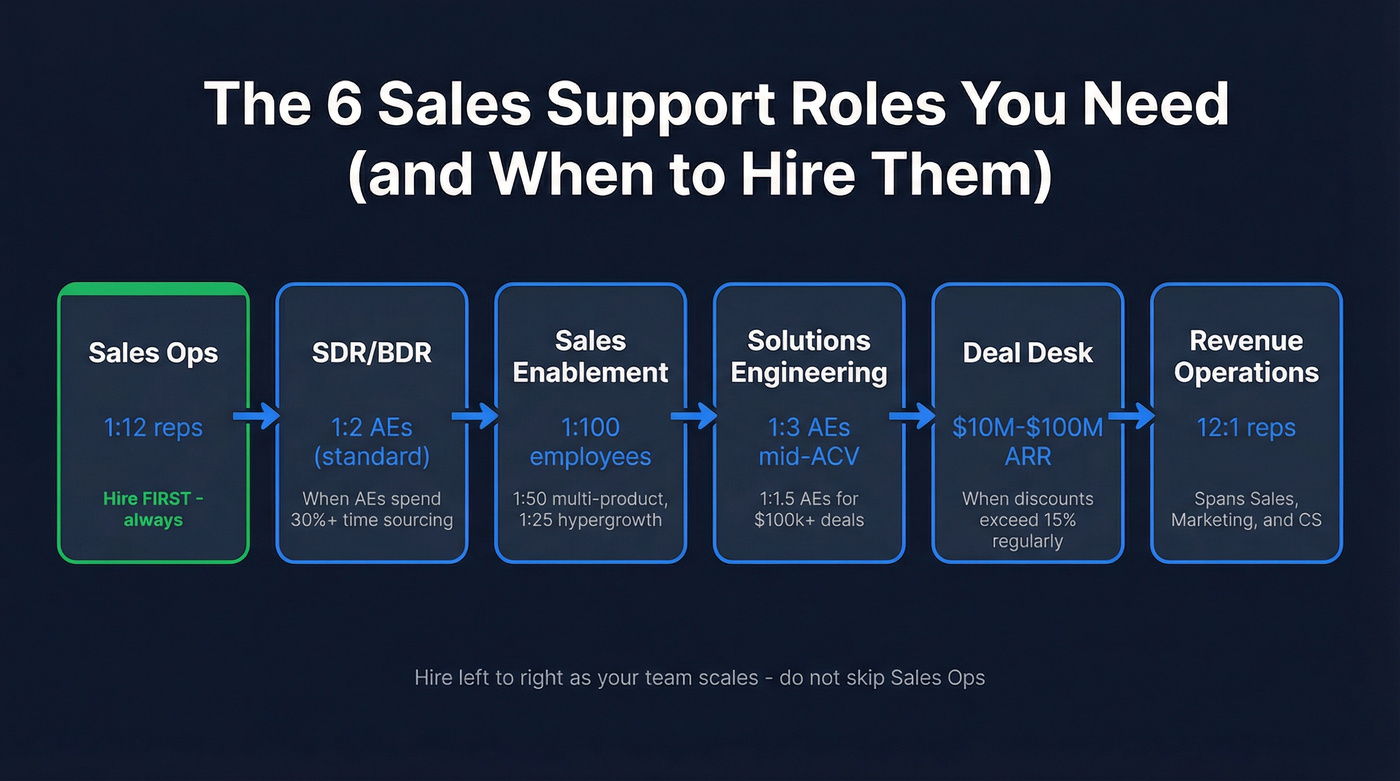
Sales Ops owns CRM configuration, reporting, process documentation, and territory management. Without them, your pipeline data is garbage and your AEs become part-time admins. A practical planning baseline is about 1 ops person per 12 reps, then specialize as you scale. Past 50 reps, this function typically evolves into Revenue Operations.
SDR/BDR Layer
The Optif.ai benchmark (N=939 companies, Q1-Q3 2025) uses 1:2 as the standard SDR-to-AE ratio. Adjust based on motion: 1:1.5 for outbound-heavy teams, 1:3 if you're high-inbound. The trigger to hire your first SDR is when AEs spend more than 30% of their time sourcing pipeline.
Ask any sales leader on r/sales when to hire their first SDR and you'll get 50 different answers. Here's the one that matters: skip this hire entirely if your AEs close sub-$15k deals with short cycles. The handoff overhead isn't worth it at that deal size.
Sales Enablement
Enablement starts as one person wearing every hat: onboarding, content, coaching, tool admin. Staffing ratios scale with complexity - 1 enablement hire per 100 employees for mature orgs, 1 per 50 for multi-product teams, 1 per 25 if you're growing above 40% YoY. Most teams start centralized, then shift to hub-and-spoke as they add product lines or regions.
With 66% of reps struggling with too many tools and information overload, enablement is the function that keeps your tech stack from becoming shelfware. Remote-first teams need this hire earlier - without hallway coaching, structured enablement fills the gap. (If you're building onboarding from scratch, use a 30-60-90 day plan as the baseline.)
Solutions Engineering / Pre-Sales
This is where the math gets compelling.
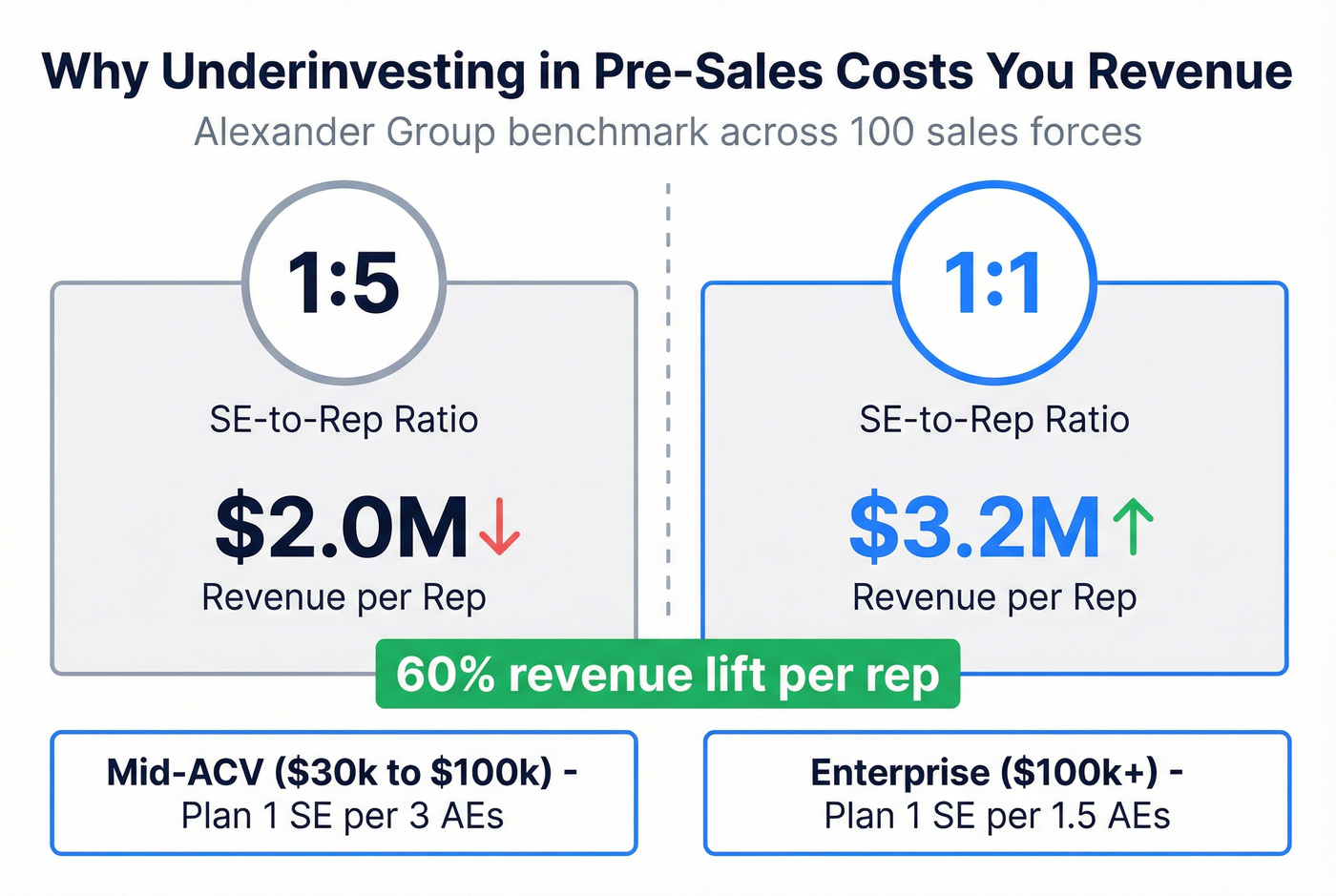
An Alexander Group benchmark across 100 sales forces found that at a 1:5 SE-to-rep ratio, revenue per rep averaged $2.0M. At 1:1, it jumped to $3.2M - a 60% lift. For mid-ACV deals ($30-100k), plan 1 SE per 3 AEs. For enterprise ($100k+), 1 SE per 1.5 AEs. Underinvesting in pre-sales is one of the most expensive mistakes in B2B, and we've watched teams learn this the hard way more than once.
Deal Desk
The most underrated support function in B2B sales. Most companies add it 12-18 months too late.
You need deal desk when discounts regularly exceed 15%, deals cross $100k ACV, or non-standard terms pile up. Typical adoption window: $10M-$100M ARR with a growing enterprise motion. If your VP of Sales is personally reviewing every contract with custom terms, that's your signal. (If discounting is getting out of control, align on an anchor in negotiation before you add headcount.)
Revenue Operations
RevOps isn't a rebrand of Sales Ops. True RevOps spans Sales, Marketing, and CS - owning cross-functional data governance, tech stack integration, and revenue forecasting. Gartner projects that 75% of highest-growth companies will have adopted RevOps by 2026. The PeerSignal benchmark across 2,500 B2B SaaS companies puts the ratio at 12:1 reps-to-RevOps.
AI tooling is compressing some of these roles. Automated CRM updates, meeting transcription, and forecasting models mean your RevOps team can stay leaner, but the strategic layer still needs humans.

You're optimizing SDR-to-AE ratios and hiring Sales Ops to clean up your CRM. But none of that matters if your reps are working bad data. Prospeo gives your support team 300M+ profiles with 98% verified emails, refreshed every 7 days - so your SDRs prospect and your Ops team stops firefighting bounce rates.
Stop hiring more reps to fix a data problem. Fix the data.
Staffing Benchmarks at a Glance
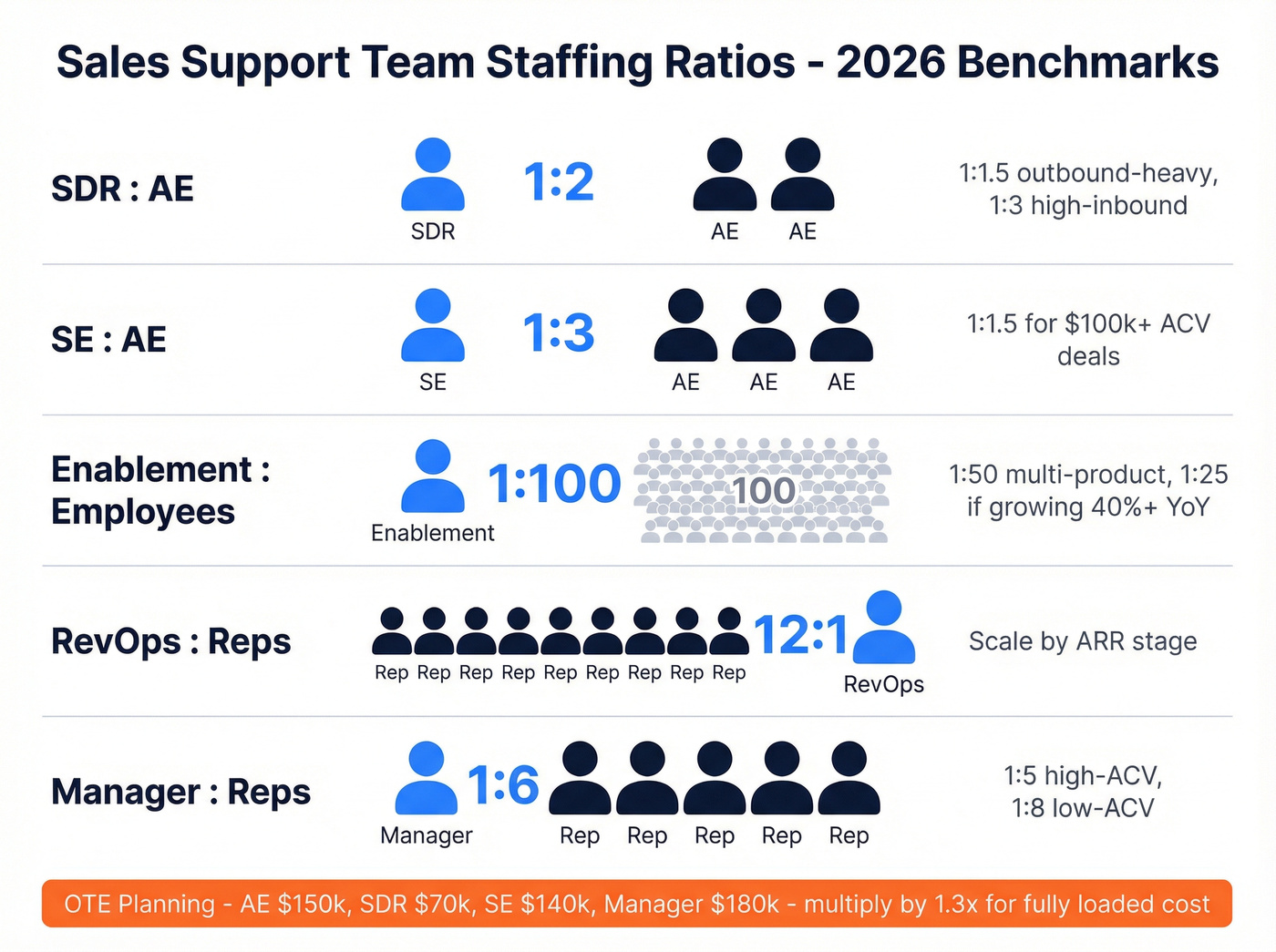
Use this as your planning baseline. Adjust for ACV, growth rate, and sales motion.
| Role | Ratio | Adjustments |
|---|---|---|
| SDR : AE | 1:2 standard | 1:1.5 outbound; 1:3 inbound |
| SE : AE | 1:3 mid-ACV | 1:1.5 high-ACV ($100k+) |
| Enablement | 1:100 employees | 1:50 multi-product; 1:25 hypergrowth |
| RevOps | 12:1 reps | Scale by ARR stage (see below) |
| Manager span | 1:6 default | 1:5 high-ACV; 1:8 low-ACV |
OTE planning: AE ~$150k, SDR ~$70k, SE ~$140k, Manager ~$180k. Multiply by 1.3x for fully loaded cost. (If you need a clean definition and benchmarks, see OTE in sales.)
Let's be honest - if your frontline sellers are spending their week on CRM hygiene, pricing approvals, and internal coordination, you're under-invested in support even if your org chart looks "lean."
Stage-Based Hiring Checklist
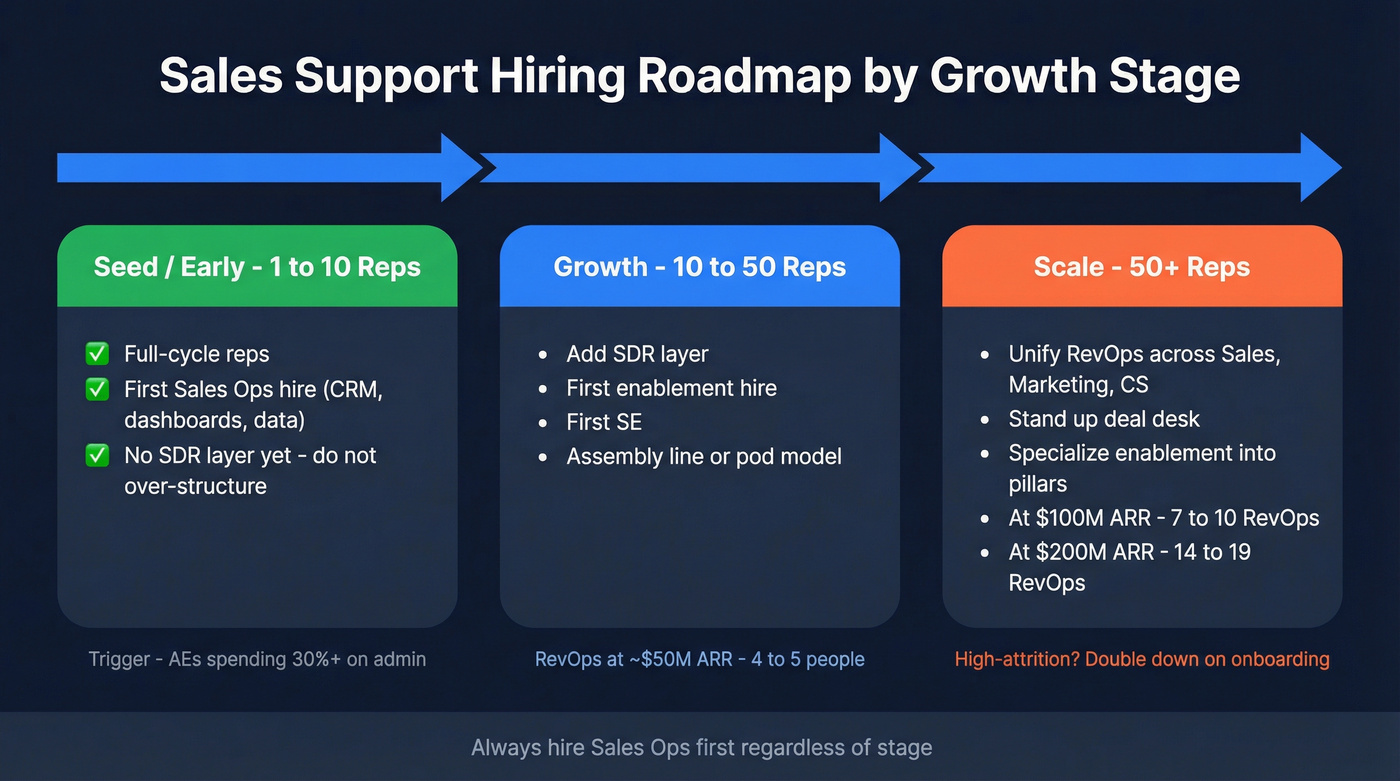
Seed / Early (1-10 reps)
- Full-cycle reps + first Sales Ops hire
- Sales Ops configures CRM, builds dashboards, keeps data clean
- Don't over-structure - no SDR layer yet
Growth (10-50 reps)
- Add SDR layer when AEs source more than 30% of pipeline
- First enablement hire, first SE
- Assembly line or pod model kicks in
- RevOps sizing at ~$50M ARR: 4-5 people (1 manager + 3-4 ICs)
Scale (50+ reps)
- Unify RevOps across Sales, Marketing, and CS
- Stand up deal desk
- Specialize enablement into pillars: onboarding, content, coaching
- At $100M ARR: 7-10 RevOps; at $200M: 14-19
- High-attrition orgs: double down on onboarding and enablement investment
Overlay Model: Layering Specialists Across Pods
Some teams outgrow a single organizational structure and need specialists who sit across multiple pods or segments rather than inside them. SEs, industry specialists, or strategic deal desk analysts serve several AE teams simultaneously instead of being embedded in one.
The overlay approach works best when you have 50+ reps, uneven deal complexity across segments, and specialists who'd be underutilized if assigned to a single pod. The trade-off is coordination cost: overlay specialists need clear engagement rules - SLA on response time, deal-size thresholds for involvement - or they become a bottleneck instead of a multiplier. We've found that writing these rules down in a one-page engagement doc, rather than leaving them implicit, saves weeks of frustration later.
Data Quality: The Function Nobody Budgets For
None of these support roles matter if your reps are working bad data. Bounced emails, wrong numbers, and stale records erode trust in every system your Sales Ops team builds. We've seen teams invest six figures in CRM tooling and fill it with contact data that's 20% invalid on day one.
Before you hire a full-time data person, automate enrichment. Prospeo keeps your CRM clean at 98% email accuracy with a 7-day refresh cycle - versus the 6-week industry average - at roughly $0.01 per email. Its CRM enrichment returns 50+ data points per contact with a 92% API match rate, plugging directly into Salesforce and HubSpot so your ops team doesn't build another manual workflow. (If you're comparing vendors, start with data enrichment services and a quick primer on lead enrichment.)
Your enablement team is onboarding reps faster and your RevOps stack is finally unified. Now arm them with data that actually connects. Prospeo's 30+ search filters - including buyer intent, technographics, and headcount growth - let every role in your support structure target the right accounts from day one. At $0.01 per email, scaling headcount doesn't mean scaling data costs.
Equip every support role with enterprise-grade data at SMB pricing.
FAQ
What's the difference between Sales Ops and RevOps?
Sales Ops supports the sales team - CRM, comp plans, territories, pipeline methodology. RevOps spans Sales, Marketing, and CS, owning cross-functional data governance and revenue forecasting. The litmus test: if your RevOps team only touches sales workflows, it's Sales Ops with a new title.
When should I hire my first support role?
Hire your first Sales Ops person when AEs spend more than 30% of their time on non-selling tasks - typically around 5-8 reps. That one hire unblocks reporting, process, and data quality for the entire team before you add any other support headcount.
How do I choose between centralized and overlay support?
A centralized sales support team structure works well under 50 reps because every specialist stays busy. Past that threshold, an overlay model - where SEs or deal desk analysts serve multiple segments - gives you coverage without duplicating headcount in every pod.
How do I keep CRM data clean without a dedicated data team?
Automate enrichment before hiring for it. Build verification rules into your CRM workflows, schedule quarterly audits, and use a tool like Prospeo that refreshes records on a 7-day cycle with 98% email accuracy - so stale data doesn't accumulate and erode your team's trust in the system.