

Sales Team Quotas: How to Set Numbers Your Reps Can Actually Hit
It's Q1 planning. Your VP just sent a spreadsheet. Every rep's number went up 20%, but the territory map didn't change, the product hasn't shipped anything new, and two of your best AEs left in November. Sound familiar?
That's the sales team quotas problem in a nutshell - and ask any rep, they'll tell you the numbers are "plucked out of thin air." They're not wrong. 87% of sales leaders have no set method for setting quotas. The math exists. Most leaders skip it. Below: the benchmarks, the framework, and a worked example so your next quota cycle isn't a coin flip.
The Quick Version
Most quotas fail because leadership works backward from a revenue target without checking whether the number is physically achievable. Before setting a single rep's number, know your benchmarks: average B2B attainment is 65%, enterprise AEs sit at 38.2%, and the trend is declining year over year. The inputs that matter most are selling time percentage, ramp time, and conversion rates. Nail those, and the quota math falls into place.
Here's the thing: historical quota-setting - last year's number plus 15% - is lazy math that punishes your best people. If that's your method, keep reading.
What Is a Sales Quota?
A sales quota is a specific, measurable target assigned to a rep or team within a defined time period - monthly, quarterly, or annual. It's not a "goal" (aspirational) or a "target" (directional). It's the number tied to comp plans, performance reviews, and pipeline forecasting. Quotas carry compensation consequences. Targets don't.
Quota-setting typically lives with sales leadership, but the best organizations involve RevOps and finance. RevOps brings the capacity math. Finance brings the revenue constraint. Sales leadership brings the field intelligence. When any one of those three is missing, you get quotas that look good on a board deck but fall apart in execution.
The 6 Types of Sales Quotas
Not every quota measures the same thing, and picking the wrong type for your motion is a fast way to incentivize the wrong behavior.
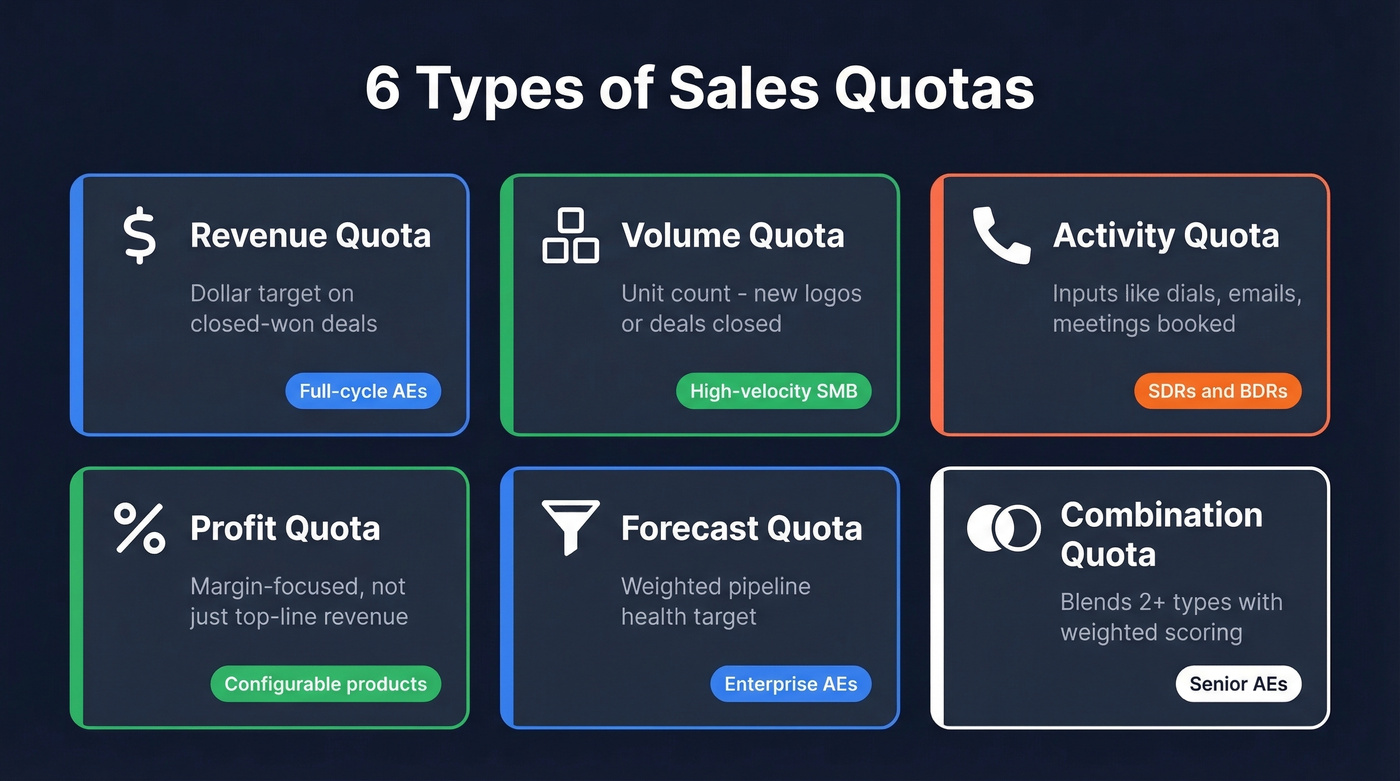
Revenue quota is the most common - a dollar target tied to closed-won deals. Think $500K/quarter for a mid-market AE. Best for full-cycle reps who own the entire deal from demo to close.
Volume quota is a unit count. Fifteen new logos per quarter for an SMB AE, for example. Best for high-velocity sales motions where deal sizes are relatively uniform.
Activity quota measures inputs, not outputs. Eighty dials per day or 200 emails per week for an SDR. Best for top-of-funnel roles where pipeline generation is the primary job (see more sales activities that actually move pipeline).
Profit quota targets margin, not just revenue. Best for teams selling configurable products or services where discounting is common and margin erosion is a real risk. If your reps are giving away 30% on every deal to hit their revenue number, a profit quota forces better discipline.
Forecast quota is a weighted pipeline target - maintain $1.5M in Stage 3+ pipeline at all times. Best for enterprise AEs with long sales cycles where pipeline health predicts revenue better than closed-won snapshots.
Combination quota blends two or more types. Say $400K revenue + 5 new logos + 90% forecast accuracy, weighted 60/25/15. A rep hitting 100%/80%/90% scores 93.5% blended attainment. Best for senior AEs where you need balanced performance across multiple dimensions, though the tradeoff is complexity - reps need to understand exactly how each component weights their comp.
Quota Attainment in 2026: The Real Numbers
The trend line isn't encouraging. Quota attainment has dropped from 52% in 2024 to 46% in early 2025 to 43% heading into 2026. That's not a blip. That's a structural shift driven by longer sales cycles, tighter budgets, and quotas that haven't adjusted to match.
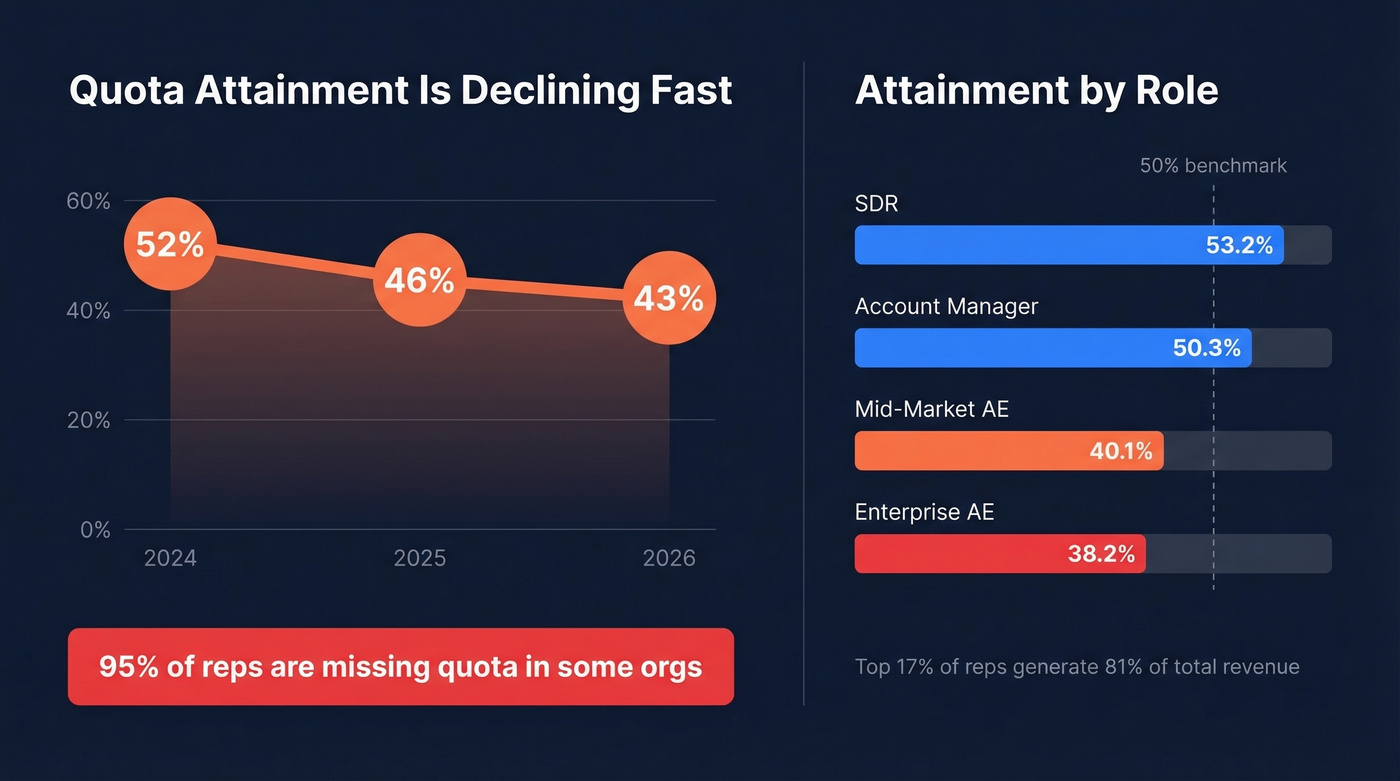
Outreach's revenue analysis paints an even bleaker picture: 95% of reps missing quota, with median sales cycles stretching to 120 days - and 408 days for mid-market deals at companies between $250M-$1B.
Attainment by Role
| Role | Avg. Attainment |
|---|---|
| SDR | 53.2% |
| Account Manager | 50.3% |
| Mid-Market AE | 40.1% |
| Enterprise AE | 38.2% |
In complex enterprise segments, some cohorts are sitting at just 16% attainment.
Attainment by Industry
| Industry | Avg. Attainment | Pipeline Conversion |
|---|---|---|
| SaaS | 70% | 25% |
| Services | 68% | ~23% |
| B2B Average | 65% | 23% |
| Manufacturing | 60% | 20% |
The concentration problem makes this worse. The top 17% of reps generate 81% of total revenue. Most teams are carried by a handful of performers while the rest of the roster misses - and leadership blames the reps instead of the quota design.
A quick diagnostic: if fewer than 50% of reps hit quota, your numbers are too aggressive. More than 80%? You're leaving revenue on the table.
The cost of getting this wrong is staggering. Sales rep turnover runs 35% annually - nearly triple the cross-industry average of 13%. Each replacement costs roughly $115K when you factor in recruiting, onboarding, and lost pipeline.

When 57% of reps miss quota, bad contact data makes it worse. Every bounced email and wrong number eats into the 28% of time reps actually spend selling. Prospeo delivers 98% email accuracy and 125M+ verified mobiles so your team connects with real buyers - not dead ends.
Stop letting bad data sabotage attainable quotas.
Why Most Quotas Fail
Five mistakes kill quota plans before the quarter even starts.
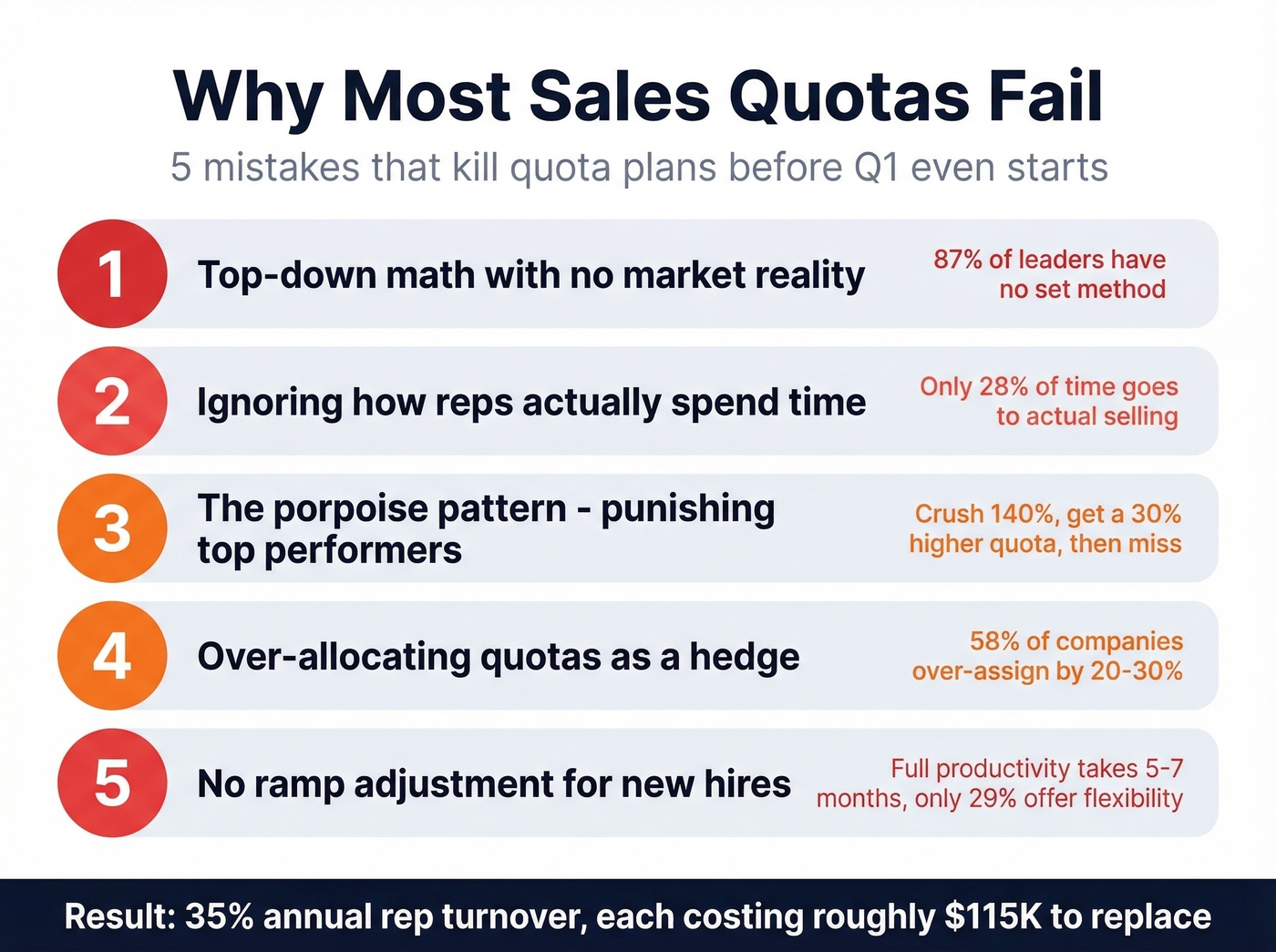
1. Top-down division without market reality. Leadership takes the board target, divides by headcount, and calls it a quota. This ignores territory potential, market conditions, and the fact that not every rep has the same opportunity set. It's the most common approach and the most reliably wrong.
2. Ignoring how reps actually spend their time. Reps spend about 60% of their time on non-selling tasks, with only about 28% going to actual selling. If your quota assumes 40 hours of selling per week, you've already built in failure. Capacity planning means accounting for admin, internal meetings, CRM updates, and the dozen other things that eat a rep's calendar.
3. The porpoise pattern. Your top AE crushed 140% last year. Reward? A 30% higher quota. She's already updating her resume. SalesGlobe calls this the "porpoise pattern" - big year, inflated quota, miss, lowered quota, repeat. It punishes your best people and creates a perverse incentive to sandbag.
4. Over-allocation as a "buffer." In 2026 benchmarks, 58% of companies intentionally over-assign quotas by 20-30%. Leadership treats this as a hedge. Reps experience it as being lied to about what success looks like.
5. No ramp adjustment. Forrester puts time-to-full-productivity at 7 months; Bridge Group breaks it down to 5.3 months for AEs and 3.6 for SDRs. If a new hire gets the same quota as a tenured rep on day one, you've guaranteed a miss - and probably a resignation by month six. Only 29% of companies offer mid-period quota flexibility, which means most organizations are structurally incapable of adjusting when reality changes.
How to Set Quotas That Actually Work
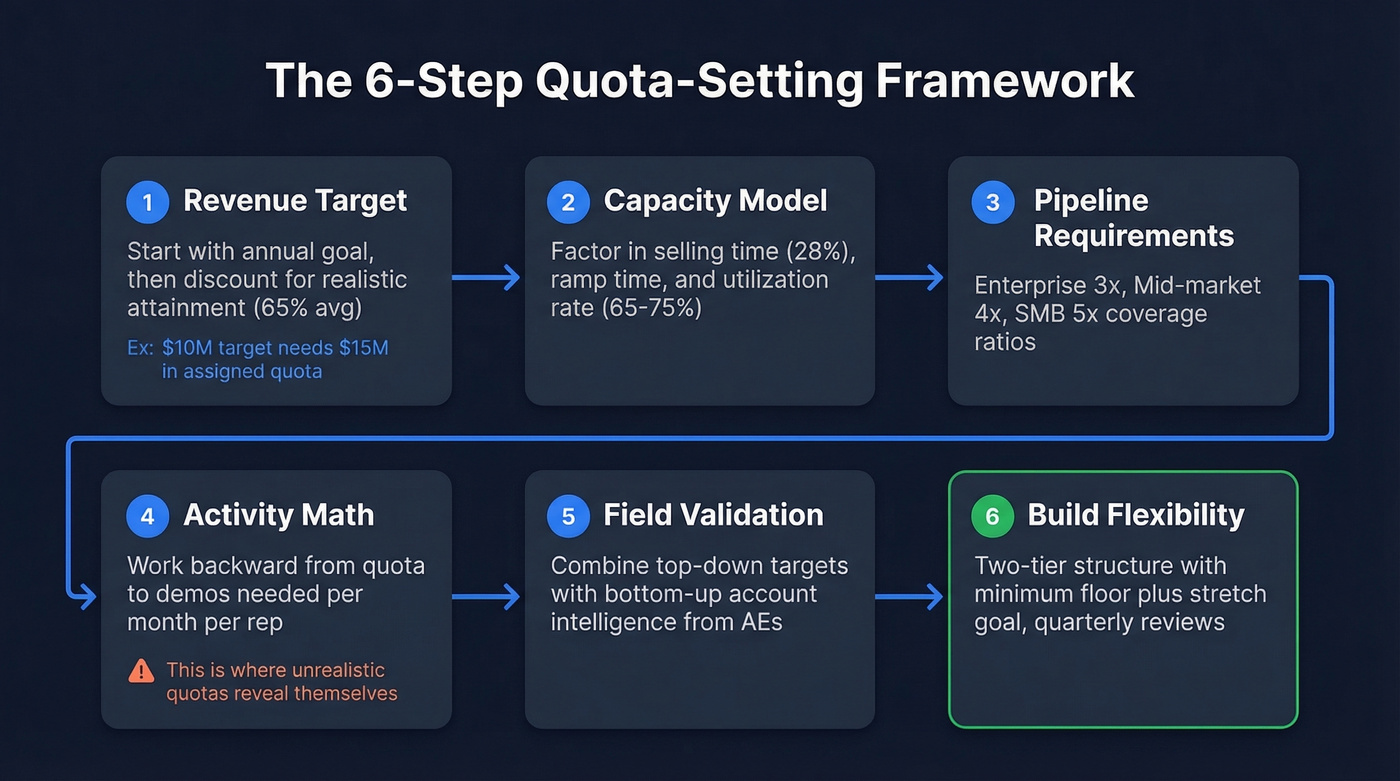
Here's the six-step framework we've seen work across dozens of quota cycles. The math isn't complicated - it just requires discipline (and a sales performance management mindset).
Step 1: Start With Revenue, Then Discount for Reality
Take your annual revenue target. Now discount it for realistic attainment. If your B2B average is 65% attainment, you need to plan for that gap - either by hiring more reps or by accepting a lower total number. A $10M target with 65% expected attainment means you need capacity to cover roughly $15M in assigned quota.
Step 2: Build a Capacity Model
This is where most teams skip straight to the spreadsheet and lose. You need three inputs: selling time percentage (28% is the benchmark, though strong orgs push this to 35-40%), ramp time by role, and utilization rate. Bridge Group benchmarks put successful B2B teams at 65-75% capacity utilization - a team of 10 reps delivers the output of 6.5-7.5 fully ramped reps at any given time. Salesforce reports sellers using AI tools are 3.7x more likely to meet quota, which is worth factoring into your capacity model as AI adoption accelerates.
Step 3: Calculate Pipeline Requirements
Pipeline coverage ratios vary by segment. Enterprise deals need roughly 3x coverage ($1M quota = $3M qualified pipeline). Mid-market runs closer to 4x. SMB, where deal velocity is higher but win rates are lower, needs 5x. These aren't arbitrary multipliers - they're derived from conversion rates. SaaS companies convert pipeline at about 25%; manufacturing closer to 20%. (If you want more benchmarks, see sales pipeline benchmarks.)
Step 4: Work Backward to Activities
This is where the math gets real - and where unrealistic quotas reveal themselves. Let's walk through a worked example from Inscaler's planning framework:
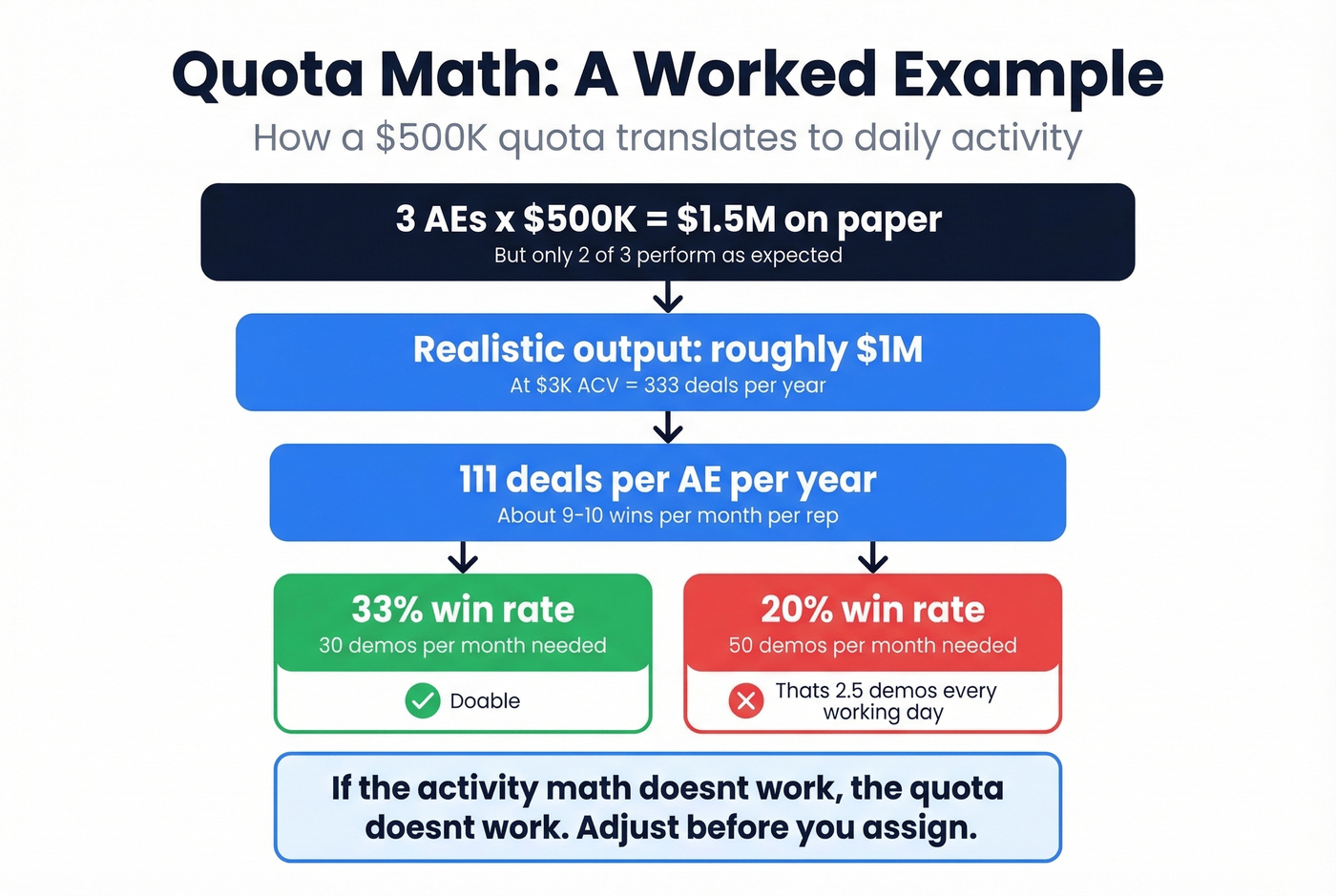
You have 3 AEs, each carrying a $500K target. That's $1.5M on paper. But assume only 2 out of 3 perform as expected - realistic output is closer to $1M in new business. With a $3K ACV, that's 333 deals per year, about 111 per AE, or 9-10 wins per month per rep.
At a 33% win rate, each AE needs roughly 30 new demos per month. Doable. But if your win rate is actually 20%? Now you need 50 demos per month per AE. That's more than two demos every working day. For most teams, that's fiction - and the quota should reflect it.
Step 5: Validate With Field Intelligence
The best quota plans combine top-down targets with bottom-up account-level intelligence. Your AEs know which accounts are in play, which territories are saturated, and where the whitespace is. Neither approach works alone.
The median annual new-business quota for enterprise AEs is roughly $800K ACV, with quotas typically set at 3-5x OTE. An AE earning $150K OTE should carry $450K-$750K. If your number is significantly above that range, you'd better have a clear reason - a massive territory, a hot product, or an unusually high ACV. (If you need a refresher on OTE math, see OTE in sales.)
Step 6: Build in Flexibility
The Reddit consensus on quotas is blunt: they're arbitrary. One of the most upvoted suggestions we've seen on r/sales is a two-tier structure - a "minimum" target based on the team mean from the previous year (commissionable), plus a harder "goal" target with a bonus kicker. This gives reps a realistic floor while still incentivizing stretch performance.
Only 29% of companies offer quota flexibility for territory shifts or market changes. Be in that 29%. Quarterly reviews at minimum. If the market moves, your quotas should move with it.
The Data Quality Problem Nobody Talks About
Activity quotas assume every dial reaches a real person and every email lands in an inbox. In practice, that's rarely true.
When bounce rates hit 30-40% and phone numbers are disconnected, your capacity model collapses. A rep tasked with 80 dials per day who's working off stale data might connect with 8 people instead of 25. The quota math doesn't hold. We've seen this firsthand with teams who rebuilt their activity models after switching to verified data - suddenly the same quota that seemed impossible became achievable because reps weren't burning half their dials on dead numbers.
Prospeo's 98% email accuracy and 30% mobile pickup rate exist to solve exactly this problem. The 7-day data refresh cycle means reps aren't wasting effort on contacts that went stale three months ago, compared to the 6-week industry average at most providers. If you're evaluating vendors, start with data enrichment services and a clear view of your email bounce rate.
Tools for Quota Planning
You don't need a massive tech stack to plan quotas well, but you do need the right layers.
| Category | Tool | Starting Price |
|---|---|---|
| CRM / Tracking | Salesforce | ~$25/user/mo |
| CRM / Tracking | HubSpot | Free; paid plans ~$20+/user/mo |
| Sales Performance | Xactly | ~$30-100+/user/mo (enterprise) |
| Quota Tracking | QuotaPath | ~$15-30/user/mo |
| Contact Data | Prospeo | Free tier; ~$0.01/email |
| Template | Lative | Free (Google Sheets) |
69% of sales leaders use Salesforce for setting and monitoring quotas, which makes sense - it's where the pipeline data lives. For comp management and attainment tracking, Xactly and QuotaPath handle the math that spreadsheets eventually break on. Lative offers a free quota assignment template in Google Sheets that's genuinely useful for teams not ready to invest in dedicated SPM software.
Skip dedicated SPM tools if you're under 20 reps. A well-built spreadsheet with clean CRM data will get you 80% of the way there. (If you're tightening your process, use a sales process optimization checklist and track pipeline health weekly.)
Quota math breaks down when reps waste hours hunting for contact info. Prospeo's 300M+ profiles with 30+ filters - including buyer intent and headcount growth - mean your AEs spend time selling, not researching. Teams using Prospeo book 26% more meetings than ZoomInfo users.
Give your reps the pipeline coverage their quotas demand.
FAQ
What percentage of reps should hit quota?
Target 60-70%. If more than half your reps consistently miss, the quota design is flawed - not the talent. Calibrate against the 65% B2B average attainment benchmark and adjust quarterly.
What's a good quota-to-OTE ratio?
The standard is 3-5x OTE. An AE earning $150K OTE should carry $450K-$750K in annual quota. Enterprise roles skew toward 5x; SMB and high-velocity roles sit closer to 3x.
Should new hires carry the same quota?
No. Use a ramped structure - 25% in month one, 50% in month two, 75% in month three, full quota by month four or five. Bridge Group data shows AEs need 5.3 months to reach full productivity.
How does bad contact data affect attainment?
Directly and measurably. If 30-40% of phone numbers and emails are invalid, activity quotas become impossible regardless of rep effort. Clean, verified data keeps the underlying capacity math intact - it's the difference between a quota that's achievable and one that's fiction from day one.
How do sales goals differ from quotas?
Goals are directional benchmarks for strategic planning - they tell the organization where it wants to go. Quotas are specific, rep-level numbers tied to compensation. A company might set a goal of 40% YoY growth, then translate that into individual quotas based on territory and capacity.