

How to Structure a Sales Team in 2026 (With Ratios, Comp Data, and Mistakes to Avoid)
You doubled the team last year. Headcount went up 100%, but pipeline grew 20%. The problem wasn't effort or talent - it was sales team structure. Reps spend just 28% of their time actually selling, and the wrong org design makes that number worse.
Getting structure right isn't a soft exercise. Korn Ferry's data shows that sales orgs with clearly defined roles hit +8% revenue attainment, +25% quota attainment, and +17% higher win rates - while cutting voluntary turnover by 17% and involuntary turnover by 20%. This is a revenue problem, not an HR problem.
The Short Answer
Most B2B teams between 10 and 100 reps should start with the Assembly Line model. Staff it at a 1:2.5 SDR-to-AE ratio. Specialize roles as soon as a rep needs to close 4x their comp to be profitable - and don't skip the handoff SLAs between stages.
Simple sizing rule: 1-10 reps is usually Island, 10-20 is usually Assembly Line, and 20+ often benefits from Pods. Selling into multiple customer types? A Segment-Based approach can work well too.
5 Sales Org Structures Explained
The Assembly Line is the default starting point for most B2B teams once you move past founder-led selling and need repeatable pipeline. Geographic territories still make sense for field sales - they reduce travel costs by keeping reps close to accounts - but they create silos and inconsistent messaging without clear handoffs and rules of engagement.
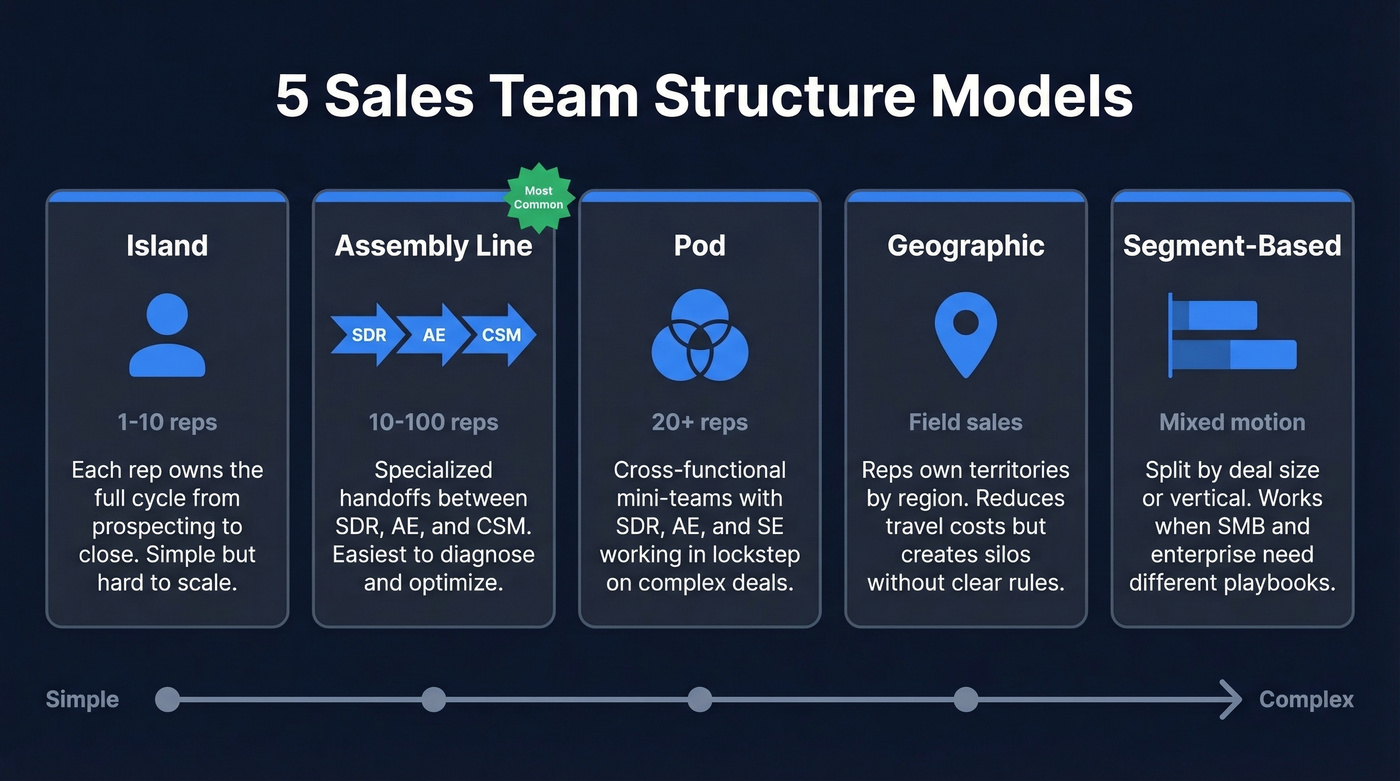
| Model | How It Works | Best For |
|---|---|---|
| Island | Each rep owns the full cycle | Early-stage, small teams |
| Assembly Line | SDR → AE → CSM handoffs | 10-100 rep B2B orgs |
| Pod | Cross-functional mini-teams | Complex enterprise deals |
| Geographic | Reps own territories | Field sales with on-site visits |
| Segment-Based | Split by ACV or vertical | Mixed SMB + enterprise motion |
The Assembly Line works because it lets you optimize each stage independently. Your SDRs get better at opening, your AEs get better at closing, and you can diagnose exactly where pipeline breaks down. Pods work well for enterprise deals where an AE, SDR, and SE need to move in lockstep, but they're harder to manage and scale. We've seen teams try to jump straight to Pods at 12 reps and regret it - the coordination overhead eats the benefit until you have enough people to staff at least three full pods.
Staffing Ratios and Benchmarks
The industry benchmark across 939 B2B companies is 1 SDR for every 2.5 AEs. That average hides important variation by segment.
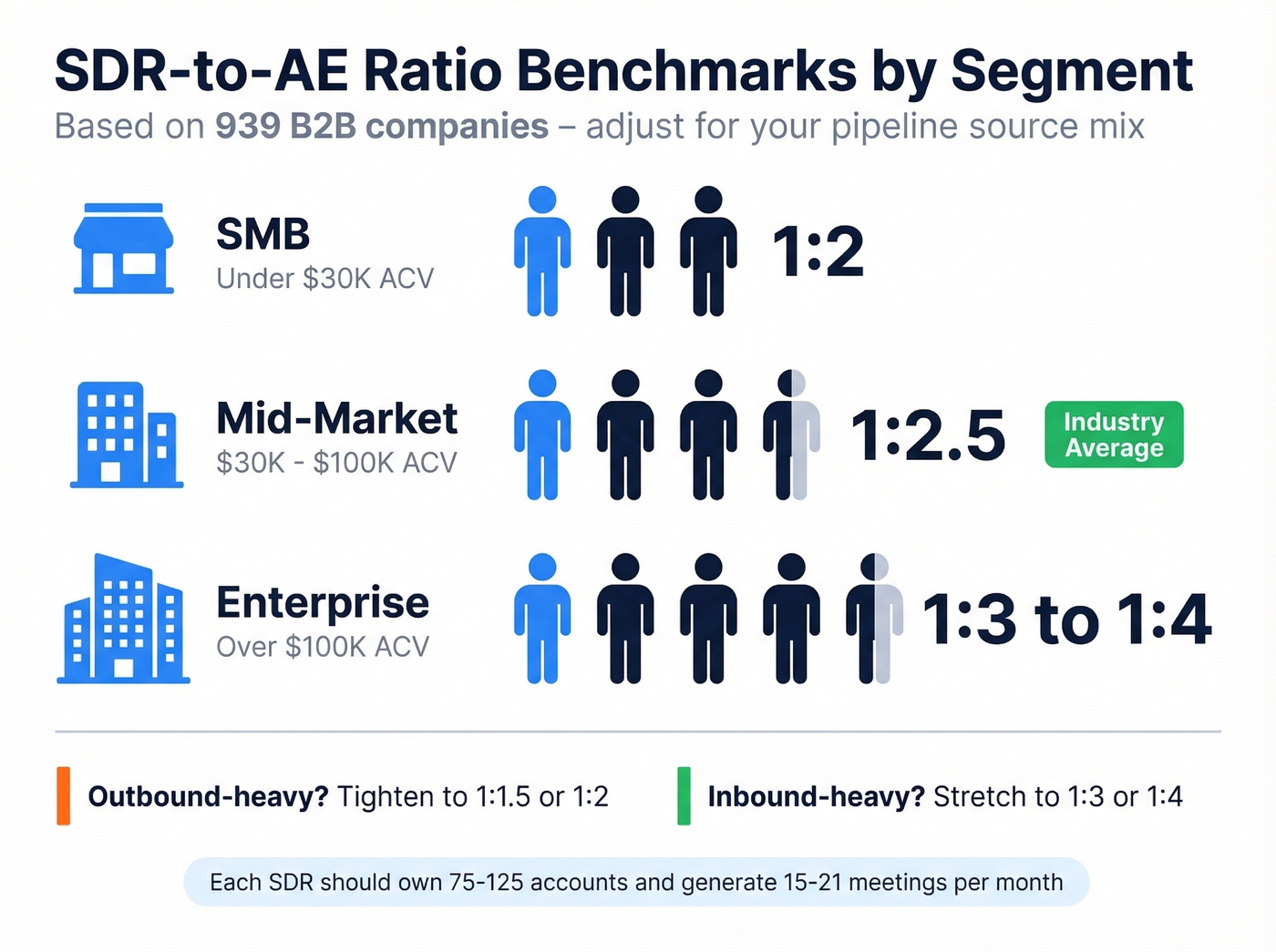
| Segment | ACV | SDR:AE Ratio |
|---|---|---|
| SMB | <$30K | 1:2 |
| Mid-Market | $30-100K | 1:2.5 |
| Enterprise | >$100K | 1:3 to 1:4 |
Outbound-heavy teams need tighter ratios - often 1:1.5 to 1:2. Inbound-heavy teams can stretch to 1:3 or 1:4.
Each SDR should own 75-125 accounts and generate 15-21 meetings per month. Plan for 65-75% capacity utilization; the rest goes to admin, training, and PTO. SDR-sourced pipeline typically accounts for 46-73% of total pipeline, and it takes 18+ dials just to connect with a prospect. That last number is why data quality matters so much - if a third of your phone numbers are wrong, you're burning dials on dead ends.

Your SDRs need 18+ dials to connect - and that's with good numbers. Bad data makes it 30+. Prospeo's 125M+ verified mobiles hit a 30% pickup rate, and emails land at 98% accuracy. At $0.01 per email, scaling your Assembly Line doesn't break the budget.
Stop burning SDR capacity on dead numbers. Start connecting.
What Each Role Costs (2026 Comp)
Less than half of AEs hit quota. Let that sink in. That's not a people problem - it's a structural one. If your org design creates impossible territories or starves closers of pipeline, comp plans don't matter.
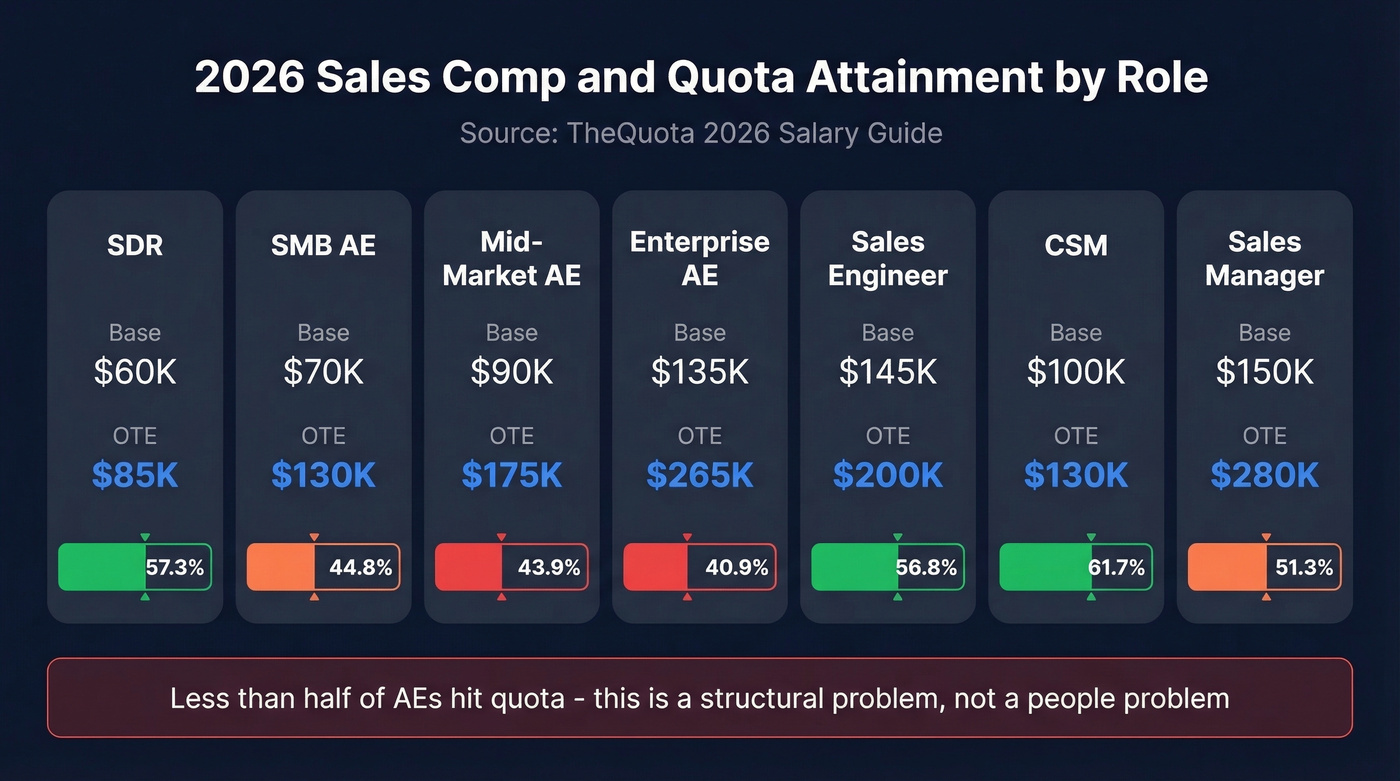
| Role | Base | OTE | % Hitting Quota |
|---|---|---|---|
| SDR | $60K | $85K | 57.3% |
| SMB AE | $70K | $130K | 44.8% |
| Mid-Market AE | $90K | $175K | 43.9% |
| Enterprise AE | $135K | $265K | 40.9% |
| Sales Engineer | $145K | $200K | 56.8% |
| CSM | $100K | $130K | 61.7% |
| Sales Manager | $150K | $280K | 51.3% |
Data from TheQuota's 2026 salary guide. Notice how quota attainment drops as deal complexity rises. If you're building an enterprise motion, your structure needs to account for longer ramp times, heavier support, and the reality that 60% of your enterprise AEs won't hit number in their first year.
Structural Mistakes That Kill Revenue
Every model has trade-offs, but these five mistakes are the most common structural failures we see across the teams we work with:
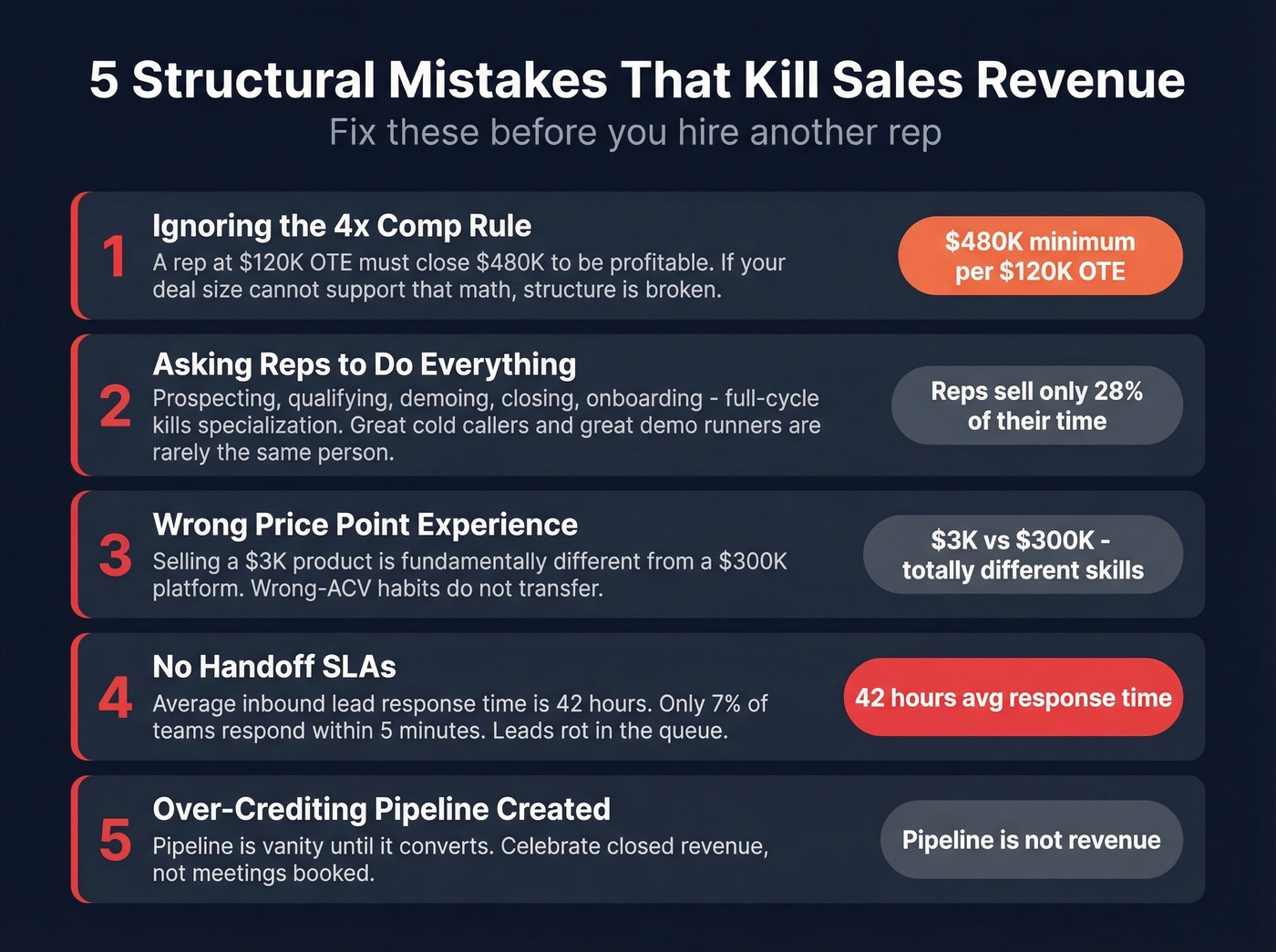
Ignoring the 4x comp rule. A rep with $120K OTE needs to close $480K to be profitable. If your deal size can't support that math, you have a structural problem before you ever write a job description.
Asking reps to do everything. Prospecting, qualifying, demoing, closing, onboarding - full-cycle kills specialization. Split openers from closers as soon as you can afford to. Here's the thing: a rep who's great at cold outreach and a rep who's great at running a complex demo are rarely the same person. If you need a refresher on what “good” looks like, start with these sales prospecting techniques.
Hiring closers from the wrong price point. Selling a $3K/year product is fundamentally different from selling a $300K platform. Wrong-ACV experience is almost worse than no experience at all, because the habits don't transfer and the rep gets frustrated fast.
No handoff SLAs. The average inbound lead response time is 42 hours. Only 7% of teams respond within five minutes. Without SLAs, qualified leads rot in a queue while your SDRs assume someone else grabbed them.
Over-crediting pipeline created. Pipeline is vanity until it converts. Celebrate closed revenue, not meetings booked. Track it like a system with pipeline health metrics, not vibes.
How to Build Your Sales Team Step by Step
The best sequencing - one that a Series A founder laid out on r/startup - follows this path:
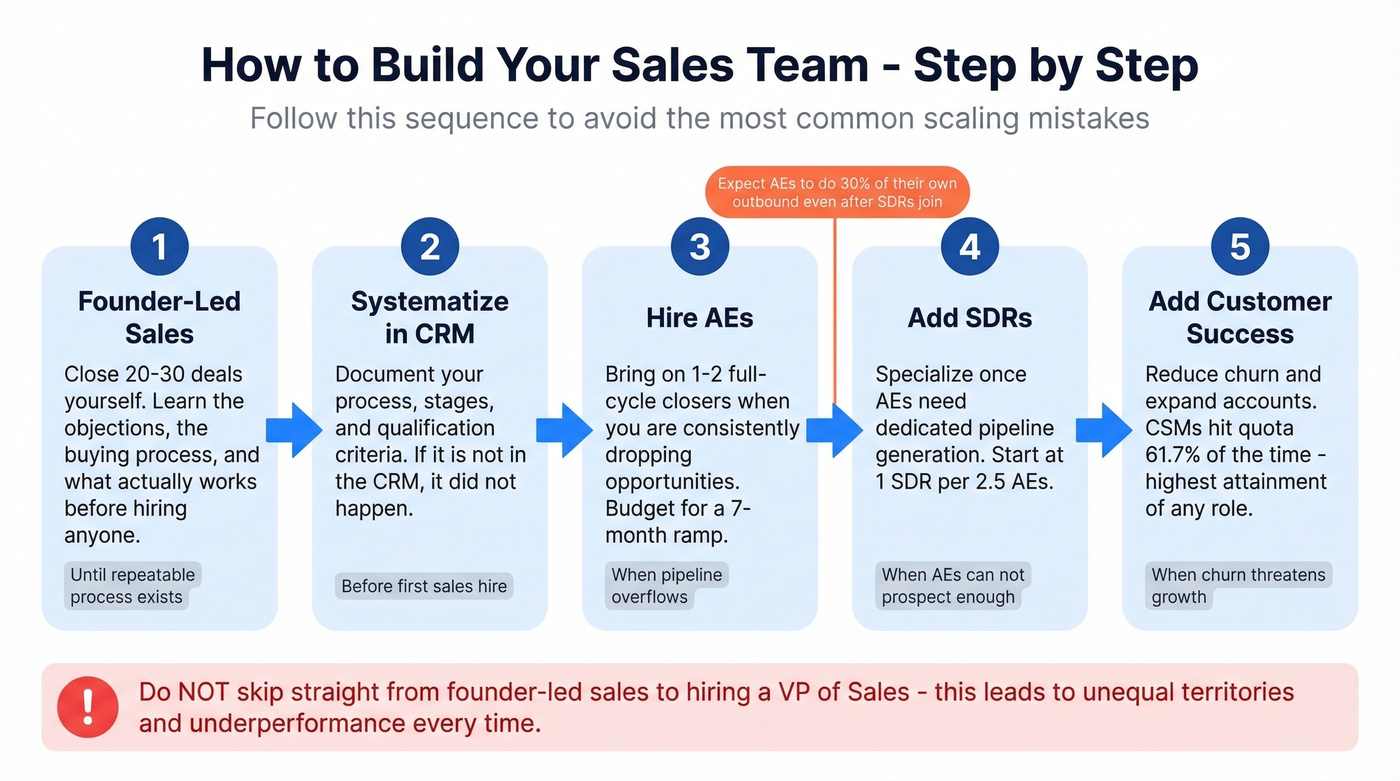
- Founder-led sales until you have a repeatable process
- Systematize everything in a CRM
- Hire AEs when you're dropping opportunities
- Add SDRs once AEs need dedicated pipeline
- Add Customer Success to reduce churn (and actually measure it with churn analysis)
Even with SDRs in place, expect AEs to do roughly 30% of their own outbound. Budget for a 7-month ramp before new reps hit full productivity. And don't skip straight from founder-led sales to hiring a VP of Sales - what Alexander Group calls the "Wild West" approach leads to unequal territories, inconsistent customer experiences, and underperformance every time.
Once roles are defined, your SDRs need accurate contact data to make the Assembly Line actually work. Prospeo gives reps verified emails at 98% accuracy and direct dials on a 7-day refresh cycle, so they spend time selling instead of chasing bounced emails. One of our customers, Snyk, cut their bounce rate from 35-40% to under 5% across 50 AEs - and saw AE-sourced pipeline jump 180%. If you're evaluating vendors, compare options in our guide to data enrichment services.

How AI Reshapes Sales Org Design
About 42% of B2B orgs are implementing generative AI in sales workflows, but only 7% have fully scaled it. And only 13% cite headcount reduction as a primary goal.
The real structural shift isn't fewer people - it's a different task split. AI handles prospect research, initial outreach sequences, and scheduling. Humans handle objection handling, needs assessment, relationship building, and complex negotiation. Deloitte projects a 1:30 human-to-AI-agent ratio by the end of 2026 - each SDR managing more pipeline with AI handling the repetitive layers. The structural advantage goes to teams that redesign workflows around this split, not ones that bolt AI onto a broken org chart. If you're building this stack now, start with generative AI sales tools that fit your workflow.
Let's be honest: if your average deal is under $10K annually, you probably don't need a dedicated SDR team at all in 2026. AI-assisted outbound from your AEs will outperform a poorly structured SDR org every time. Spend the headcount budget on better data and tooling instead - especially the basics like email deliverability and email bounce rate.
Structure gets reps to the right stage. Data gets them to the right person. Prospeo refreshes 300M+ profiles every 7 days - not 6 weeks - so your AEs and SDRs always work from current, verified contact info. Bounce rates drop under 4%, just like Snyk's 50-AE team proved.
Fuel your new sales structure with data that actually connects.
FAQ
What's the best sales team structure for a startup?
Founder-led sales first, then 1-2 full-cycle AEs once you have repeatable pipeline. Specialize into SDR + AE roles when you're consistently dropping opportunities. Most startups shouldn't hire specialized roles until they've closed at least 20-30 deals themselves.
How many SDRs per AE should I hire?
The benchmark across 939 companies is 1 SDR per 2.5 AEs. Outbound-heavy teams need 1:1.5-1:2; inbound-heavy teams can stretch to 1:3 or 1:4. Adjust based on your pipeline source mix and deal velocity.
When should I hire a sales manager?
Add a frontline manager around 6-8 reps. Sales Development Managers hit quota 71.6% of the time - one of the highest attainment rates in the industry. Waiting past 10 direct reports usually means coaching quality drops off a cliff.
What tools do SDRs need to prospect?
A CRM, a sequencing tool, and a verified contact data provider. Bad data wastes hours every week - bounced emails and wrong numbers drag down outbound output fast. Skip this and your Assembly Line breaks at the very first stage.
How does sales team structure change as you scale?
Start with the Island model for full-cycle reps, transition to an Assembly Line at 10+ reps, and consider Pods for enterprise motions at 20+. The key is matching each funnel stage to a dedicated role so no step gets neglected as volume grows.