

Sales Techniques That Actually Work in 2026: A Data-Backed Playbook
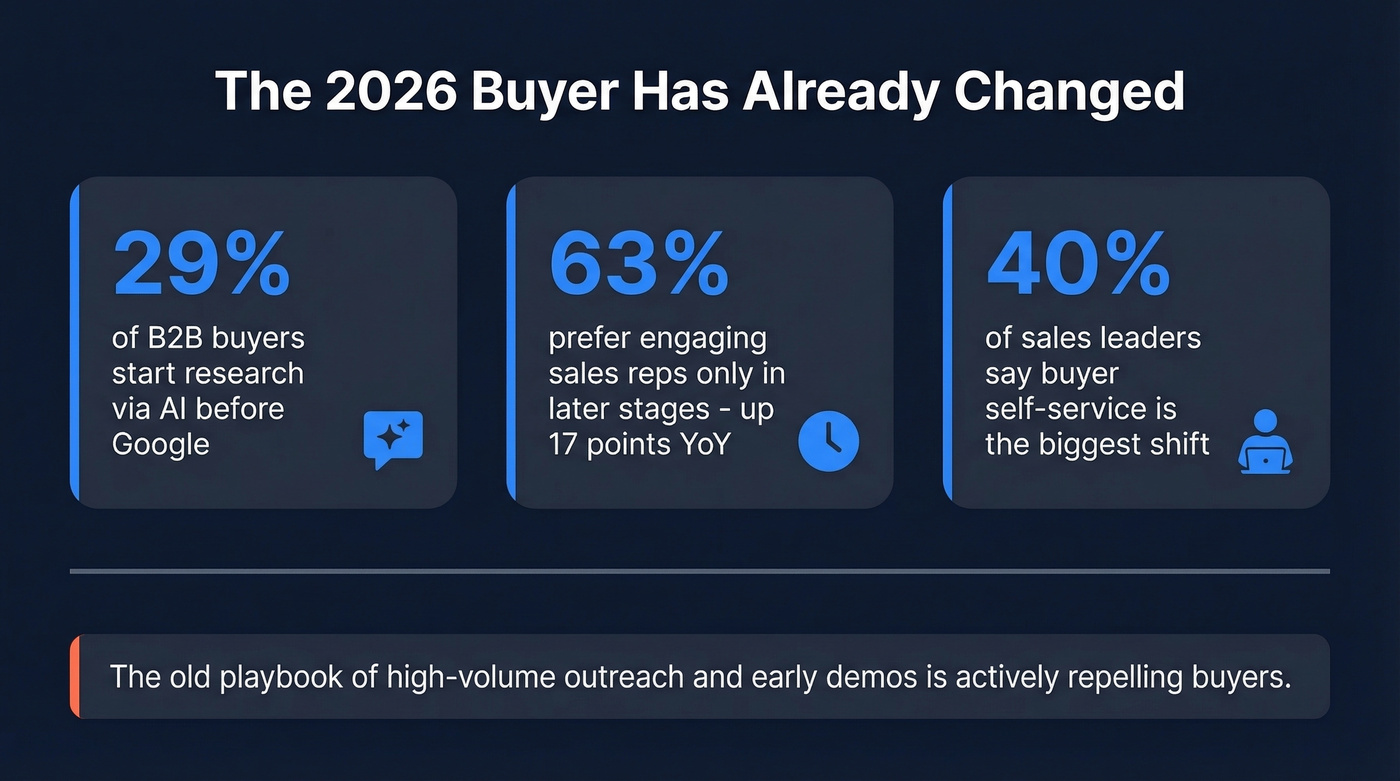
The sales techniques that worked a year ago are already losing steam. Your buyer talked to ChatGPT before they talked to you - 29% of B2B decision-makers now start research via AI more often than Google, and nearly two-thirds prefer engaging salespeople only in later stages, up 17 percentage points year over year. 40% of sales leaders call buyer self-service the single biggest shift in recent years. The old playbook of high-volume outreach and early demos isn't just underperforming - it's actively repelling the people you're trying to reach.
The Short Version
Three modern sales techniques moving pipeline most right now:
- Multichannel sequencing with verified contact data across email, calls, and social - not just one channel
- Consultative discovery that diagnoses before it prescribes (37% of deals die because buyers don't see product fit)
- Intent-signal prioritization so you're calling people who are actually in-market, not just people who match your ICP on paper
One thing to stop immediately: blasting unverified lists and trusting your platform's deliverability metrics. If your bounce rate is above 2%, fix your data before optimizing anything else.
Modern Sales Techniques for 2026
Multichannel Sequencing
Single-channel outreach is dead. Social media drives a 42% prospect response rate versus 26% for email alone. That doesn't mean you abandon email - it means you layer channels so prospects encounter you in multiple contexts.
If you need more ideas beyond sequencing, start with these sales prospecting techniques and adapt them to your ICP.
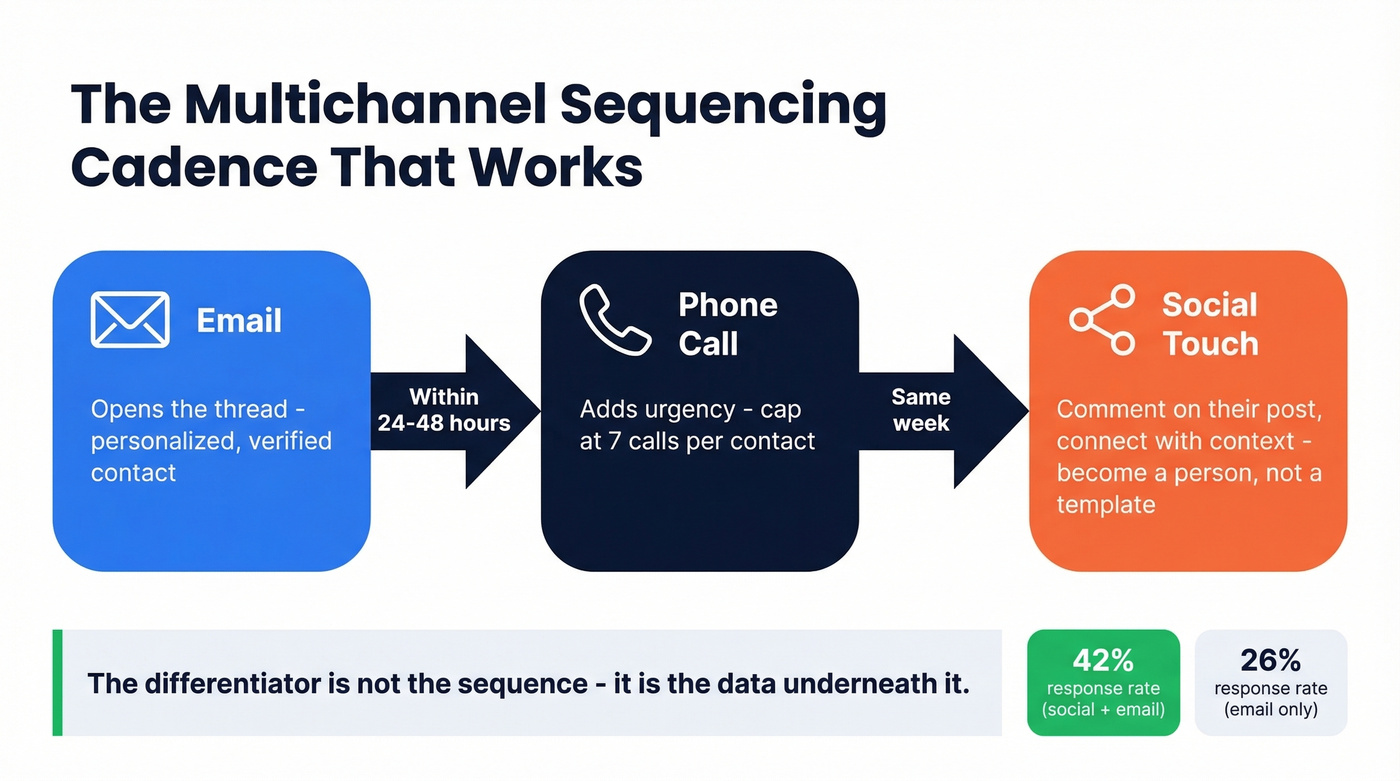
The cadence that works: email opens the thread, a call within 24-48 hours adds urgency, and a social touch - commenting on their post, sending a connection request with context - makes you a person instead of a template. Practitioners on r/sales recommend capping at roughly 7 calls per contact before moving on. More than that and you're burning goodwill.
Here's the thing: multichannel only works if your contact data is accurate across all three channels. A wrong email bounces. A wrong phone number wastes time. A wrong company attribution makes your social outreach look lazy. The sequencing strategy is table stakes; the data underneath it is the differentiator.
Social Selling With Real Numbers
45% of sales reps rate social media as "very effective" at driving sales - that's nearly half the profession saying this channel delivers.
The buying committee dynamic has shifted too. Committees are shrinking from the once-dominant 5-8 members to 3-4. Fewer stakeholders means each one carries more weight, and each one is easier to reach through social channels where they're already active. Reps who build genuine presence by sharing insights, engaging with prospect content, and contributing to industry conversations get warmer receptions when they eventually reach out directly.
Consultative Discovery: Before and After
Before (the failure mode): Prospect agrees to a meeting. Rep launches into a product walkthrough. Prospect nods politely, then ghosts. 37% of deals end this way - buyers never see product fit because nobody diagnosed the problem first.
After (gap selling): You map the prospect's current state, define their desired state, and make the gap between them feel urgent and quantifiable. We've watched teams cut their demo-to-close cycle by weeks just by spending the first call asking questions instead of showing slides. The discovery call isn't a warm-up for the demo. It is the demo.
If you want a tighter structure for this, use a discovery questions framework and standardize it across reps.
Data-Quality-First Prospecting
Use this if: your bounce rate is above 2%, your reps complain about bad phone numbers, or you've ever had a sending domain blacklisted.
Skip this if: you genuinely have clean data and your deliverability metrics are solid - but verify that independently, because your platform's dashboard won't tell you the truth.
The deliverability math is unforgiving. Bounce rates above 2% damage your domain reputation. Spam complaints should stay under 0.01%. Once your domain is burned, every email you send - even the good ones - lands in spam. One practitioner on r/sales put it bluntly: don't trust platform deliverability metrics, and always run contacts through at least two verifiers.
Crowd-sourced databases are the biggest culprit. Apollo's contact data, for example, is populated by other users - accuracy depends on who updated the record last. Meritt, an outbound agency, saw bounce rates drop from 35% to under 4% and tripled pipeline from $100K to $300K per week after switching to Prospeo. The lesson: verification isn't optional, it's the foundation everything else sits on.
If you're diagnosing deliverability issues, start with an email deliverability guide and then work backward into list hygiene.

Intent-Signal Prioritization
Volume-based outreach is what Gartner explicitly warns against heading into 2026. Buyers avoid suppliers who send too many irrelevant messages. The fix is intent data - filtering your ICP list to surface accounts actively researching solutions like yours.
Instead of calling 500 accounts that match your firmographic criteria, you call the 50 showing buying signals right now. That's a shorter list with dramatically higher conversion potential. Prospeo layers intent data across 15,000 Bombora topics, letting you combine job role and company growth filters with real-time buying signals - so you're not guessing who's in-market.
To operationalize this, build a simple lead scoring model that weights intent + fit.
Video Selling
Here's a stat worth acting on: Woodpecker's testing found that video thumbnails in cold emails lift click-through rates by up to 300%. The underlying logic is sound - video stands out in an inbox full of text.
Keep videos under 90 seconds. Personalize the first 5 seconds by saying their name, referencing their company, and mentioning something specific. Use Loom or Vidyard to record quickly. The goal isn't production quality - it's proving you're a real person who did real research. A 45-second video referencing a prospect's recent funding round outperforms a polished 3-minute product overview every time.
If you're using Loom specifically, this Loom video cold email workflow is a solid baseline.
Challenger-Style Insight Selling
The Challenger Sale framework came out of CEB research across 6,000+ sales reps, and its core loop still holds: Teach, Tailor, Take Control. You lead with an insight the prospect hasn't considered, tailor it to their specific situation, then guide the conversation toward a decision.
This is the antidote to feature dumping. Instead of walking through your product's capabilities, you're reframing how the prospect thinks about their problem. One adjacent technique worth borrowing is "negative reverse selling" - deliberately understating your solution's fit to provoke the prospect into arguing for the purchase. It requires confidence and timing, but in complex B2B sales, it consistently outperforms relationship-only approaches.
Multi-Threading Buying Committees
IT is involved in nearly 50% of purchase decisions now. Even as committees shrink to 3-4 members, those members span multiple functions. If you're single-threaded into one champion, you're one reorg away from a dead deal.
Map 3-4 contacts per target account from the start. Your champion gets the deep relationship. The economic buyer gets the ROI narrative. The technical evaluator gets the integration story. Multi-threading isn't just risk mitigation - it accelerates deals because you're building consensus in parallel rather than waiting for your champion to sell internally.
If you're formalizing this motion, borrow from account-based selling best practices.
2026 Benchmarks Worth Knowing
Cold Calling
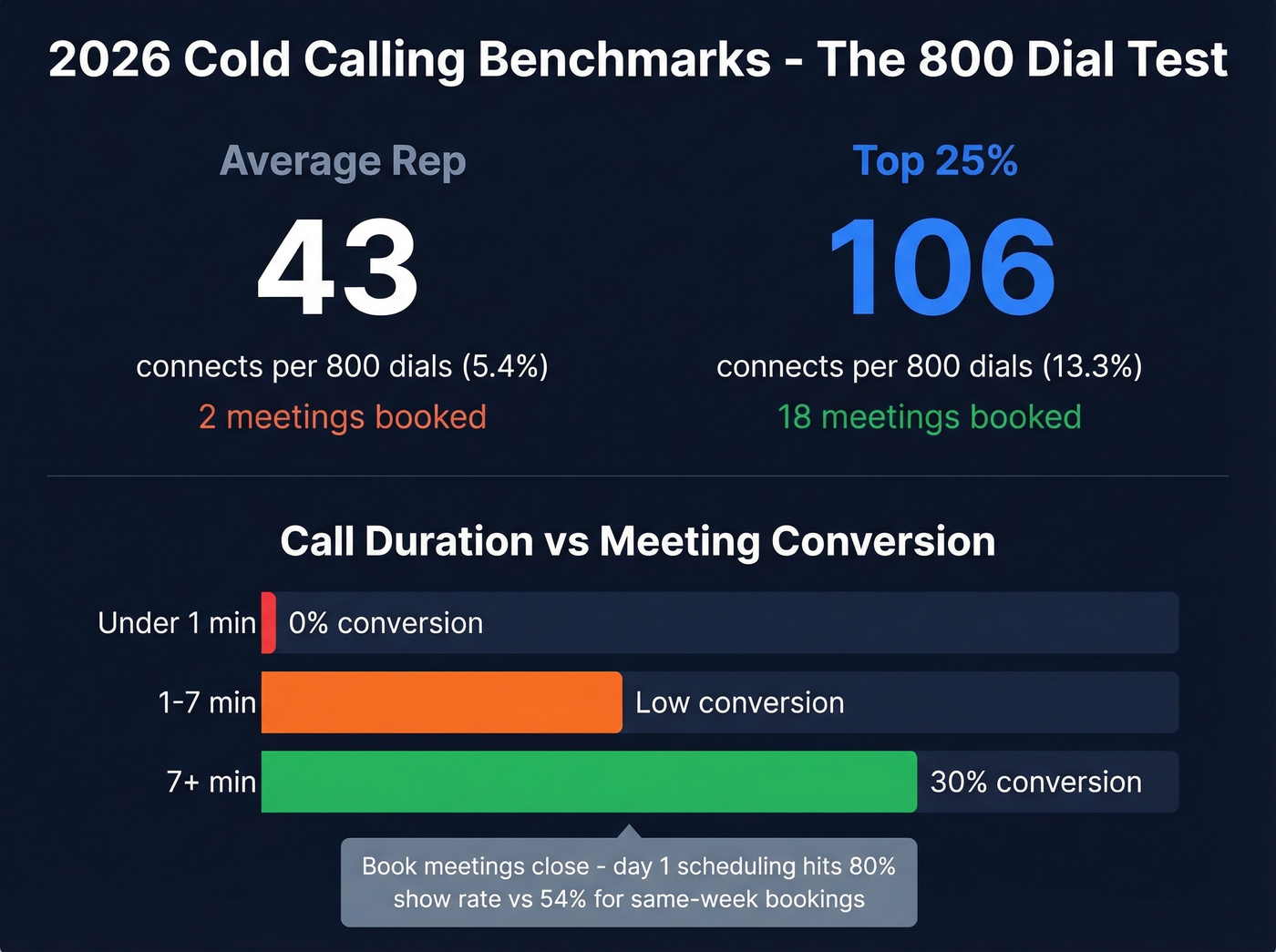
The 800-dial benchmark tells you exactly where you stand:
| Metric | Average Rep | Top 25% | Top 10% |
|---|---|---|---|
| Connects (per 800 dials) | 43 (5.4%) | 106 (13.3%) | - |
| Meetings booked | 2 | 18 | 1 per 3 connects |
Call duration is the leading indicator of success. Conversations under 1 minute have a 0% meeting conversion rate. Get past 7 minutes and conversion climbs to roughly 30%. Show rates decay fast with scheduling distance - same-week bookings show at about 54%, but day-1 scheduling hits around 80%. When you get a yes, book it close.
Quality conversations per rep per day have declined from 8 in 2014 to 3.6 in 2022 - a 55% drop, driven partly by VoIP spam-flagging. If your connect rates are cratering, check whether your numbers are being labeled as spam before you blame your script.
If you want to systematize this, build a repeatable cold calling system and track connects by number pool.
Funnel Conversions
FirstPageSage's multi-year data gives us B2B SaaS stage-by-stage benchmarks:
| Stage | Conversion Rate |
|---|---|
| Lead to MQL | 39% |
| MQL to SQL | 38% |
| SQL to Opportunity | 42% |
| SQL to Closed Won | 37% |
If your numbers fall below these, the problem isn't your closing technique - it's your pipeline quality. A 20% Lead-to-MQL rate means your targeting is off. A 15% SQL-to-Closed rate means you're qualifying poorly. Fix the top of the funnel before you invest in closing training.
To pressure-test your numbers, compare against a broader average B2B lead conversion rate dataset.
Deliverability Thresholds
These aren't guidelines - they're hard limits:
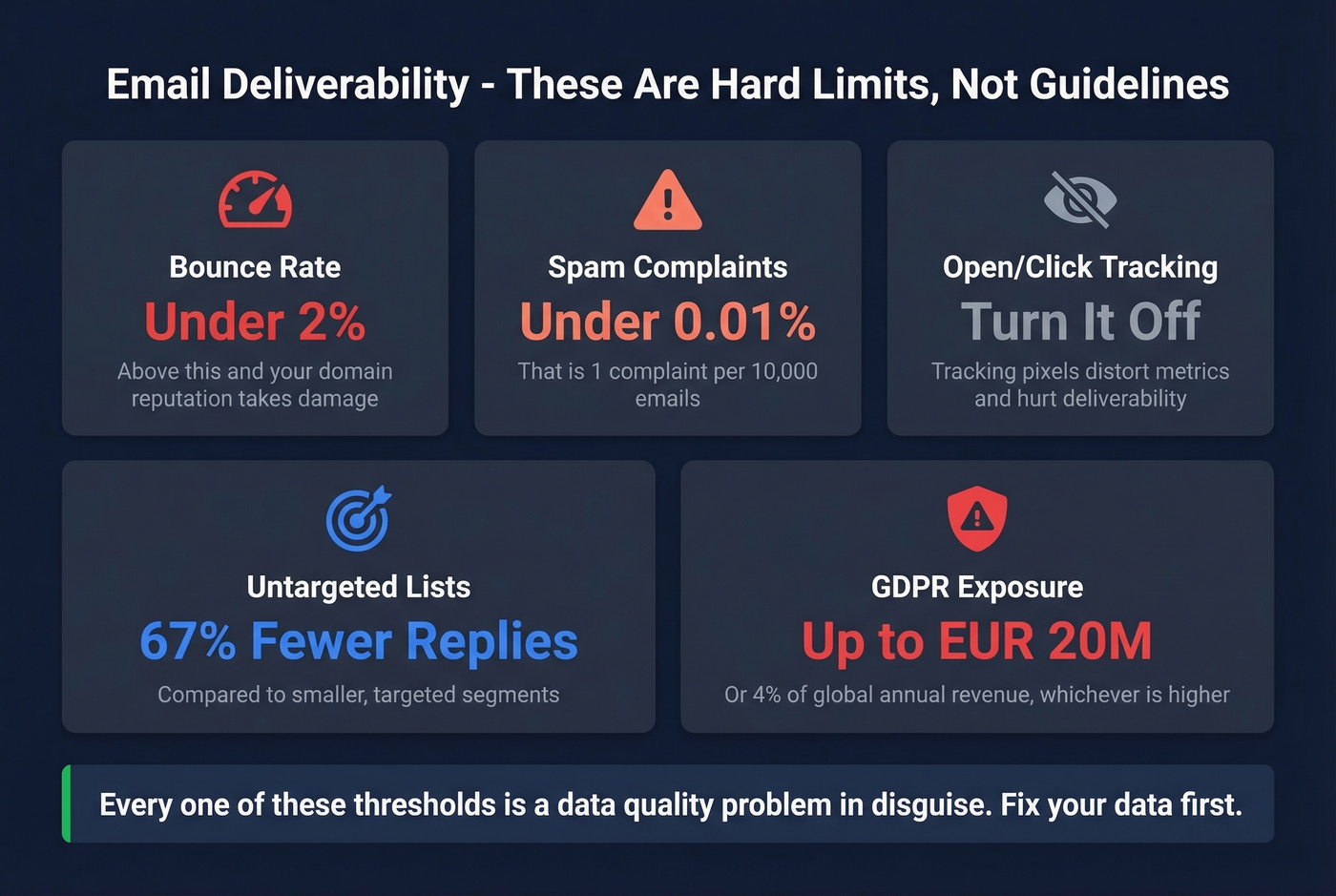
- Bounce rate: under 2%
- Spam complaints: under 0.01% - one complaint per 10,000 emails is the ceiling
- Open/click tracking: turn it off, because tracking pixels distort your metrics and hurt deliverability
- Untargeted lists: 67% fewer replies than smaller, targeted segments
- GDPR exposure: fines up to EUR 20M or 4% of global annual revenue, whichever is higher
Every one of these thresholds is a data quality problem in disguise. Bad emails bounce. Untargeted lists generate complaints. Unverified contacts in regulated markets create compliance risk.
If you're troubleshooting bounces specifically, this email bounce rate breakdown helps you map codes to fixes.

Multichannel sequencing fails when your contact data is wrong. Prospeo gives you 98% verified emails, 125M+ direct dials with a 30% pickup rate, and a 7-day refresh cycle - so every channel in your sequence hits a real person.
Stop optimizing sequences built on bad data. Fix the foundation first.
Pick a Framework, Then Stop Overthinking It
Framework Comparison
| Framework | Core Loop | Best For | Weakness | Verdict |
|---|---|---|---|---|
| BANT | Budget / Authority / Need / Timeline | High-volume SMB (<$25K) | Too shallow for enterprise | Best for most teams |
| MEDDPICC | 8-stage qualification | Complex enterprise ($50K+) | Overkill for transactional | Best for enterprise |
| Sandler | 7-stage submarine | Relationship-heavy / consultative | Slow ramp | Niche |
| SPIN | Situation to Need-payoff | Discovery-heavy sales | Requires deep product knowledge | Strong runner-up |
| Challenger | Teach / Tailor / Take Control | Insight-led selling | Needs strong marketing support | Best with content team |
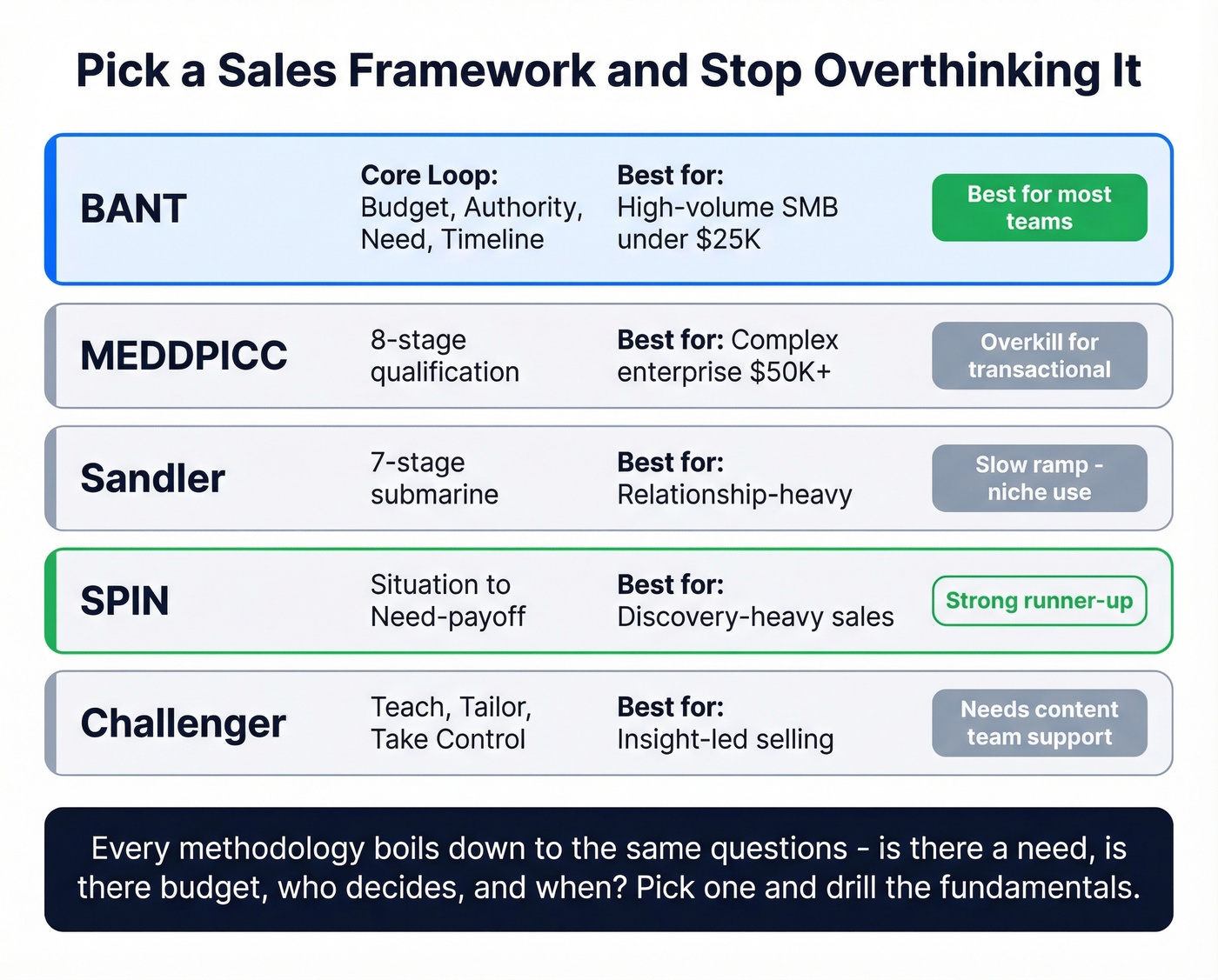
SPIN was built on 35,000+ sales calls across 20+ countries over 12 years. Challenger came from studying 6,000+ reps. These aren't theoretical frameworks - they're empirically derived patterns.
The Methodology Fatigue Reality Check
The consensus on r/sales is refreshingly blunt: every methodology boils down to the same fundamentals - is there a need, is there budget, who decides, and when? The acronyms change. The core questions don't.
32% of sales teams waste time on unqualified leads. That's not a methodology problem - it's a discipline problem. Pick BANT for sub-$25K deals, MEDDPICC for $50K+ enterprise, drill the fundamentals until they're automatic, and stop debating acronyms in Slack. The framework your team actually uses consistently beats the "perfect" one that lives in a training deck nobody opens.
AI in Sales: What Delivers Results
88% of organizations now use AI in at least one business function, and 92% of sales reps use AI tools. Those adoption numbers sound impressive - until you look at the impact data. Nearly two-thirds of companies haven't begun scaling AI across the enterprise. Only 39% report any EBIT impact at the enterprise level, and most say AI accounts for less than 5% of EBIT.
Meanwhile, 74% of sellers say AI tools made buyer research easier - which means your prospects show up more informed and less patient. The information asymmetry that used to favor sellers has flipped.
Our hot take: if your average deal size is under $10K, you probably don't need an AI-powered sales stack. You need clean data, a solid sequence, and a rep who can hold a conversation past the 7-minute mark. AI is a multiplier, not a substitute - and multiplying zero is still zero.
Five AI use cases that deliver right now: email drafting for first drafts, call prep and account research, lead scoring and prioritization, meeting summaries and follow-up generation, and coaching feedback on recorded calls. Everything beyond these five is promising but unproven at scale.
If you're evaluating tools, start with these generative AI sales tools and pick only what you can operationalize.
Gartner's guidance for 2026 is to build a sales-centric AI portfolio roadmap rather than spraying tools across the org. We've seen this play out firsthand - one team bought five AI tools and used none well, while a competitor picked two and integrated them deeply. The second team closed more deals with half the tech spend.
One more thing worth acknowledging: seller burnout is real. Gartner data shows change initiatives are increasing while seller willingness to adapt is declining. Piling on new AI tools without removing old workflows just accelerates the fatigue. Before adding another tool, ask what you're subtracting.
Tactics to Stop Using
Look - some of these will feel obvious. They keep showing up because teams keep doing them.
Fake scarcity and manufactured urgency. "This offer expires Friday" when it doesn't. One sales leader reported a 20% win rate increase over two quarters by replacing urgency CTAs with data-backed proposals and tailored value maps. Trust compounds. Manipulation doesn't.
Pitching before discovery. 37% of deals die because buyers don't see product fit. You can't demonstrate fit if you haven't diagnosed the problem.
Mass untargeted email blasts. Large, untargeted lists receive 67% fewer replies than smaller, targeted segments. Volume feels productive. It isn't.
Trusting platform deliverability metrics. Your sequencing tool says 95% delivered? That metric counts "not bounced" as "delivered." It doesn't tell you whether you landed in the inbox or the spam folder.
Over-discounting to close. Dropping price to win a deal trains buyers to negotiate harder next time and tanks your average deal size. If the prospect needs a discount to move forward, you haven't built enough value.
"Always be closing" in a buyer-led market. Nearly two-thirds of buyers prefer engaging salespeople only in later stages. Pushing for a close before the buyer is ready doesn't accelerate the deal - it kills it.
The 2026 Sales Stack
You don't need an expensive annual data contract to run effective outbound. Here's the minimal viable stack for a 5-rep team:
CRM: HubSpot (free CRM; paid Sales Hub from ~$20/user/month) or Salesforce ($25-300/user/month depending on tier). Pick whichever your team will actually use.
Sequencing: Outreach or Salesloft at ~$100-150/user/month. These handle multichannel cadences, A/B testing, and analytics.
Data + verification: Prospeo. 98% email accuracy, 125M+ verified mobile numbers, integrations with Salesforce, HubSpot, Outreach, Salesloft, Smartlead, Instantly, Lemlist, Clay, Zapier, and Make. Free tier gives you 75 verified emails per month to test before committing, and paid plans run about $0.01/email with no contracts - cancel anytime. The 30+ search filters map directly to ICP targeting: buyer intent, technographics, job changes, funding signals, headcount growth.
If you're comparing providers, use this shortlist of data enrichment services to sanity-check coverage and refresh rates.
Conversation intelligence: Gong at ~$100-150/user/month for call recording, coaching insights, and deal intelligence.

That's four tools. Total cost runs roughly $800-1,200/month depending on tiers - a fraction of what a single enterprise data contract would cost. Start lean, measure what works, and add tools only when you've maxed out what you have.
Intent-signal prioritization only works if you can act on it with accurate data. Prospeo layers 15,000 Bombora intent topics with 30+ filters - job role, company growth, technographics - so you reach the 50 accounts buying now, not 500 that match on paper.
Call prospects who are actually in-market, with numbers that actually connect.
FAQ
What's the most effective sales technique in 2026?
Multichannel sequencing - email, calls, and social layered with verified contact data - drives the highest response rates. Social media alone produces 42% prospect responses versus 26% for email. Layer all three channels so prospects encounter you in multiple contexts before you ask for a meeting.
Is cold calling still effective?
Yes, when paired with clean data and proper technique. Top-performing reps convert 1 meeting per 3 connects, and conversations over 7 minutes hit roughly 30% meeting conversion. Book meetings same-day whenever possible - day-1 scheduling achieves ~80% show rates.
Which sales methodology should I use?
BANT for deals under $25K, MEDDPICC for complex enterprise deals above $50K. Every framework boils down to need, budget, decision-maker, and timeline. Pick one your team will actually use consistently - that matters more than the acronym.
How do I improve email deliverability for outbound?
Keep bounce rate under 2% and spam complaints under 0.01%. Turn off open/click tracking. Verify every email before sequencing - tools with 5-step verification and weekly refresh cycles keep bounce rates well under 4% for teams running serious outbound volume.
What new B2B sales approaches should teams adopt first?
Start with intent-signal prioritization and consultative discovery - they deliver the fastest pipeline impact. Video selling and challenger-style insight selling layer on well once your data quality and sequencing fundamentals are solid.