


5 Best Salesbot Alternatives in 2026
You pull 500 prospects from Salesbot, load them into your sequencer, and watch 30%+ bounce before lunch. That isn't "a little messy." That's domain reputation damage, wasted SDR hours, and a pipeline forecast that starts to feel like fiction.
Salesbot markets a huge database (695M+ contacts) but doesn't publish an independent methodology. And with only a handful of public reviews on G2, it's hard to know if your results are the exception or the norm. Let's break down the Salesbot alternatives we'd actually trust for verified contact data in 2026.
Which "Salesbot" are we talking about?
Three different things get called "Salesbot," and that confusion wastes time:
- Salesbot.io: a B2B contact data platform for outbound teams (this is what we're covering).
- Salesrobot: a separate tool focused on social automation. Woodpecker has a clear overview here: https://www.woodpecker.co/blog/salesrobot/
- "Sales chatbot": a whole category of conversational tools (not a data provider).
If you're comparing pricing, make sure you're looking at the right product listing. Capterra lists Salesbot starting at $49/month: https://www.capterra.com/p/10026820/Salesbot/
Why teams leave Salesbot
Salesbot can get you from "no list" to "list + basic drip" quickly. Credit where it's due. The problem is everything around the list.
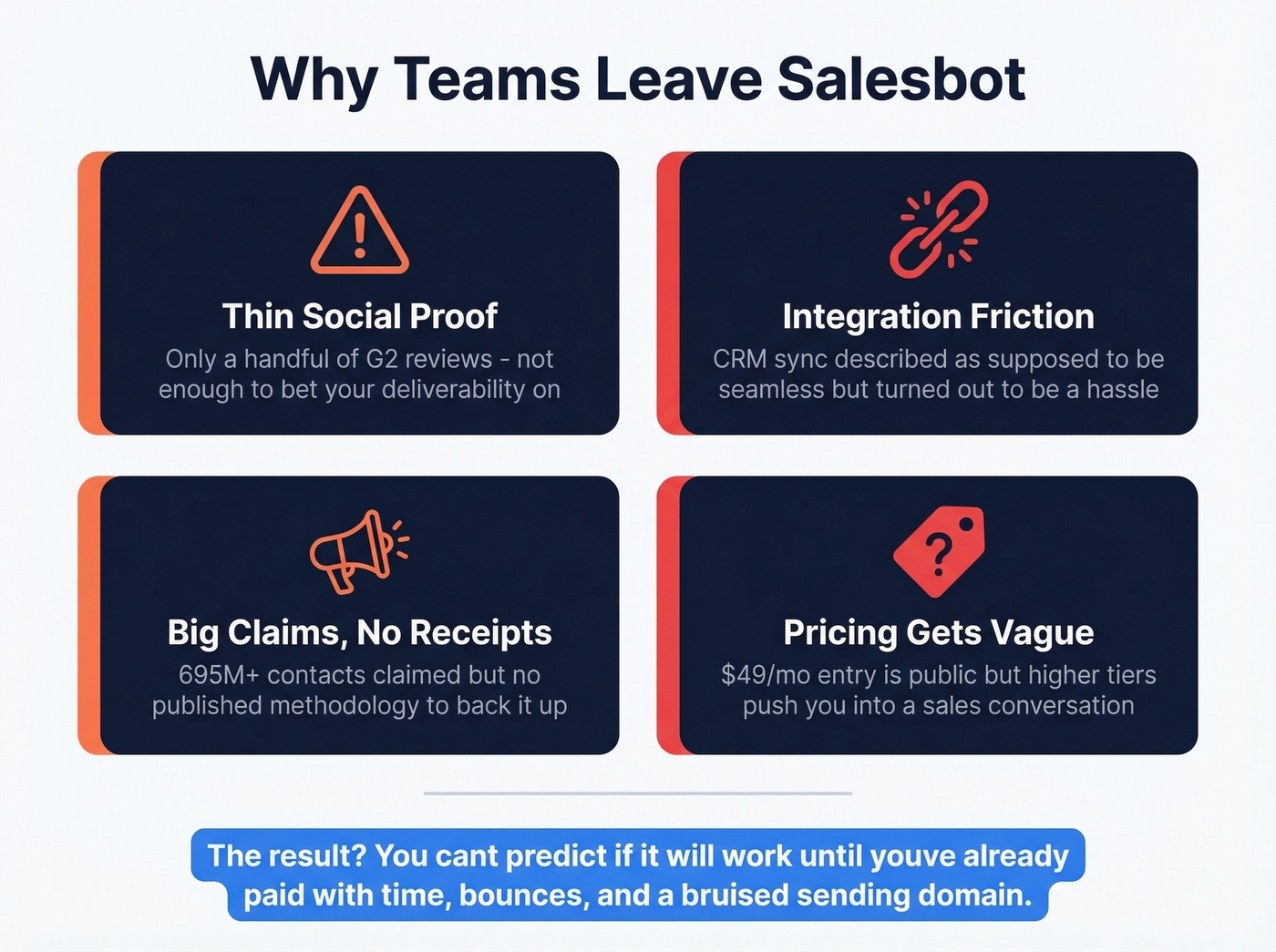
- Thin social proof. At the time of writing, Salesbot has only a few G2 reviews: https://www.g2.com/products/salesbot-salesbot/reviews. For most RevOps leads, that's not enough to bet deliverability on.
- Integration friction. One reviewer described the CRM integration as "supposed to be seamless, but it turned out to be a hassle."
- Big claims, no receipts. Huge contact counts and performance claims are easy to say and hard to verify without published methodology.
- Pricing that gets vague fast. The entry plan is public, but higher tiers push you into a sales conversation.
Look, none of this means Salesbot "doesn't work." It means you can't predict whether it'll work for you until you've already paid with time, bounces, and a bruised sending domain.
Side-by-side: the 5 best Salesbot alternatives
| Tool | Starting price | What it's best at | Data quality signal | Mobile/direct-dial strength |
|---|---|---|---|---|
| Salesbot | ~$49/mo | Basic list building + drip | Methodology not published | 900 mobile credits/year (Basic) |
| Apollo.io | Free; paid from ~$49/mo/user | Cheap volume + all-in-one starter stack | Community tests often land around ~65% "good" | Limited vs phone-first tools |
| ZoomInfo | ~ $15K+/year | US depth + enterprise workflows | Commonly benchmarked around ~75% | Strong US coverage; direct dials vary |
| Seamless.AI | Free tier; paid via sales | On-demand lookups | Users often report ~85% email accuracy | Users often report ~60% phone accuracy |
| Reply.io | From $49/user/mo | Outreach first, data second | Data isn't the main product | Not a direct-dial specialist |
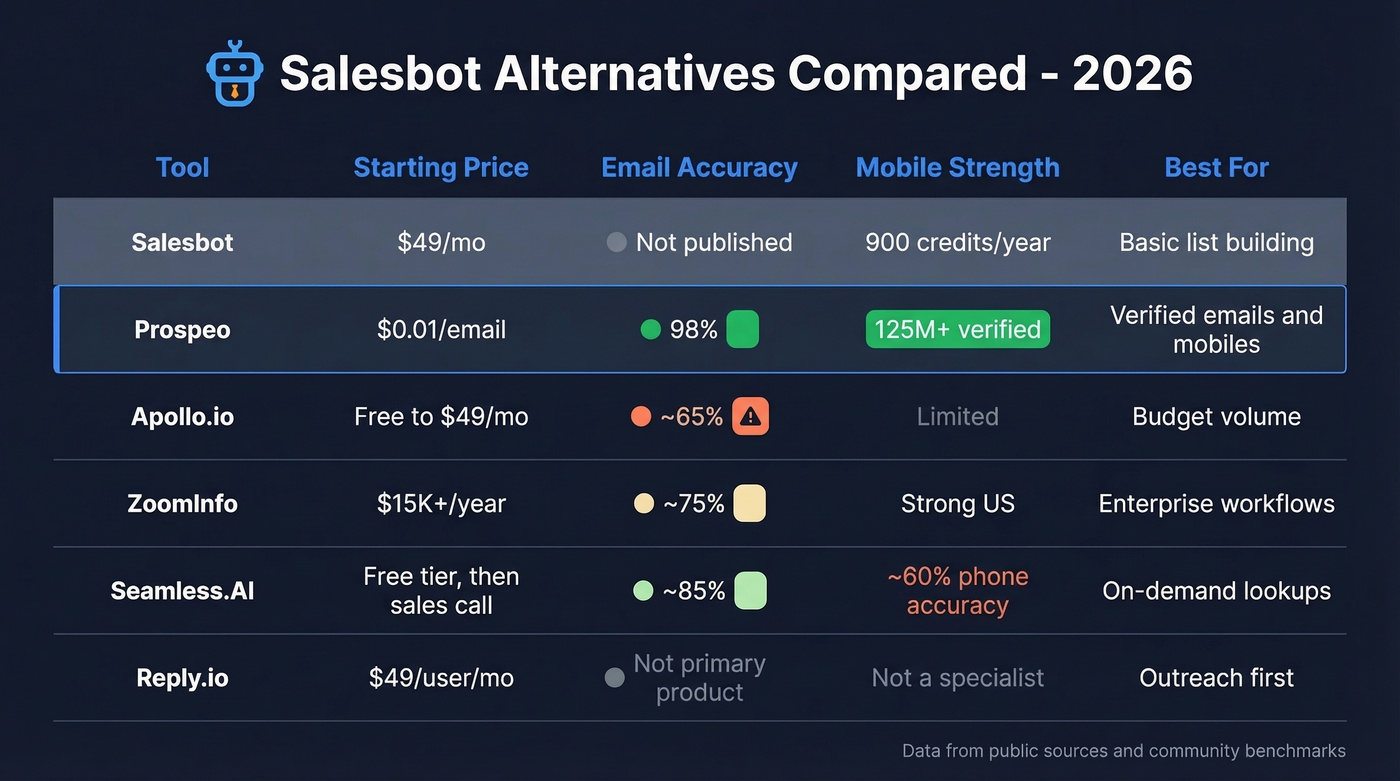

Teams leave Salesbot because bounce rates wreck their sending domains. Prospeo's 98% email accuracy and 7-day data refresh cycle mean you stop guessing whether your list is "good enough." Meritt cut bounces from 35% to under 4% after switching.
Stop paying for contacts that bounce. Start with 75 free verified emails.
The best Salesbot alternatives (ranked)
1) Prospeo
Use Prospeo if you want verified emails and mobile numbers without signing an annual contract or sitting through a sales call. In our experience, that's the fastest path to fixing bounce rates without rebuilding your entire outbound stack.
Prospeo covers 300M+ professional profiles, with 143M+ verified emails and 125M+ verified mobile numbers. Email accuracy is 98%, data refresh runs on a 7-day cycle, and mobile numbers hit a 30% pickup rate. That's the stuff that actually changes outcomes: fewer bounces, more connects, and less time arguing about whether the list is "good enough" to send.

Here's a scenario we've seen play out: a team imports a list, sends one warm-up campaign, and immediately sees bounces spike above 10%. They pause everything, spend two days "cleaning," then send again and still get burned because the underlying source is stale. With Prospeo, teams like Meritt have dropped bounce rates from 35% to under 4% after switching, which is the difference between scaling outreach and constantly putting out deliverability fires.
Prospeo also gives you 30+ search filters (including buyer intent across 15,000 topics, powered by Bombora), technographics, and job-change signals. And if you don't want to live inside yet another web app, the Chrome extension (40,000+ users) lets you pull verified contact data from "in the wild" while you're researching.
Pair it with a sequencer like Smartlead, Instantly, or Lemlist for execution. Prospeo integrates natively, so you can move from list to campaign without CSV gymnastics.
If you want to go deeper on multi-source list quality, start with data enrichment and a simple lead enrichment workflow.
2) Apollo.io
Apollo's the default "I need leads today and I have $0" option. The free tier is legitimately useful, and for early-stage teams it can be the difference between doing outbound and doing nothing.
But don't pretend it's a premium data product. Community testing and practitioner posts often peg Apollo around ~65% good contacts in real-world lists, which matches what we see teams report when they run it at scale. One of the more useful threads on this topic is here: https://www.reddit.com/r/SaaS/comments/1q26bm0/apollo_vs_zoominfo_vs_waterfall_enrichment_for/
Skip Apollo if data accuracy is the hill you're willing to die on. If you do use it, treat it like a starting layer and verify before you send. Otherwise you're rolling the dice with your domain.
If you're building a broader outbound stack, compare it against other SDR tools and free lead generation tools before you commit.
3) ZoomInfo
ZoomInfo is still the enterprise default for a reason: deep US coverage, lots of workflow tooling, and a big ecosystem around enrichment and intent.
The tradeoff is commitment. Pricing commonly starts around $15K/year and goes up quickly, and you're usually signing an annual contract. If you're coming from Salesbot's $49/month entry point, this isn't an "alternative" so much as a different operating model.
Our take: ZoomInfo makes sense when you need an all-in-one system and you'll actually use the platform breadth. If you just need accurate contact data for outbound, it's easy to overbuy.
For their own overview of products and platform, start here: https://www.zoominfo.com/
4) Seamless.AI
Seamless.AI is built around on-demand lookups rather than a "browse a giant database and export" workflow. That can be great for reps who prospect one account at a time and want contact info in the moment.
The frustration is pricing opacity. The free tier exists (their pricing page is here: https://seamless.ai/pricing), but paid plans typically require a sales process, and user-reported numbers vary a lot. If transparent, self-serve pricing is a hard requirement for your team, skip this and save yourself the back-and-forth.
If you're evaluating accuracy-first workflows, it helps to understand firmographic and technographic data so you can spot mismatches early.
5) Reply.io
Reply.io is an outreach platform first. It includes a data layer, but that's not why most teams buy it.
If you're trying to replace Salesbot specifically as a data source, Reply.io usually isn't the cleanest swap. If you're also shopping for sequencing and want one vendor for outreach + some data, it's worth a look: https://reply.io/
If you're optimizing the actual messaging layer, keep a set of sales follow-up templates handy so reps don't freestyle every touch.
The move Salesbot users usually need: waterfall enrichment
If you've been burned by single-source databases, the fix isn't always "pick a different database." A lot of teams get better results by changing the architecture.
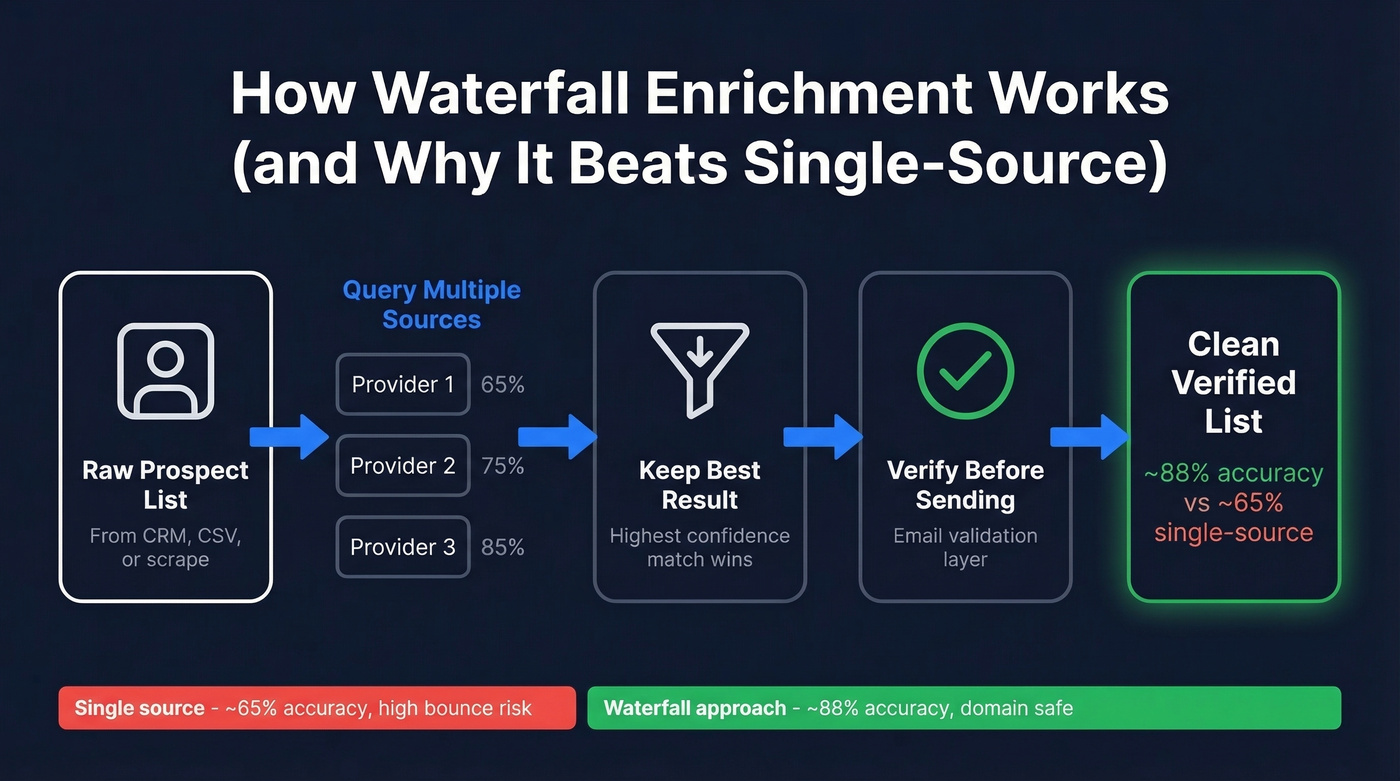
Waterfall enrichment means you query multiple providers in a sequence, keep the best result from each, and stop once you hit your quality bar. In that same practitioner thread above, teams reported ~88% accuracy using a waterfall approach, compared to ~65% from Apollo and ~75% from ZoomInfo alone.
We've watched teams cut bounce rates in half just by adding a verification layer before the sequencer, even when they kept their original data provider. It's not glamorous work, but it works, and it stops the "new tool every quarter" cycle that drives everyone nuts.
If you're seeing deliverability issues, start by benchmarking your email bounce rate and tightening your email deliverability basics.
Clay is the orchestration layer we see most often for this setup. For serious outbound volume, it's the difference between "spray and pray" and a system you can scale without constantly torching inboxes.
If you want the step-by-step, see our guide to Clay list building.
Salesbot alternatives FAQ
Is Salesbot.io the same as Salesrobot?
No. Salesbot.io is a B2B contact data platform (Capterra lists it starting at $49/month). Salesrobot is a separate automation tool with different pricing and use cases. Woodpecker's overview is a good starting point: https://www.woodpecker.co/blog/salesrobot/
What's the most accurate Salesbot alternative for email?
Can I try these alternatives for free?
Salesbot gives you 900 mobile credits per year. Prospeo gives you access to 125M+ verified mobile numbers with a 30% pickup rate - at $0.01 per email and no annual contract. That's the difference between a database and a pipeline.
Replace vague contact counts with verified data that actually connects.