

How to Build a Salesforce Go-to-Market Strategy That Actually Works
Your CEO greenlit a new product launch. You've got Sales Cloud, a messy CRM, and 90 days. The average software company runs 10.5 simultaneous GTM efforts, and most of them are diluted to uselessness. Here's how to build a Salesforce go-to-market strategy that focuses on what actually moves pipeline - not what looks good in a slide deck.
The Short Version
Start with one dominant channel, not ten. The companies running 10+ GTM motions are enterprise orgs with dedicated teams per channel. If that's not you, pick one and win it.
Map each GTM stage to a specific Salesforce tool. Sales Cloud for pipeline, Tableau for measurement, Agentforce for automation. Don't buy what you won't configure.
Fix your contact data first. Dirty CRM data costs roughly $96 per duplicate record. That's silent budget bleed killing outbound before it starts.
What a GTM Strategy Actually Means Inside Salesforce
Salesforce defines a GTM strategy as a step-by-step plan for introducing a new product to buyers - covering market, customers, channels, pricing, and competition. It's not your business plan. It's not your marketing strategy. It's product-specific and time-bound.
The owner should be RevOps. The revenue operations leader creates and maintains the go-to-market plan that Salesforce teams rely on through the entire revenue lifecycle. If your RevOps team isn't driving this, you've already got a coordination problem - and no amount of tooling fixes misalignment.
How Salesforce Built Its Own GTM
Salesforce started as an SMB CRM and stayed focused on that core for roughly a decade before broad expansion. That discipline matters more than most founders admit.
Enterprise expansion required deeper customization, so the developer platform helped large orgs tailor Salesforce to their workflows. The B2C expansion came via acquisition: ExactTarget became Marketing Cloud, and Pardot strengthened SMB automation. Each move was deliberate, not reactive. A useful mental model here is a simple 1-3-5 scoring framework for segment fit, where 1 means limited value and 5 means high value - you don't "sell harder" into 1s, you build product and ecosystem until the segment becomes a 5.
The 6 Core Elements Mapped to Salesforce Tools
Salesforce's Trailhead GTM module lays out the elements but doesn't tell you which tools to configure. That's the gap we're filling.
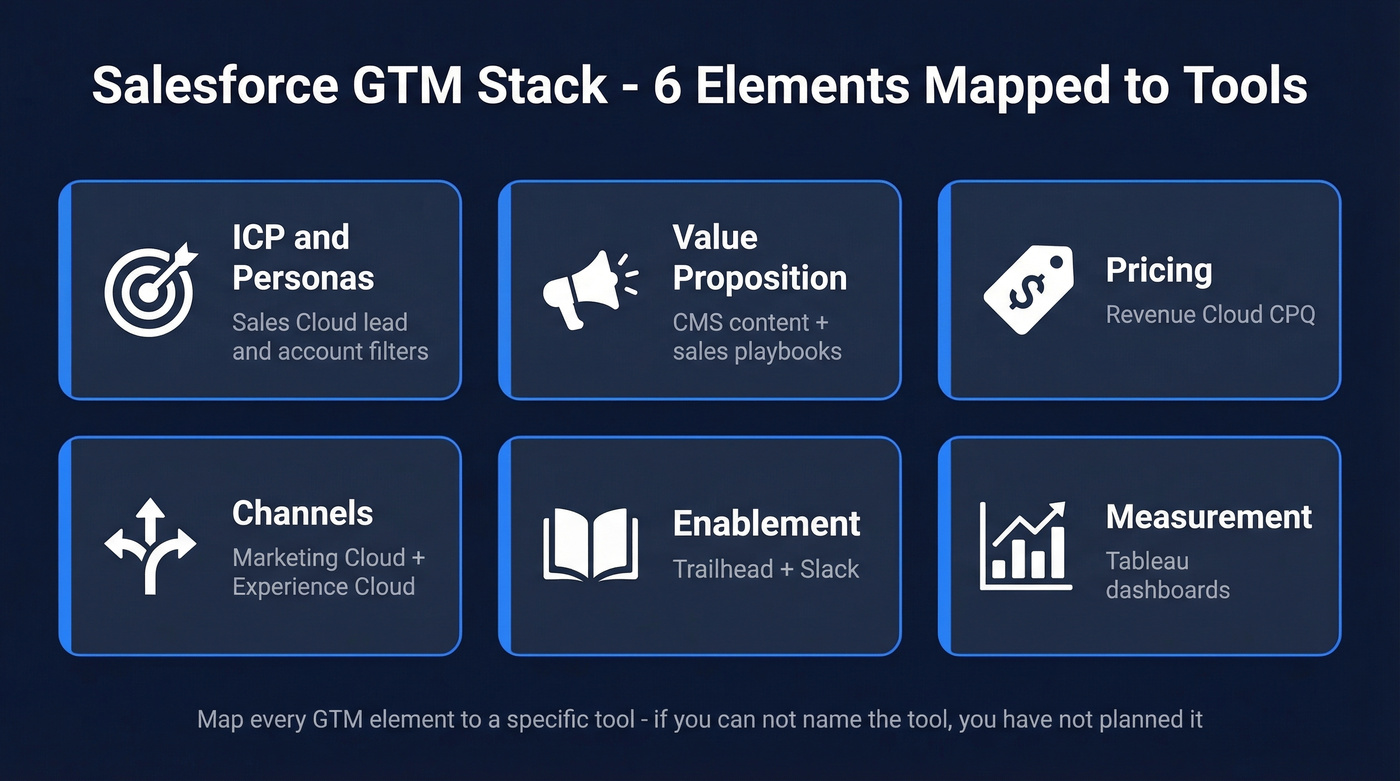
Enterprise multi-cloud stacks with Revenue Cloud, Marketing Cloud, and Agentforce often land in the mid-five to seven figures annually before implementation, depending on seats and add-ons. Sales Cloud entry-level plans are cheaper, but the real cost is always in configuration and integration - not licensing.
| GTM Element | What It Covers | Salesforce Tool |
|---|---|---|
| ICP & Personas | Segmentation, targeting | Sales Cloud lead/account filters |
| Value Proposition | Positioning, messaging | CMS content + sales playbooks |
| Pricing | CPQ, packaging | Revenue Cloud |
| Channels | Distribution, journeys | Marketing Cloud / Experience Cloud |
| Enablement | Training, playbooks | Trailhead + Slack |
| Measurement | KPIs, attribution | Tableau dashboards |
Measurement is where GTM strategies go to die. Salesforce's Cloud Kicks example on Trailhead tracks surveys completed, discount usage, channel attribution across web and mobile, and new vs. existing customer splits. Those aren't vanity metrics. They're the signals that tell you whether your GTM motion is working or just generating activity.

Your Salesforce GTM strategy lives or dies on pipeline accuracy. Prospeo's native Salesforce integration enriches every record with 98% verified emails and 50+ data points - refreshed every 7 days, not every 6 weeks. Snyk's 50 AEs cut bounce rates from 35% to under 5% and grew AE-sourced pipeline 180%.
Fix the data layer before you configure another Salesforce workflow.
Territory Planning & Segmentation
Four models, each with a clear use case:
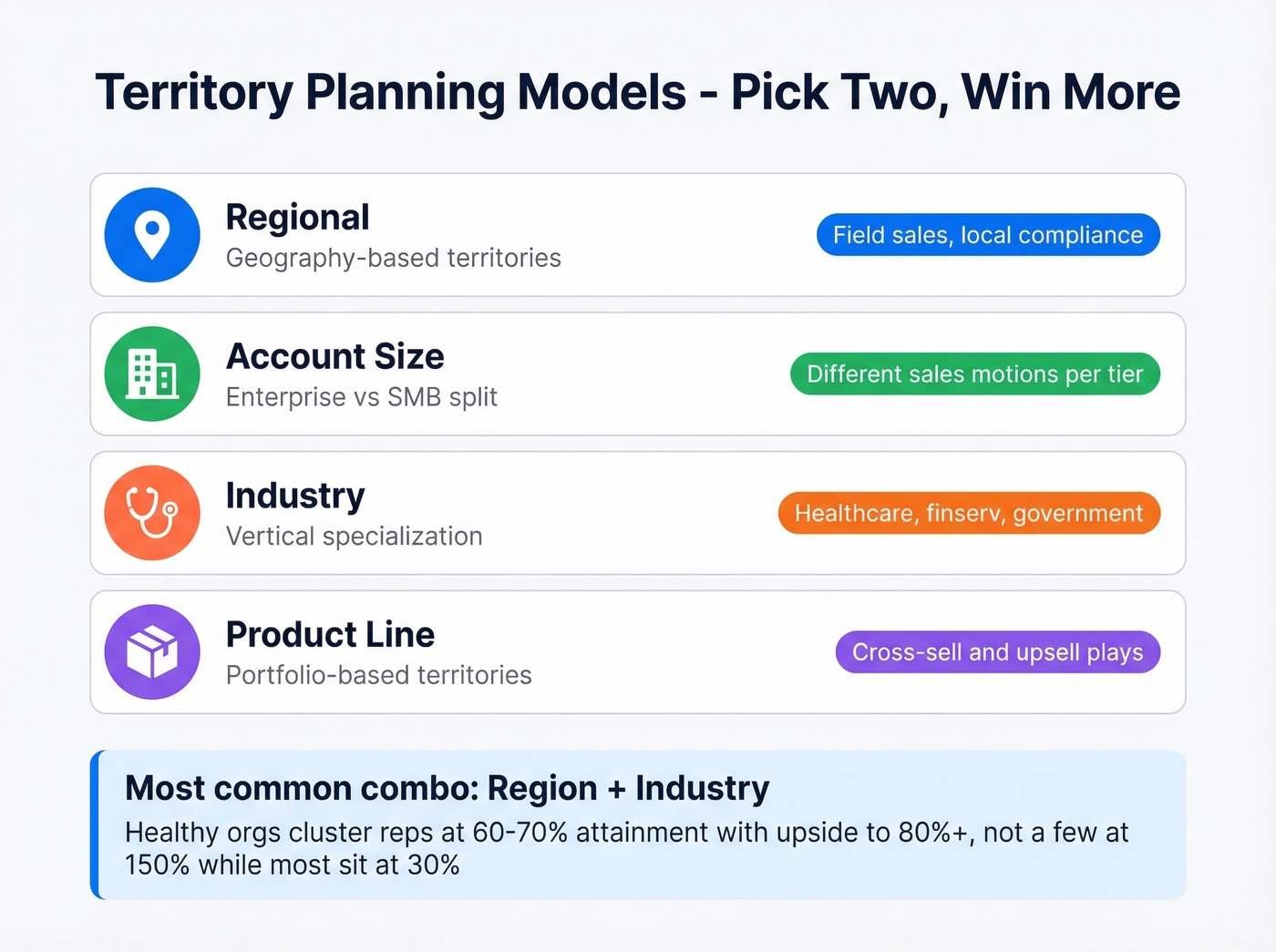
- Regional - Field sales with local compliance or geography-specific buying patterns.
- Account size - Enterprise and SMB require fundamentally different sales motions.
- Industry - Vertical expertise drives win rates in healthcare, financial services, and government.
- Product line - Complex portfolio where cross-sell and upsell represent a meaningful revenue lever.
Most mature orgs combine two models. Region plus industry is the most common pairing we've seen across our customers' Salesforce instances. Monitor each territory by revenue, win rates, pipeline coverage, and rep activity - Gartner found that more than half of sellers only review account plans once or twice a year. That's not territory management. That's territory neglect.
Here's the thing: Salesforce Ventures data shows healthier orgs have reps clustered at 60-70% attainment with upside to 80%+, not a few at 150% while most sit at 30%. If your territory map produces that lopsided distribution, the map is broken, not the reps.
AI in Your GTM: What Works in 2026
Einstein gives you insight without action. It'll surface a lead score or forecast adjustment, but it won't execute anything. Think of it as a dashboard layer - useful, but passive.
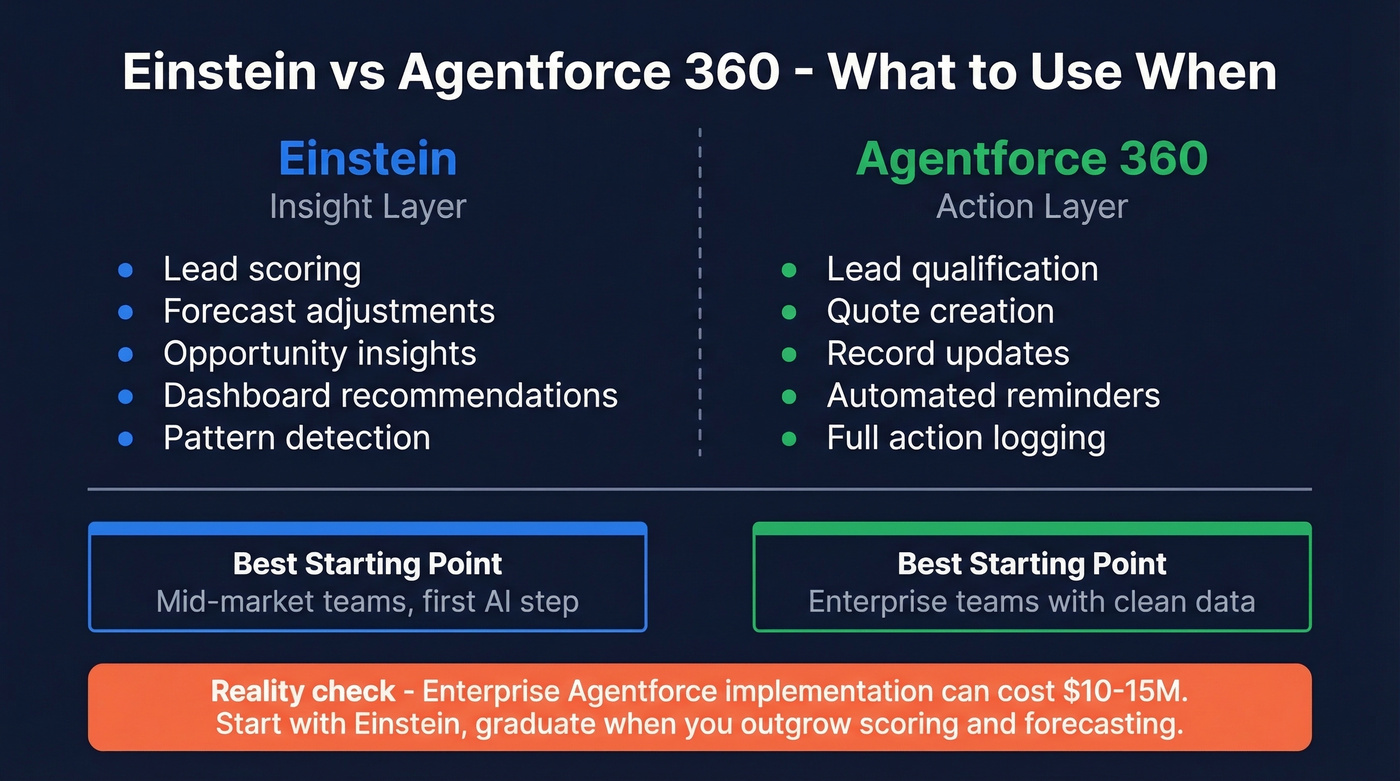
Agentforce 360 is the real leap. It qualifies leads, creates quotes, updates records, sends reminders, and logs every action for human review. If you're going to start somewhere, lead qualification is the safest entry point: clean your data first, keep humans in the loop, and measure time saved plus error reduction before expanding scope.
Let's be honest about the cost, though. The Reddit consensus on Salesforce AI isn't kind. One practitioner estimated that getting Data Cloud, MuleSoft, and Agentforce running at enterprise scale could cost $10-15M in implementation effort. Agentforce is powerful, but it's not cheap, and it's not plug-and-play. For mid-market teams, start with Einstein and graduate to Agentforce only when you've outgrown what scoring and forecasting can do on their own.
Data Quality: The GTM Foundation Nobody Talks About
Every section above assumes your CRM data is accurate. For most teams, it isn't.
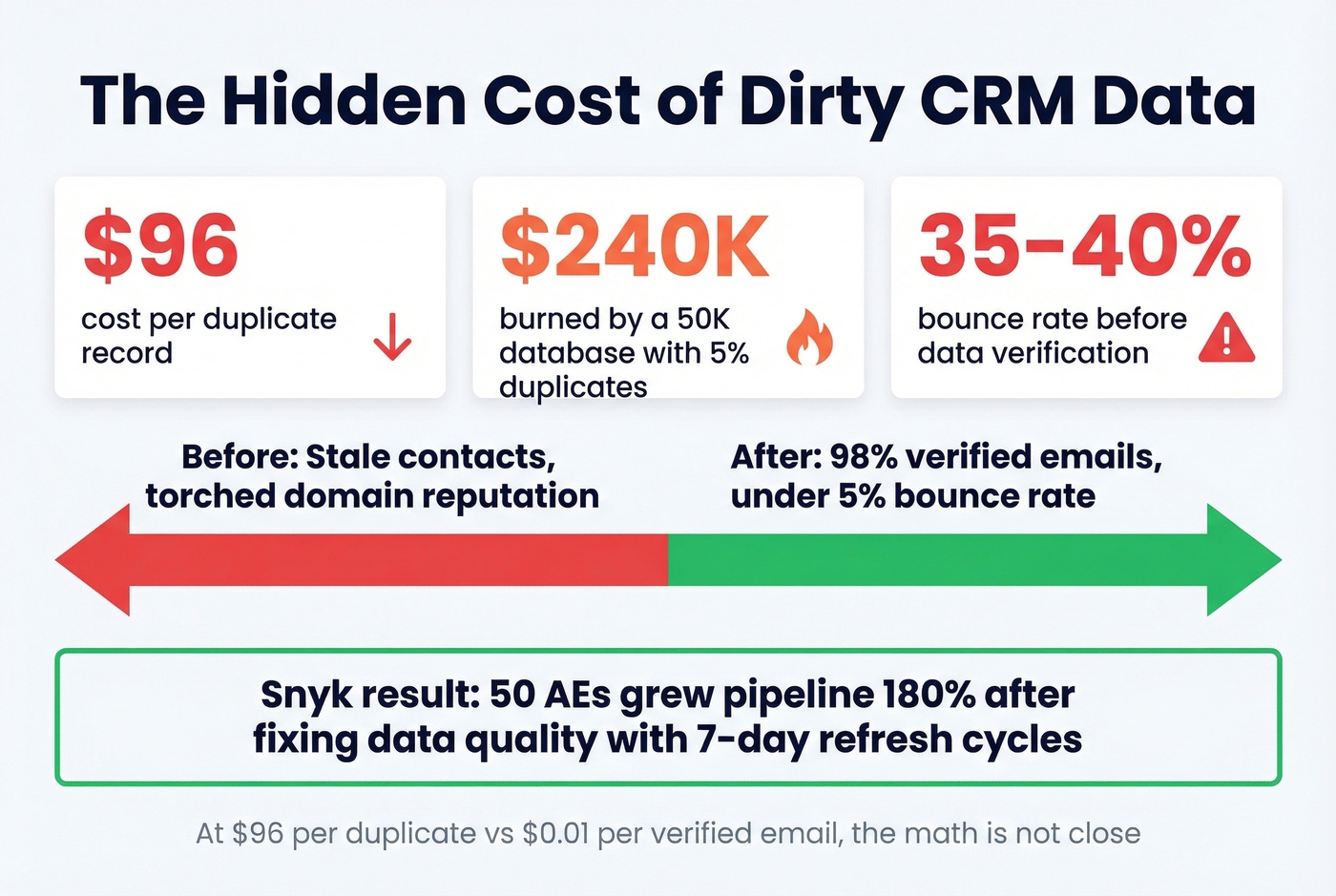
That $96 per duplicate record compounds fast - a 50,000-record database with 5% duplicates is burning $240K in hidden costs. Dirty data also makes every AI tool useless. Agentforce qualifying leads against stale job titles? Garbage in, garbage out.
We've watched teams burn through their entire outbound budget before discovering that a huge chunk of their contacts were invalid. If your sequences are running against unverified emails, you're torching your domain reputation with every campaign. And once your sending domain is flagged, recovery takes months - not days. (If you're seeing issues already, start with email deliverability and sender reputation.)
Prospeo plugs this gap with native Salesforce integration, 98% email accuracy, and a 7-day data refresh cycle versus the 6-week industry average. Snyk's team of 50 AEs dropped their bounce rate from 35-40% to under 5% after implementing it, and AE-sourced pipeline jumped 180%.

At $96 per duplicate and $0.01 per verified email from Prospeo, the math isn't close. Stop burning GTM budget on stale contacts that tank your domain reputation and starve Agentforce of clean inputs. Prospeo's 5-step verification catches spam traps, honeypots, and catch-all domains before they hit your sequences.
Run your Salesforce contacts through Prospeo and see what's actually valid.
GTM Mistakes That Kill Launches
Confusing GTM with marketing. GTM is product-specific and cross-functional. If only marketing owns it, you've lost alignment with sales and product from day one.
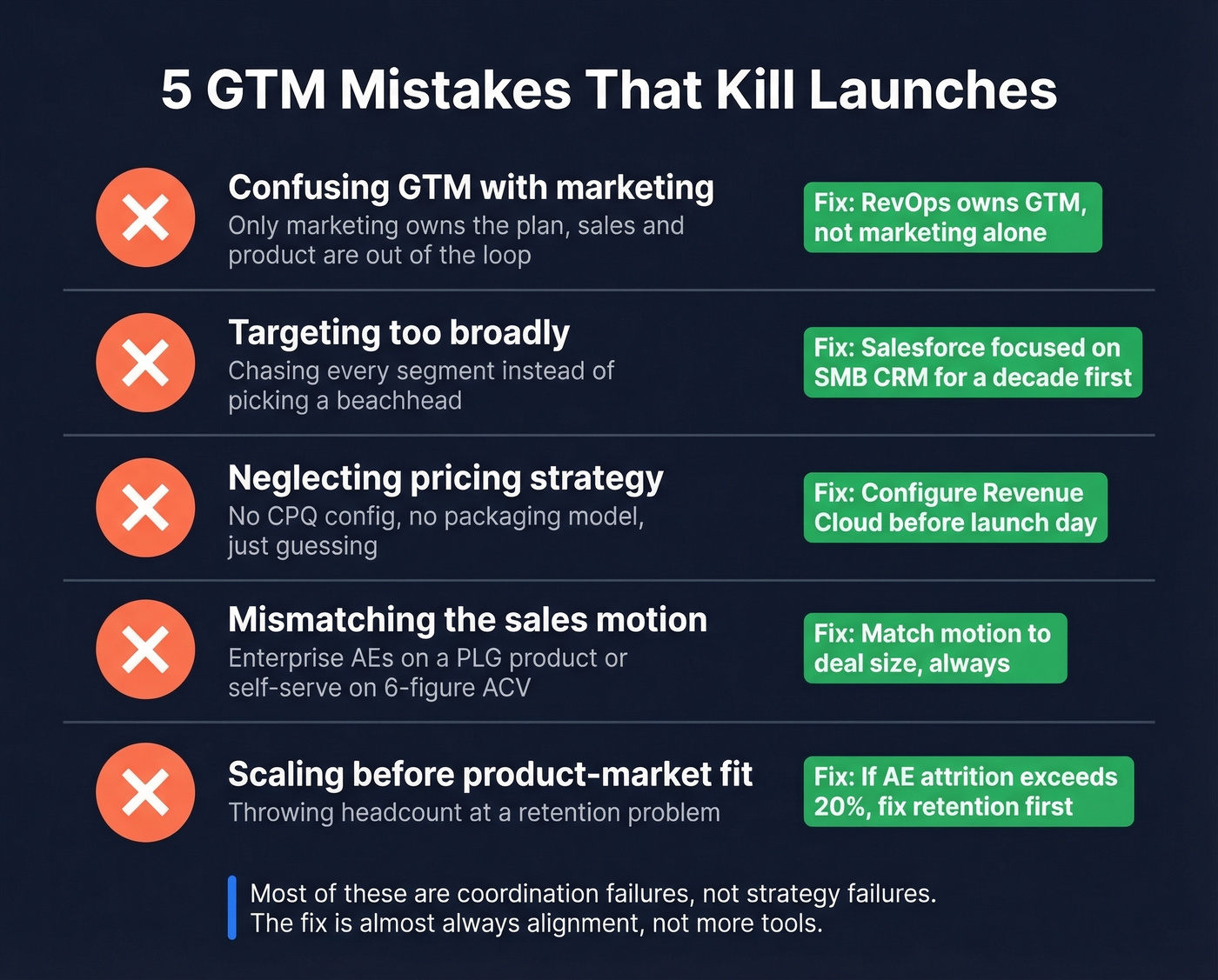
Targeting too broadly. Pick a beachhead segment. Salesforce itself focused on SMB CRM for roughly a decade before expanding - and they had Marc Benioff's Rolodex. You probably don't. (If you need a tighter approach, use intent based segmentation and a clear addressable market model.)
Neglecting pricing strategy. If you haven't configured Revenue Cloud CPQ or modeled your packaging, you're guessing at the single variable that most directly affects revenue.
Mismatching the sales motion. A PLG product doesn't need enterprise AEs on day one. A six-figure ACV product doesn't work with self-serve checkout. Match the motion to the deal size.
Scaling before product-market fit. If AE attrition exceeds 20% - Salesforce Ventures' own threshold - your problem isn't strategy, it's operations. Skip this if you're tempted to throw headcount at a retention problem. Fix retention first, then hire.
FAQ
What Salesforce tools do I need for a basic GTM stack?
Sales Cloud for pipeline management, Tableau for analytics, and a verified data source for prospecting accuracy. Start there before adding Marketing Cloud or Agentforce - those are scaling tools, not foundation tools.
How long does a Salesforce GTM implementation take?
A mid-market foundational rollout takes 8-16 weeks, covering Sales Cloud configuration, territory setup, and basic reporting. Enterprise multi-cloud implementations with data unification typically run 6-12 months, and that's before you factor in change management across sales teams who've been doing things their own way for years.
What's a healthy pipeline coverage ratio?
3-5x quota is the standard benchmark. Track it per territory and segment using Tableau dashboards - aggregate pipeline coverage hides underperforming segments behind overperforming ones, which is exactly how bad territories survive unnoticed for quarters at a time.