

How to Build a Sales Plan That Works in 2026
Leadership just Slacked you: they want a sales plan by Friday. Not a deck full of aspirations - a real plan with math, targets, and a hiring timeline. Here's the uncomfortable truth: nearly 77% of sellers missed quota even after quotas were reduced in recent GTM benchmarks. That's not a talent problem. That's a planning problem.
You've got three days, a half-built spreadsheet, and a CRM full of stale data. This is the framework that'll get you there - a plan of attack that connects every number to every action.
Start With the Skeleton
If your VP needs something by end of week, build from this:
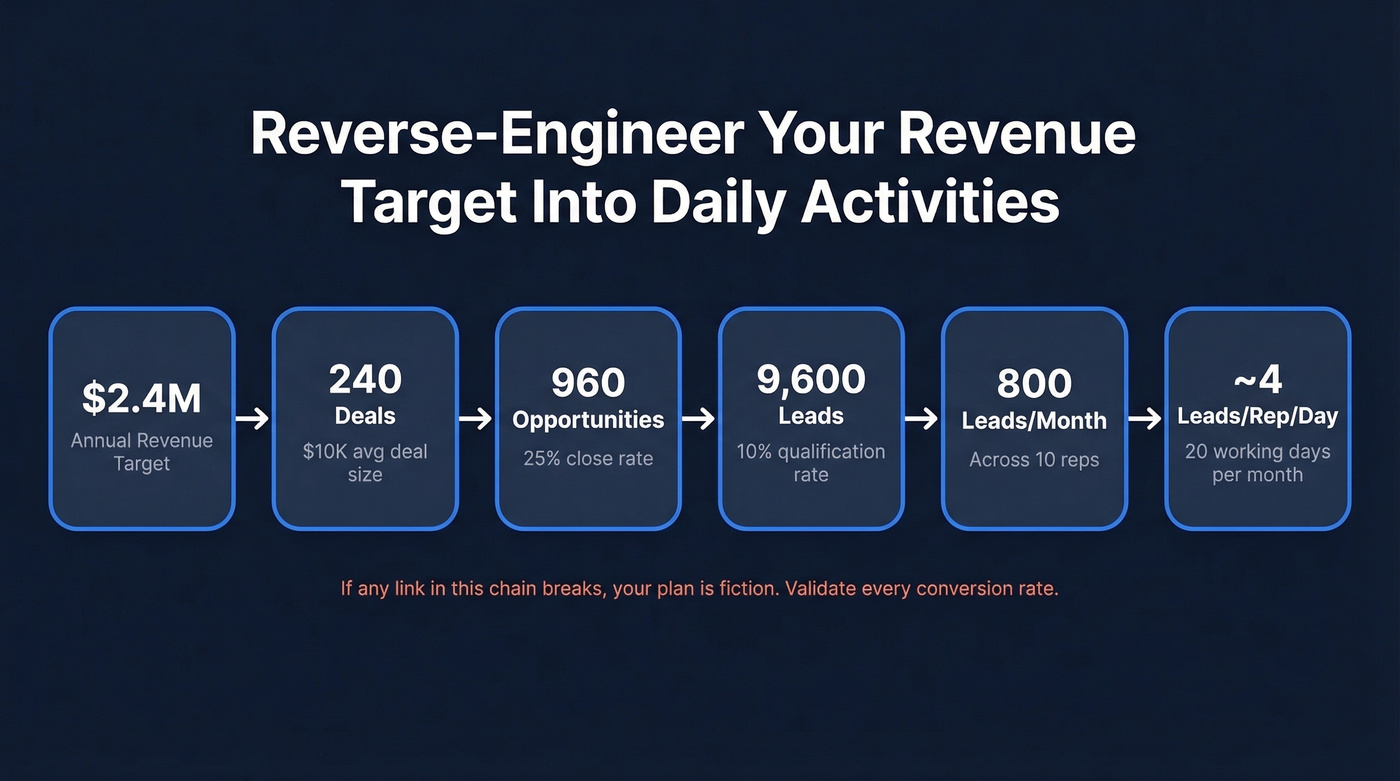
- Revenue math first: reverse-engineer your annual target into daily activities per rep. Revenue → deals → opportunities → leads → calls. If you can't show that chain, you don't have a plan.
- Five non-negotiable sections: revenue targets, ICP definition, GTM motion, quota/capacity math, and KPIs with a review cadence.
- Bottom-up meets top-down: leadership sets the target, your plan validates whether it's achievable. If the two don't reconcile, have that conversation now - not in Q3.
- Pipeline coverage at 3x minimum: $600K in closes this quarter means $1.8M in qualified pipeline. No exceptions.
- Bad data kills plans faster than bad strategy. If 35-40% of contact data bounces, your activity targets are fiction before the quarter starts.
Sales Plan vs. Business Plan
A sales plan is a bottom-up operational document that defines how your team will hit a specific revenue target - the math, the people, the process, and the timeline. It's not a vision statement. It's not a forecast. It's the bridge between "we need $2.4M this year" and "here's exactly how 10 reps will generate it." A sales strategy business plan, by contrast, sits at a higher altitude and addresses market positioning, competitive dynamics, and long-term growth. The sales plan is what makes that strategy executable.
| Business Plan | Sales Plan | |
|---|---|---|
| Direction | Top-down | Bottom-up |
| Audience | Execs, investors, board | Sales leadership, reps, RevOps |
| Focus | Market size, share, projections | Quotas, activities, pipeline math |
| Timeframe | 1-5 years | Quarterly, refreshed monthly |
| Validates | Market opportunity | Revenue target feasibility |
One more distinction that trips people up: a sales plan defines what you'll do to hit targets. A sales forecast predicts what will happen based on current pipeline. The plan drives the forecast, not the other way around.
Why Most Plans Fail

Market uncertainty kills assumptions. 47% of companies report significant market uncertainty as their #1 planning challenge. When your plan assumes a stable buying environment and the market shifts mid-quarter, every downstream number drifts with it.
Deals slip. A lot. In recent benchmarks, 36% of deals slip past their projected close dates, and only 62% of delayed deals ever close. If your plan doesn't account for slippage, your Q4 forecast is a fantasy by October.
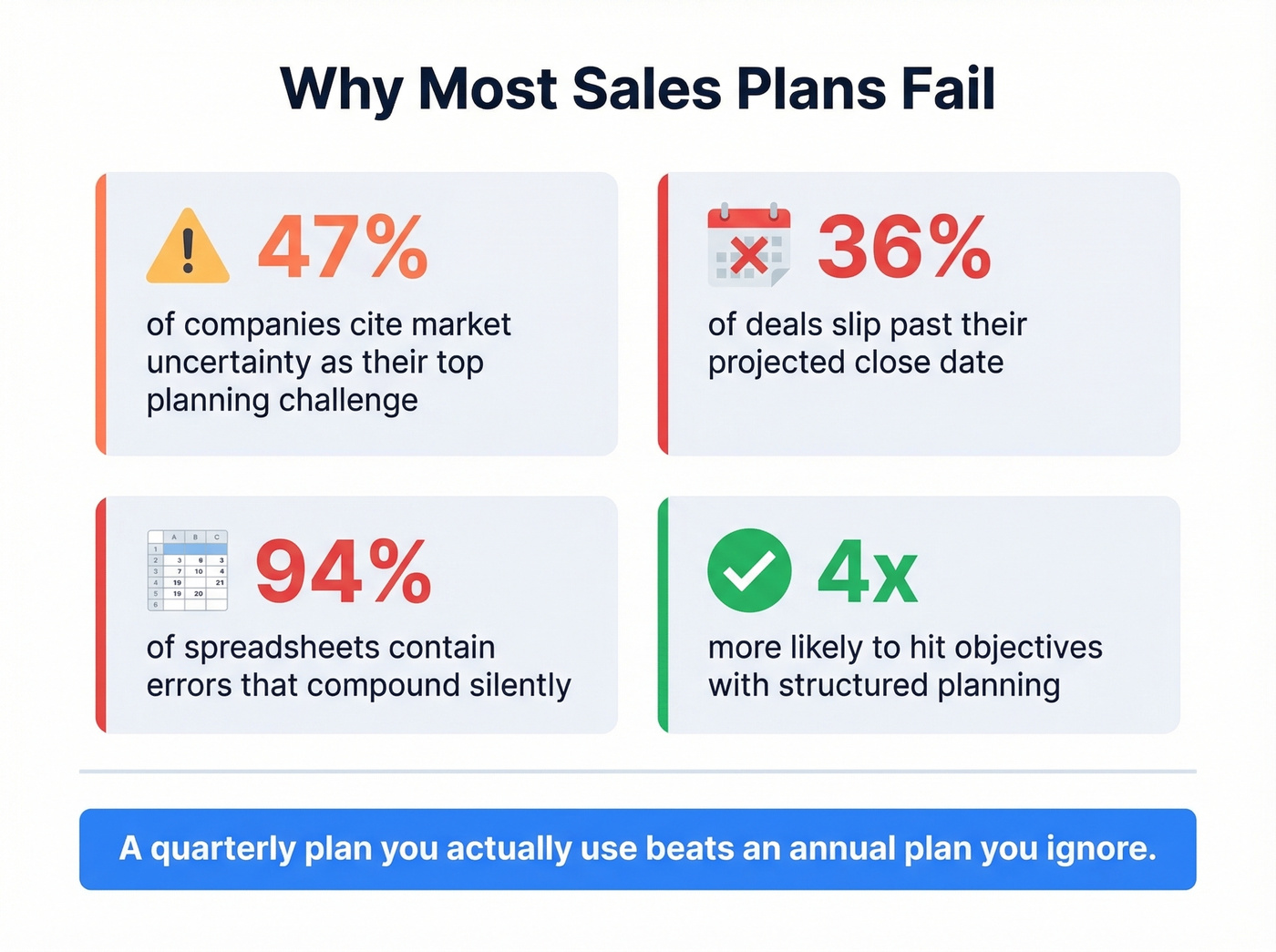
Spreadsheets lie. 94% of spreadsheets contain errors. When your quota model, territory assignments, and capacity plan all live in Excel tabs maintained by three different people, errors compound silently. We've seen a 15-person team run an entire quarter on a broken VLOOKUP that overstated pipeline coverage by a wide margin - nobody caught it until the forecast review.
Here's our contrarian take: skip annual planning entirely if you can't commit to monthly reviews. A quarterly plan you actually use beats an annual plan you ignore. Udemy reduced their annual planning time by 80% after shifting to continuous in-year adjustments. The plan should be a living system, not a January artifact.
One Reddit poster described a ~$60M government contractor that had scaled entirely on "will and luck" with no formal planning process. That works until it doesn't - and when it stops working, there's no diagnostic framework to figure out why.
The payoff for getting this right is massive. Teams using structured planning are 4x more likely to achieve their objectives and 1.7x more likely to hit quota. The gap between "has a plan" and "doesn't" is the difference between hitting quota and watching most of your team miss.
Core Components
Every credible sales plan needs seven pieces. Skip one, and you'll feel it by Q2.
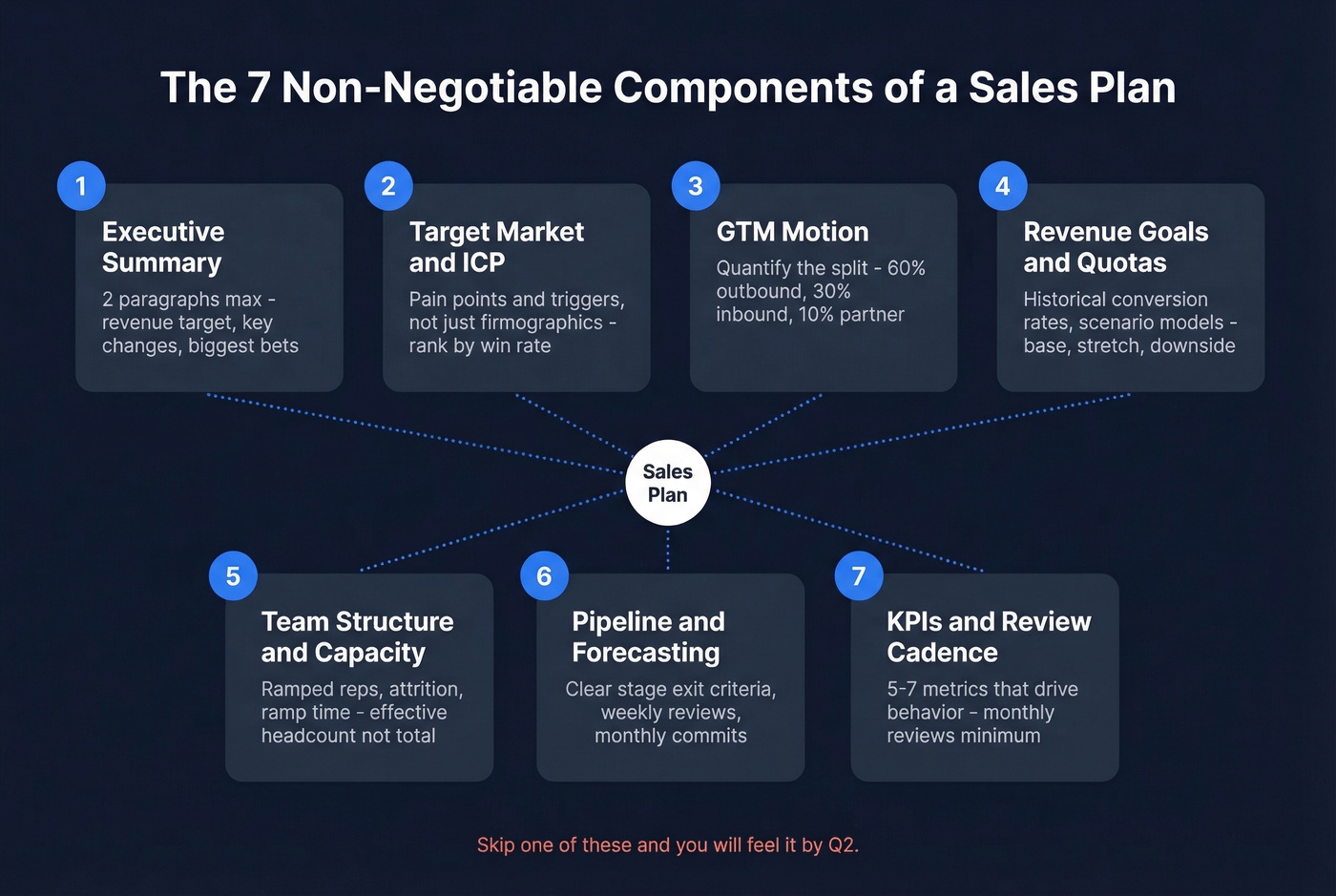
Executive Summary & Strategic Overview. Two paragraphs, max. What's the revenue target, what's changed since last year, and what are the three biggest bets you're making? This is for the CRO who'll skim the first page and decide whether to keep reading.
Target Market & ICP. Define your ideal customer profile by pain points and triggers, not just firmographics. "Series B SaaS companies with 50-200 employees" is a start. "Series B SaaS companies that just hired a VP of Sales and are scaling outbound for the first time" is an ICP. Rank your segments by revenue potential and win rate. B2B buying committees average 10-11 stakeholders in most mid-market deals, often more in enterprise - your ICP definition needs to account for the full decision-making group, not just the economic buyer.
GTM Motion. Are you inbound-led, outbound-heavy, partner-driven, or product-led? Most teams blend motions, and that's fine - but the plan needs to specify the mix and the handoffs between marketing, SDRs, and AEs. A plan that says "inbound and outbound" without quantifying the split isn't a plan.
Revenue Goals & Quota Planning. Use historical conversion rates, not aspirational ones. If your close rate was 22% last year, don't plan on 30% without a specific reason. Frame each goal concretely: "$1.8M in qualified pipeline by March 31" is a goal. "Increase pipeline" is a wish. Build scenario models - base case, stretch, and downside - so leadership isn't surprised when you miss the stretch target.
Team Structure & Capacity. How many reps do you have? How many are ramped? What's your expected attrition? A rep who starts in March isn't at full productivity until August. Your capacity model needs to account for ramp time, PTO, and the reality that not every seat will be filled all year.
Pipeline & Forecasting. Define your pipeline stages with clear exit criteria. "Discovery" means something different to every rep unless you specify: "Discovery = budget confirmed, timeline under 6 months, decision-maker identified." Set a forecasting cadence - weekly pipeline reviews, monthly forecast commits. If you need a stack, compare sales forecasting solutions before you buy.
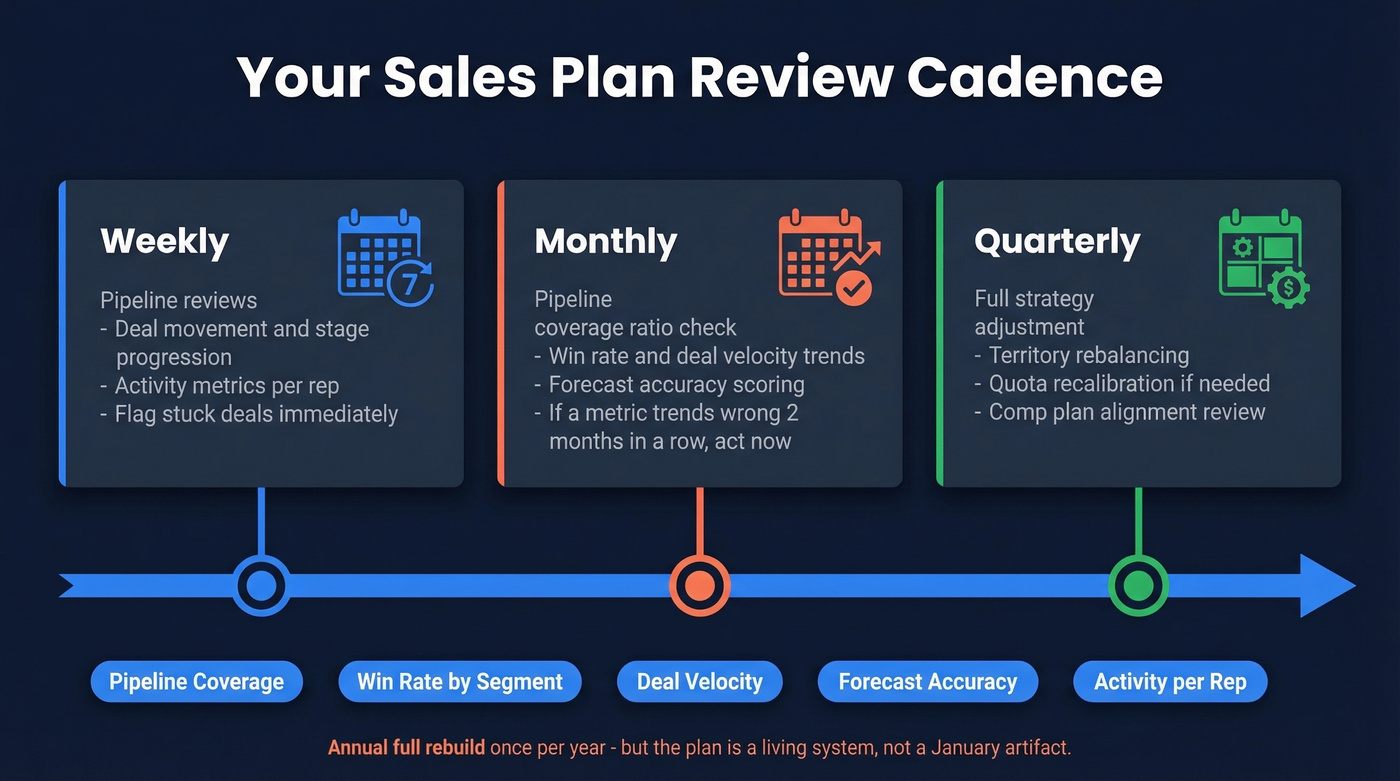
KPIs & Review Cadence. Pick 5-7 metrics that actually drive behavior: pipeline coverage ratio, average deal velocity, win rate by segment, activity metrics per rep, and forecast accuracy. Only 37% of U.S.-based employees say greater visibility into company and individual goals would spur performance - your KPIs need to fix that gap. Review monthly at minimum, with quarterly strategy adjustments. Use a RACI model so everyone knows who owns what.

You just read it: bad data kills sales plans faster than bad strategy. If 35-40% of your contacts bounce, your activity targets are fiction. Prospeo's 98% email accuracy and 7-day data refresh cycle mean every pipeline number in your plan maps to a real, reachable buyer - not a stale record.
Build your sales plan on data that actually connects reps to buyers.
How to Create a Sales Plan Step by Step
Set Your Revenue Target
Start with the number. Everything else flows from it. For a 1,000-seller org with $1.5M average quota, improving attainment by just 10% means $150M in additional booked revenue. Even for a 10-person team, a 10% improvement on a $2.4M target is $240K you'd otherwise leave on the table.
Define Your ICP and Segments
Don't just describe your ideal customer - rank your segments. Which verticals have the highest win rates? Which company sizes close fastest? Which pain points correlate with larger deal sizes? Allocate more rep capacity to higher-probability segments. This is where most plans are too democratic. Not every segment deserves equal attention. If you need a scoring rubric, use an ideal customer profile template.
Map Your GTM Motion
"60% outbound, 30% inbound, 10% partner" is a plan. "We'll do outbound and inbound" isn't. For each motion, define the expected lead volume, conversion rate, and average deal size. These numbers feed directly into your pipeline math. Your strategy should spell out the exact handoffs between channels so nothing falls through the cracks. If outbound is a core lever, align on sales prospecting techniques before you set activity targets.
Build Quota and Capacity Math
This is where plans either shine or collapse. Let's work through real numbers.
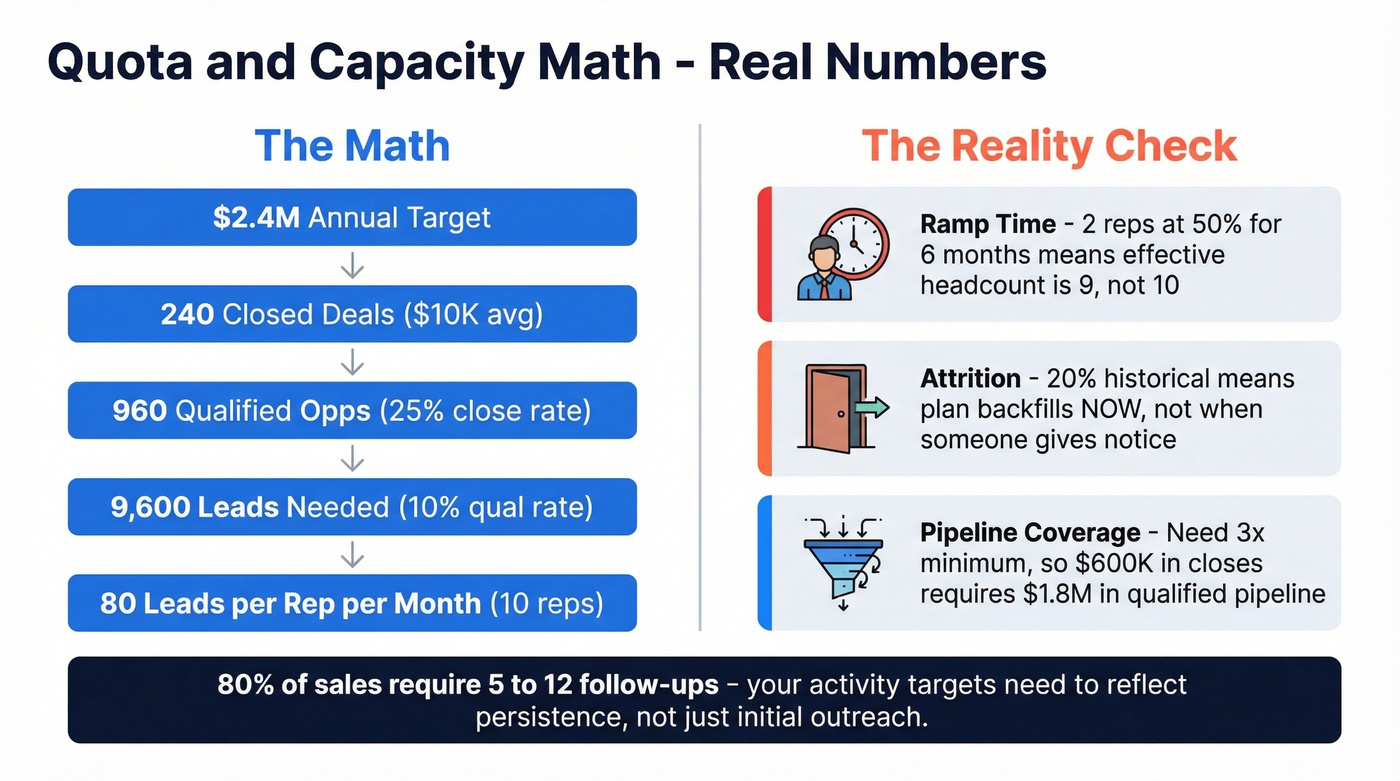
$2.4M annual target / $10K average deal = 240 closed deals. At a 25% close rate, that's 960 qualified opportunities. At a 10% qualification rate from raw leads, you need 9,600 leads - or 80 leads per rep per month across 10 reps.
Now layer in capacity. If two reps are ramping at 50% productivity for six months, your effective headcount is 9, not 10. If historical attrition is 20%, you'll lose two reps this year - plan the backfills now, not when someone gives notice. Only 30% of sales leaders say their compensation strategy is very prepared for economic volatility, which means your capacity math needs to account for comp-driven attrition too.
Pipeline coverage should run at 3x minimum. If you need $600K in closes this quarter, you need $1.8M in qualified pipeline entering the quarter. And 80% of sales require 5-12 follow-ups - your activity targets need to reflect persistence, not just initial outreach. (If you want plug-and-play sequences, keep sales follow-up templates handy.)
Design Territories
Territory design is one of the highest-leverage moves in sales planning. HBR has found that optimizing sales territories can increase sales by 2% to 7% without changing strategy or reallocating resources - no new hires, no new tools, just better allocation. The key is balancing opportunity across reps so nobody's sitting on a goldmine while their colleague grinds through a desert. Segment by geography, vertical, company size, or a hybrid. If you need tooling, evaluate sales mapping software.
Build Your Prospect List
All that pipeline math above assumes your reps can actually reach the prospects in the plan. When 35-40% of contact data bounces - more common than anyone wants to admit - your activity targets are fiction. If list quality is a bottleneck, start with data enrichment services and a clean source of sales prospecting databases.
When Snyk rolled out Prospeo across 50 AEs, their bounce rate dropped from 35-40% to under 5%, and AE-sourced pipeline jumped 180% with 200+ new opportunities per month. That's not a tools story - it's a planning story. Your pipeline math stays grounded in reality when the data underneath it refreshes weekly and delivers 98% email accuracy, rather than decaying by week three of the quarter.
Set KPIs and Review Cadence
Monthly pipeline reviews. Quarterly strategy adjustments. Annual full rebuild. Track pipeline coverage ratio, win rate, deal velocity, forecast accuracy, and activity metrics per rep. If a number trends wrong for two consecutive months, act immediately - don't wait for the quarterly review.
One-Page Sales Plan Template
Steal this format. Every number connects to every other number.
| Field | Details |
|---|---|
| Company | Acme Analytics (B2B SaaS, mid-market) |
| Annual Target | $2.4M ARR (new business) |
| ICP | VP Sales/RevOps, Series B-C SaaS, 50-300 emp, US/CA |
| ACV | $10K |
| Deals Needed | 240 closed-won |
| Close Rate | 25% |
| Opps Needed | 960 qualified |
| Pipeline Coverage | 3x ($7.2M in pipeline) |
| Team | 10 AEs (8 ramped, 2 ramping), 4 SDRs, 1 Sales Manager |
| GTM Mix | 55% outbound, 35% inbound, 10% partner |
| Activity/Rep/Month | 80 leads, 200 emails, 40 calls, 8 demos |
| Hiring Plan | 2 AEs in Q2 (backfill attrition), 1 SDR in Q3 |
| Tech Stack | HubSpot, Outreach, Prospeo, Looker |
| Q1 Milestone | $480K pipeline built, 2 ramping reps at 50% |
| Q2 Milestone | $600K closed, backfill hires onboarded |
| Q3 Milestone | $650K closed, partner channel at 10% of pipeline |
| Q4 Milestone | $670K closed, 2027 plan draft started |
| Review Cadence | Weekly pipeline, monthly forecast, quarterly strategy |
If leadership asks "how do we get to $2.4M?" you point at this table. This sales plan example works for mid-market SaaS - adapt the numbers and GTM mix for your own context.
Types of Sales Plans
Annual Plan
The default. It covers the full fiscal year with quarterly milestones. The mistake is treating it as a static document - build it annually, but refresh assumptions monthly. Market conditions in January won't hold by July.
Territory Plan
Territory plans segment your market and assign reps to maximize coverage and minimize overlap. Balance three things: revenue potential, rep capacity, and time zone logistics. Optimized territory design can lift revenue 2-7% without adding headcount - it's one of the cheapest levers in sales.
30/60/90 Day Plan
The single most underused planning format in sales. Every new hire should have one, and most don't. If you want a full version you can copy, use this 30/60/90 day plan.
Days 1-30 are learning: product knowledge at 90%+, territory analysis presented, top 20 accounts researched. Days 31-60 are executing: 30+ customer visits, 5+ qualified opportunities, 10+ solo demos. Days 61-90 are owning: pipeline at 3x monthly quota, forecast accuracy 80%+, first deal closed. Make each phase measurable, not aspirational.
Small Business Plan
For teams of five or fewer reps, you don't need a 20-page document - you need a one-page plan with tight math and weekly accountability. Small teams should focus on ICP discipline (say no to bad-fit prospects faster), outbound efficiency where verified data matters even more when you can't afford wasted dials, and a 30-day review cycle instead of quarterly. The framework above scales down cleanly; just simplify the territory and capacity sections.
Account Plan
For enterprise and long-cycle sales - industrial automation, government contracting, or any deal that takes 6-18 months. The challenge isn't picking targets. It's prioritizing high-probability opportunities, allocating time across a complex pipeline, and keeping deals warm without annoying buyers. The consensus on r/sales is that long-cycle plans need to address pipeline stage management and relationship habits across quarters, not just activity targets.
Sales Planning Tools
The sales performance and planning software market hit $15B in 2025 and is projected to reach ~$45B by 2033 at 12% CAGR. Here's how to think about the spend.
Under 50 reps: don't spend a dollar on Anaplan. Your CRM's built-in planning features plus a well-built spreadsheet will get you 80% of the way there. We've seen 30-person teams waste six months implementing enterprise planning software they didn't need.
50-500 reps: dedicated planning tools like Anaplan, Xactly, or Varicent start paying for themselves through better territory optimization and quota modeling.
500+ reps: you're often looking at $50K-$250K+/year for these platforms, but the ROI math works when a 10% improvement in attainment across 500 reps means tens of millions in additional revenue.
Enterprise planning software handles the strategy. But the data layer - verified emails and phone numbers your reps need to actually execute the plan - is a separate problem, and enterprise tools don't solve it. When Meritt switched to verified contact data, their pipeline tripled from $100K to $300K per week and bounce rates dropped from 35% to under 4%. If you're evaluating options, start with best contact management software and a clear view of your sales pipeline challenges.
| Tool | Pick This If... | Pricing |
|---|---|---|
| Salesforce | You're already in the ecosystem and need CRM + reporting | ~$25-$330/user/mo |
| HubSpot | You want a free CRM with solid templates to start | Free CRM; paid from ~$20/user/mo |
| monday.com | Your small team hates Salesforce and wants visual planning | ~$12/seat/mo and up |
| Anaplan | 500+ reps, complex territories, serious modeling needs | $50K-$250K+/yr |
| Xactly | Quota and comp planning is your primary headache | $30K-$100K+/yr |
| Varicent | Full sales performance management at enterprise scale | $50K-$200K+/yr |
| Cube | FP&A team wants sales planning integrated with financial models | From $1,250/mo |
Skip Anaplan and Varicent if you're under 200 reps - the implementation cost alone will eat a quarter of your year.
Your capacity model accounts for ramp time and attrition - but does it account for reps wasting hours on dead contacts? Teams using Prospeo's 300M+ verified profiles and 125M+ mobile numbers book 35% more meetings than Apollo users. That's the difference between hitting quota and watching your plan collapse in Q2.
Stop planning around bad data. Get contacts that pick up the phone.
Common Sales Planning Mistakes
Planning annually and never revisiting. Look, most plans fail not because the strategy is wrong, but because nobody revisits the plan after January. The fix is monthly pipeline reviews and quarterly strategy adjustments. A plan that doesn't evolve with market conditions is a historical document by Q2.
Top-down only, no bottom-up reconciliation. Leadership sets a $5M target. Nobody checks whether the team has the capacity, pipeline, or market to deliver it. Build bottom-up from rep capacity and conversion rates, then reconcile with the top-down number. If they don't match, negotiate before the year starts.
Building in silos. A plan built without Marketing, RevOps, and Finance input will fail in execution. Marketing needs to know the lead volume targets. Finance needs to approve the hiring plan. RevOps needs to build the reporting. Use a RACI model and start the process early - some companies begin annual planning six months out.
Ignoring capacity constraints. New hires aren't productive on day one. A rep who starts in April isn't fully ramped until September. Attrition will happen - plan for it. If you're assuming 10 productive reps all year and you lose two in Q2, your plan is 20% short before summer hits.
Planning with bad data. When 35-40% of your contact data bounces, your 80-leads-per-rep-per-month target actually requires reps to source 120+ leads to hit the same pipeline number. Teams that fix their data quality see up to 4x improvement in achieving sales objectives. The data layer isn't a nice-to-have - it's a planning assumption.
FAQ
How long should a sales plan be?
One page for leadership alignment, 5-10 pages for the operational version. The one-pager forces clarity on revenue targets, ICP, and pipeline math. The longer version adds territory assignments, hiring timelines, and scenario models.
How often should you update it?
Monthly pipeline reviews, quarterly strategy adjustments, annual full rebuild. Static annual plans are the #1 failure mode - market conditions and pipeline health shift faster than a yearly cadence can handle.
Who owns the sales plan?
The VP of Sales or CRO owns it, built collaboratively with RevOps, Finance, and Marketing. A plan built in a silo fails because the teams responsible for leads, budgets, and reporting weren't part of the design.
What's the difference between a sales plan and a forecast?
A sales plan defines what you'll do to hit targets - activities, quotas, hiring. A forecast predicts what'll happen based on current pipeline. The plan drives the forecast. If your forecast is off, check whether the plan's assumptions still hold.
How do you fix a plan built on bad contact data?
Switch to a verified data source with a short refresh cycle. Teams like Snyk and Meritt cut bounce rates to under 5% after moving to weekly-refreshed, 98%-accurate email data - meaning their pipeline math actually held through the quarter instead of decaying by week three.