

The Sandler Selling System: A Practitioner's Field Guide
You ran a 45-minute discovery call. Nailed the demo. Sent a proposal with custom pricing. Then the prospect went dark for two weeks and finally replied: "We need to run this by finance." They never had budget authority. That demo should never have happened.
The Sandler Selling System exists to kill that scenario before it starts. Developed by David Sandler in the late 1960s, the framework was a reaction to high-pressure, always-be-closing tactics. It flips the traditional sales process: you qualify first - ruthlessly - and only present when you've confirmed pain, budget, and the decision-making process. 50% more salespeople hit quotas when using the Sandler way than those without a structured methodology, and the psychological foundation is why its techniques - upfront contracts, negative reverse selling - feel more like behavioral science than sales training.
The Short Version
- Sandler is the best qualification framework for SMB and mid-market deals. Period.
- The 7-step "submarine" process prevents wasted demos by surfacing budget and decision process before you ever present.
- It's not built for enterprise buying committees. For complex, multi-stakeholder deals, run Sandler for discovery and layer in a structured enterprise framework like MEDDIC to manage the deal.
- Expect to pay $1,000-$3,000/seat for workshops or $6,000-$7,000 for a 9-month program.
The 7 Steps Explained
The submarine metaphor is the backbone. Each step is a sealed compartment - you don't move to the next one until the current one is airtight. Skip a step and the whole thing floods. This stage-gating discipline separates Sandler from looser discovery frameworks where reps jump to the demo the moment a prospect shows interest.
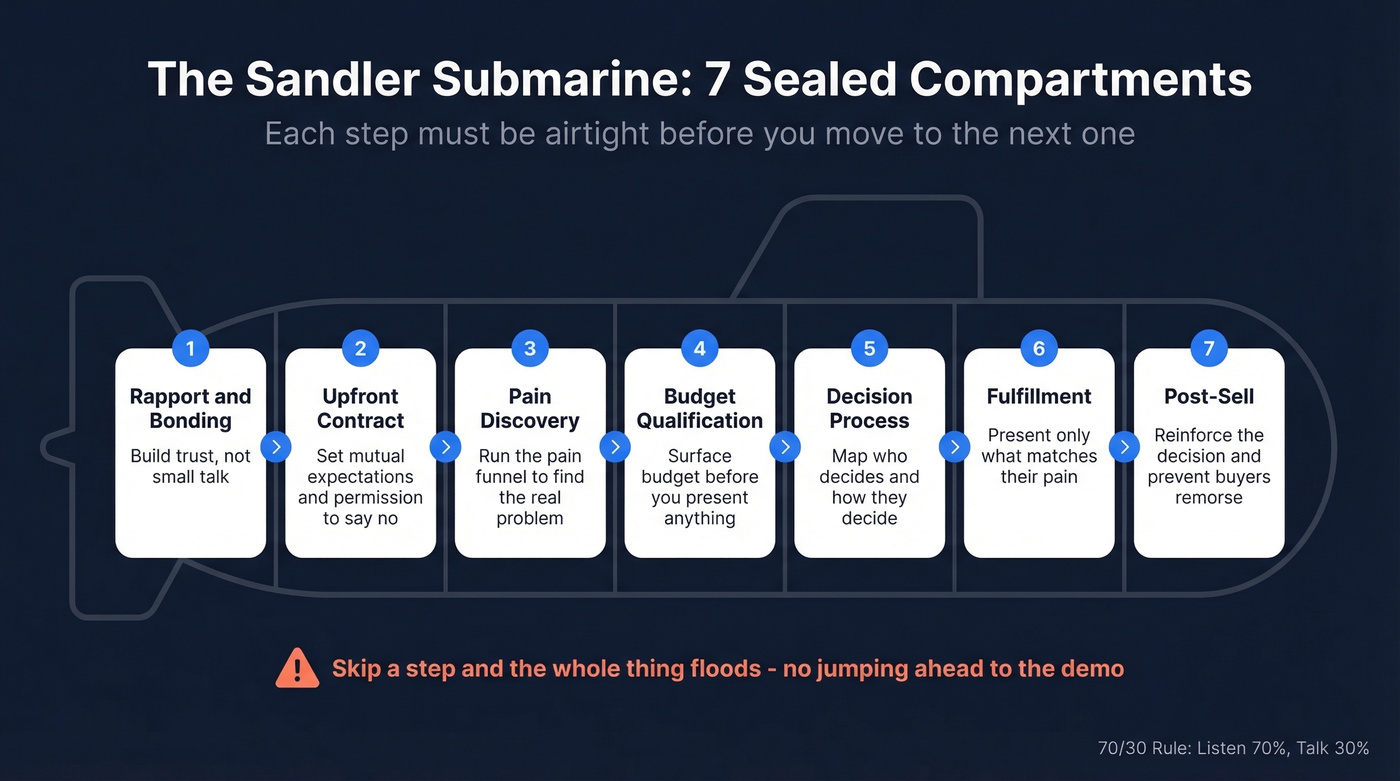
One critical principle runs through every step: maintain a 70/30 listening-to-talking ratio. You're asking questions, not pitching. And remember Sandler's Rule #1 - "Don't spill your candy in the lobby" - meaning don't dump your value proposition before you've earned the right to present.
Rapport and Bonding
This isn't small talk about the weather. Sandler rapport means matching the prospect's communication style, energy, and pace so they feel comfortable enough to be honest. The goal is trust, not friendship.
Try questions like "What does a typical day look like in your role?" or "How did you end up leading this initiative?" You're building the psychological safety that makes the rest of the process work.
Upfront Contract
The most underrated step. Before any substantive conversation, you set a mutual agreement: what you'll cover, how long it'll take, and what happens at the end - including explicit permission to say no. Something like: "If at the end of this call you don't think it's a fit, can you tell me that directly?"
This is one of the cleanest anti-ghosting moves in the Sandler toolkit because it creates an explicit yes/no expectation early. Stating the reason for a cold call upfront increases success rates by 210%, and the upfront contract applies that same "clarity first" principle to discovery calls.
Pain Discovery
Here's where the method earns its reputation. You're not asking "What are your challenges?" You're running the pain funnel to surface the real problem, its business impact, and the emotional weight behind it. If there's no pain, there's no deal. Walk away.
Questions that work: "How long has this been a problem?" "What have you tried so far?" "What happens if nothing changes in the next six months?" If you want a tighter bank of prompts, use a structured set of discovery questions to keep reps from defaulting to feature talk.
Budget Qualification
This step separates Sandler from nearly every other framework. You surface budget before you present anything. Not "What's your budget?" - that gets a deflection every time. Instead: "Typically, companies solving this problem invest between $X and $Y. Does that range feel realistic for your team?"
One practitioner on r/sales described switching to this approach specifically because other frameworks let budget surface late, leading to "talk to my accountant" stalls and ghosting. We've seen the same pattern across teams we work with - early budget qualification is the single biggest time-saver in the entire process.
Decision Process
Map the buying process before you invest in a proposal. "Walk me through what happens after our conversation - who else gets involved?" "What does their approval process look like?" If the answer reveals a 12-person committee and a 9-month procurement cycle, you know you're not in pure Sandler territory anymore. For committee-heavy deals, it helps to understand the technical buyer vs economic buyer split early.
Fulfillment and Presentation
Only now do you present. Because you've confirmed pain, budget, and decision process, your presentation is surgical - no feature dumps, no 40-slide decks. You connect your solution to the specific pain they articulated in step three. If your team still runs bloated demos, tighten the flow with a product demo checklist.
"Based on what you shared about [pain], here's how we address that specifically - does this match your expectation?"
Post-Sell
Buyer's remorse is real, especially in B2B where the signer has to justify the purchase internally. The post-sell step is a proactive conversation where you reinforce the decision and confirm next steps. It also sets the stage for referrals and expansion. Ask: "What concerns, if any, have come up since we signed?" and "Who else on your team should we loop in for onboarding?"
The Pain Funnel: Complete Question Sequence
The pain funnel is Sandler's signature technique, and it's the piece most reps get wrong. It's not a checklist. It's a progressive deepening from surface-level process questions to emotional, personal consequences.
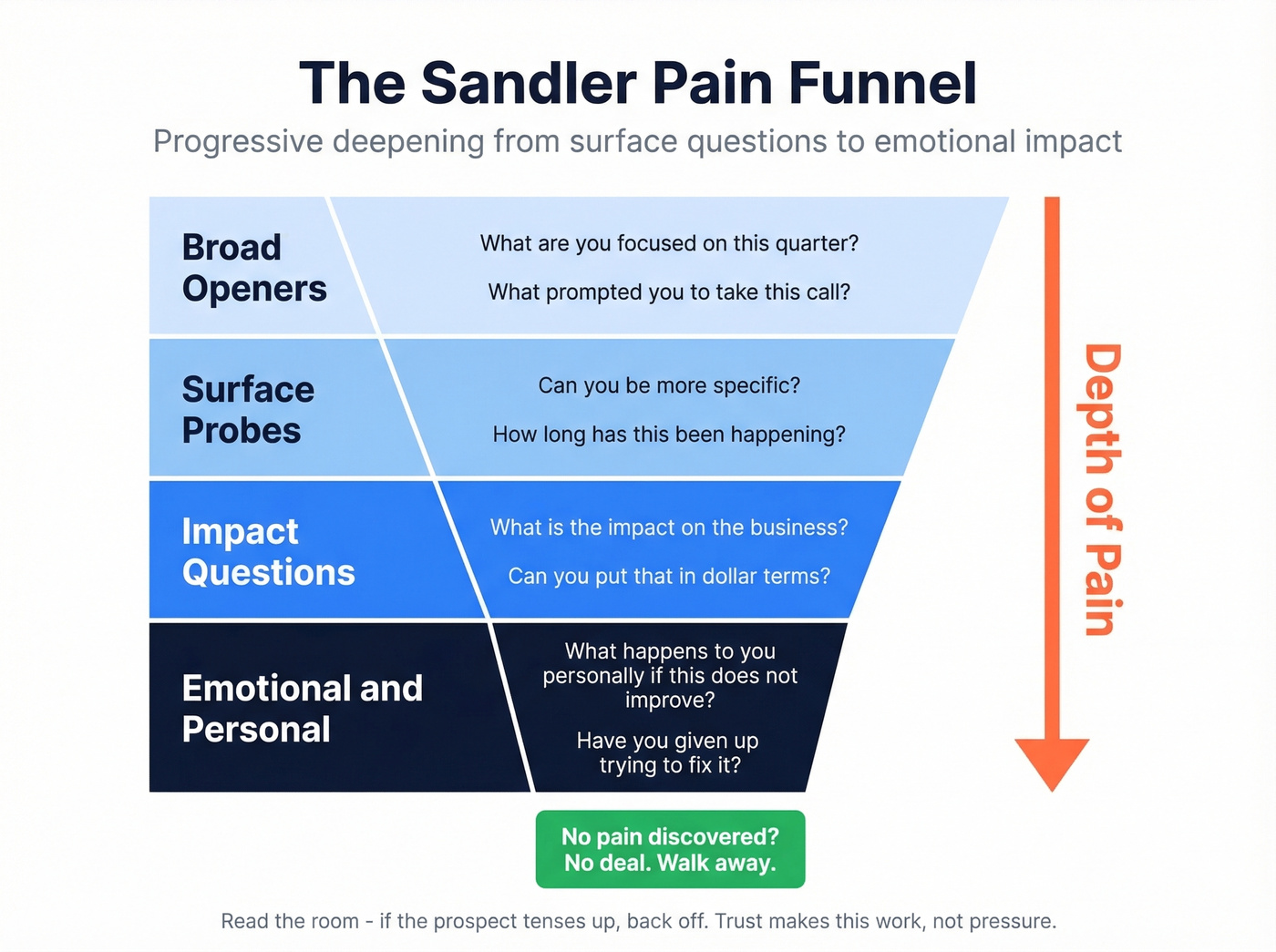
Broad openers: "What are you focused on this quarter?" "What prompted you to take this call?"
Surface probes: "Can you be more specific?" "Give me an example." "How long has this been happening?"
Impact questions: "What's the impact on the business?" "Can you put that in dollar terms?"
Emotional/personal questions: "Who else is affected by this?" "What happens if you don't address this in the next quarter?" "Have you given up trying to fix it?"
Here's a compressed example of the escalation in practice:
Rep: "You mentioned onboarding takes 8 weeks. What does that cost you?" Prospect: "We lose about two deals per rep during ramp." Rep: "At your average deal size, what does that look like annually?" Prospect: "Probably $400k across the team." Rep: "And what happens to you personally if that number doesn't improve by Q3?"
That last question is where most reps chicken out. Don't. We've tested this across dozens of teams, and the pain funnel is consistently where reps need the most coaching. But read the room: if the prospect tenses up or deflects, back off. The funnel works because of trust, not pressure.
Negative Reverse Selling Done Right
Negative reverse selling is reverse psychology applied to sales conversations. Instead of pushing the prospect forward, you gently suggest the opposite - that maybe this isn't a fit, or maybe the problem isn't a priority. The prospect then defends their own need, effectively selling themselves.
The classic pattern: "Based on what you've described, it sounds like this might not be urgent enough to justify the investment right now. Is it fair for me to assume that's the case?"
Done well, it's powerful. Done poorly, you come off as rude or dismissive. Deploy it when a prospect is stalling or giving non-committal answers. Avoid it during early rapport-building or when discussing sensitive topics like layoffs or budget cuts. The technique requires genuine empathy - if you're using it as a trick, people will feel it.

Sandler's budget step only works if you're talking to real decision-makers. Prospeo's 30+ filters - including job title, seniority, department headcount, and buyer intent - let you build lists of budget holders before you ever pick up the phone.
Stop running pain funnels on people who can't sign the check.
Sandler vs MEDDIC vs SPIN vs Challenger
Let's be honest: the consensus on r/sales is that all methodologies boil down to the same core - need, budget, stakeholders, timeline. There's some truth to that. But the differences in emphasis and execution matter more than the skeptics admit.
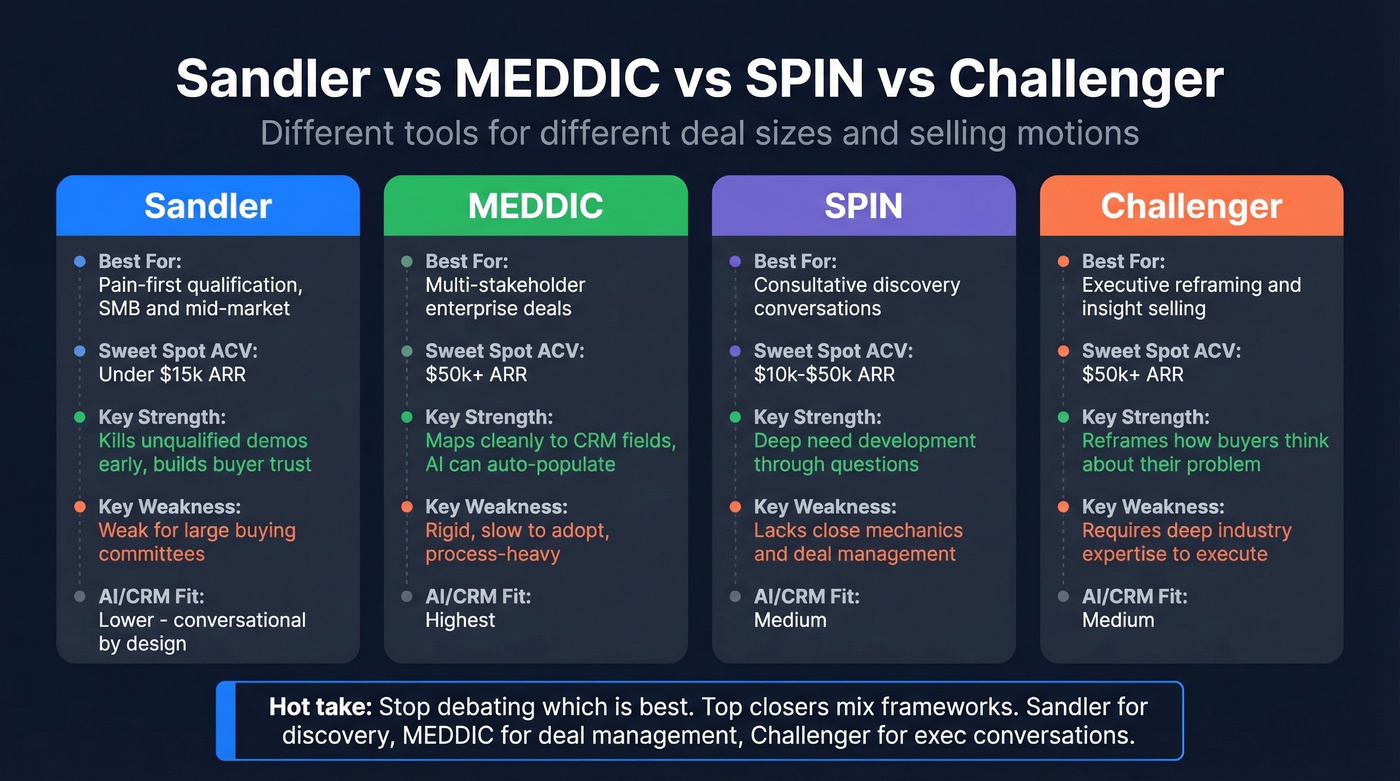
| Framework | Best For | AI/CRM Fit | Key Weakness |
|---|---|---|---|
| Sandler | Pain-first qualification | Lower (conversational) | Weak for committees |
| MEDDIC | Multi-stakeholder deals | Highest (field-mapped) | Rigid, slow to adopt |
| SPIN | Consultative discovery | Medium | Lacks close mechanics |
| Challenger | Executive reframing | Medium | Requires deep expertise |
A founder-led SaaS team selling $8k-$10k ARR deals adopted Sandler's upfront contracts and early budget checks - fewer demos, faster decisions. A $72k ARR partner-led deal needed MEDDIC to map the economic buyer and champion. A $350k ARR enterprise deal required Challenger-style reframing to close. Different tools for different jobs.
Here's our hot take: if your average contract value is under $15k, you almost certainly don't need MEDDIC's overhead. Sandler's submarine process will close those deals faster with less process bloat. Stop debating which methodology is "best" - top closers mix frameworks. Use Sandler for discovery, MEDDIC for deal management, and Challenger for executive conversations. MEDDIC maps cleanly to CRM fields that AI tools can auto-populate, while Sandler's conversational nature is harder to automate. That's part of the point: the edge is the human control you create with an upfront contract and a well-timed negative reverse.
When It Works - and When It Doesn't
Use Sandler when:
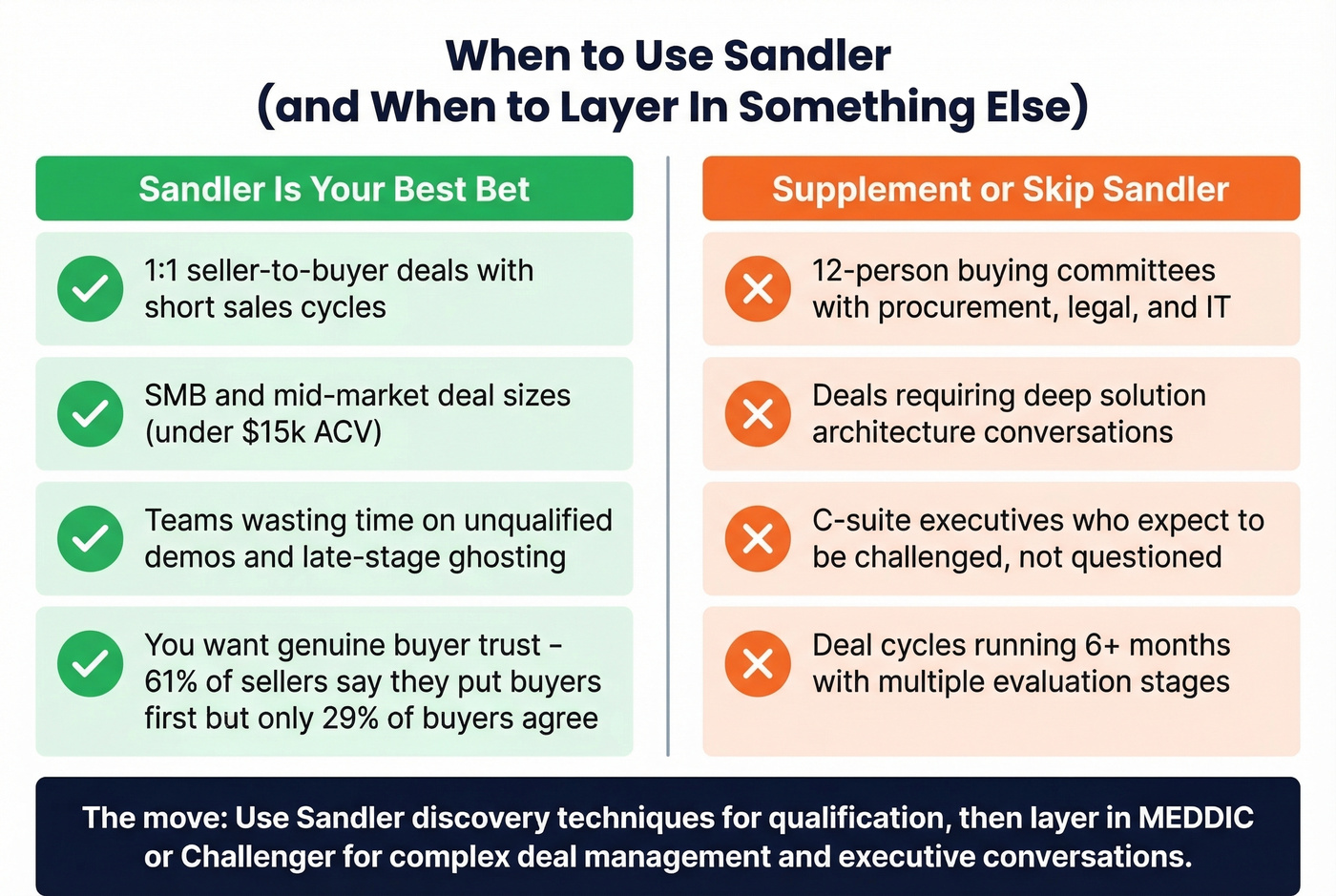
- You're selling 1:1, seller-to-buyer, with relatively short sales cycles
- Deal sizes are in the SMB or mid-market range
- Your reps waste time on unqualified demos and late-stage ghosting
- You want a framework that builds genuine buyer trust - the trust gap is real, with 61% of sellers saying they put the buyer first while only 29% of buyers agree. If your team needs a broader operating system, pair this with sales process optimization.
Skip or supplement Sandler when you're selling into 12-person buying committees with procurement, legal, and IT all weighing in. Same goes for deals requiring deep solution architecture conversations, C-suite executives who expect to be challenged rather than questioned, or deal cycles running 6+ months with multiple evaluation stages. In those cases, pair Sandler's discovery techniques with a framework built for complexity - especially if you're doing true enterprise B2B sales.
Training Costs in 2026
A training company that teaches transparency doesn't publish its own pricing. G2 confirms there's no public pricing - you have to contact them. But community reports and training-market benchmarks give us a solid picture.
| Program | Estimated Cost |
|---|---|
| Workshop (2-5 days) | $1,000-$3,000/seat |
| 9-month program | $6,000-$7,000 |
| Franchise (all-in) | ~$100k |
| Books (The Sandler Rules) | $15-$30 |
Sandler holds a 4.8/5 rating on G2 across 105 reviews, with users praising the tailored approach and leadership alignment. Organizations with formal sales training programs see a 19% improvement in sales performance and 353% ROI. For the franchise path, one r/sales poster estimated under $100k income in year one, with potential to scale to $200k-$300k long-term. If you're comparing programs, it helps to benchmark against other competitive sales training options.
Running the Sandler Selling System in 2026
Sandler's own team learned this lesson the hard way. They were running six disconnected tools with poor integration - reps didn't log consistently, and reporting was a mess. After consolidating onto HubSpot Sales Hub, they saw a 50% increase in rep adoption and freed up one full-time employee from manual data collection. Methodology without tooling is just theory.
Your CRM needs custom fields for each Sandler stage - Rapport, Upfront Contract, Pain, Budget, Decision, Fulfillment, Post-Sell. This gives managers coaching visibility and lets you identify where deals stall. If you’re standardizing your stack, start with a few examples of a CRM to see how teams structure stages and fields.
The prerequisite most teams overlook is data quality. The pain funnel only works if you're talking to the right person with a valid email and phone number. Reps already spend just 28% of their week actually selling; bad data makes it worse. Prospeo's 98% email accuracy and 7-day refresh cycle mean reps reach the right person on the first try instead of chasing bounced emails. Before you invest in Sandler training, fix your contact data - if half your emails bounce, the pain funnel never happens. If bounces are a recurring issue, start by auditing your email bounce rate and cleaning lists before outreach.

The Sandler submarine sinks when bad data sends you to dead-end contacts. Prospeo delivers 98% email accuracy on a 7-day refresh cycle, so every upfront contract you set is with a verified, reachable prospect - not a bounce waiting to happen.
Seal every compartment with contacts that actually connect.
FAQ
Is the Sandler Selling System still effective in 2026?
Yes. 50% more salespeople hit quotas when using Sandler's qualification-first approach. It prevents late-stage stalls by forcing clarity on pain, budget, and decision process before you present. The core psychology hasn't changed, even as tooling has evolved.
How long does it take to learn the Sandler method?
Workshops run 2-5 days; deeper programs span about 9 months. The fastest early win is usually fewer wasted demos and faster disqualification of bad-fit prospects within the first two weeks of practice.
What's the difference between Sandler and MEDDIC?
Sandler is a discovery and qualification framework for 1:1 conversations with short sales cycles. MEDDIC is a deal management framework for complex, multi-stakeholder enterprise sales. They're complementary - use Sandler techniques for early-stage qualification and MEDDIC for pipeline management.
Can I learn Sandler without paying for training?
Start with The Sandler Rules book (~$20). Practice the pain funnel and upfront contracts on your next 10 calls. Formal training accelerates adoption, but the core concepts are accessible through books and free online guides.
What tools pair best with Sandler for prospecting?
A CRM with custom stage fields, a conversation intelligence tool for coaching, and a verified contact data source. Prospeo gives you 75 free emails/month at 98% accuracy, so reps spend time in discovery calls instead of chasing bounced emails. Add a sequencing tool for follow-up and you've got a complete stack.