

How to Scale Sales Without Burning Everything Down
Your CEO just told the board you're tripling revenue next year. You've got four reps, no VP of Sales, and a CRM that's half spreadsheet, half graveyard. The median B2B SaaS growth rate dropped to 25% in 2024 - down from 30% the year before - and the playbooks that worked in 2021 don't survive contact with today's market.
Scaling sales isn't about hiring faster. It's about building a machine that produces more revenue per rep, per dollar, per hour - without collapsing under its own weight.
The Short Version
- Scaling isn't hiring more reps. It's more revenue per rep, per dollar, per hour. If you doubled your team and costs to double revenue, you just grew.
- Don't scale before you're ready. You need product-market fit, a repeatable sales process, and at least two reps consistently hitting quota.
- Sequence matters. Process, then methodology, then team, then tools. Most teams get this backwards.
- Data quality will wreck your scaling before anything else. If your email bounce rate exceeds 5%, fix that before adding headcount. Burned domains take months to recover.
- Start your stack with three tools. A CRM, a prospecting platform with verified contacts, and an outreach tool. Add complexity only after these three work together.
What "Scaling" Actually Means
Most people conflate scaling with growing. Growing means adding headcount and spending proportionally more to get proportionally more revenue. Scaling means increasing revenue without proportional cost increases. Hiring 10 reps to double revenue is growth; doubling revenue with your current team and smarter systems is scale.
The test is simple: if you doubled revenue, did you also double your team and budget? If yes, you grew. If no, you scaled.
Before you attempt either, you need readiness signals. Your ICP should be nailed down - not "we sell to mid-market SaaS" but specific enough that two different reps would build the same target list independently. Multiple reps should be hitting quota, not just your one rockstar. Your CRM needs to be clean enough to trust. Your unit economics need to make sense at the next stage, not just the current one. And you need documented playbooks, even rough ones, that capture what's working. Without those foundations, scaling just amplifies dysfunction.
The Scaling Ladder
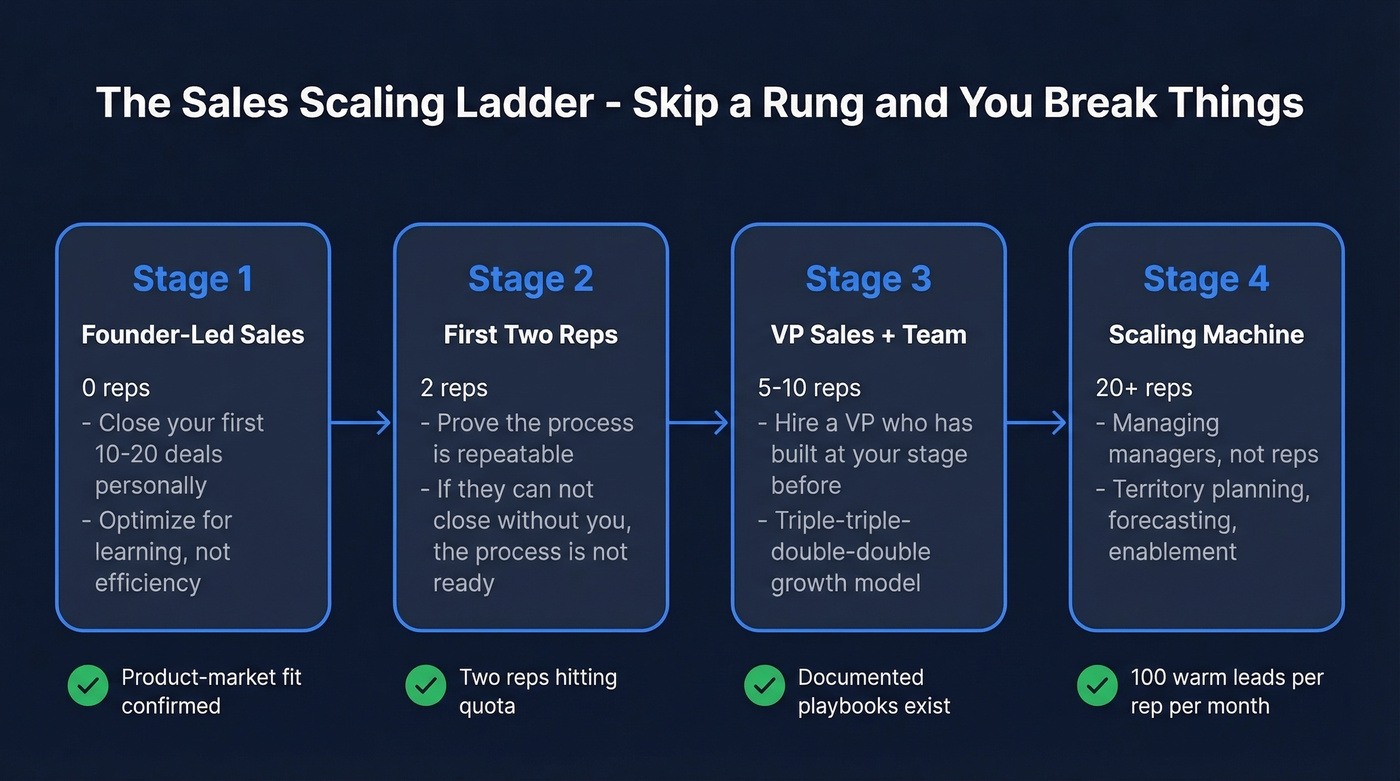
Sales organizations don't jump from zero to fifty reps. They climb a ladder, and skipping rungs is how you break things.
Stage 1: Founder-Led Sales
If a founder can't sell their own product, nobody can. This isn't a motivational poster - it's a diagnostic. Close the first 10-20 customers personally, learn the objections, discover the real ICP, and build the embryonic sales process. You're optimizing for learning here, not efficiency.
Don't hire reps until you've proven you can sell the thing yourself. And don't hire a VP of Sales to find product-market fit. That's the founder's job.
Stage 2: First Two Reps
Your first two hires prove whether the process is repeatable or whether you just had a founder with good relationships. If they can follow your process and close deals without you in every room, you've got something. If they can't, the process isn't ready.
Founders who hire reps before the process is documented always blame the reps when they underperform. The reps aren't the problem.
Stage 3: VP Sales + 5-10 Reps
Now you hire a VP of Sales - someone who's built a team at your price point and stage before. The triple-triple-double-double growth model maps this stage well: $1M to $3M to $9M to $18M to $36M over four years. The first two triples are the hardest because you're building the machine while running it.
Stage 4: 20+ Reps
At this scale, you're managing managers, not reps. You need territory planning, comp plan design, pipeline forecasting models, and a real enablement function. One team we studied grew from 2 to 30 reps with $500K annual quotas, plus a 10-person SDR team - they needed roughly 100 warm leads per rep per month to sustain that headcount. Without lead flow math, headcount plans are fiction.
Process Before Headcount
Here's the thing: most scaling failures aren't hiring failures. They're process failures that look like hiring failures.
The first process decision is your playbook model. The old approach - a PDF binder updated quarterly, disconnected from the CRM - doesn't survive scaling. A dynamic playbook lives inside your CRM, updates in real time, and surfaces the right discovery questions, battle cards, and assets based on persona and deal stage.
| Attribute | Static Playbook | Dynamic Playbook |
|---|---|---|
| Format | PDF or binder | CRM-embedded |
| Updates | Quarterly | Real-time |
| Context | Generic | Persona/stage |
| Analytics | None | Usage tracked |
| Onboarding | Weeks | Days |
As you formalize process, specialize roles. SDRs handle outbound prospecting, MDRs qualify inbound leads, and AEs close. Trying to have one person do all three is the fastest way to burn out your best people and bottleneck your pipeline.
Our take: The "one message, one ICP, one channel" framework beats multi-channel spray-and-pray at every stage below $10M ARR. Master one channel completely before adding another. Teams that launch email, cold calling, and social selling simultaneously usually do all three badly.
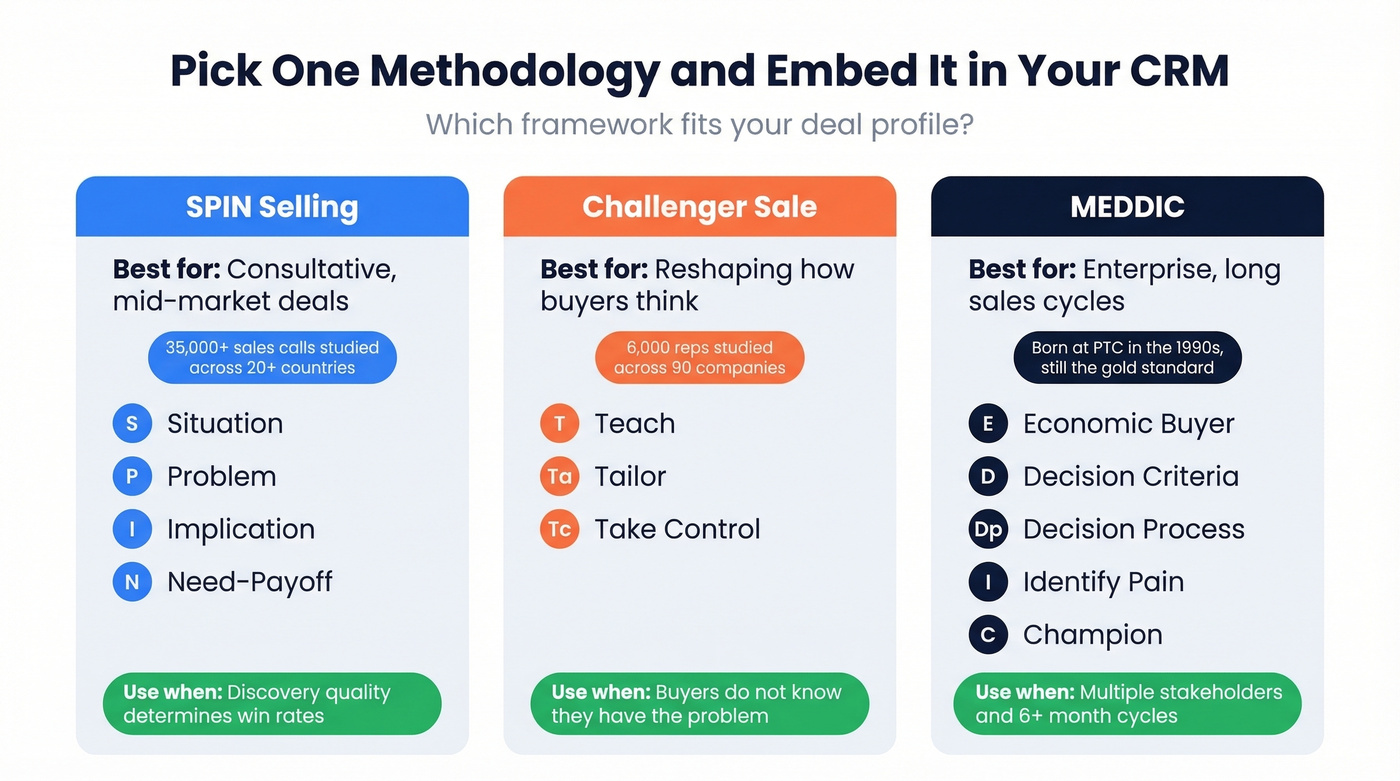
The second process decision is methodology. Three frameworks dominate, and which one you pick depends on your deal profile.
SPIN Selling came from studying 35,000+ sales calls across 20+ countries. It's question-driven and works best for consultative, mid-market deals where discovery quality determines win rates. Challenger Sale was built on research across 6,000 reps in 90 companies - teach, tailor, take control - and it's strongest when reps need to reshape how buyers think about the problem. MEDDIC is the enterprise qualification standard: six criteria covering Metrics, Economic Buyer, Decision Criteria, Decision Process, Identify Pain, and Champion. Born at PTC in the 1990s, still the best framework for deals with long cycles and multiple stakeholders.
Pick one. Train on it. Embed it in your CRM stages. Then layer in a targeting model that ranks accounts by TAM size, ease of acquisition, and ACV potential. Green accounts get the most rep time. Red accounts get automated nurture. This prevents the classic mistake of treating all accounts equally as headcount grows.
One tactic that's gaining traction among early-stage teams: recording a short Loom mini-audit of a prospect's website or workflow, then sending it as a personalized outreach asset. Takes five minutes and builds a culture of story-sharing that compounds as your team grows.

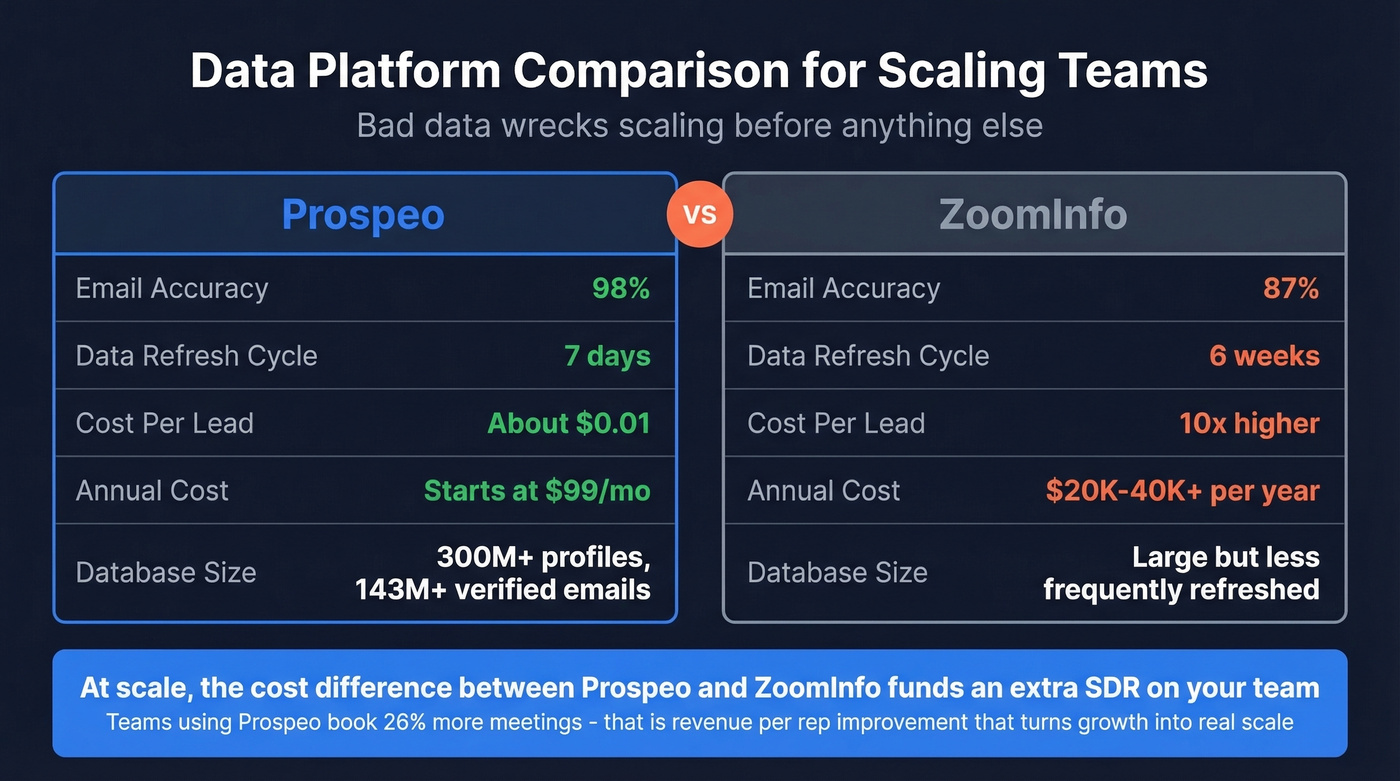
The article says it clearly: bad data wrecks scaling before anything else. Prospeo's 98% email accuracy and 7-day data refresh mean your reps spend time selling, not chasing bounces. Teams using Prospeo book 26% more meetings than ZoomInfo - that's the kind of revenue-per-rep improvement that turns growth into real scale.
Double your output without doubling your team.
Mistakes That Kill Sales Operations at Scale
These aren't theoretical. They're the patterns we see over and over.
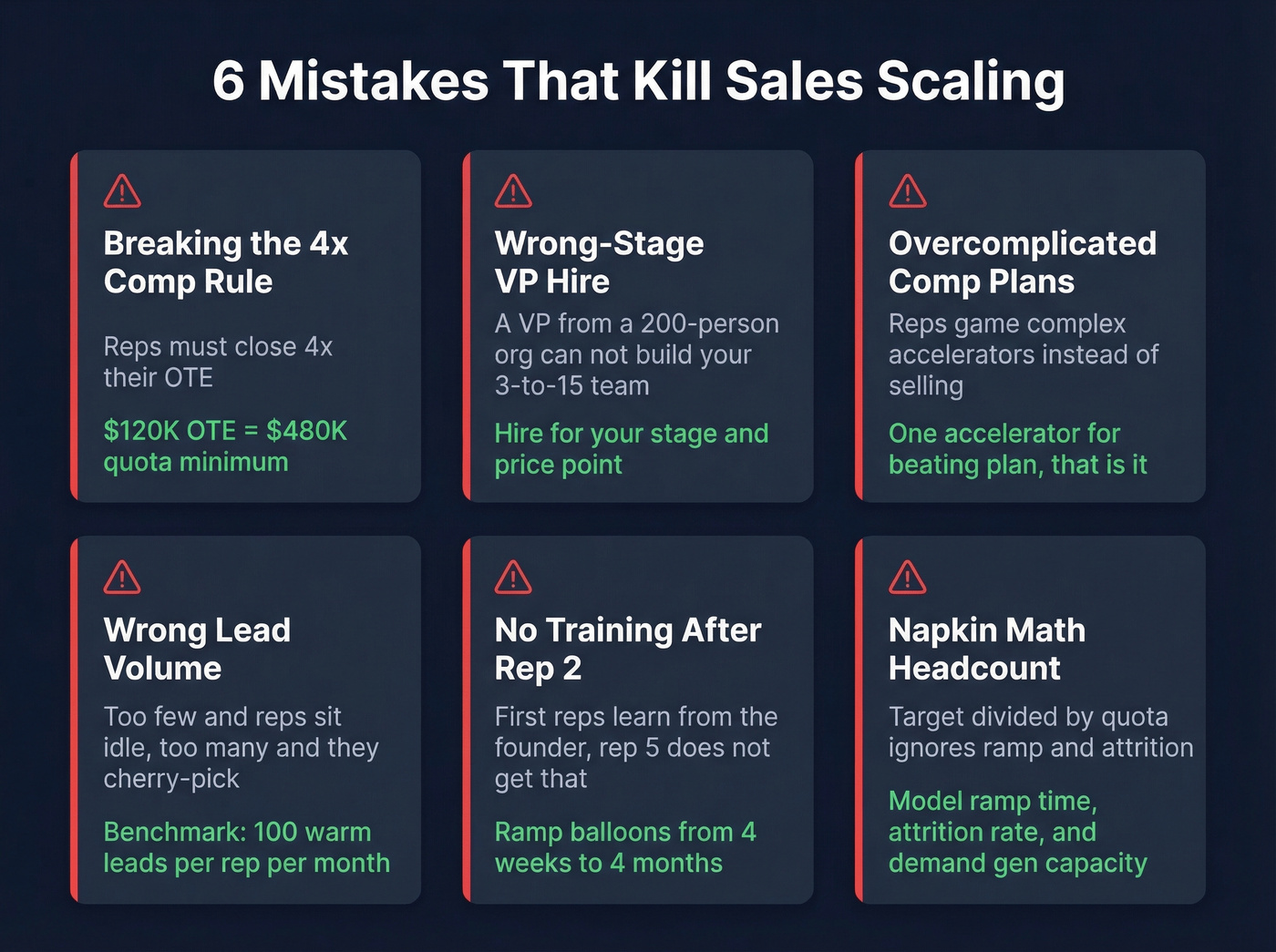
Ignoring the 4x comp rule. A rep should close roughly 4x their compensation. Paying $120K OTE means that rep needs to close $480K. If your deal sizes don't support that math, you need fewer, more expensive reps or a different motion entirely.
Hiring a VP Sales from the wrong stage. The VP who ran a 200-person team at Salesforce can't build your team from 3 to 15. Hire someone who's done it at your stage and price point.
Complicated accelerators. One accelerator for beating plan. That's it. Anything more complex and reps game the system instead of selling.
Wrong lead volume per rep. The benchmark: roughly 100 warm leads per rep per month for inbound-heavy motions. Too few and reps sit idle. Too many and they cherry-pick.
No training after the first two hires. Your first reps learned by osmosis from the founder. Rep #5 doesn't get that luxury. Skip this if you want to watch your ramp times balloon from four weeks to four months - use a simple 30-60-90 day plan instead.
Hiring reps at the wrong price point. The skills for closing $3K deals are fundamentally different from $300K deals. A rep who crushed it at a PLG company with $5K ACVs will struggle in a six-month enterprise cycle.
Forecasting headcount by target ÷ quota. "We need $10M, quotas are $500K, so we need 20 reps." This ignores ramp time, attrition, and demand generation math. It's the kind of napkin math that gets approved in board meetings and falls apart in Q2.
Strategies for Revenue Growth That Actually Scale
Pipeline coverage should run 3x-5x your target. Below 3x and you're relying on heroics. Above 5x and your pipeline is probably full of dead deals inflating the number - use basic pipeline health checks to keep it honest.
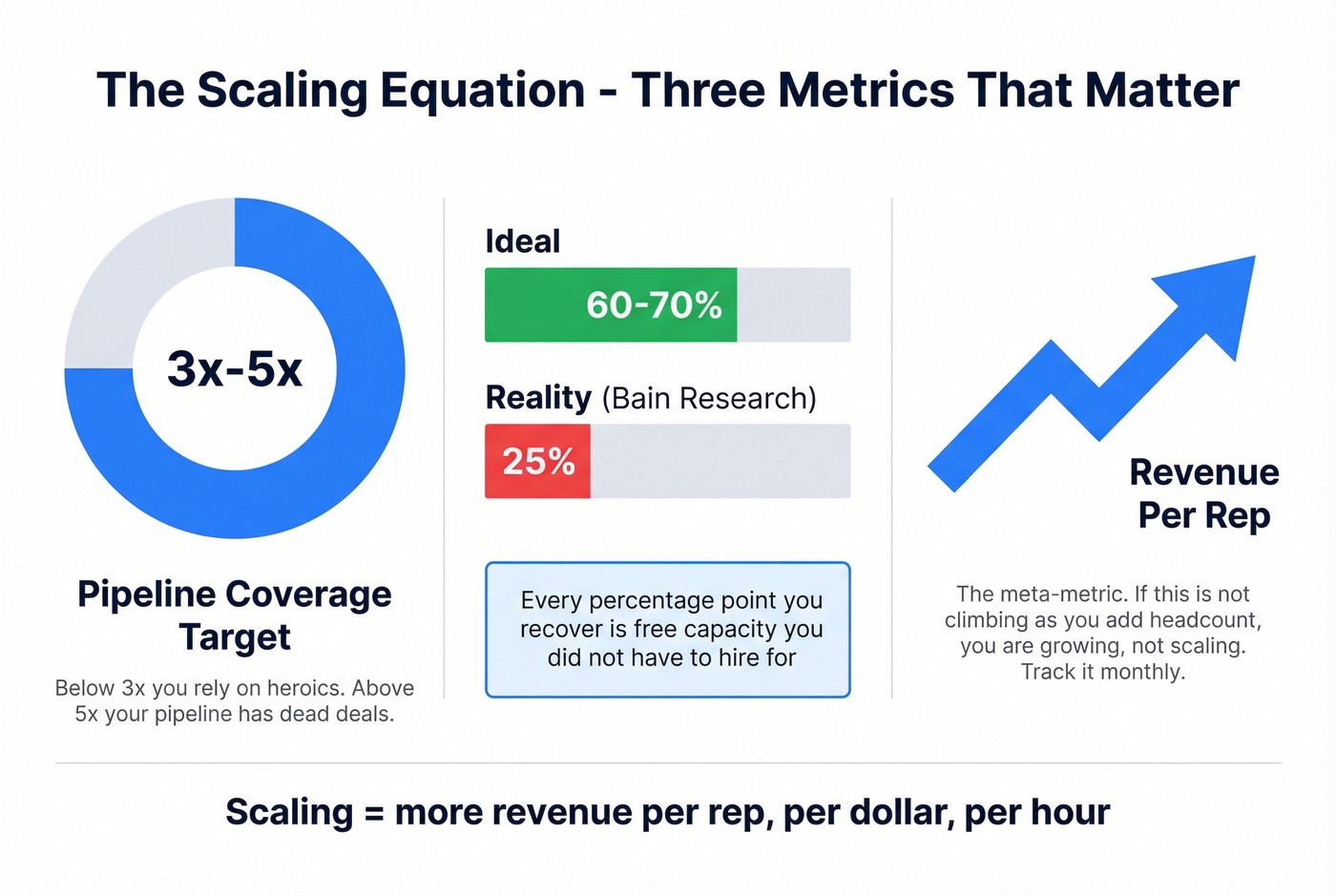
Time allocation is where most teams leak. The ideal is 60-70% of rep time on selling activities. Bain found the reality is closer to 25%. That gap is where scaling either works or doesn't - every percentage point you recover is free capacity you didn't have to hire for.
Revenue per rep is the meta-metric. If that number isn't climbing as you add headcount, you're growing, not scaling. Track it monthly.
Building the Right Tech Stack
The consensus on r/SaaS is that tools are converging and ZoomInfo at $20K+/year is - as one Redditor put it - "wild" pricing for most teams in growth mode. We've found the same thing in our own testing. Start lean and add tools only when a specific bottleneck demands it.
At Stage 2, you need three tools: a CRM, a prospecting/data platform, and an outreach tool. By Stage 3, add scheduling and conversation intelligence. Stage 4 is when forecasting and enablement platforms earn their keep.
| Category | Tool | Pricing |
|---|---|---|
| CRM | HubSpot | Starts at $99/mo |
| CRM | Pipedrive | Starts at $24/user/mo |
| CRM | Salesforce | Starts at $25/user/mo |
| Prospecting/Data | Apollo | Free tier, paid ~$49-99/user/mo |
| Prospecting/Data | Clay | $149/mo |
| Prospecting/Data | ZoomInfo | $20K-40K+/yr |
| Outreach | Instantly | $47/mo |
| Outreach | Lemlist | $79/mo |
| Scheduling | Calendly | $12/seat/mo |
| Scheduling | Chili Piper | Starts at $45/mo |
Prospeo covers the data layer with 300M+ profiles, 143M+ verified emails, and 125M+ verified mobile numbers on a 7-day refresh cycle versus the 6-week industry average. At roughly $0.01 per lead, it's 90% cheaper than ZoomInfo with higher accuracy - 98% vs. 87%. For a team scaling from 5 to 20 reps, that cost difference funds an extra SDR.
Don't buy five tools that overlap. Buy three that integrate cleanly and add complexity only when you've maxed out what the core stack can do - especially your sales engagement platform.
Data Quality: The Silent Killer
Look - if your bounce rate is above 5%, you don't have a scaling problem. You have a data problem. Expanding your outbound with bad data just means burning domains faster and wasting more rep hours on dead numbers.
GreyScout grew their sales team from 2 to 5 reps and watched their bounce rate sit at 38%. Pipeline was stagnant. After switching to verified data, bounce rates dropped under 4%, pipeline jumped 140%, and rep ramp time was cut from 8-10 weeks to 4 weeks. That's not a marginal improvement - that's the difference between a plan that works and one that doesn't.
The pattern repeats at larger scale. Snyk had 50 AEs each prospecting 4-6 hours per week with bounce rates running 35-40%. After implementing verified contact data, bounces dropped under 5%, AE-sourced pipeline increased 180%, and the team generated 200+ new opportunities per month.
Burned sending domains take months to recover. Every bounced email damages your sender reputation, which damages deliverability for every rep on your team. A weekly data refresh cycle means your reps work with current, verified contacts - not stale records from a database that updates every six weeks. If you need a baseline, start with email deliverability and email bounce rate benchmarks.
You need 100+ warm leads per rep per month to sustain headcount growth. Prospeo's 300M+ database with 30+ filters - buyer intent, technographics, headcount growth, funding - lets you build precisely targeted lists at $0.01 per verified email. No burned domains. No bloated budgets. Just the lead flow math that makes your hiring plan real.
Feed your pipeline before you grow your payroll.
AI as a Scaling Multiplier
Sellers spend roughly 25% of their time actually selling. The rest goes to research, data entry, CRM updates, and internal reporting. AI's biggest promise for teams scaling sales isn't replacing reps - it's recovering that lost 75%.
Teams using AI-driven funnel optimization are seeing 30%+ improvement in win rates. One solo GTM operator on r/startups built an AI classification pipeline using Clay, Apollo, and OpenAI's API to go from 3,000 messy CRM accounts to 30,000+ cleanly mapped and scored companies. The output: six distinct ICP segments with a qualified SAM of 4,000-5,000 accounts ready for activation. That kind of work used to require a team of five.
But piecemeal AI adoption - automating one email step here, one CRM field there - produces micro-productivity gains that don't move the needle. And dirty data makes AI outputs unreliable. Start with high-volume, low-judgment tasks: automate prospect research, CRM data entry, follow-up scheduling, and meeting prep. Save the complex stuff for after your data foundation is solid.
That tripling target your CEO promised the board? It's achievable - if you build the machine in the right order. Process first, then methodology, then team, then tools. Skip a step and you'll scale your problems faster than your revenue.
FAQ
What's the difference between scaling and growing sales?
Growing means adding headcount and budget proportionally to increase revenue. Scaling means increasing revenue without proportional cost increases - more output per rep, per dollar. The litmus test: if you doubled revenue but also doubled your team size and spend, you grew. If revenue doubled while costs stayed flat, you scaled.
When should a founder stop selling and hire reps?
After closing 10-20 customers yourself and proving the process is repeatable. If two different reps can follow your documented playbook and hit quota independently, you're ready. Hire a VP of Sales to build the machine - never to find product-market fit.
What three tools do you need to start?
A CRM (HubSpot or Pipedrive for most teams under $5M ARR), a prospecting platform with verified contacts like Prospeo (98% email accuracy, free tier with 75 credits), and an outreach tool such as Instantly or Lemlist. Add more tools only after these three integrate cleanly and you hit a specific bottleneck.
How many leads per rep should you plan for?
Roughly 100 warm leads per rep per month for inbound-heavy motions. For outbound-dominant teams, plan 200-300 accounts per rep per quarter with multi-touch sequences. Too few leads and reps sit idle; too many and they cherry-pick, leaving pipeline on the table.