

The SDR Leadership Playbook: Systems, Benchmarks, and Frameworks for 2026
It's Monday morning. You pull up the dashboard and three of your six reps are below 50% of quota. One hasn't booked a meeting in nine days. Your best performer just pinged you about "exploring other opportunities." The VP of Sales wants a pipeline forecast by noon.
This isn't a motivation problem. It's an operations problem - and that reframe is the foundation of effective SDR leadership. Cold B2B email reply rates sit around 5.1%. Cold-calling converts at roughly 2.3% of dials to booked meetings. The margin for error in how you build, run, and coach an SDR team has never been thinner.
The Short Version
If you read nothing else, take these five things:
- SDR leadership is an operations problem. Systems beat speeches. Every time.
- Three metrics actually matter: conversations per day, pipeline-to-close rate, and cost per opportunity. Everything else is vanity.
- The org design mistake that kills most teams: hiring your way out of a broken system instead of fixing the system first.
- AI changes management, not headcount. 54% of sales orgs already deploy AI agents, but they require daily QA - not set-and-forget.
- Data quality is the lever most leaders ignore. When 17% of your cold emails never reach the primary inbox, no amount of coaching fixes the funnel.
The Cost of Getting It Wrong
SDR turnover averages 30-35% annually, and 12% of companies see annual SDR turnover above 55%. Each lost rep costs $15k-$60k when you factor in recruiting, onboarding, ramp time, and the pipeline that evaporates while the seat sits empty.
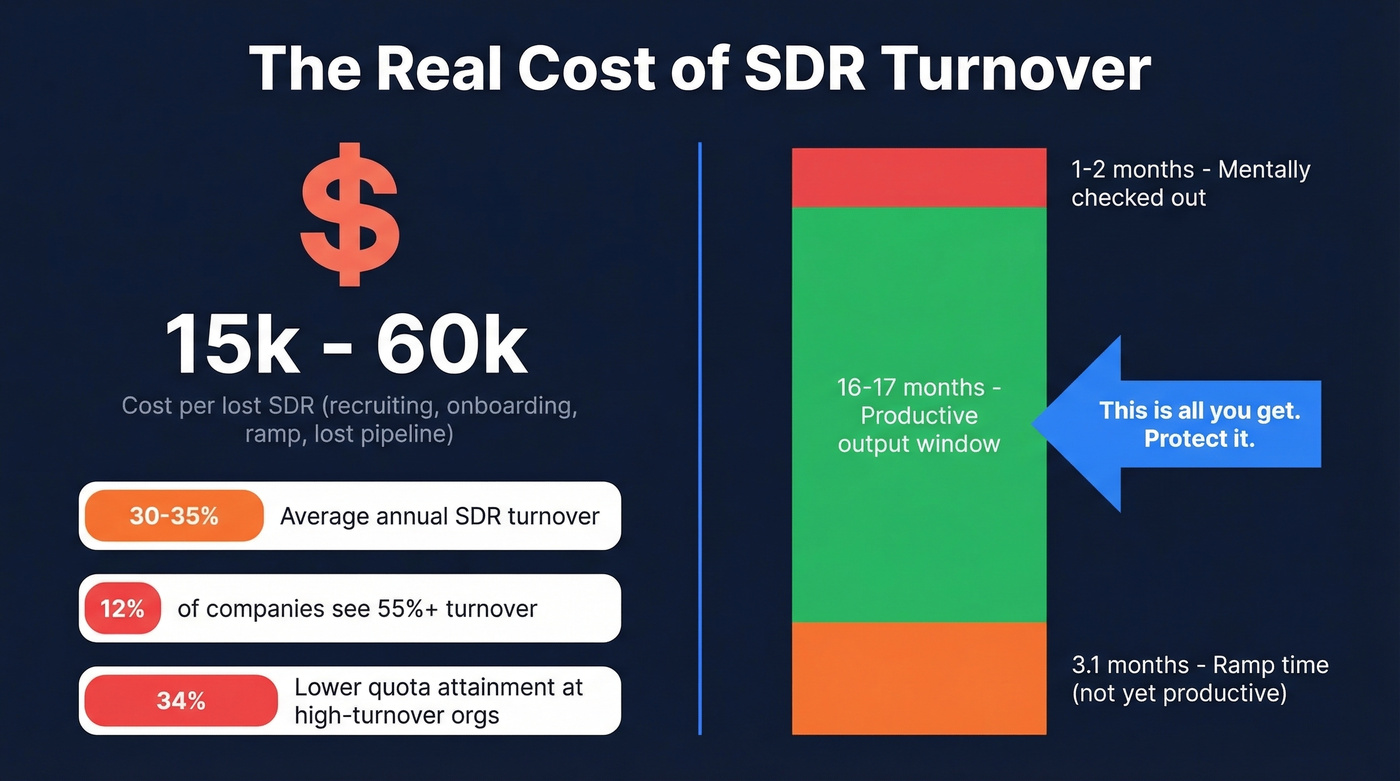
Here's the scenario we've all lived through. Your best SDR gives notice after 14 months. Nine quota hits in a row. No career conversation in the last six months. No one asked what she wanted next. She leaves for a closing role at a competitor, and you're back to square one - posting the job, screening 200 applicants, spending three months ramping someone who might not make it. Organizations with high sales turnover see 34% lower quota attainment than those with average turnover. That's not a rounding error. That's the difference between hitting your pipeline number and explaining to the board why you didn't.
The math is brutal. Average SDR tenure is 1.8 years. Subtract 3.1 months of ramp time. Subtract the last month or two when they're mentally checked out. You're getting roughly 16-17 months of productive output per hire. Every month you shave off ramp or add to retention compounds directly into pipeline.
Building Your SDR Team
Start with two SDRs, not one. This is SaaStr's advice and it's right. A single SDR has no peer learning, no healthy competition, and no redundancy. If they quit or underperform, you've got zero pipeline coverage. Two reps give you a baseline to compare performance, identify process issues versus individual issues, and build a culture from day one.
A commonly cited target AE-to-SDR ratio is roughly 2.6 AEs per SDR. If you're running a 10-AE team, you need four SDRs feeding them - not two, not eight.
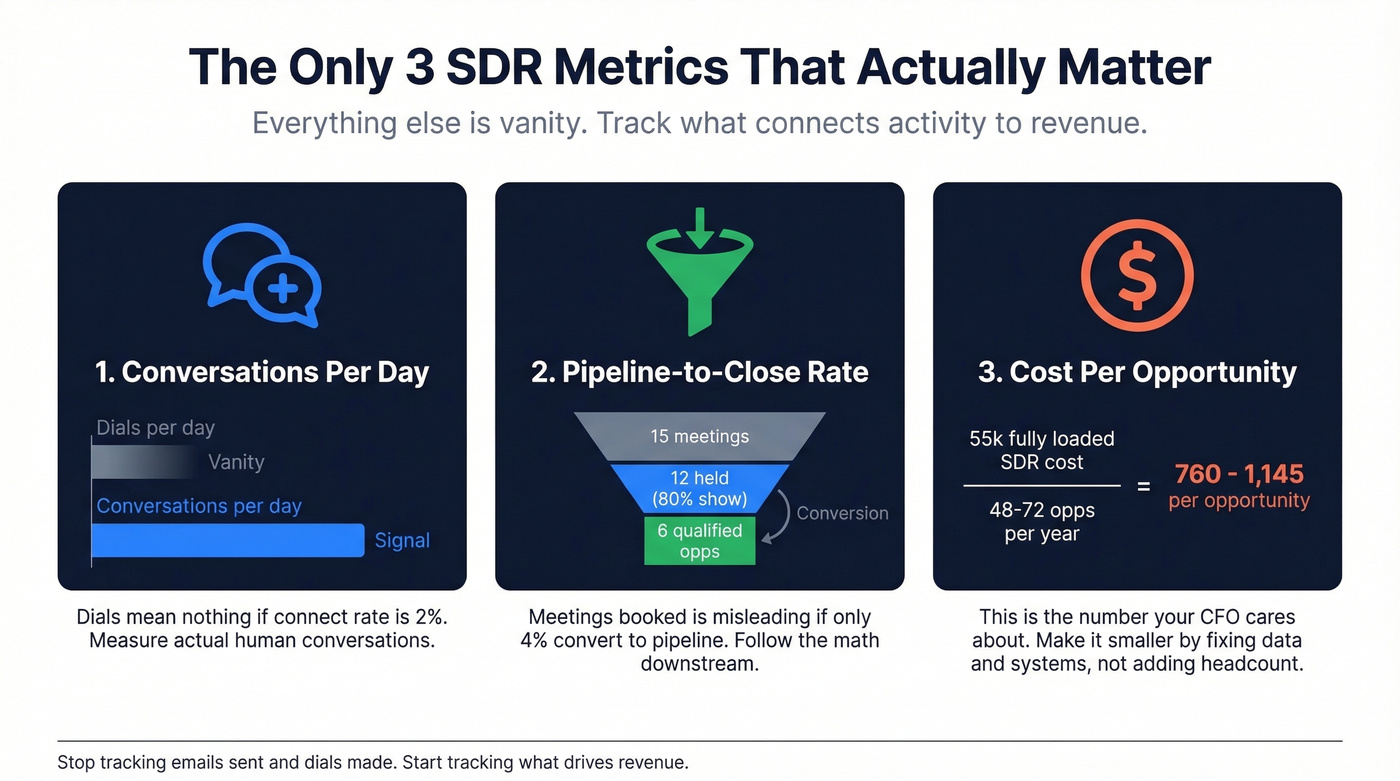
For span of control, plan on 6-10 direct reports per SDR manager. Below six, you're underutilizing leadership capacity. Above ten, coaching quality degrades fast - your 1:1s become status updates instead of development conversations, and you lose the ability to do meaningful call coaching. One cost reality that shapes everything: a fully loaded SDR runs about $55k/year when you add base salary, benefits, tools, and overhead. Scaling headcount without fixing the underlying system just multiplies that cost. Before you post another req, ask whether the problem is people or process.
If you're rebuilding your stack at the same time, start with a short list of SDR tools that support your operating cadence.
Onboarding and Ramp
The industry average ramp time is 3.1 months to full productivity. Most teams treat that as a given. It's not - it's a ceiling you can push down with the right structure.
If you want a plug-and-play structure for new hires, use a 30-60-90 day plan and tie it to leading indicators (not just quota).
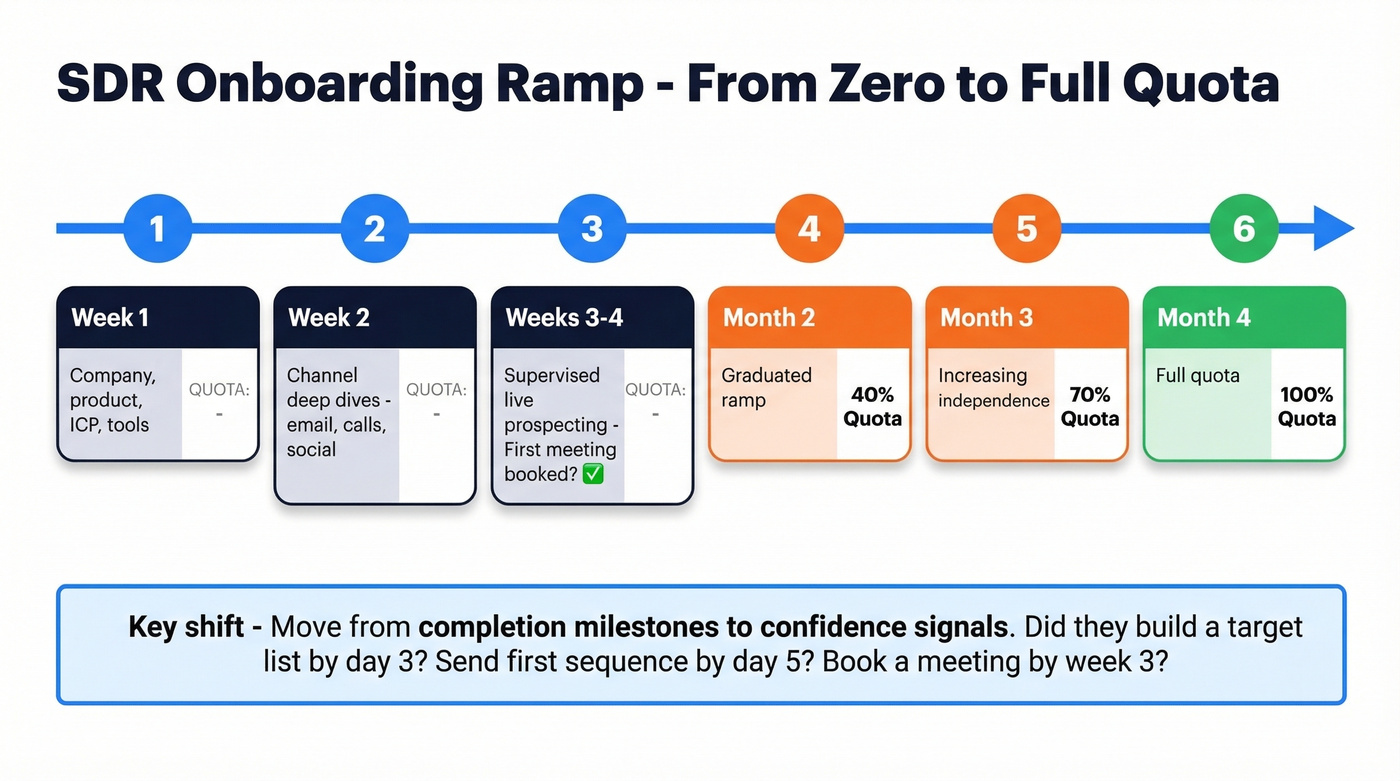
LeadIQ's six-week onboarding framework is one of the better templates out there:
| Timeline | Focus | Quota Target |
|---|---|---|
| Week 1 | Company, product, ICP, tools | - |
| Week 2 | Channel deep dives: email, calls, social | - |
| Weeks 3-4 | Supervised live prospecting | - |
| Month 2 | Graduated ramp | 40% |
| Month 3 | Increasing independence | 70% |
| Month 4 | Full quota | 100% |
The key insight from Chili Piper's onboarding redesign is moving from "completion-based" milestones to "confidence plus signal" milestones. Did the rep build a target account list by day three? Did they send their first personalized sequence by day five? Did they book a meeting by week three? These signals tell you whether someone's tracking toward quota long before the quota period starts.
One of the fastest ways to accelerate ramp is giving new reps clean data from day one. GreyScout cut rep ramp time from 8-10 weeks to 4 weeks after implementing Prospeo in their prospecting workflow - when a new SDR doesn't waste their first two weeks bouncing emails and dialing disconnected numbers, they build confidence faster and hit pipeline-generating activity sooner.
If your reps are still fighting bad records, prioritize data enrichment before you add more headcount.
How to Lead an SDR Team
Great SDR managers don't wing their weeks. They run an operating cadence that's as predictable as the pipeline they're trying to build.
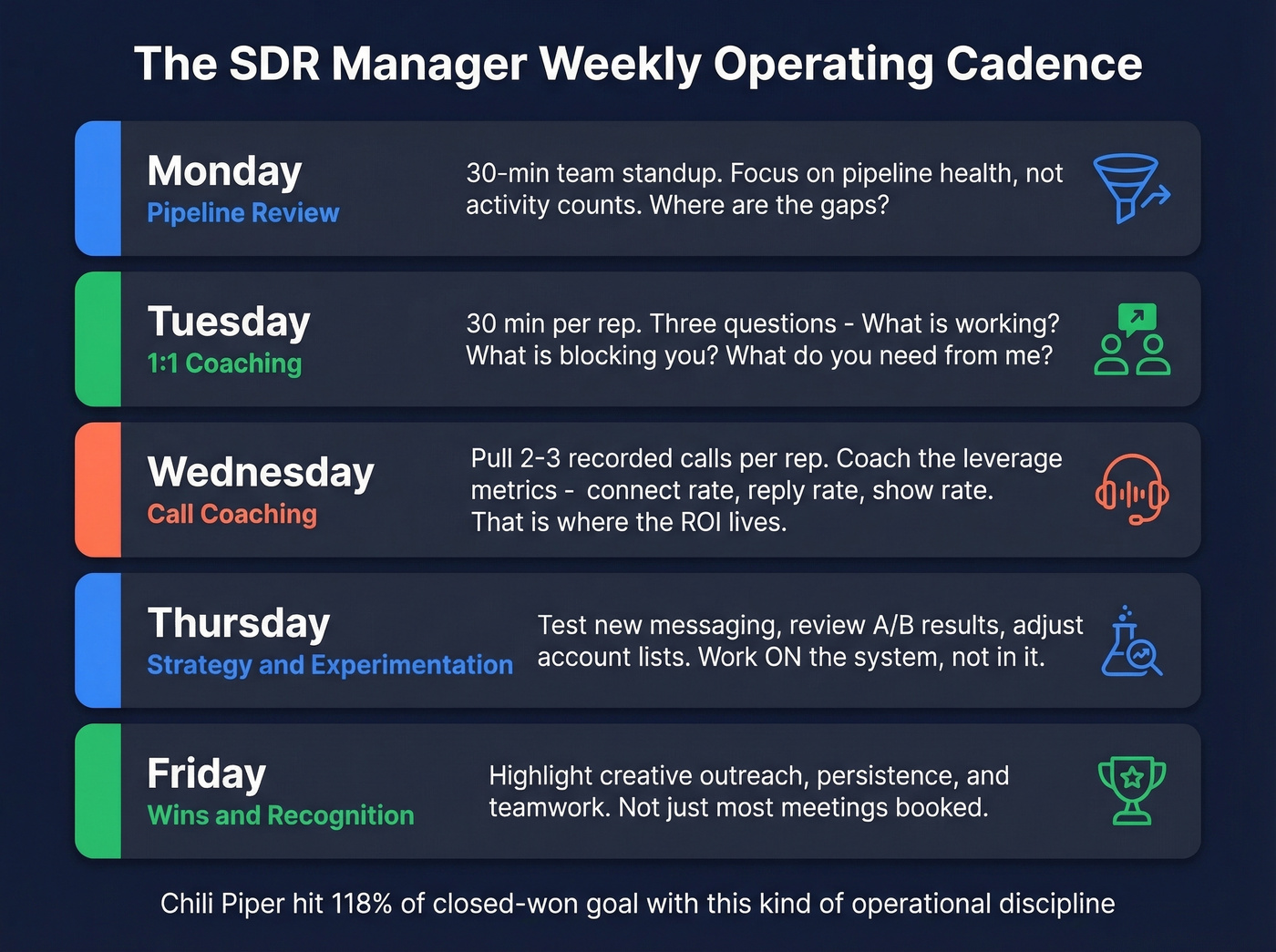
Monday: Pipeline review. Start the week with a 30-minute team standup focused on pipeline health, not activity counts. Which deals are stuck? Which accounts need a different approach? Where are the gaps?
Tuesday: 1:1s. Thirty minutes per rep, structured around three questions: What's working? What's blocking you? What do you need from me? Don't let these become status updates. If a rep is just reading their numbers back to you, the 1:1 is broken.
Wednesday: Call coaching. Pull two or three recorded calls per rep. Listen together. Use a framework like "lead, lag, and leverage metrics" - lead metrics are the activities reps control, like dials and emails sent; lag metrics are the outcomes like meetings booked and pipeline created; leverage metrics are the multipliers connecting the two, including connect rate, reply rate, and show rate. Coach the leverage metrics. That's where the ROI lives.
If your team’s call blocks are inconsistent, build a repeatable cold calling system so coaching has a stable baseline.
Thursday: Strategy and experimentation. Test new messaging, review A/B results, adjust account lists. This is where you work on the system, not in it.
Friday: Wins and recognition. Close the week by highlighting creative outreach, persistence on tough accounts, and reps who helped teammates - not just "most meetings booked."
Chili Piper's SDR team ended 2025 at 118% of their closed-won goal, with outbound responsible for nearly 20% of net new business. That didn't happen because reps were sending 200+ emails a day. It happened because their sales development leaders shifted from volume to operational efficiency - rebalancing account distribution, pivoting to a hybrid call-plus-email approach, and building a system that didn't depend on individual heroics.

GreyScout cut SDR ramp time from 8-10 weeks to 4 by giving new reps clean data from day one. Prospeo's 98% email accuracy and 7-day data refresh mean your SDRs spend time booking meetings - not bouncing emails off dead addresses.
Stop ramping reps on bad data. Give them Prospeo on day one.
KPIs and Benchmarks That Matter
Most teams track too many metrics. You end up with dashboards full of activity numbers that don't connect to revenue. Let's cut through it.
If you want a clean measurement model, start with funnel metrics and work backward from closed-won.
| Metric | Benchmark | Source |
|---|---|---|
| Touches per account | 16 | TOPO |
| Accounts per rep | 75-125 | TOPO |
| Dials to connect | 18+ | Gartner |
| Meetings/month | 15 | Operatix |
| Show rate | 80% | Operatix |
| Annual pipeline/SDR | $3M | Bridge Group |
| AE:SDR ratio | 2.6:1 | BlossomStreetVentures |
| Quota attainment | 56-60% | Tenbound |
| Ramp time | 3.1 months | Bridge Group |
| Average tenure | 1.8 years | Bridge Group |
That quota attainment number should stop you cold. If only 56-60% of SDRs hit quota, the "average" SDR team is underperforming by design. Either quotas are set wrong, territories are unbalanced, or the system isn't giving reps what they need to succeed.
SDRs generate 46-73% of pipeline depending on ACV. That range alone justifies treating SDR operations as a strategic function, not a cost center.
We've run enough pipeline analyses to have a strong opinion here: conversations per day, pipeline-to-close rate, and cost per opportunity are the three metrics that actually matter. Dials per day is a vanity metric if your connect rate is 2%. Emails sent is meaningless if 17% never reach the inbox. Meetings booked is misleading if only 4% convert to pipeline. Track the metrics that connect activity to revenue, and let the rest go.
One diagnostic metric worth adding: book-of-business coverage - the percentage of assigned accounts a rep is actively working. If a rep has 100 accounts and is only touching 30, you don't have an effort problem. You have a prioritization problem, and that's coachable.
The Tenbound benchmark data reveals something important about the gap between top-quartile and bottom-quartile SDR teams. It isn't effort. It's systems. Top teams have better data, better account distribution, better coaching, and better tooling. The reps themselves aren't dramatically different.
Pipeline Math Every Leader Needs
Every SDR leader should have this funnel math memorized.
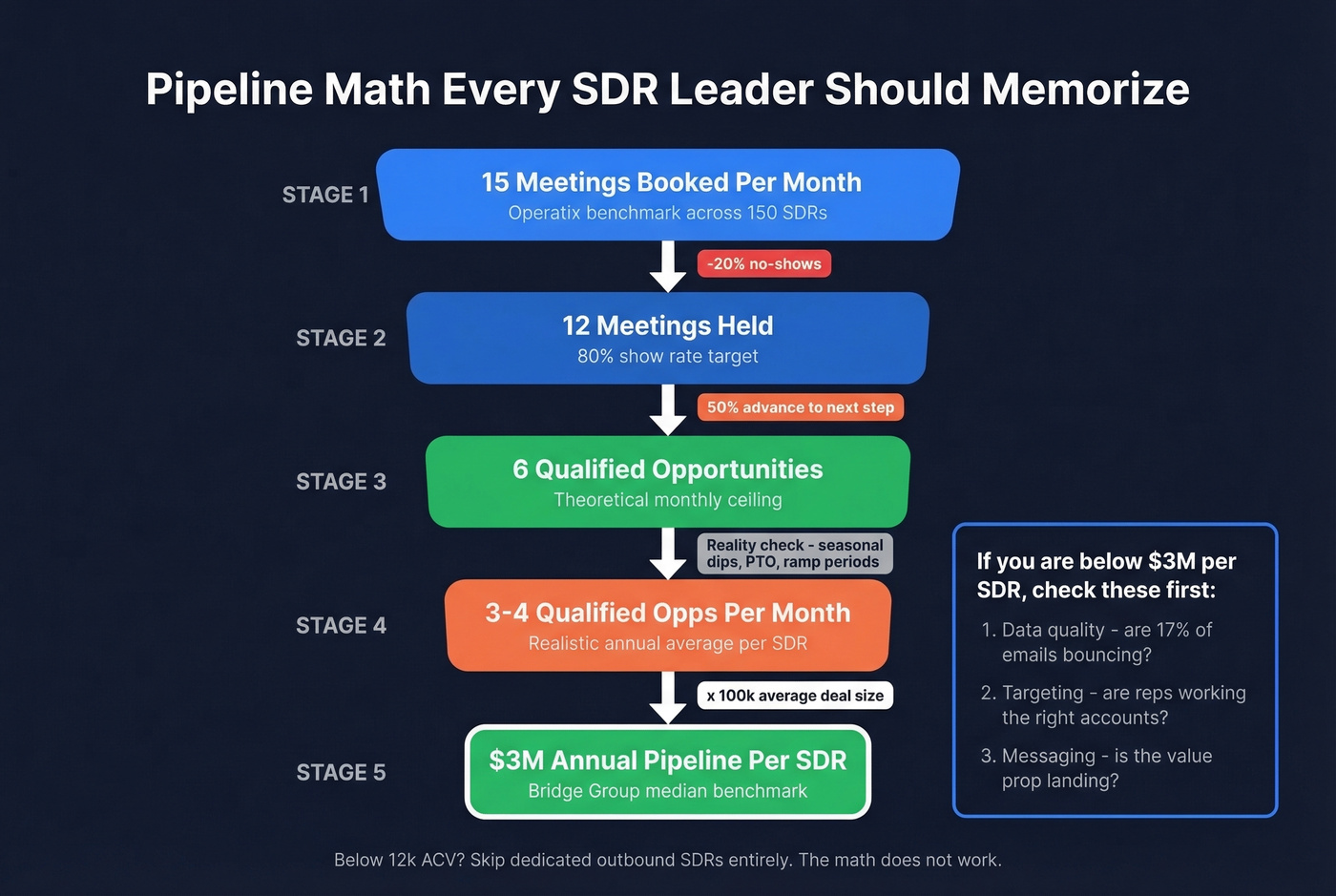
Start with 15 meetings per month - an Operatix study of 150 SDRs uses that as an average. Apply a 20% no-show rate and you're at 12 held meetings. Assume 50% of those advance to a next step. That gives you 6 qualified opportunities per month - the theoretical ceiling.
In practice, not every month hits the ceiling. Seasonal dips, PTO, ramp periods for new hires, and territory transitions mean the average SDR produces closer to 3-4 qualified opportunities per month across a full year. At a $100k average deal size, that lands you near the Bridge Group's median of $3M in annual pipeline per SDR. If your team is consistently below that number, the problem is almost certainly upstream - data quality, targeting, or messaging - not rep effort.
For inbound SDRs, the math shifts dramatically. Low-intent leads like content downloads and webinar attendees convert to meetings at 5-10%. High-intent leads like demo requests and pricing page visits convert at 75-80%. Each inbound SDR can handle roughly 15 leads per day, or about 300 per month. The key decision is how you weight inbound versus outbound capacity - and most teams get this wrong by over-investing in inbound when their lead volume doesn't justify it.
Skip dedicated outbound SDRs entirely if your average contract value is under $12k. The pipeline math doesn't pencil out at $55k per fully loaded rep when each deal is worth a fraction of that cost. Invest in product-led growth and inbound instead, and redeploy those SDR dollars into content and paid acquisition.
If you’re pressure-testing your model, compare it against sales pipeline benchmarks before you reset quotas.
Data Quality as a Leadership Lever
Here's the thing most SDR leaders won't admit: they spend 80% of their time on coaching and motivation, and almost none on the data their reps are actually working. Roughly 17% of cold emails never reach the primary inbox - they bounce, land in spam, or get filtered. Nearly one in five outreach attempts is dead on arrival.
The Salesforce State of Sales report shows how strongly this correlates with performance: 74% of teams prioritize data cleansing and integration, and high performers hit 79% on that metric versus 54% for underperformers.
Look at what happened at Snyk. Fifty AEs were prospecting 4-6 hours per week with bounce rates between 35-40%. After fixing their data pipeline, bounce rates dropped to under 5%, AE-sourced pipeline jumped 180%, and the team was generating 200+ new opportunities per month. Same reps, same effort, radically different results. When your reps stop wasting dials on dead numbers and emails on invalid addresses, conversations per day go up without increasing activity targets. That's the kind of multiplier that transforms a team.
If you’re seeing bounces creep up, use an email deliverability guide to diagnose the root cause before you rewrite sequences.
Common Mistakes to Avoid
Optimizing for meetings instead of pipeline. SOMAmetrics documented a team booking 40 meetings per month - impressive on paper. But only 4% converted to pipeline. That's 1.6 real opportunities. The manager was celebrating the wrong number.
The "more dials" fallacy. When numbers are down, the instinct is to increase activity targets. More dials, more emails, more touches. But prospects don't pick up unknown calls, and 73% of B2B buyers avoid suppliers with irrelevant outreach. The answer isn't more volume - it's better targeting and better messaging.
If your team’s outreach is generic, rebuild it around sales prospecting techniques that force relevance.
Hiring your way out of a broken system. At $55k per fully loaded SDR, adding headcount to a broken process just multiplies the waste. If your existing reps can't hit quota, a seventh rep won't either. Fix the system first.
Ignoring what reps actually say. The consensus on r/sales is blunt: if over half your team misses quota, it's a company problem. Fear-based management, quick PIPs, and unrealistic targets are symptoms of leadership failure, not individual failure. When reps describe their SDR org as a place where success depends more on territory and internal politics than skill, that's a system design problem you own.
Skipping attribution entirely. If you can't tell whether a closed deal started with an SDR's cold call, a marketing webinar, or an AE's own outreach, you can't allocate resources intelligently. Even a simple first-touch attribution model is better than nothing. Build it before you scale.
Managing SDR Teams in the AI Era
AI isn't coming to SDR teams - it's already here. The Salesforce 2026 State of Sales report surveyed 4,000+ sales professionals and found 87% of organizations use AI, with 54% already deploying AI agents across the sales cycle. Top-performing teams are 1.7x more likely to use AI agents than underperformers. The time savings are real: 34% reduction in research time, 36% in content creation.
But the implications for how you lead a sales development team are what matter. AI doesn't reduce your management burden - it changes it.
Running Hybrid Human-AI Teams
AI SDRs are not set-and-forget. The leader who treats them like magic will get burned. SaaStr's guidance is clear - AI SDRs must be QA'd every single day. They handle 3-5x more conversations than human reps, which means 3-5x more opportunities for something to go wrong. I've personally seen AI SDRs fabricate case studies, quote wrong pricing, and promise features that don't exist - all in a single day's output.
The performance data is compelling where AI excels: time to technical qualification drops from 8.3 days with human reps to 2.1 days with AI, and technical questions answered immediately jump from 15% to 87%. But those numbers only hold when someone is actively monitoring output quality, updating training data, and catching the inevitable hallucinations.
If you’re evaluating vendors, start with a shortlist of AI agents for sales and map them to your QA workflow.
The best sales development leaders in 2026 are running hybrid teams: AI for volume, speed, and technical qualification; humans for complex, relationship-driven outreach and the accounts where nuance matters. The leader's job shifts from managing activity to managing the boundary between human and AI work.
Retention and Career Pathing
With average tenure at 1.8 years, you're essentially rebuilding a chunk of your team every year. The question isn't whether you'll lose reps - it's whether you'll lose them to burnout and broken promises, or to genuine career progression that reflects well on your team.
SDR purgatory is real. Reddit threads are full of reps who were promised "SDR to AE in 12-18 months" and are still making cold calls two years later. That promise, when broken, doesn't just cost you one rep - it poisons the entire team's trust in leadership.
The fix isn't just the SDR-to-AE path. Build multiple tracks: lateral moves into customer success or solutions engineering, specialization tracks for industry verticals or enterprise accounts, and leadership tracks for reps who want to manage. Not everyone wants to be a closer. Give them options.
Training and development aren't soft perks - 86% of millennials say they'd stay at a company that invests in their growth. Chili Piper's "pipeline equality" concept applies here too: when tenured reps hoard the best accounts and new reps get the scraps, you're building resentment into the system. Rebalance territories regularly. Make account quality transparent. Give every rep a fair shot at quota.
The leaders who retain their best people do four things consistently: fair territories, realistic quotas, visible career paths, and weekly coaching that's actually about development. Not pizza parties. Not motivational Slack messages. Systems. That's what SDR leadership comes down to - building the machine that makes good reps great, and keeping them around long enough to prove it.
You can't coach your way out of a 17% bounce rate. When SDR turnover costs $15K-$60K per rep, the fastest ROI comes from fixing the data layer. Prospeo delivers 98% verified emails at $0.01 each - so your operating system actually works.
Great SDR leadership starts with data your reps can trust.
FAQ
How many SDRs should one manager oversee?
Plan for 6-10 direct reports per manager. Below six, you're underutilizing leadership capacity. Above ten, coaching quality drops sharply - 1:1s become status updates. If your team exceeds ten, split into pods with team leads who each own 4-5 reps.
What's a realistic SDR ramp timeline?
Industry average is 3.1 months to full productivity. Expect Month 2 at 40% quota, Month 3 at 70%, Month 4 at 100%. Teams using verified contact data have cut ramp to as little as 4 weeks by eliminating bounced emails and dead numbers from day one.
Should SDR teams report to sales or marketing?
Sales, with a dotted line to marketing for lead quality feedback. Whoever owns the SDRs must also own the pipeline number - split accountability creates finger-pointing and nobody fixes the system.
What does great SDR management look like day-to-day?
A predictable operating rhythm: Monday pipeline reviews, Tuesday 1:1s focused on development, Wednesday call coaching on leverage metrics, Thursday experimentation, Friday recognition. The best managers spend 60% of their time working on the system, not just in it.
Are AI SDRs replacing human reps?
Not yet. 54% of sales orgs deploy AI agents, and they handle 3-5x more conversations - but they require daily QA and hallucinate regularly. The best teams in 2026 use AI for speed and volume, humans for nuance and relationship-driven accounts.