

The SDR Management Playbook for 2026
Your VP just asked why pipeline is down 30% and your activity dashboards look fine. Reps are making calls, sending emails, booking meetings - and somehow the number that matters keeps shrinking. The gap between activity and pipeline is where SDR management actually lives, and most advice on the topic is useless platitudes about "setting clear goals" without a single benchmark to anchor against.
This is the operating manual nobody gave you when you got promoted.
What You Need (Quick Version)
If you just inherited an SDR team or got the title last month, here are the three highest-leverage moves before you touch anything else:
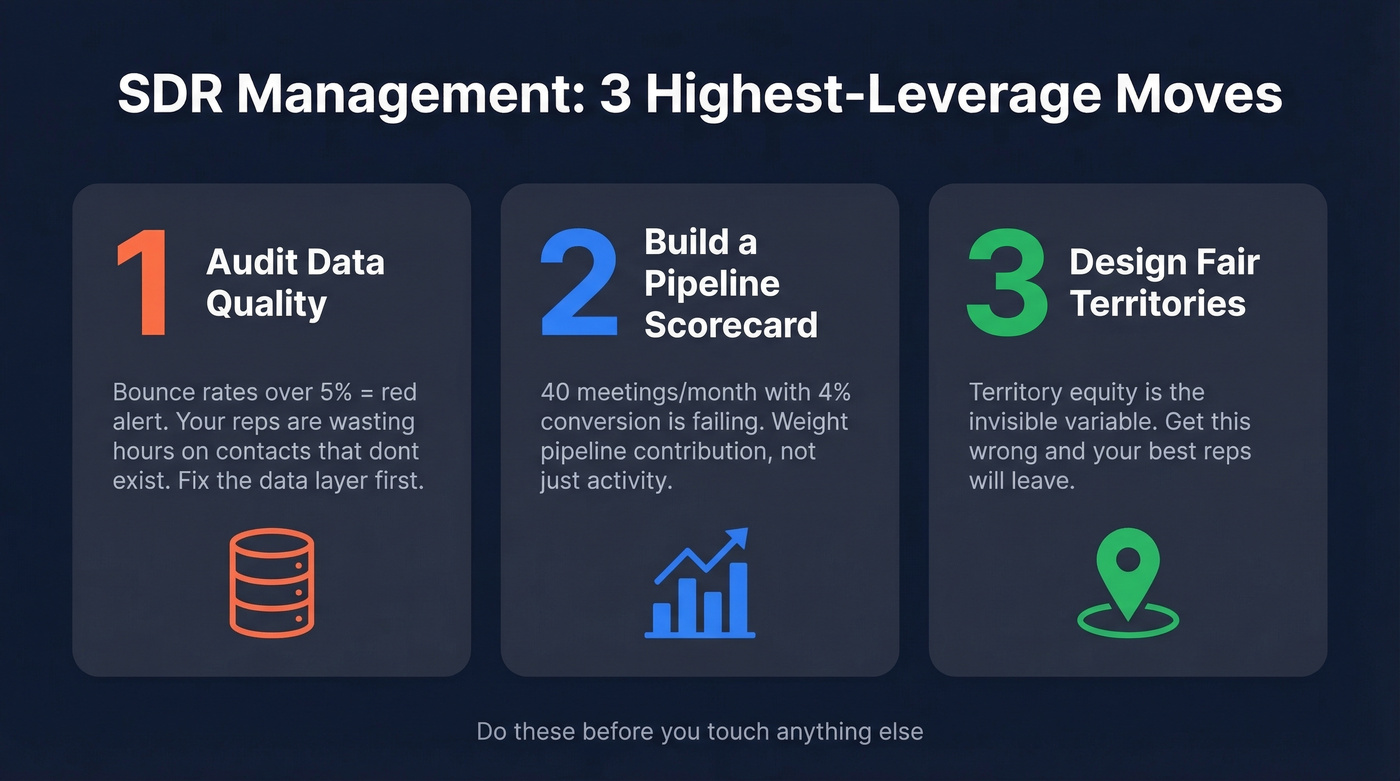
- Audit your data quality. If your bounce rates are over 5%, treat it like a red alert. Your reps are wasting hours on contacts that don't exist. That's a you problem, not a rep problem. Fix the data layer first.
- Build a scorecard that weights pipeline contribution, not just activity. A team booking 40 meetings a month with 4% pipeline conversion is failing. Activity metrics alone will mislead you.
- Design fair territories before you coach a single rep. Territory equity is the invisible variable that makes or breaks SDR performance. Get this wrong and your best reps will leave.
Core Responsibilities of an SDR Manager
There's a real difference between managing SDRs and coaching them. Managing is the operational work - pipeline reviews, hiring, reporting, cross-functional alignment. Coaching is the one-on-one work that actually moves rep performance. Most new managers over-index on operations and under-invest in coaching because ops feels productive and coaching feels ambiguous.
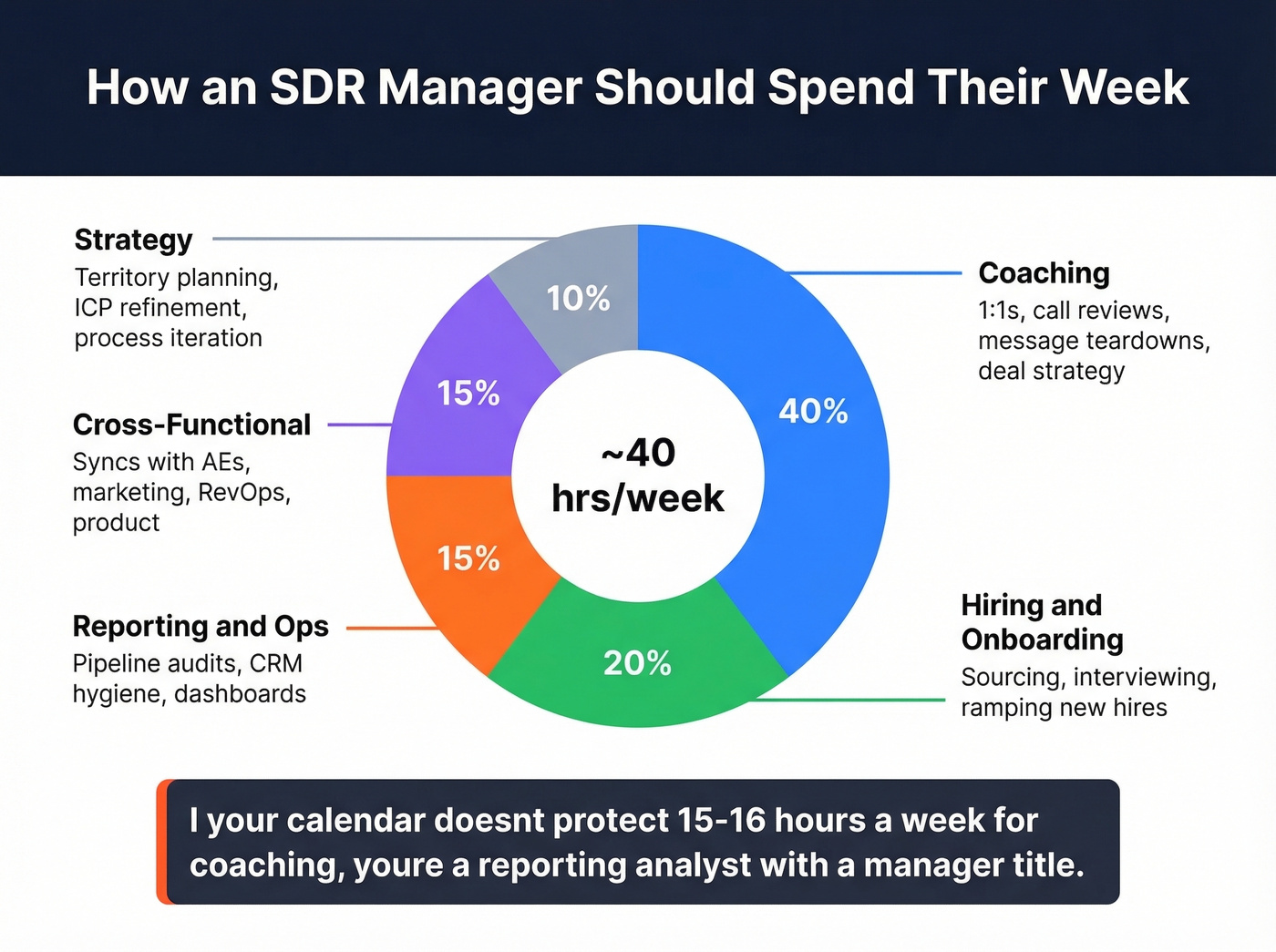
Here's how the week should roughly break down:
- ~40% coaching - 1:1s, call reviews, message teardowns, deal strategy
- ~20% hiring and onboarding - sourcing, interviewing, ramping new hires
- ~15% reporting and ops - pipeline audits, CRM hygiene, dashboard reviews
- ~15% cross-functional - syncs with AEs, marketing, RevOps, product
- ~10% strategy - territory planning, ICP refinement, process iteration
The coaching block is non-negotiable. If your calendar doesn't protect at least 15-16 hours a week for direct rep development, you're a reporting analyst with a manager title. Weekly call reviews, 1:1s with each rep, and pipeline audits form the operating cadence. Everything else flexes around those.
SDR KPI Benchmarks for 2026
Benchmarks aren't targets - they're calibration tools. If your team is wildly off from these numbers, it tells you where to dig. If you're close, the problem is probably upstream - data, territory, ICP - rather than effort.
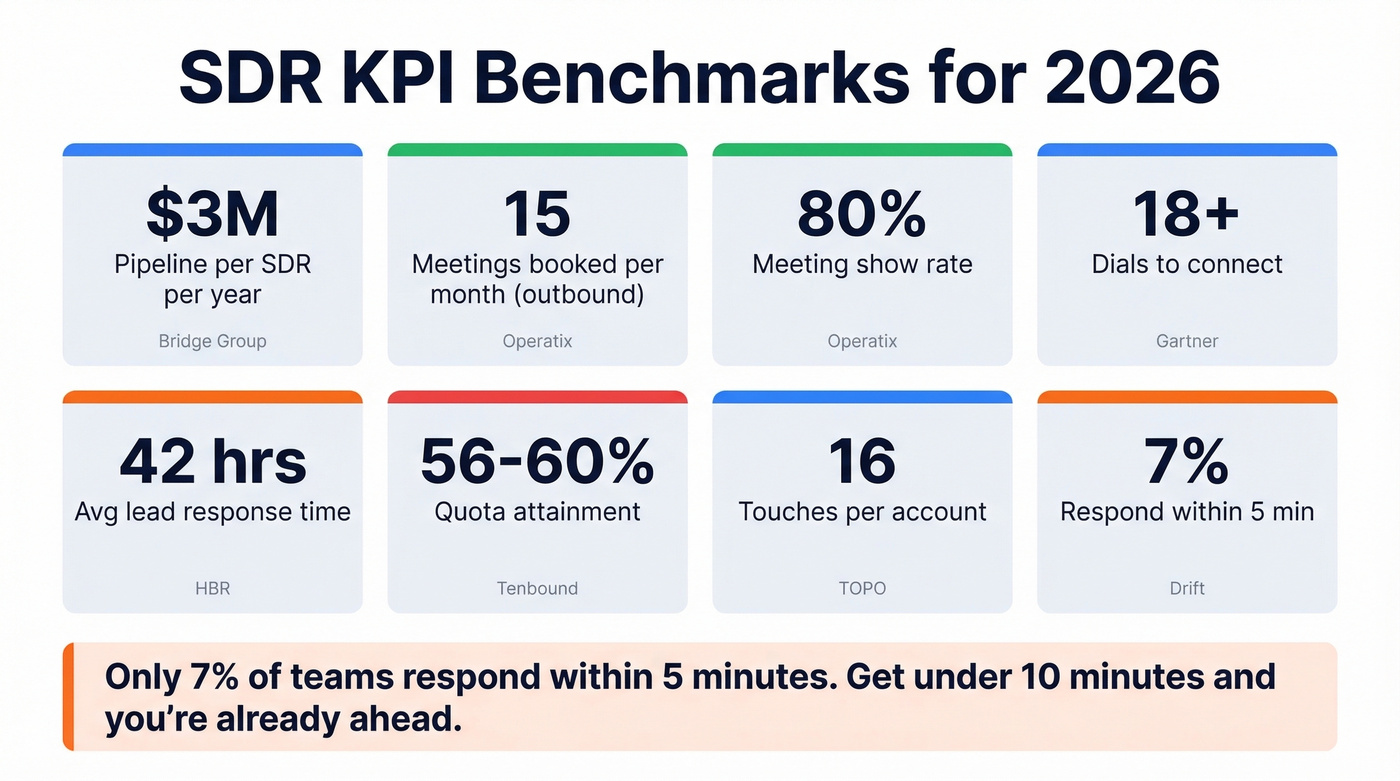
| Metric | Benchmark | Source |
|---|---|---|
| Pipeline per SDR/year | $3M | Bridge Group |
| Meetings booked/month | 15 (outbound) | Operatix |
| Meeting show rate | ~80% | Operatix |
| Dials to connect | 18+ | Gartner |
| Touches per account | 16 | TOPO |
| Accounts per rep | 75-125 | TOPO |
| Cold email reply rate | 1-5% | GMass |
| Respond within 5 min | 7% | Drift |
| Avg lead response time | 42 hours | HBR |
| Quota attainment | 56-60% | Tenbound |
| SDR-to-AE ratio | 2.6 AEs per SDR | Blossom Street |
| Inbound conversion (low) | 5-10% | Crunchbase |
| Inbound conversion (high) | 75-80% | Crunchbase |
A few things jump out. The 42 hours average lead response time is embarrassing for the industry - only 7% of teams respond within five minutes. If you can get your inbound response under 10 minutes, you're already ahead of most teams. That alone can lift conversion noticeably.
The 56-60% quota attainment number is also telling. If over half your team is missing quota, that's not a coaching problem - it's a system design problem involving territories, data quality, ICP definition, or quota setting itself. Anyone learning SDR management needs to internalize this: quota misses at scale are a leadership signal, not a rep signal.
SDRs generate 30-45% of new revenue at many B2B companies, which makes these benchmarks worth obsessing over. The 16 touches per account and 75-125 accounts per rep numbers from TOPO are particularly useful for capacity planning. If your reps are working 200+ accounts, they're spreading too thin to hit the touch frequency that actually books meetings. Forty accounts? They'll run out of runway by mid-quarter.
And the 18+ dials to connect stat? That's the average. It varies a lot by market. If your reps are dialing into a segment where connect rates are 3%, the math doesn't work no matter how many calls they make. You need to know your specific connect rate before setting activity targets.
Building an SDR Scorecard
The scorecard is how you separate signal from noise. Activity metrics are easy to game, pipeline metrics take too long to materialize, and you need a weighted blend that rewards the right behaviors while tracking the outcomes that matter.
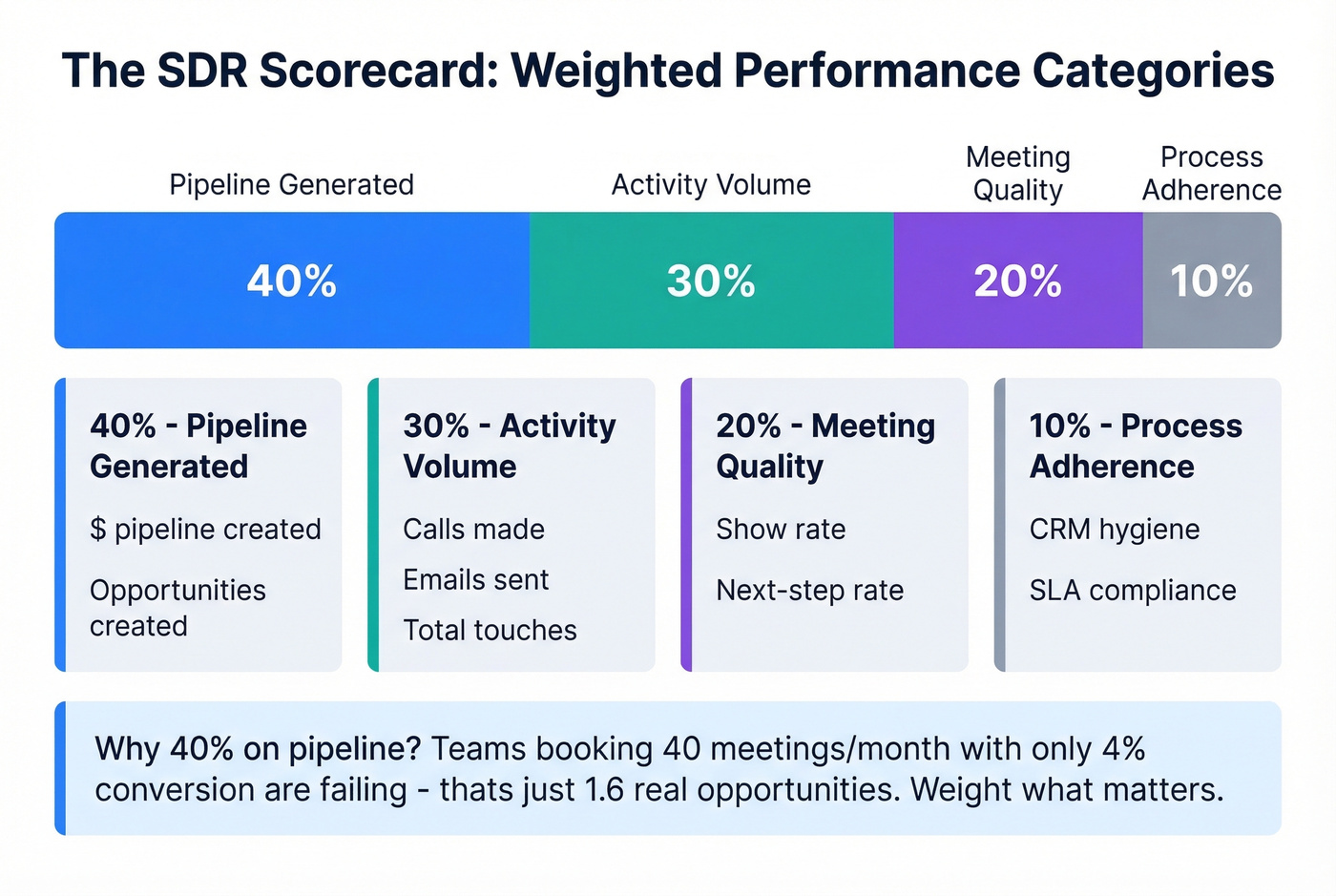
| Category | Weight | Metrics |
|---|---|---|
| Pipeline generated | 40% | $ pipeline, opps created |
| Activity volume | 30% | Calls, emails, touches |
| Meeting quality | 20% | Show rate, next-step rate |
| Process adherence | 10% | CRM hygiene, SLA compliance |
The 40% weight on pipeline is deliberate. We've seen teams where reps booked 40 meetings a month but only 4% converted to pipeline - roughly 1.6 real opportunities. That's a targeting problem masquerading as productivity. A scorecard that weights meetings at 40% would've rewarded those reps. One that weights pipeline at 40% would've flagged the issue in week two.
For context, TOPO research shows 58% of SDR-qualified leads should become opportunities. If your conversion rate is dramatically lower, the problem isn't effort - it's ICP alignment or data quality. The scorecard should surface that gap fast.
Process adherence at 10% sounds low, but it's a hygiene gate. Reps who don't log activities or update dispositions create downstream reporting problems that compound fast.
Onboarding New SDRs
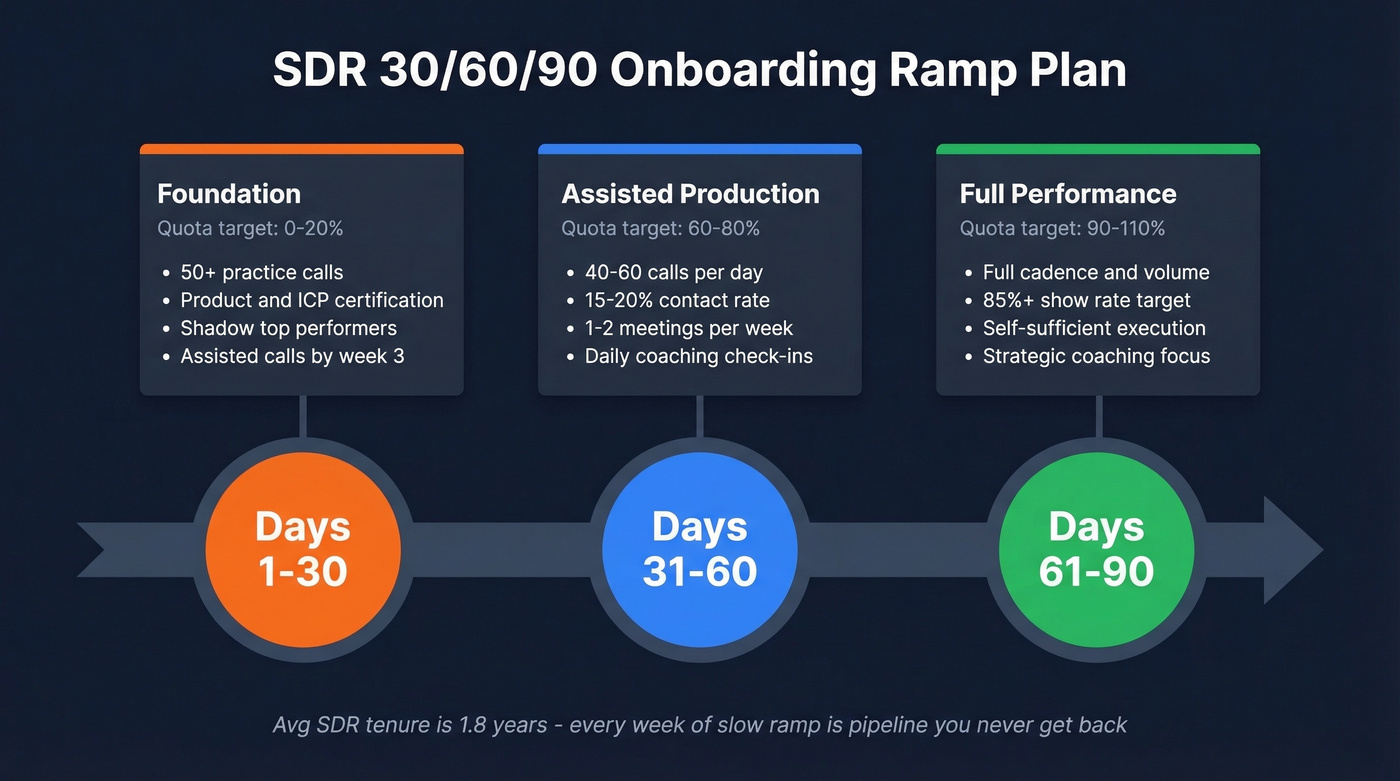
Average SDR tenure is 1.8 years. Every week of slow ramp is pipeline you never get back. A structured 30/60/90 plan isn't optional - it's the difference between a rep contributing in month two versus month five.
Days 1-30: Foundation
Target quota attainment: 0-20%. This phase is about product knowledge, ICP mastery, and building muscle memory. Reps should complete 50+ practice calls, pass certification tests on your product and market, and shadow top performers. No live quota pressure yet, but they should be making assisted calls by week three.
The temptation is to throw new hires into live calling on day five. Resist it. A rep who doesn't understand your ICP will book meetings that waste AE time and poison the pipeline metrics you're trying to fix.
Days 31-60: Assisted Production
Target: 60-80% of quota. Reps should be running 40-60 calls per day, hitting a 15-20% contact rate, and booking 1-2 meetings per week. This is where coaching intensity peaks - daily check-ins, call reviews on every meeting set, and message iteration.
By the end of this phase, a well-ramped SDR should be operating at 80%+ of full capacity. If they're not, the problem is usually one of three things: bad data meaning they're calling disconnected numbers, bad territory meaning not enough accounts to work, or a skills gap that needs targeted coaching.
Days 61-90: Full Performance
Target: 90-110% of quota. Full cadence, full activity volume, 85%+ show rate target. At this point, the rep should be self-sufficient on daily execution and your coaching shifts from tactical work like objection handling to strategic work like account prioritization.
Territory Design and AE Alignment
Here's the thing: territory design is the single most underrated lever in sales development management, and it's not close. A top-performing rep in a bad territory will look mediocre. A mediocre rep in a great territory will look like a star. Most managers don't audit territory equity nearly often enough.
There's a story on r/techsales that captures this perfectly. An SDR was top three in activity metrics every month but struggled because of a terrible territory and a disengaged AE. After switching to a new territory and a new AE, they "finally started crushing it." Too late - they got fired because "past 6 months of meetings booked to no closed won can't be undone."
That's a management failure, not a rep failure. The manager should've caught the territory imbalance months earlier, flagged the AE follow-through problem, and adjusted quota expectations for the territory.
AE alignment is the other half of this equation. If your AEs aren't following up on SDR-sourced meetings within 24 hours, or if they're cherry-picking which meetings to take, your SDRs will burn out. Meeting-to-opportunity conversion is a shared metric, and managers need to own the handoff process - not just the meeting-booking side.
If over half your team misses quota, it's not a people problem. It's a system problem. Start with territories.

You read it above: bounce rates over 5% are a red alert. Teams using Prospeo cut bounce rates from 35%+ to under 4% and tripled pipeline. 98% email accuracy, 7-day data refresh, and 125M+ verified mobiles so your SDRs connect with real buyers.
Stop letting bad data sabotage your team's quota attainment.
Coaching Frameworks That Work
Stop responding to missed targets with "make more calls." That's not coaching - it's a reflex.
The simplest diagnostic framework runs three levels: quantity of prospects, quality of prospects, quality of outreach. If a rep is touching enough accounts but not connecting, it's a data or timing problem. If they're connecting but not booking, it's a messaging problem. If they're booking but meetings aren't converting, it's a targeting problem. Frameworks like the TRACE funnel - tracking quantity, quality, and conversion at each stage - formalize this diagnostic approach so you're not guessing.
The Skill vs. Will matrix is useful for the human side. A rep who has the skills but lacks motivation needs a different conversation than a rep who's motivated but can't handle objections. Capability gaps get coaching. Motivation gaps get honest conversations about fit, career path, and whether the role is right for them.
Weekly call reviews are the single highest-ROI coaching activity. Here's what a good one looks like: pull up a recording, listen to the first 30 seconds together, and ask the rep what they'd change before you say a word. Then listen to the prospect's first objection and discuss the response. Pick two calls per rep each week - one that went well, one that didn't. The rep learns more from hearing their own calls than from any training deck you could build.
The SDR Tech Stack
CRM
Salesforce (typically ~$25-$300/user/mo depending on edition) or HubSpot (free CRM, Sales Hub starts around ~$20/user/mo). Pick one. Everything else is a distraction at the team-management level. Your CRM is the system of record - it needs to be clean, adopted, and integrated with everything downstream.
Sequencing
Outreach or Salesloft, typically around ~$100-$200/user/mo depending on package and volume. Pick whichever your AEs already use. Continuity across the SDR-to-AE handoff matters more than feature differences between the two platforms.
Conversation Intelligence
Gong typically prices via annual contracts and often lands in the ~$100-$200/user/mo range depending on seat count and modules. Chorus works fine if you already have it. The point is recorded, searchable calls you can use for coaching - without conversation intelligence, your call reviews are based on memory and self-reporting, both unreliable.
Data and Enrichment
Your SDRs are only as good as the data you give them. If your bounce rate is above 5%, you have a data problem, not a people problem. This is the category where the manager's choice directly impacts every rep's productivity.
We use Prospeo for this. 300M+ professional profiles, 98% email accuracy, 125M+ verified mobile numbers with a 30% pickup rate, and a 7-day data refresh cycle versus the 6-week industry average. The refresh cycle matters more than people realize - a contact database that's six weeks stale means your reps are calling people who've already changed jobs. Free tier starts at 75 emails/month, and paid plans run ~$0.01 per email with no annual contracts.

For comparison: ZoomInfo typically lands around $15k-$40k/year depending on seats and modules, and bundles a lot of features most SDR teams don't use. Apollo has a free tier and paid plans from ~$49-$99/user/mo - solid for startups, but email accuracy drops off at scale. Cognism runs ~$1k-$3k/mo for small teams and wins on EMEA data.
If you're evaluating providers, start with a shortlist of data enrichment options and validate accuracy on your own domain before you commit.
AI SDR Tools
This is the fastest-moving category. Lightweight tools start around $500/mo; enterprise-grade platforms run $15k-$35k/year. They're supplements, not replacements - more on that in the AI section below. If you're evaluating AI SDR tools, start with a narrow use case like inbound response automation or research enrichment rather than trying to replace human reps wholesale.
If you want a broader shortlist, use a ranked guide to SDR tools to avoid tool sprawl.
Mistakes That Kill SDR Teams
Optimizing for meetings instead of pipeline. The Soma Metrics example is instructive: 40 meetings a month, 4% pipeline conversion. That's a team that looks productive on a dashboard and is actually failing. Weight your scorecard toward pipeline, not activity.
The "dial more" fallacy. Stephan Schiffman's 2006 math - 15 dials, 7 conversations, 1 appointment - doesn't work in 2026. Robocall screening, spam labeling, and caller ID have fundamentally changed phone connect rates. If your coaching defaults to "make more calls," you're applying 2006 logic to a a 2026 problem.
Hiring your way out of a pipeline gap. A fully loaded SDR costs $75k-$110k/year when you factor in base, benefits, tools, overhead, and ramp time. Hiring two more reps to fix a targeting or data quality problem just doubles the cost of the problem.
Ignoring data quality. Teams waste 20-30% of outreach effort on bad data - bounced emails, disconnected numbers, contacts who left the company months ago. In our experience, this is the silent killer of SDR productivity, and it's the manager's job to fix it. GreyScout saw bounce rates drop from 38% to under 4% after switching data providers, and pipeline jumped 140%. Of all the best practices you can adopt, data hygiene delivers the fastest ROI.
If you need a quick diagnostic, start with email bounce rate benchmarks and remediation steps.
Territory equity and rep coaching won't matter if your SDRs are dialing dead numbers and emailing bounced addresses. Prospeo gives your team 300M+ verified profiles with 30+ filters - intent data, technographics, headcount growth - so every rep works high-quality accounts from day one of their ramp.
Cut SDR ramp time in half with data that actually connects.
Compensation Benchmarks
SDR manager comp has standardized significantly. Geographic pay premiums have largely disappeared - according to Betts Recruiting's most recent compensation report, ranges are now identical across time zones.
| Experience | Base Salary | OTE |
|---|---|---|
| 0-2 years | $100k-$140k | $140k-$200k |
| 3-5 years | $135k-$190k | $170k-$230k |
The comp compression is notable: managers with 0-2 years of experience earn roughly 70-74% of what experienced counterparts make. That's a tighter gap than most people expect, and it means the jump from senior SDR to SDR manager is financially meaningful even at the entry level.
If you’re building comp plans, it helps to understand OTE mechanics and how they map to quota.
Career Pathing and Retention
Let's be honest: the SDR-to-AE "guaranteed stepping stone" narrative is dead. Reddit's r/techsales is full of stories about SDR purgatory - reps who were promised a promotion path that never materialized. If you're managing SDRs and not having honest conversations about promotion timelines, you're setting them up for resentment.
The best retention mechanism we've seen is a tier system within the SDR role itself. SDR I, SDR II, Senior SDR - each with clear criteria, comp bumps, and expanded responsibilities. This gives reps a sense of progression even when AE seats aren't available. Pair that with transparent timelines like "AE promotions happen in Q1 and Q3, here's what you need to qualify" and you'll retain your best people longer.
With average tenure at 1.8 years, you're going to lose SDRs. The goal isn't to prevent all turnover - it's to keep your top performers long enough to justify the ramp investment and give them a genuine path forward. Leading a sales development team is a retention game as much as a performance game.
AI and the Future of SDR Teams
The economics are compelling on paper. AI cost per qualified lead runs ~$39 versus ~$262 for humans. AI responds in under a minute versus the industry's embarrassing 42-hour average. Greenhouse replaced human reps with AI agents for inbound engagement and saw chat-to-meeting conversion jump from 20% to 50-70%.
But here's what the vendor pitches leave out. In a Leads at Scale experiment running July 2025 through January 2026, a human SDR generated $147k in revenue versus $56k from AI. Meeting show rates: 71% human versus 52% AI. The AI was 54x cheaper per touch, but the human generated 2.6x more actual revenue.
The right model for 2026 is hybrid. AI handles roughly 70% of SDR tasks - research, data entry, initial outreach, lead scoring - while humans own discovery calls, objection handling, and relationship building. Projections show that by 2028, 60% of the total sales process will be handled by AI-driven activities, and the agentic AI market is on track to hit $200B by 2034. But the consensus on r/sales is that companies who over-indexed on AI are already bringing humans back.
If you’re rolling this out, treat it like sales process optimization, not a tooling project.
The reputational risk is real too. AI-generated outreach at scale becomes a spam cannon fast, and the damage to your domain reputation and brand is hard to undo. Budget $500/mo for lightweight tools or $15k-$35k/year for enterprise platforms, but deploy them as supplements to your human team, not replacements.
FAQ
What's a good SDR-to-AE ratio?
The benchmark is 2.6 AEs per SDR. Higher-ACV deals (six-figure contracts and up) need fewer SDRs per AE; high-volume motions push closer to 1:1.
How long should SDR ramp take?
A structured 30/60/90 plan gets reps to 80%+ quota by day 60. With 1.8-year average tenure, every slow ramp week is pipeline you never recover.
What's the biggest SDR management mistake?
Optimizing for activity instead of pipeline. A team booking 40 meetings with 4% conversion is failing - fix targeting and data quality before you touch effort.
How do I fix high bounce rates on my team?
Switch your data provider. GreyScout dropped bounces from 38% to under 4% after moving to a provider with a 7-day refresh cycle and 98% email accuracy, and pipeline jumped 140%. Stale data is the root cause for most teams.
Should I replace my SDRs with AI?
Not yet. Human SDRs generate 2.6x more revenue and 19 points higher show rates in head-to-head tests. Use AI for research and initial outreach, humans for discovery and relationship building.