

What Does SDR Mean in Business? The Data-Backed Guide for 2026
You just got promoted to SDR - or you're about to hire one - and every article explaining the role reads like a glossary entry from 2019. The role has changed. Median OTE sits at $85K, only 57.1% of reps hit quota, and AI agents are handling tasks that used to fill half the workday. Here's what the role actually looks like right now, backed by numbers instead of platitudes.
What SDR Means in Business
SDR stands for Sales Development Representative. It's the person responsible for filling the top of your sales pipeline - finding potential buyers, reaching out, qualifying interest, and booking meetings for Account Executives to close. Think of it as the engine that turns cold prospects into qualified pipeline.
In most revenue orgs, the SDR sits between marketing and the closing team. Marketing generates awareness and inbound leads. The sales development rep takes those leads (plus their own outbound prospecting) and turns them into qualified conversations. The AE takes the meeting and runs the deal.
That handoff is where most pipeline stalls.
The role exists because closing reps are too expensive to spend their day cold-calling. A dedicated SDR lets your $200K+ AEs focus on deals instead of prospecting. That's the economic logic, and it hasn't changed even as everything else about the role has.
What an SDR Actually Does Day-to-Day
The daily reality is simpler and more repetitive than most job descriptions suggest. A sales development rep's core loop: research prospects, reach out across multiple channels, qualify interest, book meetings. Repeat.
Median activity sits at 50-60 outbound calls per day, 30-40 cold emails, and 15-20 social touches. Top-quartile reps push 70-80 calls and 140-170 total activities daily. Multi-touch cadences - combining calls, emails, and social - convert 2-3x higher than single-channel outreach, which is why modern SDRs aren't just phone jockeys anymore.
The consensus on r/sales is that territory and company matter more than individual skill. One highly-upvoted thread describes the same rep performing completely differently after switching companies - same work ethic, different results. Most "wins" are simple relevance checks, not sophisticated objection handling.
SDR vs BDR vs AE
These three titles confuse everyone, including the companies using them.
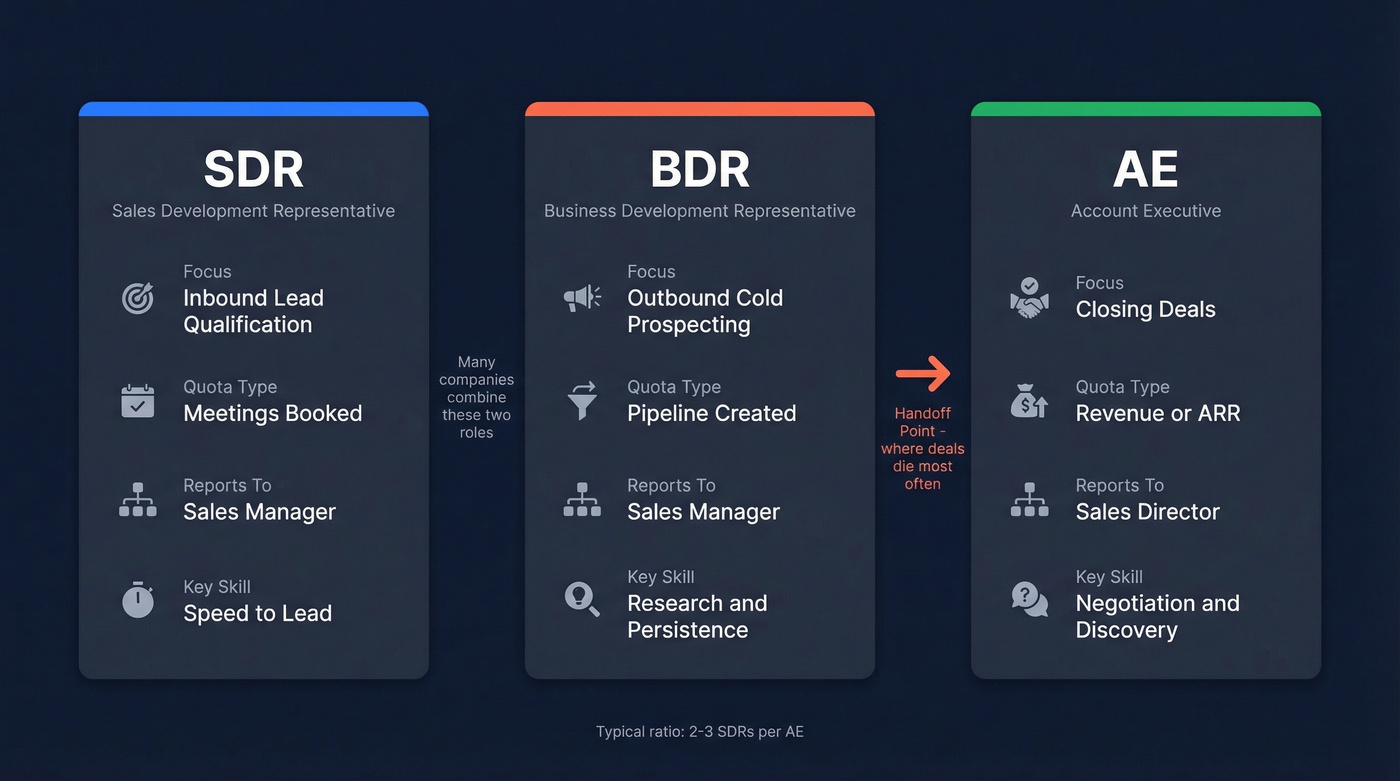
| Role | Primary Focus | Typical Quota | Reports To |
|---|---|---|---|
| SDR | Inbound leads | Meetings booked | Sales Manager |
| BDR | Outbound prospecting | Pipeline created | Sales Manager |
| AE | Closing deals | Revenue / ARR | Sales Director |
The textbook distinction: SDRs qualify inbound leads from marketing, BDRs do cold outbound prospecting, and AEs close. In practice, many companies don't separate SDR and BDR at all. They just run "inbound SDRs" and "outbound SDRs" under the same title. If a job posting says "SDR" but the description is all cold outbound, that's a BDR with a different name tag.
Most orgs staff 2-3 SDRs per AE. The handoff between them is where deals die most often - the best teams use structured handoff notes with qualification criteria, not just a calendar invite and a prayer.
How SDRs Qualify Leads
Qualification is the skill that separates reps who get promoted from reps who churn out. Three frameworks dominate:
| Framework | Best For | Key Question |
|---|---|---|
| BANT | SMB / high-velocity | "Do you have budget?" |
| CHAMP | Mid-market consultative | "What's your biggest challenge?" |
| MEDDIC | Enterprise / complex | "Who's the economic buyer?" |
BANT works for simpler deals where you need to qualify fast and move on. CHAMP flips the script - lead with pain, not budget. MEDDIC is the enterprise standard: we've seen teams jump forecast accuracy from 62% to 89% after switching from BANT to MEDDIC because it matched their complex sales motion.
Modern B2B buying groups include 6-10+ stakeholders. That's why lightweight qualification breaks down in enterprise - you need to map the decision process, not just confirm a budget exists. But consistency matters more than which framework you choose. A simple framework used by every rep beats a complex one used by three.

If your SDRs' connect rate is below 5%, it's not a coaching problem - it's a data problem. Prospeo delivers 98% email accuracy and 125M+ verified mobile numbers with a 30% pickup rate, so every dial and send actually reaches a real buyer.
Stop training reps on bad data. Start connecting them to real buyers.
SDR KPIs and Benchmarks
These are the numbers your manager is tracking, whether they've told you or not.
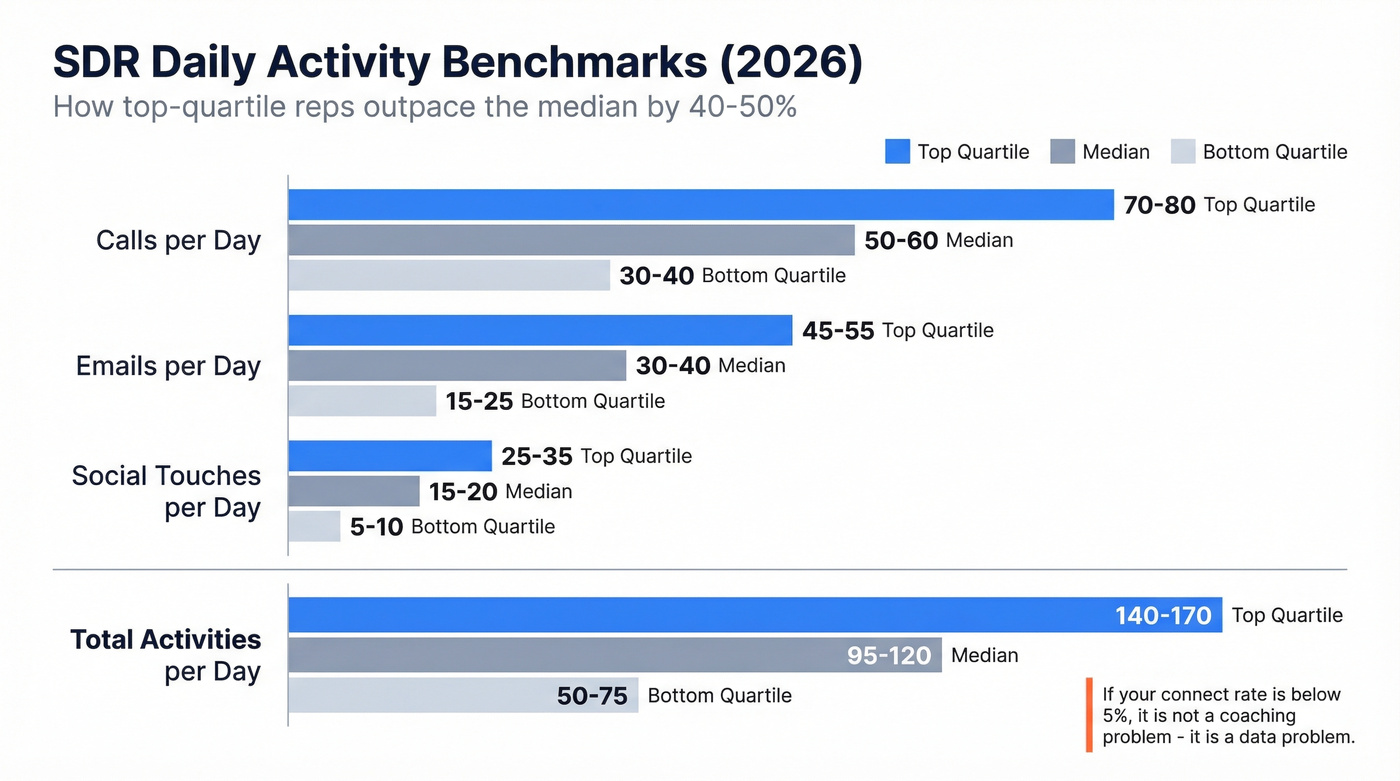
Daily Activity by Tier
| Metric | Top Quartile | Median | Bottom Quartile |
|---|---|---|---|
| Calls/day | 70-80 | 50-60 | 30-40 |
| Emails/day | 45-55 | 30-40 | 15-25 |
| Social/day | 25-35 | 15-20 | 5-10 |
| Total/day | 140-170 | 95-120 | 50-75 |
Conversion and Meeting Benchmarks
| Metric | Benchmark |
|---|---|
| Connect rate (healthy) | 8-12% |
| Connect rate (problem) | Below 5% |
| Cold call to meeting | 2.0-3.5% |
| Cold email to meeting | 0.8-2.0% |
| Social DM to meeting | 2.0-4.5% |
| Multi-touch to meeting | 4.0-7.0% |
| Outbound meetings/mo (median) | 8-10 |
| Outbound meetings/mo (top quartile) | 12-15 qualified |
| Inbound meetings/mo | 20-25 |
| Show rate | 75-85% |
| Meeting-to-opp ratio | 1:3 to 1:5 |
| Median SDR-generated pipeline | ~$3M/year |
Ramp Expectations
New reps don't hit full quota on day one. Expect Month 1 at 20-30% of quota, Month 2 at 40-60%, Month 3 at 70-80%, and full ramp by Month 4. If your no-show rate exceeds 20%, your meeting numbers are overstating actual pipeline contribution - aim to keep no-shows under 15%.
Here's the thing: the diagnostic that matters most is connect rate. If yours is below 5%, you don't have a coaching problem. You have a data quality problem. Your phone numbers are wrong, your emails are bouncing, and no amount of "smile and dial" training fixes bad contact data.
If you're rebuilding your workflow, start with the lead generation workflow and work backward from meetings booked.

SDR Salary and Compensation in 2026
Two major salary datasets tell a consistent story.
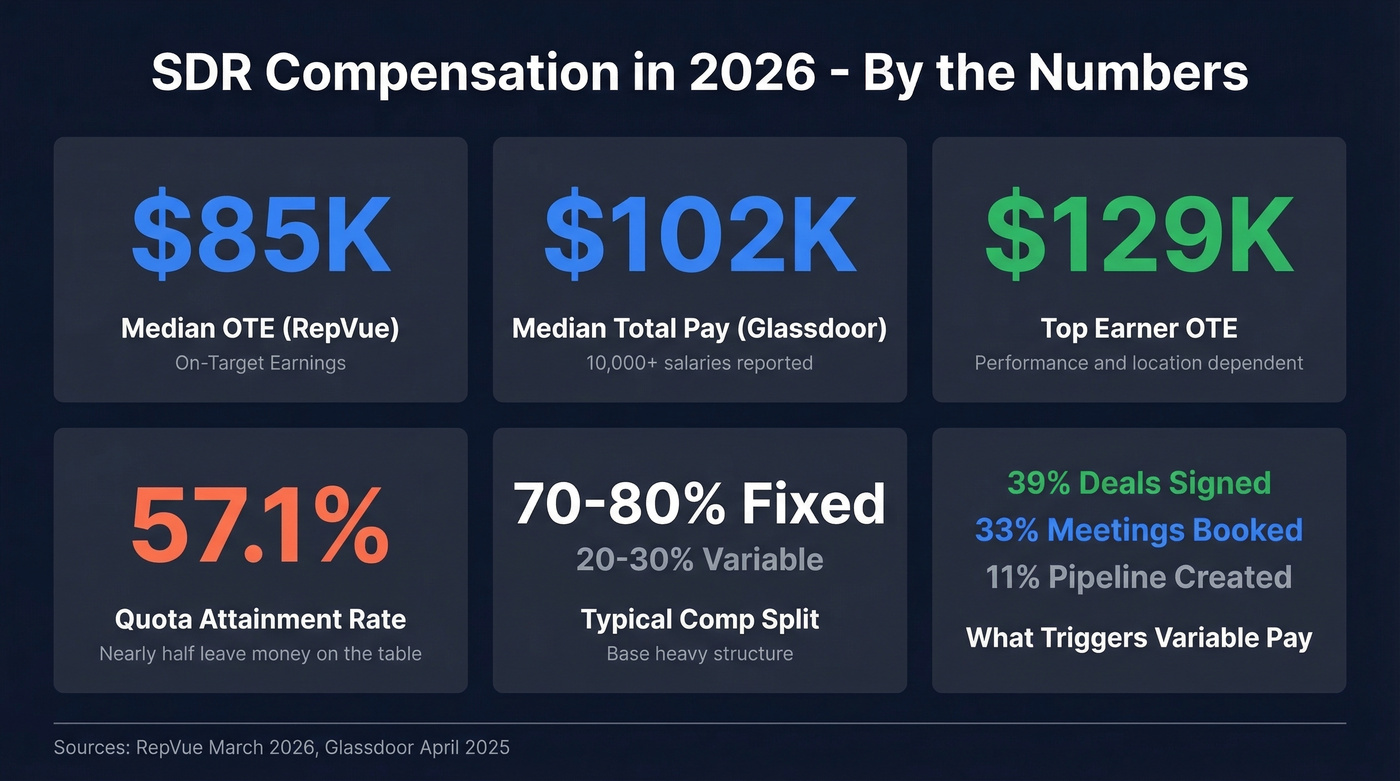
| Source | Base | OTE / Total | Top Earners | Quota Attainment | Sample |
|---|---|---|---|---|---|
| RepVue (Mar 2026) | $60K | $85K OTE | $129K | 57.1% | Self-reported |
| Glassdoor (Apr 2025, latest available) | $53-71K | $102K median | $128K | - | 10K salaries |
The gap between RepVue's $85K OTE and Glassdoor's $102K median total pay reflects methodology differences - Glassdoor's model includes additional pay beyond standard variable comp. Either way, the range is real: $83K-$128K depending on company, city, and performance.
Comp plans typically split 70-80% fixed and 20-30% variable. What triggers the variable portion varies by company: deals signed (39%), meetings booked (33%), pipeline created (11%). The post-2023 tech layoffs and 2025 hiring freeze slowed compensation growth, but 2026 is showing modest recovery - especially for reps who can work effectively with AI tools.
Only 57.1% of SDRs hit quota. That means nearly half are leaving money on the table every quarter. (If you want to sanity-check comp math, use an OTE breakdown.)
SDR Career Path and Promotion
The sales development role is a launchpad, not a destination. Common next moves include Account Executive, SDR Manager, Customer Success, Sales Operations, and Sales Enablement. 53% of people who held the role say they started specifically to advance to AE.
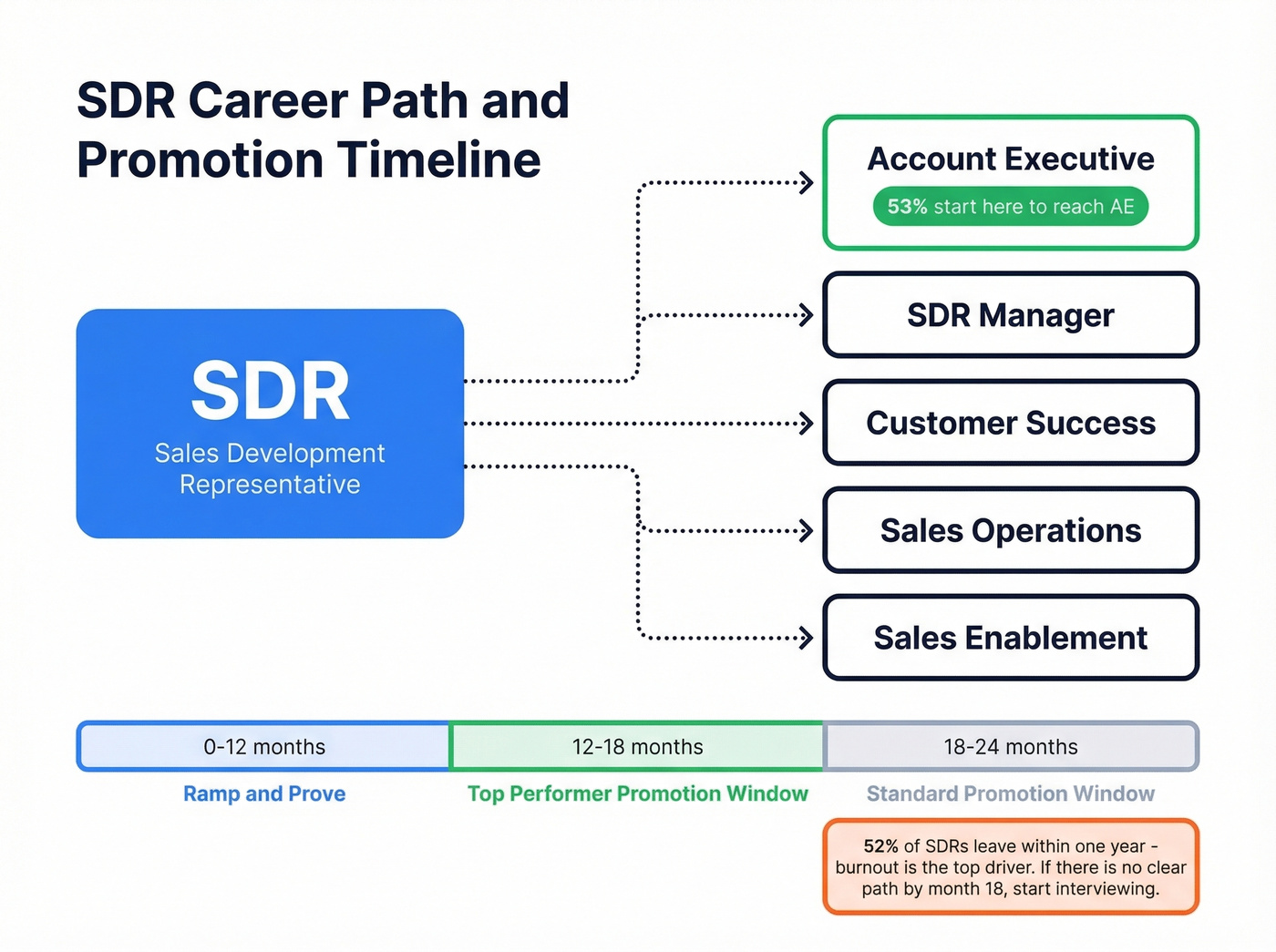
Promotion timelines run 12-18 months for top performers and 18-24 months in tougher markets or larger orgs. But here's the uncomfortable stat: 52% of companies report SDR tenure under one year. Burnout is the primary driver - high rejection volume, repetitive daily tasks, and unclear promotion timelines push most reps out before they'd naturally advance.
If you're trying to get promoted faster, build a measurable 30-60-90 day plan and align it with your manager's KPIs.
Let's be honest: if there's no clear promotion path by month 18, start interviewing. The skills transfer everywhere, and staying too long in a dead-end seat is the fastest way to stall a sales career.
The SDR Tech Stack in 2026
The average team uses 12-15 tools daily, costing $2,000-$5,000 per rep per month across the full stack. Most of that is waste. Here's what actually matters, broken into tiers.
CRM: HubSpot (free tier available) or Salesforce ($25-300/user/mo) - if you need examples, see CRM options by use case.
Engagement: Outreach ($100-150/user/mo), SalesLoft ($75-125/user/mo) - this is basically sequence management with reporting and guardrails.
Dialer: Aircall ($30-50/user/mo), Orum ($250-350/user/mo) - if you're evaluating call stacks, start with a cold calling system.
Scheduling: Calendly or Chili Piper ($10-30/user/mo)
Intent/Signals: Bombora, 6sense ($500-5,000/mo)
Conversation Intelligence: Gong or Chorus ($100-200/user/mo)
Start with three things: a CRM, a data provider, and a sequencing tool. Everything else can wait until you've proven the motion works.
If you're shopping for tooling, compare the full list of SDR tools before you sign annual contracts.
Skip ZoomInfo if your team is under 20 seats. The $20-50K/year contracts are built for enterprise revenue orgs, and the ROI math doesn't work at smaller scale. In our testing, Prospeo users book 26% more meetings than ZoomInfo users at roughly $0.01 per lead versus ZoomInfo's $1+ - with 98% email accuracy and a 7-day data refresh cycle versus the 6-week industry average.
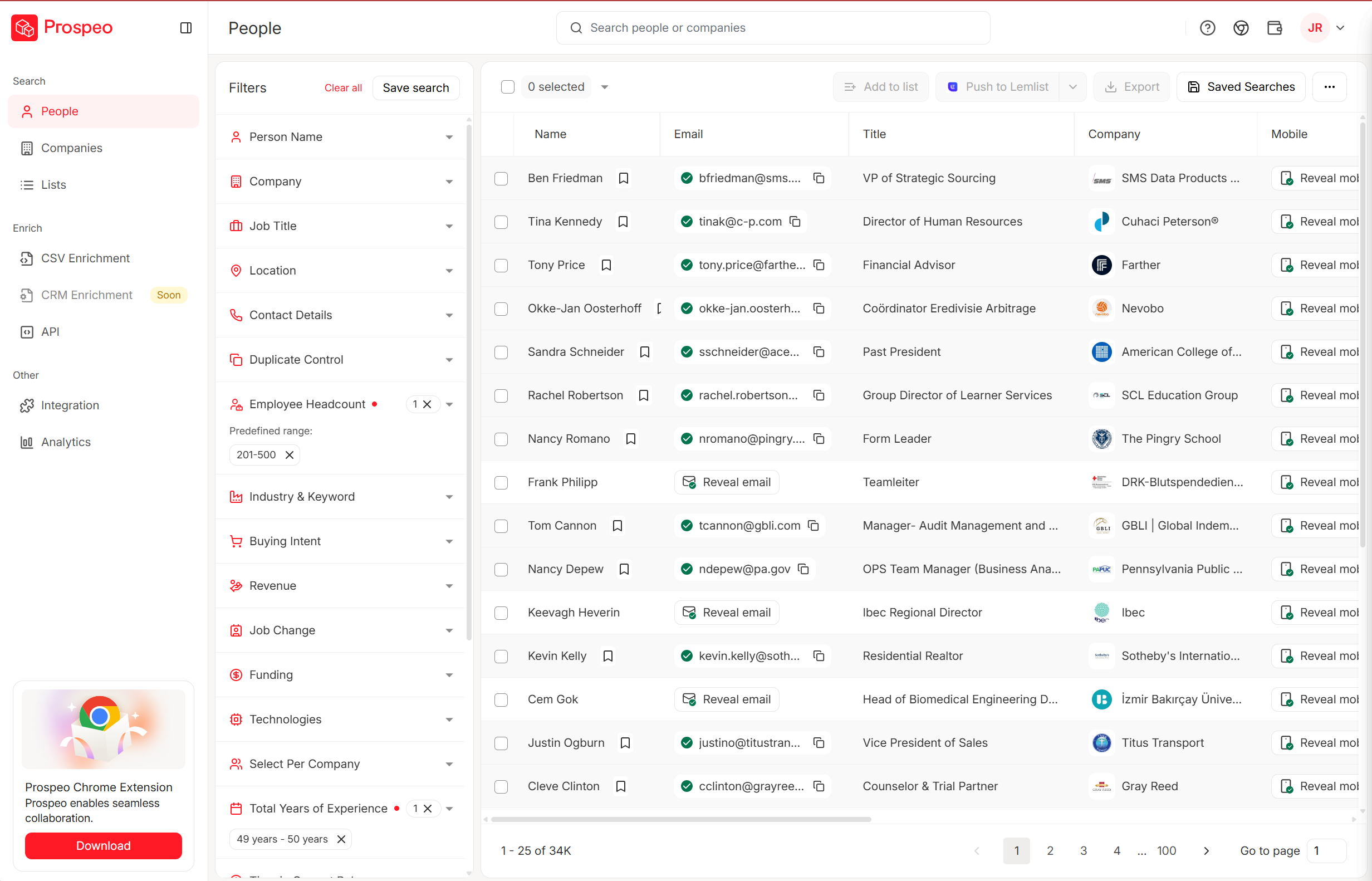
Top-quartile SDRs hit 140-170 activities a day. That volume only works when the contacts are real. Prospeo refreshes all 300M+ profiles every 7 days - not 6 weeks - so your reps aren't burning hours on bounced emails and dead numbers.
Book 26% more meetings with data that's never more than a week old.
Will AI Replace SDRs?
No. But it'll reshape what the role looks like.
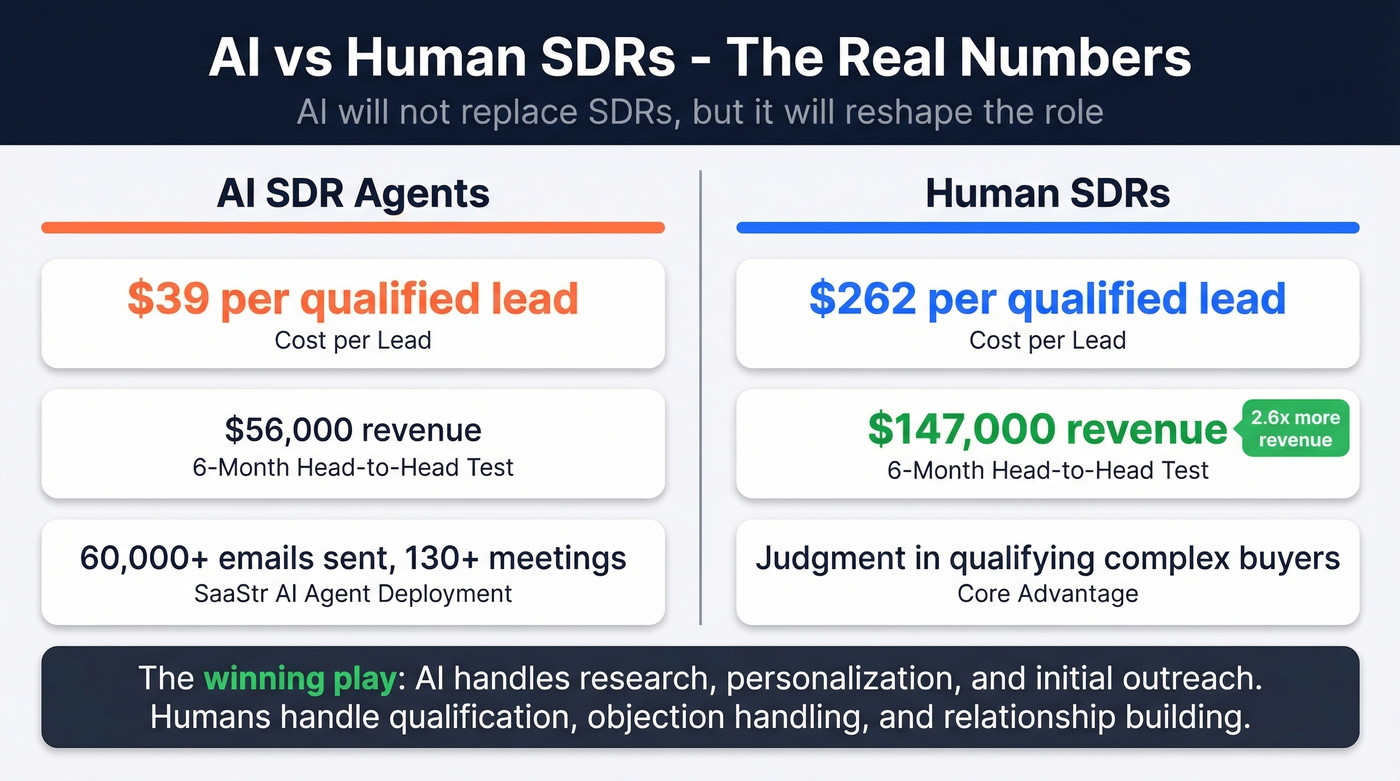
AI will replace a chunk of low-performing work and make top reps significantly more productive. The role is fundamentally about human judgment in qualifying buyers, and that's the part AI still struggles with.
The cost math is compelling on the surface - AI generates qualified leads at roughly $39 per lead versus $262 for humans. SaaStr deployed 20 AI agents that sent 60,000+ personalized emails, booked 130+ meetings, and generated 15% of their London event revenue.
But in a head-to-head experiment running July 2025 through January 2026, a human rep generated $147,000 in revenue versus $56,000 from AI. Human show rates hit 71% versus AI's 52%. AI was 54x cheaper per touchpoint - and the human still produced nearly 3x the revenue. Even SaaStr's AI deployment required two dedicated humans, a vendor engineer and an internal GTM engineer, to keep agents performing.
The hybrid model is where the real gains live. Teams see a 35% productivity boost when AI handles follow-ups, low-scored leads, and re-engagement while humans run discovery calls and complex qualification. AI is excellent at the work humans hate and mediocre at the work that actually closes deals.
If you're testing AI in outbound, start with AI cold email outreach and measure impact on reply quality, not just volume.
FAQ
What does SDR mean in business?
An SDR (Sales Development Representative) is the frontline rep who prospects, qualifies leads, and books meetings so closers can focus on revenue. The role creates the pipeline that feeds every downstream sales metric - without SDRs, AEs spend half their time sourcing deals instead of closing them.
Is SDR a good entry-level sales job?
Yes, if you treat it as a 12-18 month launchpad rather than a career. Median OTE is $85K, and 53% of SDRs started specifically to advance to AE. Choose a company with strong territory coverage, accurate data, and a clear promotion timeline - not just the highest base salary.
How many calls should an SDR make per day?
Median is 50-60 outbound calls per day; top quartile hits 70-80. But raw dial volume matters less than connect rate. If yours is below 5%, you've got a data quality problem, not a coaching problem - fix the root cause before you optimize talk tracks.
What tools do SDRs need to get started?
At minimum: a CRM (HubSpot's free tier works), a verified data provider like Prospeo with 75 free credits per month, and a sequencing tool like Instantly or Smartlead. That three-tool stack costs a fraction of what enterprise stacks run per rep and covers the entire prospecting workflow.