

How to Write a Self Introduction Email to Business Partners That Gets a Reply
You found the perfect co-marketing partner. Complementary audience, aligned values, obvious overlap. Now you need a self introduction email to business partners that actually gets a reply - without a deck, without a pitch, and without three paragraphs about your career history.
One core structure beats ten generic templates every time. Let's build it.
What Every Partner Introduction Email Needs
Six components, no more:
- Subject line - 47% of recipients open based on subject line alone
- Opener - who you are, in one sentence
- Why them - what you noticed about their business
- Win-win block - what both sides gain
- Low-friction CTA - a question, not a calendar link (see email call to action best practices)
- Signature - make it easy to trust you and forward you internally
Here's the thing: 81% of people read email on smartphones. If your intro doesn't fit on one screen, it's already too long. And here's a stat most guides bury - a Snov.io analysis of 44M emails found that disabling open tracking more than doubled reply rates (2.36% vs 1.08%). Turn it off.
The One-Screen Structure That Gets Replies
The framework that consistently works follows a clarity-first approach: who you are, why them, what happens next. No backstory. (If you want more examples, see company introduction email examples.)
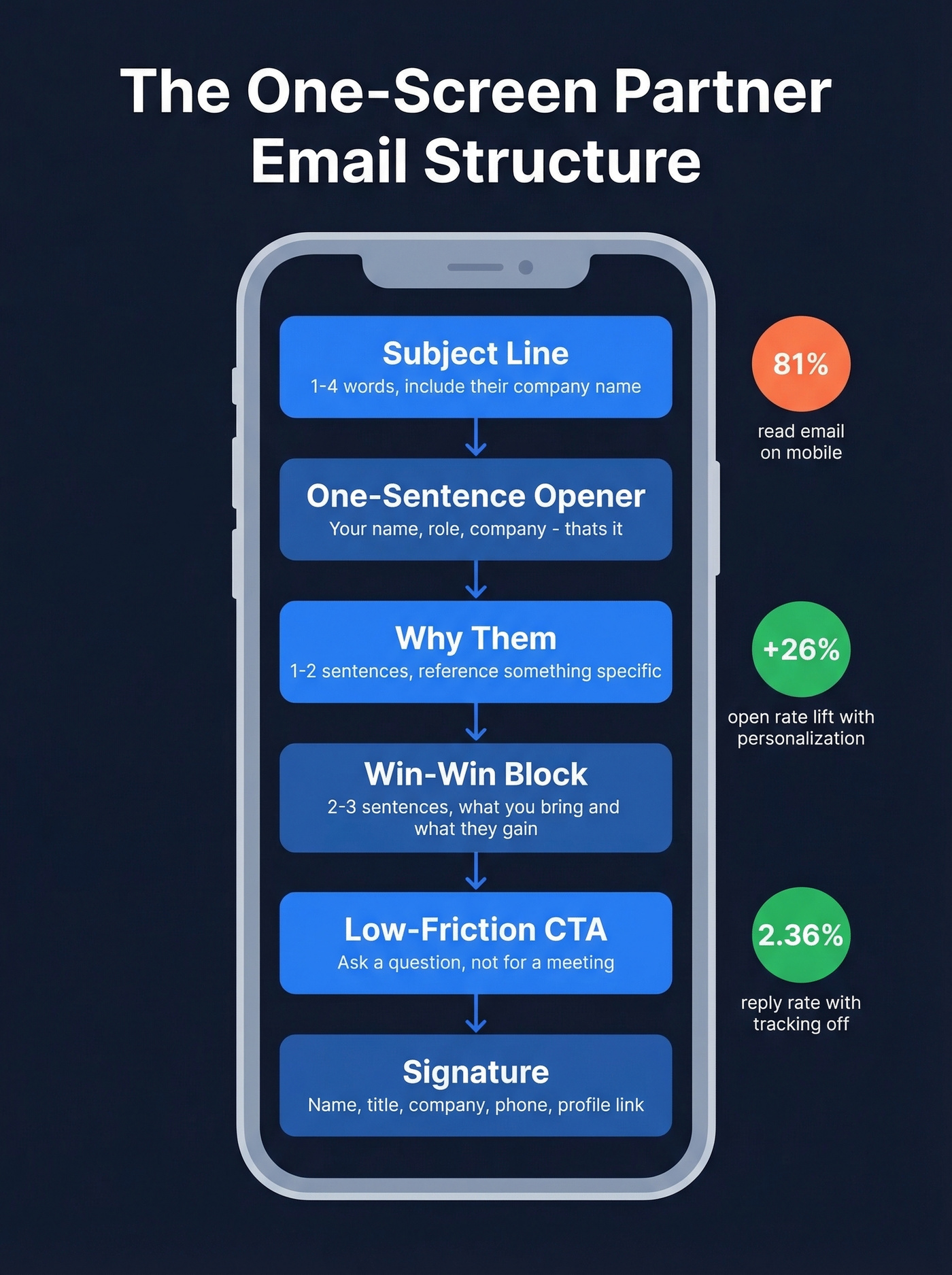
1. Subject line (1-4 words). Short enough to display fully on mobile. Including the recipient's name or company lifts open rates by 26%. For more ideas, browse these email subject line examples.
2. One-sentence opener. Your name, your role, your company. That's it.
3. Why them (1-2 sentences). Reference something specific - a recent launch, a shared audience, a complementary product. This is where personalization lives. Think of a bookstore emailing a local coffee shop about co-hosting author events: the "why" is obvious and concrete.
4. Win-win block (2-3 sentences). What you bring, what they gain. You're not selling anything - you're starting a relationship where both sides benefit. Be specific about the outcome you envision, because vague promises of "mutual growth" read like filler and get treated accordingly.
5. Low-friction CTA. Ask a question, not for a meeting. Add a redirect line: "If this isn't your focus, could you point me to the right person?"
6. Signature. Full name, title, company, phone, and a link to your professional profile. Skip the inspirational quotes.
Templates by Partner Type
Mutual Value / Co-Marketing Partner
Subject: [Their Company] x [Your Company]
Hi [Name],
I'm [Your Name], [role] at [Your Company]. We [what you do] for [audience type], and I noticed [Their Company] serves a similar market from the [complementary angle] side.
I think there's a natural fit - our [asset] paired with your [their strength] could [specific outcome]. Would a quick collab conversation make sense this month?
Channel / Reseller Partner
This one needs numbers upfront. Channel partners evaluate ROI before they evaluate you.
Subject: revenue share idea
Hi [Name],
[Your Company] offers [product/service] with a [commission structure, e.g., "30% recurring revenue share"] for channel partners. Your clients in [vertical] are a direct fit.
I'm [Your Name] - I run our partner program and can set you up with co-branded materials and dedicated support. Worth 15 minutes to see if there's a match?
Tech / Integration Partner
Lead with customer demand, not your resume. Product teams respond to user pull.
Subject: [Your Product] + [Their Product]
Our customers keep asking for a native integration with [Their Product]. I'm [Your Name], [partnerships/product] at [Your Company], and the user overlap makes this worth exploring.
Would your partnerships or product team be the right people to talk to? Happy to send a one-pager on the technical scope.
Vendor / Supplier Introduction
Subject: new point of contact at [Your Company]
Hi [Name],
I'm [Your Name], your new [role] at [Your Company]. I'll be handling [what you handle - renewals, orders, support]. Think of me as your advocate on the inside. I'd love a quick call to learn what's working and where I can help - what does your week look like?
Existing Partner Handoff
Keep this one brutally short. The recipient doesn't need context - they need confidence that nothing falls through the cracks.
Hi [Name], quick note - I'm [Your Name], stepping in for [Previous Contact] as your [role] at [Your Company]. Can we grab 15 minutes this week to align on priorities?
PS - Saw [personalized detail from their recent news]. Congrats.
If you need more handoff language, use these handoff email templates.
Connector Introduction (On Behalf of Someone Else)
Sometimes you're the mutual connection making the intro. Forward this format to both parties:
Subject: intro - [Person A] / [Person B]
[Person A], meet [Person B]. [Person B] runs [their company/role] and is doing [relevant thing]. [Person A] is [relevant context]. I think you two should talk about [specific overlap]. I'll let you take it from here.
Subject Lines That Don't Look Like Outreach
Gong's analysis of 85M+ cold emails found 1-4 words is the ideal range. Salesy techniques reduce open rates by 17.9%, and 69% of recipients flag emails as spam based on the subject line alone. (More data-backed patterns: subject lines that get opened.)
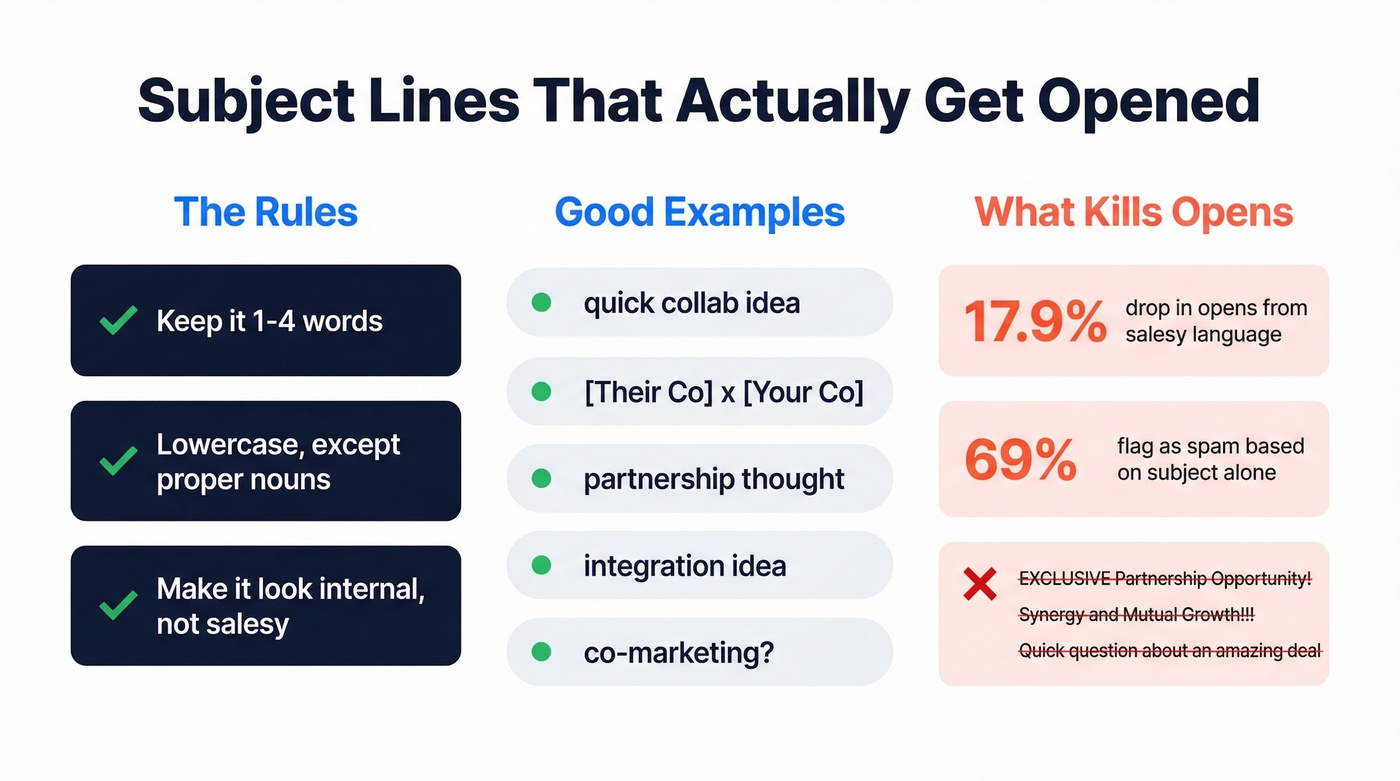
Three rules: keep it lowercase (except proper nouns), keep it short, make it look internal.
- quick collab idea
- [Their Company] x [Your Company]
- partnership thought
- intro - [Your Name]
- [First Name], quick question
- mutual customers
- integration idea
- co-marketing?
- new contact at [Your Company]
- referral program - [Your Company]

The best introduction email in the world won't get a reply if it lands in the wrong inbox. Prospeo gives you verified emails for partnership decision-makers - VP of Partnerships, Head of BD, Channel Directors - with 98% accuracy and 30+ filters to find exactly the right person.
Stop crafting perfect emails to the wrong people. Verify the contact first.
Mistakes That Kill Partner Email Replies
Sending a generic template without tailoring it. Recipients spot copy-paste intros immediately. On Reddit, people describe bad intro emails as a "dog and pony show" - too much background, not enough relevance. The consensus on r/sales is blunt: if you can't explain why this partner in this sentence, don't send it.
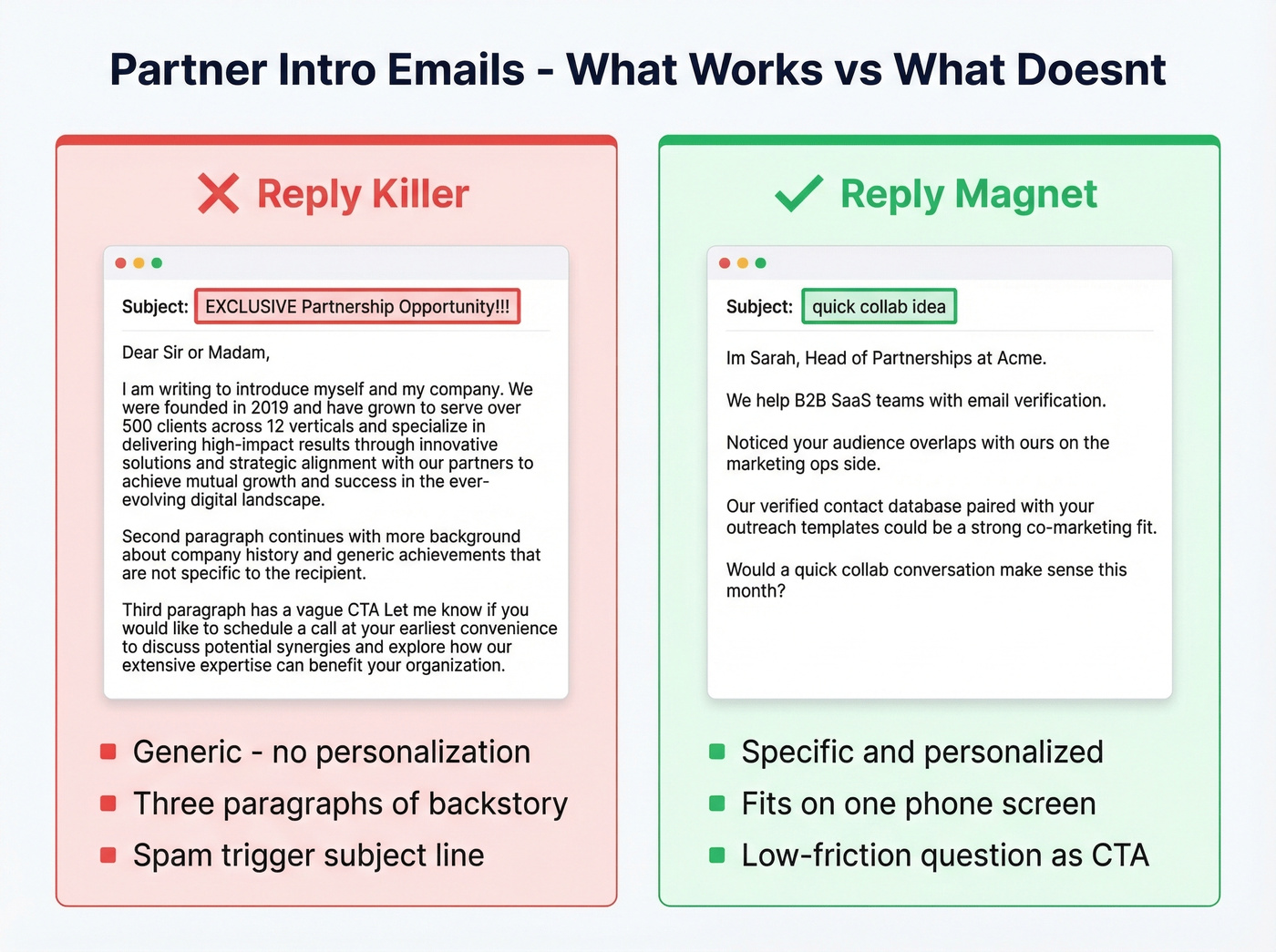
Writing three paragraphs about your background. State your purpose, not your biography. (If you want a tighter positioning line, borrow from these sample elevator pitches.)
Using ALL CAPS, exclamation marks, or "exclusive opportunity" in the subject line. These are spam triggers, not persuasion tools.
In our experience, the single biggest killer is sending to the wrong person entirely. A beautifully written email to the marketing coordinator when you needed the VP of Partnerships is a wasted shot. Verify the contact and their role before you write a word. We've seen teams spend hours on copy and zero minutes confirming the recipient actually handles partnerships - and then wonder why they get silence. If you're troubleshooting bounces and inboxing, start with an email deliverability guide.
Follow-Up Sequence
Follow-up emails generate 42% of all campaign replies, yet 48% of professionals never send a second message. Two follow-ups is a solid default for partner intros. Send your initial email on Monday and aim for Wednesday on follow-ups, when engagement peaks. (More options: sales follow-up templates.)
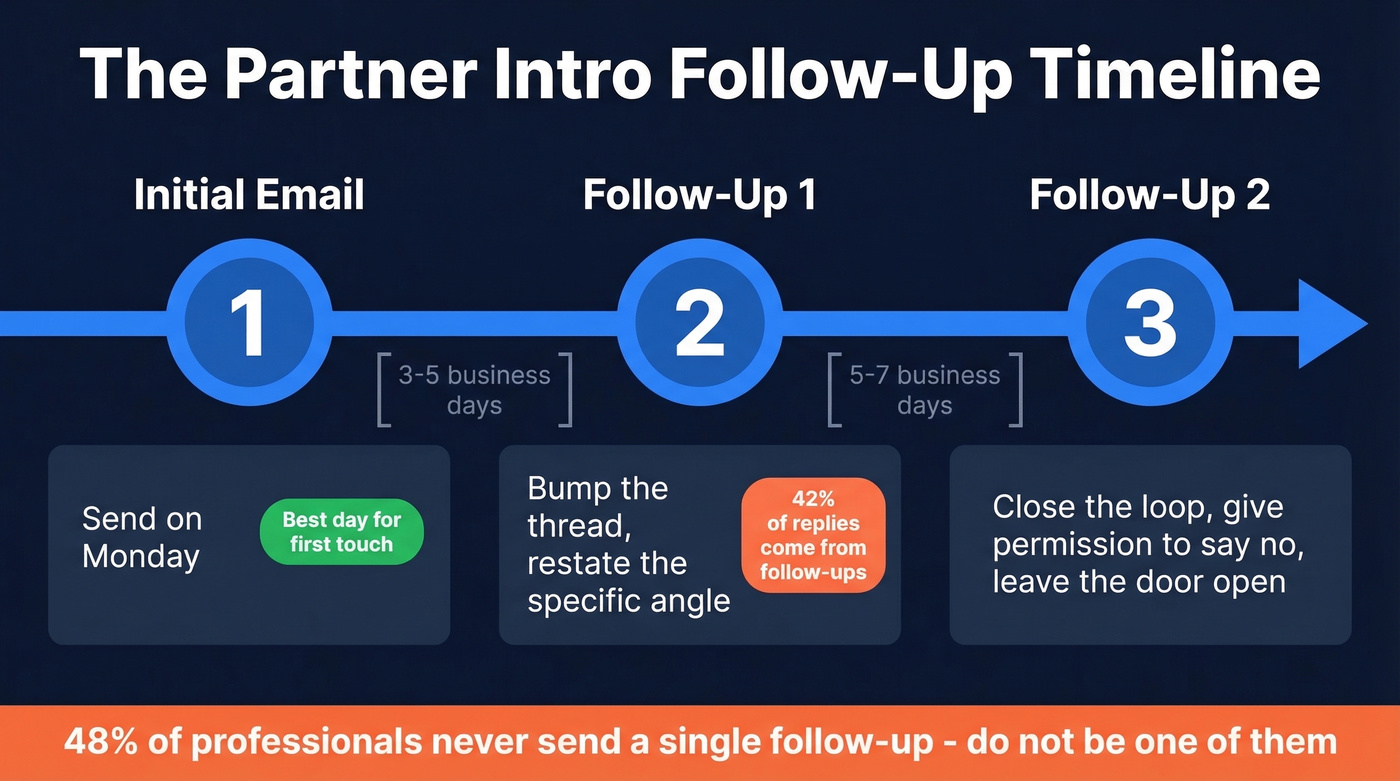
Follow-up 1 (3-5 business days later):
Hi [Name], wanted to bump this in case it got buried. The [specific partnership angle] still seems like a strong fit - happy to share more detail if helpful.
Follow-up 2 (5-7 days after that):
Hi [Name], closing the loop. If the timing isn't right, no worries - I'll leave the door open. If priorities shift, I'm at [email].
A "permission to say no" line removes pressure and makes it easier for people to respond. Average cold email open rates sit around 27.7%, with reply rates averaging 3.43%. Partner intros outperform pure cold outreach, but don't panic if the first send is quiet.
Tips for International Partners
American directness can feel abrupt in many cultures. A few rules that prevent missteps:
Use proper titles. In France, default to "Madame." When in doubt, err formal. Add pleasantries where expected. In Japan, opening with a brief seasonal reference is standard - skipping it can feel rude. Watch date formats. The US uses MM/DD/YY, most of Europe uses DD/MM/YY, and China uses YYYY/MM/DD. Getting this wrong in a proposed meeting date creates real confusion. Close safely. "Kind regards" works across nearly every culture. Skip "Cheers" unless you know the recipient's style.
For a deeper look at cross-cultural email norms, Harvard Business Review's guide to global communication is worth bookmarking.
Before You Hit Send
None of this matters if your email bounces. 17% of cold emails never reach the inbox, and a bounced partner intro doesn't just waste the opportunity - it damages your sender reputation for every email that follows.
Before you send that carefully written introduction, verify the contact. Prospeo checks emails in real time with 98% accuracy and refreshes data every 7 days, so you're not sending to stale addresses. The free tier gives you 75 verified emails plus 100 Chrome extension credits per month - more than enough to validate a partner outreach list. If you're trying to reduce bounces systematically, track your email bounce rate and fix the root causes.
Look, most people obsess over email copy when the actual bottleneck is sending to the wrong address or the wrong person. Get the targeting right and a mediocre email will outperform a brilliant one sent to a dead inbox.
You just read that sending to the wrong person is the single biggest reply killer for partner intros. Prospeo's database of 300M+ profiles lets you filter by job title, company, and department so your introduction email reaches the person who actually owns partnerships - not a coordinator who can't act on it.
One verified email at $0.01 beats ten guesses that bounce.
FAQ
How long should a partner introduction email be?
Two to three short paragraphs that fit on one phone screen - roughly 75-125 words. 81% of people check email on smartphones, so if your intro requires scrolling, it's too long. Cut the backstory and lead with relevance.
What's the best subject line for introducing yourself to a partner?
Keep it 1-4 words, lowercase, and non-salesy. 47% of recipients decide to open based on the subject line alone. Strong examples: "quick collab idea" or "[Their Company] x [Your Company]." Avoid exclamation marks and buzzwords like "exclusive."
How many follow-ups should I send after a partner intro?
Two. Send the first 3-5 business days later, the second 5-7 days after that. Follow-up emails generate 42% of all campaign replies, yet nearly half of professionals never send even one.
How do I find the right contact at a potential partner company?
Use a verified B2B data tool to search by company and job title, then verify the email before sending. Real-time verification and a short data refresh cycle help you avoid bounces that damage your sender reputation - and stop you from wasting intros on the wrong person.