

Self-Reported Attribution: What It Is, Why It Matters, and How to Do It Right
Your attribution dashboard says 80% of deals came from "direct traffic." Your CRM shows deals that appeared from nowhere. Meanwhile, your podcast, your community presence, and every conference handshake get zero credit.
Self-reported attribution fixes a big part of this - and it takes one form field to start.
What Is Self-Reported Attribution?
Self-reported attribution (SRA) is the practice of asking buyers directly how they first heard about you, typically through a field on high-intent forms like demo requests or consultation bookings. Instead of relying on cookies, UTM parameters, or multi-touch models, you go straight to the source. A simple "How did you originally hear about us?" captures the channels that software can't reliably see.
The Dark Funnel Problem
A massive chunk of your buyer's journey is invisible to analytics. Scroll through any B2B marketing forum or Reddit thread on r/demandgeneration and you'll see the same frustration: deals appearing from nowhere, dashboards that don't match reality.
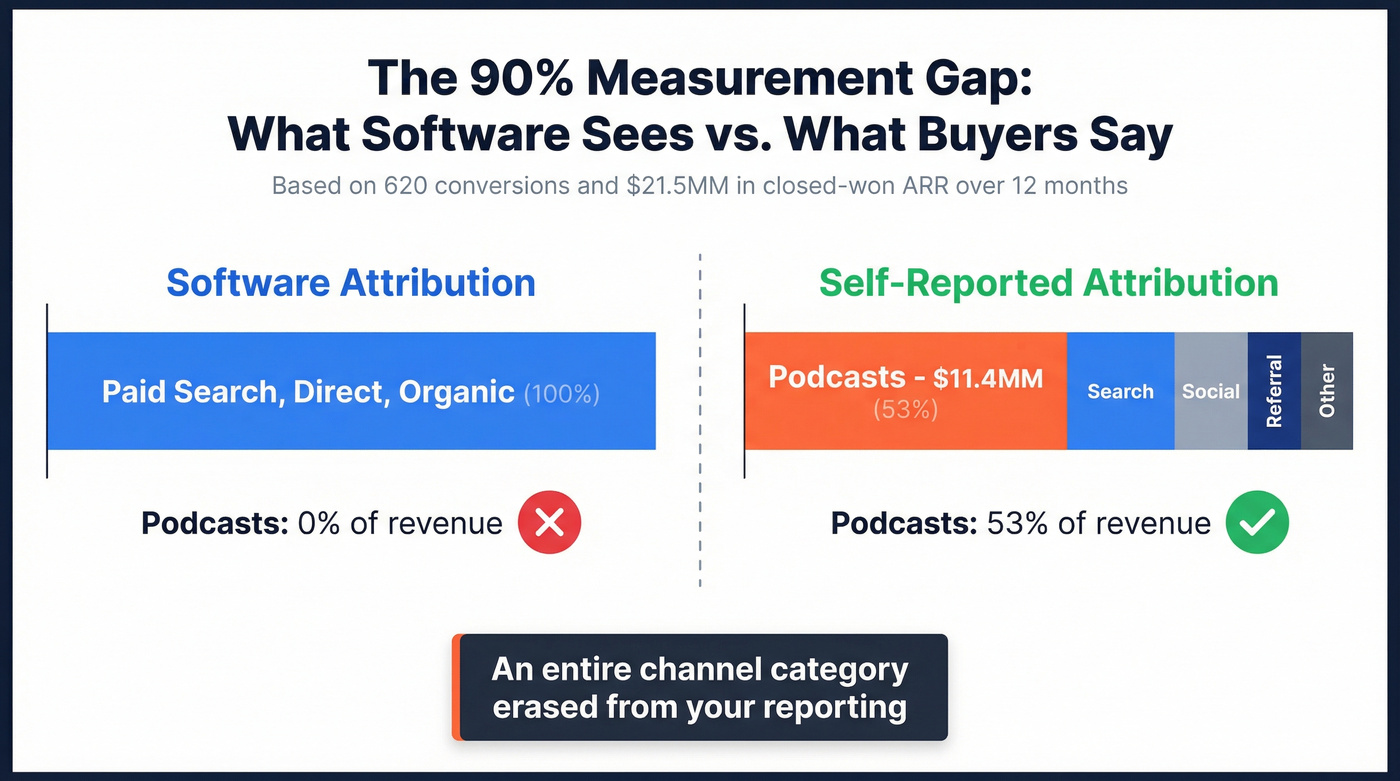
Refine Labs published a hybrid attribution study covering 620 declared-intent conversions and $21.5MM in closed-won ARR over 12 months. They found a 90% measurement gap between what software attribution reported and what buyers actually said. Podcasts drove 53% of revenue - $11.4MM - according to self-reported data. Software attribution? Zero percent.
That's not a rounding error. That's an entire channel category erased from your reporting.
The dark funnel includes everything your analytics stack can't track: private Slack communities, word-of-mouth referrals, podcast mentions, conference conversations, and review site browsing. In 2026, add AI tools to that list. Buyers researching solutions through ChatGPT, Claude, or Gemini build entire shortlists without ever clicking through to your site - zero-click research that's completely invisible to web analytics and makes traditional first-touch attribution meaningless.
SRA vs. Software Attribution
These aren't competing approaches. They measure different things.
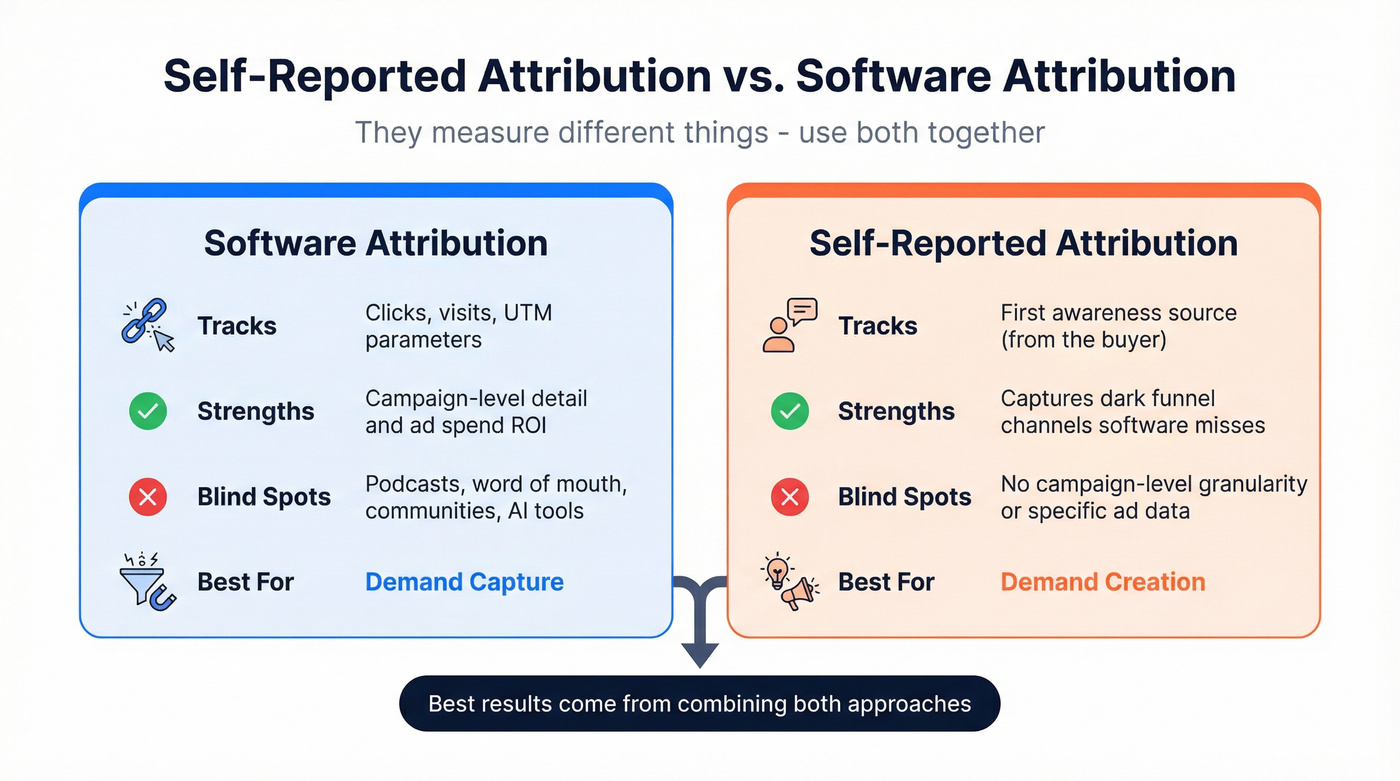
| Dimension | Software Attribution | Self-Reported Attribution |
|---|---|---|
| What it tracks | Clicks, visits, UTMs | First awareness source |
| Strengths | Campaign-level detail | Captures dark channels |
| Blind spots | Podcasts, WOM, communities | Can't tie to specific ads |
| Best for | Demand capture | Demand creation |
Multi-touch attribution excels at mapping digital journeys but breaks down when buyers research offline or in private channels. Marketing mix modeling works top-down with aggregate spend data, but it's expensive, opaque, and needs years of clean data - and B2B volumes rarely support the sample sizes it requires. SRA fills the gap none of these can cover. Use both software and buyer-reported data together for a complete picture.

SRA shows you which dark funnel channels actually create demand. But attribution data is worthless if you can't reach those buyers. Prospeo's 300M+ profiles with 98% email accuracy and 7-day data refresh mean your outreach connects - whether leads came from a podcast, community, or word of mouth.
Stop losing pipeline between attribution insight and actual outreach.
How to Implement SRA
Where to Add the Question
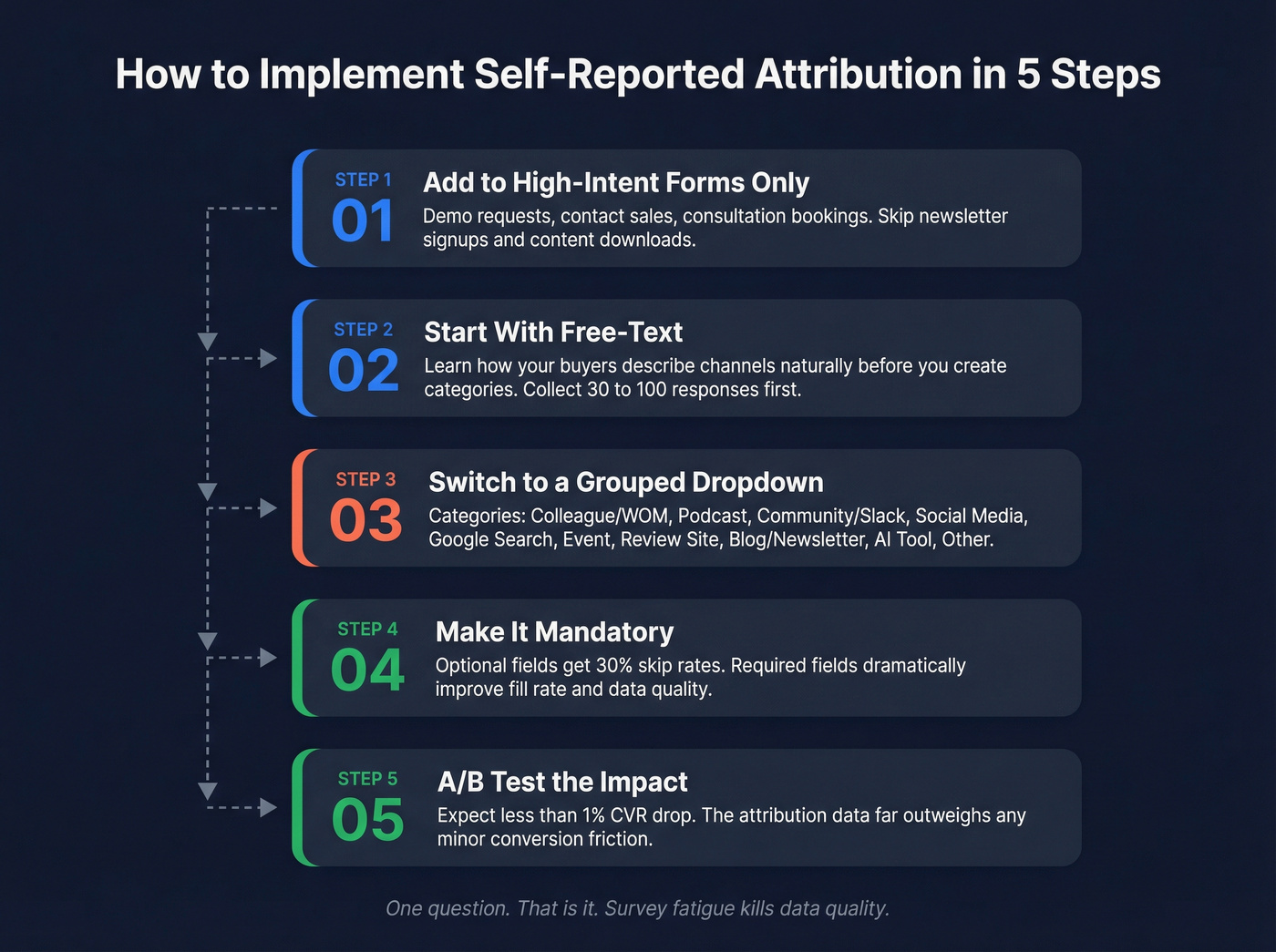
High-intent forms only. Demo requests, contact sales pages, consultation bookings. Don't put this on newsletter signups or content downloads - those respondents haven't made a buying decision yet, so their answers won't reflect what actually drives pipeline.
If you're mapping this into your sales funnel, treat SRA as a late-stage signal (demo/contact) rather than a top-of-funnel survey.
Free-Text First, Dropdown Later
Start with an open-text field. You need to learn how your buyers describe channels before you impose categories on them. After 30-100 responses, patterns emerge - that's when you build a grouped dropdown.
This is also a good moment to align on lead status definitions so SRA doesn’t get lost between MQL → SQL → opportunity.
A solid starter taxonomy: colleague/word of mouth, podcast, community/Slack group, social media post, Google search, event/conference, review site, blog/newsletter, AI tool, and other. Automate categorization in HubSpot or Salesforce using keyword-matching workflows. If the response contains "friend" or "colleague," route it to the word-of-mouth bucket.
Make It Mandatory
Dreamdata tested SRA on 100 demo bookings with an optional field. About 70% filled it in, but only 49 out of 100 submissions were useful enough to act on. Making the field required improves both the fill rate and data quality significantly.
Keep It to One Question
Survey fatigue is real. A Walr study on survey design across 1,000 participants found "Don't know" responses jumped 50% in later question loops, with results significant at 95% confidence. One question on your form. That's it.
A/B Test the Impact
The biggest objection we hear: "Won't this hurt conversion rates?" Outbrain tested this across multiple B2B brands and never saw a significant negative impact that outweighed the value of the data. Their threshold was a less-than-1% CVR drop. In our experience, a single well-placed field lands comfortably within that range.
If you want to quantify impact cleanly, track it alongside your sales conversion rate and form-to-meeting rate.
Limitations and Fixes
Recency bias. Buyers remember the last touchpoint, not the first. Use "How did you originally hear about us?" to anchor them on initial awareness.
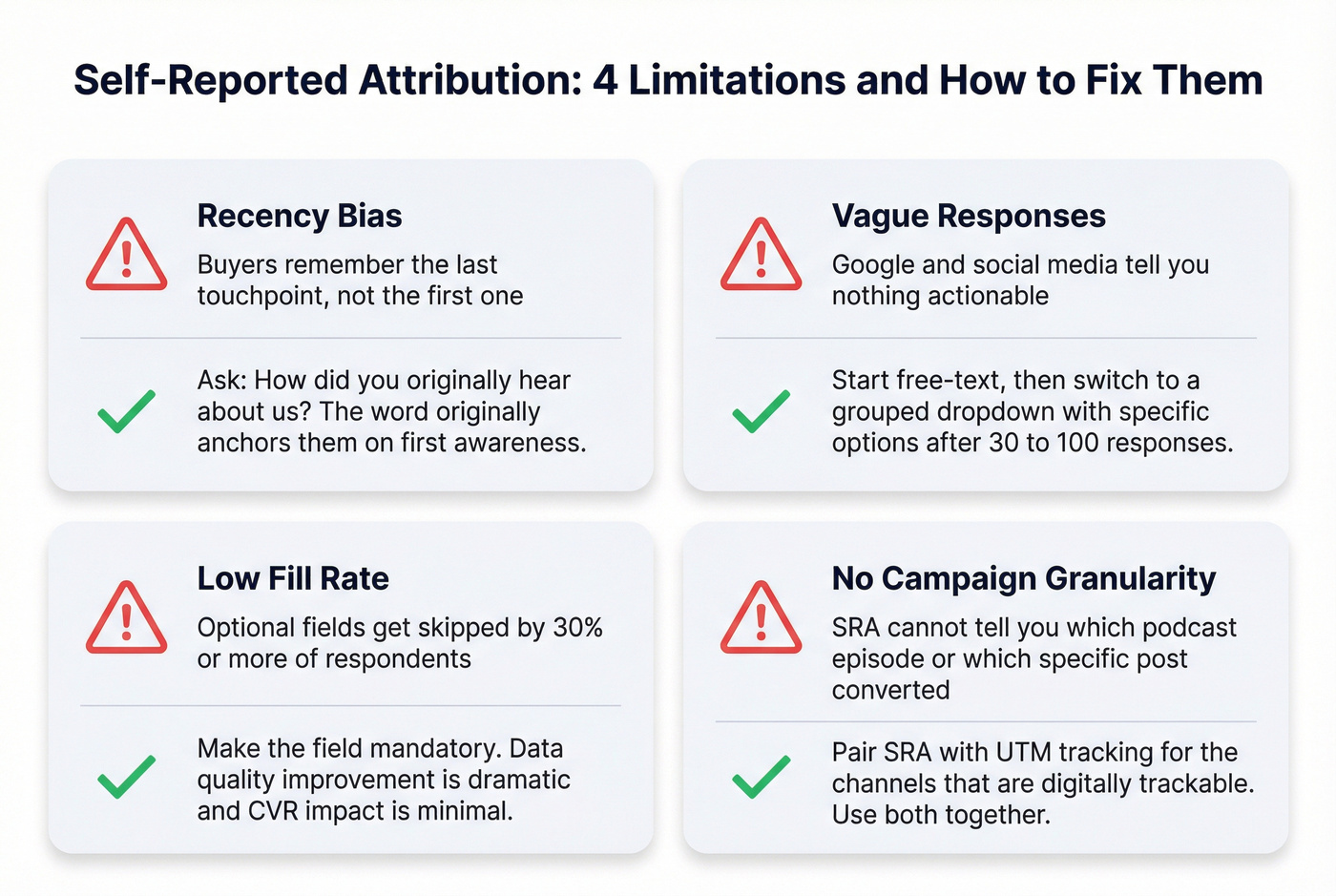
Vague responses. "Google" and "social media" tell you nothing actionable. Switch from free-text to a grouped dropdown with specific options after your initial collection phase.
Low fill rate. Optional fields get skipped. Make it mandatory - the data quality improvement is dramatic.
No campaign-level granularity. SRA can't tell you which podcast episode or which post converted. Pair it with UTM tracking for the channels that are trackable.
What to Do With the Data
Here's the thing: the biggest mistake teams make with SRA data is leaving it stranded in a form field. Connect it to pipeline and revenue in your CRM. Track trends monthly, not just in aggregate.
To operationalize it, add SRA as a field in your CRM and include it in your RevOps reporting cadence.
When 30-60% of your buyer-reported responses cite dark channels like word of mouth, communities, and podcasts, that's a signal to reallocate budget toward demand creation. Use SRA to challenge your software attribution reports - if software says paid search drives 70% of pipeline but buyers say they heard about you on a podcast, you've got a measurement gap worth investigating. We've seen teams completely restructure their channel mix after six months of SRA data, shifting spend from paid search to community sponsorships and seeing pipeline hold steady at lower cost.
Once SRA reveals which channels actually drive pipeline, you need accurate contact data to work those segments. Tools like Prospeo, with 98% email accuracy and a 7-day data refresh cycle, make sure your outreach doesn't stall on bounced emails when you're following up with podcast listeners or event attendees. (If you’re evaluating options, compare data enrichment services before you commit.)
If you’re turning those insights into outbound plays, keep a set of sales follow-up templates ready for each source (podcast, event, community).
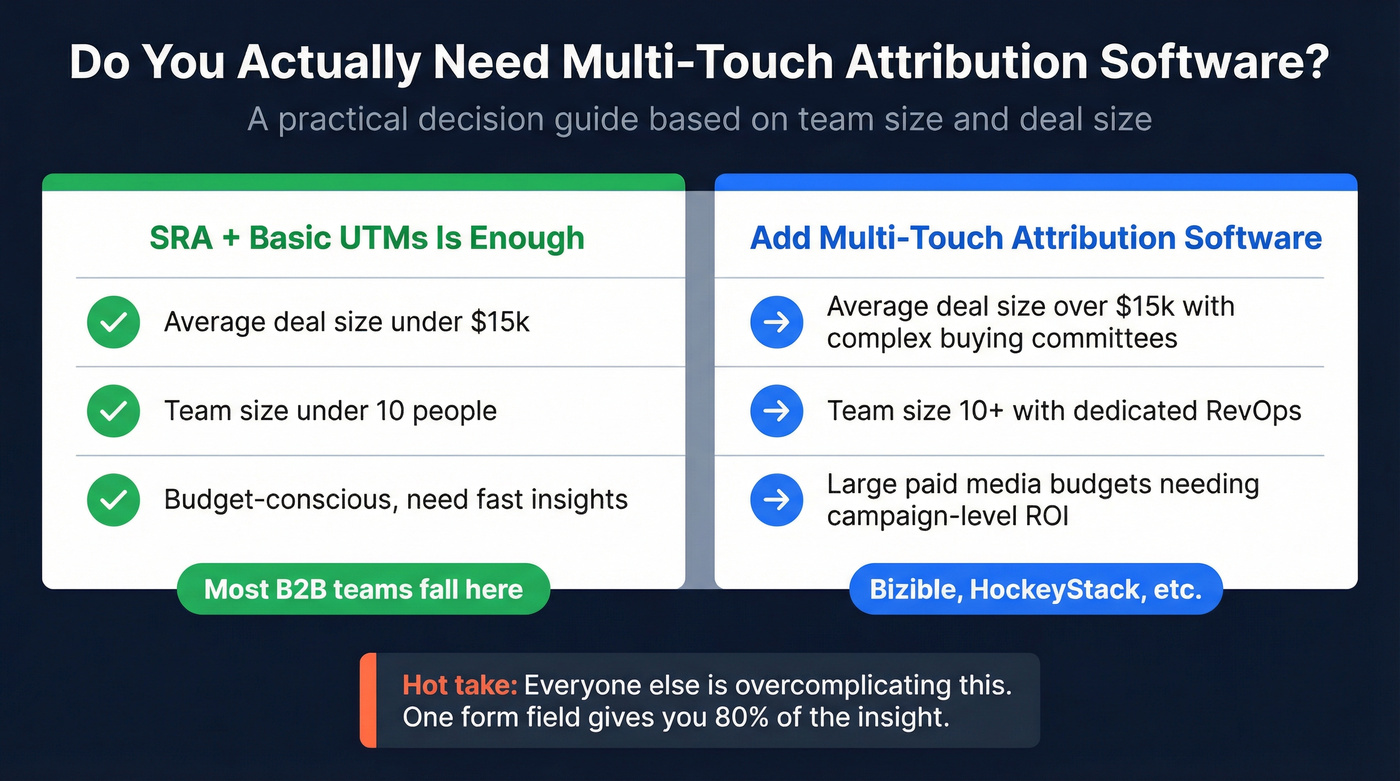
And here's the hot take most attribution content won't give you: if your average deal size is under $15k and your team is under 10 people, skip multi-touch attribution software entirely. An SRA field plus basic UTM tracking will give you most of the insight at a fraction of the cost. The companies that need Bizible or HockeyStack know who they are. Everyone else is overcomplicating this.
If you do go deeper, prioritize funnel metrics that connect SRA → meetings → pipeline → revenue.
When SRA reveals that conferences, communities, or podcasts drive your best deals, you need verified contact data to follow up fast. Prospeo enriches your CRM with 50+ data points per contact at a 92% match rate - so no dark funnel lead goes cold.
Turn every self-reported source into a reachable, enriched contact for $0.01 each.
FAQ
What's the best wording for an SRA question?
"How did you originally hear about us?" outperforms "How did you find us?" because it anchors buyers on initial awareness rather than the last touchpoint. Keep it simple, use language your buyers naturally understand, and skip jargon like "attribution source."
Should the field be mandatory or optional?
Mandatory. Dreamdata's test showed 30% of respondents skip optional fields, and only 49 out of 100 submissions were useful after filtering. Making it required dramatically improves both fill rate and data quality without measurably hurting conversion rates.
Will adding this field hurt my conversion rate?
Outbrain's tests across multiple B2B brands treated a less-than-1% CVR drop as a successful outcome, and they never saw a significant negative impact that outweighed the data's value. A single well-placed field consistently lands within that safe range.
How do I clean up vague responses like "Google"?
Start with free-text to learn how buyers describe channels naturally. After 30-100 responses, switch to a grouped dropdown with specific options. Automate categorization in your CRM using keyword-matching workflows that route responses into standardized buckets.
How do I act on the channels SRA reveals?
Once you identify top-performing dark channels, build targeted outreach lists for those segments. Prospeo's CRM enrichment returns 50+ data points per contact at a 92% match rate, so you can turn channel-level insight into prospect-level action without manual list building.