

Selling Psychology: What Actually Makes People Buy
You spent 45 minutes crafting the perfect cold email. Personalized opener, social proof from a logo they'd recognize, a CTA that practically wrote itself. You hit send. It bounced. Wrong email address. The psychology was flawless - the data wasn't.
That's the gap nobody talks about in selling psychology. Every article gives you the same Cialdini summary, the same scarcity examples, the same "people buy on emotion" truism. You already know that. What you need is the neuroscience behind why, the data on how modern buyers actually behave, and scripts you can deploy tomorrow morning.
The Quick Version
- The science: Buyers decide emotionally and justify logically. EEG and fMRI studies confirm it. Roughly 95% of purchasing decisions happen unconsciously.
- The modern reality: 86% of B2B purchases stall. Buyers define requirements before talking to you. Psychology has to work across 16+ touchpoints, not just one call.
- The prerequisite: None of this works if you're reaching the wrong person with a bad email. Start with verified data, then layer on the psychology.
The Neuroscience Behind Buying Decisions
Selling psychology isn't pop science - there's real measurement behind it. A 2023 study in Frontiers in Psychology wired 40 participants with EEG headsets and eye-tracking devices while they watched sales presentations. Seller characteristics like trustworthiness and performance, along with neurophysiological measures tied to attention and engagement, significantly impacted purchase intention and willingness to pay.
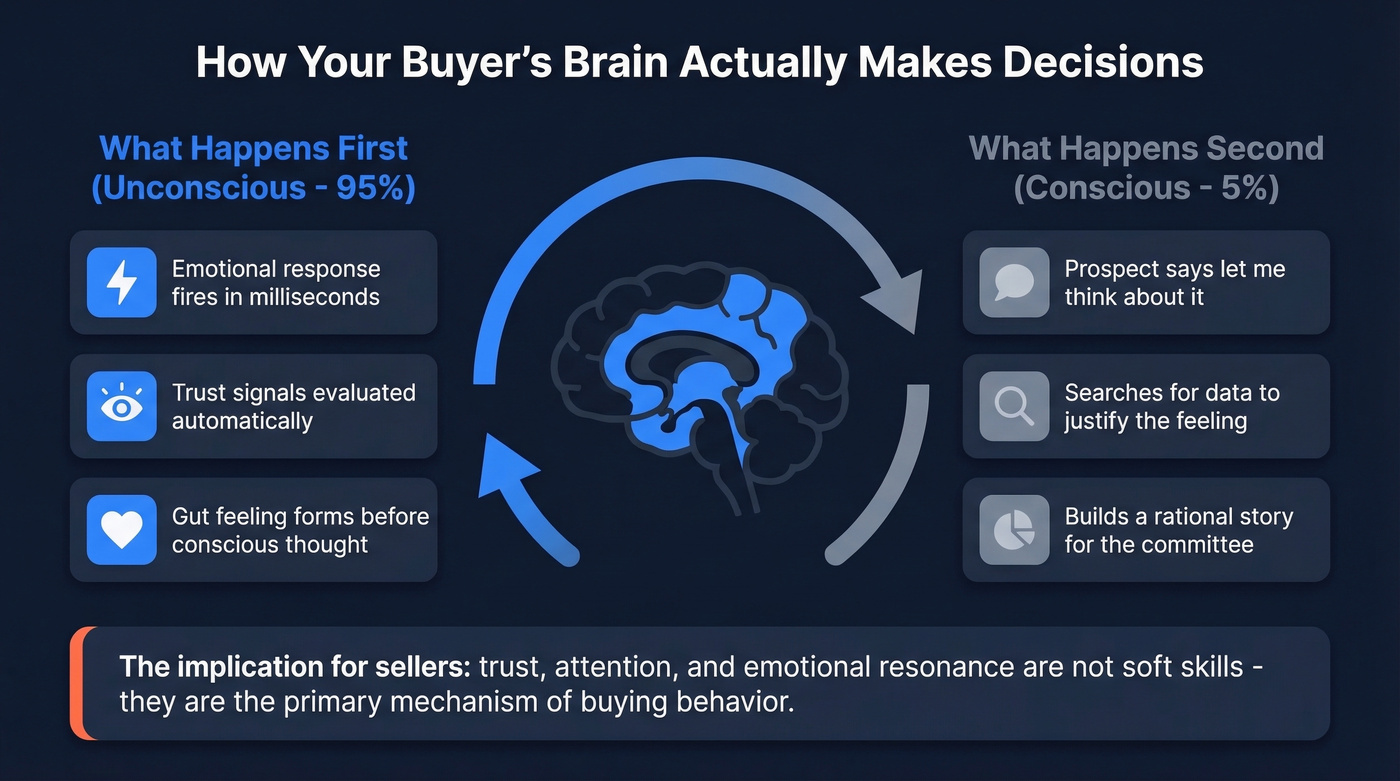
This aligns with older neuromarketing research. In the famous Coke vs. Pepsi brain scan experiment, participants who knew which brand they were drinking showed enhanced activity in brain regions tied to emotions and memories - their perception of taste changed based on the brand. The product was secondary to the story their brain told about it.
Researchers found the same pattern with wine: identical bottles labeled with different prices produced different pleasure signals in the brain. Same liquid, different story, different neurological response.
For sellers, the implication is direct. Your buyer's brain is making decisions before their conscious mind catches up. The widely cited benchmark - 95% of decision-making happens unconsciously - is directionally supported by decades of neuroscience research. By the time a prospect says "let me think about it," they're often looking for rational cover for a decision that's already forming.
The practical takeaway isn't "manipulate the unconscious." Trust signals, attention management, and emotional resonance aren't soft skills - they're the primary mechanism of buying behavior. Understanding the psychology of sales at this level separates reps who guess from reps who engineer outcomes.
Sales Psychology Principles Beyond Cialdini
Robert Cialdini's seven principles of persuasion are table stakes. Reciprocity, commitment and consistency, social proof, authority, liking, scarcity, and unity (the seventh one most articles still miss). If you're in sales, you've read Influence or at least absorbed these through osmosis. Let's go deeper.
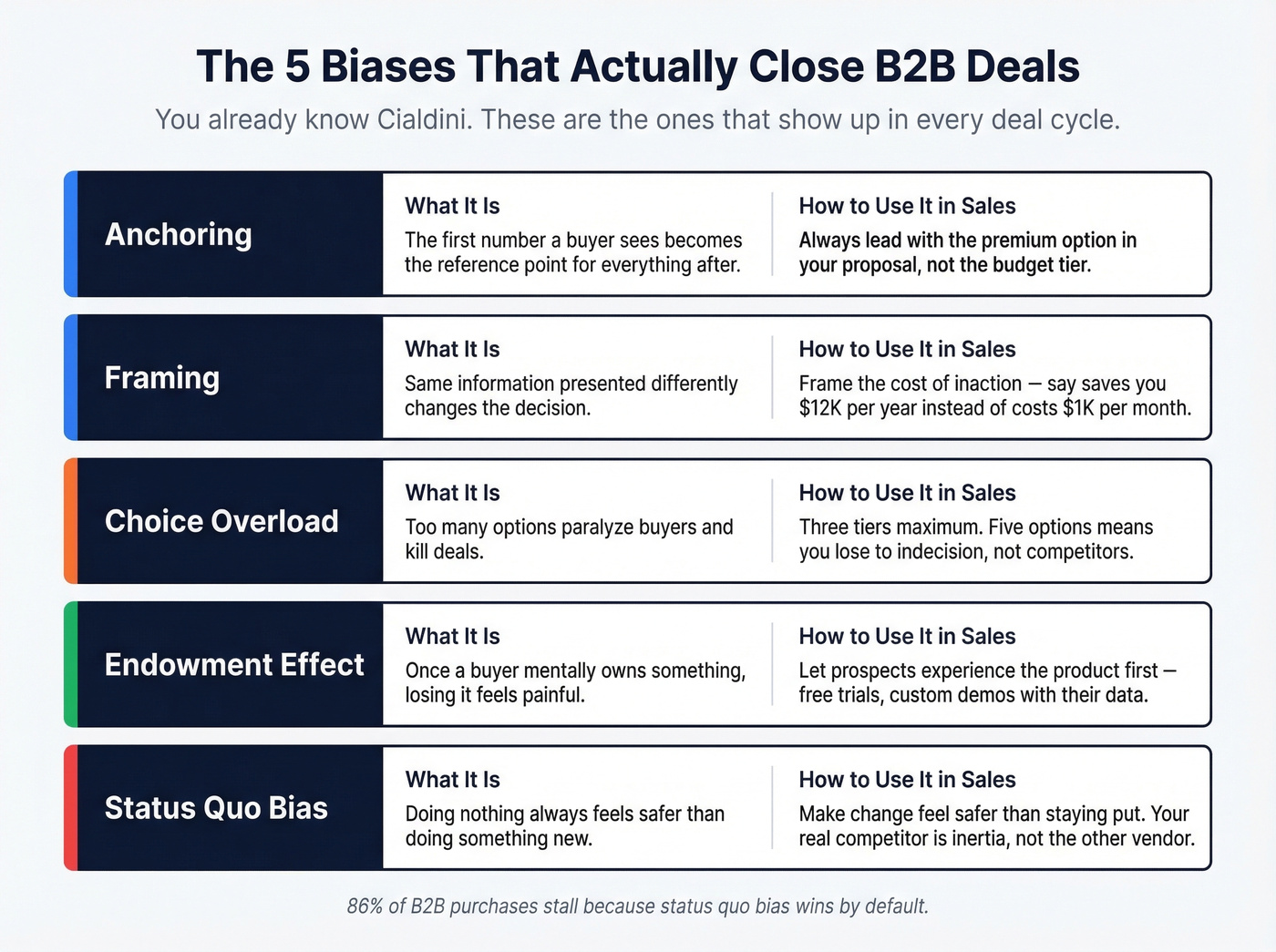
What matters more in 2026 is the set of cognitive biases that Cialdini doesn't cover but that show up in every deal cycle.
Anchoring. The first number a buyer sees becomes the reference point for everything after. This is why you lead with the premium option in a proposal, not the budget tier. Daniel Kahneman's work on anchoring showed that even random numbers influence subsequent estimates - your pricing page is doing this whether you design it to or not. (If you want to go deeper on structuring anchors in deals, see anchor price.)
Framing. "This saves you $12,000 a year" and "this costs $1,000 a month" describe the same thing. The frame changes the decision. In practice, framing the cost of inaction is one of the fastest ways to make a B2B buyer pay attention.
Choice overload. Sheena Iyengar's jam study is famous for a reason. Too many options paralyze buyers. If your proposal has five tiers, you're probably losing deals to indecision, not to competitors.
The endowment effect. Once a buyer mentally "owns" something - a free trial, a customized demo built around their data - taking it away feels like a loss. This is why the best sellers let prospects experience the product before asking for a commitment. Ownership, even psychological ownership, rewires the math. (Tactically, this shows up in a strong product demo.)
Status quo bias. Doing nothing always feels safer than doing something new. This is why 86% of B2B purchases stall - because "do nothing" is the default outcome unless you make change feel safer than staying put. Your real competitor isn't the other vendor. It's inertia.
Research from Kaski, Niemi & Pullins (2017) and Good, Mangus & Pullins (2023) reinforces a consistent finding: rapport-building and emotional intelligence measurably enhance sales effectiveness and long-term loyalty. The reps who outperform aren't the ones with the best pitch decks. They're the ones who make buyers feel understood.
The Psychology of Pricing
Pricing psychology is the most underrated weapon in a seller's toolkit, and most teams completely ignore it.
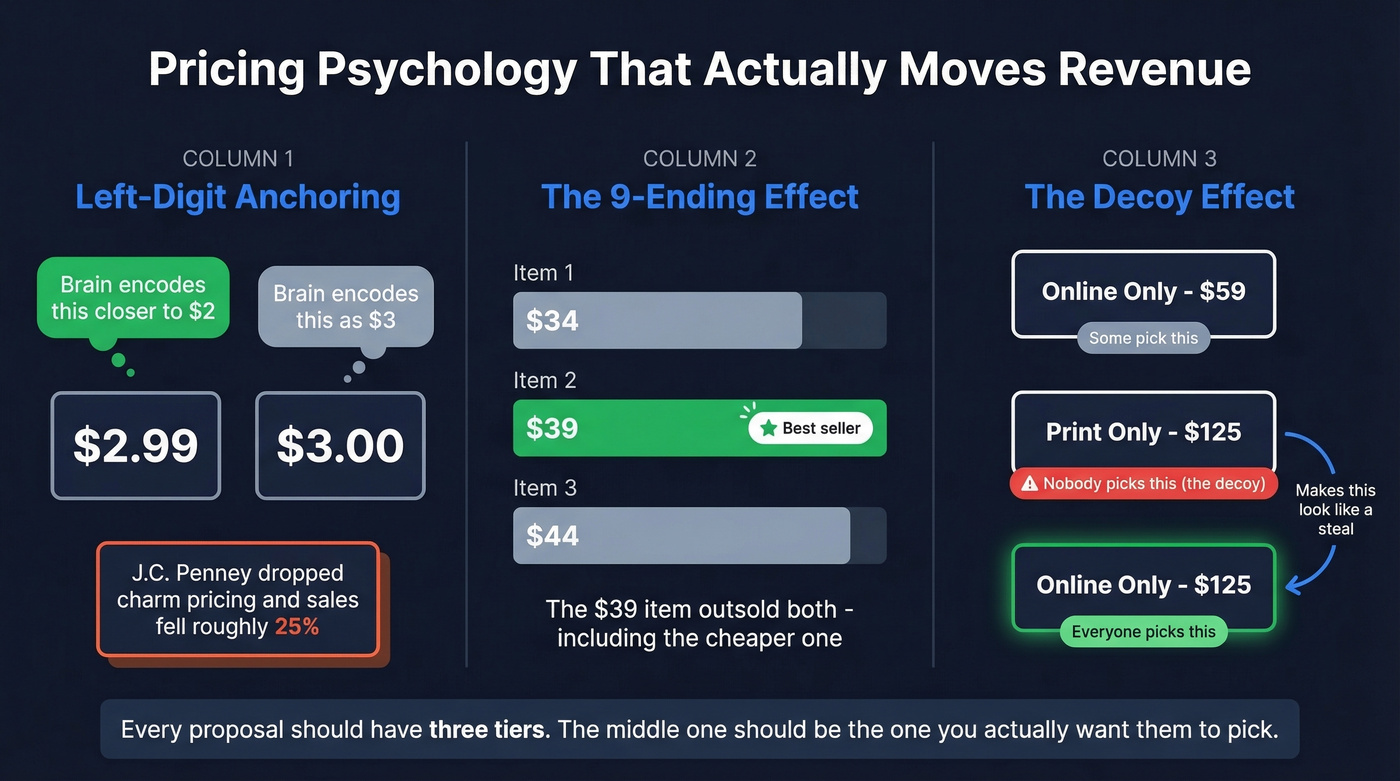
Thomas & Morwitz (2005) demonstrated the left-digit anchoring effect: $2.99 isn't perceived as "basically $3." The brain encodes it closer to $2 because the left digit anchors the estimate. An experiment attributed to MIT and the University of Chicago tested women's clothing at $34, $39, and $44. The $39 item outsold both - including the cheaper option. The 9-ending effect is real and measurable.
J.C. Penney learned this the hard way. When they eliminated charm pricing in favor of "honest" rounded prices, sales dropped roughly 25%. Buyers don't want "fair" pricing - they want to feel like they're getting a deal, even when the math is identical.
Then there's the decoy effect, which Dan Ariely made famous with The Economist subscription example. Three options: online-only at $59, print-only at $125, and print-plus-online at $125. Nobody picks print-only - it exists solely to make the combo look like a steal. This asymmetric dominance works in proposals, pricing pages, and enterprise negotiations alike.
Here's the thing: if you're sending proposals without an anchor price or a decoy option, you're leaving money on the table. Every proposal should have three tiers, and the middle one should be the one you actually want them to pick.

You just learned that 95% of buying decisions happen unconsciously. But none of those psychology principles matter if your email never reaches the buyer's inbox. Prospeo delivers 98% email accuracy with a 7-day refresh cycle - so your perfectly crafted message actually lands.
Stop wasting flawless psychology on bounced emails.
How Modern Buyers Actually Think
The buyer you're selling to in 2026 operates with a fundamentally different process than even a few years ago - and we finally have numbers that show it.
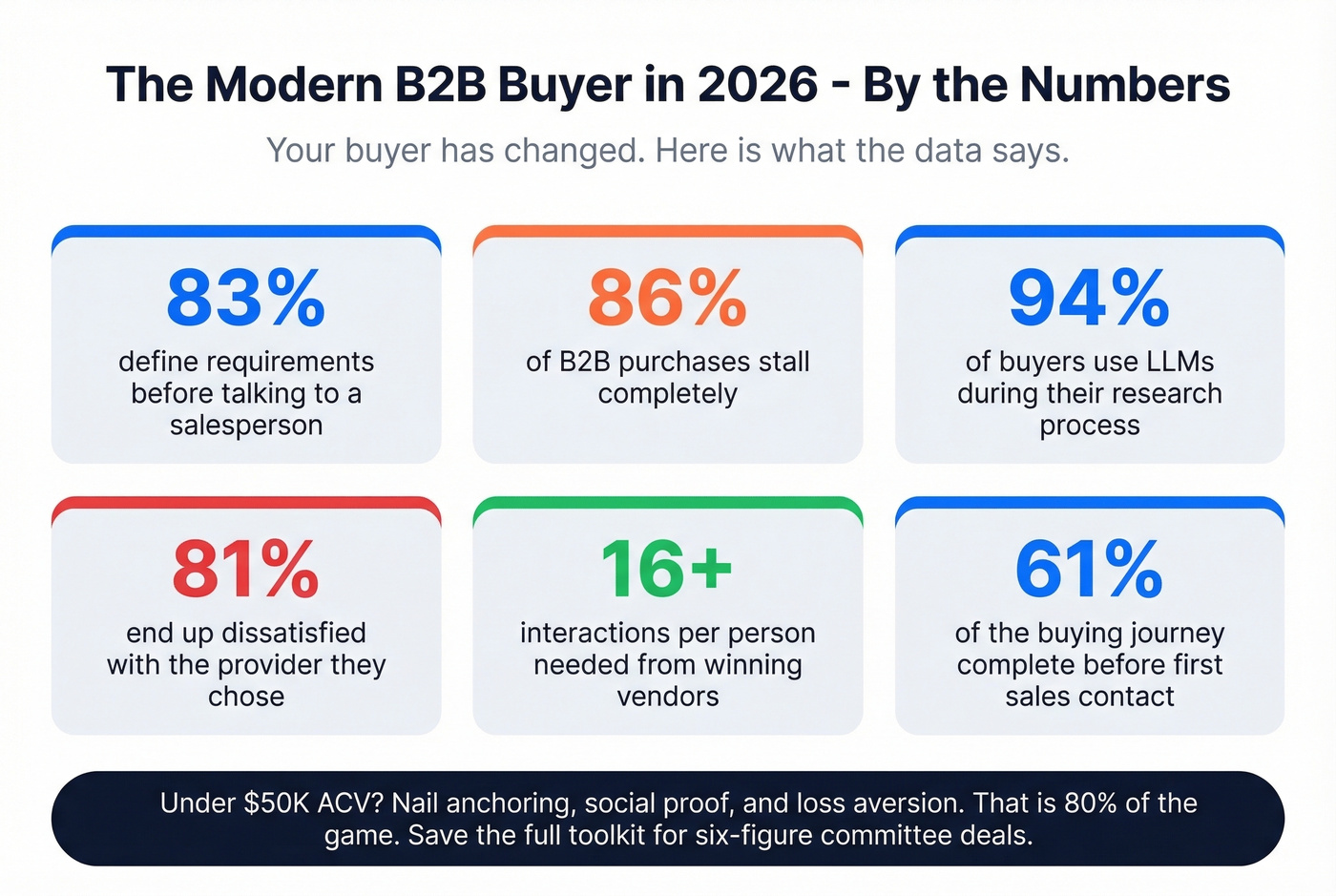
According to 6sense's research, 83% of B2B buyers define their requirements before they ever talk to a salesperson. First contact now happens at 61% of the buying journey, down from 69% - about six weeks earlier than before - partly because 62% of buyers say market pressures pushed them to engage sellers sooner. And 94% of buyers now use LLMs during their research process, so they're showing up more informed and more opinionated than ever.
The numbers that should worry you: 86% of B2B purchases stall, and 81% of buyers end up dissatisfied with the provider they chose. That's a market full of regret and indecision. Winning vendors average 16 interactions per person across the buying committee - and in B2B, that committee is often 5-10 stakeholders, not one.
Compare this to B2C, where you're usually persuading one or two decision-makers over minutes or days. B2B persuasion has to work across weeks or months, multiple personas, and a buying committee where each member has different fears and incentives. The VP of Sales cares about pipeline. The CFO cares about ROI. The end user cares about not having to learn another tool. Your psychology has to flex for all of them. (If you're selling into committees, the enterprise B2B sales motion is a different game.)
Our take: If your average deal closes under five figures, you don't need to master every principle on this page. Nail anchoring, social proof, and loss aversion. That's 80% of the game at lower ACVs. The full toolkit matters when you're selling six-figure deals to committees of eight.
Emotional Decision Making: Scripts That Work
Theory is useless without execution. Here are practical frameworks you can use in calls, emails, and proposals.
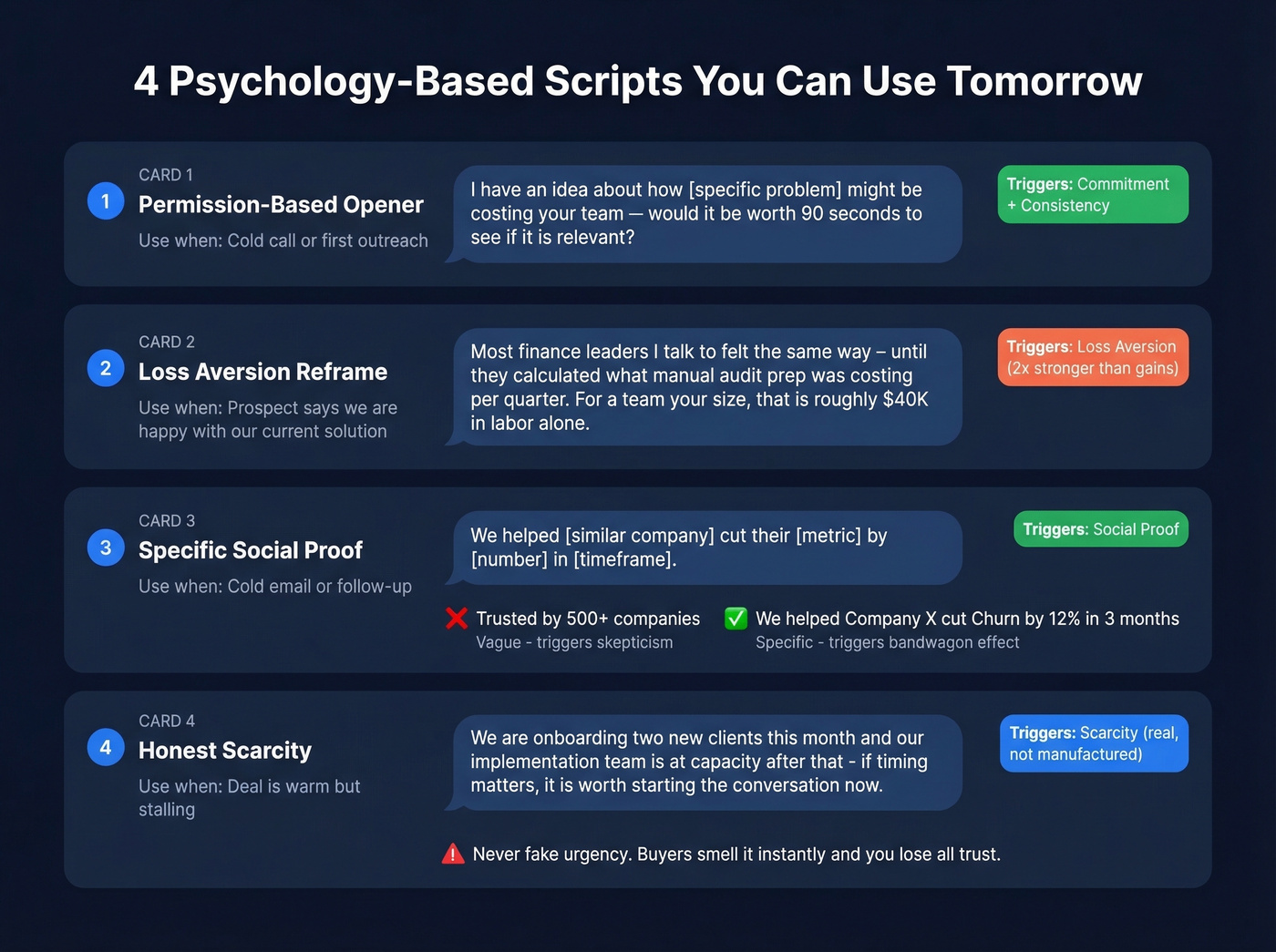
Permission-Based Openers
Instead of launching into your pitch, try: "I have an idea about how [specific problem] might be costing your team - would it be worth 90 seconds to see if it's relevant?" This triggers commitment and consistency while respecting autonomy. It outperforms traditional openers because it lowers the buyer's defensive wall immediately.
Reframing Objections with Loss Aversion
When a prospect says "we're happy with our current solution," don't argue. Reframe.
A rep selling compliance software to a mid-market CFO might say: "Most finance leaders I talk to felt the same way - until they calculated what manual audit prep was costing per quarter. For a team your size, that's roughly $40K in labor alone." Loss aversion is roughly twice as powerful as equivalent gains, so making the cost of inaction concrete hits harder than any feature pitch. This same reframe works in written proposals - quantify the status quo cost in the executive summary before presenting your pricing.
Social Proof in Cold Email
Don't just name-drop logos. Be specific: "We helped [similar company] cut their [metric] by [number] in [timeframe]." Vague social proof ("trusted by 500+ companies") triggers skepticism. Specific social proof triggers the bandwagon effect. We've seen this play out across hundreds of campaigns - the emails with one sharp proof point that mirrors the prospect's situation consistently outperform the ones stuffed with logo bars. (If you need follow-up copy to reinforce proof points, use these sales follow-up templates.)
Of course, none of this matters if the email bounces. Start with verified contact data so your message actually lands, then structure it around that single proof point. (If you're troubleshooting bounces, start with email bounce rate benchmarks and fixes.)
Honest Scarcity (Not Manufactured)
Fake urgency is the fastest way to lose trust. "Only 3 spots left!" when you have unlimited capacity is manipulation, and buyers smell it.
Honest scarcity sounds like: "We're onboarding two new clients this month and our implementation team is at capacity after that - if timing matters, it's worth starting the conversation now." True, specific, and respectful.
Persuasion vs. Manipulation
This line matters, and most sellers draw it too vaguely. A simple test: does the tactic require a lie to work?
If yes, it's manipulation:
- False urgency: "This offer expires Friday" when it doesn't
- Fake testimonials: Fabricated reviews or inflated case studies
- Reciprocity abuse: Sending a cheap gift to guilt someone into a six-figure contract
- Manufactured authority: Claiming expertise or endorsements you don't have
These tactics don't just fail ethically - they fail commercially. Buyer's remorse drives churn. Deceptive practices generate negative word-of-mouth that spreads faster than any marketing campaign. The consensus on r/sales is pretty clear on this: reps who rely on pressure tactics burn out their territories and their own credibility within months.
Ethical persuasion helps buyers make decisions they'll be happy with six months later. That's not just a moral position - it's the only sustainable revenue strategy. (If you want a deeper line-in-the-sand framework, see ethics in sales.)
The Psychology Before the Conversation
All of the above falls apart if your outreach never reaches the right person.
Call someone by the wrong name and you've lost trust before the first sentence. Send an email to a role that changed six months ago and you've wasted the touchpoint. Hit a bounced address and your domain reputation takes the hit - which means your next 500 emails land in spam too. (This is why email deliverability is a systems problem, not a copy problem.)
This is where data quality becomes the prerequisite for everything else. Prospeo covers 300M+ professional profiles with 98% email accuracy and a 7-day data refresh cycle - compared to the six-week industry average. Meritt, one of their customers, saw their bounce rate drop from 35% to under 4% after switching. When your emails actually land, the psychology has a chance to work. When they bounce, nothing else matters. (If you're evaluating vendors, start with data enrichment services.)
83% of B2B buyers define requirements before talking to sales. That means your first touchpoint has to be precise - right person, right moment, right data. Prospeo's intent data tracks 15,000 topics so you reach buyers while they're actively researching, not after they've already decided.
Reach in-market buyers before your competitors even know they exist.
FAQ
What is selling psychology?
Selling psychology is the study of how cognitive biases, emotions, and social dynamics influence buying decisions. It encompasses neuroscience research, pricing behavior, trust mechanics, and persuasion principles - going well beyond simple "sales tricks" into how the brain actually processes purchasing choices.
What are the 7 principles of persuasion?
Cialdini's seven principles are reciprocity, commitment and consistency, social proof, authority, liking, scarcity, and unity. Anchoring, framing, loss aversion, the endowment effect, and status quo bias are equally critical in modern sales - especially in B2B deal cycles with multiple stakeholders.
Is sales psychology manipulation?
No - unless a tactic requires a lie to work. Fake urgency, fabricated testimonials, and manufactured scarcity are manipulation. Ethical selling psychology helps buyers make decisions they'll genuinely be satisfied with afterward, which also drives lower churn and higher lifetime value.
What's the best book on selling psychology?
Brian Tracy's The Psychology of Selling covers mindset and fundamentals. Cialdini's Influence is the definitive guide to persuasion principles. For the deepest understanding of how decisions actually work at a neurological level, Kahneman's Thinking, Fast and Slow is unmatched.
How do I apply sales psychology to cold outreach?
Start with verified contact data so bounces don't kill your credibility before the message is read. Then structure your email with a personalized opener using reciprocity, specific social proof in the body, and a single clear CTA. One ask, one proof point, one reason to reply.