

15 Selling Tactics That Actually Work in 2026
You just pulled your pipeline report. Win rate: 19%. Half the "losses" aren't even losses - they're prospects who went silent, never said no, and never said yes. The deals didn't die. They just... stopped.
That's the selling problem most teams actually have, and generic advice about "building rapport" won't fix it. These 15 selling tactics will.
If You Only Do Three Things
- Respond in under 5 minutes. Leads contacted within 5 minutes convert at 9x the rate of those contacted later. Set an SLA and enforce it.
- Multi-thread 3+ contacts in the buying group. Engaging three or more stakeholders produces a 2.4x higher close rate. Single-threaded deals die when your champion goes on vacation.
- Help the buyer decide, don't just sell the product. 87% of deals show medium-to-high buyer indecision. The JOLT framework exists specifically to address this - learn it.
One prerequisite cuts across all three: verify your contact data before outreach. Bad emails and dead phone numbers make speed-to-lead impossible and multi-threading a fantasy.
What Are Selling Tactics?
A selling tactic is a specific, repeatable move a rep makes during a deal to advance it toward closed-won. It's not a strategy, and it's not a methodology. Your strategy is the plan - who you sell to, at what price, through which channels. Your methodology is the operating system: SPIN, Sandler, Challenger, MEDDIC. Tactics are the individual plays you run inside that system.
None of those methodologies tell you exactly what to do when a champion goes dark on day 14, or when a CFO joins the thread and asks for a pilot instead of a contract. That's where tactics live - in the gap between methodology and execution. The 15 below aren't tied to any single framework, and they plug into whatever system you're already running.
Buyers Changed. Your Tactics Should Too.
A 6sense study of roughly 4,000 B2B buyers confirmed what most sellers already feel: the game moved upstream. Buyers select a favored vendor before they ever talk to sales, and that pre-contact favorite wins about 80% of the time. Even more stark - 95% of the time, the winning vendor was already on the buyer's Day One shortlist.
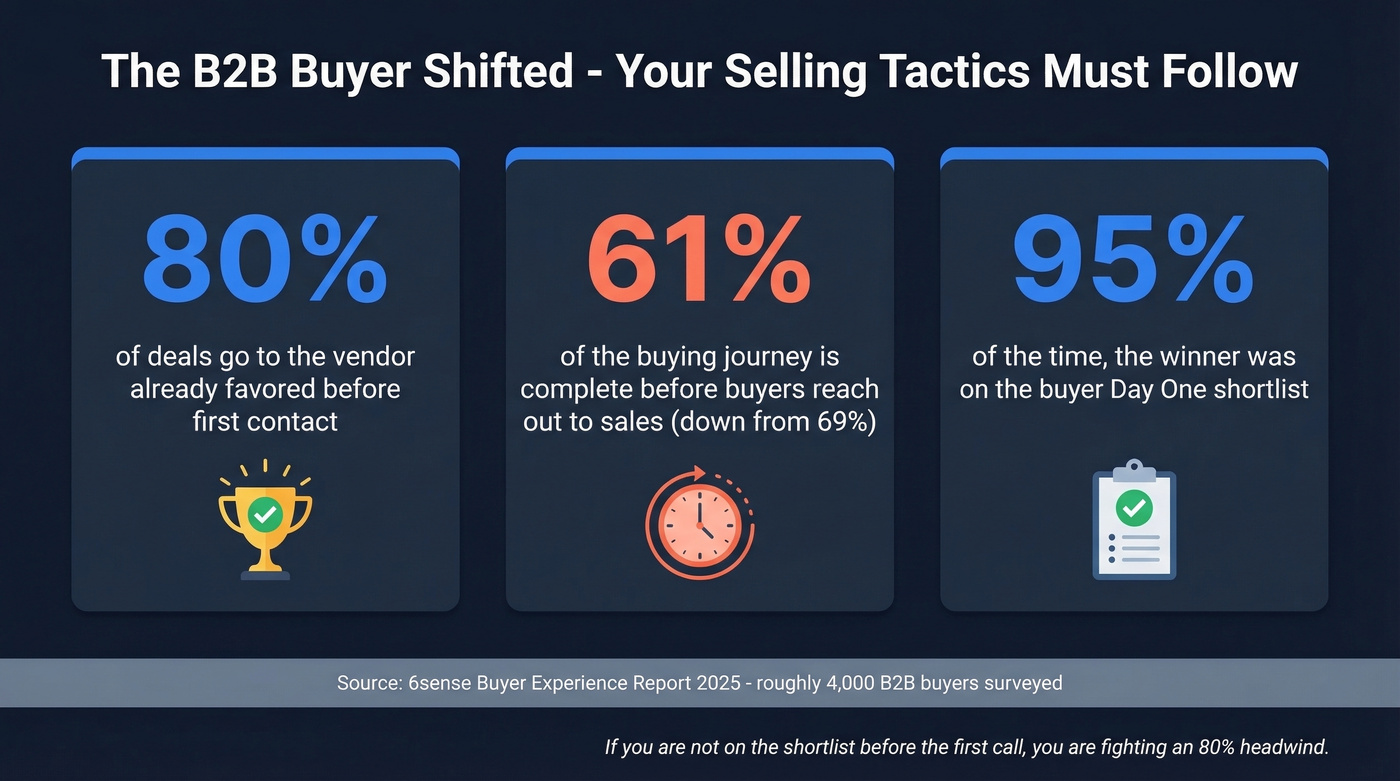
The point of first contact shifted from 69% to 61% of the buying journey, roughly 6-7 weeks earlier than the year before. Cycles compressed from 11.3 months to 10.1. Nearly 90% of buyers said AI features were part of the solutions they acquired, pulling evaluation timelines forward.
What this means in practice:
- You're not creating preference - you're confirming it. If you're not on the shortlist before the first call, you're fighting an 80% headwind.
- Earlier contact isn't a gift. Buyers reach out sooner because they have harder questions about AI pricing, security, and implementation - not because they're more open-minded.
- Speed and relevance beat persistence. The old playbook of grinding through 20 touches matters less when buyers already know who they want.
Benchmarks That Matter
These numbers come from recent benchmark analyses and they're sobering.
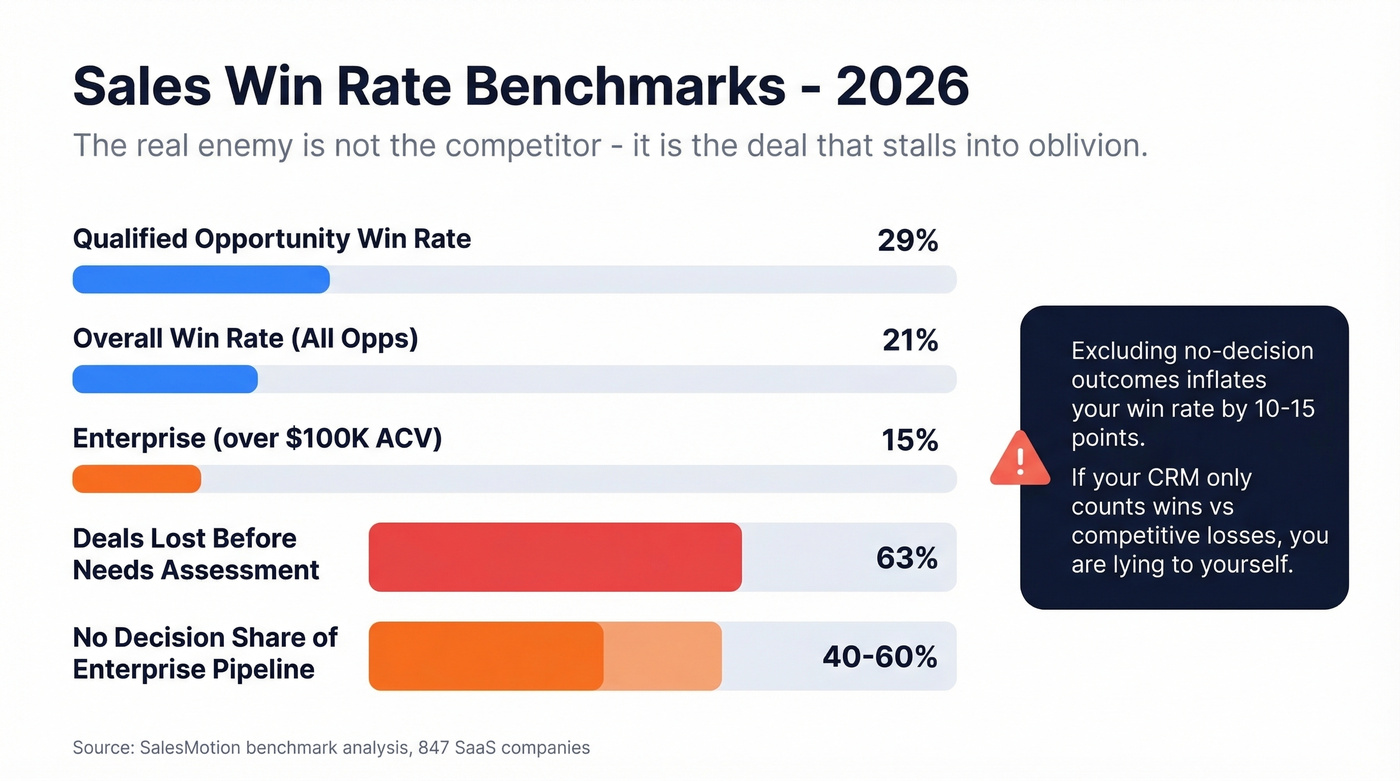
| Metric | Benchmark | Context |
|---|---|---|
| Overall win rate | ~21% | All opportunities |
| Qualified opp win rate | ~29% | After proper qualification |
| Enterprise (>$100K ACV) | ~15% | Median across 847 SaaS cos |
| "No decision" share | 40-60% | Enterprise pipeline |
| Stage loss before needs assessment | 63% | Discovery + qualification |
Excluding "no decision" outcomes inflates your win rate by 10-15 points. If your CRM only counts wins vs. competitive losses, you're lying to yourself. The real enemy isn't the competitor - it's the deal that stalls into oblivion.

Every tactic on this list - speed-to-lead, multi-threading, persistent follow-up - breaks down the moment you hit a bad email or dead phone number. Prospeo delivers 98% email accuracy and 125M+ verified mobile numbers with a 30% pickup rate, refreshed every 7 days.
Stop losing deals to bad data. Start closing them with verified contacts.
The 15 Tactics (With Scripts)
1. Respond in 5 Minutes
Speed-to-lead is the highest-leverage tactic in sales. The data is unambiguous: leads contacted within 5 minutes are 9x more likely to convert, calling within one hour produces a 450% higher response rate, and the first vendor to respond wins 35-50% of deals.
Use this on every inbound lead, every demo request, every hand-raise signal. No exceptions. If you can't hit 5 minutes, fix your routing before you fix anything else. Quick checklist: round-robin routing configured, Slack alerts on form fills, mobile notifications enabled, backup rep assigned for off-hours.
2. Follow Up 5-12 Times
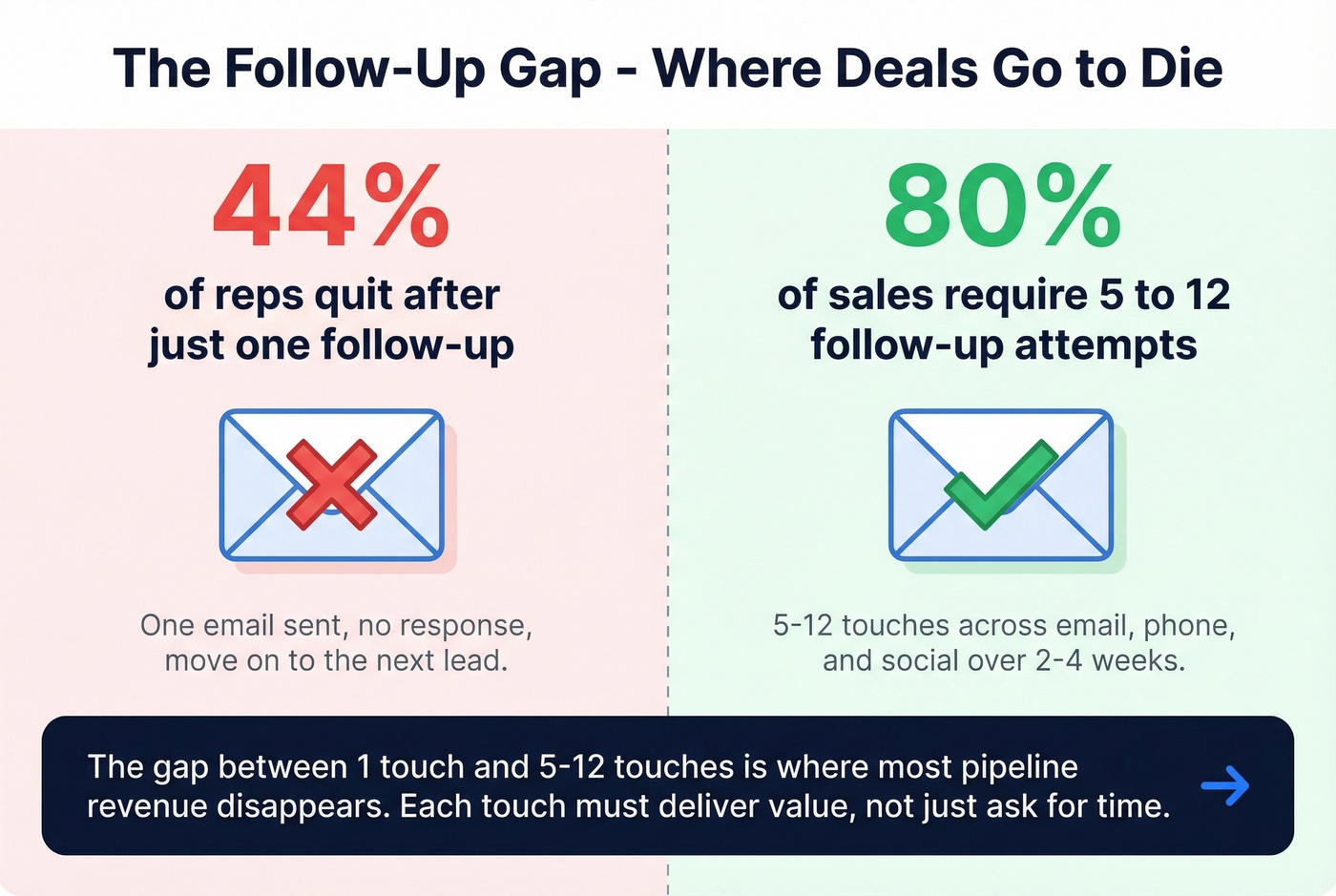
80% of sales require 5-12 follow-up attempts. Yet 44% of reps quit after a single follow-up. That gap is where deals go to die. Here's a cadence that hits 16 touchpoints in 2-4 weeks:
| Day | Channel | Action |
|---|---|---|
| 1 | Personalized intro (insight-led) | |
| 2 | Phone | Call + voicemail |
| 3 | Social | Comment or DM |
| 5 | Follow-up with proof point | |
| 7 | Phone | Second call attempt |
| 8 | Short video (30 sec) | |
| 10 | Social | Share relevant content |
| 12 | Phone | Third call |
| 14 | Breakup email |
Run this on every net-new outbound sequence. The only exception: if the prospect explicitly asks you to stop. Persistence is one of the most underrated skills in sales, but only when each touch delivers value.
3. Beat "No Decision" With JOLT
Your biggest competitor isn't the other vendor. It's indecision. The JOLT Effect research analyzed 2.5 million recorded sales conversations and found that 87% of deals show medium-to-high buyer indecision. When indecision is high, win rates crater to 6%.
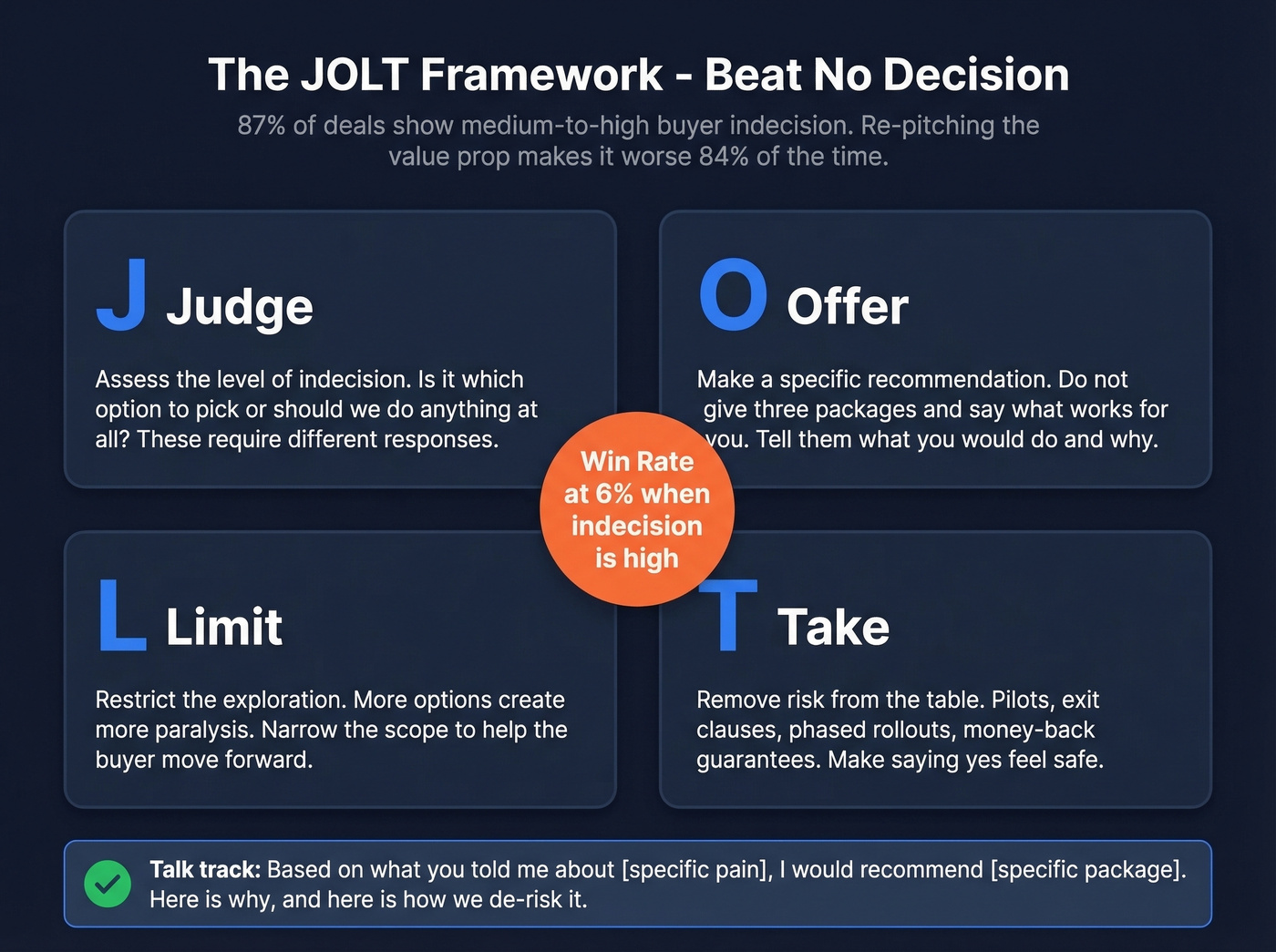
Here's what makes this worse: 73% of reps respond to cold feet by re-pitching the value prop. In 84% of those interactions, this increased the likelihood the deal would be lost. Re-pitching feels productive. It isn't.
The JOLT framework flips the script:
- Judge the level of indecision - "which option?" vs. "should we do anything?"
- Offer your recommendation - don't give three packages and say "what works for you?"
- Limit the exploration - more options create more paralysis
- Take risk off the table - pilots, exit clauses, phased rollouts
Talk track: "Based on what you've told me about [specific pain], I'd recommend [specific package]. Here's why - and here's how we de-risk it if it doesn't work."
4. Multi-Thread the Buying Group
B2B buying groups average 6-10 stakeholders. Engaging 3+ contacts per deal produces a 2.4x higher close rate - 3.1x for enterprise. When Palo Alto Networks shifted to buying group orchestration, their win rates doubled.
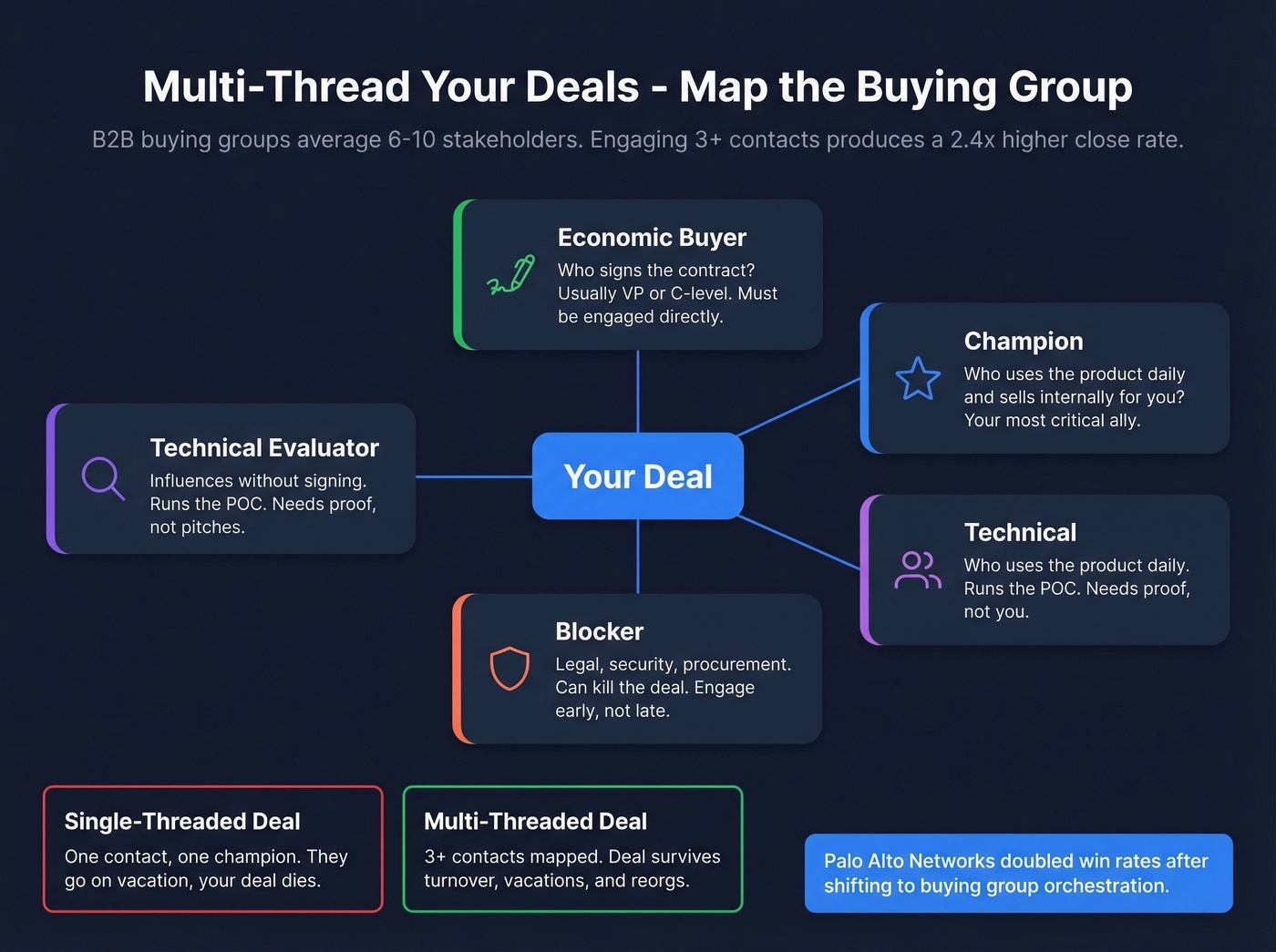
Skip this if you're running high-velocity, single-buyer SMB deals where the user is the buyer. For everything over $25K ACV, map these four roles: who signs the contract (economic buyer), who uses the product daily (champion), who can kill the deal (legal, security, procurement), and who influences without signing (technical evaluator, executive sponsor). If you can't name at least three people, your deal is single-threaded and at risk.
5. Qualify With MEDDIC
Documented qualification criteria correlate with 40% higher close rates. MEDDIC gives you the framework: Metrics (what outcomes?), Economic Buyer (who signs?), Decision Criteria (how will they evaluate?), Decision Process (what steps remain?), Identify Pain (cost of inaction?), Champion (who's selling internally?).
Use this on every deal that enters your qualified pipeline. Don't force full MEDDIC on a $500/mo self-serve deal - scale the rigor to the deal size. Mastering qualification is what separates quota-crushers from quota-missers. (If you want a deeper checklist, start with MEDDIC.)
6. Lead With Unconsidered Needs
If the buyer already has a favorite before talking to you - and 80% of the time, they do - validating their known needs just confirms their existing preference. Corporate Visions and Emblaze found that introducing unconsidered needs increases persuasive impact by 10% compared to validating what the buyer already knows.
Before: "I see you're looking for a faster CRM. We're the fastest on the market."
After: "Most teams shopping for a faster CRM don't realize the real bottleneck is data entry, not load times. We eliminated manual entry entirely - and that's where the 40% time savings actually comes from."
This is a challenger move. Use it in first meetings with prospects who already have a shortlist. If you're the incumbent, skip it - unconsidered needs work for challengers, not defenders.
7. Use Micro-Proof, Not Big Claims
Generic ROI claims ("we save companies 30%") bounce off buyers. Micro-proof - small, specific, verifiable results from similar customers - lands harder. Invensis Technologies shifted to a micro-proof strategy and saw closed-won rates jump from 21% to 29%, with sales cycles shrinking by roughly 2 weeks.
Three scripts you can steal:
- "Our customer [similar company] cut their [specific metric] from X to Y in [timeframe]. Happy to intro you to their VP of Ops."
- "Here's a 90-second Loom showing exactly how [similar customer] uses our [feature] in their daily workflow."
- "We ran a pilot with [company in their industry] last quarter. Here's the before/after dashboard - no NDA needed."
8. Personalize With Short Video
A 30-45 second Loom or Vidyard video outperforms text-only outreach by a wide margin. One CMO at AIG Marketer saw a 34% increase in meeting bookings and 19% higher closed-won rates. McKinsey's analysis backs this up: personalization drives 10-15% revenue increases, with top performers seeing up to 25%.
Template (30-45 seconds): Open with something specific about their company - a hiring post, product launch, or tech stack change. Bridge to a micro-proof from a similar company. Close with a 15-minute ask and a calendar link. Worth the 3-minute recording investment for high-value prospects; skip it for high-volume sequences targeting hundreds of contacts. (More examples: Loom.)
9. Run Insight-First Prospecting
Nextiva's shift from high-volume outbound to insight-first prospecting - 30-40 accounts per week, enriched with AI account intelligence - produced dramatic results: closed-won rate went from 12% to 19% in 90 days, average deal size increased 14%, and revenue per rep climbed 22%.
Three steps: pick 30-40 accounts showing buying signals (hiring, funding, tech changes, intent surges). Build a custom insight for each account - not "I saw your company is growing" but "You just posted 3 SDR roles and adopted Outreach, so your team is probably hitting data quality issues." Lead with the insight in your first touch. The insight is the hook, not your product. (If you need more ideas, see sales prospecting techniques.)
10. Use AI to Prepare, Not to Replace
AI in sales breaks into three buckets. Automation handles CRM updates, meeting summaries, and follow-up drafts - Salesforce data shows reps spend 70% of their time on non-selling tasks. Augmentation covers real-time call coaching and objection handling - Harvard Business School research found skilled workers using GenAI perform roughly 40% better. Analysis means pipeline pattern detection, deal scoring, and forecast modeling.
Edstellar's AI-driven context-first flow lifted enterprise conversion from 18% to 27% and cut sales cycles by 12 days. We've tested similar approaches across teams and the pattern holds: use AI for pre-call research and post-call reinforcement, but don't let it replace the human conversation. Buyers can tell when an entire email is AI-generated. (Related: AI sales follow-up.)
11. Verify Contact Data First
Every tactic above assumes you can actually reach the prospect. If 35% of your emails bounce and your phone numbers are disconnected, speed-to-lead is impossible and your personalized Loom videos land in spam folders.
Here's the thing: domain reputation is fragile. One bad batch of emails can tank your sender score for weeks, and a single invalid address in an enterprise thread can break the entire engagement chain. Snyk's 50-person AE team was bouncing 35-40% of emails before cleaning their data. After switching to verified data through Prospeo: bounce rate under 5%, AE-sourced pipeline up 180%, 200+ new opportunities per month.
The workflow is straightforward - search by 30+ filters (job title, company size, tech stack, intent signals), verify in bulk, and push directly into your stack via native integrations with Salesforce, HubSpot, Smartlead, Instantly, Lemlist, Salesloft, Outreach, Clay, Zapier, n8n, or Make. (If deliverability is a recurring issue, start with email deliverability and email bounce rate.)
None of the other 14 tactics work if your data is garbage.
12. Expand Accounts on Purpose
Upsell and cross-sell can drive roughly 20% additional sales according to McKinsey's analysis. Yet most teams treat expansion as an afterthought - something that happens when a customer asks, not something reps proactively pursue.
Build a trigger list and check it monthly: new executive hired means new budget and new priorities, headcount growth above 15% signals scaling pains, a new tool adopted creates integration opportunity, contract renewal within 90 days opens the expansion window, and support ticket volume spikes reveal pain worth solving. Use this on any account with a healthy NPS and at least 6 months of usage - but fix retention before you pitch expansion to at-risk accounts. (See also: cross-sell vs up-sell.)
13. Ask for Referrals at the Right Moment
Most reps never ask. The ones who do ask at the wrong time. Sales practitioners consistently rank referrals as the highest-converting lead source, yet it remains the most underused tactic in outbound. Use the Rule of 3 - three natural moments when a referral request feels earned:
- After value delivered: "You just hit [milestone] with our platform. Know anyone else dealing with [same problem]?"
- After a win: "Congrats on [result]. Who else on your team - or at another company - would benefit from this?"
- After expansion: "You just added [new team/use case]. Anyone come to mind who's facing similar challenges?"
14. Make Risk Smaller
This ties directly back to JOLT's "Take risk off the table." When a buyer is indecisive, reducing perceived risk is more effective than increasing perceived value. Four risk-reversal options to keep in your back pocket: a 60-day pilot scoped to one team, a 90-day exit clause on the annual contract, a fast-tracked security review to remove that blocker, or a phased rollout where Phase 2 only happens after Phase 1 delivers results.
Use these on late-stage deals showing indecision signals - delayed responses, new stakeholders appearing, "we need more time." If the buyer is ready to sign, don't introduce doubt by offering escape hatches they didn't ask for.
15. Audit Your Own Calls Weekly
We've seen reps improve faster from self-audits than from manager coaching sessions. In our experience, the reps who hit President's Club aren't the most naturally talented - they're the most self-critical. Spend 15 minutes every Friday reviewing one call with this scorecard:
- Talk/listen ratio - were you under 40% talk time?
- Next step clarity - did you leave with a specific, calendared next action?
- Stakeholder coverage - did you ask about other decision-makers?
- Proof used - did you share at least one micro-proof point?
- Decision friction addressed - did you surface and address indecision?
Score each 1-5. Track weekly. The patterns reveal themselves within a month. (If you want more structure, use these sales activities.)
Choosing Tactics by Deal Type
Not every tactic applies to every deal. The average B2B tech sales cycle reached 6.5 months, up from 4.9 months in 2019. Enterprise cycles run 6-12+ months with 6-25 stakeholders. SMB deals close in 1-3 months with one or two buyers.
| Tactic | SMB | Enterprise |
|---|---|---|
| Speed-to-lead | Must | Must |
| Follow up 5-12x | Must | Must |
| JOLT (beat indecision) | Nice | Must |
| Multi-thread | Nice | Must |
| MEDDIC qualification | Nice | Must |
| Unconsidered needs | Nice | Must |
| Micro-proof | Must | Must |
| Personalized video | Nice | Must |
| Insight-first prospecting | Nice | Must |
| AI preparation | Nice | Must |
| Verify contact data | Must | Must |
| Expand accounts | Nice | Must |
| Referrals | Must | Nice |
| Make risk smaller | Nice | Must |
| Weekly call audit | Must | Must |
For SMB, speed and follow-up cadence drive the most leverage. For enterprise, multi-threading, JOLT, and MEDDIC are non-negotiable - without them, you're just hoping your single-threaded champion can sell internally better than you can.
Hot take: If your ACV is under $15K, you probably don't need half the tactics on this list. Speed-to-lead, persistent follow-up, micro-proof, and clean data will get you 80% of the way there. The complex plays earn their keep on enterprise deals where a single stalled opportunity costs you a quarter. (More benchmarks: B2B sales.)
Tactics That Backfire
Let's talk about what to stop doing.
Fake scarcity and manufactured urgency damage trust faster than almost anything else. HubSpot's analysis highlights manipulation tactics - exaggerated social proof, artificial deadlines, aggressive pressure - as trust killers that push deals into "no decision." Bryan Vasquez, Head of Sales at LinkBuilder.io, put it bluntly: urgency and scarcity manipulation "can backfire fast." His team replaced urgency-based CTAs with data-backed proposals and tailored value maps, and the result was a 20% win-rate increase over two quarters.
We've seen the same pattern across teams we work with - the moment reps stop manufacturing urgency and start helping buyers decide, close rates climb.
Other tactics to retire: sending a pitch deck two minutes into a call before you've earned the right to pitch, "just checking in" follow-ups that deliver zero value, and discounting before being asked, which signals desperation and anchors the buyer to a lower price permanently.
Your Next 7 Days
Pick one tactic per day. By Friday, you'll have a fundamentally different sales motion.
- Day 1: Set a speed-to-lead SLA. Configure routing so every inbound lead gets a response within 5 minutes.
- Day 2: Pick your three highest-value open deals. Map the buying group for each. Identify stakeholders you haven't engaged.
- Day 3: Write a JOLT talk track for your most common indecision scenario. Practice it with a colleague. (More scripts: talk track examples.)
- Day 4: Audit your contact data. Upload your active prospect list to Prospeo and verify emails and phone numbers. Remove anything that bounces.
- Day 5: Record one personalized video for a high-value prospect. Keep it under 45 seconds.
- Day 6: Build a MEDDIC checklist in your CRM. Add the six fields as required before any deal moves past qualification.
- Day 7: Pull your last recorded call. Run the 5-point self-audit scorecard. Be honest with yourself.
Stacking these selling tactics one per day is how compound improvement kicks in - not by overhauling everything at once.
You can't multi-thread 3+ stakeholders if you only have one contact per account. Prospeo's 300M+ profiles with 30+ filters - including buyer intent, job changes, and department headcount - let you map the entire buying group in minutes, not days.
Map every decision-maker before your competitor finds the first one.
FAQ
What are selling tactics vs. sales strategies?
A sales strategy is your overarching plan - who you target, how you position, which markets you pursue. Selling tactics are the specific moves reps execute within that strategy to advance individual deals. Methodologies like SPIN, Challenger, and MEDDIC sit between the two as operating frameworks.
What's the fastest tactic to improve win rate?
Speed-to-lead combined with persistent follow-up. Responding within 5 minutes produces a 9x conversion improvement, and 80% of sales require 5-12 follow-ups while 44% of reps quit after one. Fixing these two gaps alone can move your win rate within a single quarter.
How do you stop deals from stalling to "no decision"?
Use the JOLT framework: Judge the buyer's indecision level, Offer a specific recommendation, Limit further exploration, and Take risk off the table with pilots or exit clauses. Re-pitching value when buyers hesitate increases loss likelihood 84% of the time.
How many stakeholders should you engage in B2B?
B2B buying groups include 6-10 stakeholders, and engaging 3+ contacts per deal produces a 2.4x higher close rate. Map the economic buyer, end users, technical evaluators, and potential blockers early. Single-threaded deals are the most common reason enterprise opportunities stall.
How do I keep bounce rates low in outbound?
Verify every email before it enters your sequence. A 5-step verification process with catch-all handling delivers 98% email accuracy - teams like Snyk dropped from 35-40% bounces to under 5% after switching to verified data. Upload your list, verify in bulk, and remove invalid addresses before sending.