

Skyp vs Apollo.io: Competitors or Stack Partners?
Skyp vs Apollo.io is the wrong framing - they do fundamentally different jobs. Apollo is a lead database with sequences bolted on. Skyp is an AI email writer with managed sending infrastructure bolted on. Most teams run both, and the real question isn't which one wins but which one you actually need and what data source sits underneath everything.
30-Second Verdict
If you need contacts and search filters, Apollo. If you need AI-written emails that don't read like a mail merge, Skyp. If you need both, pair Skyp with a dedicated data source - you'll get better accuracy for less money than using Apollo as your data layer.
What Each Tool Actually Does
Apollo.io
Use this if you need a massive B2B contact database with built-in sequencing. Apollo covers 275M+ contacts, 65+ search filters, and a free tier. It holds a 4.7/5 on G2 across 9,500+ reviews.
Skip this if you care about AI email quality. Apollo's composer stuffs personalization tokens into templates, and the result looks exactly like what it is. One Reddit user put it bluntly: Apollo "creates very AI-looking emails" because it personalizes parts of a template rather than crafting the whole message. We've seen the same thing across dozens of client campaigns - the output is recognizable from a mile away.
Skyp
Use this if you want AI-written emails that pass the eye test, plus done-for-you domain setup, inbox warming, and deliverability management. Skyp writes unique emails per prospect - not templates with {{first_name}} swapped in.
Skip this if you need a lead database. Skyp doesn't have one. You'll pair it with Apollo, Clay, or another data provider for contact sourcing.
Feature Comparison
| Category | Apollo.io | Skyp | Winner |
|---|---|---|---|
| Primary use | Lead database + sequences | AI email writing + sending | Depends on need |
| AI email quality | Template + merge fields | Unique per prospect | Skyp |
| Deliverability mgmt | DIY | Done-for-you infra | Skyp |
| Contact database | 275M+ contacts | None | Apollo |
| Intent triggers | Basic signals | Website visits, hires, funding | Skyp |
| Entry price | Free / $59/user/mo | $99/mo (Pro) | Apollo |
| Setup time | Minutes | ~2 weeks including warmup | Apollo |
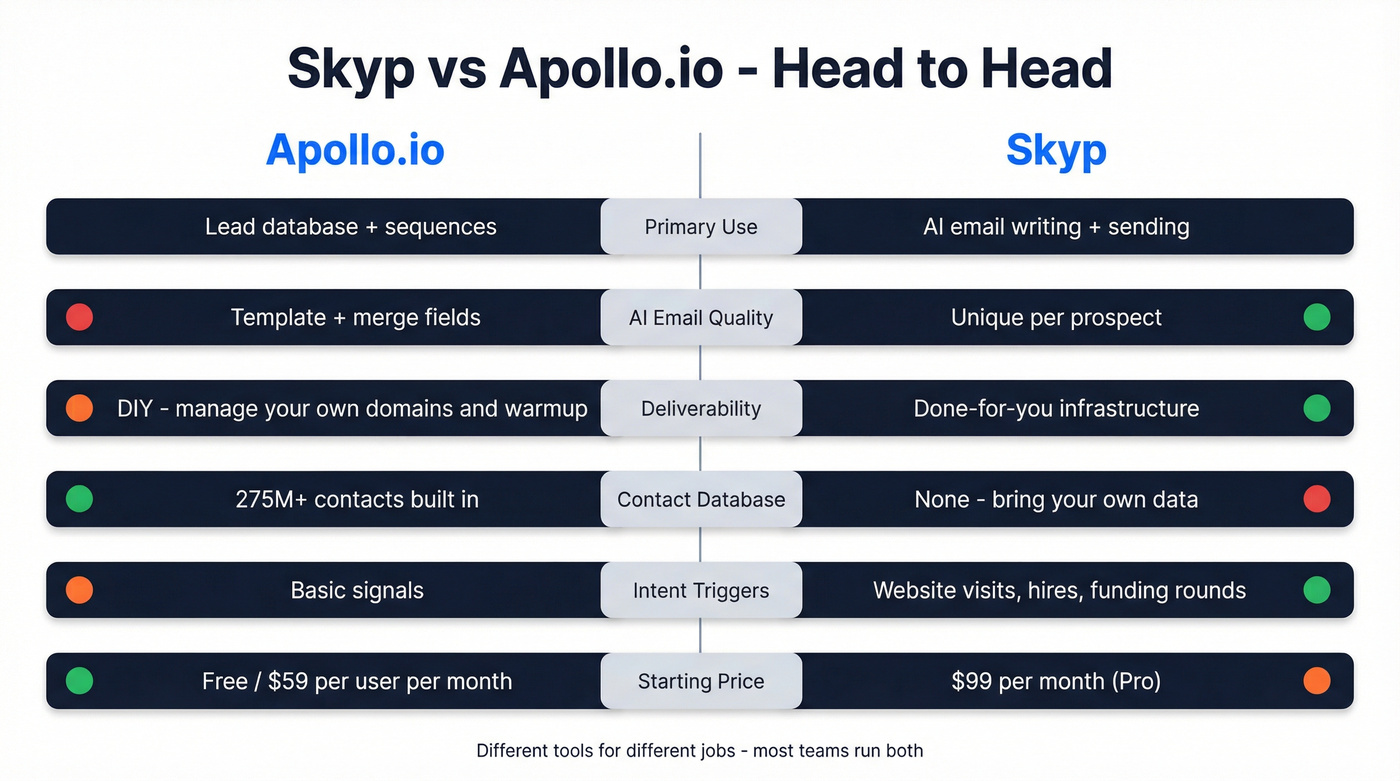
Here's the thing about Apollo's "verified" emails: they have a well-documented accuracy problem. Teams have posted about bounce rates hitting 15-35%, with complaints surfacing as early as January 2025 and continuing through 2026. Skyp's managed infrastructure handles deliverability on the sending side, but it can't fix bad data going in - garbage in, garbage out. (If you're troubleshooting bounces, start with email bounce rate benchmarks and root causes.)

Apollo's bounce rates hit 15-35%. Skyp can't fix bad data going in. Prospeo's 5-step verification delivers 98% email accuracy at $0.01/lead - refreshed every 7 days, not every 6 weeks. Feed Skyp cleaner data and stop burning domains.
Replace Apollo's data layer with 143M+ verified emails starting free.
AI Email Quality
This is the real differentiator. Apollo's AI composer takes a template, drops in merge fields, and calls it personalization. The output reads like exactly what it is. If you're trying to improve the writing layer, see our guide to AI cold email outreach.
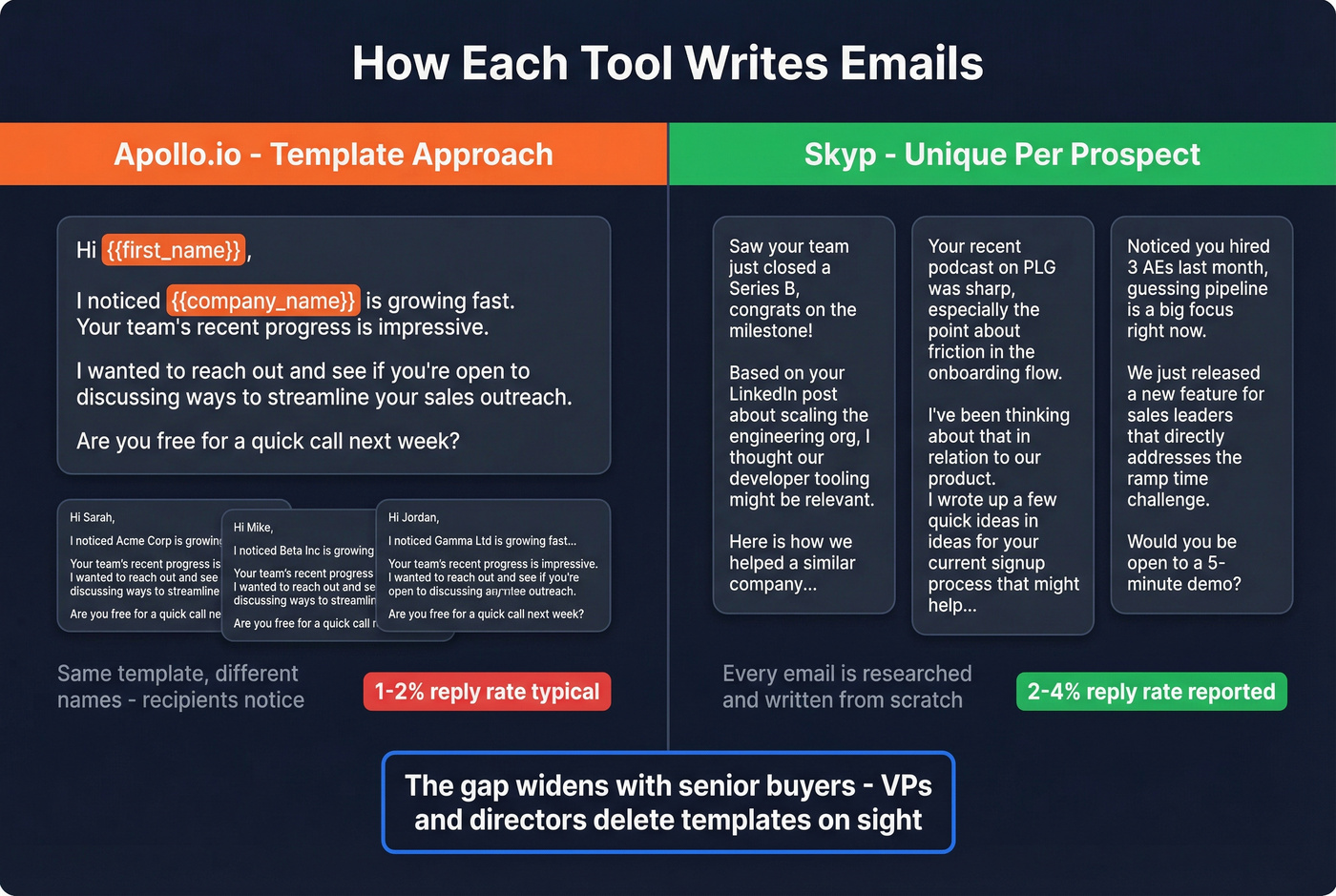
Skyp writes unique emails per prospect based on research. Teams report 2-3x higher reply rates versus template-based approaches, and at least one practitioner posted a 4% reply rate using a Skyp stack - solid when the cold outbound benchmark sits around 1-2%. In our experience testing both approaches across different verticals, the gap widens as your ICP gets more senior; directors and VPs have seen enough {{company_name}} templates to spot them instantly, and they hit delete without reading past the first line.
Hot take: Most teams don't need Skyp-level AI writing. If your average deal size is under $15k and you're sending 500+ emails a week, template-based sequences from Apollo are fine. Skyp earns its premium when every reply matters - enterprise deals, niche verticals, or accounts you can't afford to burn. (If you're building a more targeted motion, account-based selling best practices apply here.)
Pricing Breakdown
Apollo.io:
| Plan | Monthly Price | Key Limits |
|---|---|---|
| Free | $0 | Unlimited email credits, 5 mobile credits, 10 export credits, 2 sequences |
| Basic | $59/user/mo | 75 mobile credits, 1,000 exports |
| Professional | $99/user/mo | 100 mobile credits, 2,000 exports |
| Organization | $149/user/mo | 200 mobile credits, 4,000 exports - annual-only, minimum 3 users |
That free plan sounds generous until you realize 10 export credits per month is a teaser, not a trial.
Skyp:
| Plan | Monthly Price | What You Get |
|---|---|---|
| Pro | $99/month per seller | Up to 500 emails/month, 1 primary email address, 1 primary domain |
| Growth | $1,250/month per seller | Up to 3,000 emails/month, managed infrastructure and deliverability optimization |
| Scale | $5,000/month | Up to 15,000 emails/month, 5 sellers included, advanced analytics and priority support |
Skyp also offers a List Building Service at $500/month for 750 verified contacts.
Real-world stack cost: A 3-person team on Apollo Professional pays $297/mo but manages their own domains, warmup, and deliverability. The same team on Skyp Growth plus Prospeo for data pays ~$1,350/mo - but gets managed infrastructure, 98% email accuracy from Prospeo's 143M+ verified addresses, and emails that don't read like a robot wrote them. The premium buys reply rates, not just sends. (If you're comparing data vendors, start with data enrichment services and best sales prospecting databases.)

The Stack That Actually Works
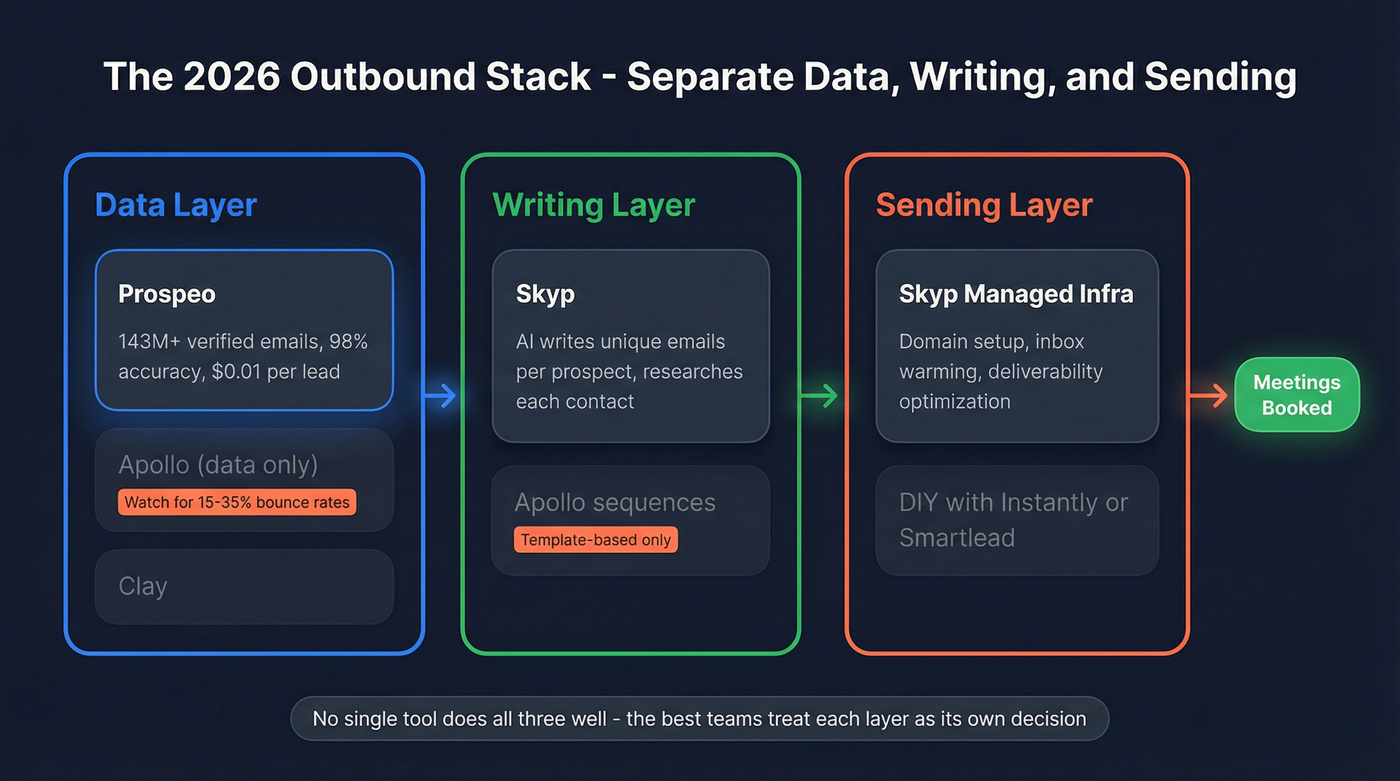
The best outbound stack separates data from writing from sending. That separation matters because no single tool does all three well, and the teams we've seen book the most meetings in 2026 treat each layer as its own decision. If you're mapping the full toolchain, our roundup of SDR tools is a good starting point.
When to Choose What
Apollo alone works when you're budget-constrained, need an all-in-one, and can live with template-style emails. Good for teams spending under $500/mo total who prioritize volume over personalization. (If you're still iterating on messaging, keep a set of sales follow-up templates handy.)
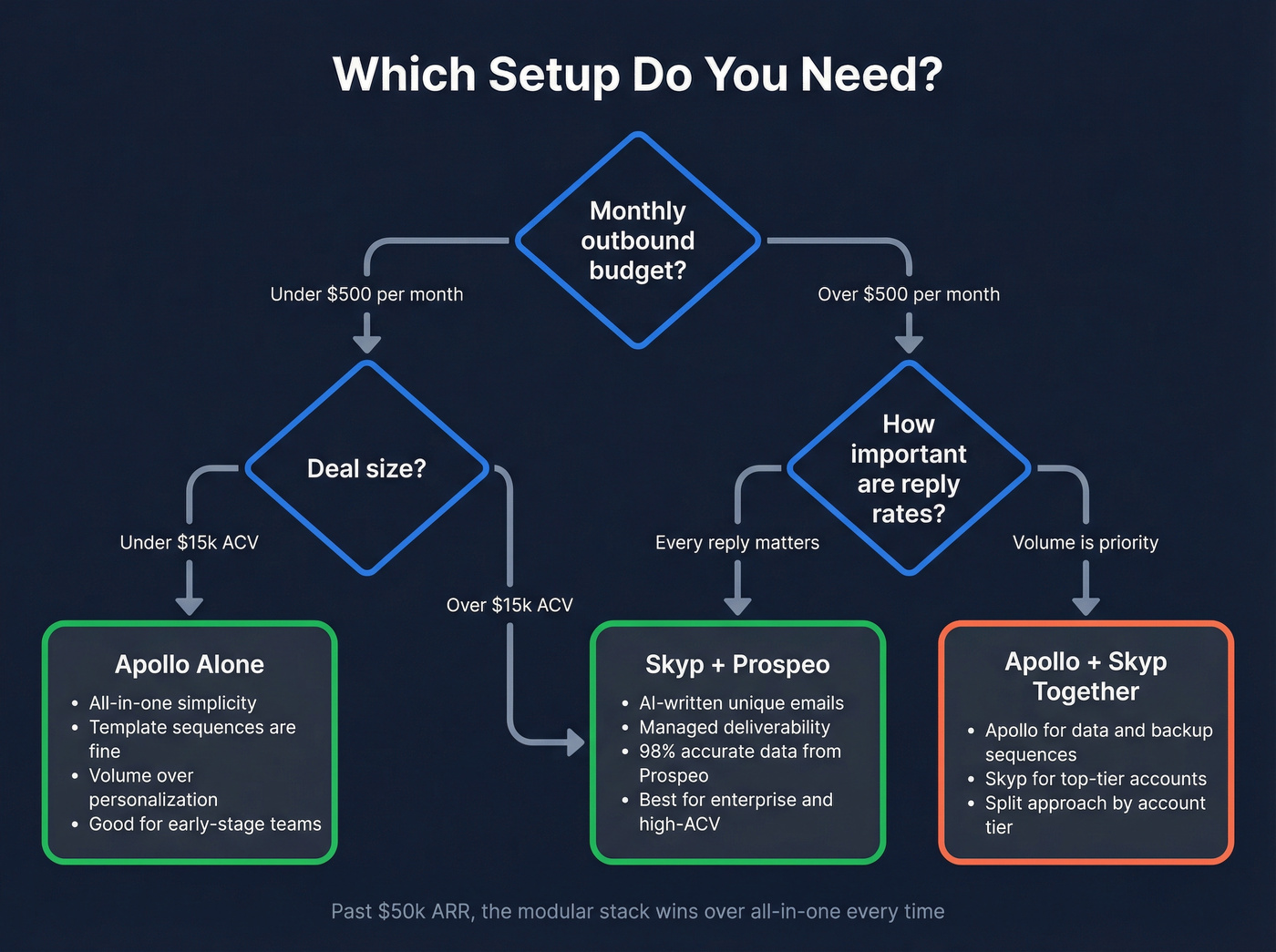
Skyp plus a data source is the move when reply rates and deliverability matter more than blast volume. The teams getting the most from Skyp are typically running 3-20 reps on high-ACV accounts where a single meeting justifies the infrastructure cost.
If you're using Apollo only for data and sending through Skyp anyway, you're overpaying. Prospeo delivers 98% accuracy at roughly $0.01 per email - cheaper and more reliable than workflows where "verified" emails still bounce at double-digit rates. That's the most common swap we've seen teams make this year. (For the deliverability side, see our email deliverability guide.)
Let's be honest: the "all-in-one vs. best-of-breed" debate isn't really a debate anymore for teams past $50k ARR. The all-in-one saves time at small scale. The modular stack wins everywhere else.
The best 2026 outbound stacks separate data from writing from sending. Prospeo slots into that stack as your data layer - 300M+ profiles, 30+ filters, 98% accuracy, and native integrations with Clay, HubSpot, and every sequencer you already use. No contracts, no sales calls.
Pair Prospeo with Skyp and stop overpaying Apollo for data you don't trust.
FAQ
Is Skyp a lead database?
No. Skyp handles AI writing, sending, and deliverability management. You need an external data source like Prospeo, Apollo, or Clay to feed it leads. Most Skyp users pair it with a dedicated data provider.
Can I use Skyp and Apollo together?
Yes, and most practitioners do. Apollo provides lead data; Skyp handles personalized writing and managed sending. The overlap is minimal since they solve different problems in the outbound workflow.
What's a good free option for contact data?
Prospeo offers 75 free email credits plus 100 Chrome extension credits per month with no contracts - enough to test a small campaign. Apollo's free tier gives unlimited email credits but caps exports at 10/month, making it impractical for real prospecting beyond a handful of contacts.
What's a microcampaign?
A small, focused outreach play targeting a specific ICP segment rather than blasting thousands of generic emails. Skyp is built around this concept, writing unique messages per prospect instead of running one template across a massive list. Think 50-100 highly targeted sends rather than 5,000 spray-and-pray emails.