

SMB Market in 2026: Size, Trends & Data
Someone tells a B2B SaaS founder to "go after SMBs" like it's a simple strategy. It isn't. The SMB market is the most misunderstood segment in B2B - 33.3 million businesses in the US alone, roughly 90% of companies worldwide, and the single most fragmented buyer pool you'll find. Selling to a 5-person landscaping company and a 200-person SaaS startup are completely different motions, but they're both "SMBs."
The Quick Version
The SMB market covers 33.3 million US businesses - 99.9% of all businesses in the country - employing 61.6 million people. Globally, SMEs represent about 90% of companies and more than half of all employment. Three forces are reshaping this segment in 2026: rising costs and tariffs (77% of small employer firms are affected), a fintech lending boom (usage up 70% since 2020), and AI going mainstream (46% of SMBs already use it).
If you sell to SMBs, the single most important thing to understand is that their top challenge is reaching customers and growing sales - and they buy fast, cheap, and based on trust. Transparent pricing, fast time-to-value, and social proof aren't nice-to-haves. They're table stakes.
What Counts as an SMB?
There's no universal definition, and that's the first thing most people get wrong. The term means different things depending on which side of the Atlantic you're on - and in the US, it varies by industry.
The US Small Business Administration doesn't use a single employee or revenue threshold. Instead, it sets industry-specific size standards based on NAICS codes, usually keyed to employee count or average annual receipts. This makes the US definition uniquely messy, which is why you'll see different vendors draw the line at 100, 250, or 500 employees depending on their go-to-market motion.
The EU is cleaner. The European Commission's official SME definition uses fixed tiers based on headcount and turnover, in effect since 2005.
| Category | US (SBA) | EU (European Commission) |
|---|---|---|
| Micro | No federal category | <10 employees, ≤€2M |
| Small | Varies by NAICS code | <50 employees, ≤€10M |
| Medium | Varies by NAICS code | <250 employees, ≤€50M |
| Share of all businesses | 99.9% | 99% |
"SMB" and "SME" describe the same segment. SMB (small and medium-sized business) is the standard US term. SME (small and medium-sized enterprise) is the EU and international standard. Most B2B vendors use a working definition of under 500 employees and move on, which is the pragmatic approach.
How Big Is the SMB Market?
The numbers are staggering when you lay them out.
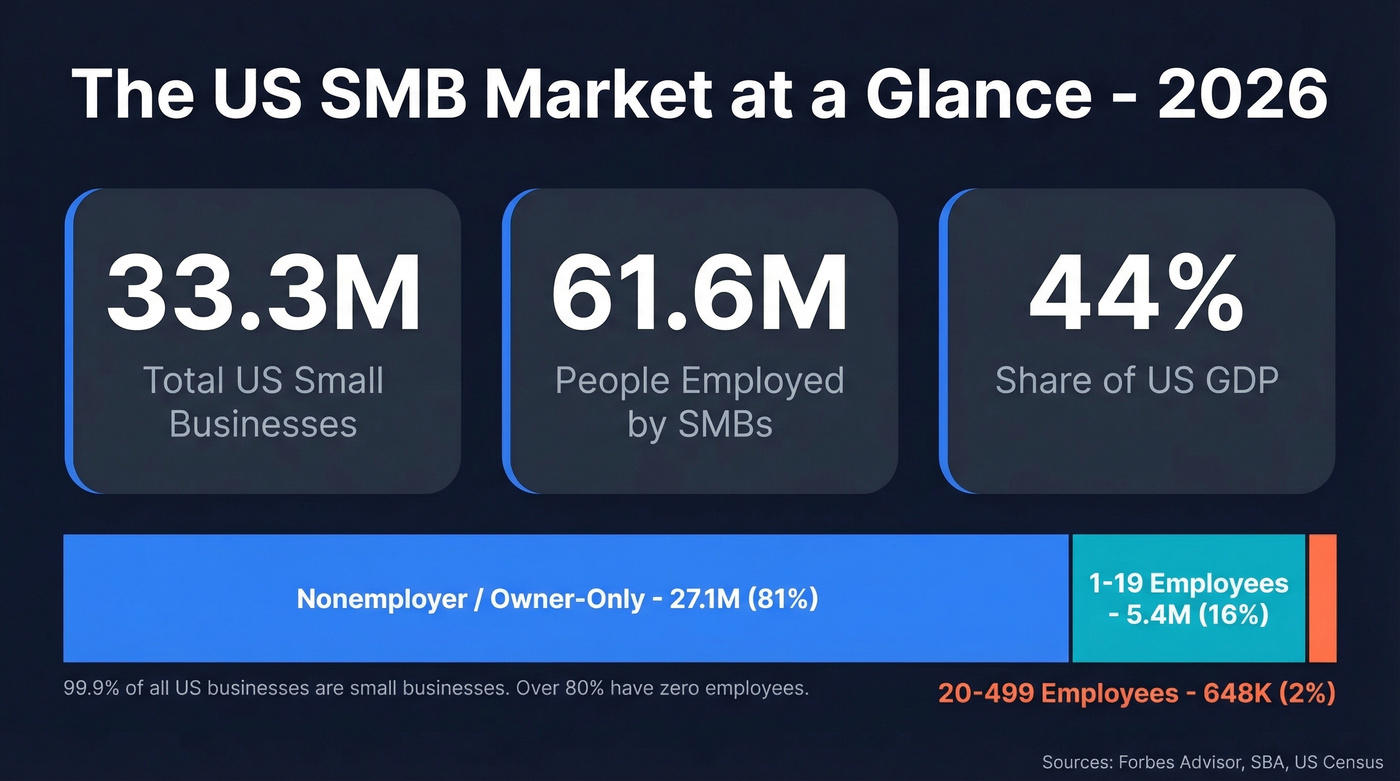
In the US, 33.3 million small businesses represent 99.9% of all businesses. They employ 61.6 million people - 45.9% of the entire American workforce. Over the last 25 years, small businesses created roughly 12.9 million net new jobs, accounting for about two-thirds of all net new job creation.
Here's the part that surprises people: over 80% of those businesses have zero employees. The breakdown tells the real story.
| Size Tier | Businesses | % of Total |
|---|---|---|
| Nonemployer (owner-only) | 27.1M | 81% |
| 1-19 employees | 5.4M | 16% |
| 20-499 employees | 648K | 2% |
The small business world is overwhelmingly solopreneurs and micro-businesses. If your product requires a "team admin" to set up, you've already excluded four out of five potential buyers.
SMBs contribute roughly 44% of US GDP. In the EU, SMEs account for 99% of all businesses and generate 2 out of every 3 jobs. Globally, SMEs represent about 90% of companies and more than 50% of employment. This isn't a niche. It's the backbone of every major economy.
For B2B vendors trying to size the total addressable market, consider that Gartner forecasts software spending at $1.433 trillion in 2026. Even if SMBs account for just 20-30% of that, you're looking at a $300-$430 billion software TAM. The opportunity is enormous; the challenge is reaching buyers who don't show up at SaaStr conferences.
If you want a tighter framework for sizing and prioritizing segments, start with total addressable market basics (TAM, SAM, SOM).
Key SMB Challenges in 2026
The Federal Reserve's 2026 Small Business Credit Survey - fielded across 6,525 employer firms in late 2025 - paints a clear picture of what's keeping SMB owners up at night.
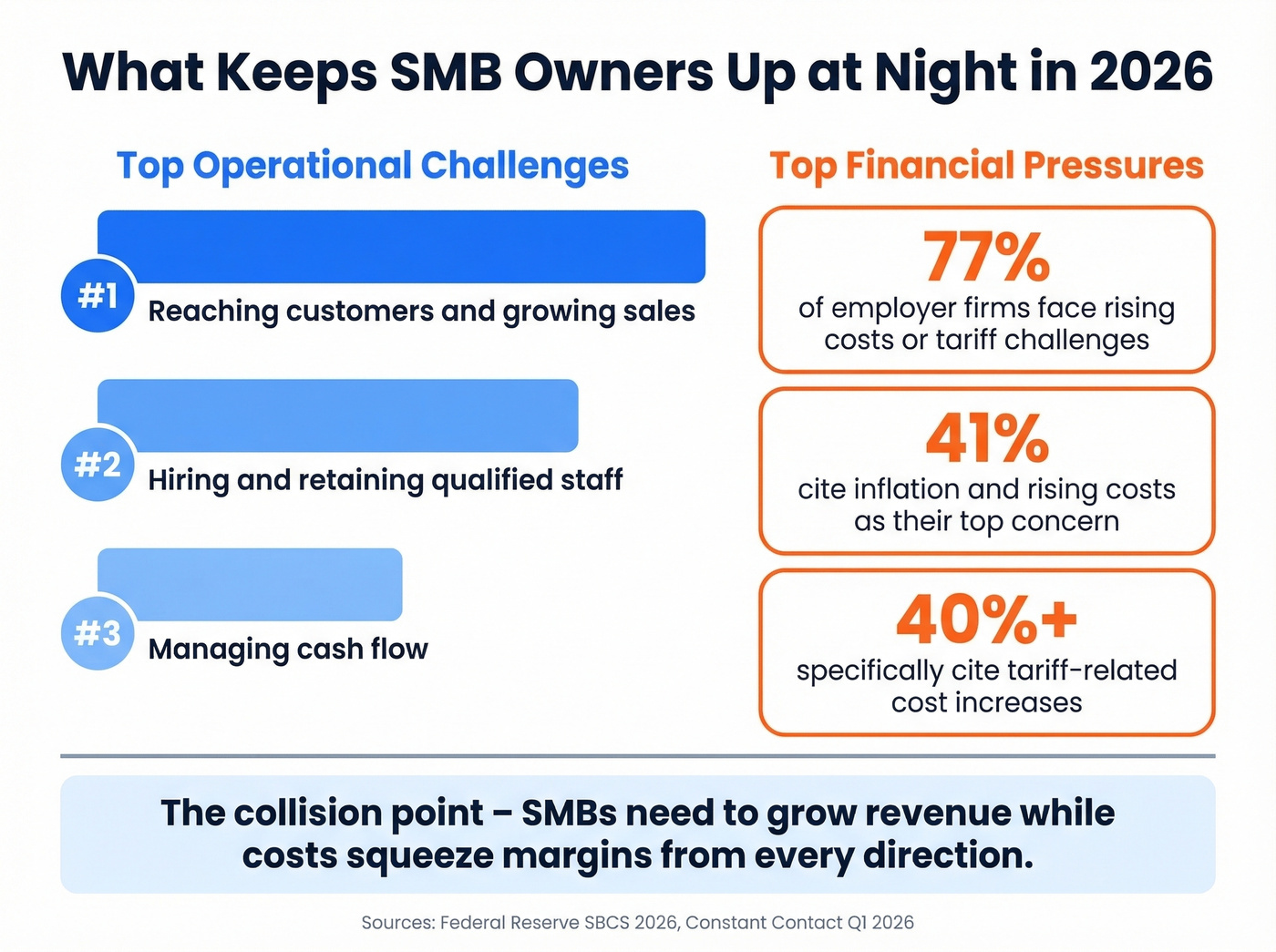
The top operational challenge: reaching customers and growing sales. Not cash flow. Not hiring. Revenue growth. The second biggest challenge is hiring and retaining qualified staff, a persistent pain point since the post-pandemic labor market tightened.
But the financial pressure is what's really squeezing margins. Rising costs of goods, services, and wages is the top financial challenge, and the numbers are brutal: 77% of employer firms report one or both of rising costs and tariff-related cost challenges. More than 40% specifically cite increased costs associated with tariffs.
This lines up with what Constant Contact found in their Q1 2026 survey of 1,500+ small business owners: 41% cite inflation and rising costs as their top concern, far ahead of weak customer spending at 19%.
Think about what this means in practice. A 30-person services company facing 15% cost increases across materials and labor doesn't have the margin cushion of a Fortune 500 firm. They can't absorb it. They either raise prices and risk losing customers, or cut somewhere else - growth ambitions colliding with cost pressure from every direction.
If you're mapping these pressures to your funnel, it helps to track funnel metrics and where SMBs drop off fastest.

SMBs' top challenge is reaching customers and growing sales. If you sell to this segment, you need verified contact data for millions of decision-makers - not stale lists. Prospeo covers 300M+ profiles with 98% email accuracy, 30+ filters including headcount and revenue, and data refreshed every 7 days. At $0.01 per email, it's built for the economics of selling to SMBs.
Stop guessing which SMBs to target. Start reaching the right ones today.
SMB Financing & Credit
SMB financing is shifting faster than most people realize.
Per the Fed's survey, 60% of small employer firms applied for financing in the prior 12 months. The top reasons were operating expenses (56%) and expansion or new opportunities (46%). These aren't businesses borrowing to survive - most are borrowing to operate and grow.
Approval outcomes are mixed. 42% received the full amount they sought, 36% got a partial amount, and 22% received nothing. That last number matters: nearly one in four small businesses that applied for financing walked away empty-handed.
The most underreported trend in SMB finance right now is the fintech channel shift. Applicants seeking financing from online fintech lenders rose from 17% in 2020 to 29% in 2025 - a 70% increase in five years. Traditional banks still dominate, but fintech lenders are eating share at a pace that should worry every community bank in the country. Fintech companies are also increasingly using trade association partnerships to reach SMBs at scale, tapping into the 14,000+ trade organizations in the US that collectively represent millions of small businesses.
Technology & AI Adoption
AI adoption in SMBs is further along than most B2B vendors think. We've seen this firsthand - teams still pitching "AI-powered" features as a differentiator to SMBs that have been using ChatGPT for over a year.
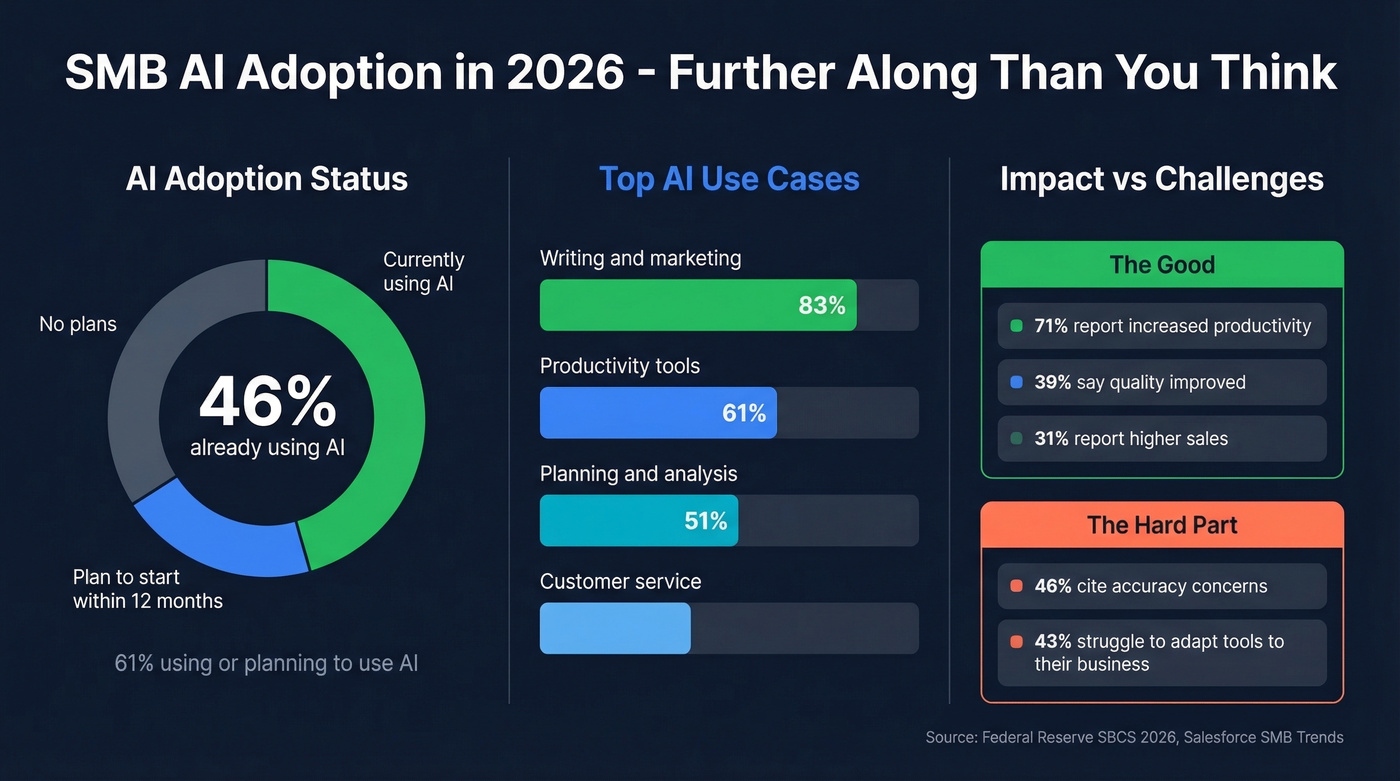
The Fed's survey puts hard numbers on it: 46% of small employer firms currently use AI, 15% plan to start within 12 months, and 33% have no plans. Among those using AI, about half are still experimenting, 44% have partially integrated it into operations, and 7% are fully integrated.
Use cases skew heavily toward content and productivity. Writing and marketing leads at 83%, followed by productivity tools (61%) and planning/analysis (51%). The impact is real: 71% of AI users report increased productivity, 39% say quality improved, and 31% report higher sales. The challenges are equally real - 46% cite accuracy concerns and 43% struggle to adapt tools to their specific business needs.
Salesforce's SMB Trends Report reinforces this trajectory: 76% of SMBs increased tech spending over the past year, 75% are investing in AI, and 91% of AI users report a revenue boost. One data point worth highlighting - 84% of SMB leaders say complete, accurate data is increasingly important, which tracks with the broader shift toward data-driven customer acquisition even at the smallest companies.
If you're operationalizing AI in outbound, pair it with generative AI lead generation workflows so it actually ships pipeline.
The macro backdrop supports continued investment. Gartner forecasts $6.15 trillion in global IT spending in 2026, up 10.8% year-over-year. Software spending alone hits $1.433 trillion (+14.7%), and GenAI model spending is projected to grow 80.8%. SMBs aren't driving those numbers alone, but they're riding the same wave - increasingly buying the same categories of tools that enterprises buy, just at lower price points.
SMB Marketing Trends
SMBs aren't cutting marketing budgets. They're increasing them.
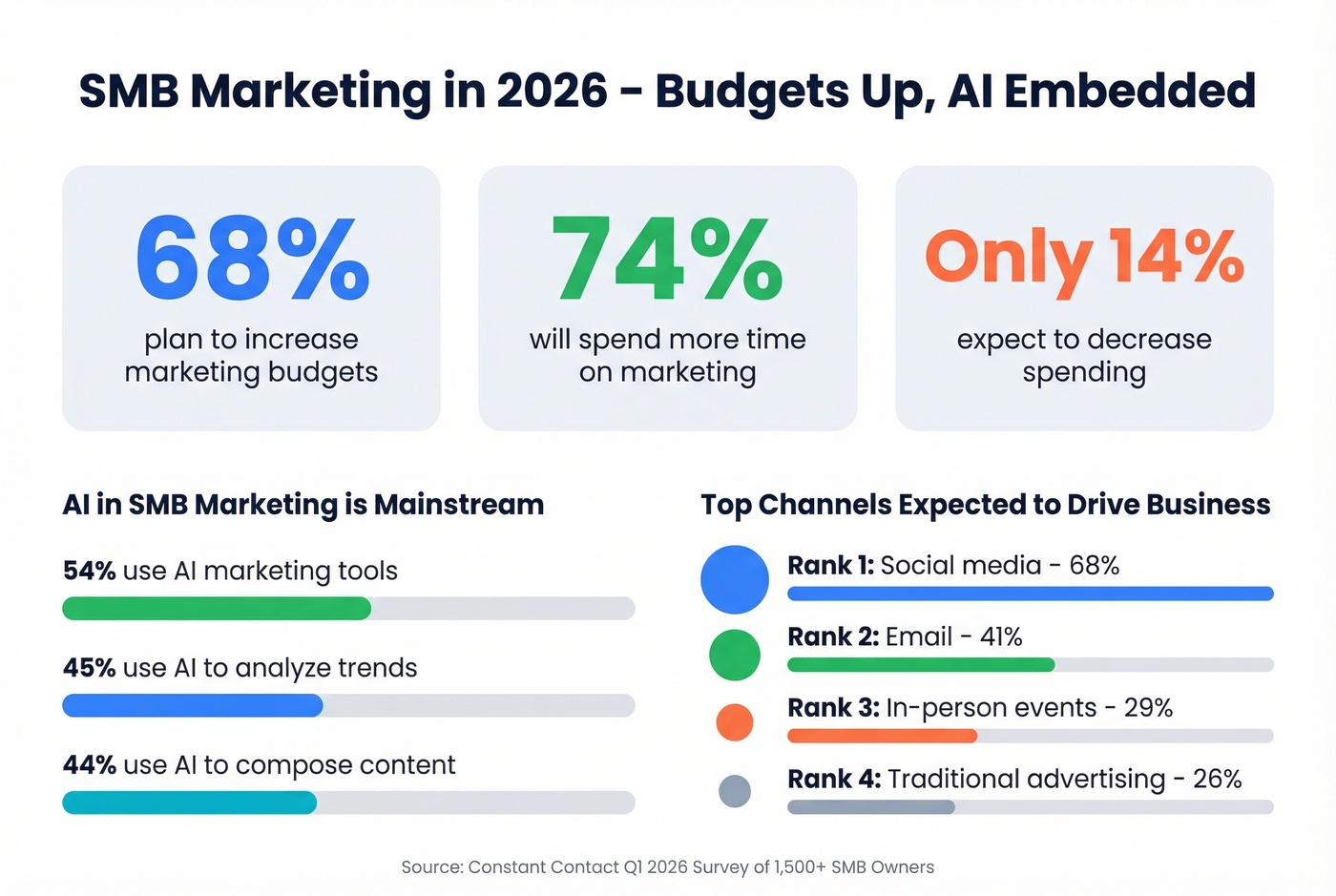
That's the headline from Constant Contact's Q1 2026 survey: 68% plan to increase marketing budgets, and 74% expect to spend more time on marketing this year. Only 14% anticipate a decrease.
AI is already embedded in SMB marketing workflows. 54% use AI marketing tools, 45% use AI to analyze trend data, and 44% use it to compose content. This isn't early adoption anymore - it's mainstream. Social media dominates at 68% as the channel expected to drive the most business, with email at 41% still serving as the workhorse for direct revenue. In-person events (29%) and traditional advertising (26%) round out the top four.
To keep up with channel shifts, track the broader lead generation trends that are reshaping budgets.
How to Sell to SMBs
Here's the thing about selling to small and medium-sized businesses: the buying process looks nothing like enterprise sales. Digital Commerce 360's analysis nails the key differences - fewer people involved, faster decisions, and trust carrying outsized weight. You often get one shot to align with the buyer's journey.
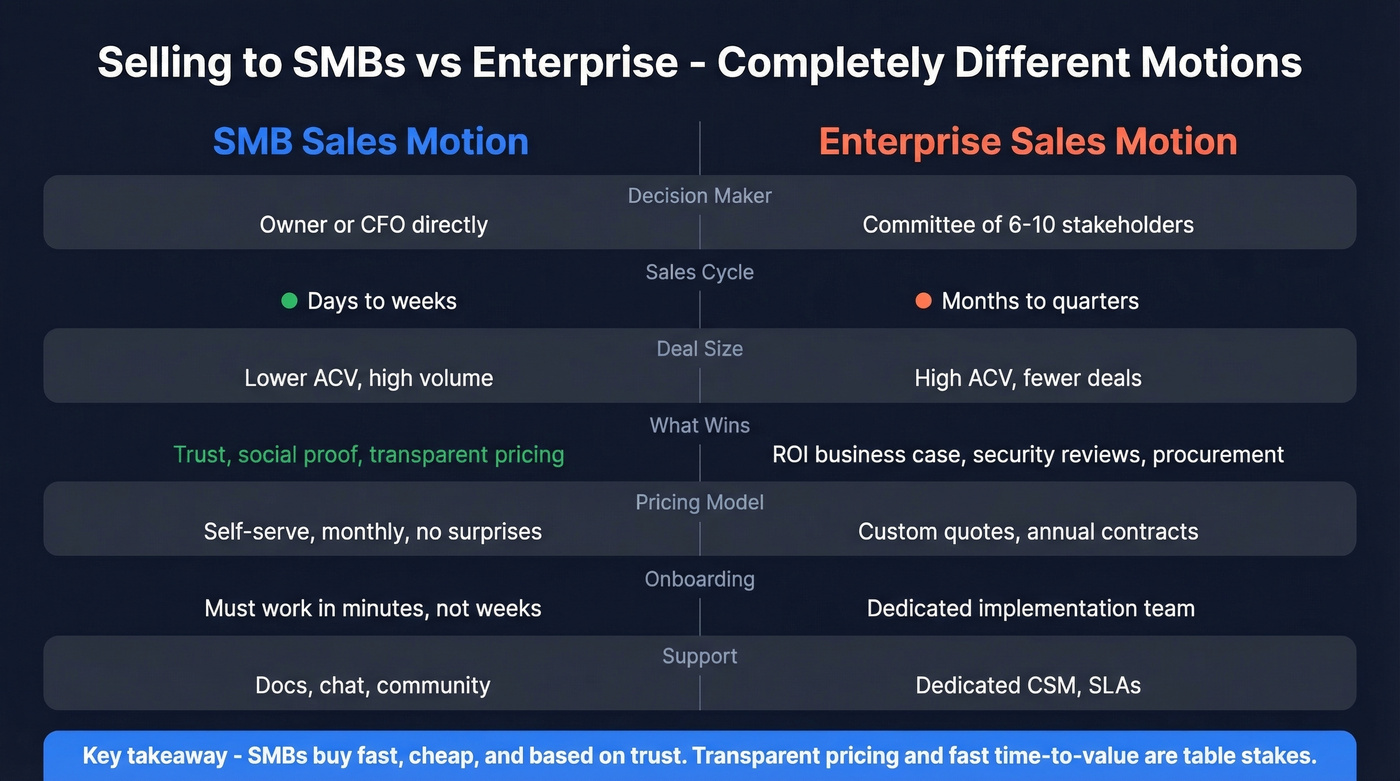
The decision-maker pattern shifts by company size. Under 25 employees, you're typically talking to the owner or CFO directly. Above 25, subject matter experts start getting involved. But in both cases, the cycle is compressed compared to enterprise deals. Salesforce's Connected Customer research found that 46% of business buyers would work with an AI agent if it meant faster service - a signal that SMBs are open to AI-assisted buying experiences, not just AI-assisted selling.
The consensus on r/sales is blunt: SMB deals in the $2K-$20K range are price-sensitive and transactional. Closing them can feel like pulling teeth. That's not a knock on the segment - it's a structural reality. SMB buyers have tighter budgets, less tolerance for long sales cycles, and zero patience for "let's schedule a demo to discuss pricing."
If your average deal size is under $10K, you probably can't afford a sales-led motion for SMBs. The customer acquisition cost will eat your margins alive. Self-serve or product-led growth isn't a nice option - it's the only math that works.
What actually works comes down to three things. First, transparent pricing - if an SMB buyer can't find your price on the website, you've already lost half of them. They don't want to "talk to sales" for a $200/month tool. Second, fast time-to-value through self-serve onboarding, free trials, and quick wins in the first session. If it takes two weeks to see results, they're gone. Third, social proof - case studies, reviews, G2 ratings, and peer recommendations carry more weight than any sales deck.
If you're building the motion, borrow from proven sales prospecting techniques and keep the process lightweight.

The top SMB challenge is reaching customers. For B2B vendors, the parallel challenge is finding the right person at a 15-person company where there's no org chart on the website. In our experience, the vendors who win SMB deals are the ones who let buyers self-serve from day one - and that starts with accurate contact data. Prospeo's 30+ search filters let you narrow by company size, role, and industry to find verified emails and direct dials for SMB decision-makers at 98% email accuracy.
If you're cleaning and enriching lists at scale, data enrichment services can help fill gaps before outreach.
Don't overlook trade associations as a distribution channel either. There are 14,000+ trade organizations in the US, and partnering with them lets you borrow trust at scale - a strategy that's especially effective when your target buyers are skeptical of cold outreach.
For the actual outreach layer, keep a set of sales follow-up templates ready so you can move fast without sounding generic.
The SMB market is 33.3M businesses, but 81% are owner-only firms with no switchboard and no LinkedIn presence. You need direct dials. Prospeo gives you 125M+ verified mobile numbers with a 30% pickup rate - and you only pay when a number is found. Pair that with headcount growth and funding filters to find the SMBs actually ready to buy.
Reach SMB founders directly with verified mobiles and emails at scale.
SMB Market Outlook
SMB confidence is at a record high. The U.S. Chamber of Commerce and MetLife Small Business Index hit 72.0 in Q3 2025 - the highest reading ever recorded. Salesforce's survey backs it up: 81% of SMB leaders feel good about the future.
The macro picture is cautiously optimistic. US growth is expected around 1.6%, with inflation easing toward roughly 3% and unemployment hovering near 4.5%. Not a boom, but stable enough for SMBs to invest.
Compliance is the wildcard. SECURE Act 2.0 updates, emerging AI employment regulations, multi-state employment rules, pay transparency laws, and expanding data privacy standards are all hitting SMBs in 2026. Most don't have a compliance team - they have an owner who Googles things at midnight.
Let's be honest about the biggest mistake B2B vendors make: treating the SMB market as a monolith. A 3-person e-commerce brand and a 400-person manufacturing company are both "SMBs." They have almost nothing in common besides the label. The vendors who win in this segment pick a slice, understand it deeply, and build for that specific buyer - not the ones who slap "built for SMBs" on an enterprise product and call it a strategy.
If you're formalizing that slice, use an Ideal Customer Profile to score and prioritize the right SMB sub-segment.
FAQ
What qualifies as an SMB?
In the US, the SBA defines "small" by industry-specific thresholds based on employee count or annual receipts - there's no single cutoff. The EU uses fixed tiers: micro (under 10 employees), small (under 50), medium (under 250). Most B2B vendors use under 500 employees as a working definition.
How many SMBs are in the US?
There are 33.3 million small businesses, representing 99.9% of all US businesses and employing 61.6 million people - 45.9% of the workforce. Over 80% have zero employees beyond the owner, making solopreneurs the dominant segment.
What's the difference between SMB and SME?
Same segment, different regional vocabulary. SMB (small and medium-sized business) is the US term; SME (small and medium-sized enterprise) is the EU and international standard. The definitions overlap almost entirely - use whichever your audience expects.
What are the biggest challenges for SMBs in 2026?
Rising costs top the list - 77% of employer firms face increased costs or tariff-related challenges. The top operational challenge is reaching customers and growing sales, followed by hiring qualified staff. Only 42% of financing applicants receive the full amount they seek.
How do you find decision-makers at small businesses?
Small companies rarely publish org charts, so identifying the right contact requires a data platform with company-size and role filters. Prospeo's 30+ search filters and 98% email accuracy let you pinpoint verified emails and direct dials at companies of any size, with a free tier of 75 credits per month and no contracts.