

How to Build a Software Go-to-Market Plan That Actually Has Numbers
Every software go-to-market plan on the internet defines five conceptual pillars and leaves you with zero benchmarks. You don't need another strategy deck. You need a two-page plan with validated numbers - ICP thresholds, stage-appropriate KPIs, pricing frameworks, and a channel mix that matches your ACV.
The most common complaint in GTM threads on r/SaaS and r/startups? Plans that read like strategy decks with no numbers attached. This one has numbers.
The Plan in Five Sentences
A software go-to-market plan turns your market thesis into a numbered execution doc. You validate your ICP through real conversations, not TAM slides. You pick a motion based on ACV, price based on value, and choose channels based on where buyers actually spend time. You set stage-appropriate KPIs so you know whether you're winning or guessing. Then you build a lean stack to execute without manual data wrangling.
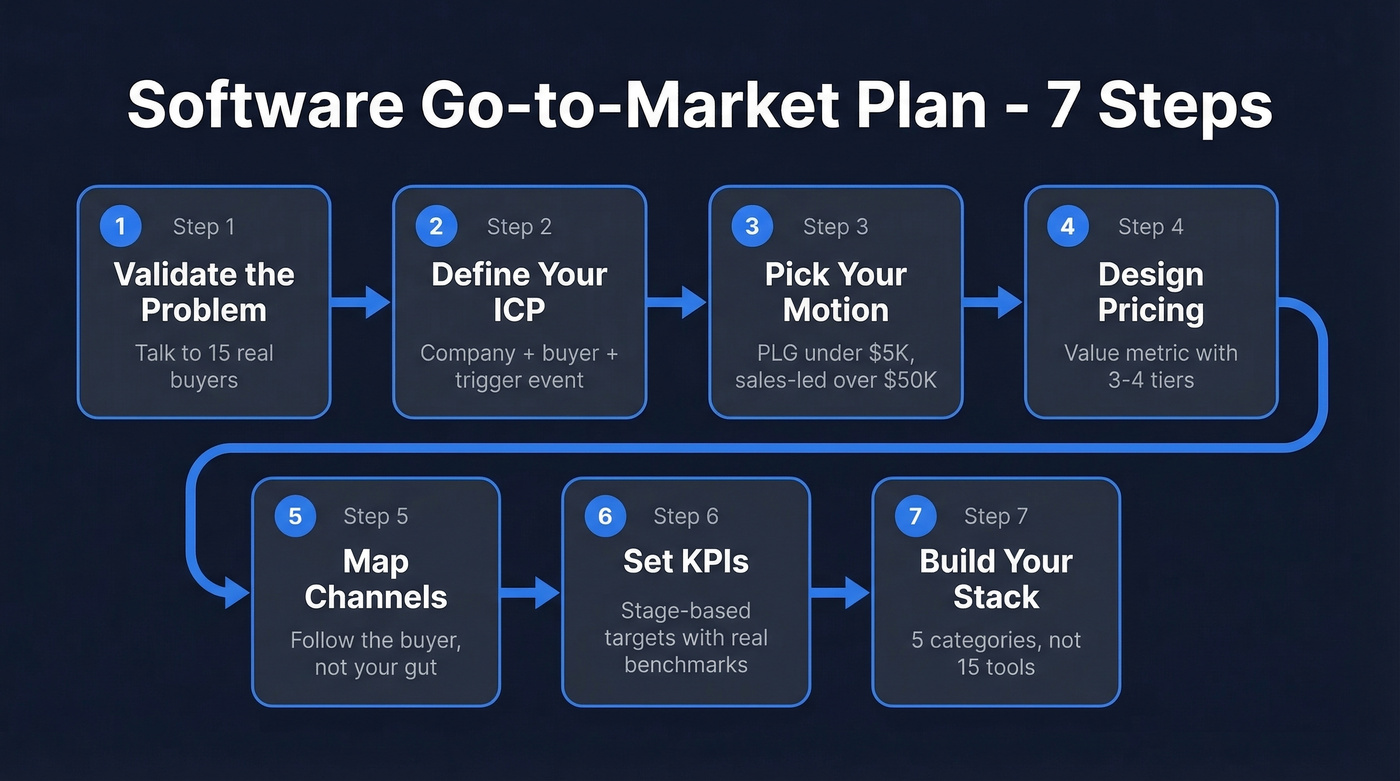
Here's what that covers:
- ICP: Validated by real conversations, not a TAM slide
- Problem: Confirmed by 8+ of 15 interviews
- Motion: PLG, sales-led, or hybrid - determined by ACV
- Pricing: Value metric and willingness-to-pay data
- Channels: Where buyers spend time, not where you wish they did
- KPIs: Stage-appropriate targets for growth, NRR, churn, CAC payback
- Stack: Tools that make execution possible

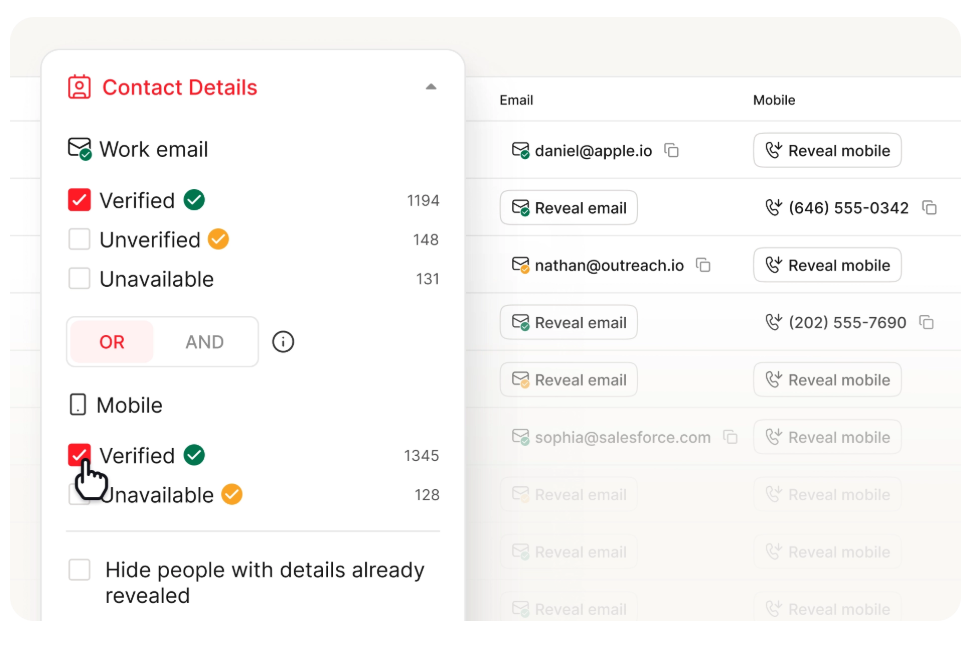
You just built an ICP card with trigger events and pain points. Now you need verified contact data to reach those buyers. Prospeo gives you 300M+ profiles with 30+ filters - intent signals, technographics, headcount growth, funding - so your GTM targeting stays as sharp as your plan.
Stop planning outreach to an ICP you can't actually contact.
7 Steps to a GTM Plan That Works
Define the Problem and Who Has It
Your ICP isn't your TAM. A SaaS company selling livestreaming to schools initially targeted "all high schools." After digging in, they narrowed to roughly 200 schools based on sports success, geography, and budget signals. That's the difference between a strategy slide and a plan you can actually execute against - and it's the kind of specificity that separates teams who hit $1M ARR from teams who burn through runway wondering why nothing converts.
Validate Your ICP
Talk to 15 potential buyers: 5 existing customers, 5 competitor customers, 5 from your target market. If 8 of 15 describe the same pain, you've got signal. Fewer than 8? You're guessing.
Median time to reach $1M ARR is roughly 1,000 days. Bad ICP targeting is the fastest way to make that number longer.
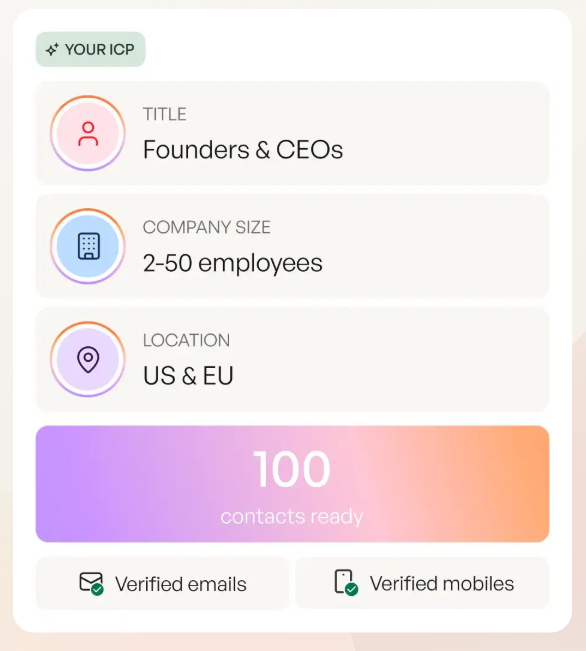
Build an ICP card with these fields: company profile (industry, employee range, ARR, tech stack, geography), buyer profile (title, department, budget authority), trigger event, specific pain, desired outcome, and proof you can deliver. We've seen teams skip the trigger event field and regret it - without a timing signal, you're cold-calling people who aren't ready to buy.
Choose Your Motion
Your ACV determines your motion. Under $5K, go PLG. $5K-$50K, hybrid. Over $50K, sales-led. Don't overthink this.
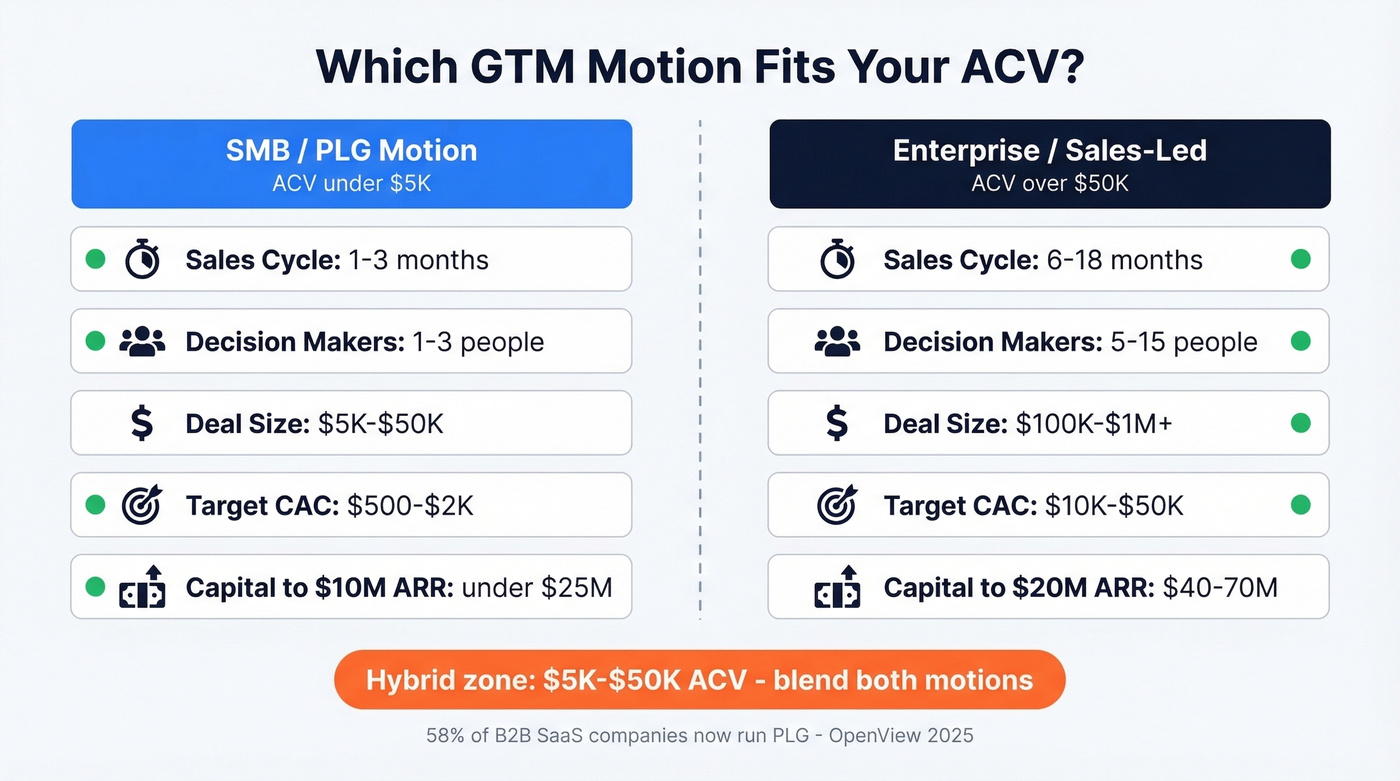
| Dimension | SMB / PLG | Enterprise / Sales-Led |
|---|---|---|
| Sales cycle | 1-3 months | 6-18 months |
| Decision makers | 1-3 | 5-15 |
| Deal size | $5K-$50K | $100K-$1M+ |
| Target CAC | $500-$2K | $10K-$50K |
OpenView's 2025 Product Benchmarks report found that 58% of B2B SaaS companies now run a PLG motion, and 91% of those plan to increase investment. Freemium drives 12% median visitor conversion, free-to-paid averages around 9%, and PQL-driven trials convert at roughly 3x the rate of non-PQL trials - about 25% on average.
Here's what that means in funding terms: an SMB/PLG company can reach $10M ARR with less than $25M in capital. Enterprise strategies often need $40-70M to hit $20M ARR. That's not a small difference. It's a fundamentally different business model.
Design Pricing and Packaging
For software, value-based pricing is almost always the right default. Cost-plus makes no sense when your marginal cost per user is near zero.
Pick a value metric that scales with customer success - seats, workflows, projects, or budget managed - and build 3-4 tiers around it. Profitwell's pricing research shows a 1% improvement in price optimization drives an 11% increase in profit. Most founders underprice because they're afraid of losing deals. The data says the opposite is the bigger risk.
Let's be honest: if you haven't talked to at least 10 prospects about willingness to pay, your pricing page is a guess dressed up as strategy.
Map Channels to Buyers
Channel strategy must match buyer behavior, not founder preference. WorkCompOne generated nearly 100% of traffic, leads, and sales through organic search by targeting geo-specific keywords. They didn't try to be everywhere - they went deep on the one channel their buyers actually used.
If your buyers live in Slack communities, go there. If they search Google, invest in content. The channel follows the buyer, period. We've watched teams burn $30K/month on paid social because a board member suggested it, while their actual buyers were reading niche industry newsletters. Skip channels that don't match your ICP's behavior, no matter who's pushing them.
Set Targets and KPIs
Most GTM plans skip this entirely. Here are stage-based benchmarks to anchor your targets:
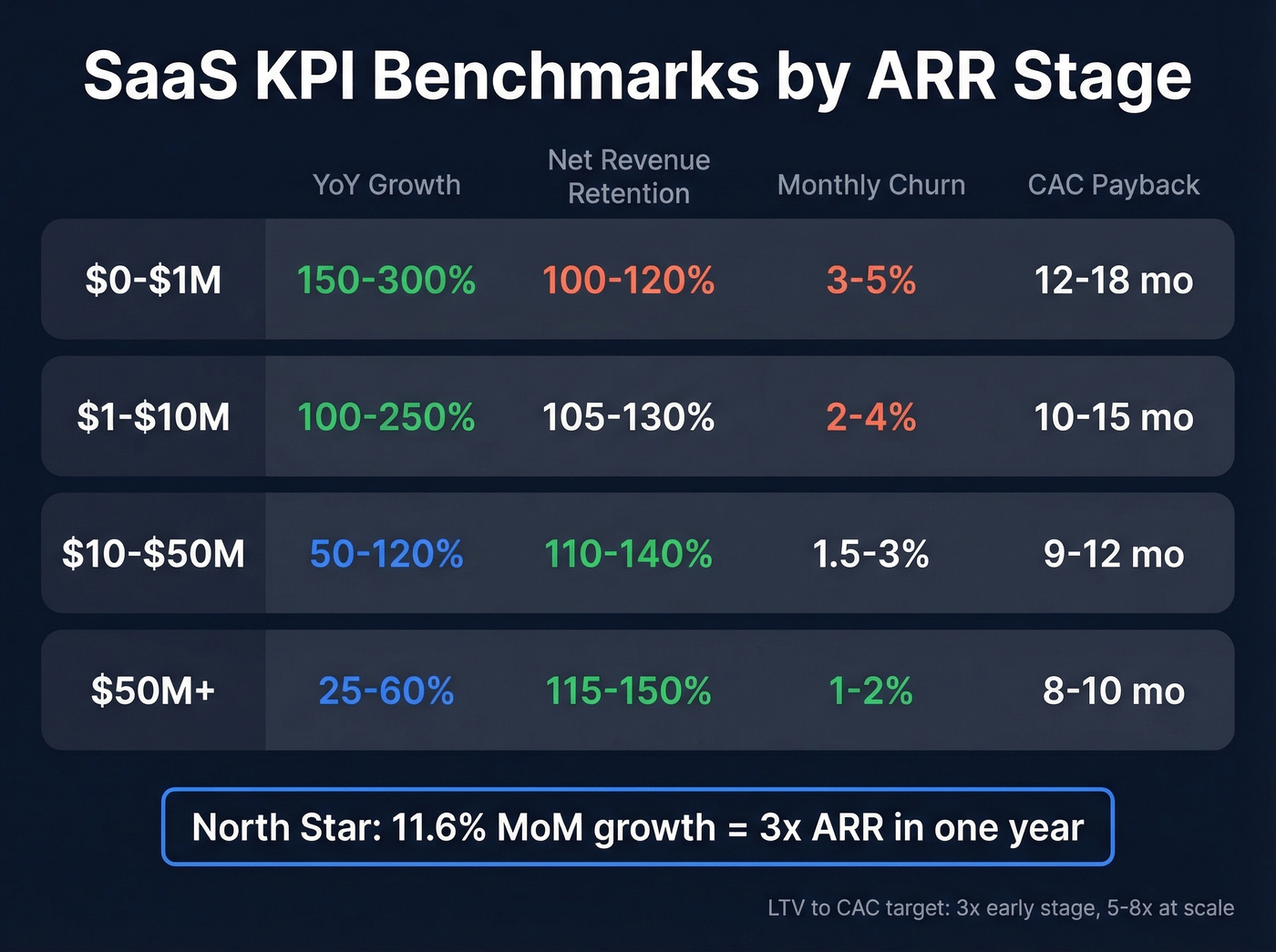
| Stage (ARR) | YoY Growth | NRR | Monthly Churn | CAC Payback |
|---|---|---|---|---|
| $0-$1M | 150-300% | 100-120% | 3-5% | 12-18 mo |
| $1-$10M | 100-250% | 105-130% | 2-4% | 10-15 mo |
| $10-$50M | 50-120% | 110-140% | 1.5-3% | 9-12 mo |
| $50M+ | 25-60% | 115-150% | 1-2% | 8-10 mo |
LTV:CAC should range from 3x at early stage to 5-8x at scale. If you need a single north star, aim for 11.6% month-over-month growth - that's the rate required to triple ARR in a year.
BenchmarkIt's 2026 data shows median growth at 26%, NRR at 101%, and a New CAC Ratio of $2.00. Expansion ARR now represents 40% of total new ARR. If your numbers are worse than these medians, you've got a plan problem, not a market problem.
If you want to pressure-test your KPI math, start with funnel metrics and then sanity-check your CAC assumptions.
Build Your Tech Stack
You need the right tools in five categories, not fifteen tools across all of them.
Data and Prospecting is where we'd start. Your outbound channel is only as good as your contact data. Prospeo covers 300M+ professional profiles with 98% email accuracy on a 7-day refresh cycle, and the free tier gives you 75 verified emails per month - enough to validate ICP outreach before committing budget. Pair it with Clay for orchestration if you're running multi-step enrichment workflows.
For CRM, HubSpot's free tier handles early-stage needs; Salesforce makes sense once you're past $5M ARR and need custom objects. Marketing automation through HubSpot Marketing Hub or ActiveCampaign covers nurture sequences. Revenue intelligence via Gong gives you call recording and deal insights. And for product adoption, Userpilot (Starter at $299/month) handles in-app onboarding and PQL tracking.
If you're building an outbound motion, make sure your team has a repeatable sales prospecting process and a clean sequence management setup before you add more tools.
Why Go-to-Market Plans Fail
Five failure modes kill GTM plans repeatedly:
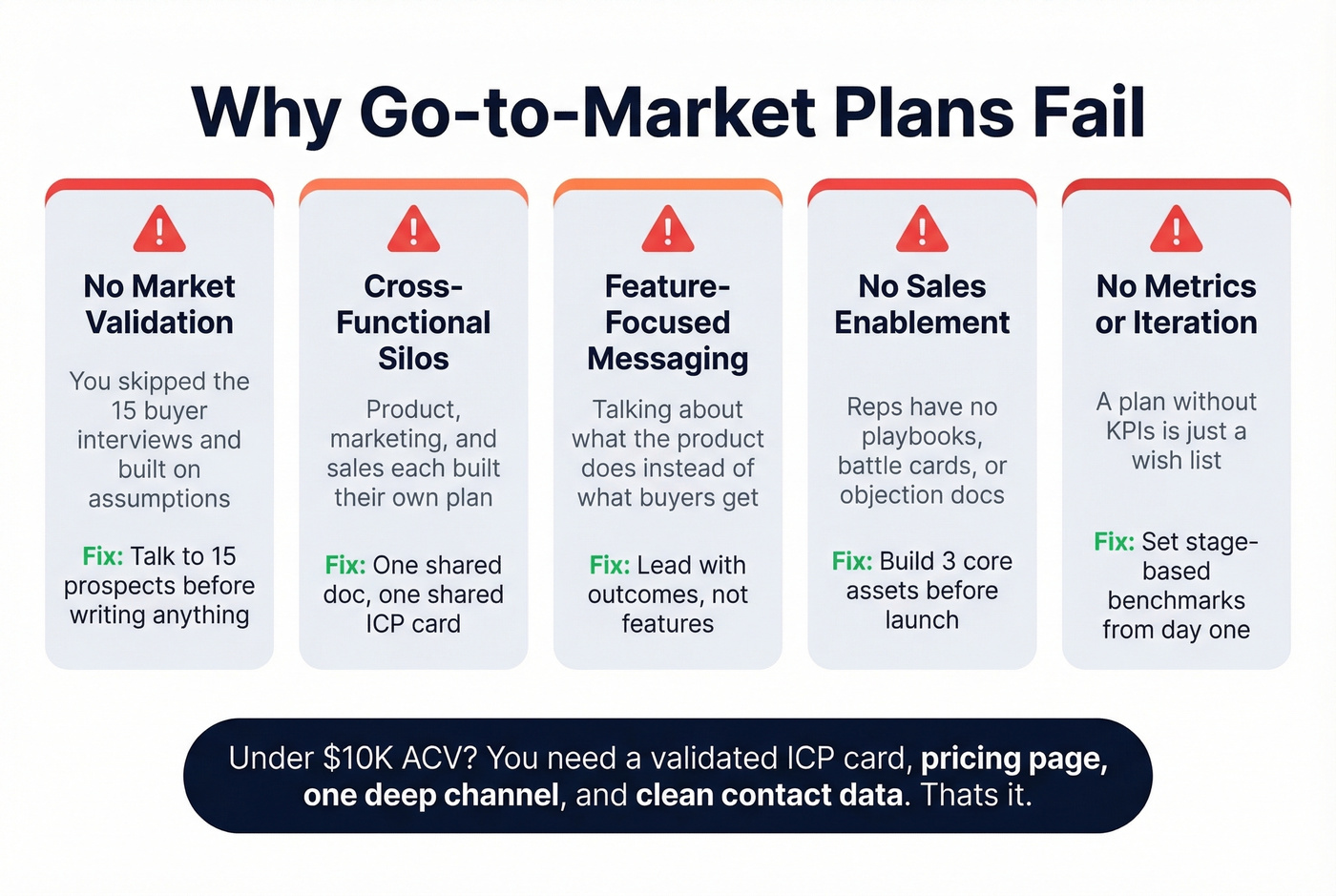
- No market validation. You skipped the 15 interviews and built a plan around assumptions.
- Cross-functional silos. Product, marketing, and sales build separate plans. Messaging fractures.
- Feature-focused messaging. You're talking about what the product does instead of what the buyer gets.
- Inadequate sales enablement. Reps have no playbooks, no battle cards, no objection-handling docs.
- No metrics or iteration. A plan without KPIs is a wish list.
Look - if your average deal size is under $10K, you probably don't need a 30-page GTM plan. You need a validated ICP card, a pricing page, one channel you'll go deep on, and clean contact data. Everything else is procrastination disguised as strategy.
Bad data inflates CAC payback and kills GTM timelines. Prospeo delivers 98% email accuracy on a 7-day refresh cycle - not the 6-week industry average. At $0.01 per email, your stack budget stays lean while your pipeline stays full. Teams using Prospeo book 26% more meetings than ZoomInfo users.
Hit those stage-based KPIs with data that actually connects you to buyers.
FAQ
What's the difference between a GTM strategy and a go-to-market plan?
A strategy is the "why" and "what" - your market thesis and positioning. A plan is the "who, when, how much" - validated ICP, channel mix, KPI targets, and launch sequence. You need both. Most guides only give you the first.
How long should a software go-to-market plan take to build?
One to two weeks for a first version. Spend 3-5 days on ICP interviews and the rest documenting motion, pricing, channels, and KPIs. If your plan takes longer to write than to start executing, it's a strategy deck, not a plan.
What tools do I need to execute a GTM plan?
At minimum: a CRM (HubSpot free tier works), a prospecting tool for verified contact data, and an outbound sequencer like Instantly or Smartlead. Add revenue intelligence and product analytics as you scale past $1M ARR.