

The Software Sales Funnel: Benchmarks, Frameworks, and Fixes for 2026
You're staring at the board deck: 500 MQLs last quarter, 15 closed deals. The CEO wants to know where the other 485 went. The honest answer - "somewhere between the demo request form and the third follow-up email nobody sent" - isn't going to land well.
Your software sales funnel isn't broken because your team can't sell. It's broken because nobody's measuring where the leaks actually are. Only 3 in 10 companies have even attempted to measure their funnel, which means the teams that do have a structural advantage before they optimize a single thing.
What You Need (Quick Version)
- Pick your funnel model. PLG, sales-led, or hybrid - most SaaS companies in 2026 need the hybrid (product-led sales). The benchmarks below tell you which motion fits your ACV.
- Benchmark your stage-by-stage conversion rates against the data tables in this guide. The biggest leak for most teams is MQL-to-SQL. If yours is below ~20%, start there.
- Fix your data before fixing your messaging. If your email bounce rate is above 5%, nothing downstream matters. The pipeline velocity formula and the AI tools section won't help you if half your contacts are stale.
What Is a Software Sales Funnel?
The concept traces back to E. St. Elmo Lewis) in the 1890s - Awareness, Interest, Desire, Action (AIDA). We're still using a 19th-century metaphor to describe how software gets bought in 2026. That should tell you something about how slowly sales methodology actually evolves, despite what every "thought leader" on your feed claims.
Real SaaS buying isn't linear. Prospects loop back, skip stages, ghost for three months, then reappear asking for a contract. The funnel is a useful mental model - TOFU for awareness, MOFU for evaluation, BOFU for decision - but it's a simplification. The stages you'll see in most CRMs (Lead, MQL, SQL, Opportunity, Closed Won) represent the seller's view of a process that, from the buyer's side, looks more like a pinball machine.
What makes a software funnel different from a generic marketing funnel? Two things. First, the product itself is often part of the selling motion - free trials, freemium tiers, and product demos create stages that don't exist when you're selling consulting or industrial equipment. If you're running a freemium or trial model, you'll want to add a "Sign-up" stage between Lead and MQL in your funnel reporting, since HubSpot's default lifecycle stages don't include one. Second, the data infrastructure matters more. A bad email list doesn't just waste marketing spend; it poisons every conversion rate downstream.
PLG vs. Sales-Led vs. Hybrid
Before you optimize anything, you need to know which funnel you're actually running. The three models have fundamentally different economics, team structures, and conversion expectations.
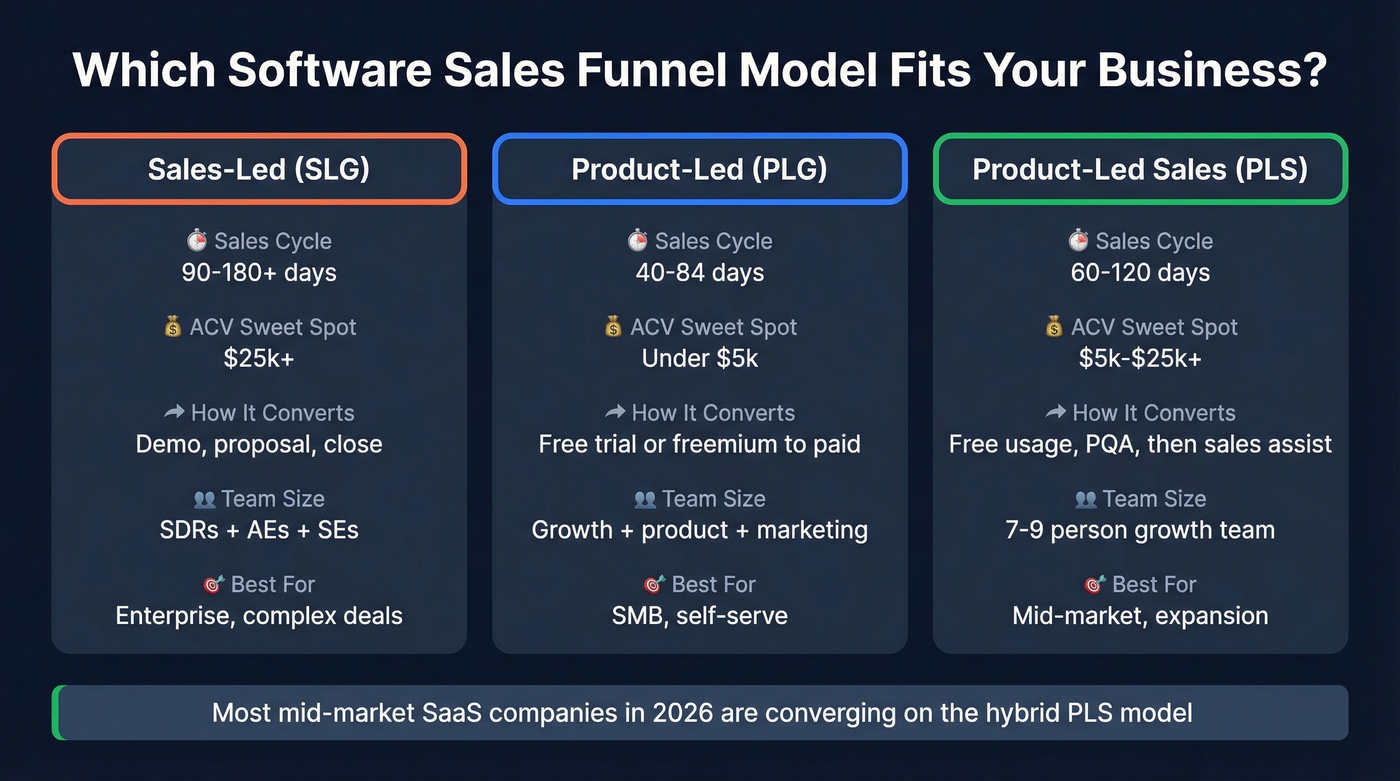
| Dimension | Sales-Led (SLG) | Product-Led (PLG) | Product-Led Sales (PLS) |
|---|---|---|---|
| Sales cycle | 90-180+ days | 40-84 days | 60-120 days |
| ACV sweet spot | $25k+ | Under $5k | $5k-$25k+ |
| Conversion model | Demo, proposal, close | Free trial/freemium to paid | Free usage, PQA, then sales |
| Team structure | SDRs + AEs + SEs | Growth + product + marketing | 7-9 person growth team |
| Best for | Enterprise, complex | SMB, self-serve | Mid-market, expansion |
The Sales-Led Funnel
This is the traditional motion. If you've used HubSpot, you've seen the lifecycle stages: Subscriber, Lead, MQL, SQL, Opportunity, Customer. Reps work deals through a pipeline that typically runs 90-180+ days for enterprise contracts. Cisco's approach is a good example - gated whitepapers generate leads, case studies and webinars nurture them through mid-funnel, and sales conversations happen later when the prospect has self-educated.
Sales-led works when your ACV justifies the cost of a human-intensive process. It falls apart when deal sizes drop below the point where a dedicated AE makes economic sense.
The PLG Funnel
The PLG funnel compresses into fewer, faster stages: Discover, Understand, Try, Activate. The product does the selling. Freemium models typically monetize 3-8% of users - which sounds low until you realize the acquisition cost per user is near zero.
Free trial to paid conversion ranges wildly, from 2% to 25%, depending almost entirely on activation clarity. The #1 reason users churn from free tiers isn't that the product is bad - it's that they don't know what the first win looks like. Behavior-triggered onboarding emails fired on actions, not timers, consistently outperform time-based drip sequences. Founders on r/SaaS repeat this endlessly: nail the "aha moment" in onboarding and you'll see 2-3x better retention than teams relying on generic welcome sequences.
The metrics that matter here are different too: Signup to Activation, Activation to 2nd Activation, 2nd Activation to Weekly Habit. Habit formation is the leading indicator, not pipeline stage progression.
Product-Led Sales (The Hybrid)
McKinsey analyzed 107 publicly listed B2B SaaS companies and found that PLG alone doesn't guarantee outsize performance. The companies that win combine product-led acquisition with sales-assisted conversion - what they call Product-Led Sales.
The key concept is the Product-Qualified Account (PQA): a lead that's already experienced product value through a free tier or trial, making them far more likely to convert than a traditional MQL. Instead of cold-calling prospects who downloaded a whitepaper, your AEs are calling people who've already built three dashboards in your product.
The typical PLS growth team runs 7-9 people - product managers, data scientists, demand gen, content, and design - running experiments to improve activation and time-to-value. It's not cheap to build, but it's the model most mid-market SaaS companies are converging on. For contracts in the $5k-$25k+ range, pure self-serve probably isn't enough, and pure sales-led is too expensive. The hybrid is where most teams should start.
Here's the thing: if your average contract value sits below $10k, you almost certainly don't need a ZoomInfo-level tech stack or a 12-person sales org. A PLG motion with a lightweight sales assist will outperform a bloated enterprise funnel every time. Stop cosplaying as Salesforce when you're selling $6k contracts.
Stage-by-Stage Conversion Benchmarks
Numbers make the funnel real. Without them, you're optimizing based on vibes.
The Benchmark Table
Here's what the data shows, pulling from First Page Sage's multi-year dataset and Causal Funnel's 2026 analysis:
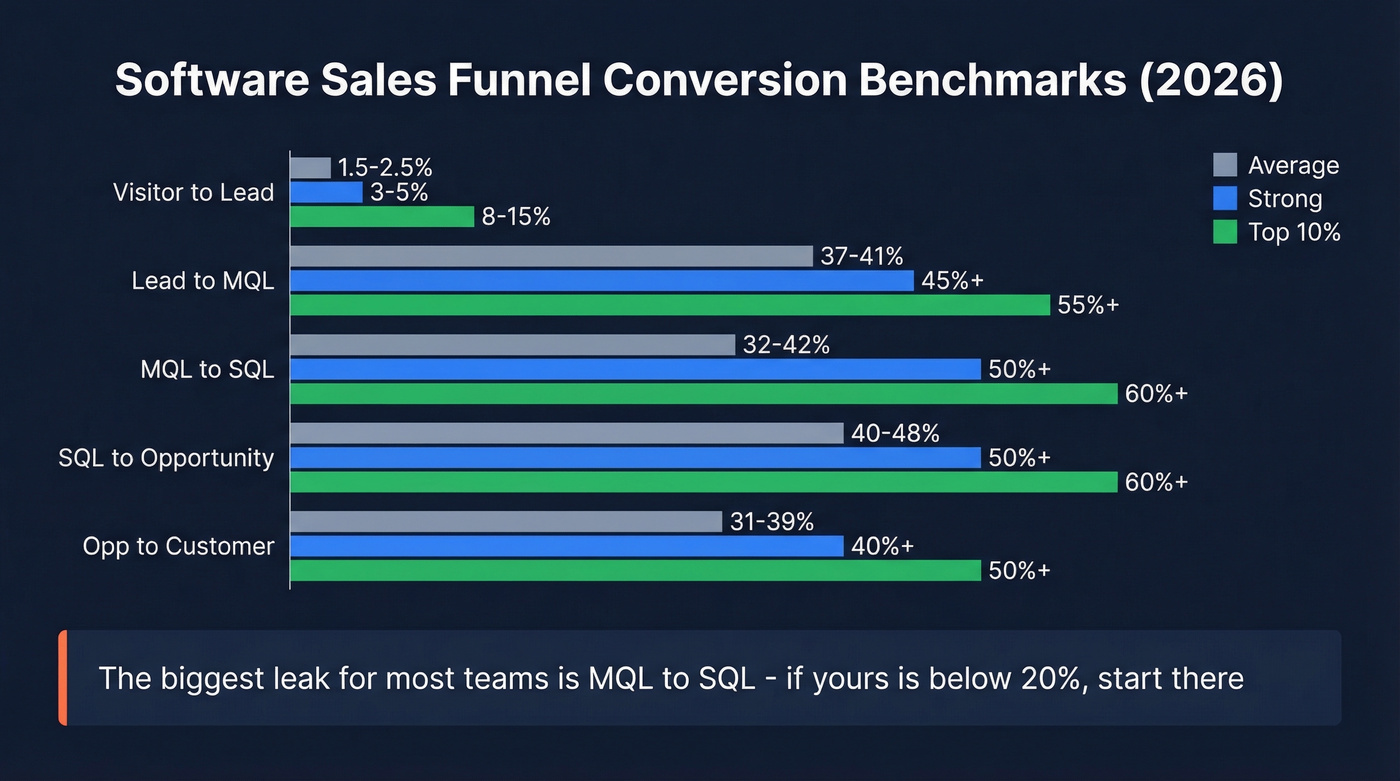
| Stage | Average | Strong | Top 10% |
|---|---|---|---|
| Visitor to Lead | 1.5-2.5% | 3-5% | 8-15% |
| Lead to MQL | 37-41% | 45%+ | 55%+ |
| MQL to SQL | 32-42% | 50%+ | 60%+ |
| SQL to Opportunity | 40-48% | 50%+ | 60%+ |
| Opp to Customer | 31-39% | 40%+ | 50%+ |
Company size matters. SMB visitor-to-lead conversion runs about 1.4%, while enterprise drops to ~0.7%. On the close side, SMB teams close at ~39% versus enterprise at ~31%. Bigger deals take longer and involve more stakeholders.
Channel Benchmarks
Not all traffic converts equally. SEO-sourced leads convert MQL-to-SQL at 51%, while PPC leads convert at just 26%. The visitor-to-lead gap is similarly stark: SEO at 2.1% versus PPC at 0.7%. Email sits in between, with MQL-to-SQL conversion around 46%.
The takeaway isn't "stop running ads." It's that organic and email leads arrive with more intent and context, so they qualify faster. If your funnel is PPC-heavy, your MQL-to-SQL rate will naturally be lower - and that's fine, as long as you're accounting for it in your forecasts.
A Worked Example
Let's make this concrete. Take a mid-market SaaS company with decent conversion rates:
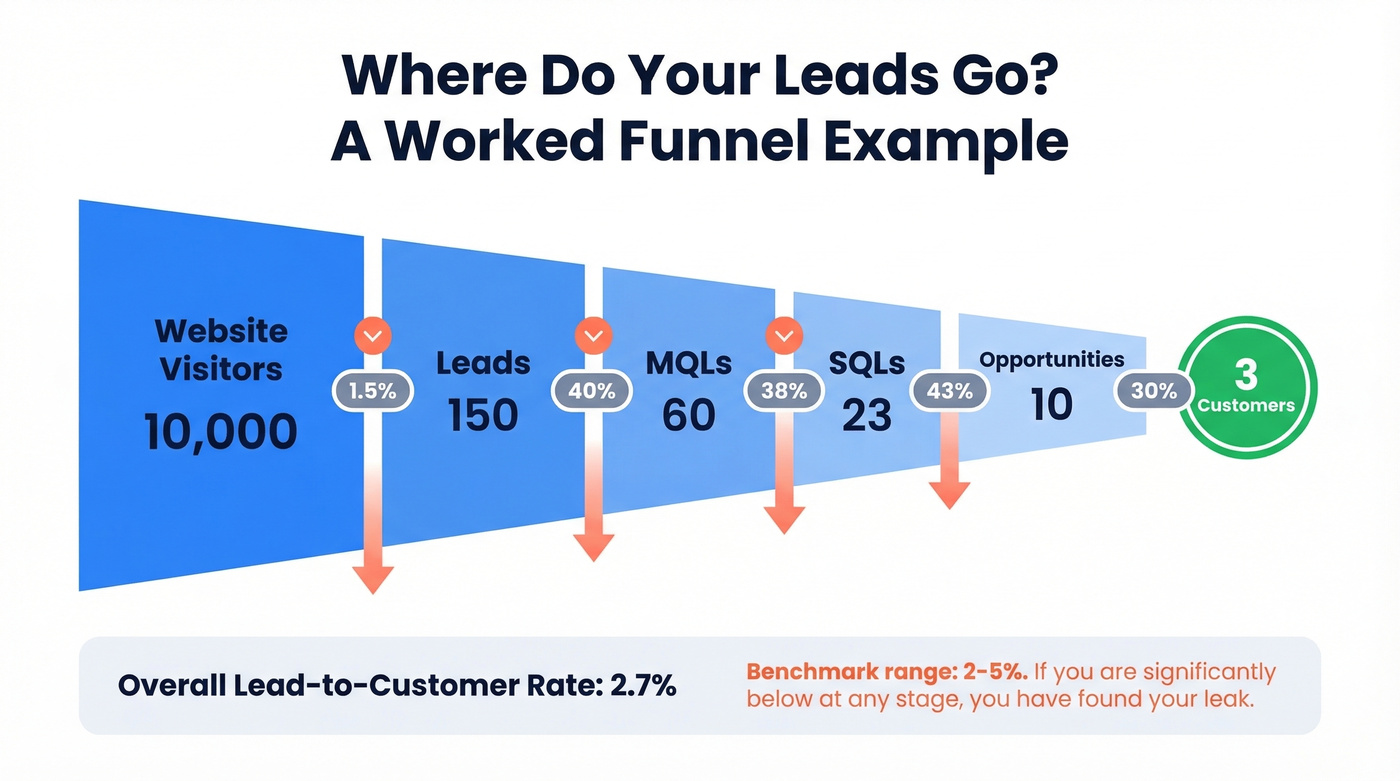
10,000 website visitors → 150 leads (1.5%) → 60 MQLs (40%) → 23 SQLs (38%) → 10 opportunities (43%) → 3 customers (30%)
That's a ~2.7% lead-to-customer rate, right in the middle of the 2-5% benchmark range. If your numbers fall significantly below these at any stage, you've found your leak.

You just read it: if your email bounce rate is above 5%, nothing downstream in your software sales funnel matters. Prospeo delivers 98% email accuracy with a 7-day data refresh cycle - 6x faster than the industry average. Teams using Prospeo cut bounce rates from 35%+ to under 4% and tripled pipeline output.
Stop optimizing a funnel that's built on stale data.
Pipeline Velocity Formula
Pipeline velocity tells you how much revenue your funnel generates per day. It's the single best diagnostic metric for funnel health.
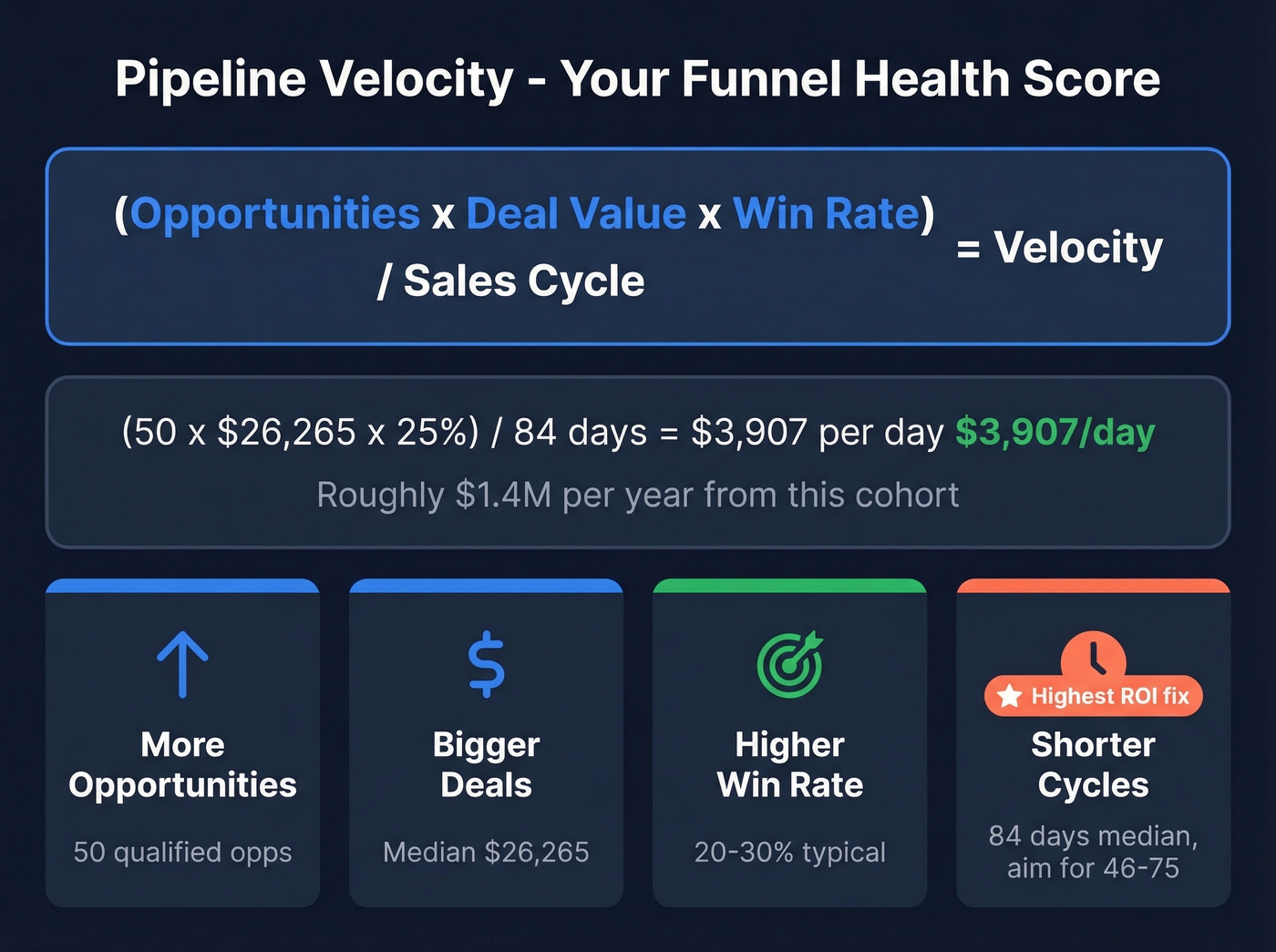
Pipeline Velocity = (Number of Opportunities x Average Deal Value x Win Rate) / Sales Cycle Length
Let's plug in benchmark numbers. Say you have 50 qualified opportunities, a median deal size of $26,265, a 25% win rate, and an 84-day median sales cycle:
(50 x $26,265 x 0.25) / 84 = $3,907/day in pipeline velocity
That's roughly $1.4M/year from this cohort. Want to double it? You have four levers: more opportunities, bigger deals, higher win rate, or shorter cycles. Most teams fixate on "more opportunities" when the highest-ROI fix is usually shortening the cycle or improving win rate.
Benchmark ranges to keep in mind: median sales cycle is 84 days, with an optimal range of 46-75 days. Typical win rate is 20-30%, and median deal size for B2B SaaS is $26,265. If your cycle is running 120+ days, focus there before you hire another SDR.
Why Your Funnel Is Leaking
Every funnel leaks. The question is where, and whether the leak is a drip or a hemorrhage.
Six Common Leaks
1. Poor lead qualification. If marketing and sales don't agree on what an MQL means, you'll pass garbage to the pipeline. One SaaS provider refined their qualification criteria and saw SQL rates jump from 30% to 45% in three months.
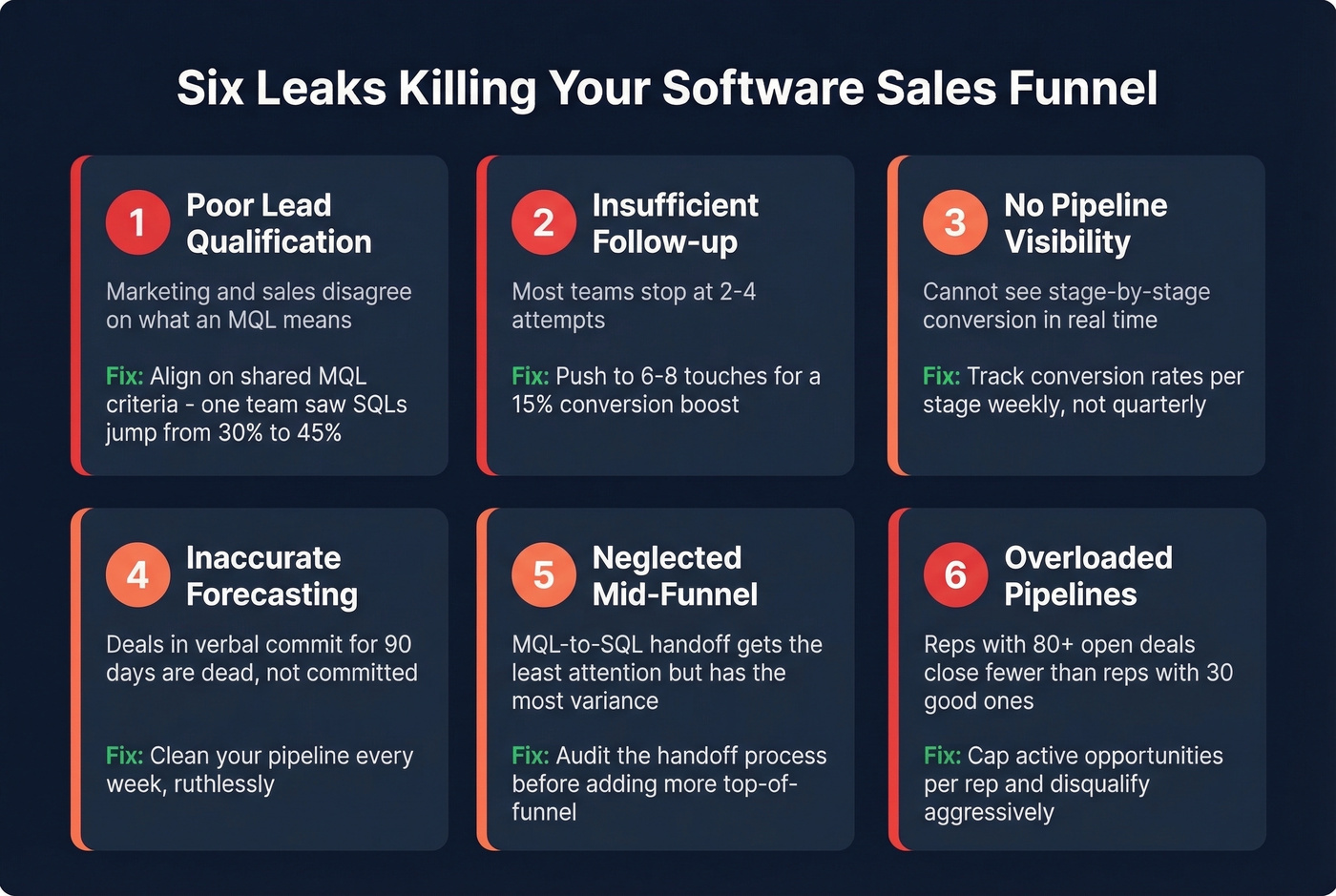
2. Insufficient follow-up. Most teams attempt 2-4 follow-ups. The data says 6-8 attempts is where the conversion gains live - that gap alone can represent a ~15% conversion increase. We've seen this pattern repeatedly: reps give up right before the prospect was ready to engage. If you need a starting point, steal a few follow-ups that are built for replies.
3. No pipeline visibility. If you can't see stage-by-stage conversion rates in real time, you're flying blind. Teams that document their funnel stages and track conversion rates consistently outperform those that don't. This is exactly what good funnel metrics reporting is designed to surface.
4. Inaccurate forecasting. Deals sitting in "verbal commit" for 90 days aren't committed. They're dead. Clean your pipeline weekly. If this is a recurring issue, it’s usually a tooling/process gap - use a dedicated sales forecasting workflow.
5. Neglected mid-funnel. Everyone obsesses over top-of-funnel lead gen and bottom-of-funnel closing. The MQL-to-SQL handoff - the stage with the most variance - gets the least attention. Tighten your lead scoring rules before you rewrite another sequence.
6. Overloaded pipelines. More isn't better if half your opportunities are stale. Reps with 80+ open deals close fewer than reps with 30 well-qualified ones. The consensus on r/sales is that bloated pipelines look impressive in dashboards but produce nothing.
The Data Quality Problem
Here's the leak nobody talks about in strategy meetings: bad contact data. Revenue leakage isn't just about process - it's about the raw material feeding your funnel. If 20% of your emails bounce, your sequences tank, your domain reputation drops, and every downstream metric suffers. The damage doesn't stop at closed-lost deals either - it cascades into customer success, inflating churn and depressing LTV when the wrong accounts get through.
This is where RevOps alignment becomes structural, not just organizational. Snyk's outbound team was running bounce rates of 35-40% before they fixed their data source. After switching to Prospeo, bounces dropped under 5%, and AE-sourced pipeline increased 180% - over 200 new opportunities per month. With 98% email accuracy and a 7-day data refresh cycle, contact data doesn't decay between the time you build a list and the time your sequence fires. At ~$0.01 per email, it's the cheapest fix with the highest downstream impact. If your bounce rate is above 5%, you have a data problem, not a strategy problem - start with email bounce rate benchmarks and remediation.
How AI Is Reshaping the Funnel
McKinsey's research shows sales teams spend only one-third of their time actually selling. The rest goes to CRM entry, follow-up scheduling, and admin work. AI is compressing that overhead - and the teams adopting it are pulling ahead fast.
Highest-Impact Use Cases
The 5-minute speed-to-lead stat is the one that should keep you up at night: responding within 5 minutes makes you 21x more likely to qualify a lead. No human team can consistently hit that window without automation.
The highest-impact AI applications right now are instant lead qualification and routing, automated scoring based on behavioral and firmographic signals, smart follow-up triggers that fire when engagement patterns shift, and predictive deal insights that flag at-risk opportunities before they stall. Early adopters report ~30% improvement in win rates. If you’re building this into your motion, start with AI sales follow-up workflows that reduce manual touches.
The next wave - agentic AI that autonomously handles multi-step workflows like research, outreach sequencing, and meeting scheduling - is already in early deployment at companies like Salesforce and HubSpot. By late 2026, expect autonomous agents to handle the first two touches in most outbound sequences.
Tools Worth Knowing
AI tooling for revenue teams breaks into clear categories. Gong handles conversation intelligence - analyzing calls to surface what top reps do differently, typically running $100-200+/user/month for enterprise teams. Clari owns forecasting and pipeline inspection, with pricing that usually lands around $30k-$80k/year for mid-market deployments. 6sense layers intent data and ABM signals to identify in-market accounts before they raise their hand, with pricing typically around $60k-$150k+/year. HubSpot and Salesforce both ship native AI features now for lead scoring, email drafting, and deal prediction.
For the enrichment layer, Prospeo's API workflows return 50+ data points per contact at a 92% match rate, integrating natively with HubSpot and Salesforce. Automated pipeline hygiene means your AI scoring models aren't training on stale data. If you’re comparing vendors, use a shortlist of data enrichment services to sanity-check match rates and refresh cycles.
Skip the $60k+ intent data platforms if you're under $5M ARR. The signal-to-noise ratio isn't worth it until you have enough pipeline volume to act on the insights.
Metrics That Matter at Each Stage
You don't need to track everything. You need to track the right things at the right stage.
| Metric | Formula | What It Tells You | Benchmark |
|---|---|---|---|
| CAC | Total sales + marketing spend / new customers | Acquisition efficiency | Varies by ACV |
| LTV | ARPU x gross margin x avg lifespan | Customer value ceiling | 3:1 LTV:CAC minimum |
| MRR | Sum of monthly recurring revenue | Growth trajectory | Track month-over-month |
| Churn rate | Lost customers / starting customers | Retention health | Under 5% monthly |
| Lead velocity rate | (New leads this month - last month) / last month | Pipeline momentum | Positive = good |
| Stage conversion | Leads progressing / leads entering stage | Funnel efficiency | See benchmark table |
| Net revenue retention | (Starting MRR + expansion - contraction - churn) / Starting MRR | Post-sale health | 110%+ is strong |
For PLG motions, add the behavior-based activation metrics: Signup to Activation rate, Activation to 2nd Activation, and 2nd Activation to Weekly Habit. These leading indicators predict revenue 60-90 days before it shows up in your MRR.
The funnel doesn't end at Closed Won. For SaaS, onboarding, activation, and expansion are revenue stages too. Track net revenue retention alongside your acquisition funnel - a 120% NRR can compensate for a mediocre top-of-funnel, and it's often cheaper to fix than pouring more leads into a leaky bucket. If you’re seeing retention drag, run a proper churn analysis before you blame acquisition.
Let's be honest: most teams track too many metrics and act on too few. Pick three that map to your biggest funnel leak, set a weekly review cadence, and ignore everything else until those three improve.
Building Your Tech Stack
You don't need 14 funnel tools. You need a CRM, a data source, and an automation layer. Everything else is optional until you've outgrown those three.
| Category | SMB / Startup | Mid-Market | Enterprise |
|---|---|---|---|
| CRM | Pipedrive (~$15-$100/user/mo) | HubSpot (Free-$926/mo Pro) | Salesforce (~$25-$330+/user/mo) |
| Funnel builder | GetResponse (from $59/mo) | ClickFunnels ($81-$248/mo annual) | Custom / Marketo |
One thing the comparison tables won't tell you: pricing models vary wildly across categories. CRMs charge per seat, data tools charge per credit or per contact, and funnel builders use a mix of flat-rate and visitor-based pricing. Before you commit, model out your actual usage. A $14/seat CRM looks cheap until you have 50 reps; a credit-based data tool at $0.01/email stays cheap at any scale. If you’re still deciding, skim a few examples of a CRM to map features to your motion.
Perspective ($62-391/mo) is worth a look if you need a mobile-first funnel builder with built-in CRM and email/SMS sequences. But for most teams, the CRM + data source combination is where 80% of the value lives. Get those right first.
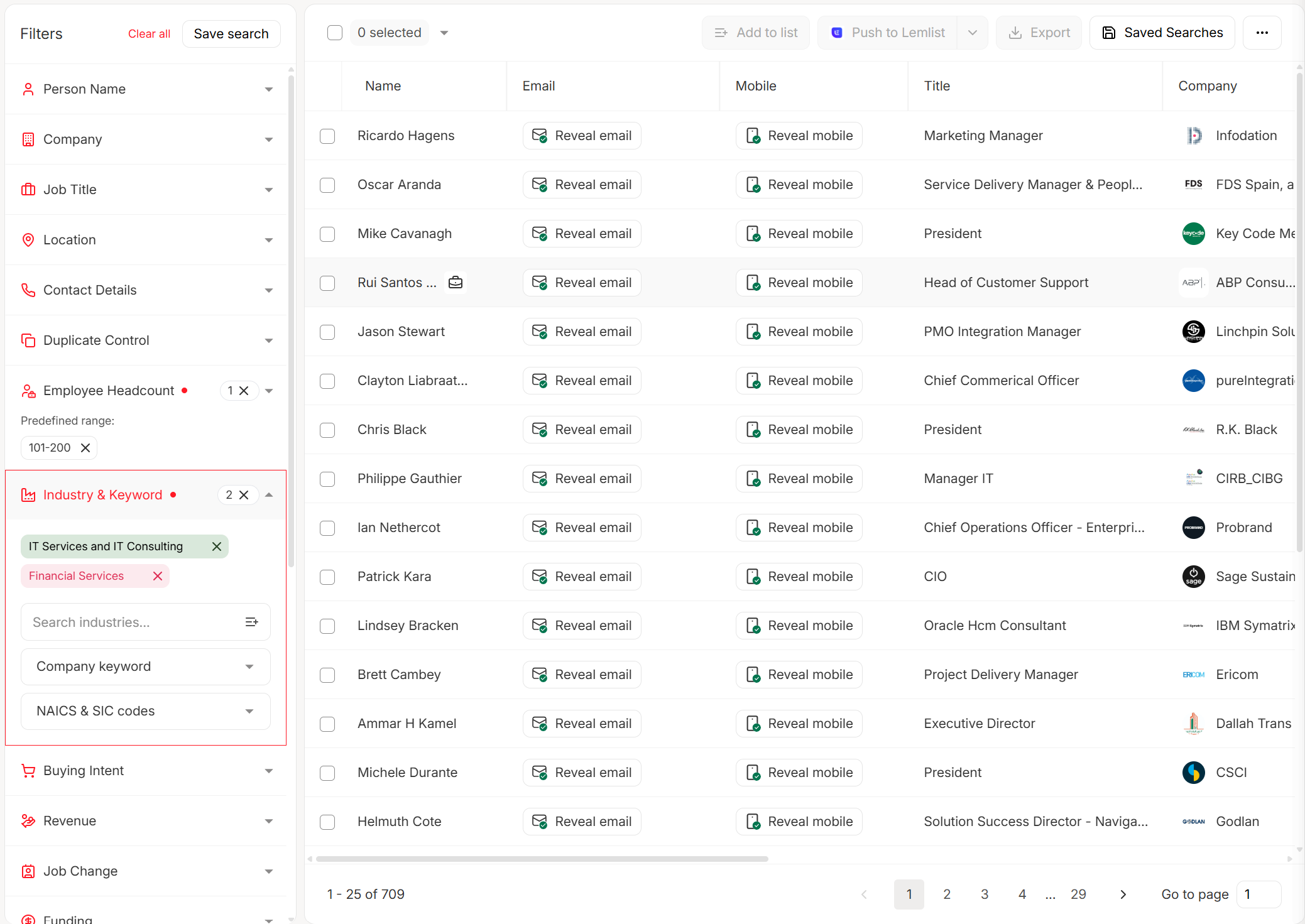
Your MQL-to-SQL conversion rate is only as good as the contacts feeding it. Prospeo's 30+ search filters - including buyer intent, technographics, and headcount growth - let you build lists that match your ICP at every funnel stage. At $0.01 per email, you get enterprise-grade data without the enterprise price tag.
Fill your software sales funnel with contacts that actually convert.
FAQ
What's the difference between a sales funnel and a sales pipeline?
A funnel describes the buyer's journey from awareness to purchase; a pipeline describes your internal deal stages and revenue progression. They should map to each other, but they measure different things - funnels track conversion rates while pipelines track deal value and stage velocity.
What's a good lead-to-customer conversion rate for SaaS?
B2B SaaS lead-to-customer conversion benchmarks sit at 2-5%. Top performers hit the upper end by tightening the MQL-to-SQL handoff and maintaining verified contact data throughout the funnel. Below 2%, audit your qualification criteria first.
How long is a typical SaaS sales cycle?
The median SaaS sales cycle is 84 days. PLG motions average 40-84 days; enterprise sales-led deals run 90-180+ days. Larger ACVs and more stakeholders extend timelines - there's no shortcut around that, but improving speed-to-lead and follow-up cadence can shave 15-20 days off the total.
How do I reduce email bounce rates in my outbound funnel?
Use a real-time verification tool with 98%+ accuracy and a refresh cycle measured in days, not weeks. A 7-day refresh and multi-step verification process keeps bounce rates under 5%, protecting domain reputation. Upload a CSV or connect via API - verification should run in minutes, not hours.