

7 Software Sales Techniques Your Manager Should Have Taught You
The SaaS market is growing from $317B in 2024 to over $1.2T by 2032. Every company riding that wave needs reps who can sell - yet every "software sales techniques" guide online defines what SaaS sales is instead of telling you what to actually say on the call.
Here's the short version: master three things and you'll outperform 90% of software reps. Handle objections with a framework. Multithread every deal over $20k. Lead demos with pain instead of features. Below are the scripts and numbers to execute each one.
Pick the Right Sales Motion
Product-led growth lets users self-serve - ideal for low-ACV products where CAC efficiency matters. One widely cited average SaaS CAC sits around $702. Sales-led growth is the play for enterprise deals where $100k+ contracts take 90-180 days and require a human to navigate the buying committee.
Most scaling companies run both. McKinsey calls this product-led sales: using product usage signals to spot accounts with high engagement, then layering a sales motion on top. If your company hasn't decided which motion you're running, that's the first conversation to have with leadership.
Choose a Methodology That Fits
Methodologies aren't religions. They're frameworks you adapt to deal complexity.
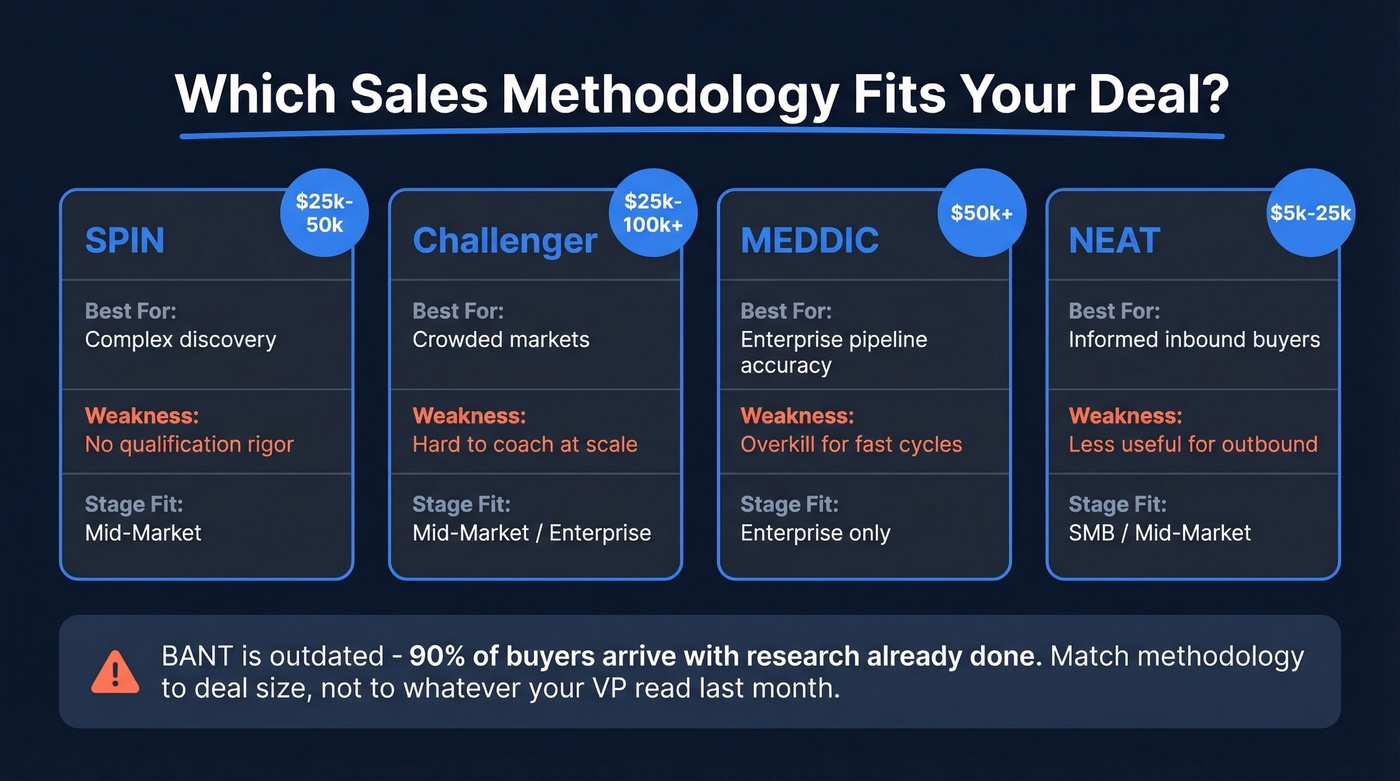
| Methodology | Best For | Weakness | SaaS Stage Fit |
|---|---|---|---|
| SPIN | Complex discovery | No qualification rigor | Mid-market |
| Challenger | Crowded markets | Hard to coach at scale | Mid-market / Enterprise |
| MEDDIC | Enterprise pipeline | Overkill for fast cycles | Enterprise ($50k+ ACV) |
| NEAT | Informed inbound buyers | Less useful for outbound | SMB / Mid-market |
BANT feels like a relic. It was designed when sellers controlled information. Today's buyers show up with roughly 90% of their research already done. NEAT - Need, Economic Impact, Access to Authority, Timeline - reflects that reality better.
We've seen teams waste entire quarters trying to implement MEDDIC on $15k deals. Match the methodology to the deal size, not to whatever the VP of Sales read in a book last month.
Cold Outreach That Books Meetings
57% of senior-level buyers still prefer phone calls for initial outreach. The problem isn't the channel. It's the execution.
Here's the thing: your script doesn't matter if the number is disconnected. Bad data is the silent killer of outbound programs, and we've watched it destroy pipeline for teams that had everything else dialed in. Before you optimize openers, fix the input. Prospeo covers 125M+ verified mobile numbers with a 30% pickup rate, and emails run at 98% accuracy on a 7-day refresh cycle. One customer, Meritt, dropped their bounce rate from 35% to under 4% after switching - and tripled pipeline from $100K to $300K per week.
With clean data in hand, structure cold calls around three beats: a pattern-interrupt opener tied to a specific trigger ("I noticed you're hiring three SDRs"), a one-sentence value prop tied to their pain, and an open question that hands them the mic. Always end with a specific next step - "Can we grab 15 minutes Thursday?" - not "I'll follow up sometime." If you need more ways to land the meeting, steal a few proven follow-up lines.
Relevance beats cleverness every time. "Your CEO just posted about expanding into EMEA" works better than any cute one-liner you borrowed from a LinkedIn influencer.
Run Demos That Close
86% of buyers are more likely to convert when companies understand their goals. Your demo can't be a feature tour with their logo pasted on slide one.
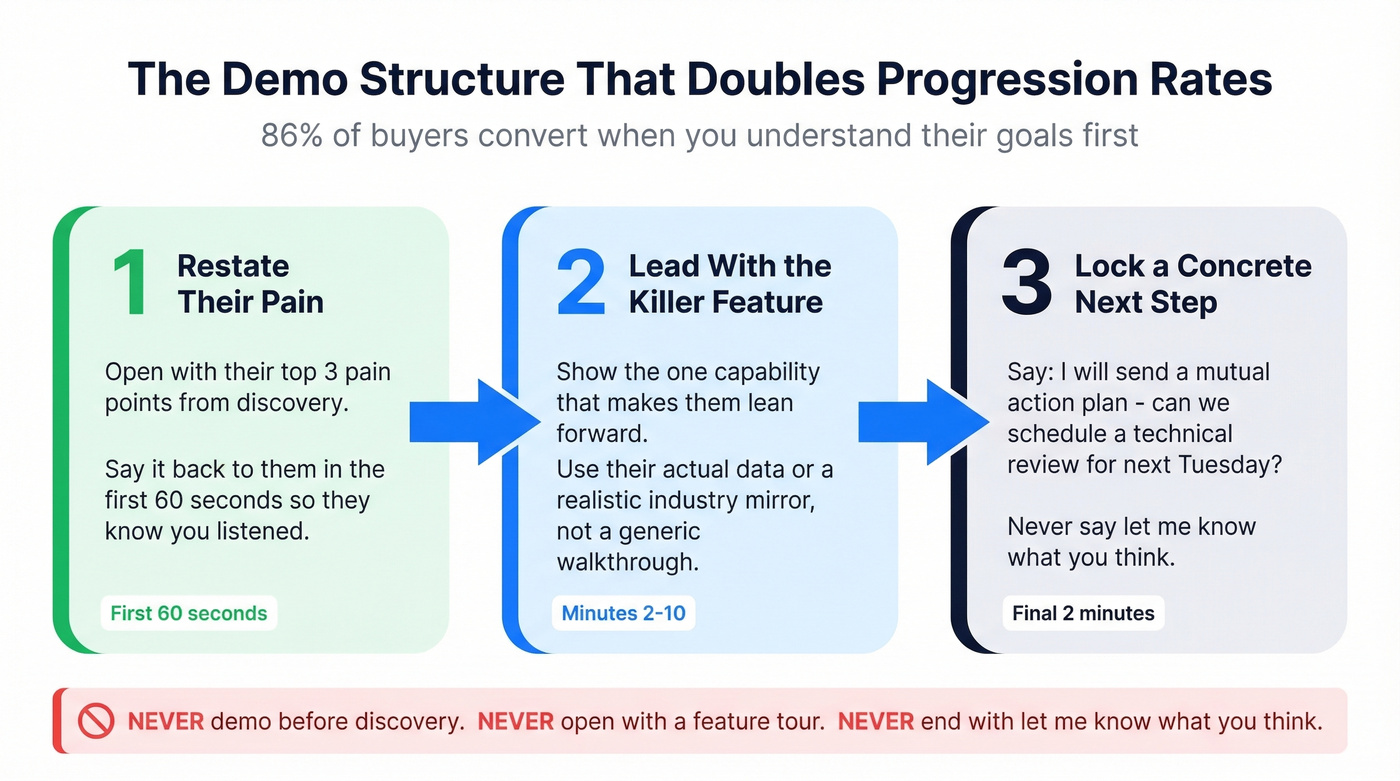
There's a common refrain among top reps, and it's worth repeating: never demo before discovery. Restate their pain in the first 60 seconds, lead with the killer feature that makes them lean forward, and personalize with their actual data or a realistic industry mirror. We ran an internal test where reps who opened demos by restating the prospect's top three pain points from discovery saw 2x the progression rate to next steps compared to reps who opened with a product overview. If you want a tighter structure, use a product demo checklist to keep the call on rails.
End with a concrete next step - "I'll send a mutual action plan; can we schedule a technical review for next Tuesday?" - not "let me know what you think." That phrase is where deals go to die.

Every software sales technique above depends on reaching the right person. Meritt tripled pipeline from $100K to $300K/week after switching to Prospeo's 98% accurate emails and 125M+ verified mobiles - bounce rate dropped from 35% to under 4%.
Stop perfecting your pitch and start fixing your data.
Handle Objections With a Framework
Most reps improvise through objections. That's why most reps lose deals they should've won.
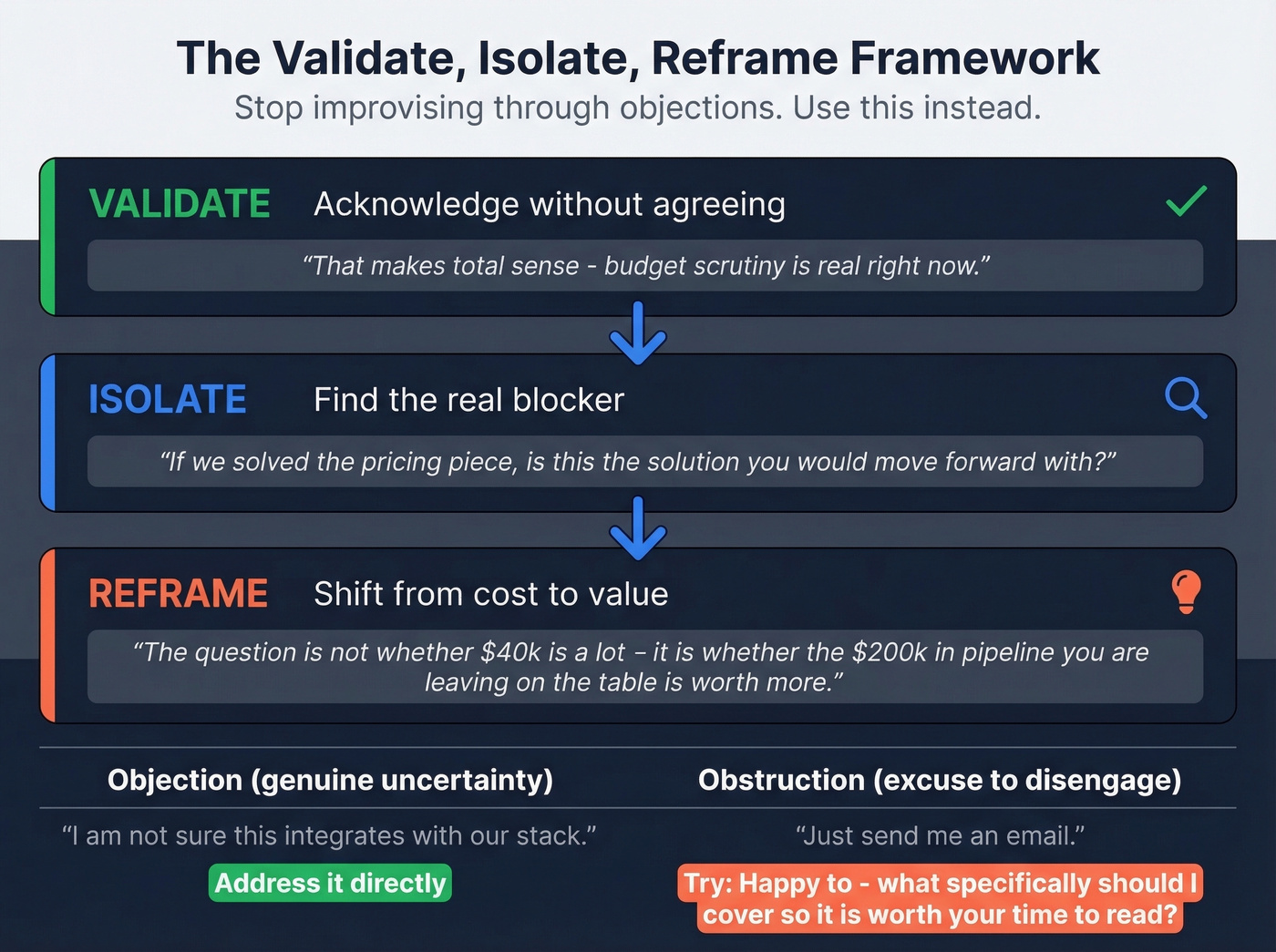
Use the Validate, Isolate, Reframe framework instead. Validate the concern without agreeing: "That makes total sense - budget scrutiny is real right now." Isolate to find the real blocker: "If we solved the pricing piece, is this the solution you'd move forward with?" Reframe from cost to value: "The question isn't whether $40k is a lot - it's whether the $200k in pipeline you're leaving on the table is worth more." If your team is hearing the same pushbacks every week, build a simple objection reduction playbook.
One distinction that'll change your approach: objections aren't obstructions. An objection is genuine uncertainty - "I'm not sure this integrates with our stack." An obstruction is an excuse to avoid engagement - "Just send me an email." Treat them differently. For the email brush-off, try: "Happy to - what specifically should I cover so it's worth your time to read?"
Multithread Every Deal
Single-threading is the number one deal-killer in enterprise software sales. A typical B2B deal now involves 6-10 decision-makers. The data is brutal: deals with one contact close at 5%. Deals with five contacts close at 30%.
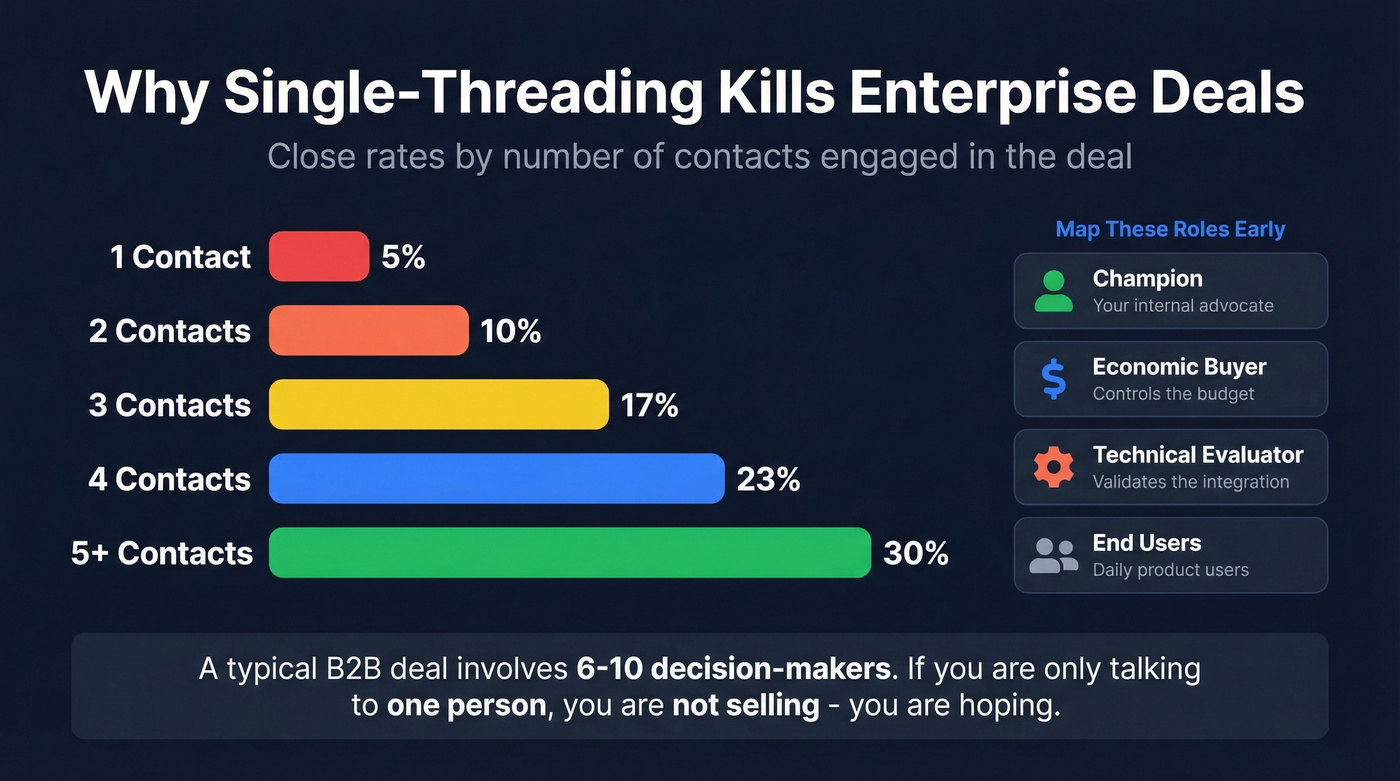
Map the buying committee early - champion, economic buyer, technical evaluator, end users. Build separate relationships with each. Your champion can't do all the internal selling for you, and if they leave the company mid-deal, you're starting from zero. This is also where enterprise B2B sales discipline matters most.
Let's be honest: if you're running enterprise deals and only talking to one person, you're not selling. You're hoping. The consensus on r/sales backs this up - thread after thread of reps sharing post-mortems on six-figure deals that died because their single contact got reassigned or went on leave. Tools like Prospeo make it straightforward to find direct dials and verified emails for multiple stakeholders at the same account, so there's no excuse for single-threading in 2026. If you’re building this into your process, borrow a few account-based selling best practices.
Mistakes That Kill Deals
Premature pitching. Sending a pitch deck five minutes into discovery tells the buyer you don't care about their problem. Earn the right to pitch first. A better baseline is a repeatable discovery questions bank.
Fake urgency. "This pricing expires Friday" when it doesn't. One sales leader reported a 20% win-rate lift over two quarters just by replacing urgency CTAs with data-backed proposals and tailored value maps. That's not a marginal improvement - it's the difference between making quota and missing it.
Hot take: if your ACV is under $25k, you probably don't need a 12-stage sales process. A tight two-call close with strong discovery will outperform a bloated pipeline every time. Complexity is the enemy of velocity at that deal size. Skip the elaborate stage gates and focus on getting to "yes" or "no" faster. If you need a clean baseline, map it to the classic steps to close a sale.
Know Your Benchmarks
Here are 2026 SaaS funnel benchmarks worth pinning to your wall:
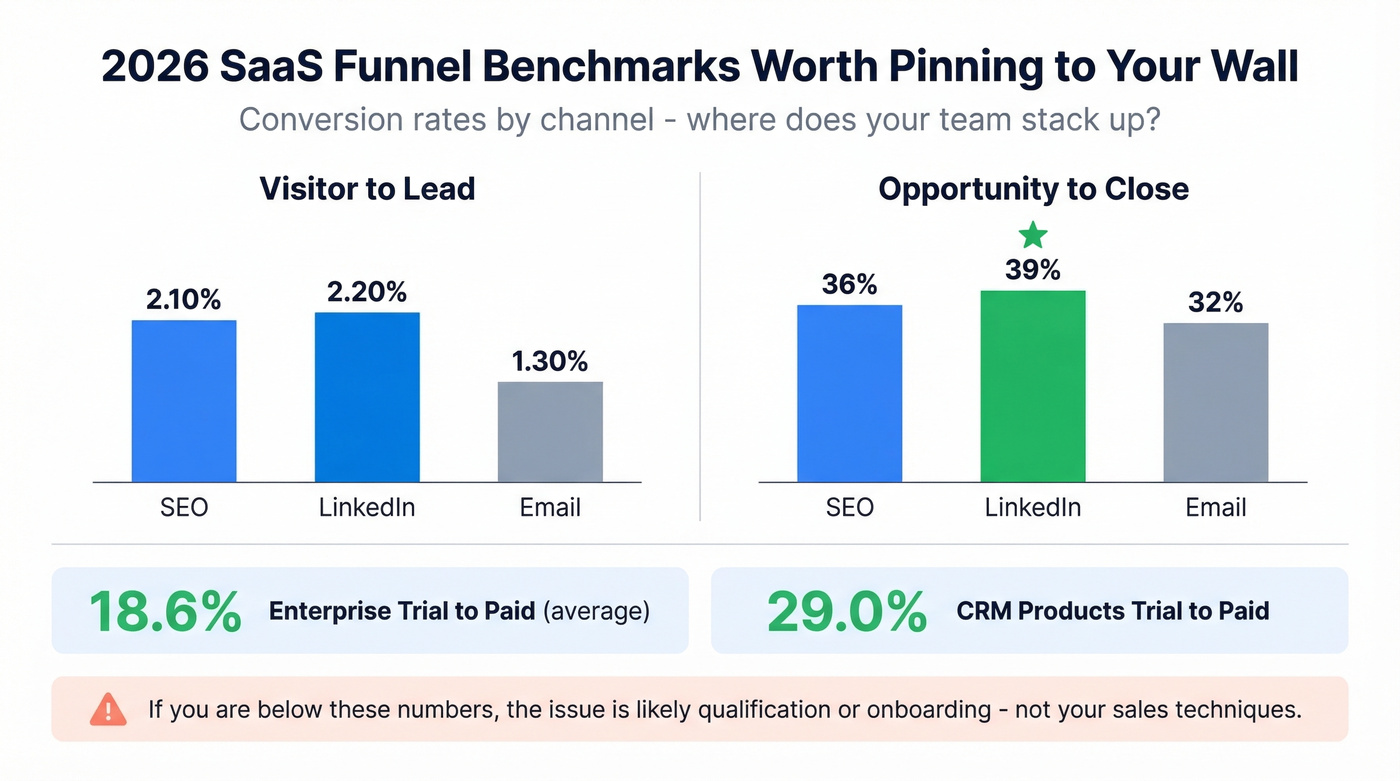
| Channel | Visitor to Lead | Opp to Close |
|---|---|---|
| SEO | 2.10% | 36% |
| 2.20% | 39% | |
| 1.30% | 32% |
For PLG teams, enterprise trial-to-paid conversion averages 18.6%, while CRM products hit 29.0%. If you're below these numbers, the issue is likely qualification or onboarding - not your software sales techniques. To diagnose where you’re leaking, track a few core funnel metrics.
And don't forget the metric that matters most post-sale: net revenue retention. The best SaaS companies expand existing accounts as aggressively as they close new ones. LinkedIn-sourced opportunities close at the highest rate, but SEO drives more consistent top-of-funnel volume. Build your outbound motion around the channel that matches your sales cycle and ACV. If you want a broader baseline, compare against current sales pipeline benchmarks.
Multithreading kills single-threaded deals - but only if you can actually find direct dials for 6-10 stakeholders. Prospeo gives you verified emails and mobile numbers across entire buying committees, refreshed every 7 days, at $0.01 per email.
Map the full buying committee in minutes, not days.
FAQ
What are the most effective software sales techniques for SaaS?
It depends on deal size. MEDDIC works best for enterprise deals at $50k+ ACV where pipeline accuracy and buying committee navigation matter most. Challenger or SPIN fit mid-market cycles. NEAT is ideal for qualifying inbound leads from buyers who've already done their homework.
How many stakeholders should I engage on an enterprise deal?
Aim for five or more. Deals with one contact close at 5%; deals with five contacts close at 30%. Map the buying committee early - champion, economic buyer, technical evaluator, end users - and build separate relationships before the deal stalls.
How do I improve cold outreach response rates?
Start with clean data - verified emails and direct dials, not generic info@ addresses. Pair accurate contact data with a personalized opener tied to a specific trigger, not a generic template. The channel matters less than the relevance of your message and the quality of the number you're dialing.