

Soleadify vs TAMI AI: Which B2B Data Tool Deserves Your Budget?
Comparing Soleadify vs TAMI AI comes down to what you're actually buying data for. They overlap on paper but serve genuinely different buyers - one is built around SMB company datasets and enrichment workflows, while the other targets European contact-level prospecting and technographics. We've dug into the pricing, reviews, and feature sets to give you a straight answer.
30-Second Verdict
TAMI AI wins for European contact-level prospecting with tech stack insights and CRM integrations.
Soleadify wins for SMB company-level data used in KYB, verification, and onboarding workflows - not outbound sales.
Neither is the right pick if your primary need is verified emails for outbound. More on that below.
What Each Tool Actually Does
Soleadify provides access to an SMB database of 35M+ companies across 100+ countries, with weekly data updates. In practice, it fits best when you need company profiles, matching/deduplication, and data provisioning for onboarding, verification, enrichment, or internal data infrastructure. It's not really a prospecting tool. If you're evaluating vendors in this category, compare it against other B2B company data providers too.
TAMI AI specializes in European B2B data with a GDPR-compliant framework. Beyond contact records, it surfaces tech stack insights - payment providers, ecommerce platforms, shipping partners - which is genuinely useful for account-based targeting. CRM integrations with HubSpot, Salesforce, and Pipedrive plus API access round out the workflow side.
Pricing Breakdown
| Tool | Starting Price | Credits | Cost per Lead |
|---|---|---|---|
| TAMI Free | $0 | 50 exports + 5 mobile | N/A |
| TAMI Basic | $55/mo ($47/mo billed annually) | 250 exports + 40 mobile | ~$0.22 |
| TAMI Growth | $79/mo ($67/mo billed annually) | 500 exports + 80 mobile | ~$0.16 |
| TAMI Enterprise | Custom | Unlimited exports | Not public |
| Soleadify | $99/user/mo | Not published | N/A - company records, not contacts |
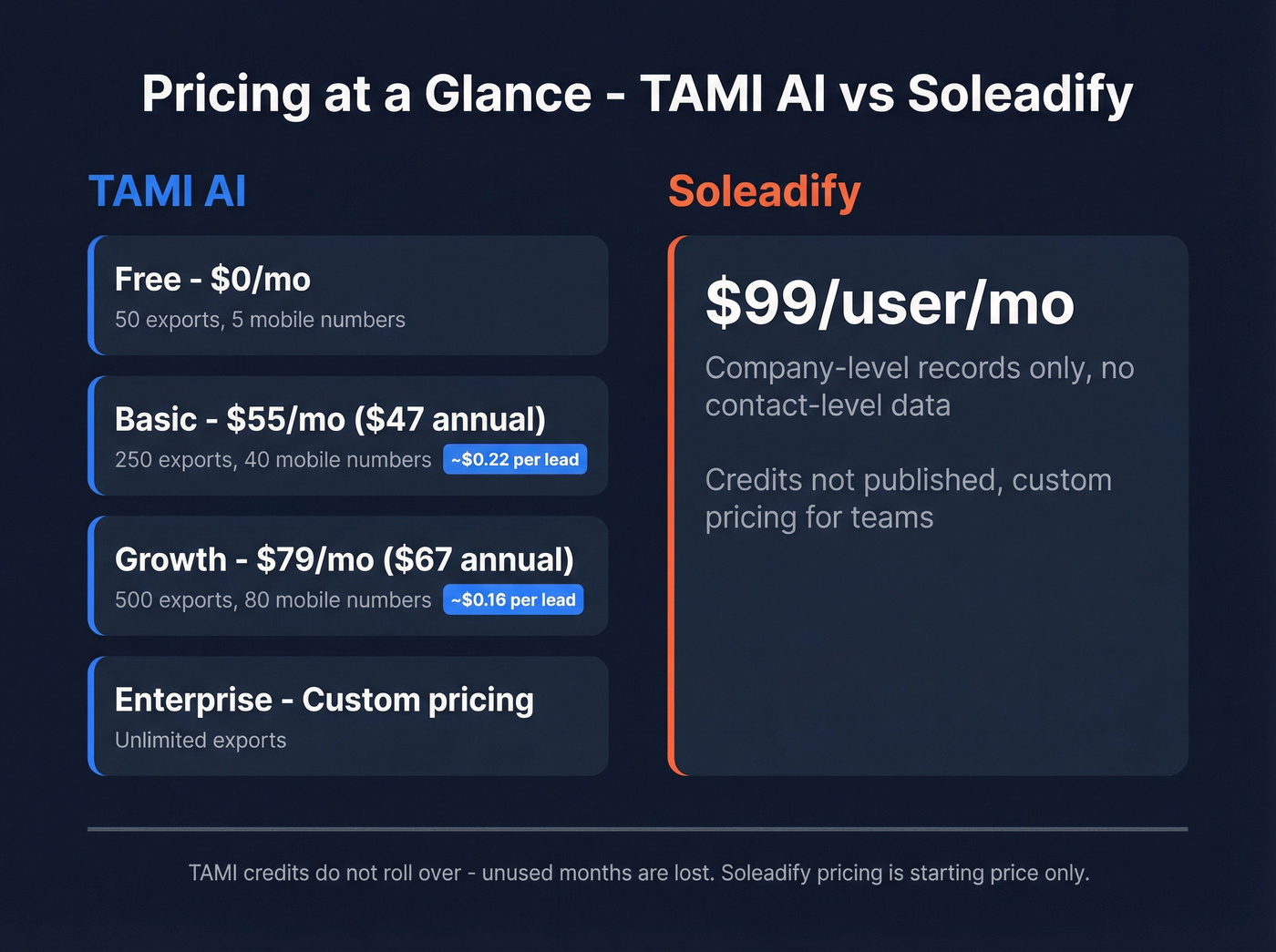
Annual billing on TAMI drops Basic from $55 to $47 and Growth from $79 to $67, roughly a 15% discount. Credits don't roll over, so missed months mean wasted budget. Soleadify's $99/user/month is the published starting price; expect custom pricing for larger deployments.
Here's the thing: at ~$0.16-$0.22 per contact on TAMI and $99/month for company-level records on Soleadify, neither tool is expensive. But neither is cheap enough to justify if the data quality doesn't hold up - and that's where things get interesting.
Head-to-Head Feature Comparison
| Dimension | Winner | Why |
|---|---|---|
| Data Coverage | TAMI AI | Contact-level data across Europe vs. Soleadify's SMB company records |
| Contact Accuracy | TAMI AI (with caveats) | Offers contacts, but reviewers flag wrong-company matches |
| Pricing Transparency | TAMI AI | Full tier breakdown vs. Soleadify's starting price only |
| CRM Integrations | TAMI AI | Multiple CRM integrations plus API access |
| SMB Company Data | Soleadify | Purpose-built SMB company dataset with weekly updates |
| Customer Support | Soleadify | 4.9/5 Customer Service rating on Capterra |
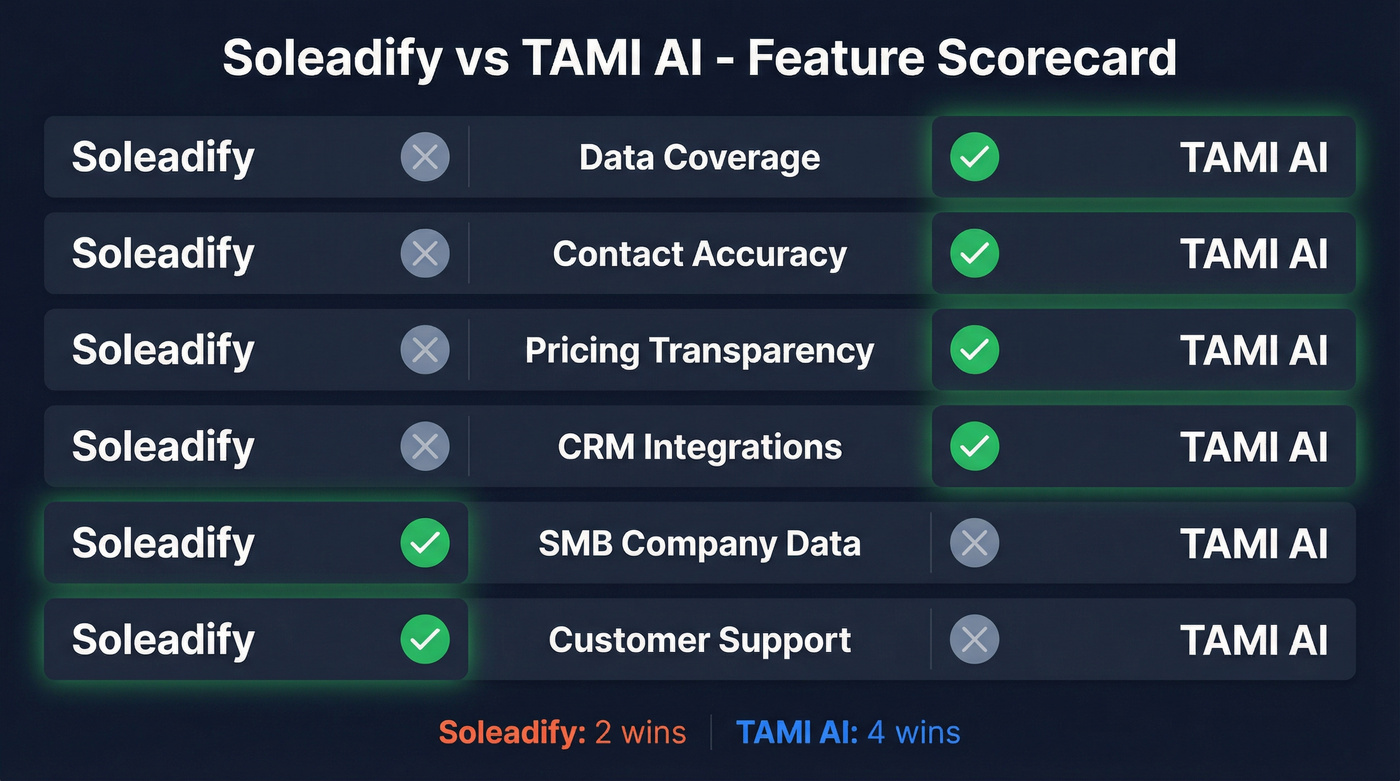
TAMI takes four of six categories. Soleadify wins where it should - SMB company data and support - but loses everywhere that matters for prospecting teams.

Neither Soleadify nor TAMI AI solves the core outbound problem: verified contact data you can actually send to. Prospeo delivers 300M+ profiles with 98% email accuracy and 125M+ verified mobiles - refreshed every 7 days, not every 6 weeks. At $0.01/email, you pay a fraction of TAMI's $0.16-$0.22 per contact.
Stop comparing tools that weren't built for outbound in the first place.
Data Quality and Coverage
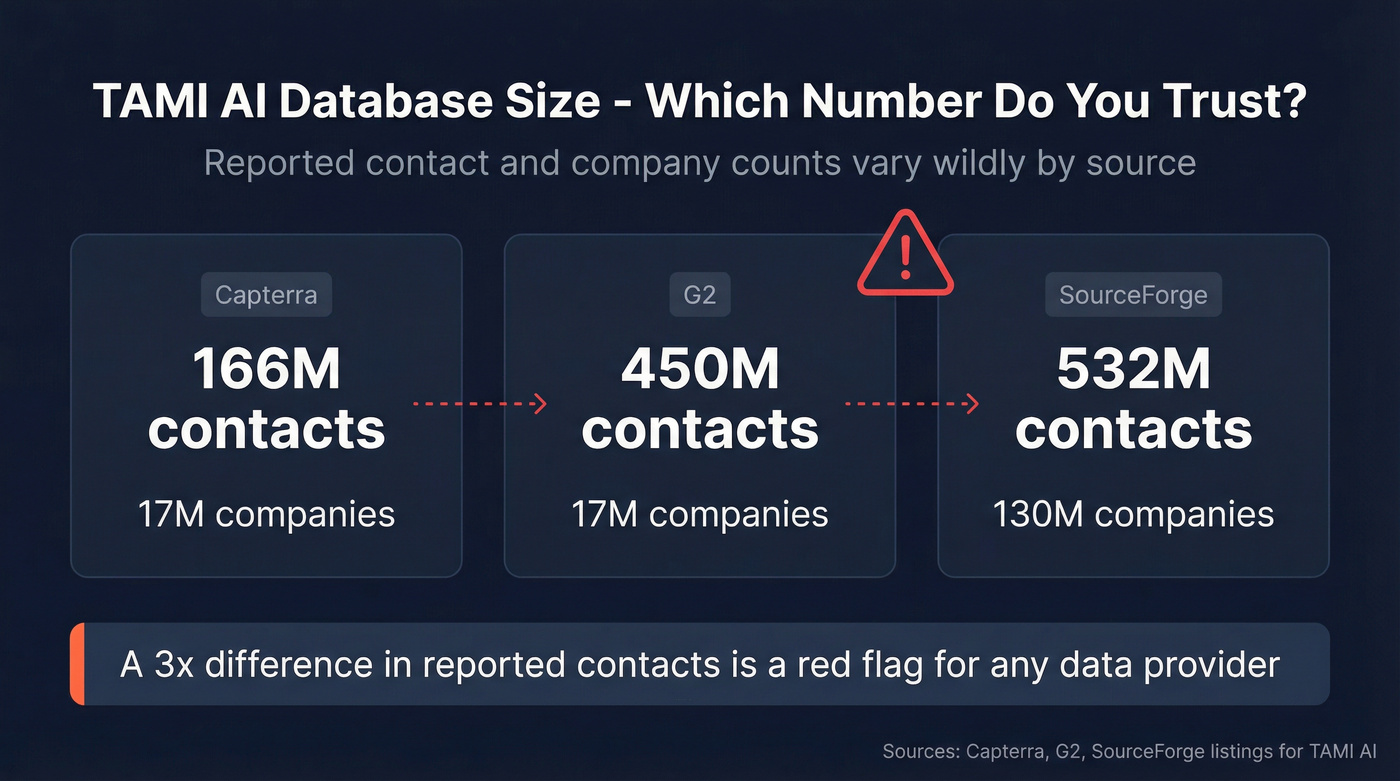
TAMI AI has a consistency problem in third-party listings. Its database size varies wildly depending on where you look: 166M contacts and 17M companies on Capterra, 450M contacts and 17M companies on G2, and 532M contacts with 130M companies on SourceForge. That kind of discrepancy doesn't inspire confidence when you're evaluating data providers, and we haven't seen a clear explanation for the gaps. If you're auditing vendors, it helps to use a consistent lead generation metrics checklist.
TAMI markets a <5% bounce rate. At the same time, Capterra reviews include blunt accuracy complaints - contacts that "can often be from incorrect companies." That's not a minor bug when you're running outbound sequences at scale and your sender reputation is on the line.
Soleadify covers 35M+ companies across 100+ countries, with weekly updates. The challenge: with only 11 Capterra reviews, there's limited third-party data on accuracy at scale. The numbers look good, but the sample size is too small to draw firm conclusions.
Ratings and User Sentiment
TAMI AI - 4.3/5 on G2 (139 reviews), 4.4/5 on Capterra (131 reviews). Ease of Use scores 4.6, Customer Service 4.7, Features 4.3. Likelihood to Recommend sits at 7.5/10. Filtering and segmentation get consistent praise. Recurring complaints include contacts from wrong companies, clunky Excel exports, and slow-loading pages. One Reddit post flags a user being cold-called by TAMI where the caller had their personal phone details - raising uncomfortable data sourcing questions.
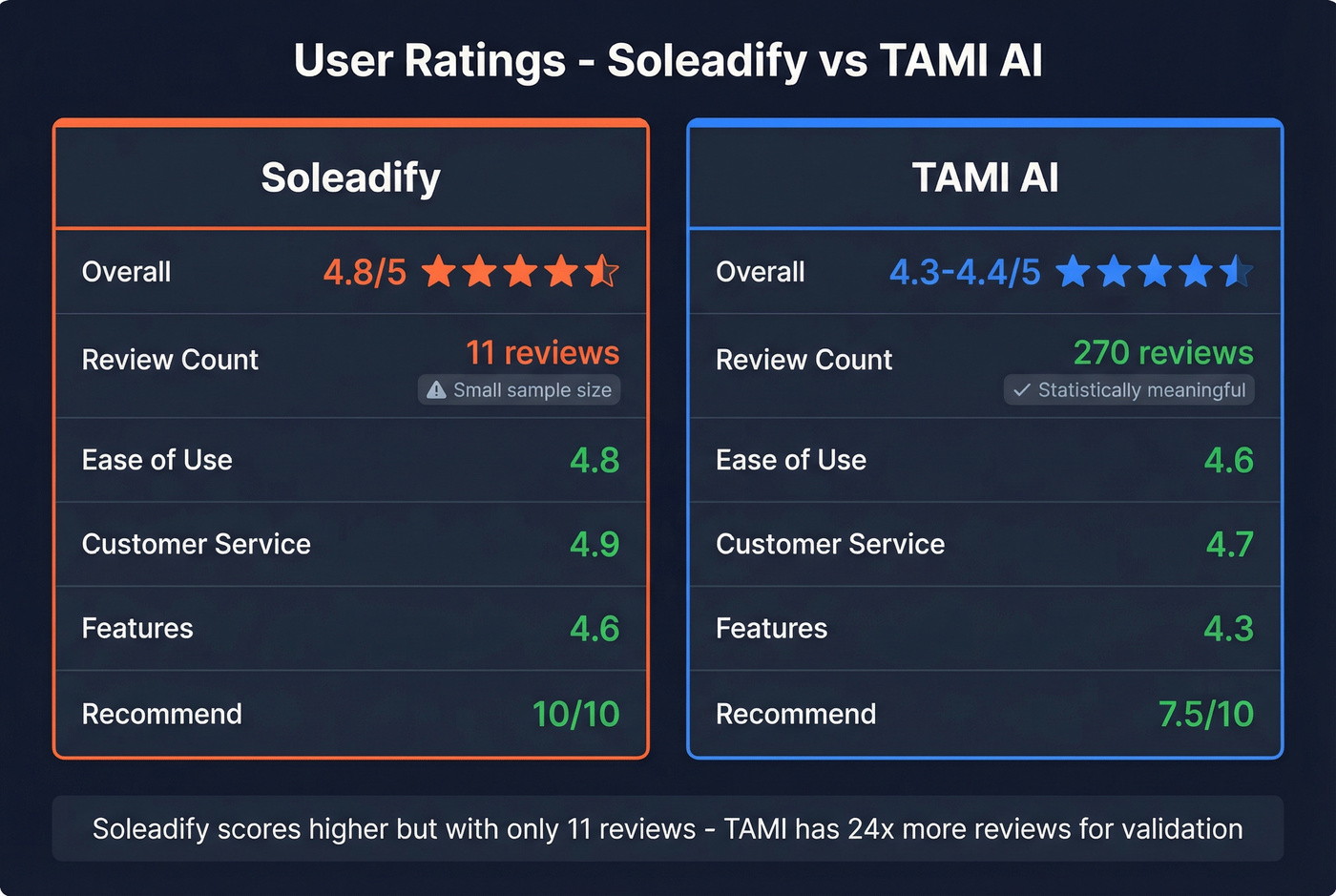
Soleadify - 4.8/5 on Capterra (11 reviews). Ease of Use 4.8, Customer Service 4.9, Features 4.6, Likelihood to Recommend 10/10. Impressive numbers on the surface. But I've seen enough small-sample ratings collapse once a tool hits 50+ reviews to know better than to take a 4.8 from 11 people as gospel. Treat it as directional, not definitive.
Which Buyer Should Pick Which
A mid-market sales team targeting European accounts with HubSpot or Salesforce should go with TAMI AI. The tech stack intelligence adds a targeting layer most competitors don't offer, and the CRM integrations cut down on manual CSV juggling. For teams doing account-based plays where knowing a prospect's payment provider or ecommerce platform matters, that technographic data is a real differentiator. If you're building the motion, these sales prospecting techniques help you turn technographics into actual meetings.
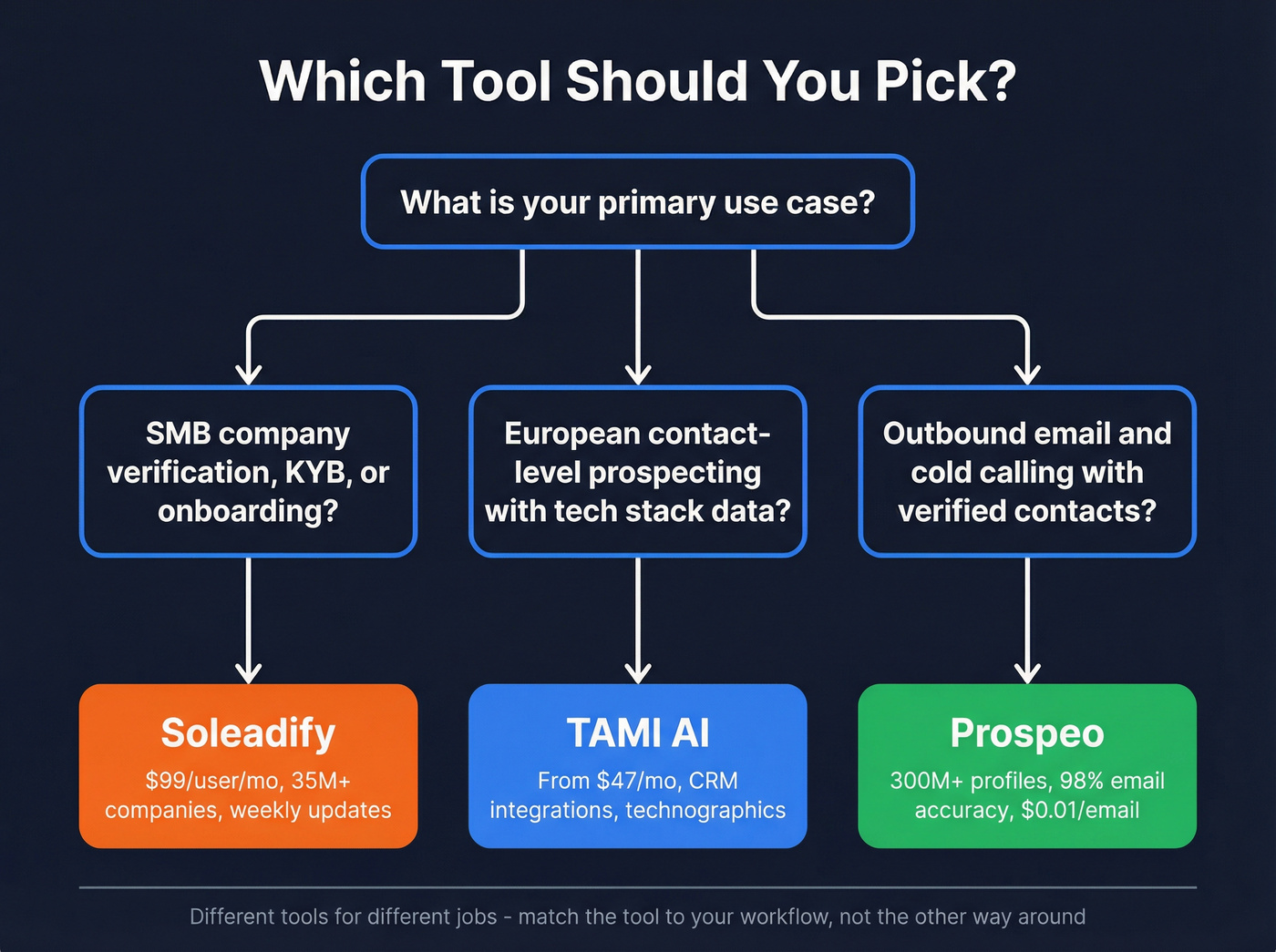
A compliance, onboarding, or risk team that needs to validate SMB business entities across 100+ countries should go with Soleadify. It's much closer to a company-data and enrichment layer than a prospecting tool.
Skip both if you're an outbound sales team that needs verified emails and direct dials. Soleadify is primarily company-level, and TAMI's accuracy complaints are a real liability when your sender reputation is at stake. If you're comparing options, start with a shortlist of sales prospecting databases built for outbound.
For Outbound Teams: A Stronger Option

Both tools leave a gap for outbound prospecting. Prospeo fills it with 300M+ professional profiles, 98% email accuracy, and 125M+ verified mobile numbers with a 30% pickup rate. Data refreshes every 7 days versus the 6-week industry average. The free tier includes 75 verified emails per month, and paid plans run about $0.01/email with no contracts - making it significantly cheaper per verified contact than either TAMI or Soleadify while solving the actual problem outbound teams care about. If you're tightening deliverability, pair verified data with email reputation tools and a clear email deliverability guide.
TAMI users report contacts matched to wrong companies. Soleadify doesn't even offer contact-level data. Prospeo's 5-step verification with catch-all handling and spam-trap removal means your domain reputation stays clean - backed by a 98% accuracy rate across 143M+ verified emails.
Protect your sender reputation with data that's verified weekly, not guessed at.
FAQ
Is TAMI AI better than Soleadify?
For contact-level prospecting into European markets, yes - TAMI offers contacts, tech stack data, and CRM integrations that Soleadify doesn't. For SMB company verification and KYB workflows, Soleadify is the better fit. They're solving different problems.
Does Soleadify have an API?
One third-party directory lists Soleadify as having no API, but Soleadify does offer API integration for data provisioning. If API access is a hard requirement, confirm the exact integration approach during procurement before signing anything.