

Solution Selling Training: What It Costs, Why It Fails, and How to Make It Work
A sales leader on r/salestechniques hired a $15K consultant for a six-hour solution selling workshop. The next morning, a rep opened a discovery call with "So, what's keeping you up at night?" The prospect replied, "Are you reading from a script?" and hung up. That's the training paradox: you spend five figures teaching reps to be consultative, and they come out sounding less human than before.
72% of sales leaders say training fails because it's one-size-fits-all. The methodology isn't the problem. The implementation is.
Here's how to get it right - what it should cost, which teams it actually fits, and the reinforcement system that separates wasted budget from pipeline growth.
What Is Solution Selling?
Solution selling traces back to Michael Bosworth in the mid-1980s. The core idea was radical for its time: stop pitching products, start diagnosing problems. Instead of leading with features, reps would uncover a buyer's pain, build a vision of a better future, and map their product's capabilities to that vision. Bosworth's original work - along with later solution selling books by Keith Eades and others - gave an entire generation of reps a structured framework for consultative conversations.
The critique today is fair: clients don't buy solutions, they buy results. When buyers show up to a call having already read three case studies and watched a demo video, the classic "tell me about your challenges" opener feels patronizing. The market has shifted toward prescriptive and insight-led selling, where reps lead with a point of view rather than waiting for the buyer to articulate their own pain.
It's Not Dead - It Evolved
Every modern sales methodology carries solution selling's DNA. Challenger reps still diagnose problems; they just lead with insights first. MEDDIC still maps stakeholders and quantifies pain. SPIN still probes for implications. The core framework - needs-first discovery, value articulation, stakeholder alignment - isn't dead. It's been absorbed into everything that came after it.
The practical shift: open with an executive briefing that frames industry trends and insights, then guide the conversation. Don't wait for the buyer to articulate pain. If someone tells you solution selling is obsolete, they're confusing the brand name with the underlying skill set.
Solution Selling vs. Other Methodologies
A sales process tells you what happens when; a methodology tells you how to execute each step. Methodology choice isn't about which one sounds smartest in a boardroom. It's about deal size, cycle length, and buyer complexity.
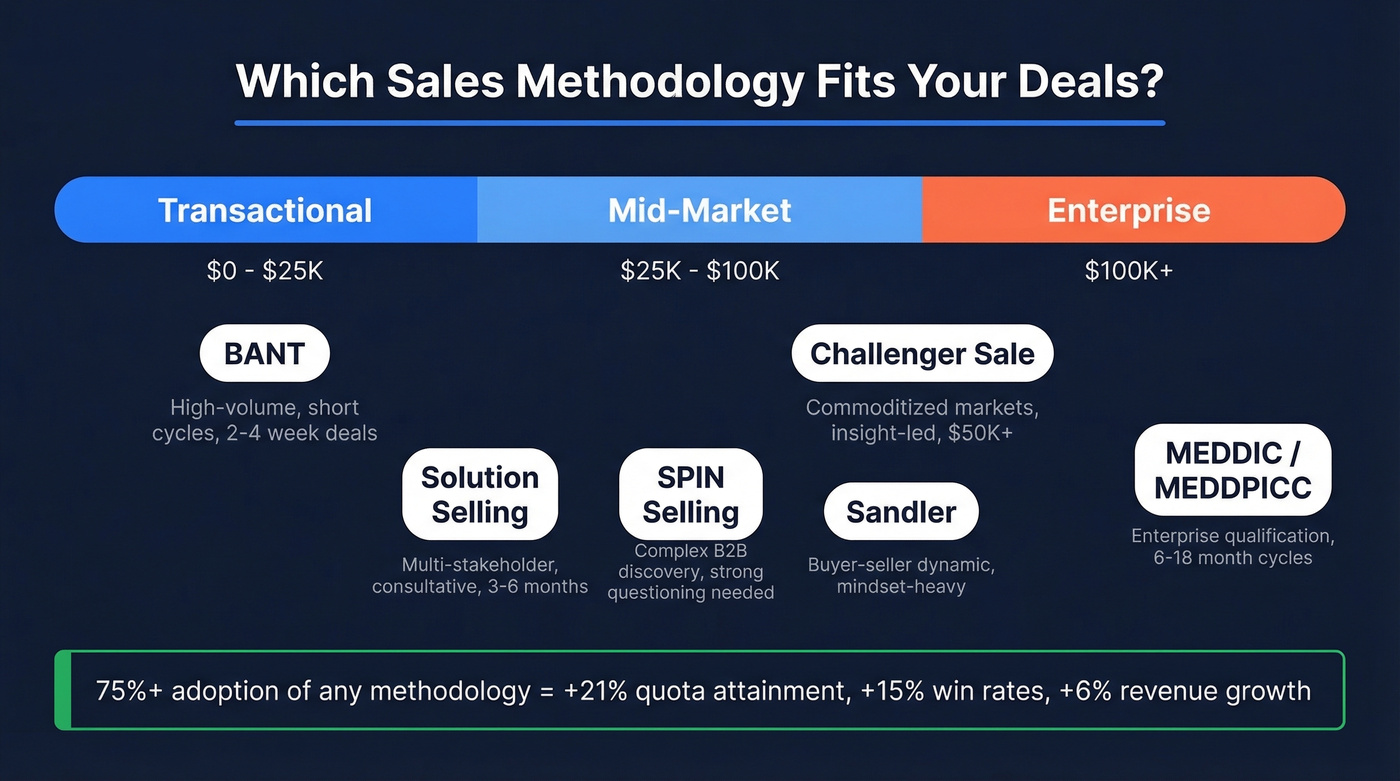
| Methodology | Research Basis | Best Deal Size | Best For | Watch Out For |
|---|---|---|---|---|
| Solution Selling | Bosworth, needs-first | $25K-$100K+ | Multi-stakeholder, consultative | Scripted if taught poorly |
| SPIN Selling | Rackham, 35K+ calls, 20+ countries | $25K-$100K+ | Complex B2B discovery | Needs strong questioning skills |
| Challenger Sale | CEB, 6,000+ reps | $50K+ | Commoditized markets | Heavy enablement investment |
| MEDDIC/MEDDPICC | Enterprise qualification | $100K+ | 6-18 month enterprise deals | Overkill for shorter cycles |
| Sandler | Buyer-seller dynamic | $10K-$100K | Teams with pushy-rep culture | Mindset shift takes time |
| BANT | Transactional qualification | <$25K | High-volume, short cycles | Too shallow for complex deals |
The deal-size decision matrix is straightforward. Enterprise deals over $100K with 6-18 month cycles need MEDDIC's qualification rigor. Mid-market deals between $25K and $100K over 3-6 months are where solution selling, SPIN, and Challenger all thrive - Xerox reported a 17% sales increase and $65M in contract value after implementing Challenger, which gives you a sense of the upside when adoption sticks. Transactional deals under $25K? Just use BANT. Don't over-engineer a two-week sales cycle.
Let's be honest about something: 64% of sellers missed their most recent quota. The methodology you pick matters far less than whether your team actually uses it. Korn Ferry research shows that when teams reach over 75% adoption of a structured methodology, quota attainment jumps 21%, win rates climb 15%, and revenue grows 6%. Stop agonizing over Challenger vs. SPIN. Pick one, commit, and drive adoption past 75%.
What Training Programs Cover
A solid curriculum - whether from Richardson, Klozers, or RAIN Group - typically follows a progression: identify needs, customize the approach, build value, manage objections, close, and maintain ongoing support.
The core modules break down like this:
- Discovery frameworks - structured approaches to uncovering buyer pain, not just asking "what keeps you up at night" (use a tighter set of discovery questions)
- Needs analysis - mapping opportunities using the PPVVC framework: Pain, Power, Vision, Value, Consensus
- Value articulation - translating features into business outcomes with quantified impact (more on how to add value in sales)
- Stakeholder mapping - identifying decision-makers, influencers, and blockers across the buying committee (especially in enterprise B2B sales)
- Objection handling - reframing objections as unresolved needs rather than fighting them (see how to reduce sales objection rate)
- Closing techniques - earning commitment through value alignment, not pressure (tie it to your steps to close a sale)
- Post-sale relationship building - expanding accounts through ongoing consultative engagement
The skills underneath these modules are what separate good programs from bad ones: active listening, strategic probing questions, tailored communication, and long-term account planning. Programs that teach frameworks without building these underlying skills produce the scripted-sounding reps that Reddit loves to complain about.

Training teaches reps how to sell consultatively. But methodology adoption stalls when reps can't reach decision-makers. Prospeo's 300M+ profiles with 30+ filters - including buyer intent, job changes, and department headcount - let trained reps apply solution selling skills on the right prospects from day one.
Stop training reps on leads they can't actually reach.
How Much Does Training Cost?
Most providers don't publish pricing - they teach consultative selling but gate their own pricing behind a sales call. The irony isn't lost on anyone.
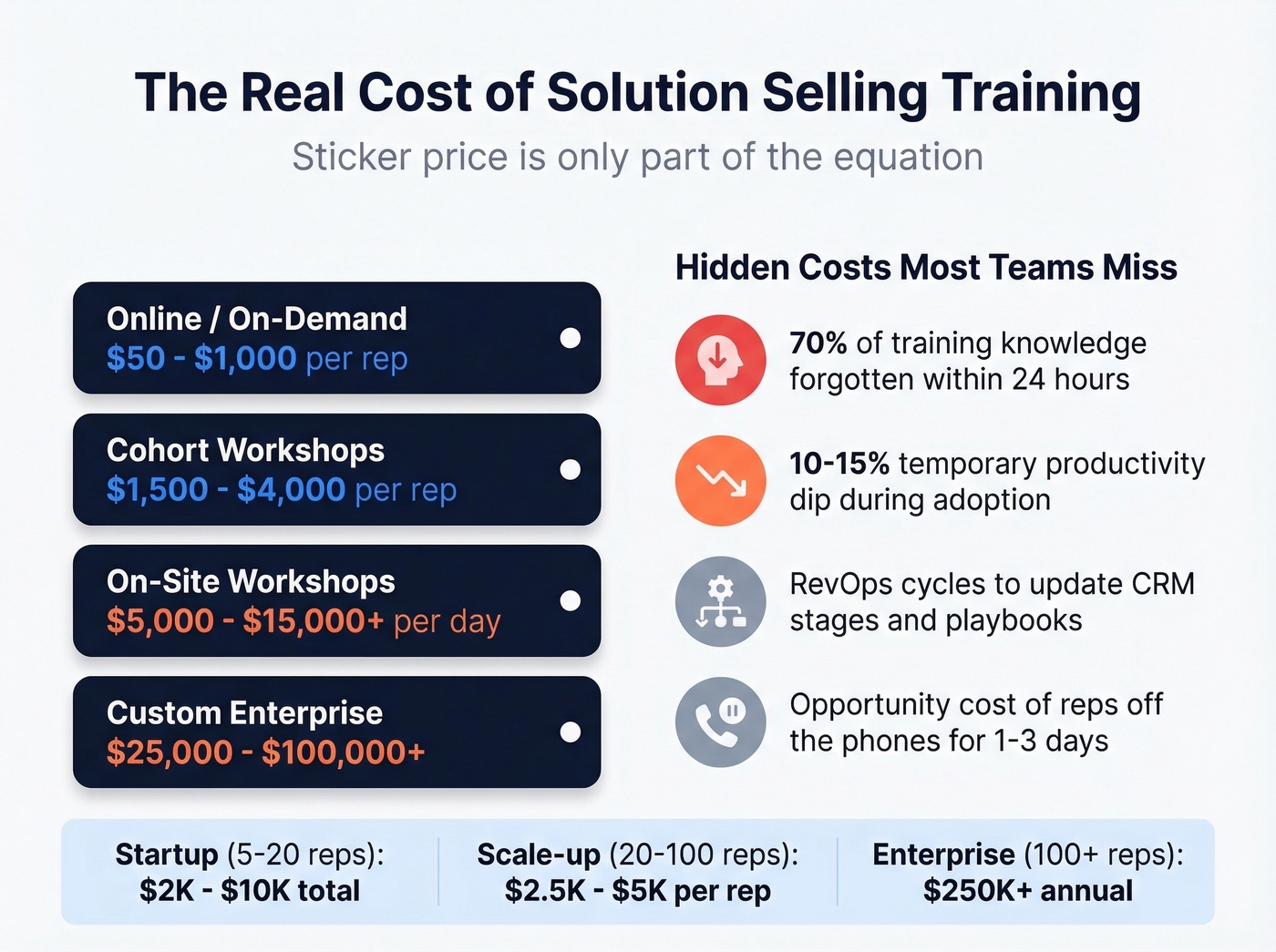
Here's what you'll actually pay based on published benchmarks and market conversations:
| Format | Price Range | Best For |
|---|---|---|
| Online/on-demand | $50-$1,000/rep | Individual skill-building |
| Cohort/group workshops | $1,500-$4,000/rep | Teams of 10-30 reps |
| On-site workshops | $5,000-$15,000+/day | Full-team immersion |
| Custom enterprise programs | $25,000-$100,000+ | Org-wide transformation |
That $15K consultant from the intro? Squarely in the on-site workshop range. Cohort programs typically land in the $2,000-$4,000/rep range, with custom enterprise engagements running $25K-$50K+.
Hidden Costs to Budget For
The sticker price is only part of the equation. Factor in the opportunity cost of pulling reps off the phones for 1-3 days. Expect a 10-15% temporary productivity dip while reps adopt new techniques - they'll be slower before they're faster. Your RevOps team will need cycles to update CRM stages, playbooks, and reporting to match the new methodology. And here's the stat that should scare every enablement leader: 70% of training knowledge is forgotten within 24 hours without reinforcement.
Budget heuristics by company size:
- Startup (5-20 reps): $2,000-$10,000 total
- Scale-up (20-100 reps): $2,500-$5,000/rep
- Enterprise (100+ reps): $250,000+ annual enablement budget
Measuring Training ROI
The numbers, when training is done right, are compelling. Teams exceeding 75% methodology adoption see +21% quota attainment, +15% win rates, and +6% overall revenue. Accenture research found that corporate training delivers 353% ROI on average, with organizations reporting roughly $4.53 back for every $1 invested. ValueSelling Associates went further, finding that training accounted for 57% of their clients' total sales increase - not a marginal contributor, but the primary driver.
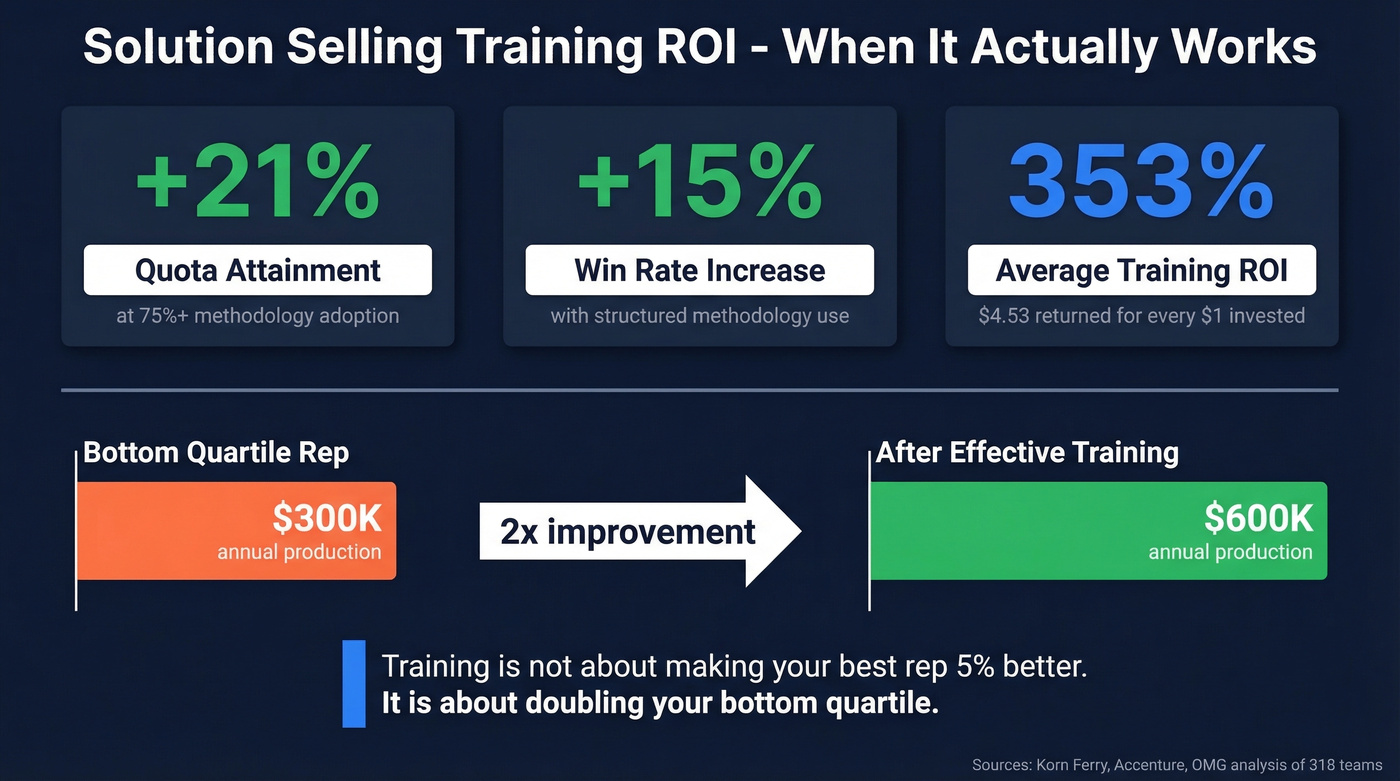
The distribution problem is what makes this interesting. An OMG analysis of 318 sales teams found that 30% relied on a single salesperson for more than half their revenue. Top producers generate 10x more than bottom producers. Training's real value isn't making your best rep 5% better - it's moving your bottom quartile from $300K to $600K in annual production.
OMG's conclusion: companies should be willing to spend up to $30K per salesperson on training that works. The average spend? Under $2K. Organizations with ongoing training programs see up to 20% higher quota attainment versus those running one-off events. The gap between what companies should spend and what they actually spend is where most of the unrealized pipeline lives.
Why Most Programs Fail
Five mistakes kill most training investments. We've seen every one of these play out across teams we've worked with.
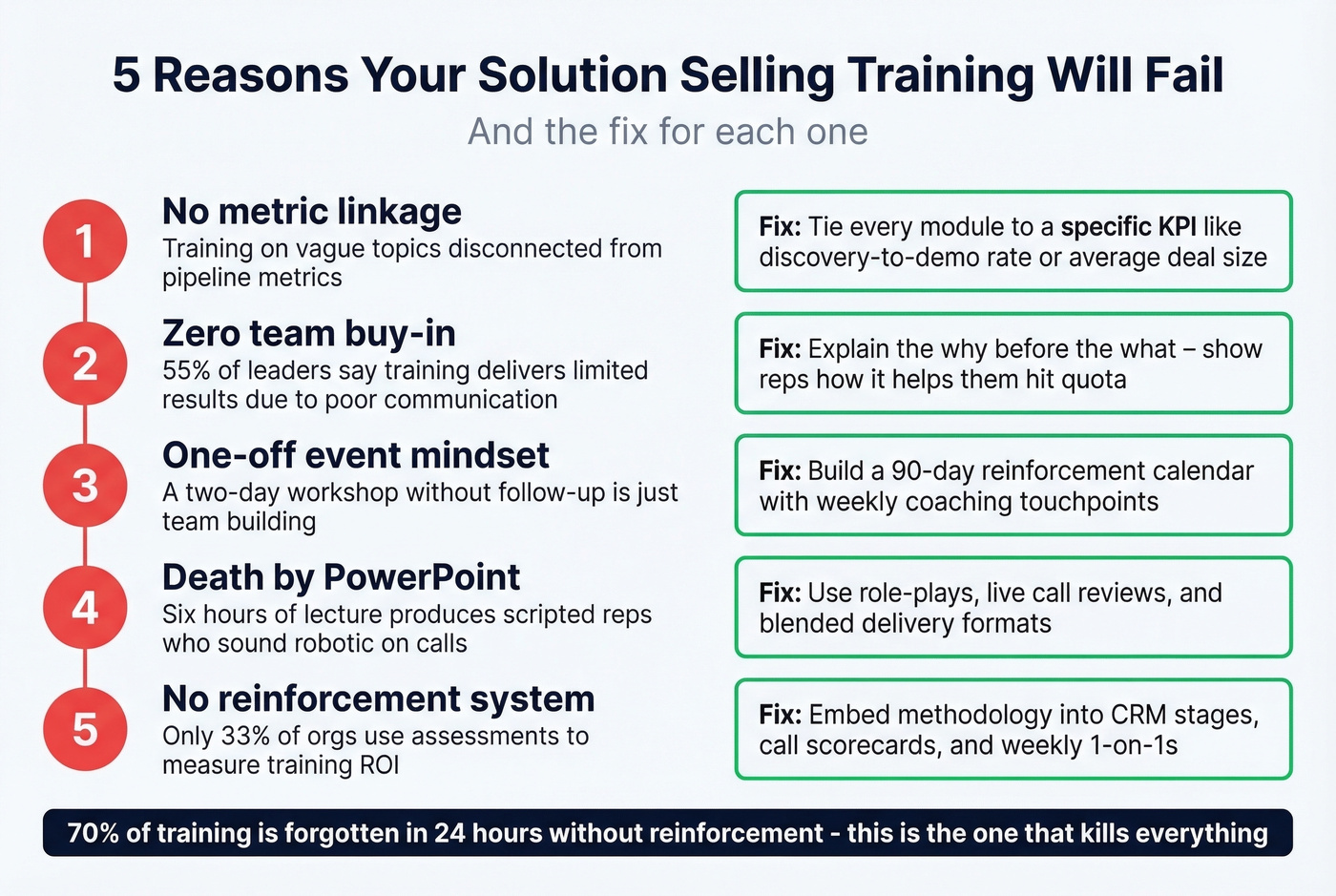
1. Irrelevant topics with no metric linkage. Training on "consultative questioning" when the team's real problem is pipeline generation. If you can't connect a training module to a specific metric - discovery-to-demo conversion, average deal size, cycle length - cut it. (If you're diagnosing the real bottleneck, start with sales pipeline challenges.)
2. Poor communication and zero buy-in. When training gets announced as a mandate with no context, reps treat it as punishment. 55% of sales leaders say their current training is effective but delivers limited results - often because the team never bought in to begin with.
3. Treating training as a one-off event. A two-day workshop without follow-up is a team-building exercise, not a behavior change program. 62% of leaders cite outdated content as the biggest training barrier, which happens when programs aren't refreshed or reinforced over time.
4. Lazy delivery. Death by PowerPoint. Talking slides for six hours. This is exactly what produced the scripted-rep backlash from the intro - a $15K consultant delivering content so rigid that reps came out sounding robotic. 90% of leaders say blended delivery works best, yet most programs still default to lecture format.
5. No reinforcement system. No coaching cadence, no job aids, no workflow integration. Only 33% of organizations use assessments to measure training ROI. Research cited by Qwilr found that only 38% of sales teams have formal guidelines for using key tools and workflows - meaning most reps finish training and walk back into an environment with zero standardization. If you're not measuring, you're not reinforcing. And if you're not reinforcing, you're burning budget.
How to Make Training Stick
Here's the implementation playbook that separates programs that work from expensive offsites.
Assess your current state. Pull your win rates, average cycle length, and deal size. These numbers determine which methodology fits - not a vendor's sales pitch. If your average deal is $40K with a 4-month cycle and three stakeholders, solution selling or SPIN is the right lane. (To operationalize this, align on funnel metrics first.)
Choose the right format. Match format to team size and budget. Ten reps? Cohort workshop. Fifty reps? Blended program with virtual modules and in-person practice sessions. Two reps? An on-demand course plus weekly role-plays with their manager.
Customize to your deal profile. Generic training produces generic reps. Your program should use your actual buyer personas, your real objections, and your specific competitive landscape. Not a hypothetical SaaS company selling to "enterprise buyers." (If you need a starting point, use an ideal customer profile template.)
Run blended delivery. 90% of leaders prefer it for a reason. Combine self-paced learning for concepts with live sessions for practice. Space it out over 6-8 weeks instead of cramming everything into two days.
Build reinforcement loops. Weekly coaching sessions. Bi-weekly role plays. Call recording reviews. Job aids pinned in Slack. The forgetting curve is real - fight it with repetition, not hope. Supplement formal sessions with solution selling books like Eades' The New Solution Selling or Rackham's SPIN Selling so reps can revisit core concepts on their own time.
Measure with leading indicators. Don't wait for closed-won revenue to judge training effectiveness. Track discovery call quality scores, pipeline velocity changes, and multi-threading rates. These move first.

Fix your data foundation. Look - the biggest ROI improvement for most teams isn't better methodology. It's better data. 61% of sellers say admin tasks and inefficient processes slow them down most. Consultative selling requires knowing your buyer's pain before the call, and that means verified emails and direct dials so reps can research and personalize instead of cold-spraying into the void. (If you're auditing your stack, start with data enrichment services.)
Bad data undermines every discovery framework. You can't run a consultative process if you can't reach the right person. When Snyk rolled out Prospeo across 50 AEs, their bounce rate dropped from 35-40% to under 5%, and AE-sourced pipeline jumped 180%. That's the kind of lift no two-day workshop delivers on its own.
You're investing $2K-$15K per rep on solution selling training. Don't let bad contact data kill your ROI. Prospeo delivers 98% email accuracy and 125M+ verified mobile numbers - so every consultative conversation your reps are trained to have actually happens.
Protect your training investment with data that connects.
FAQ
Is solution selling certification worth it?
For individual reps building a resume, yes - certification signals methodology fluency to hiring managers and can justify a 10-15% salary bump in mid-market roles. For teams, skip certification and invest in custom coaching with 90-day reinforcement instead. Certification proves knowledge; coached practice changes behavior. The ROI gap between the two is significant.
How long before training shows results?
Expect 60-90 days for behavior change to appear in pipeline metrics. The 10-15% productivity dip during adoption is normal and shouldn't trigger panic. Teams that build reinforcement loops - weekly coaching, call reviews, role plays - see measurable improvement faster than those relying on the workshop alone.
Does solution selling work for startups?
Yes, for deals over $10K involving two or more stakeholders. For transactional sales under $25K with a single decision-maker, BANT or a simple qualification framework is more efficient. Don't over-engineer a two-week sales cycle with stakeholder mapping and multi-threaded discovery.
What tools do trained reps need?
A CRM like HubSpot or Salesforce, a verified contact data platform for accurate emails and direct dials, and a call recording tool like Gong or Chorus. The methodology is only as good as the data feeding it - reps can't run consultative discovery if they're dialing wrong numbers or emailing invalid addresses.