Spam Words to Avoid in Email - And What Actually Sends You to Spam
90% of emails pass content checks. Only 60% reach a visible inbox. That gap has nothing to do with the word "free" in your subject line - it's broken authentication, poor sender reputation, and bad list hygiene. The list of spam words to avoid in email below is worth scanning, but if your messages are landing in junk, the fix is almost certainly infrastructure, not copywriting.
The 90/60 Paradox
The [Validity Benchmark Report](https://www.validity.com/resource-center/2026-email-deliverability-benchmark-report/) puts global average inbox placement at 83.5% - roughly 1 in 6 legitimate marketing emails never gets seen. [Unspam's testing](https://unspam.email/articles/email-deliverability-report/) paints an even bleaker picture: only 60% of sent emails reached a visible mailbox.
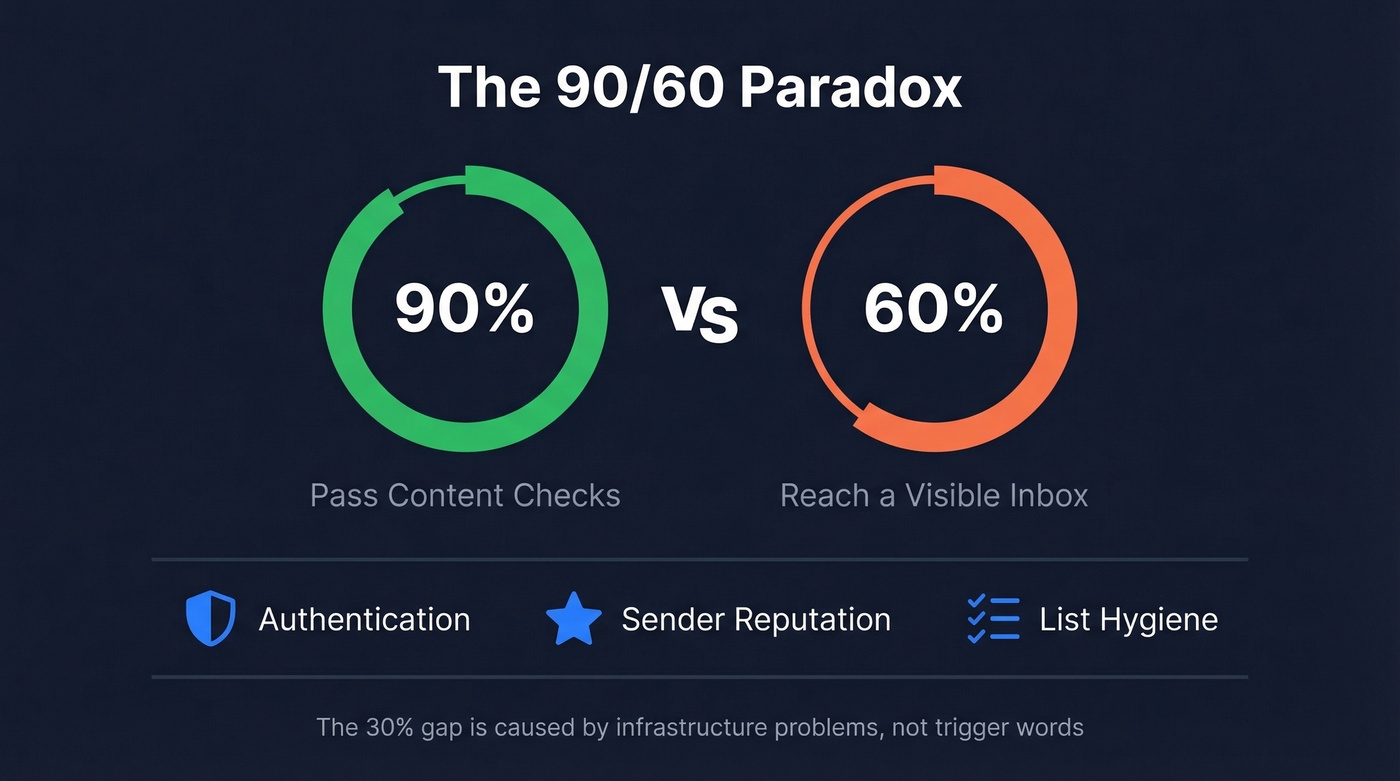
Content-level checks, meanwhile, pass at around 90%. Email marketers on Reddit have been flagging this exact disconnect for months.
That gap between "content looks fine" and "email actually arrives" is the whole story. Modern spam filters evaluate hundreds of signals - sender reputation, authentication records, engagement history, complaint rates, link structure - and content-level triggers sit near the bottom of the priority stack. One trigger phrase won't kill you. A cluster of aggressive sales language on a damaged domain absolutely will.
Spam Trigger Words by Category
These words raise flags when they appear in clusters, combined with poor sender reputation or aggressive formatting like ALL CAPS, excessive exclamation marks, or heavy HTML. A single "free" in an otherwise clean email from a reputable domain won't tank your deliverability. But stacking these patterns alongside weak domain reputation is a recipe for the spam folder.
Finance & Money
Financial language is the oldest email spam trigger category. Filters have decades of training data on get-rich-quick schemes, so lean on product specifics rather than generic money language.
| Trigger Phrase | Safer Alternative |
|---|---|
| Make money fast | Grow your revenue |
| $$$ / Cash bonus | Financial incentive |
| Double your income | Increase earnings |
| No credit check | Flexible approval |
| Earn extra cash | Side income opportunity |
Urgency & Scarcity
Manufactured urgency is the hallmark of spam. Real urgency uses specific dates. Fake urgency uses vague pressure - and filters know the difference. Instead of "Act now - limited time!" try "Offer ends Friday at 5pm."
| Trigger Phrase | Safer Alternative |
|---|---|
| Act now | Take the next step |
| Limited time offer | Available through [date] |
| Don't miss out | Worth a look |
| Once in a lifetime | A rare opportunity |
Promotions & Discounts
| Trigger Phrase | Safer Alternative |
|---|---|
| Buy now / Order now | Get started |
| Free trial | Try it yourself |
| 50% off | We've reduced pricing |
| Lowest price | Competitive pricing |
| Special promotion | Updated offer |
Guarantees & Overpromises
Overpromises trigger both spam filters and reader skepticism. "Guaranteed results" makes your email sound like a late-night infomercial - and filters treat it accordingly. Swap "risk-free" for "no commitment required," replace "100% satisfaction" with "full refund policy," and drop "miracle" or "amazing" in favor of "effective" or "reliable." Toning down the language usually improves both deliverability and conversion rates.
Health, Tech & Misc
| Trigger Phrase | Safer Alternative |
|---|---|
| Weight loss / Lose weight | Wellness program |
| Suspicious activity | Account security update |
| Click here immediately | Review your settings |
| Dear friend / Dear user | [First name] or no salutation |
Generic greetings like "Dear friend" are a dead giveaway. If you don't know someone's name, skip the salutation entirely - it's less suspicious than a fake-personal one. One emoji per subject line is fine; avoid alarm or siren emojis that mimic phishing alerts. For a full reference, Mailmeteor maintains a list of 349+ trigger terms organized by category.

Trigger words matter less than list quality. A 12% bounce rate will destroy your sender reputation faster than any subject line. Prospeo's 5-step email verification delivers 98% accuracy - teams using it cut bounce rates from 35% to under 4%.
Stop rewriting subject lines. Start sending to verified addresses.
What Actually Sends You to Spam in 2026
Here's the thing: if you fixed every trigger phrase and still had broken authentication, your emails would still land in spam.
Gmail's Filtering Stack
Gmail uses ML models that prioritize domain reputation and engagement signals over content keywords. The evaluation runs in this order: authentication, then historical domain/IP reputation, then content patterns, then sending behavior consistency, then real-time user actions.
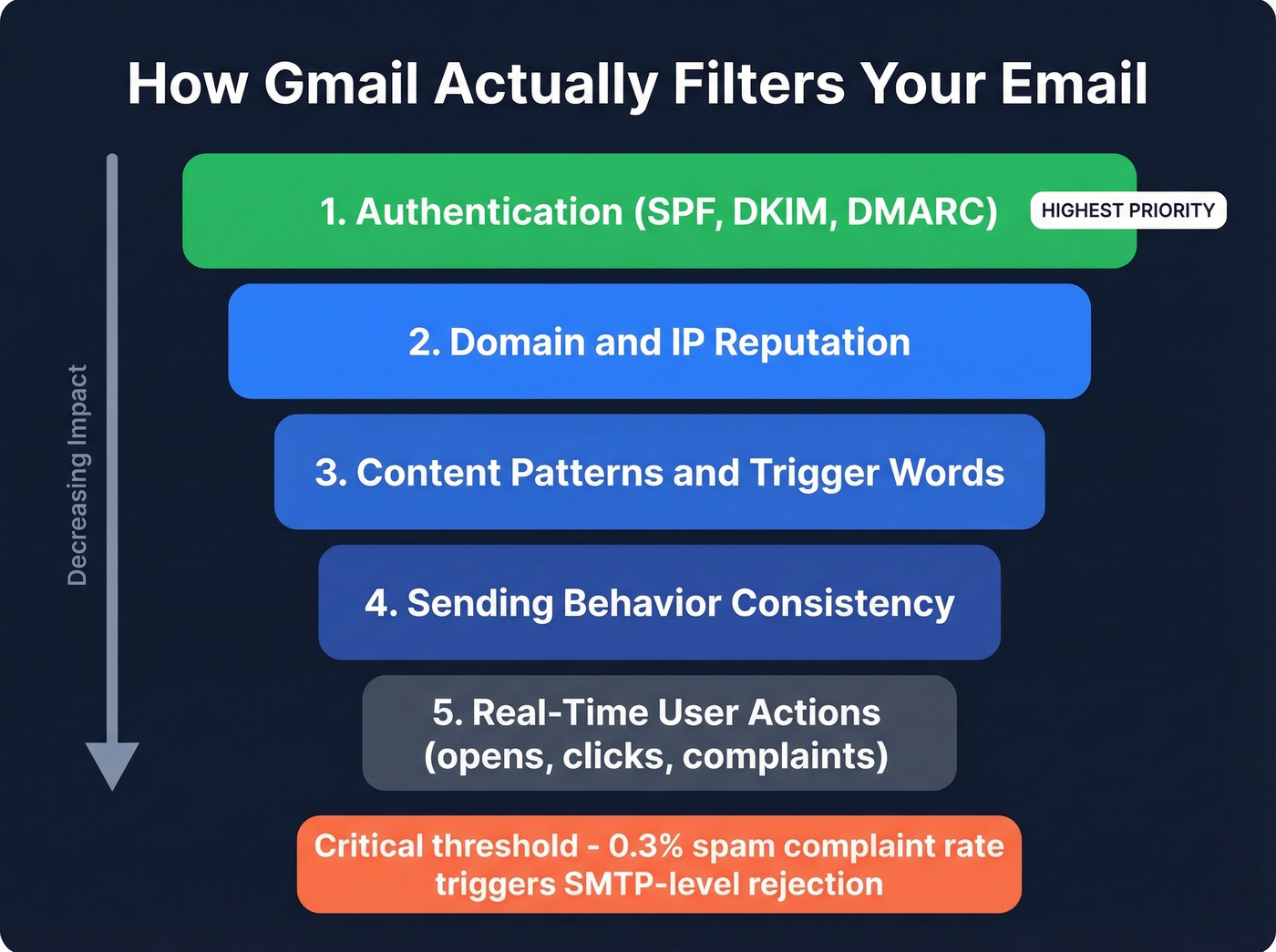
The critical threshold is a [0.3% spam complaint rate](https://support.google.com/a/answer/14229414?hl=en). Cross that line and Gmail can start rejecting messages at the SMTP level, especially when the sender is also failing [SPF/DKIM/DMARC alignment]. Starting in late 2025, Gmail moved from educational warnings to active rejection for non-compliant senders. Gmail inbox placement averaged 87.2% in recent benchmarks - higher than Microsoft in the same period - but that number drops fast without proper authentication.
Microsoft's SCL Scoring
Microsoft 365 assigns a Spam Confidence Level (SCL) to every inbound message. SCL 5-6 means spam. SCL 7-9 means high-confidence spam.
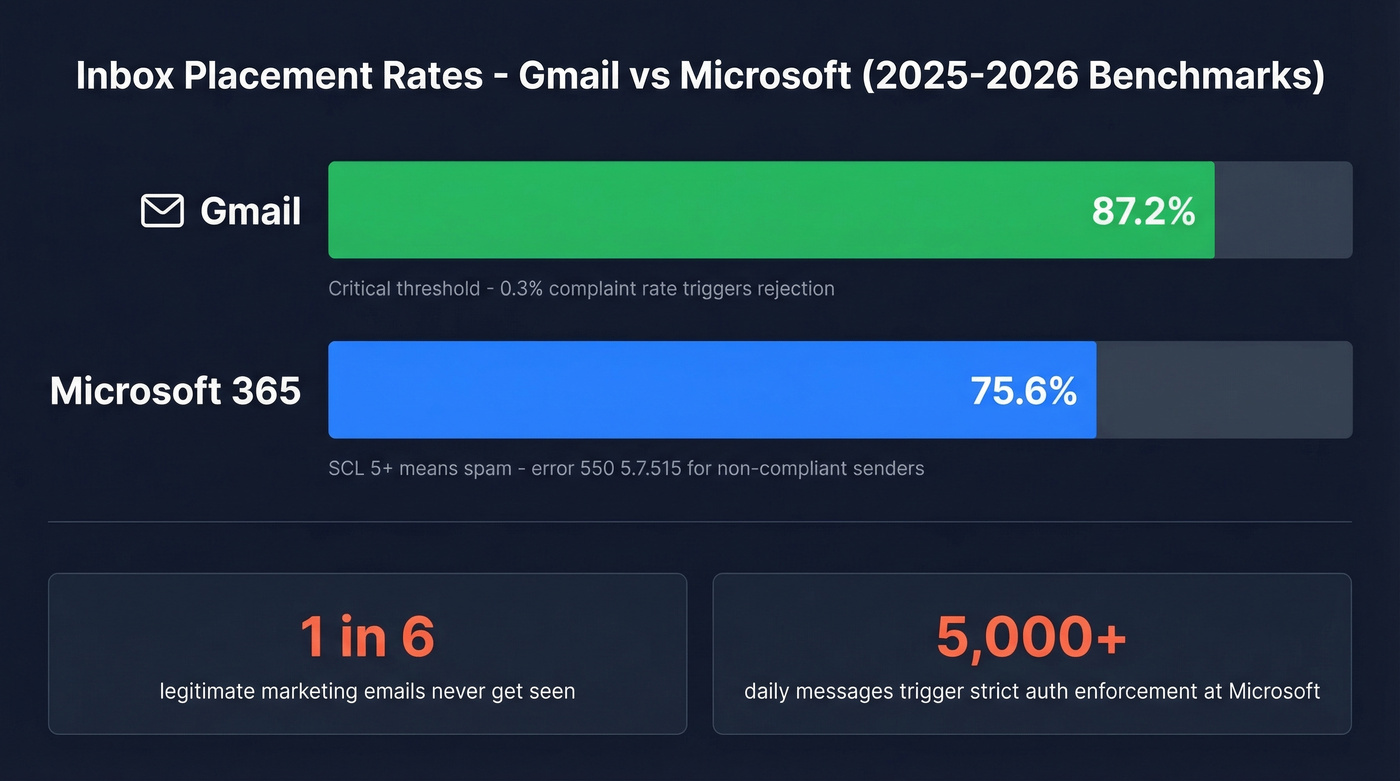
Since mid-2025, Microsoft has enforced strict authentication for high-volume senders pushing 5,000+ messages per day to its consumer domains. Non-compliant messages get rejected with error code 550 5.7.515. Microsoft's inbox placement sits at 75.6% in recent benchmarks, so if your audience skews Outlook-heavy, you'll feel deliverability problems faster when authentication and reputation slip.
SpamAssassin Scoring
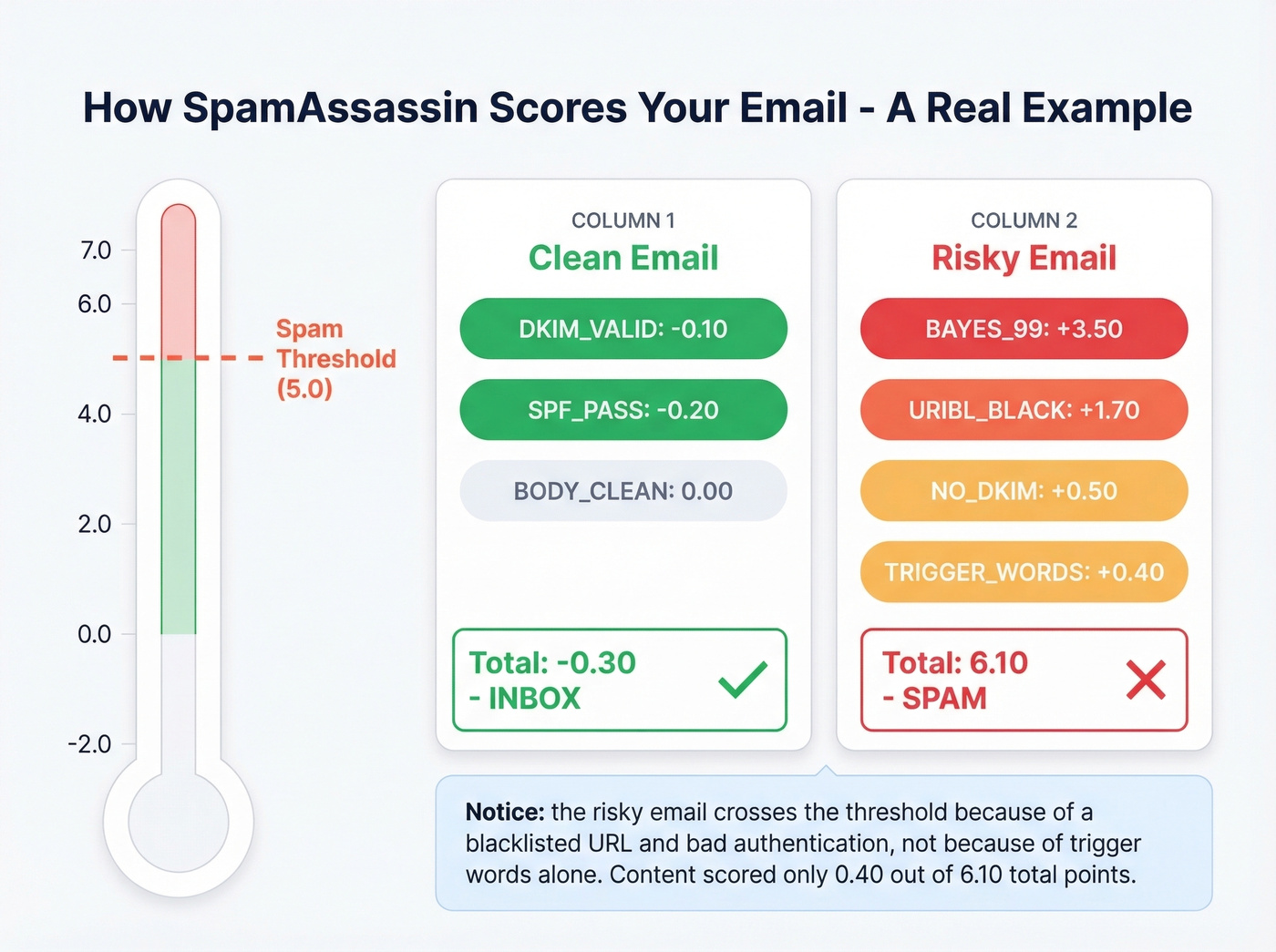
SpamAssassin uses a transparent, additive scoring model where messages exceeding a threshold (typically 5.0) get flagged. Real-world examples from production headers:
- BAYES_99: 3.50 points (classifier is 99%+ confident it's spam)
- URIBL_BLACK: 1.70 points (contains a blacklisted URL)
- DKIM_VALID: -0.10 points (valid DKIM signature reduces score)
A clean email with good authentication can score negative. A borderline email with one bad link and no DKIM can cross the threshold without a single trigger word in the body. That's the part most "spam words" articles miss entirely.
The Deliverability Checklist
Stop tweaking subject lines and fix these infrastructure issues first.
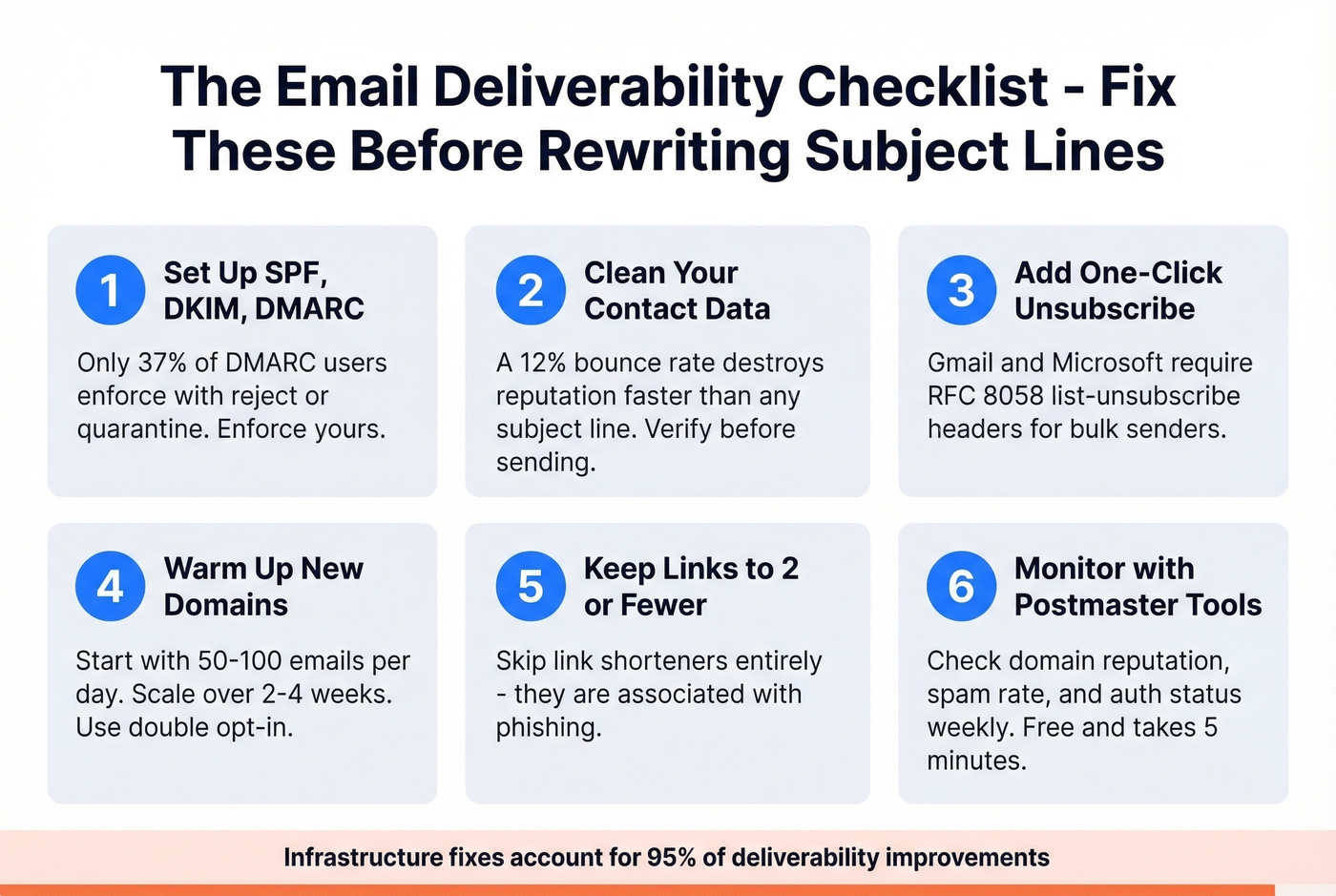
1. Set up SPF, DKIM, and DMARC. 66% of senders know they use SPF and DKIM, but only 37% of DMARC users enforce with reject or quarantine. If you aren't enforcing, you're leaving the door open. Look into BIMI as well - it's emerging as a trust signal that major providers increasingly reward.
2. Clean your contact data before sending. Bad addresses cause bounces. Bounces destroy sender reputation. Reputation determines inbox placement. We've seen teams obsess over email phrasing while running a 12% bounce rate - fix the data first. Prospeo's 5-step verification delivers 98% email accuracy; Snyk's team dropped bounce rates from 35-40% to under 5% after switching, directly protecting their sender reputation across 50 AEs running outbound.
3. Add one-click unsubscribe. Gmail and Microsoft now require RFC 8058 list-unsubscribe headers for bulk senders. No header, no inbox. (If you need the implementation details, start with the List-Unsubscribe Header guide.)
4. Warm up new domains gradually. Start with 50-100 emails per day and scale over 2-4 weeks. Use double opt-in for marketing lists. If you're doing outbound, follow a dedicated domain warm-up schedule.
5. Keep links to two or fewer for cold outreach. Skip link shorteners entirely - they're associated with phishing.
6. Monitor with Google Postmaster Tools. Check your domain reputation, spam rate, and authentication status weekly. It's free and takes five minutes. Use Google Postmaster Tools to track reputation trends before they become deliverability incidents.

Let's be honest: most "spam words to avoid" articles are solving a problem that accounts for maybe 5% of deliverability failures. If you're running outbound on deals under $10k, you'll get more ROI from 30 minutes in Google Postmaster Tools than from rewriting every subject line you've ever sent.
You just read 2,000 words on deliverability. Here's the one fix that moves the needle most: clean contact data. Prospeo refreshes 300M+ profiles every 7 days - not every 6 weeks - so you're never sending to stale addresses that spike bounces and tank reputation.
Bad data is the spam trigger no word list will fix.
Test Before You Send
Measure deliverability in the right order: inbox placement first, then replies, then meetings. If you're optimizing reply rates on emails that land in spam, you're solving the wrong problem.
For A/B testing content changes, you need at least 10,000 recipients to draw meaningful conclusions - anything smaller is noise. In our experience, plain-text emails consistently outperform heavy HTML for cold outreach because they look like real 1:1 messages, not marketing blasts. Knowing which spam trigger phrases to avoid matters, but only after your authentication and reputation are solid.
FAQ
Do spam trigger words still matter in 2026?
They're the least important deliverability factor. Authentication, sender reputation, and engagement carry far more weight with Gmail and Microsoft. One "free" won't hurt you - a cluster of sales language on a damaged domain will. Fix infrastructure before rewriting copy.
What's the #1 reason emails land in spam?
Missing or misconfigured authentication (SPF, DKIM, DMARC). Gmail and Microsoft reject non-compliant messages at the SMTP level before content is even scanned. Check Google Postmaster Tools before editing a single word of copy.
How do I keep bounce rates low enough to protect sender reputation?
Verify every address before sending. Bounce rates above 5% signal bad lists to mailbox providers, which tanks domain reputation. Snyk's 50-person sales team saw theirs drop from 35-40% to under 5% after switching to verified data, directly protecting their outbound domains.
How many spam trigger words does it take to get flagged?
No fixed number exists. SpamAssassin adds fractional points per pattern, and the threshold is typically 5.0. A single phrase scores 0.1-0.5 points - you'd need a cluster of 10+ aggressive terms alongside weak authentication to cross the line on content alone.