

The SPIN Sales Methodology: What Still Works, What Doesn't, and How to Use It
A rep on r/sales recounted sitting through six hours of consultative sales training, then hopping on a call and opening with "What's keeping you up at night regarding your current solution?" The prospect laughed - "Are you reading from a script?" - and hung up. That's the SPIN sales methodology in a nutshell: the most commonly taught framework in B2B sales, and the most commonly butchered.
Neil Rackham published SPIN Selling in 1988. Thirty-eight years later, it's still the default discovery framework at most enterprise sales orgs. The problem isn't the methodology. The problem is how people use it.
The 30-Second Version
If your VP just assigned SPIN and you need the essentials fast, here it is. SPIN stands for four question types - Situation, Problem, Implication, and Need-Payoff. The one to maximize is Implication: top performers ask 4x as many implication questions as average reps. The one to minimize is Situation - every basic "tell me about your current setup" question signals you didn't do your homework.
The single biggest mistake reps make is treating SPIN as a sequential checklist instead of a conversational framework. Keep reading for the full breakdown, a complete example call, and how to modernize the approach for 2026 buyers.
What Is SPIN Selling?
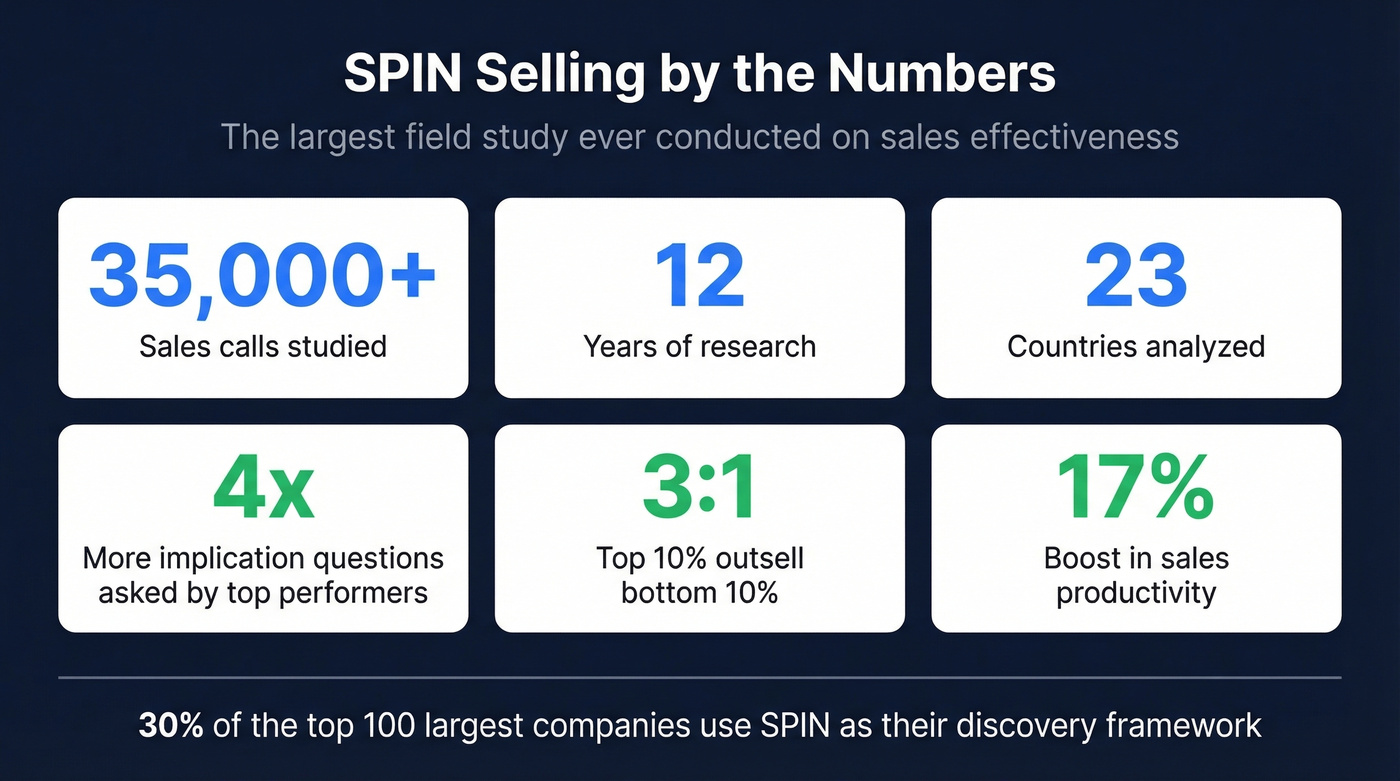
The SPIN selling model comes from one of the largest field studies ever conducted on sales effectiveness. Rackham's research analyzed 35,000+ sales calls over a 12-year period - often summarized as 10,000 salespeople across 23 countries. What made the study groundbreaking wasn't just its scale. It was the first time anyone had applied rigorous behavioral observation to live sales conversations rather than relying on self-reported surveys or anecdotal "top performer" interviews.
The research found that successful sellers in complex B2B deals followed remarkably similar questioning patterns regardless of industry or geography. Those patterns formed the SPIN framework.
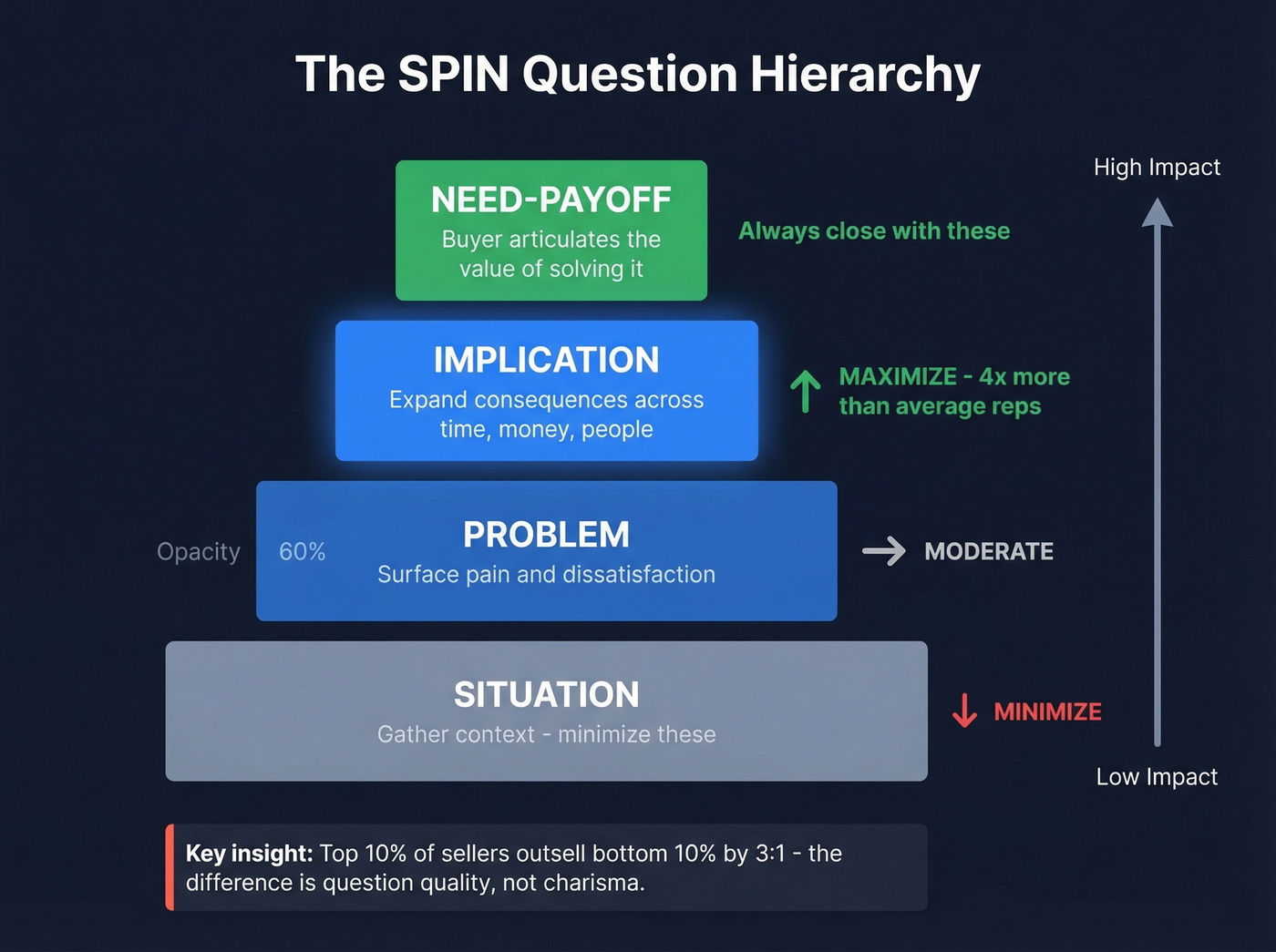
The acronym breaks down into four question types that build on each other. Situation questions gather context. Problem questions surface pain. Implication questions expand the cost of that pain across the organization. Need-Payoff questions get the buyer to articulate the value of solving it. Rackham's top finding: the top 10% of sellers outsell the bottom 10% by 3:1, and the difference wasn't charisma or closing technique. It was what they did differently in live conversations.
SPIN by the numbers: 35,000 calls studied · 10,000 salespeople · 23 countries · 12-year research period · 17% boost in sales productivity · Top 10% outsell bottom 10% by 3:1 · 30% of the top 100 largest companies use SPIN
The Four SPIN Question Types
Most training decks stop here - they list the four types, give two examples each, and move on. Let's go deeper.
Situation Questions (Minimize These)
Situation questions gather facts about the prospect's current state. They're necessary but dangerous. Every situation question you ask is one you could've answered with 10 minutes of research.
- "How many reps are on your outbound team?"
- "What CRM are you using today?"
- "Who owns the decision on sales tools?"
- "What does your current prospecting workflow look like?"
The data is clear: top performers ask fewer situation questions, not more. Reps who run 40-minute discovery calls dominated by situation questions create fatigue and signal inexperience. In 2026, when 96% of prospects research before engaging with sales, asking "So tell me about your company" is a credibility killer.
Problem Questions (The Entry Point)
Problem questions surface dissatisfaction with the status quo. They're where the real conversation starts. You might ask where deals are stalling, what happens when reps can't reach a decision-maker directly, how reliable the contact data is, or whether parts of the sales cycle feel unnecessarily long.
The goal is to uncover what Rackham called "implied needs" - frustrations the buyer feels but hasn't necessarily prioritized. Your job is to take those implied needs and make them impossible to ignore. That's where implication questions come in.
Implication Questions (Maximize These)
Here's the single most important stat in SPIN research: successful salespeople ask 4x as many implication questions as average performers. Most reps ignore this because implication questions are harder to ask - they require genuine understanding of the buyer's business. You can't fake them.
Implication questions expand a small problem into a business-critical issue by exploring consequences across time, money, people, and downstream processes:
- "If your reps are spending 4 hours a day on research instead of selling, what does that cost you per quarter in lost pipeline?"
- "When bad contact data causes a sequence to bounce at 15%, how does that affect your domain reputation long-term?"
- "If you can't reach the economic buyer directly, how does that extend your average deal cycle?"
- "What happens to your forecast accuracy when deals stall because the wrong stakeholder was engaged?"
Need-Payoff Questions (The Close Setup)
This is the most skipped question type, and skipping it is a costly mistake. Reps get through implication and then jump straight to pitching. But the buyer needs to verbalize the value before your solution lands. When a prospect says "That would save us two headcount" or "We'd probably close 20% more deals," they're selling themselves.
- "If your reps could reach decision-makers on the first attempt, how would that change your pipeline velocity?"
- "What would it mean for your team if bounce rates dropped from 15% to under 3%?"
- "If you could cut rep ramp time in half, what would that free up for your managers?"
- "How would having verified direct dials change your connect rate math?"
| Question Type | Purpose | Example | Frequency |
|---|---|---|---|
| Situation | Gather context | "What CRM do you use?" | Minimize |
| Problem | Surface pain | "Where are deals stalling?" | Moderate |
| Implication | Expand consequences | "What does that cost quarterly?" | Maximize |
| Need-Payoff | Buyer articulates value | "How would fixing that help?" | Always close with these |
Four Stages of a SPIN Sale
The SPIN selling framework isn't just a questioning model - it maps to four stages of a sales call. Most training focuses exclusively on the questions and skips the structure entirely.
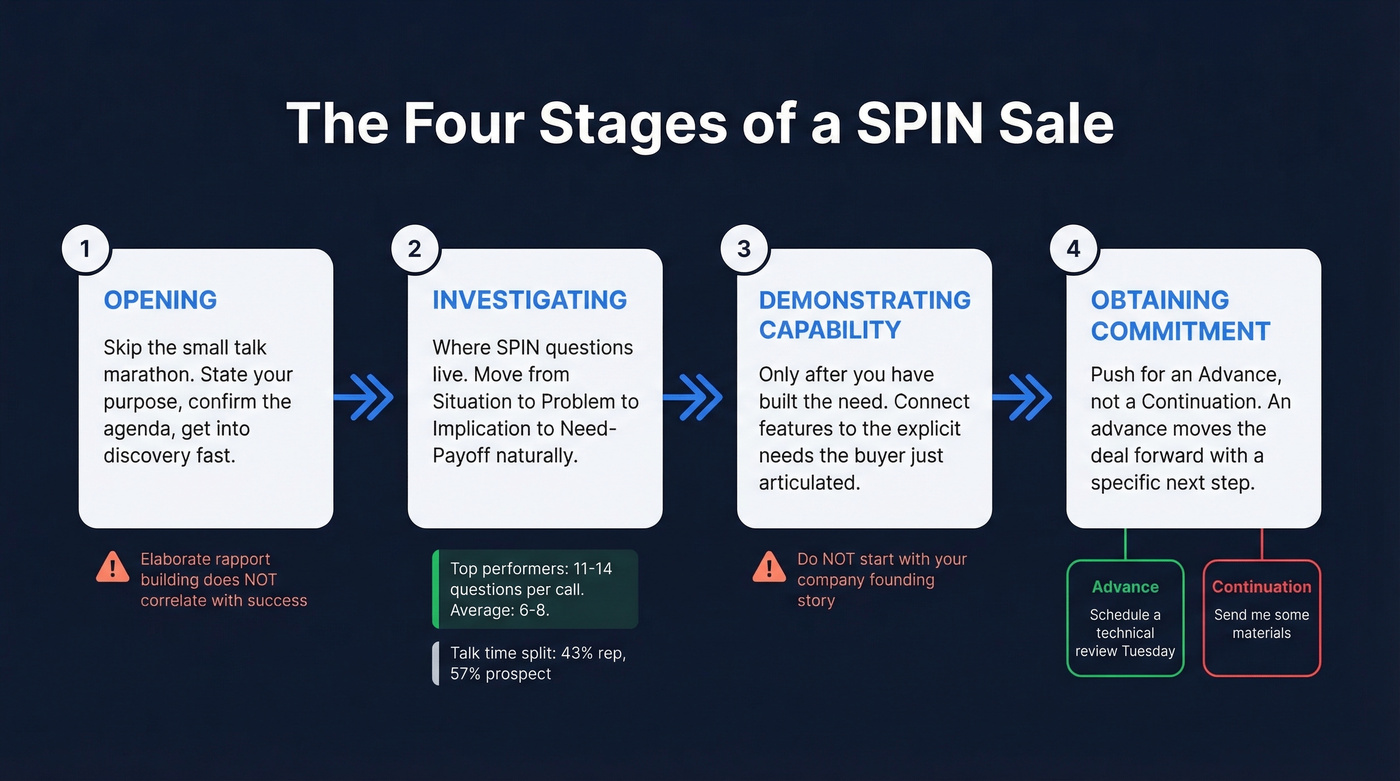
Opening. Skip the small talk marathon. Rackham's research found that elaborate rapport-building didn't correlate with success in complex sales. State your purpose, confirm the agenda, get into discovery.
Investigating. This is where SPIN questions live. The goal is to move from situation to problem to implication to need-payoff in a natural conversational flow, not a rigid sequence. In discovery benchmarks, top performers ask 11-14 questions per discovery call versus 6-8 for average performers. The talk-time split tends to land around 43% rep / 57% prospect.
Demonstrating Capability. Only after you've built the need. Connect your solution's features to the explicit needs the buyer just articulated. If they said "We need verified direct dials to cut through to VPs," your demo should start there - not with your company's founding story. (If you want a tighter structure here, use a product demo checklist.)
Obtaining Commitment. Rackham identified four possible call outcomes: Order, Advance, Continuation, and No-sale. The critical distinction is between an Advance and a Continuation. An advance moves the deal forward - "Let's schedule a technical review with my CTO next Tuesday." A continuation feels positive but commits to nothing - "This looks great, send me some materials." Reps who confuse the two inflate their pipeline with dead deals (and create avoidable sales pipeline challenges).
Full SPIN Discovery Call
Here's a complete example showing the framework in action - a sales enablement platform rep talking with a VP of Sales at a mid-market SaaS company. Before the call, the rep verified the prospect's direct email and mobile through Prospeo, reviewed their recent funding announcement, and noted they'd posted multiple SDR roles - signals of a scaling outbound team.
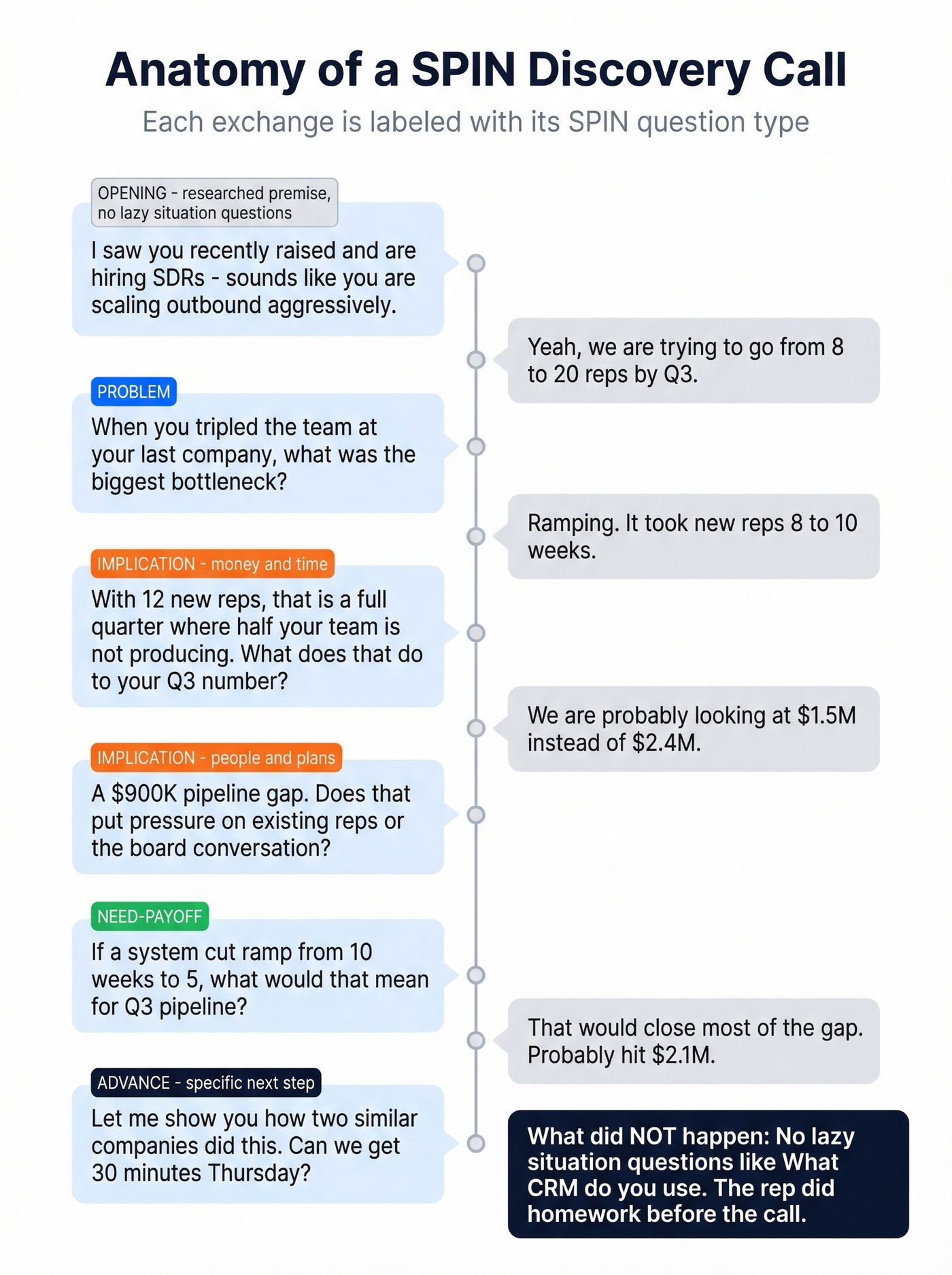
Rep: "Sarah, thanks for taking this. I saw you recently raised and you're hiring SDRs - sounds like you're scaling outbound aggressively. I wanted to see if the challenges we're solving for similar teams resonate with yours. Fair?" [Opening - states researched premise, no lazy situation questions]
Sarah: "Yeah, that's accurate. We're trying to go from 8 to 20 reps by Q3."
Rep: "That's aggressive growth. When you tripled the team at your last company, what was the biggest bottleneck - hiring, ramping, or something else?" [Problem]
Sarah: "Ramping, honestly. It took new reps 8 to 10 weeks before they were booking qualified meetings consistently."
Rep: "8 to 10 weeks is a long ramp. With 12 new reps coming in, that's essentially a full quarter where half your team isn't producing pipeline. What does that do to your Q3 number?" [Implication - money/time]
Sarah: "It's a real problem. We're forecasting $2.4M in new pipeline for Q3, but if ramp takes that long, we're probably looking at $1.5M realistically."
Rep: "A $900K pipeline gap. Does that put pressure on your existing reps to overperform, or does it push the board conversation about hitting plan?" [Implication - people/plans]
Sarah: "Both. My top reps are already stretched. And the board is watching Q3 closely after the raise."
Rep: "What's driving the long ramp time - is it product knowledge, prospecting skill, or something about the process itself?" [Problem - drilling deeper]
Sarah: "It's process. Every rep builds their own workflow. There's no standardized playbook for discovery or demo structure."
Rep: "So if you had a system that cut ramp from 10 weeks to 5 - where new reps followed a proven discovery framework with real-time guidance - what would that mean for your Q3 pipeline?" [Need-Payoff]
Sarah: "That would close most of the gap. We'd probably hit $2.1M, maybe more."
Rep: "And for your existing reps - if they had the same framework reinforced on every call, would that help with consistency across the team?" [Need-Payoff - expanding]
Sarah: "Absolutely. Right now my best rep closes at 28% and my worst is at 11%. That variance is killing us."
Rep: "That's exactly what we help with. Let me show you how two companies at your stage used our platform to cut ramp by 45% and narrow that win-rate variance. Can we get 30 minutes with you and your enablement lead on Thursday to walk through it?" [Demonstrating Capability + Obtaining Commitment - asking for an Advance, not a Continuation]
Sarah: "Thursday works. I'll pull in Marcus."
Notice what didn't happen: the rep never asked "What CRM do you use?" or "How many reps do you have?" The conversation started at Problem and escalated through Implication to Need-Payoff in under 10 minutes. That's SPIN done right - conversational, not interrogative.

Implication questions only land when you're talking to the actual decision-maker. Prospeo gives your reps 125M+ verified mobile numbers with a 30% pickup rate - so they skip the gatekeeper and run SPIN discovery with the person who signs the check.
Stop perfecting your questions for the wrong contact.
Why SPIN Fails Without Modernization
SPIN was built for a world where sellers controlled information. That world is gone. 96% of prospects research before engaging sales, and 71% prefer doing their own research over talking to a rep. When a buyer has already read your case studies, watched your demo video, and compared your pricing on G2, opening with "Tell me about your current challenges" feels tone-deaf.
The #1 failure mode we see is situation-question overload. Reps run 45-minute discovery calls that are 40 minutes of situation questions, creating what one CRO blog aptly called "vendor script" vibes. The prospect checks out, gives polite non-answers, and ghosts the follow-up.
SPIN also has structural gaps Rackham never addressed: no required dollar quantification (implication questions hint at cost but don't force a number), no stage-by-stage buyer commitments, no tonality or status guidance, and no disqualification framework. You can run a textbook SPIN call and still have no idea if the deal is real.
Three Fixes for 2026
State premises instead of asking. Replace "How are you handling outbound today?" with "I saw you're hiring SDRs and investing in outbound - are you hitting the connect rates you need, or is that a pain point?" You've demonstrated research and jumped straight to Problem.
Quantify in dollars. Don't let implication questions float. Push for numbers: "What does that cost per quarter?" or "If each rep loses 5 hours a week to bad data, that's roughly $40K per rep per year in lost selling time." Dollar quantification creates urgency. And urgency matters - deals closed within 50 days have a 47% win rate versus ~20% after that threshold.
Require explicit commitments. Every call should end with a concrete advance, not "let's circle back." If the prospect won't commit to a next step with a specific date and additional stakeholders, the deal isn't real.
Using AI to Prepare for SPIN Calls
Neil Rackham said it best: "A minute spent planning a call is worth ten minutes analysing why a call went wrong." In 2026, GenAI makes that planning minute far more productive.
Three prompt templates we've found effective:
Defining call objectives
"I'm calling [Name], [Title] at [Company]. They recently [trigger event]. Based on what companies like theirs typically struggle with, what are 3 realistic call objectives that would qualify as an 'advance' rather than a 'continuation'?"
Identifying implied needs
"[Company] is a [size] [industry] company that just [trigger]. Based on common pain points for companies at this stage, list 5 implied needs their [Title] likely has but may not have prioritized."
Generating implication angles
"For each implied need below, generate 2 implication questions that explore consequences across these dimensions: money, time, plans, process, and people. [Paste implied needs]"
These prompts aren't a replacement for genuine business acumen. They compress 30 minutes of pre-call research into 5, and they surface angles you might not have considered. The key is using AI for preparation, not for live conversation - nobody wants to talk to a rep who's clearly reading ChatGPT outputs in real time. (If you want more practical templates, see our guide to discovery questions.)
SPIN vs Challenger vs MEDDIC vs Sandler
Look, ask any rep with 10+ years of experience and they'll tell you all sales methodologies are basically the same. They all boil down to understanding needs, qualifying budget, mapping stakeholders, and driving urgency. The r/sales consensus is that fundamentals matter more than frameworks.
That said, each methodology has a sweet spot.
| SPIN | Challenger | MEDDIC | Sandler | |
|---|---|---|---|---|
| Best for | Discovery calls | Reframing status quo | Deal qualification | Mutual commitment |
| Question style | Open, exploratory | Teaching + tailoring | Structured checklist | Reversing + contracts |
| Deal type | Complex B2B | Competitive / entrenched | Enterprise, multi-stakeholder | Any (strong on disqual) |
| Cycle length | 3-9 months | 2-6 months | 6-18 months | 1-4 months |
| Key strength | Buyer self-discovers need | Creates urgency from insight | Forecast accuracy | Early disqualification |
| Key weakness | No disqual framework | Needs deep industry knowledge | Rigid, process-heavy | Can feel adversarial |
Real scenarios make this concrete. A chatbot platform rep used SPIN discovery to surface the cost of slow lead response for a real estate enterprise - $20K ARR signed. A billing SaaS rep used Challenger to reframe a "works fine" status quo into a growth bottleneck - $350K ARR closed over a 6-month cycle. A MEDDIC review on a $72K ITSM deal exposed fatal gaps: no economic buyer access, no quantified metrics, no champion. The deal was pulled from forecast and eventually lost, but MEDDIC saved the team from counting on it.
Our hot take: If your average deal size is under $25K, you probably don't need formal SPIN training. Read the book, internalize the implication question concept, and spend the $30K training budget on better data and more at-bats. The reps who close the most aren't the ones who memorized a framework - they're the ones who get 50 discovery calls a month instead of 15.
The best teams don't pick one methodology. They use SPIN for discovery, Challenger for reframing, and MEDDIC for qualification. The explicit recommendation to combine Challenger and SPIN for SaaS is gaining traction, and it makes sense - SPIN uncovers pain, Challenger teaches the prospect why that pain is worse than they thought, and MEDDIC ensures the deal is real before it hits your forecast. (If you're implementing MEDDIC, start with MEDDIC sales qualification.)
Rolling Out SPIN on Your Team
Let's be realistic about cost. Enterprise sales methodology training typically runs $10K-$50K+ depending on team size and delivery format. Huthwaite (the firm Rackham founded) is the official SPIN training provider. The book itself is ~$15-$20 paperback, ~$10 on Kindle - but Huthwaite explicitly warns that SPIN isn't a technique you can read about and apply easily. It requires proper training, coaching, and commitment to long-term behavior change. Budget 3-6 months for meaningful adoption.
Here's what most rollout plans miss: any consultative selling framework is useless if your reps can't reach decision-makers. You can train the most elegant discovery process in the world, but if reps are calling wrong numbers and emailing bounced addresses, they never get to use it. Before investing $30K in questioning technique, invest in contact accuracy. Tools like Prospeo verify emails in real-time at 98% accuracy and provide 125M+ verified mobile numbers - so reps actually get to the discovery call where SPIN matters. (If you're evaluating vendors, compare data enrichment services and review email bounce rate benchmarks.)

The rollout sequence that works: clean your data first, train the framework second, then coach weekly using recorded calls. Skip any of those steps and you'll have reps who can recite the four question types but can't get a VP on the phone. (For more ways to increase volume, use these sales prospecting techniques.)
Rackham proved that top reps minimize situation questions by doing their homework first. Prospeo surfaces 50+ data points per contact - job title, tech stack, funding, headcount growth - so you walk into every SPIN call armed with context, not guesses.
Eliminate situation questions before the call even starts.
Honest Criticisms of SPIN
The strongest critique comes from a thread on r/sales that challenges SPIN's core assumption: does getting prospects to express explicit needs actually cause wins, or do explicit needs only surface when the buyer is already in crisis mode and would've bought anyway? It's a correlation-vs-causation argument, and it's legitimate. Rackham's research showed that explicit needs correlated with closed deals, but that doesn't prove the questions created the needs.
There's also the "methodology fatigue" problem. Experienced sellers have sat through SPIN, Challenger, MEDDIC, Sandler, and whatever the new framework of the year is. At some point, they all blur together. The Reddit consensus - that all methodologies are basically the same - isn't wrong. They all converge on the same fundamentals: understand the problem, quantify the impact, map the stakeholders, drive a decision. (If you want a more operational view, see sales process optimization.)
And then there's the script trap we opened with. The framework gives reps a structure, and insecure reps turn structure into a script. The prospect can always tell.
Here's our take: structured discovery beats winging it, every time. SPIN isn't perfect, and it's showing its age. But a rep who understands implication questions and need-payoff questions will outperform a rep who just demos and hopes. The SPIN sales methodology is a floor, not a ceiling. Master the floor, then build your own ceiling.
FAQ
Is SPIN selling still relevant in 2026?
Yes, but only if you modernize it. Eliminate lazy situation questions by stating researched premises instead. Add dollar quantification to every implication question. Combine SPIN with Challenger for reframing and MEDDIC for deal qualification - the questioning framework alone doesn't cover the full sales cycle.
What's the difference between SPIN and Challenger?
SPIN uncovers existing pain through questions, letting the buyer self-discover their need. Challenger teaches the prospect something new to reframe their status quo and create urgency. Best results come from combining both - SPIN for discovery, Challenger for the insight that changes how they see the problem.
How long does it take to learn SPIN selling?
Reading the book takes a weekend. Changing actual selling behavior takes 3-6 months of coaching and reinforcement. Huthwaite is explicit about this - it requires training and long-term commitment, not a quick read.
Does SPIN work for SMB or transactional sales?
Poorly. The Situation-Problem-Implication-Need-Payoff sequence is designed for complex, high-value B2B sales with multiple stakeholders and longer decision cycles. For transactional deals under five figures, simpler frameworks like BANT are more efficient. You don't need four layers of questioning to sell a $500/month tool.
What tools help reps prepare for SPIN discovery calls?
A solid B2B data platform lets reps research accounts and verify direct contact data before the call, eliminating most situation questions. Pair that with GenAI prompt templates for implication angles, and you compress 30 minutes of pre-call prep into 5.