

SPIN Selling vs Challenger Sale: A Decision Framework (Not Another "Use Both" Cop-Out)
Every SPIN selling vs Challenger sale comparison ends with the same non-answer: "use both!" That's not a framework. That's a cop-out.
The 30-second verdict. SPIN uncovers pain the buyer can't articulate. Challenger reframes what the buyer thinks they already know. The methodology you pick matters far less than whether your team actually runs it. Korn Ferry research shows 75%+ adoption of a dynamic methodology drives 21% higher quota attainment, 15% higher win rates, and 6% more revenue. Adoption beats selection every time.
SPIN Selling in 60 Seconds
Neil Rackham built SPIN in the early 1970s, funded by Xerox. The methodology is widely cited as being based on 35,000+ sales calls over 12 years - spanning 13 countries according to Huthwaite - and found top performers followed the same questioning pattern regardless of culture or industry:
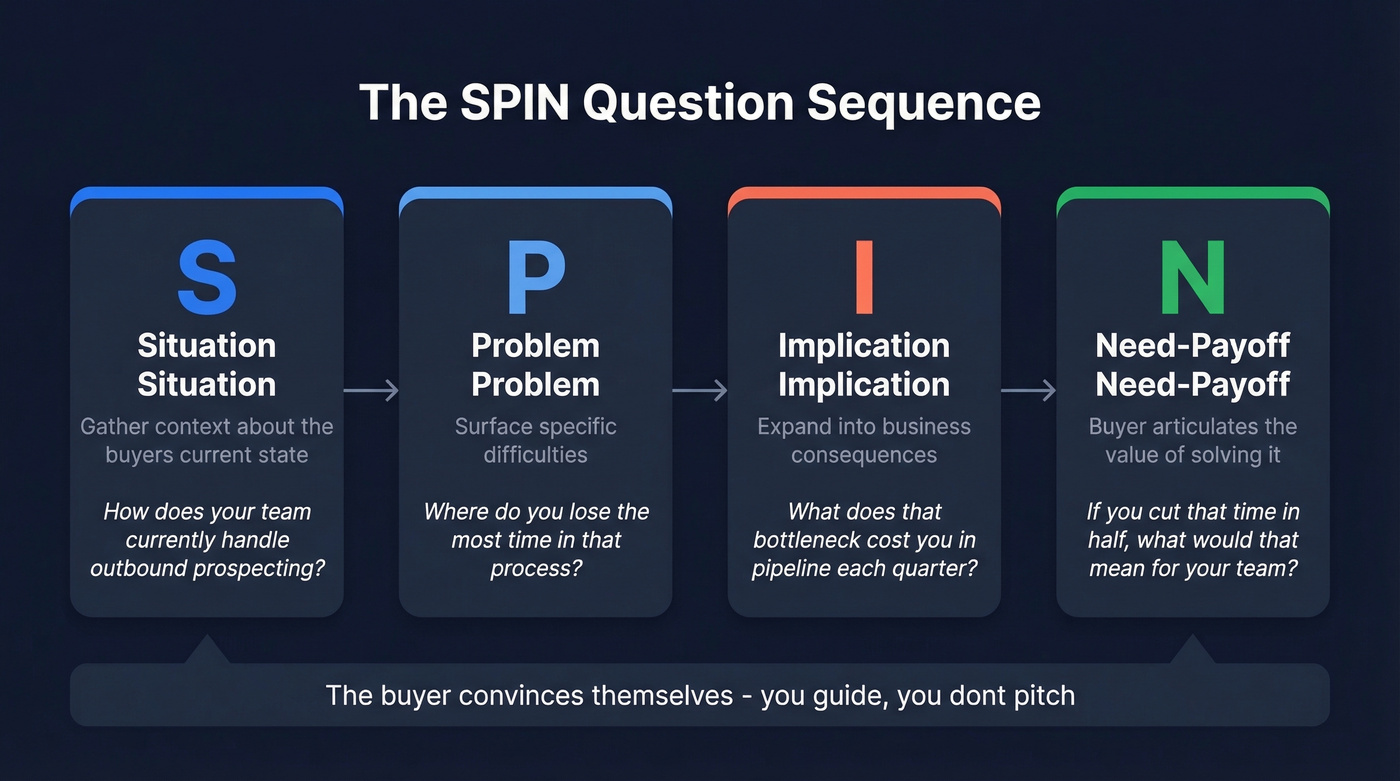
- Situation - gather context about the buyer's current state
- Problem - surface specific difficulties (use sharper discovery questions than generic prompts)
- Implication - expand those into business consequences
- Need-Payoff - get the buyer to articulate the value of solving the problem
The buyer convinces themselves. You're not pitching. You're guiding them to their own conclusion, and that's what makes it stick.
The Challenger Sale in 60 Seconds
The Challenger Sale came out of a CEB (now Gartner) study that started as a customer loyalty investigation. The headline finding: the sales experience accounted for 53% of customer loyalty - more than brand, product, or price combined. Researchers clustered reps into five profiles based on 44 attributes.
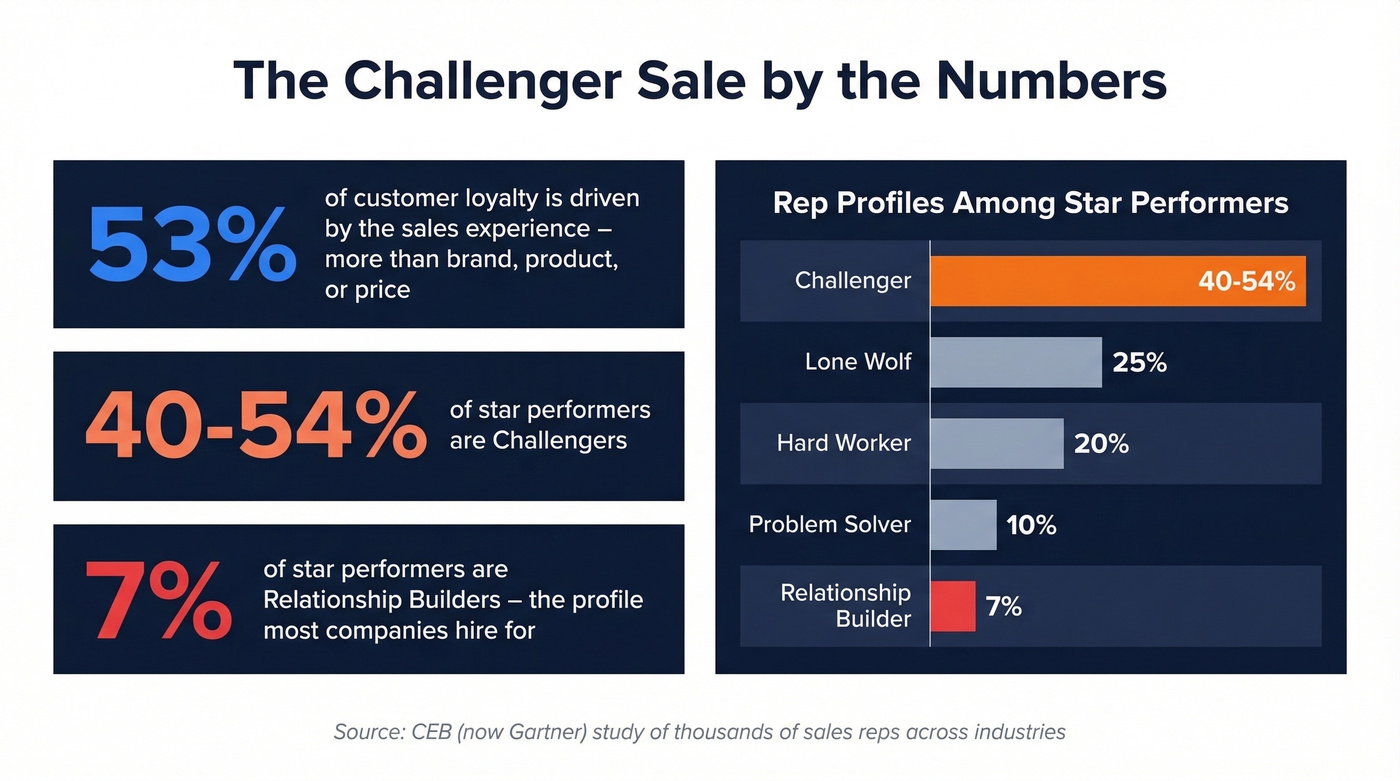
Nearly 40% of star performers were Challengers, with some analyses putting that figure closer to 54%. Relationship Builders - the profile most companies hire for - produced just 7% of star performers. Let that sink in. The methodology distills into three moves: Teach the buyer something new, Tailor to their context, and Take Control of the commercial conversation.
Head-to-Head Comparison
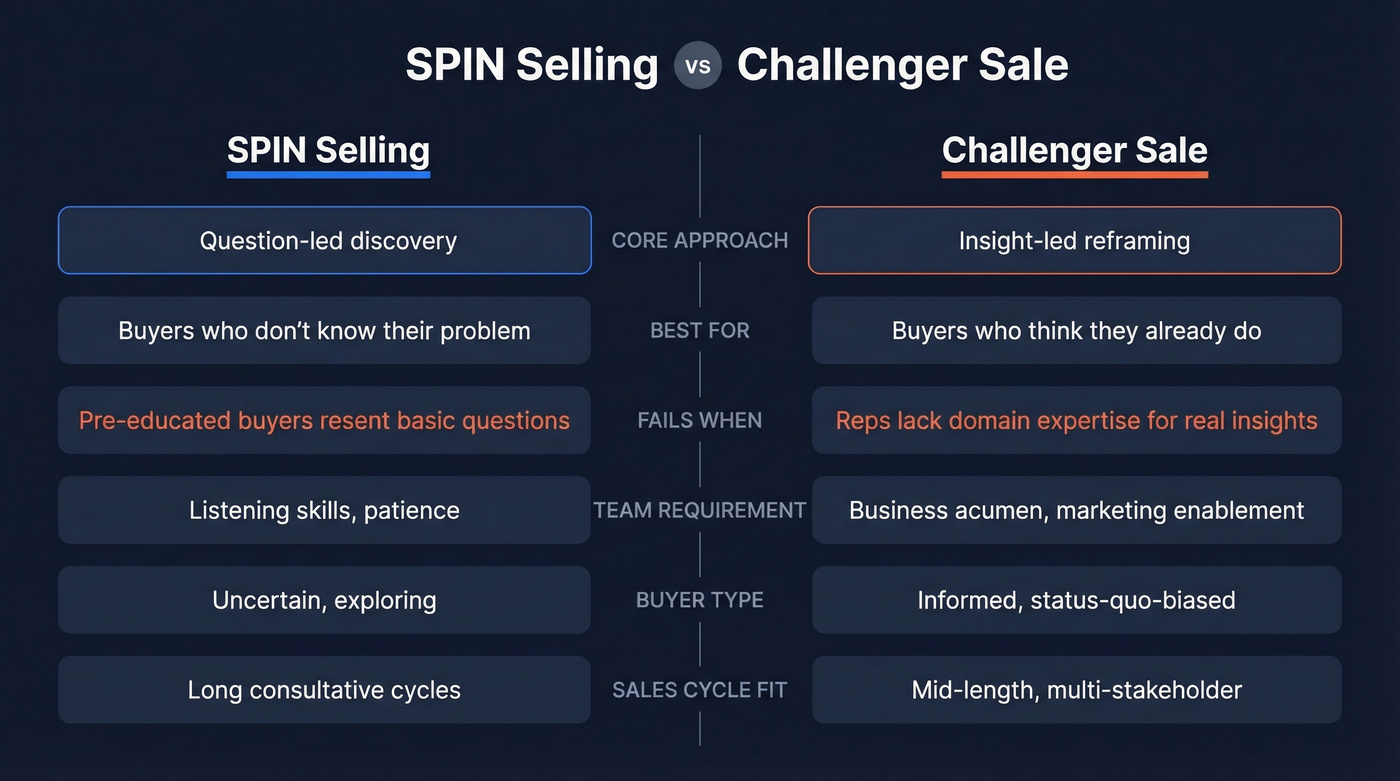
| Dimension | SPIN | Challenger |
|---|---|---|
| Core approach | Question-led discovery | Insight-led reframing |
| Best for | Buyers who don't know their problem | Buyers who think they already do |
| Fails when | Pre-educated buyers resent basic Qs | Reps lack domain expertise for real insights |
| Team requirement | Listening skills, patience | Business acumen, marketing enablement |
| Buyer type | Uncertain, exploring | Informed, status-quo-biased |
| Sales cycle fit | Long consultative cycles | Mid-length, multi-stakeholder |

SPIN and Challenger both assume you're talking to the right person. But 70-80% of buyers are deep in their journey before you reach them - if you reach them at all. Prospeo gives you 300M+ profiles with 98% verified emails and 125M+ direct dials, so your reps spend time executing their methodology instead of hunting for contact info.
Stop perfecting your pitch to an inbox that bounces.
Where Each Breaks Down
Where SPIN Fails
SPIN was built for an era when buyers relied on sellers for information. That era's over. Today's B2B buyer completes 70-80% of their journey before talking to a rep, so opening with Situation questions - "Tell me about your current process" - feels like homework the buyer already did. It signals you haven't done yours.
The fix isn't abandoning SPIN; it's trimming the Situation layer. Top performers ask roughly 11-14 targeted questions per discovery call, while average reps ask 6-8. If you haven't researched the account before the call, no questioning framework saves you (build a repeatable lead generation workflow so research actually happens).
Where Challenger Fails
One popular r/sales thread puts it bluntly: the book reads like it was written by researchers, not practitioners. Conceptually compelling, light on actionable technique.
In practice, three failure modes recur. Reps interpret "take control" as "be aggressive," which alienates instead of guiding. "Teaching" becomes a repackaged product pitch buyers see through instantly. And organizations skip the change management entirely - no coaching cadence, no marketing-built insight decks, no reinforcement plan. If your org doesn't have marketing enablement, Challenger collapses into opinionated pitching. Korn Ferry's critique adds another wrinkle: Challenger is risky with buyers who feel insecure about their authority, because the assertive reframe threatens rather than enlightens. We've watched this blow up firsthand - a rep "challenging" a VP who didn't ask to be challenged is a fast way to lose a deal.
Which Framework Fits Your Team?
If your average deal size is under $15k and your reps have less than two years of domain experience, start with SPIN. Challenger without genuine expertise is just arrogance with a framework.
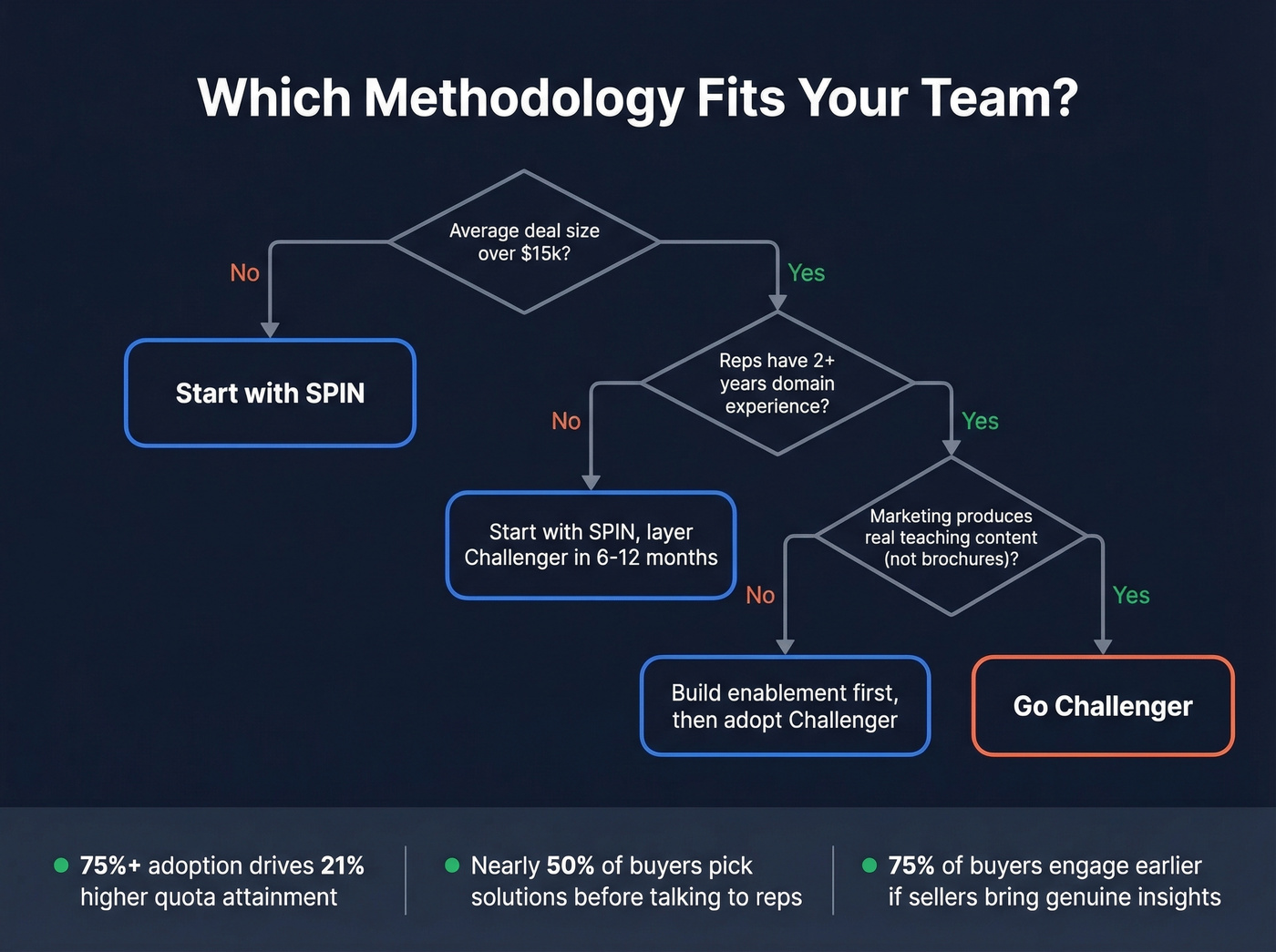
Use SPIN when your buyers genuinely don't understand the scope of their problem, you're selling complex solutions with long cycles, or your reps are still building domain knowledge. SPIN's structure is easier to coach because the question sequence gives reps a clear path through every call.
Use Challenger when you're selling against the status quo, your market is competitive, your reps have deep domain knowledge, and your marketing team produces real teaching content - not brochures. It also maps well to account-based motions where you need to reframe thinking across an entire buying committee, not just one champion.
Here's the stat that settles most debates: nearly 50% of buyers identify specific solutions before talking to a rep. If your buyers already have a shortlist, pure SPIN discovery feels redundant. But Korn Ferry also found that 75% of buyers will engage sellers earlier - if those sellers bring genuine insights. That's the Challenger opening.
How to Combine Them (Without the Cop-Out)
Let's be honest: most experienced reps already blend these instinctively. Here's how to do it deliberately.
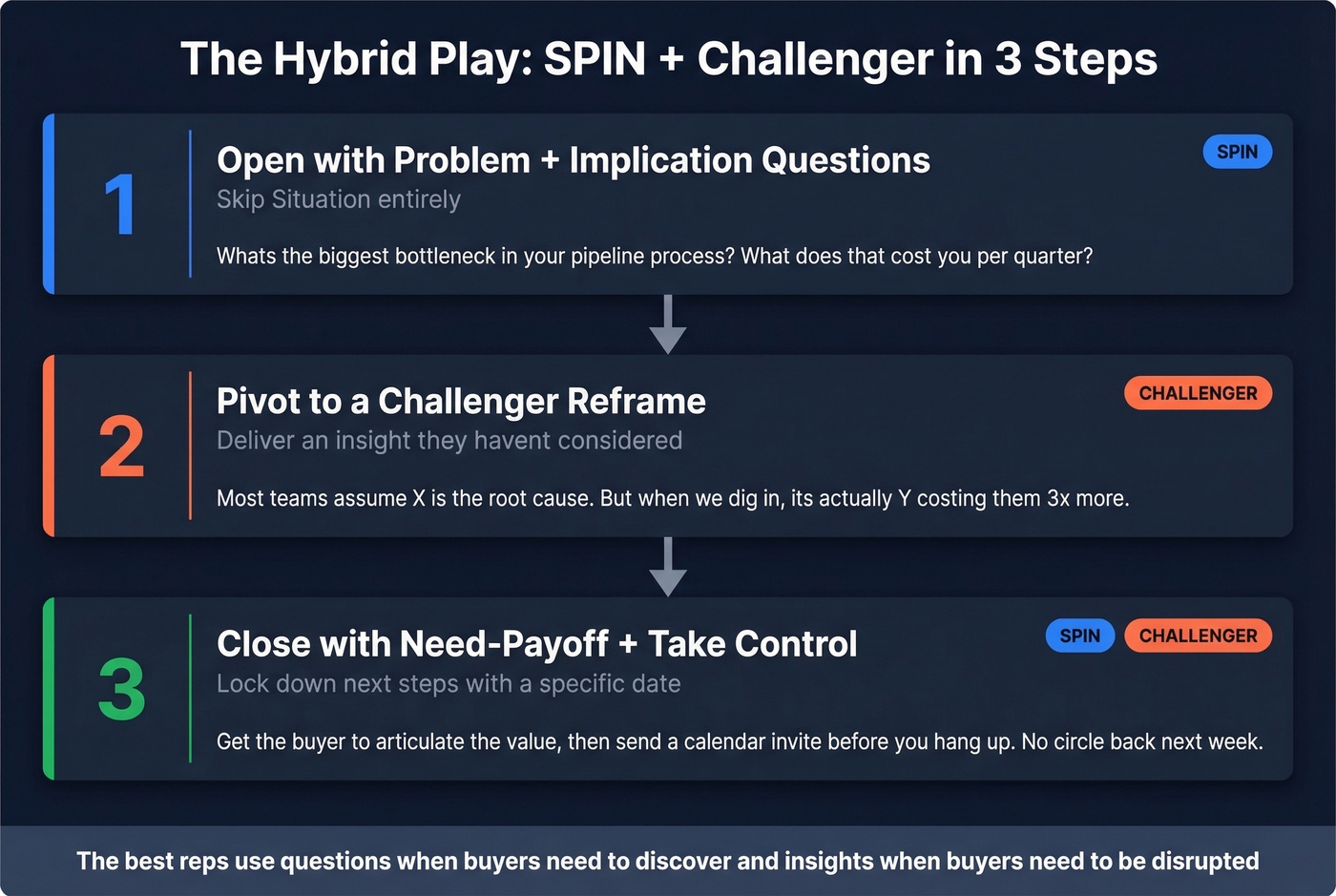
- Open with Problem + Implication questions. Skip Situation entirely. Go straight to "What's the biggest bottleneck in your pipeline process?" then expand consequences (use a consistent discovery call script so reps don’t freestyle).
- Pivot to a Challenger reframe. Once you've surfaced pain, deliver an insight the buyer hasn't considered - a perspective shift, not a product pitch. Something like: "Most teams we talk to assume X is the root cause. But when we dig in, it's actually Y costing them 3x more."
- Close with Need-Payoff + Take Control. Get the buyer to articulate the value of solving the problem, then lock down next steps with a specific date and agenda. No "let's circle back next week" - a calendar invite before you hang up (tighten your steps to close a sale so next steps are non-negotiable).
Pick a Framework, Then Execute
Stop treating methodologies like religions. The best reps use questions when the buyer needs to discover and insights when the buyer needs to be disrupted. The entire SPIN selling vs Challenger sale debate misses the point if your team never internalizes either one.
The real differentiator isn't which book you read. It's whether your team adopts what you choose. Pick one framework, run it for 90 days with weekly coaching, measure call-to-meeting conversion, then iterate (a simple 30-60-90 day plan for sales reps keeps the rollout from dying in week two). Everything else is academic.
FAQ
Is SPIN Selling still effective in 2026?
Yes, but only if you skip Situation questions and do pre-call research. Top performers ask 11-14 targeted Problem and Implication questions per discovery call. SPIN's core insight - letting buyers articulate their own pain - remains powerful for complex, long-cycle deals where buyers haven't self-diagnosed yet. It's not outdated; it just needs updating for buyers who show up informed.
Can junior reps run the Challenger method?
Rarely. Challenger requires genuine domain expertise to deliver insights buyers haven't heard. Reps with under two years of industry experience typically default to product pitches disguised as "teaching." Start junior reps on SPIN's structured questioning, then layer in Challenger reframes as their knowledge deepens. In our experience, that transition takes 6-12 months of deliberate coaching.
Which methodology works better for multi-stakeholder deals?
Challenger edges out SPIN for deals with 6+ stakeholders. Its teach-tailor-control loop lets reps deliver role-specific insights to each buyer - CFOs hear financial reframes, end-users hear workflow disruption stories. SPIN works better one-on-one but struggles to scale across a buying committee without significant adaptation.
How do I get accurate contacts for outreach?
Look, neither methodology matters if you can't reach the right people. Prospeo delivers 98% email accuracy with 143M+ verified emails and 125M+ verified mobiles, refreshed every 7 days. The free tier includes 75 emails per month - enough to test either methodology on real prospects without burning your domain.
Whether you open with Implication questions or a Challenger reframe, you need account context before the call. Prospeo's 30+ search filters - buyer intent, technographics, headcount growth, funding - give your reps the pre-call intelligence that makes Situation questions obsolete and Challenger insights credible. All at $0.01 per email.
Research every account in minutes, not hours.