


7 Best SpruceSend Alternatives for Cold Email (2026)
You're managing 30 inboxes, warming domains, rotating IPs - and reply rates keep dropping. If you're shopping for SpruceSend alternatives, resist the urge to blame your SMTP provider first. Half the time, the real problem isn't infrastructure. It's a 12% bounce rate torching your IP reputation on every provider you touch.
That said, sometimes you genuinely need better pipes. We'll cover both angles.
Our Picks (TL;DR)
- Best for data quality (fix deliverability at the source): Prospeo
- Best managed SMTP relay: Mailgun
- Best for transactional email: Postmark
- Best automated cold email infra: Hypertide
- Cheapest at scale (if you have DevOps): Amazon SES
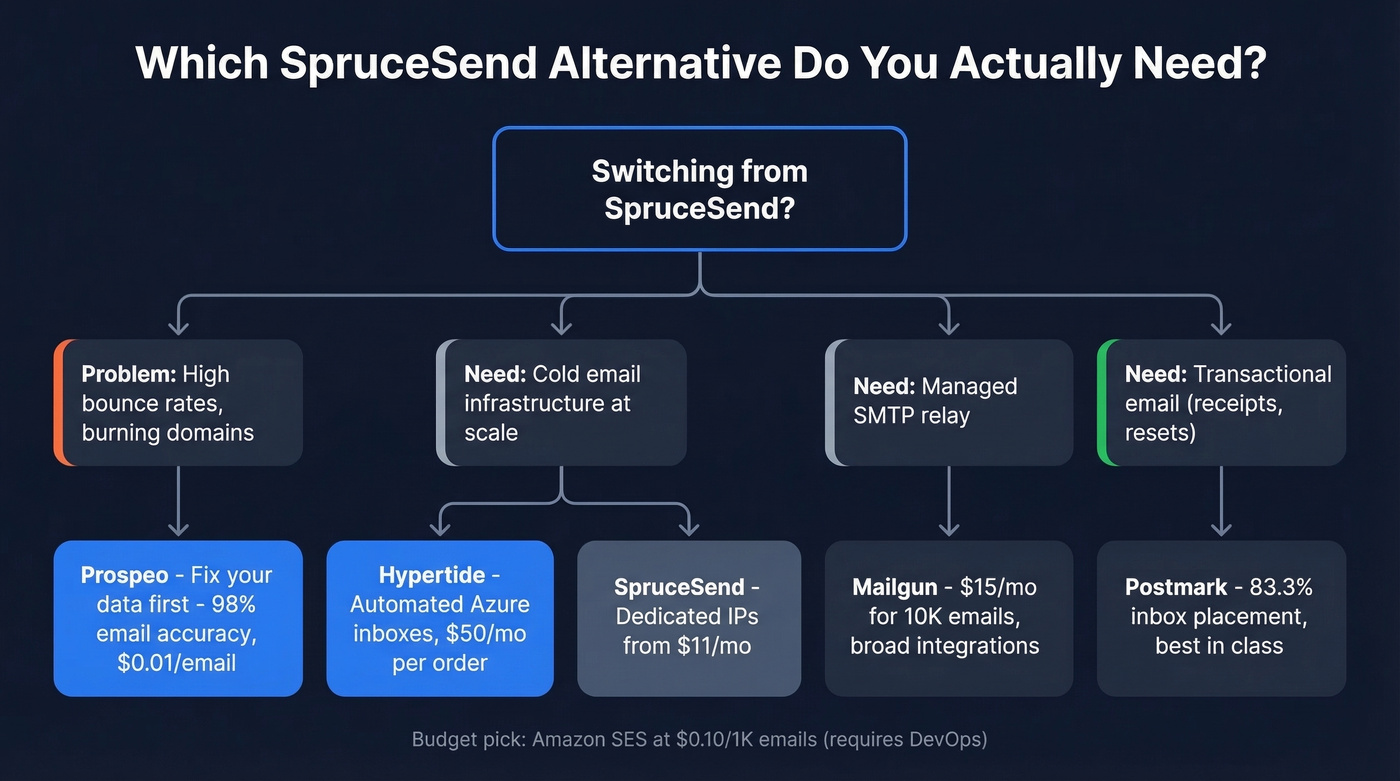
Most "SpruceSend alternatives" lists recommend email marketing platforms like Mailchimp or ActiveCampaign. Those aren't in the same category. SpruceSend is sending infrastructure, and that's what we're comparing here.
What Is SpruceSend?
SpruceSend is an SMTP relay service that provides custom email infrastructure with dedicated IPs starting at $11/month, no per-user fees, and lifetime support.
Why Teams Switch
Scaling is the obvious trigger. Once you're running dozens of inboxes across multiple domains, you need real control over IP isolation, warmup automation, and blacklist monitoring. If you're troubleshooting bounces and reputation issues, it helps to know the email bounce rate benchmarks and what actually causes them.
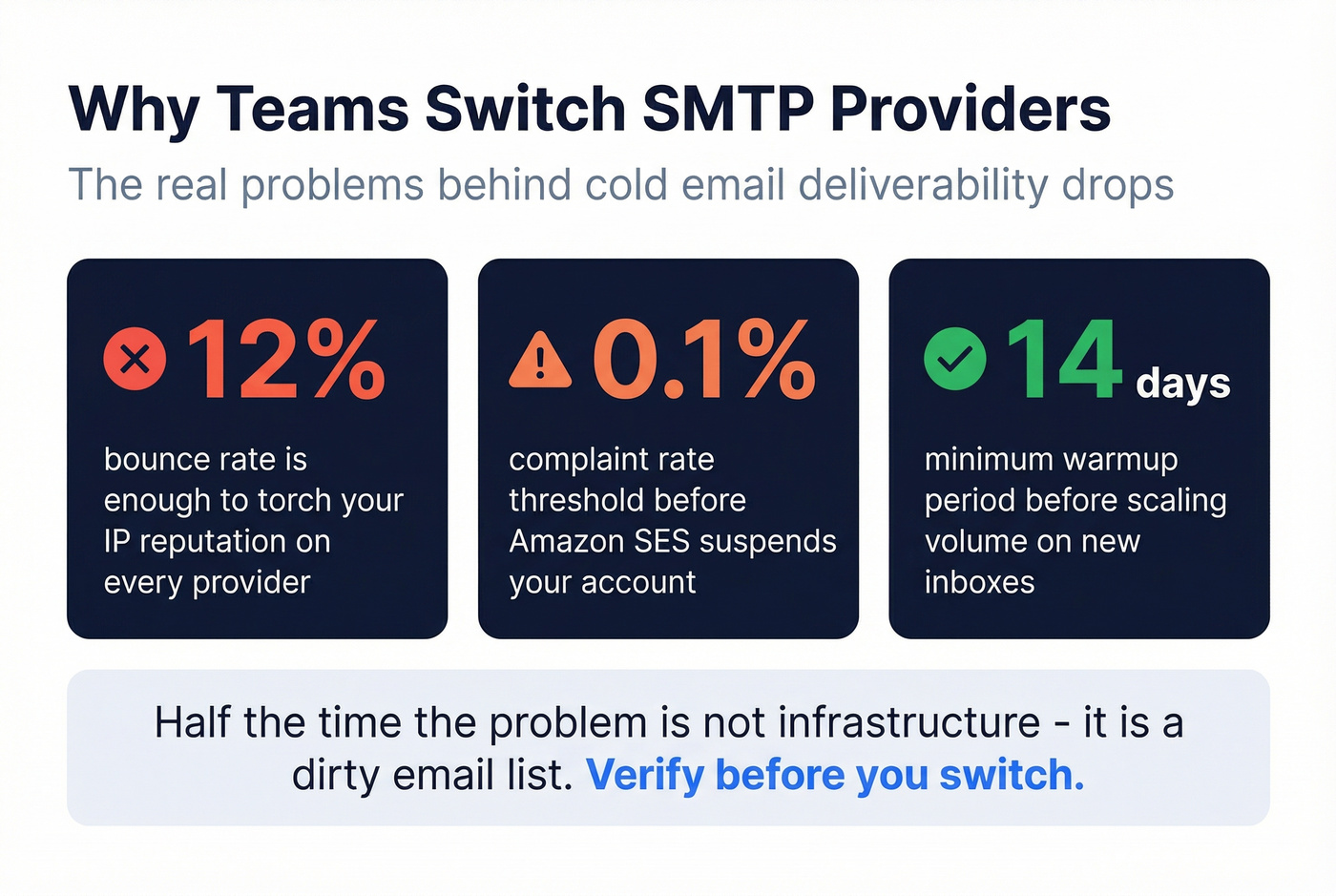
Then there's the Microsoft-to-Microsoft deliverability problem. We've seen teams with perfect SPF/DKIM/DMARC setups suddenly land in Outlook spam with no public blacklist showing an issue. Microsoft support sometimes needs to manually release IPs at the domain level, and that troubleshooting eats days.
The biggest time sink is what r/coldemail calls "infra babysitting" - warming inboxes, watching dashboards that show green while replies quietly drop, managing domains that go cold overnight. Before you switch providers, though, audit your email list. A proper verification process that catches invalid addresses, spam traps, and honeypots will do more for your deliverability than any infrastructure swap. If you want the full framework, start with an email deliverability guide and a dedicated email reputation tools checklist.

Switching SMTP providers won't fix a dirty list. Prospeo's 5-step verification catches spam traps, honeypots, and catch-all domains before they torch your IP reputation - delivering 98% email accuracy on a 7-day refresh cycle.
Stop blaming your infrastructure. Clean your data at $0.01 per email.
Best Alternatives Compared
Prospeo - Fix Your Data First
Use this if: Your bounce rate is above 3%, you're burning domains, or your data provider is the real bottleneck.
Skip this if: You only need raw sending infrastructure and your lists are already verified.
Here's the thing: Prospeo isn't an SMTP provider. It solves the upstream problem that makes every SMTP provider look bad - dirty data. The platform runs 143M+ verified emails through a 5-step verification process with catch-all handling, spam-trap removal, and honeypot filtering, delivering 98% email accuracy on a 7-day refresh cycle versus the 6-week industry average. If you're comparing verifiers, see our breakdown of Bouncer alternatives and the broader landscape of data enrichment services.
Stack Optimize built from $0 to $1M ARR using Prospeo, maintaining client deliverability above 94%, bounce rates under 3%, and zero domain flags. That's what clean data does for infrastructure - it doesn't matter how good your pipes are if you're pumping garbage through them.
Pricing sits at roughly $0.01 per email with a free tier of 75 emails/month. No contracts, fully self-serve.

Mailgun
Use this if: You want a well-documented SMTP API with broad integrations and don't want to manage servers.
Skip this if: You need dedicated cold email infrastructure with IP isolation per domain - Mailgun's shared-IP testing landed at 71.4% inbox placement. If you're weighing the tradeoffs, our Mailgun vs Prospeo comparison clarifies what each tool is actually for.
Mailgun starts at $15/mo for 10,000 emails with a free tier of 100 emails/day. For transactional and light outbound, it's a safe pick. Just know that shared-IP deliverability won't match dedicated setups.
Amazon SES
At $0.10 per 1,000 emails, SES looks like a steal. Dedicated IPs run $24.95/mo each. Inbox placement tested at 77.1% on shared IPs.
The reality: you'll build bounce handling via SNS/Lambda, monitoring via CloudWatch, and reputation management from scratch. Cheapest on paper, expensive in practice without DevOps. If you don't have a dedicated engineer who wants to babysit email infrastructure, SES will cost you more in time than it saves in dollars.
SES also enforces strict anti-spam policies. Cold email senders risk account suspension if complaint rates spike above ~0.1%. To stay safe as you scale, follow an email velocity playbook and keep a spam trap removal process in place.
Postmark
Postmark posted the highest inbox placement at 83.3% in shared-IP testing - and it's not close. If you need bulletproof delivery for order confirmations, password resets, and notifications, Postmark handles that lane better than anyone. Pricing scales cleanly: $15/mo for 10K emails, $245/mo for 300K, $695/mo for 1M.
The catch: Postmark explicitly separates transactional and promotional streams. It's not designed for cold outreach and won't pretend to be.
Hypertide
Use this if: You want the closest direct competitor to SpruceSend - automated cold email infrastructure on Azure with tenant isolation and isolated IPs.
Hypertide automates Azure inbox setup in 4-6 hours, configuring SPF/DKIM/DMARC automatically. Each order gets two domains on separate Azure tenants with isolated IPs - up to 100 inboxes per order. After a two-week warmup, expect roughly 5,000 cold emails/month per order at $50/month per order. It's newer with thin public reviews, but the automation eliminates most of the infra babysitting that drives people away from SpruceSend in the first place.
MailerSend
Developer-friendly budget option with a free tier of 500 emails/month and paid plans from $7/mo for 5,000 emails. Good for small teams and transactional use cases, not built for cold email at scale.
Brevo
Multi-channel platform covering email, SMS, and chat. Free tier of 300 emails/day, paid from $8/mo. Useful for newsletters and drip campaigns, not cold outreach infrastructure.
Pricing Comparison
Deliverability scores below come from a Mailtrap shared-IP seed test - useful as a relative benchmark, not an absolute guarantee. For context, SendGrid tested at just 61.0% inbox placement on shared IPs. If you're trying to avoid deliverability landmines, see our guide on the best way to send bulk email without getting blacklisted.
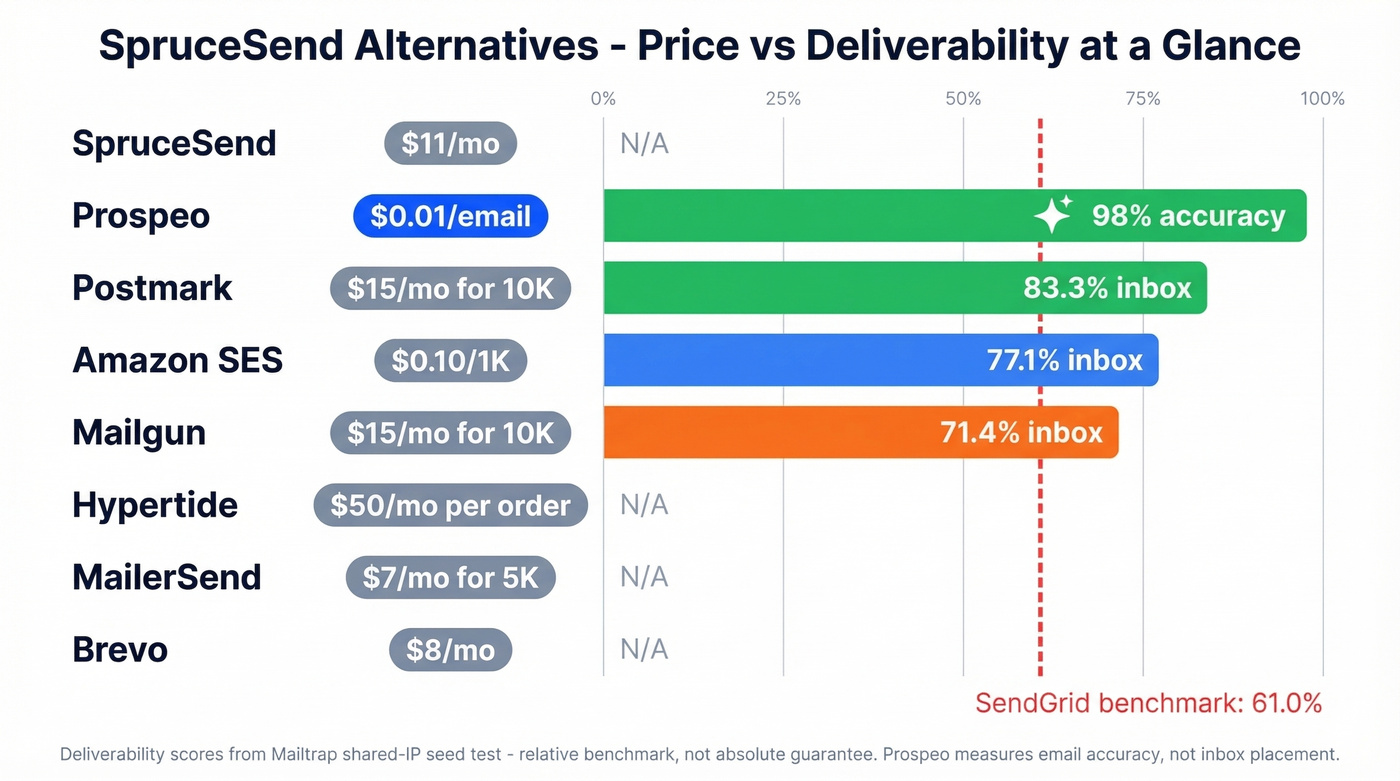
| Tool | Starting Price | Free Tier | Deliverability | Best For | |------|---------------|-----------|----------------|----------| | SpruceSend | $11/mo | N/A | N/A | Budget cold email SMTP | | Prospeo | ~$0.01/email | 75 emails/mo | 98% accuracy | Data quality / verification | | Mailgun | $15/mo (10K) | 100/day | 71.4% inbox | Managed SMTP relay | | Amazon SES | $0.10/1K emails | 62,000/mo (EC2 apps) | 77.1% inbox | High-volume + DevOps | | Postmark | $15/mo (10K) | Trial only | 83.3% inbox | Transactional email | | Hypertide | $50/mo per order | None | N/A | Automated cold email infra | | MailerSend | $7/mo (5K) | 500/mo | Dev-friendly budget | | Brevo | $8/mo | 300/day | N/A | Marketing multi-channel |
How to Choose
Start with the fundamental question: cold email, transactional email, or newsletters? Each requires different infrastructure. If you're building sequences, use a proven B2B cold email sequence structure and keep a library of cold email follow-up templates ready.
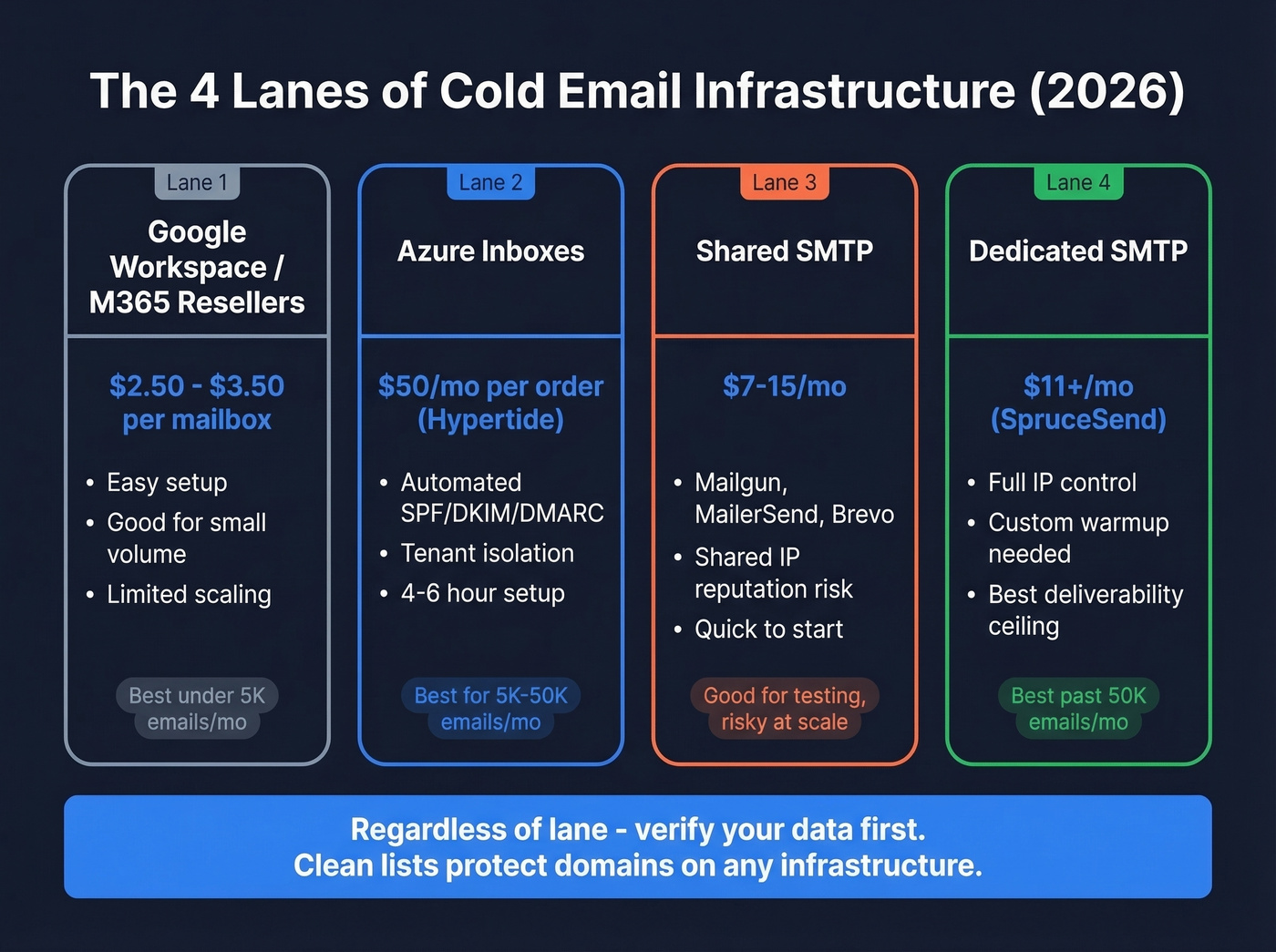
For cold email, a practitioner framework from r/coldemail breaks it into four lanes: Google Workspace/M365 reseller accounts ($2.50-$3.50/mailbox), Azure inboxes, shared SMTP, and dedicated SMTP. Dedicated SMTP makes sense past 50K sends/month. Self-hosting on a $5-10/month VPS sounds cheap, but without proper config, new IPs land on blacklists fast - most teams are better off with managed infrastructure.
Whatever lane you pick, diversify across at least two providers. A single policy change shouldn't take your entire operation offline. Look for DNS control, dedicated IP options, warmup support, and blacklist monitoring.
And regardless of provider, start with verified data. In our experience, clean lists protect your domains on any infrastructure - we've watched teams switch SMTP providers three times before realizing their 8% bounce rate was the actual problem all along.
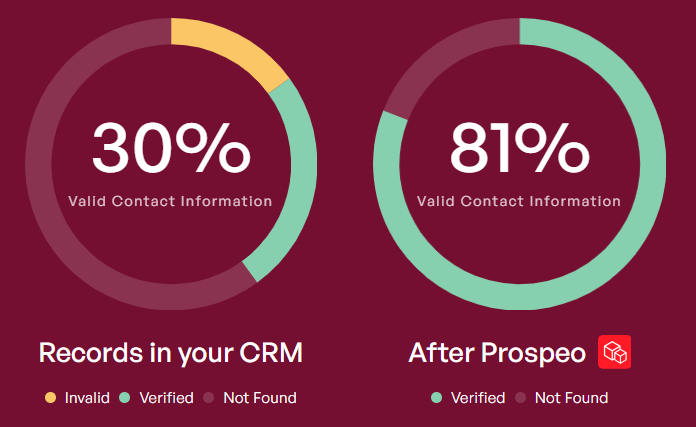
Stack Optimize ran cold email campaigns across every client without a single domain flag - bounce rates under 3%, deliverability above 94%. The difference wasn't better pipes. It was 143M+ verified emails refreshed every 7 days, not every 6 weeks.
Zero domain flags. Zero contracts. 75 free emails to prove it.
FAQ
What does SpruceSend do?
SpruceSend is an SMTP relay service providing custom email infrastructure with dedicated IPs starting at $11/month, no per-user fees, and lifetime support. It handles sending infrastructure - not sequencing, list building, or full outreach automation.
Can I use Amazon SES for cold email?
Technically yes, but SES enforces strict anti-spam policies and will suspend accounts if complaint rates spike above ~0.1%. Most cold email operators choose providers built for outbound, like Hypertide, or at minimum providers that don't actively police cold outreach volume.
How do I improve cold email deliverability without switching providers?
Start with verified email addresses - a bounce rate above 5% destroys IP reputation on any SMTP provider. Then ensure proper SPF/DKIM/DMARC setup and warm new inboxes for at least 14 days before scaling volume.
What's the cheapest SpruceSend alternative?
Amazon SES at $0.10 per 1,000 emails is the cheapest raw sending option, but it requires DevOps to build bounce handling and monitoring. For managed infrastructure, MailerSend starts at $7/mo for 5,000 emails.