

The Complete Guide to the Strategic Account Manager Role
A RevOps lead once told us their company had 87 "strategic" accounts. Eighty-seven. Every rep had labeled their biggest deal "strategic" to justify more resources, and the result was that none of those accounts got actual strategic treatment. If you're considering, currently in, or hiring for a strategic account manager position, that story should sting - because the difference between strategic account management done right and done wrong is the difference between your most profitable growth engine and an expensive account manager with a fancier title.
What You Need (Quick Version)
Considering the role? Strategic account managers own the top 20% of accounts that drive 80% of revenue. Median total comp sits at $143K based on 4,300+ salary reports, but pharma/biotech SAMs pull $242K. Industry selection matters more than negotiation skills.
Already a SAM? Your KPIs are CLV, NRR, NPS, and upsell/cross-sell rates. If you've got more than 30 "strategic" accounts, none of them are strategic. This guide covers the frameworks, mistakes, and benchmarks that separate career SAMs from people who get stuck.
Hiring a SAM? Skip the generic job description. We've included KPIs, comp ranges by industry and experience, account tiering criteria, and a tech stack recommendation at the bottom. Steal what you need.
What Does a Strategic Account Manager Do?
Eighty percent of a company's revenue typically comes from 20% of its customers. SAMs exist to protect and grow that 20%.
The role isn't about managing a book of business. It's about treating your most valuable customer relationships as strategic assets that require dedicated investment, executive-level engagement, and long-term planning. A SAM builds deep, multi-threaded relationships across a client's organization, creates account plans that span quarters instead of weeks, and identifies expansion opportunities before the customer even realizes they have a need. They're the connective tissue between their company's product, engineering, and leadership teams and the client's buying centers.
Here's the thing: losing a single strategic account is catastrophic. When a $2M annual account churns, you don't just lose the revenue - you lose the referenceability, the case study, the executive relationships, and the institutional knowledge that took years to build. That's why SAMs exist as a distinct role, not just senior account managers with bigger quotas.
SAM vs Account Manager vs KAM
Let's clear up the naming confusion. DemandFarm puts it bluntly: strategic account management is a synonym for key account management. SAM and KAM are interchangeable titles - the difference is branding, not function. Don't overthink it. You'll also see variants like Global Account Manager for multi-region accounts and Industry-Specific SAM for vertical expertise, but these are specializations within the same framework.
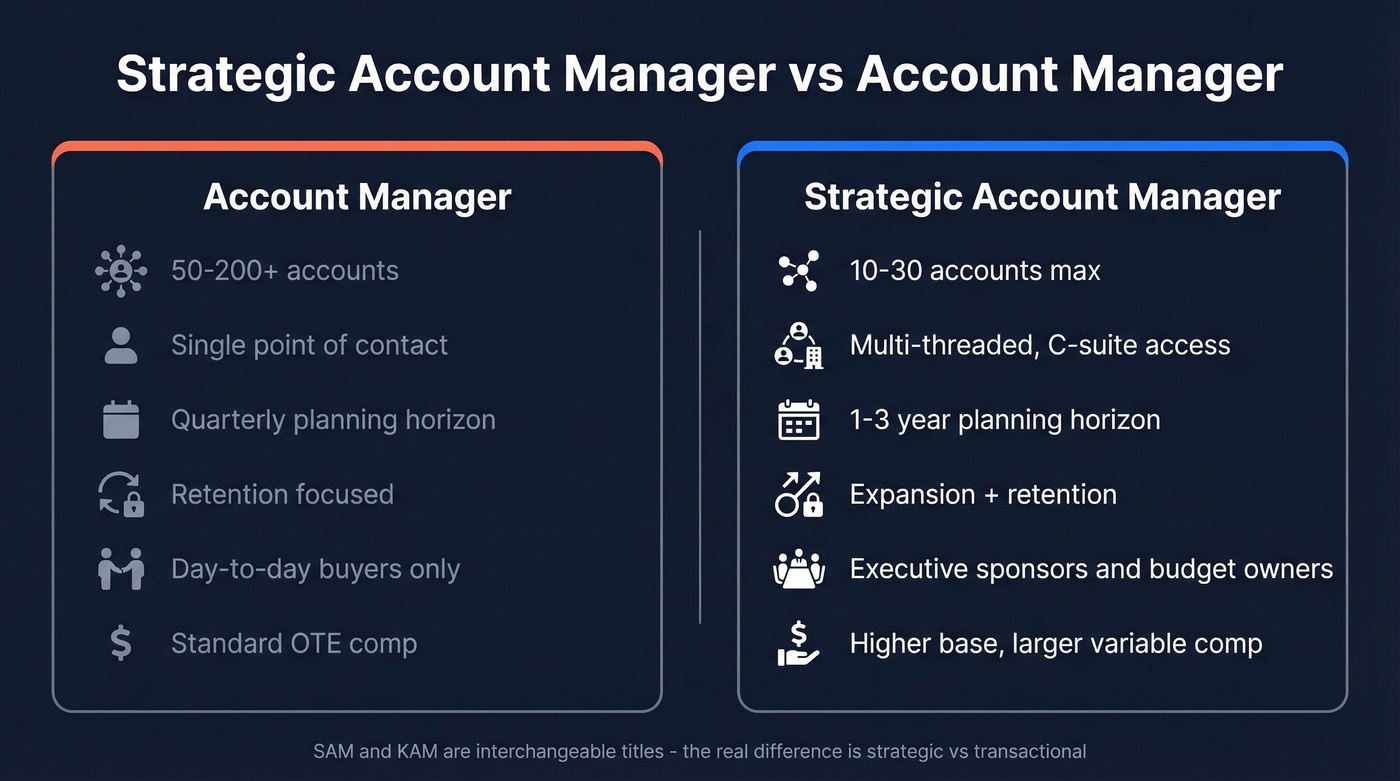
The real distinction is between a strategic/key account manager and a regular account manager. Kapta identifies five core differences: expectations, long-term vision, competition protection, loyalty focus, and proactive planning. A typical AM's motion revolves around transactions and renewals. A SAM manages the entire business relationship - understanding the client's org goals, providing strategic solutions, and working with the entire business rather than a single point of contact.
| Dimension | Account Manager | Strategic/Key Account Manager |
|---|---|---|
| Number of accounts | 50-200+ | 10-30 max |
| Relationship depth | Primary contact | Multi-threaded, C-suite |
| Planning horizon | Quarterly | 1-3 years |
| Revenue responsibility | Retention-focused | Expansion + retention |
| Stakeholder access | Day-to-day buyers | Executive sponsors |
| Comp structure | Lower base, standard OTE | Higher base, larger variable |
Core Responsibilities
A SAM's job description looks nothing like a standard AM role - and if it does, the company doesn't actually understand what they're hiring for.
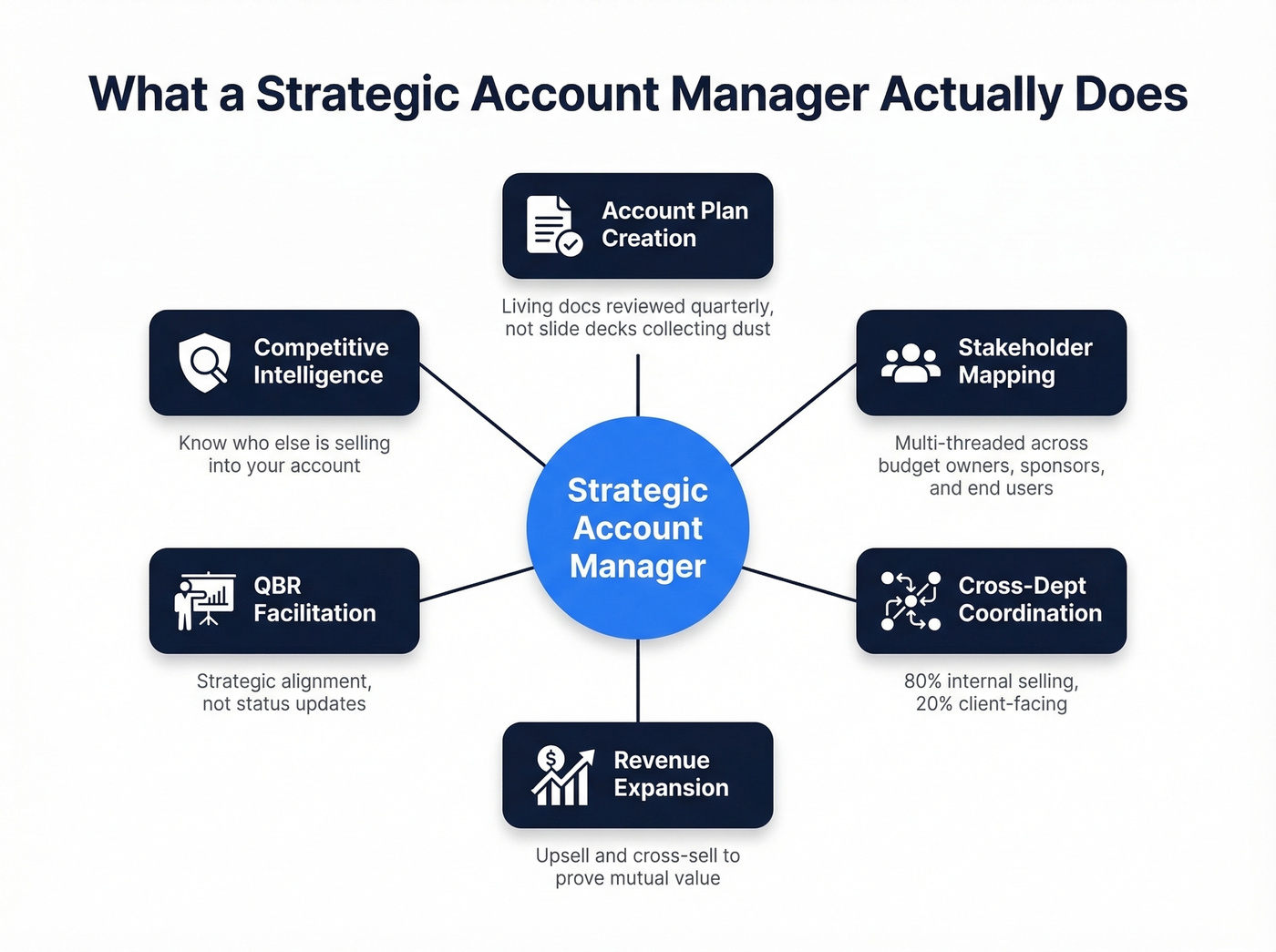
Account plan creation. Build and maintain strategic account plans with short-term objectives and long-term goals. These aren't slide decks that collect dust. They're living documents reviewed quarterly with internal stakeholders and, ideally, with the customer.
Stakeholder relationship building. Proactively map and build relationships across the client's organization. You're not just managing your champion - you're building connections with budget owners, technical evaluators, executive sponsors, and end users. Single-threaded accounts are fragile accounts.
Cross-department coordination. SAMs sit at the intersection of sales, product, customer success, and leadership. You're the one pulling engineering into a call about a custom integration or getting your VP on a plane for an executive business review.
Revenue expansion. Upsell and cross-sell aren't dirty words - they're how you prove the strategic relationship creates mutual value. Identify whitespace, propose solutions, close expansion deals. (If you need a clean definition, see cross-sell vs upsell.)
QBR facilitation. Quarterly business reviews aren't status updates. They're strategic alignment sessions where you present ROI, discuss the customer's evolving goals, and co-create the next quarter's priorities.
Competitive intelligence within accounts. Know who else is selling into your account, what they're pitching, and where your wallet share stands. If a competitor is gaining ground, you should know before your customer tells you. (Related: competitive intelligence strategy.)
Practitioners frequently describe the role as "80% internal selling, 20% client-facing." You spend more time convincing your own organization to support the account - getting engineering resources, executive attention, custom pricing - than you do talking to the customer. Expect 25-50% travel, occasional evening calls for global accounts, and the stress of knowing that a single misstep on a $2M account has board-level visibility.
The distinction that matters: a SAM isn't a glorified support rep. If you're spending your days answering tickets and forwarding feature requests, something has gone wrong.
2026 Salary Benchmarks
Salary is the #1 question people ask about this role, and the data is surprisingly rich.
Compensation Overview
Three major salary databases give us a clear picture. The variation comes from methodology - Glassdoor includes total comp while Salary.com skews toward base salary framing.
| Source | Base Pay | Total Pay | Sample Size | Last Updated |
|---|---|---|---|---|
| Glassdoor | $70K-$108K | $143K median | 4,300 salaries | 2026 |
| PayScale | $94,098 avg | $71K-$163K range | 381 profiles | 2026 |
| Salary.com | $103,541 avg | $90,802-$115,192 typical range | Not disclosed | 2026 |
PayScale breaks variable comp into useful components: bonuses run $4K-$42K, commissions $8K-$68K, and profit sharing $1K-$18K. The wide ranges reflect the reality that SAM comp structures vary wildly by industry and company stage.
Salary by Experience
The experience curve is steep. An entry-level SAM earns less than half what an expert-level SAM commands.
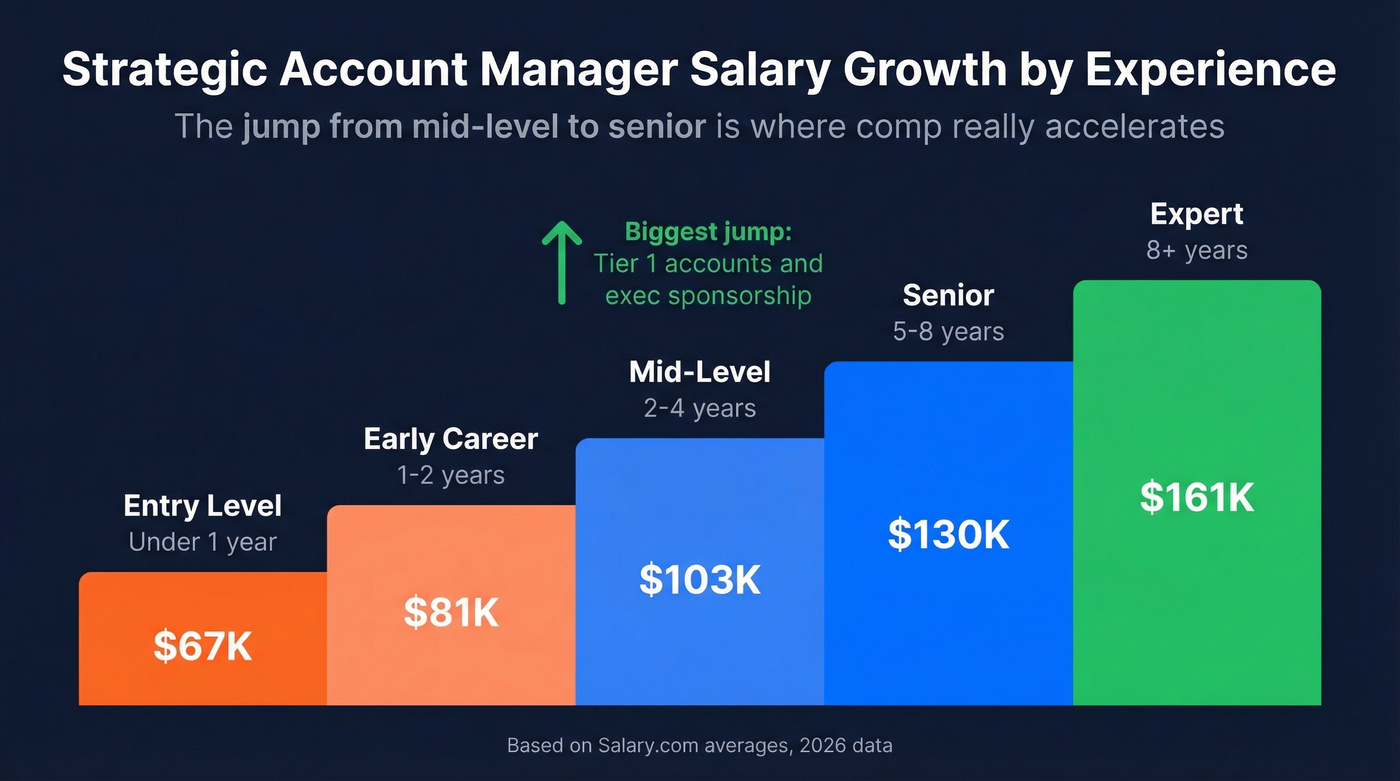
| Experience Level | Salary.com Avg | PayScale Total Comp |
|---|---|---|
| Entry (<1 year) | $67,537 | $57,621 |
| Early Career (1-2 yr) | $81,247 | - |
| Mid-Level (2-4 yr) | $102,684 | $77,269 (1-4 yr) |
| Senior (5-8 yr) | $129,604 | - |
| Expert (8+ yr) | $160,949 | - |
The jump from mid-level to senior is where comp really accelerates. That's typically when SAMs start owning Tier 1 flagship accounts and getting executive sponsorship responsibilities.
Salary by Industry
Industry selection is the single highest-leverage salary decision you can make. A pharma SAM earns 70% more than the national median - and that gap compounds over a career.
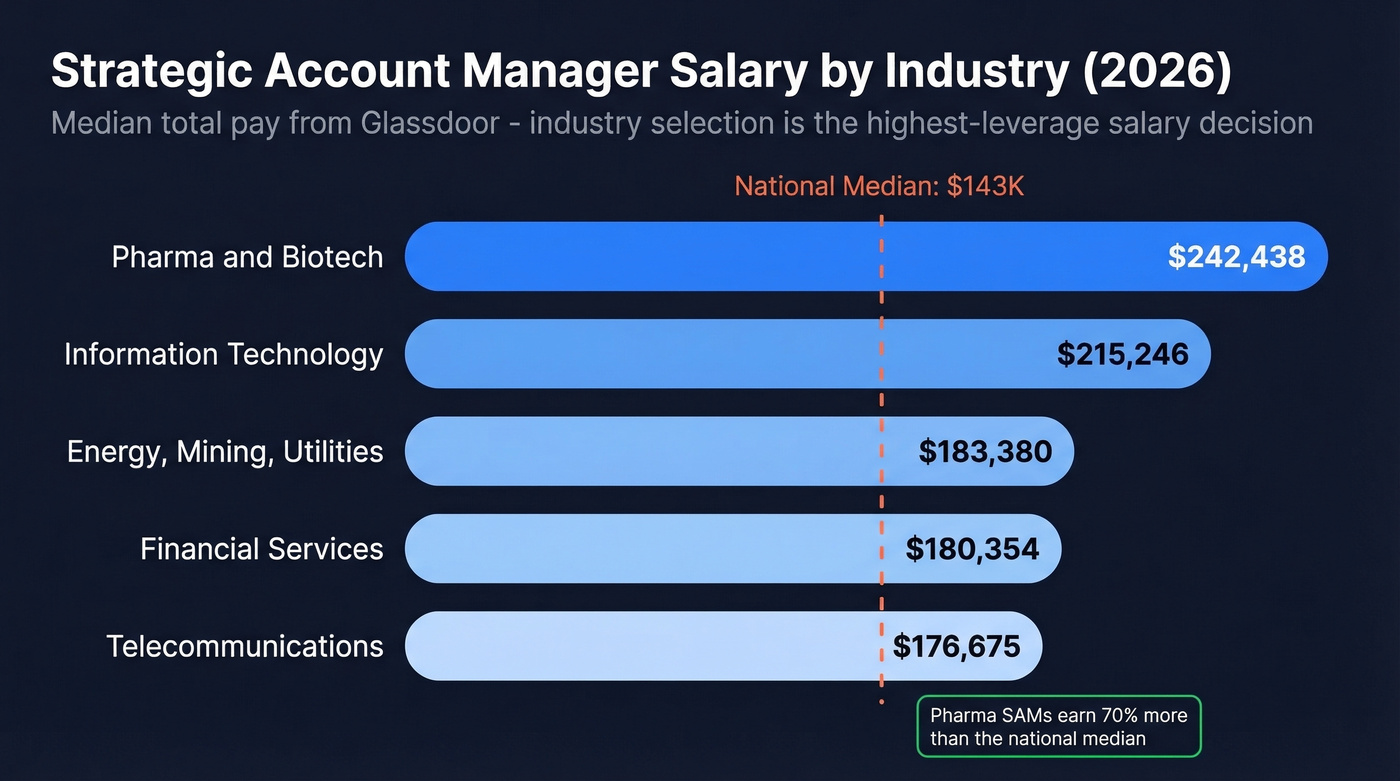
| Industry | Median Total Pay (Glassdoor) |
|---|---|
| Pharma & Biotech | $242,438 |
| Information Technology | $215,246 |
| Energy/Mining/Utilities | $183,380 |
| Financial Services | $180,354 |
| Telecommunications | $176,675 |
Look, if your average contract value is under $50K, your company probably doesn't need a dedicated SAM. They need a senior AM with a smaller book. The role only justifies its cost when individual accounts are large and complex enough to warrant the investment - think $500K+ annual contracts with multi-department buying centers. Companies that slap the "strategic" label on mid-market accounts end up with overpaid AMs who lack the enterprise complexity to actually develop SAM skills.
For ceiling context: Meta's SAM total comp ranges from $321K-$543K. Google runs $304K-$525K. Outliers, but they show what's possible.
Salary by Location
Geography still matters, even in a hybrid world.
| Location | Average Salary (Salary.com) |
|---|---|
| San Jose, CA | $130,596 |
| San Francisco, CA | $129,312 |
| New York, NY | $119,994 |
| Washington, DC | $114,641 |
| California (state) | $114,206 |
| Massachusetts (state) | $112,684 |
The Bay Area premium is ~26% over the national average. Remote SAMs based in lower-cost markets but working for Bay Area companies often get the best of both worlds - though that arbitrage is narrowing as more companies adopt location-based pay bands.

Strategic account managers live and die by stakeholder coverage. Single-threaded accounts churn. Prospeo gives you 300M+ verified profiles with 30+ filters - map every budget owner, technical evaluator, and executive sponsor across your top accounts in minutes, not weeks.
Multi-thread your strategic accounts before a competitor does.
Skills and Qualifications
| Hard Skills | Soft Skills |
|---|---|
| Account planning frameworks | C-suite communication |
| Revenue forecasting | Empathy and active listening |
| Data analysis and reporting | Organizational discipline |
| CRM and tech stack fluency | Cross-functional leadership |
| Contract negotiation | Strategic thinking |
| Competitive analysis | Conflict resolution |
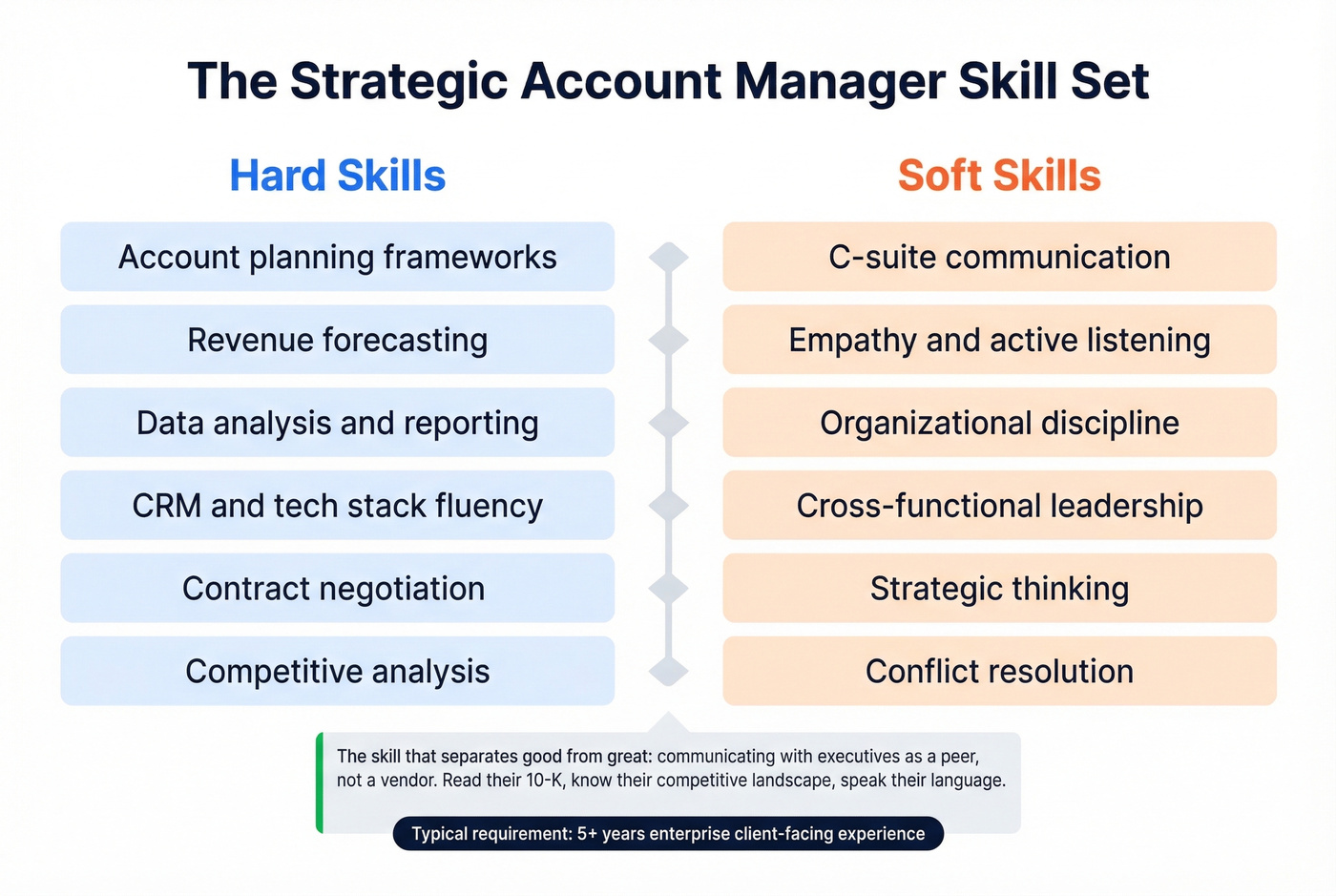
Most SAM roles require a bachelor's degree in business, marketing, or a related field - though we've seen plenty of successful SAMs who came up through sales without a traditional degree. What matters more is experience: 3-10 years in account management or enterprise sales is the typical range, with the sweet spot being 5+ years of direct client-facing work at the enterprise level.
The skill that separates good SAMs from great ones? The ability to communicate with C-suite executives as a peer, not a vendor. That means understanding their business at a strategic level - reading their 10-K, knowing their competitive landscape, and speaking their language. If you can't hold a conversation about a customer's board-level priorities, you're not ready for this role.
Career Path and Progression
The typical career ladder: Account Coordinator (0-2 years) to Account Manager (2-4 years) to Senior Account Manager (4-6 years) to Strategic/Key Account Manager (6-10 years) to Director of Strategic Accounts (10-14 years) to VP of Strategic Accounts (14+ years).
Many professionals start as a B2B account manager handling mid-market clients before graduating to the strategic tier, where account complexity and deal sizes justify the dedicated investment. These timelines compress significantly in SaaS and tech, where the fastest path to VP runs through high-growth companies that promote based on impact rather than tenure. In pharma and manufacturing, expect the progression to take longer - Cranfield's research notes that KAM programs in large organizations take years to fully mature, and career advancement follows a similar pace.
The SAMA certification is the gold standard for credentialing, though most hiring managers we've talked to value demonstrated results - revenue expansion, retention rates, executive relationships - over any certification. If you're choosing between getting certified and closing a major expansion deal, close the deal.
Key KPIs for SAMs
The KPIs that matter are fundamentally different from standard sales metrics. You're not measured on pipeline generation or cold outreach volume. You're measured on the health and growth of existing strategic relationships.
Customer Lifetime Value (CLV). The foundational metric. CLV = Customer Value x Average Customer Lifespan. Every decision you make should increase one or both of those variables. Track it quarterly, not annually.
Net Revenue Retention (NRR). The SaaS-native version of "are your accounts growing?" Top-performing SAM programs target 110-130% NRR, meaning accounts expand faster than any contraction or churn. Below 100% means you're shrinking. (If you're building a retention model, pair this with churn analysis.)
NPS / CSAT. Promoters renew. Detractors churn. Track both the score and the trend - a declining NPS in a strategic account is a leading indicator of trouble, even if revenue hasn't moved yet.
Upsell and Cross-Sell Rate. What percentage of your strategic accounts expanded in the last 12 months? In our experience, strong SAM programs see 40-60% of strategic accounts expanding annually.
Referenceable Clients. Can your strategic accounts serve as references for new business? Track social mentions, case study participation, and willingness to take reference calls. This is one of the most undervalued SAM KPIs.
Interaction Frequency. How often are you engaging with each strategic account - and at what level? Long gaps between executive touchpoints signal relationship mapping issues. Track calls, meetings, QBRs, and executive interactions separately.
Leading Indicators. Lagging indicators tell you what happened. Leading indicators - product adoption rates, support ticket trends, engagement with new features - tell you what's about to happen. The best SAMs obsess over leading indicators because they're actionable.
A good benchmark regardless of framework: logo retention above 90%, QBR completion rate above 85%, and at least one executive-level interaction per strategic account per quarter.
Best Practices and Frameworks
Account Selection and Tiering
Most organizations should maintain 10-30 strategic accounts maximum. More than that, and you're diluting the "strategic" designation into meaninglessness.
The common mistake is selecting accounts based on current revenue alone - a $500K account with no growth potential and thin margins isn't strategic, even if it's big. Selection criteria should include revenue impact, profitability, strategic fit, growth potential, and referenceability. A tiering model helps allocate resources:
- Tier 1 (Flagship): 5-10 accounts. Dedicated SAM, executive sponsor, custom account plan, monthly executive touchpoints.
- Tier 2 (Strategic): 15-25 accounts. Structured account plans, quarterly QBRs, proactive expansion motions.
- Tier 3 (High-Touch): 30-50 accounts. Lighter coverage, semi-annual reviews, reactive expansion.
Stakeholder Mapping and Multi-Threading
The most actionable stakeholder mapping framework we've used with SAM teams comes from DemandFarm. Map every relevant contact in the account by role, influence level, sentiment (champion/neutral/detractor), and budget authority. Then identify gaps. If you only know three people in a 500-person division, you're dangerously single-threaded. (For a broader view of tools, see contact management software.)
The goal is multi-threading: building relationships with 8-15 stakeholders per strategic account so that no single departure or role change puts the relationship at risk. Once you've mapped the org chart, you need verified contact data for each stakeholder - and stale CRM records are the norm, not the exception. Prospeo pulls verified emails and direct dials across 300M+ professional profiles with 98% email accuracy, which matters when bad data wastes your limited face-time with strategic accounts.
Whitespace Analysis
Whitespace analysis maps your offerings against the customer's buying centers to identify where you're engaged, where competitors are entrenched, and where nobody's selling yet. That third category - true whitespace - is where SAMs find their biggest expansion opportunities.
Build an account health score that combines quantitative signals like NRR, product adoption, and support ticket volume with qualitative ones like executive relationship strength, competitive threat level, and strategic alignment. Track competition and wallet share relentlessly. If you own 30% of a customer's spend in your category, the other 70% is your expansion target. (If you need a measurement framework, start with funnel metrics.)
Mistakes That Kill SAM Careers
B2B organizations that prioritize customer outcomes are 3x more likely to see 10%+ growth in revenue, profits, and retention. Yet most SAMs fall into the same traps. The "seven deadly sins" framework captures them well:
Being tactical instead of strategic. You become a glorified help desk - answering questions and forwarding requests instead of building account plans and identifying expansion. This is the #1 career killer, and it's insidious because reactive work feels productive.
Being reactive instead of proactive. Your inbox runs your calendar. If you're spending more than 30% of your time on reactive requests, you've lost the strategic part of your title.
Being self-centered instead of customer-centric. Internal meetings focus on your pipeline and contract renewals instead of the customer's challenges. The customer can feel this shift.
Not building account plans. You don't need fancy software to start - a structured document with goals, stakeholder maps, and expansion opportunities is enough. But flying blind on a $1M+ account is malpractice.
Using the wrong systems. CRM + Outlook + spreadsheets is a hodgepodge, not a tech stack. KAM is a business model, not a sales tactic. It needs purpose-built tools.
Not reporting value back. Customers don't perceive value unless you communicate it. If you're not showing ROI in every QBR, you're letting the relationship become a commodity.
Assuming everyone internally understands the client. Your product team doesn't know what your SAM accounts need unless you tell them. Evangelize customer context internally - it's how you get roadmap influence and executive support.
That internal evangelism is the invisible half of the role. It never shows up in job descriptions, but it's what separates SAMs who get promoted from SAMs who get stuck.
SAM Tools and Tech Stack
A CRM isn't a strategic account management tool. Salesforce and HubSpot are necessary but insufficient. Every SAM needs four things: a CRM, an account planning platform, a relationship intelligence tool, and a B2B data platform. (If you need examples, start with examples of a CRM.)
| Category | Tool | What It Does | Approximate Cost |
|---|---|---|---|
| CRM | Salesforce | Account records, pipeline | $25-$300/user/mo |
| CRM | HubSpot | Account records, pipeline | Free-$150/user/mo |
| Account Planning | DemandFarm | Plans, whitespace, health | ~$20K-$50K/yr |
| Account Planning | Kapta | Plans, QBRs, scorecards | ~$1K-$3K/mo |
| Relationship Intelligence | LinkedIn Sales Navigator | Org mapping, account alerts | ~$100-$180/user/mo |
| Stakeholder Mapping | OrgChartHub | HubSpot-native org charts | ~$50-$150/mo |
| B2B Data | Prospeo | Contact data, verification | Free tier available; ~$39+/mo |
Account planning platforms sit on top of your CRM and add the strategic layer: account health scores, whitespace analysis, stakeholder maps, and structured QBR workflows. They're not cheap, but for teams managing 10+ strategic accounts, they pay for themselves in retained revenue.
Relationship intelligence tools like Sales Navigator give you org mapping, account alerts, and relationship path suggestions. OrgChartHub adds visual org charts with role tagging and activity heatmaps for HubSpot users.
B2B data platforms solve the "I've mapped the org chart but I can't reach half these people" problem. When you need a direct email or mobile number for a VP who isn't in your CRM, you can find and verify it in seconds with tools like Prospeo - which covers 300M+ professional profiles, 143M+ verified emails, and 125M+ verified mobile numbers on a 7-day refresh cycle. (If you're comparing vendors, see data enrichment services.)
Skip the account planning platform if budget is tight. Start with Salesforce, a B2B data platform, and Sales Navigator, then layer in DemandFarm or Kapta once you've got 10+ strategic accounts that justify the spend.
Competitive intelligence inside your accounts starts with knowing who your competitors are talking to. Prospeo's 125M+ verified mobile numbers and 98% accurate emails let SAMs reach any stakeholder directly - no gatekeepers, no bounced emails burning your domain.
Protect your top 20% with direct-dial access to every decision-maker.
FAQ
What's the difference between a SAM and a customer success manager?
CSMs focus on product adoption, onboarding, and churn prevention across a broad book of business. Strategic account managers focus on revenue expansion, executive relationships, and long-term alignment with a small number of high-value accounts. In many orgs, CSMs handle the day-to-day while SAMs own the commercial relationship and account plan.
What certifications help SAMs advance?
SAMA certification is the gold standard, and Miller Heiman's Strategic Selling methodology is widely recognized. Most hiring managers value 3-5 years of enterprise account experience over any credential - results in revenue expansion and retention speak louder.
How many accounts should a SAM handle?
Ten to thirty maximum. If you've got more than 30 "strategic" accounts, none of them are truly strategic. Tier 1 flagship accounts (5-10) get the deepest investment; Tier 2 (15-25) get structured plans; Tier 3 (30-50) get high-touch but lighter coverage.
What tools do SAMs use for stakeholder mapping?
Dedicated account planning platforms like DemandFarm or Kapta, org chart tools like OrgChartHub, and B2B data platforms for finding verified contact info for mapped stakeholders. Most SAMs also use CRM relationship mapping features, though these are often limited compared to purpose-built tools.
Can strategic account managers work remotely?
Partially. Most SAMs work hybrid - remote for planning and internal work, in-person for QBRs and executive meetings. Expect 25-50% travel depending on industry. Fully remote roles exist in SaaS but are less common in pharma or manufacturing, where face-time still drives trust.