

How to Build a Strategic Sales Plan That Doesn't Get Ignored
There's a post on r/sales where a senior SDR - the only rep hitting quota - gets asked to present a 10-15 minute Q1 strategy plan. Their honest reaction? "I'll just keep doing what I've been doing." That's the problem with most strategic sales plan documents. They're management theater, built for leadership optics that reps never open again after the kickoff meeting.
This article is the opposite. Real formulas, real benchmarks, and a framework that connects your revenue target to what you do on Tuesday morning. Whether you're developing a sales strategy for the first time or overhauling one that stopped working, the process starts with math - not slides.
The Quick Version
- Audit your baseline numbers first - not your goals. You can't plan what you can't measure.
- Work backward from revenue to daily activity with real math. $3.2M ARR / $18K average deal = 178 closed deals. Now figure out how many demos that requires.
- Pick one qualification framework (BANT, MEDDIC, or SPICED) and embed it in your CRM. Not all three. One.
- Verify your contact data. Pipeline coverage targets are fiction if 35% of your emails bounce.
- Review monthly, not annually. Teams with structured review cadences are 4x more likely to hit objectives.
The rest of this article puts muscle on that skeleton.
What a Strategic Sales Plan Actually Is
The terminology gets used interchangeably, and it shouldn't. Here's the distinction that matters:
Sales strategy = the what and who. What you sell, who you sell to, how you position against competitors. Sales methodology = the how. MEDDIC, Challenger, Sandler - the conversational framework your reps use in deals. Sales plan = the operational document connecting both to targets, timelines, territories, and KPIs.
A strategic sales plan goes further. It connects revenue targets to daily activities with real-time visibility into whether you're on track. It's not a slide deck. It's a living system.
Organizations with strategic plans predict quarterly revenue with 85% greater accuracy and see 30% productivity improvements within the first year. Teams that plan with math outperform teams that plan with vibes. Every time.
Why Most Sales Plans Fail
Most sales plans fail before anyone opens a spreadsheet.
They're performative. The consensus on r/sales is blunt: territory plans and quarterly strategies often exist to make your boss look good in front of their boss. Reps see through this immediately. If the plan doesn't change what a rep does on Monday morning, it's decoration.
They're incremental. The classic strategic planning pitfall is anchoring to last year's numbers and adding 15%. That's not strategy - it's arithmetic. Real planning starts with marketplace needs, the jobs your buyers are actually trying to get done, and works backward. Sales strategy development demands that you challenge assumptions, not recycle them.
They ignore data quality. This is the silent killer. You build a plan requiring 3x pipeline coverage. Reps start prospecting. Then 35-40% of emails bounce because your contact database hasn't been refreshed in months. Snyk's 50 AEs lived this exact scenario - their AE-sourced pipeline was crippled by bad data until they fixed the foundation, dropping bounce rates from 35-40% to under 5% and increasing AE-sourced pipeline by 180%. Your 3x coverage is actually 2x if a third of your contacts are dead.

They target the wrong accounts. Only [5% of B2B accounts are actively buying](https://www.swordandthescript.com/2024/04/5-percent-b2b-buyers/) at any given time. If your plan treats every account equally, your reps are spending 95% of their effort on companies that aren't ready. Account tiering isn't optional - it's the difference between a plan that works and one that exhausts your team.

Your strategic sales plan says 593 demos. But pipeline coverage targets are fiction when a third of your emails bounce. Prospeo's 98% email accuracy and 7-day data refresh mean your activity math actually holds - just like Snyk's 50 AEs who dropped bounce rates from 35% to under 5% and grew AE-sourced pipeline 180%.
Build your plan on data that connects, not contacts that bounce.
How to Develop a Sales Strategy in 7 Steps
Step 1 - Audit Your Baseline
Before you touch a revenue goal, pull these numbers from your CRM:
- Win rate - opportunities closed-won divided by total opportunities
- Average deal size - total revenue divided by deals closed
- Sales cycle length - average days from opportunity creation to close
- Pipeline coverage ratio - total pipeline value divided by quota
- Email bounce rate - bounced emails divided by total sent in prospecting sequences
That last one surprises people. Bounce rate isn't a marketing metric - it's a planning metric. If your bounce rate is above 10%, every activity target downstream is inflated. We've seen teams skip this audit and end up revising their entire plan by Q2.
Pull 90 days of data minimum. If your CRM is messy, pull 180 days and clean the outliers. This audit takes a few hours. Skip it, and you're building on sand.
Step 2 - Set Revenue Goals With Real Math
Most plans set a revenue target and stop. A plan that actually works goes backward from that target to daily activity.
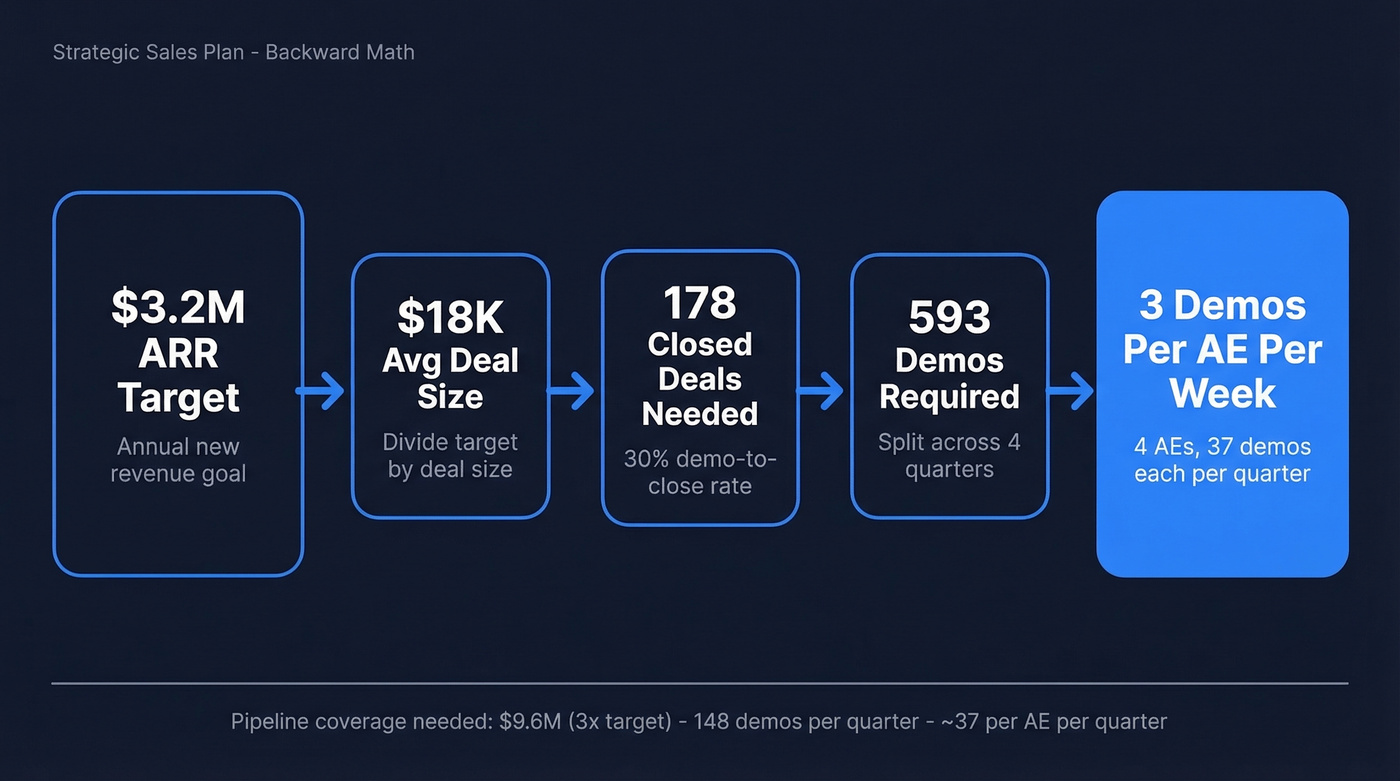
Say your target is $3.2M in new ARR for the year. Your average deal size is $18K. That means you need:
- $3,200,000 / $18,000 = 178 closed deals
- At a 30% demo-to-close rate: 178 / 0.30 = ~593 demos
- At 3x pipeline coverage: $3.2M x 3 = $9.6M in qualified pipeline
Now you have a number that means something. 593 demos across your team, spread across four quarters, broken down by rep. That's roughly 148 demos per quarter. With four AEs, each one needs about 37 demos per quarter - roughly 3 per week.
Suddenly the plan isn't abstract. It's "each AE needs 3 qualified demos per week." That's what a real operational plan looks like.
Step 3 - Define Your ICP and Tier Accounts
Not every account deserves the same effort. Companies with structured account planning see 28% faster sales cycles and 35% higher close rates - yet fewer than 20% of companies have fully embedded account planning into operations. That gap is your competitive advantage.
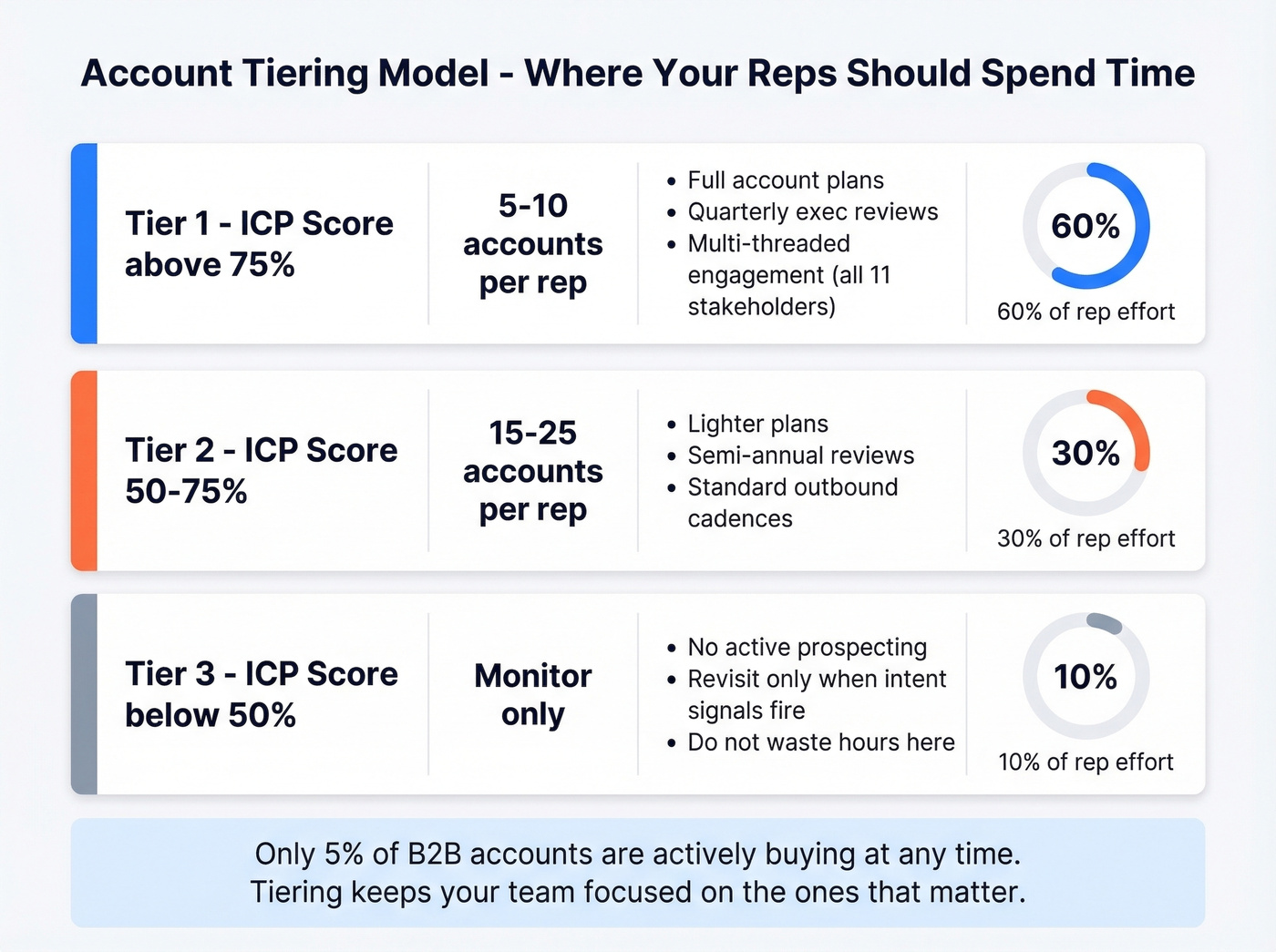
Score each account against your ideal customer profile: industry fit, company size, tech stack, growth signals, budget indicators. Then tier based on score:
- Tier 1 (score >75%): 5-10 accounts per rep. Full account plans, quarterly executive reviews, multi-threaded engagement.
- Tier 2 (score 50-75%): 15-25 accounts per rep. Lighter plans, semi-annual reviews, standard outbound cadences.
- Tier 3 (score <50%): Monitor only. Don't waste prospecting hours here unless intent signals change.
This tiering matters because the average B2B deal now involves 11 stakeholders. You can't multi-thread 50 accounts. You can multi-thread 8. Focus your reps' energy where the math supports it.
Step 4 - Choose a Qualification Framework
Pick one framework and embed it in your CRM. Not three. Not a "blended approach" that nobody follows. One framework, with specific fields reps fill out on every opportunity.
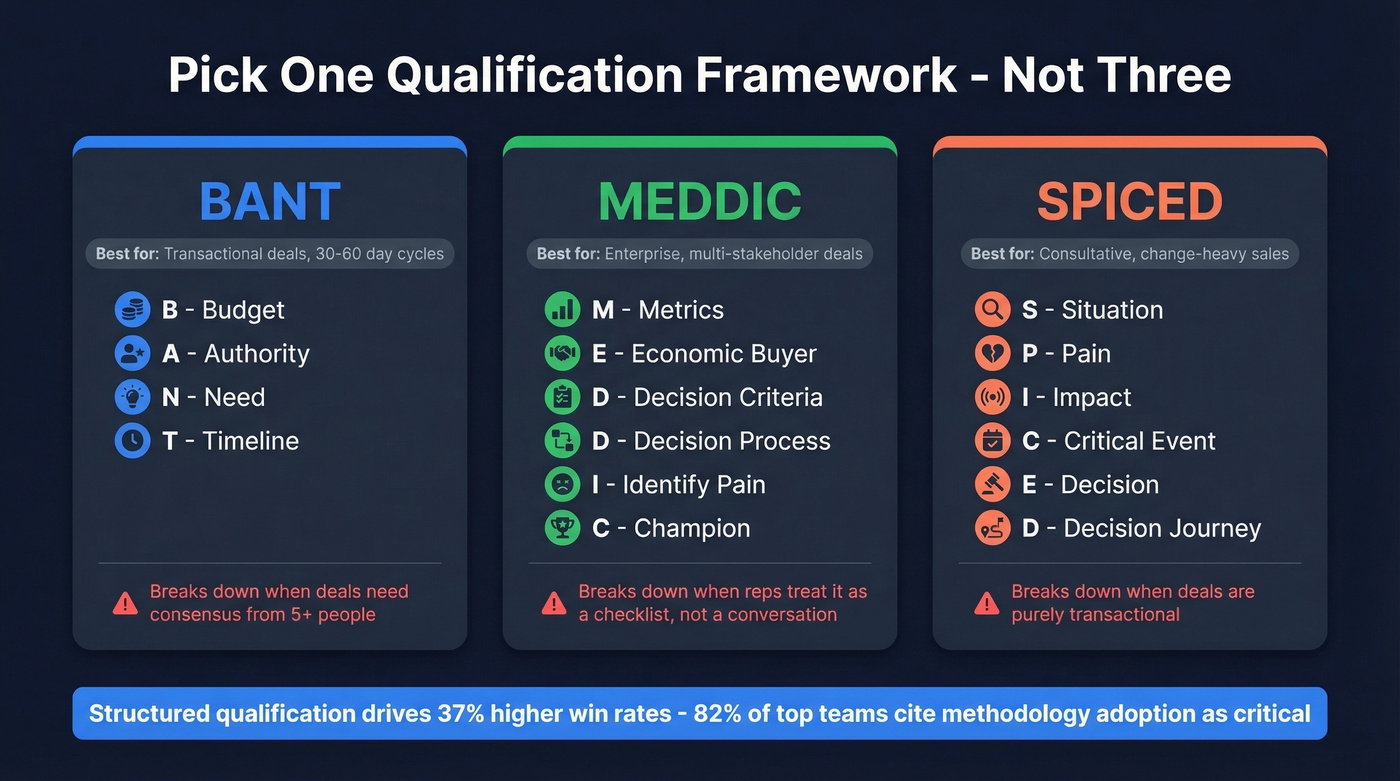
| BANT | MEDDIC | SPICED | |
|---|---|---|---|
| Best for | Transactional, 30-60 day cycles | Enterprise, multi-stakeholder | Consultative, change-heavy |
| Key questions | Budget? Authority? Need? Timeline? | Metrics? Economic buyer? Decision criteria? Champion? | Situation? Pain? Impact? Critical event? Decision? |
| CRM fields | Budget, decision maker, timeline | Metrics, buyer roles, criteria, process, champion | Stack, pain, quantified upside, critical event, journey |
| Breaks down when | Deals need consensus from 5+ people | Reps treat it as a checklist, not a conversation | Deals are purely transactional |
The framework matters less than the consistency. Structured qualification frameworks drive a 37% increase in win rates, and 82% of high-performing sales teams cite methodology adoption as a critical success factor.
For a practical hybrid, use BANT as a quick filter to qualify in or out, SPICED for discovery, and MEDDIC for navigating enterprise approvals. But start with one. You can layer complexity later.
Step 5 - Map Your Process and Plan Capacity
With your revenue math, account tiers, and qualification framework set, map the actual sales process stage by stage and calculate capacity.
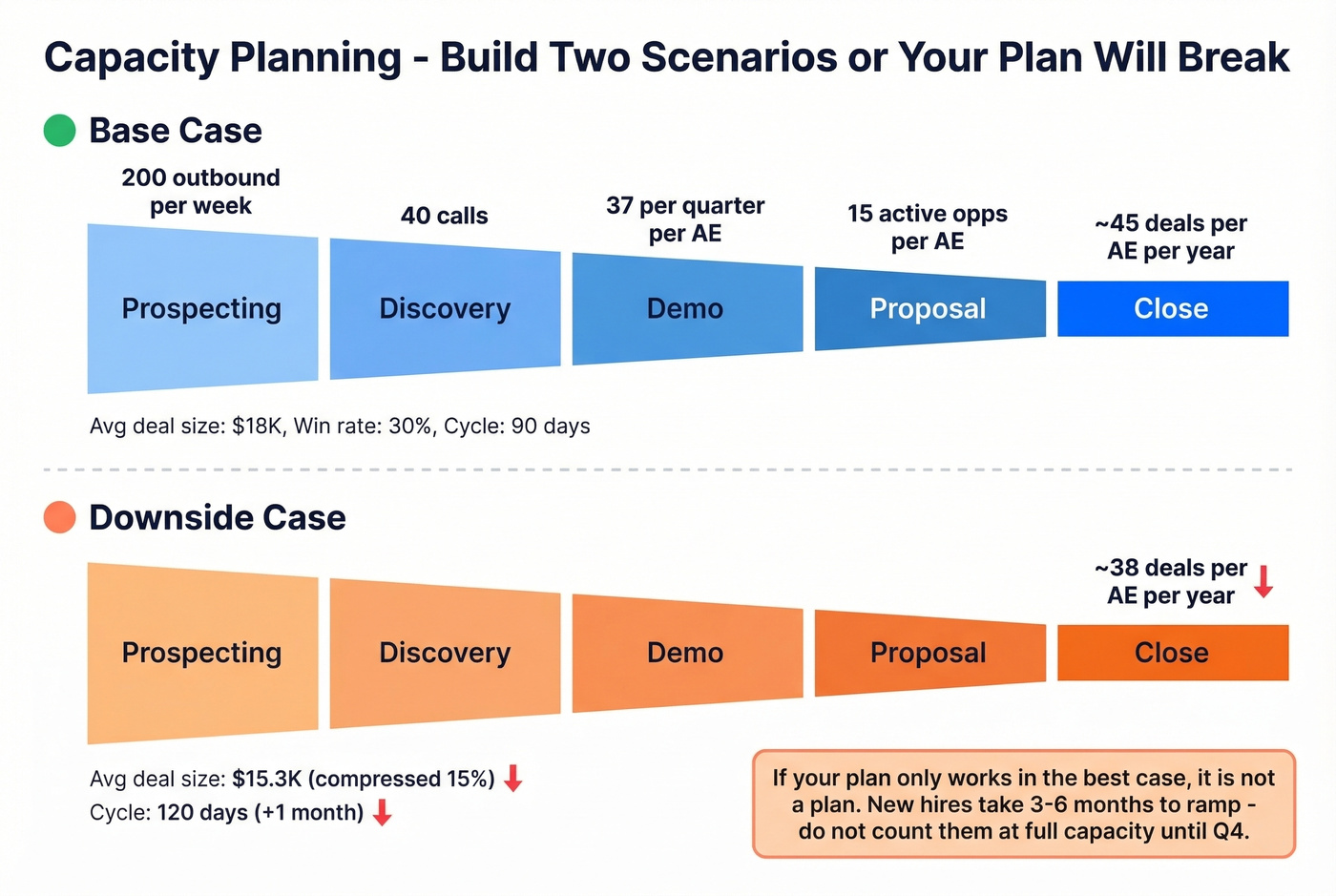
Take your demo target - say, 37 per quarter per AE - then add time for discovery calls, proposals, negotiations, and internal meetings. A typical AE can manage 15-25 active opportunities simultaneously. If your math requires 40, you need more headcount or a longer timeline.
Don't forget ramp. New hires take 3-6 months to reach full productivity. If you're planning to hire two AEs in Q2, don't count them at full capacity until Q4.
Build at least two scenarios - a base case and a downside case where deal sizes compress 15-20% or cycles extend by a month. If your plan only works in the best case, it's not a plan. With 11 stakeholders per B2B deal, enterprise cycles eat more rep time than SMB cycles, so build that into your capacity model or you'll blow past your headcount budget by Q3. The point is to make the plan physically possible, not just clean on paper.
Step 6 - Build Your Data Foundation
Here's the thing: your pipeline coverage target is only as good as your contact data. This is where most plans quietly fall apart.
B2B contact databases decay at roughly 30% per year. People change jobs, companies get acquired, email domains rotate. If you built your prospecting lists six months ago and haven't refreshed them, a significant chunk of your outreach is hitting dead addresses. We've watched teams set aggressive prospecting goals only to realize half their outreach never lands.

Verification isn't optional - it's a planning requirement. Prospeo handles this at the foundation level with 300M+ professional profiles at 98% email accuracy, refreshed on a 7-day cycle. It also includes intent data tracking 15,000 topics, so you can prioritize accounts showing active buying signals and tie it directly back to the tiering model from Step 3. Instead of blasting your entire Tier 2 list, you focus on accounts actually in-market right now. Define your ICP filters, layer in intent signals, export verified contacts, and push them into your sequencer. Your pipeline math stays honest because the data underneath it is real.
If you want to go deeper on list hygiene, start with email bounce rate benchmarks and fixes, then tighten your stack with an email deliverability guide so your sequences land.
Account tiering only works if you can actually reach Tier 1 decision-makers. Prospeo gives you 30+ filters - buyer intent, technographics, headcount growth, funding - to score and prioritize accounts, then delivers verified emails and direct dials to multi-thread the ones that matter. At $0.01 per email, your plan stays on budget too.
Stop prospecting blind. Layer intent data on every account in your plan.
Step 7 - Set KPIs and Review Monthly
A plan that lives in a slide deck isn't a plan. It needs to live in your CRM - Salesforce, HubSpot, whatever your team uses - with dashboards that show leading indicators, not just lagging results.
Track pipeline coverage ratio and quota attainment pace weekly, since these are your earliest warning signals. Monthly, review win rate by stage, average deal size (watch for compression), sales cycle length by segment, and bounce rate - your data quality canary. Layer in activity metrics like demos booked and discovery calls completed to connect inputs to outcomes.
If you need a tighter measurement layer, use a pipeline health dashboard and compare against sales pipeline benchmarks so you know whether you're ahead or behind.
Review cadence: monthly adjustments to activity targets and territory focus. Quarterly deep reviews of strategy, ICP fit, and framework effectiveness. Annual overhaul of the full plan. Organizations with structured planning predict revenue with 85% greater accuracy - and they catch problems in February instead of discovering them in the Q4 fire drill.
Sales Plan KPI Benchmarks for 2026
Benchmarks give your plan guardrails. Without them, you're guessing whether a 25% win rate is good or terrible. It depends on your segment.
| KPI | SMB | Mid-Market | Enterprise |
|---|---|---|---|
| Pipeline coverage | 3x | 3.5x | 4-5x |
| Lead-to-customer | 3-5% | 2-4% | 1-3% |
| Avg sales cycle | 30-45 days | 45-90 days | 90-180+ days |
| CAC target | Under $500 | $500-2,000 | $2,000-10,000+ |
| Lead response time | Under 5 min | Under 5 min | Under 5 min |
The uncomfortable reality: up to 70% of B2B reps missed quota in 2024. The typical B2B lead-to-customer conversion rate sits at 2-5%. These aren't aspirational numbers - they're the baseline you're planning against.
If you want a dedicated reference point for conversion math, use the average B2B lead conversion rate benchmarks and then pressure-test your funnel with funnel metrics.
By 2026, an estimated 65% of B2B sales organizations are running data-driven strategies. If your plan is still built on gut instinct and last year's numbers plus 15%, you're already behind.
Let's be honest: if your average deal closes under $10K, you probably don't need a 47-slide strategy deck. You need a one-page doc with your revenue math, your ICP, and your weekly activity targets. Complexity is a luxury for teams selling six-figure deals with nine-month cycles. Everyone else should optimize for speed and iteration.
Templates That Actually Work
You don't need 13 templates. You need one plan you'll actually use.
Annual Sales Plan
Revenue target broken down by quarter and by rep, previous year performance, ICP definition with scoring criteria, territory assignments with account tiers, qualification framework and CRM field requirements, hiring plan with ramp assumptions, KPI targets with monthly review dates, and budget for tools, headcount, events, and content. Using the worked example from Step 2: $3.2M ARR target, $18K average deal, 178 deals needed, 593 demos required, $9.6M pipeline target. Fill in your own numbers and the plan writes itself.
30-60-90 Day Plan
Days 1-30: audit baseline metrics, map existing pipeline, learn qualification framework, shadow top performer. Days 31-60: build Tier 1 account plans, launch first outbound sequences, hit 50% of weekly activity targets. Days 61-90: full activity cadence, first closed deals, refine ICP based on early wins and losses. The CaptivateIQ templates offer copy-ready versions if you want a head start.
If you're building this for new hires, use a full 30-60-90 day plan for sales reps and plug your Step 2 activity math into it.
Territory Plan
Named accounts by tier with ICP scores, whitespace analysis for departments not yet penetrated, competitive landscape showing who's installed and where you win or lose, quarterly pipeline targets by account tier, and a multi-threading map covering contacts per account and roles covered. Smartsheet offers 15+ free sales planning templates in Excel and Word - they're dated but the structures are solid. Adapt them to your CRM rather than using them as standalone spreadsheets.
The r/sales consensus matches what our team has seen firsthand: format doesn't matter, consistency does. A messy Google Doc that gets reviewed every month beats a beautiful Notion template nobody opens after January.
FAQ
How often should you update a strategic sales plan?
Monthly adjustments to activity targets and territory focus, quarterly deep reviews of strategy and ICP fit, and a full annual overhaul. The biggest mistake is treating the plan as a January exercise - markets shift, reps ramp, and deals slip. Monthly check-ins catch drift before it compounds.
What's the difference between a sales plan and a sales strategy?
A sales strategy defines what you sell and to whom - your positioning, target market, and competitive differentiation. A sales plan is the operational document with targets, timelines, territories, and KPIs that executes the strategy. You need both, but the plan is where accountability lives.
What KPIs belong in a sales plan?
Pipeline coverage, quota attainment, win rate, average deal size, sales cycle length, CAC, and bounce rate. Most plans skip bounce rate, but it directly impacts whether your pipeline numbers are real. With up to 70% of B2B reps missing quota, tracking leading indicators separates plans that course-correct from plans that crash in Q4.
How do you build a sales strategy from scratch?
Start with Step 1: audit your current numbers - win rate, average deal size, and sales cycle length from your CRM. Work backward from your revenue target to daily activity using the math in Step 2. Pick one qualification framework and add the fields to your CRM. Verify your contact data before setting pipeline targets so your pipeline math stays honest. The seven steps above walk you through the full process from baseline audit to monthly review cadence.