

Third-Party Data Providers: What They Are, What They Cost, and How to Choose One
Contact data decays at 2-3% per month. Roughly 30% of any database needs cleansing every year. If you're buying from a third-party data provider, you're paying for that rot unless you pick the right vendor.
These providers split into two worlds: AdTech audience segments (cookie and MAID-based, sold on a CPM basis) and B2B contact databases (person-level records with emails, phones, and firmographics). B2B buyers should evaluate on accuracy, freshness, and pricing transparency. Programmatic buyers should evaluate on segment taxonomy, compliance posture, and CPM ranges. We've spent years testing both sides, and the evaluation criteria are more different than most guides admit.
What Is a Third-Party Data Provider?
First-party data comes from your own audience. Second-party data is someone else's first-party data shared through a partnership. Third-party data is collected by an external company and sold or licensed to you - you have no direct relationship with the people in the dataset.
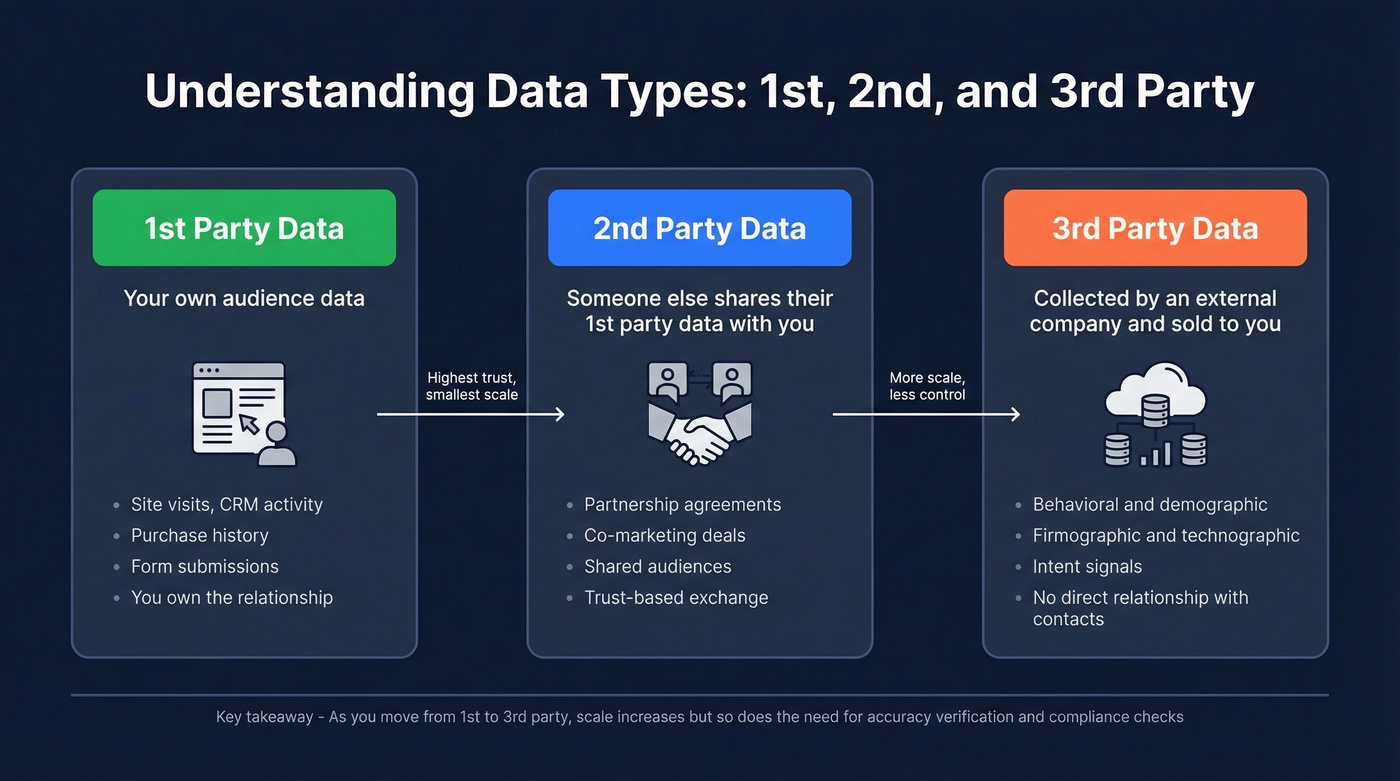
The data spans several categories: behavioral (web activity), demographic (job title, seniority), firmographic (company size, revenue), technographic (tech stack signals), and intent (topic-level research activity). Most providers specialize in one or two. The ones worth your time are transparent about sourcing and refresh frequency.
AdTech vs. B2B: Two Different Worlds
Most guides conflate these categories, and it creates real confusion. On the AdTech side, you're buying audience segments - cookie-based or MAID-based clusters sold at CPM rates through platforms like Datarade or directly from providers like Lotame and OnAudience. Practitioners think in terms of PMP partners (Audigent, Peer39, Seedtag, Wunderkind, Activision) rather than classic "data brokers."
If you're a sales or RevOps leader, the B2B sections below are where you should focus.
The Privacy Shift You Can't Ignore
Safari and Firefox block cross-site tracking by default. Chrome moved to a user-choice model instead of a full cookie phase-out, but the damage is done. Consent banners cause roughly 25% information loss, and ad blockers strip out another ~25%.
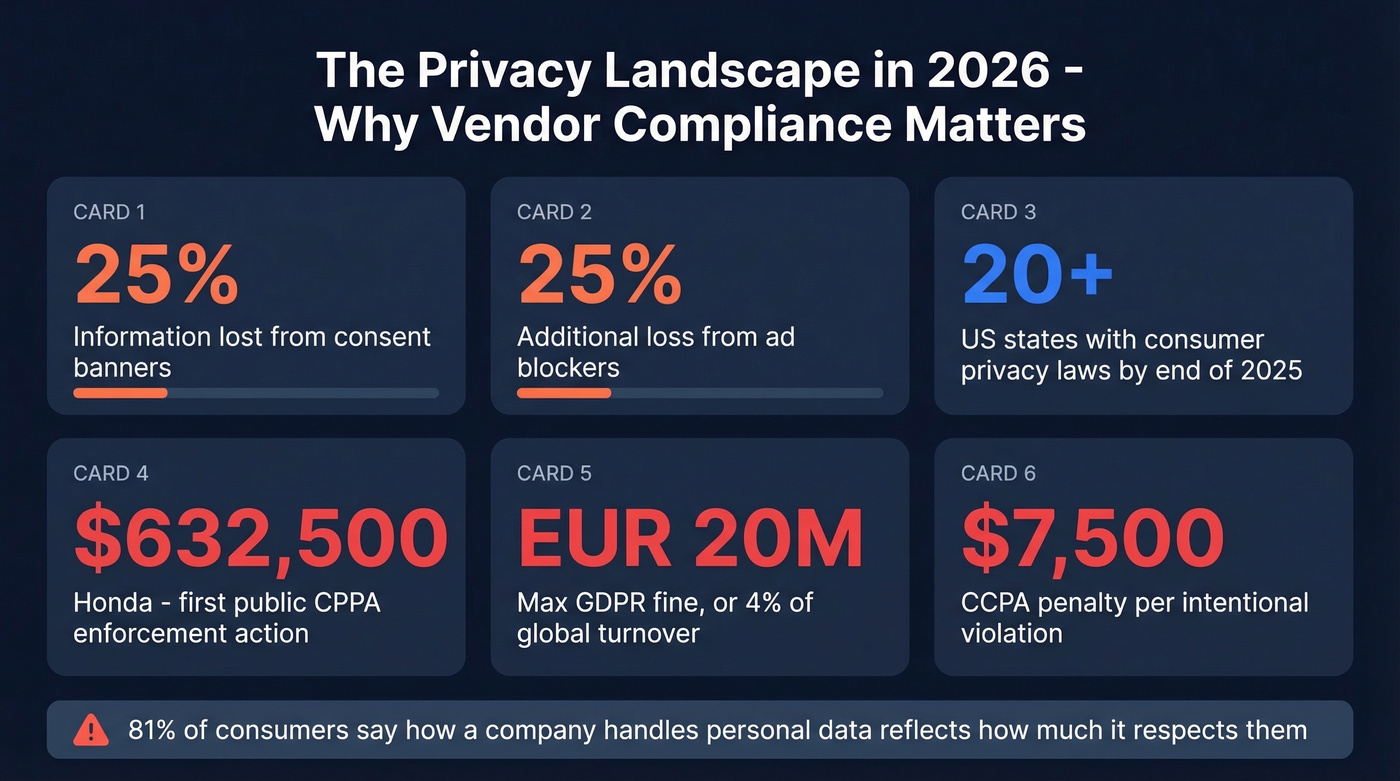
Enforcement has teeth. Honda paid $632,500 in the [first public CPPA enforcement action](https://cppa.ca.gov/announcements/2025/20250312.html). Tractor Supply settled for $1.35M over inadequate notices. By the end of 2025, 20 states had consumer privacy laws on the books. GDPR fines reach EUR 20M or 4% of global turnover; CCPA penalties hit $7,500 per intentional violation.
Here's the thing: if your vendor can't show documented compliance, you're inheriting their risk. And 81% of consumers say how a company handles personal data reflects how much it respects them.

You just read that contact data decays 2-3% per month. Prospeo's 7-day refresh cycle means you're never sending to stale records - while most providers let data rot for 6 weeks. With 98% email accuracy and 5-step verification that catches spam traps and honeypots, your bake-off results will speak for themselves.
Run your 500-record benchmark against Prospeo. The data does the talking.
How to Evaluate a Data Provider
Vendor demos always look great. The real test is running their data against records you already know are accurate.
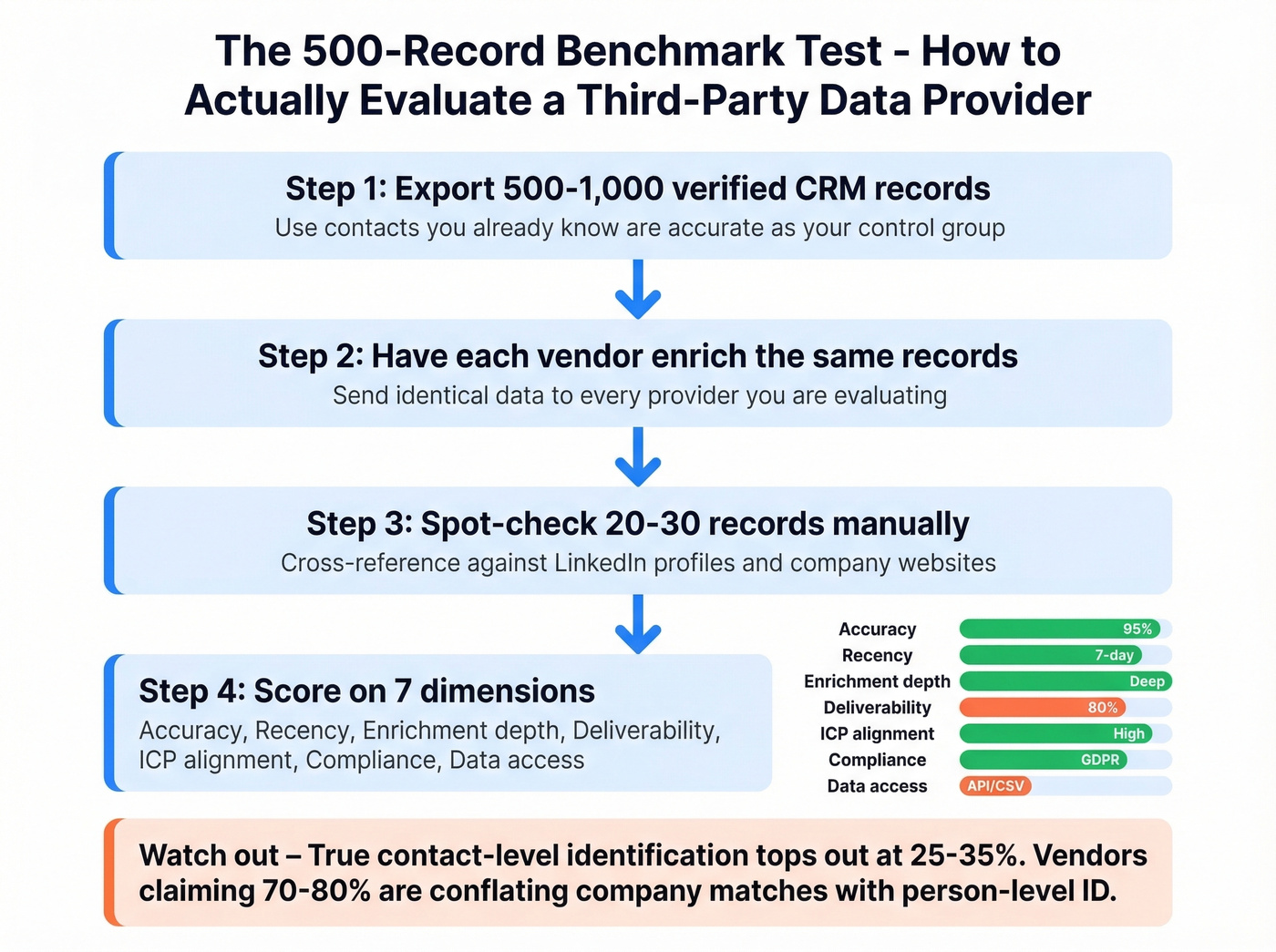
The Cognism evaluation framework nails this: export 500-1,000 verified CRM records, have the vendor enrich them, then spot-check 20-30 against professional profiles manually. We've used this method ourselves, and it catches accuracy gaps that demos never reveal. One vendor we tested showed 94% match rates in their demo but dropped to 71% on our own CRM data - a gap that would've cost us thousands in wasted outreach.
Score every provider on these dimensions:
- Accuracy - What percentage of emails are deliverable? What's the phone connect rate? (If you're comparing verifiers, see email accuracy benchmarks.)
- Recency - How often is data refreshed? A 7-day cycle beats a 6-week cycle every time.
- Enrichment depth - How many data points per record? (Compare data enrichment services if you’re layering vendors.)
- Deliverability - Verified emails vs. "we think this is right" emails. (Tie this to your email deliverability work.)
- ICP alignment - Does the provider cover your target market? Use an ideal customer profile scorecard.
- Compliance - GDPR documentation, DPAs, opt-out enforcement.
- Data access - API, warehouse sync, or UI-only export?
Watch out for inflated match rates. True contact-level identification tops out around 25-35%. Vendors claiming 70-80% are conflating IP-based company matches with person-level identification. That's not the same thing, and you shouldn't pay as if it were.
What Third-Party Data Costs in 2026
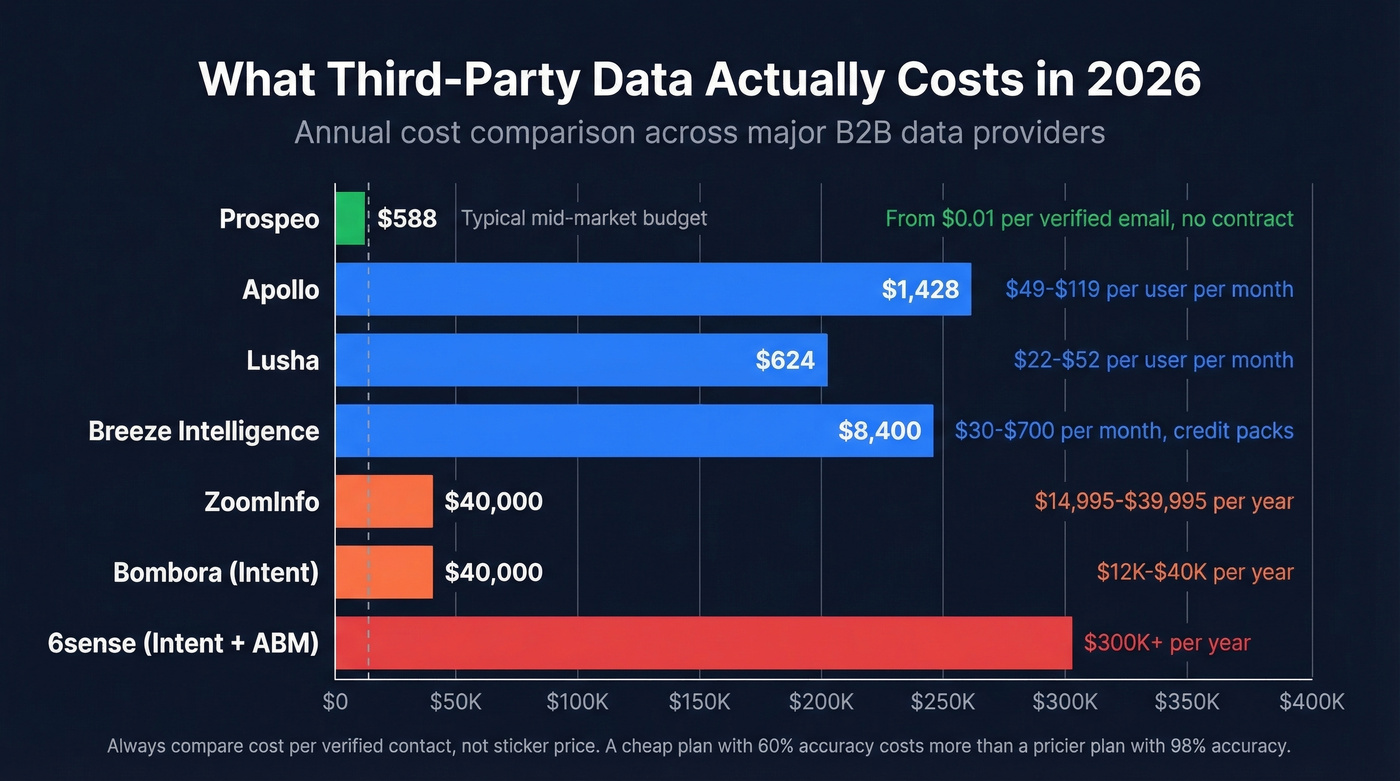
We've seen teams overpay by 10x because they didn't benchmark cost-per-verified-contact before signing. Here's what the market actually charges:
| Category | Provider | Price Range |
|---|---|---|
| Audience segments | Standard CPM | $1-$5 CPM |
| Audience segments | Rare/niche CPM | Up to $20 CPM |
| B2B contacts | Apollo | $49-$119/user/mo |
| B2B contacts | Lusha | $22-$52/user/mo |
| B2B contacts | Breeze Intelligence | $30-$700/mo (credit packs) |
| B2B contacts | ZoomInfo | ~$14,995-$39,995/yr |
| Intent data | Bombora | $12K-$40K/yr |
| Intent data | 6sense | $300K+/yr |
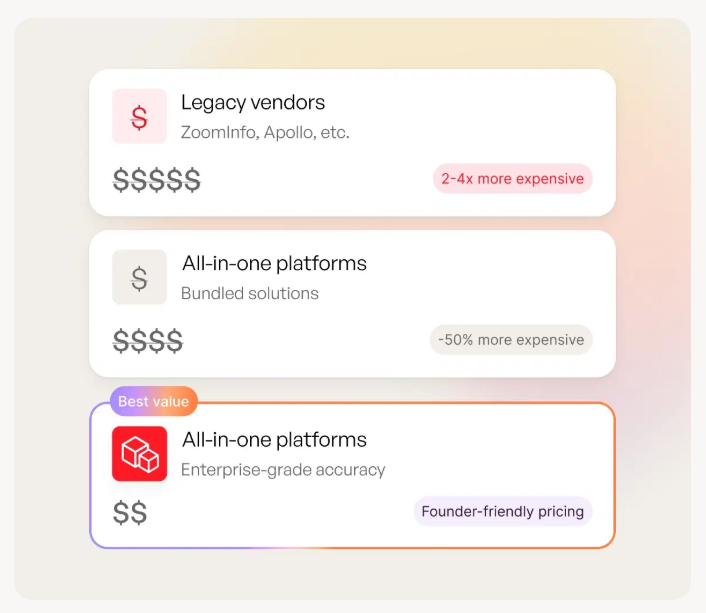
The spread is enormous. ZoomInfo typically runs ~$14,995-$39,995/year depending on tier. Apollo charges $49-$119/user/month with a free plan. Lusha sits in the middle at $22-$52/user/month. Breeze Intelligence (formerly Clearbit) offers credit packs from $30 to $700/month.
For programmatic audience data, expect $1-$5 CPM for standard segments, scaling up to $20 for niche audiences. Intent data is its own budget line - Bombora runs $12K-$40K/year, and enterprise ABM platforms like 6sense can exceed $300K annually. If you’re shopping broadly, compare sales prospecting databases and B2B company data providers side-by-side.
Choosing the Right Provider
Let's be honest - picking a vendor comes down to your use case, not a feature matrix. AdTech teams should prioritize segment taxonomy breadth and CPM efficiency. B2B teams should obsess over email deliverability, phone connect rates, and refresh cadence. In both cases, demand a trial or pilot before committing to an annual contract. Any provider confident in their data quality will agree to one. If they won't, that tells you something.
Run the 500-record benchmark test. Compare cost-per-verified-contact, not sticker price. And make sure your vendor's compliance posture won't become your legal problem six months from now. If your plan includes outbound, align the data decision with your sales prospecting techniques and cold email marketing motion.
Tired of inflated match rates and opaque pricing from third-party data providers? Prospeo delivers 92% API match rates on real CRM data, charges ~$0.01 per verified email, and requires zero contracts. 15,000+ companies already made the switch - and teams book 26% more meetings than with ZoomInfo.
Stop overpaying 10x for data that bounces. Start with 75 free emails today.
FAQ
What's the difference between first-party and third-party data?
First-party data is what you collect directly - site visits, CRM activity, purchases. Third-party data is collected by an outside company and licensed to you. Because you have no direct relationship with those contacts, accuracy verification and compliance documentation matter far more before you sign anything.
Are third-party data providers GDPR compliant?
Some are, many aren't - always verify before signing. Demand documented GDPR compliance, data processing agreements, and opt-out enforcement. GDPR fines reach EUR 20M or 4% of global turnover; CCPA penalties hit $7,500 per intentional violation. Prospeo is fully GDPR compliant with DPAs available and opt-outs enforced globally.
How do I benchmark email accuracy across vendors?
Run the known-data test: export 500-1,000 verified CRM records, have each vendor enrich them, then spot-check results manually. A 7-day refresh cycle matters as much as initial accuracy - data decaying at 2-3% per month means a slow refresh schedule erodes even great starting numbers. Top-tier providers hit 95%+ deliverability.
What's a good free or low-cost B2B data provider?
Prospeo offers 75 free email credits and 100 Chrome extension credits per month with no contract required - enough for small teams running real outbound campaigns. Apollo also has a limited free plan. For most teams, a credit-based model at ~$0.01/email beats a locked-in annual subscription every time.