

Third Party Data Providers: 2026 Buyer's Guide
Your SDR team ran a 10,000-contact outbound campaign last quarter and 30% bounced. That's 3,000 wasted touches, a damaged sender domain, and a sequence tool billing you for emails that never arrived. Third party data providers are the backbone of modern sales and marketing - but most buyers don't know how to evaluate them, what they should cost, or which category they actually need.
This is the buyer's operating manual your current vendor doesn't want you to have.
What Is Third-Party Data?
Third-party data is information collected by a company that has no direct relationship with the people in the dataset. They source it, aggregate it, and license it to you.
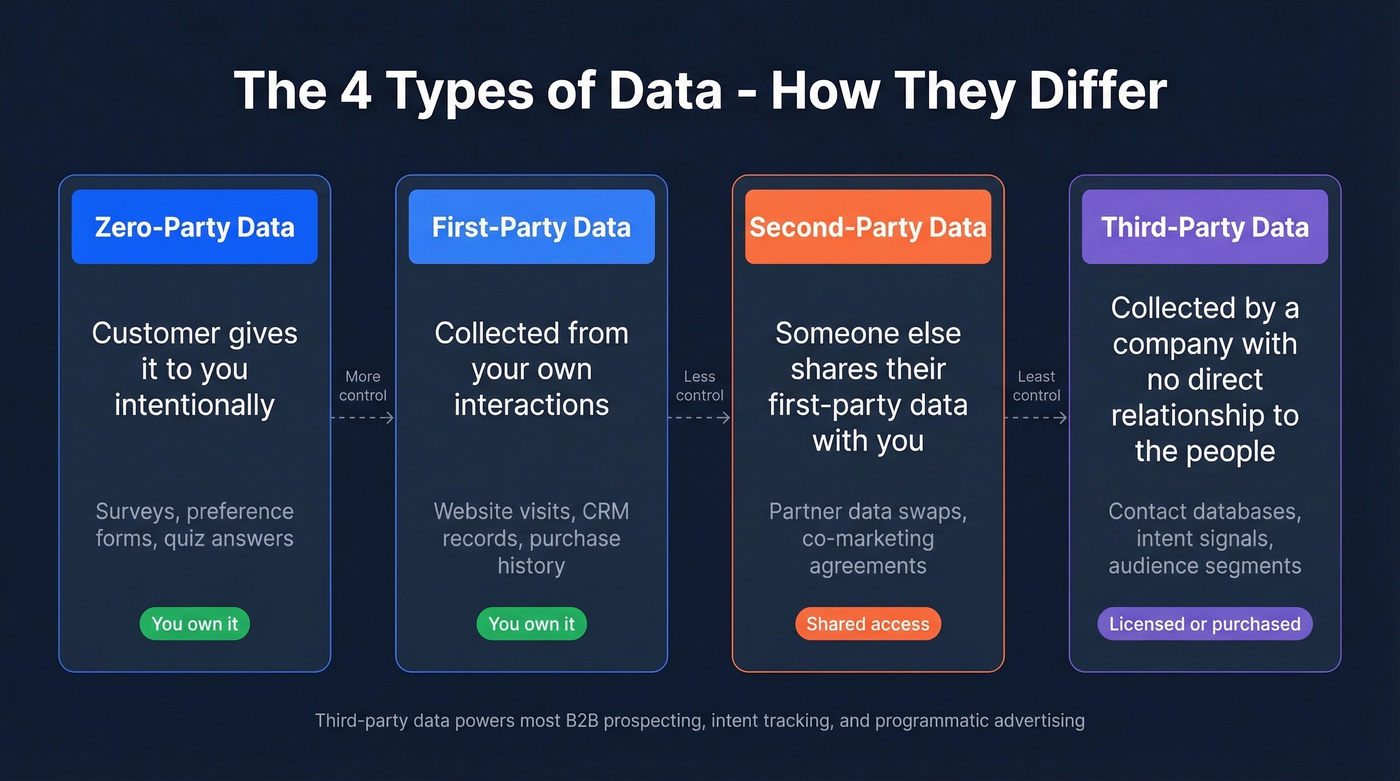
First-party data comes from your own interactions - website visits, CRM records, purchase history. Second-party data is someone else's first-party data, shared through a partnership. Zero-party data is what customers intentionally hand you, like survey responses or preference forms. Third-party data is everything collected and sold by an external provider.
Most guides treat "third-party data" as synonymous with adtech audience segments. It's not. The category spans B2B contact databases (ZoomInfo, Apollo), intent signals (Bombora, 6sense), technographic data (BuiltWith), location data (Foursquare), audience activation infrastructure (LiveRamp), and DMP platforms (Lotame). The IAB/Winterberry Group estimated marketers would spend $19.2B on third-party audience data plus related solutions back in 2018, and that number has grown well beyond it, even as cookies eroded underneath.
What Changed in 2026
Google reversed its plan to kill third-party cookies. That headline made some marketers exhale. They shouldn't have.
Google moved to a user-choice model - a one-time prompt in Chrome asking users whether they want cross-site tracking. Roughly 70% of users deny cookies when prompted, a figure consistent with broader industry tracking studies. Chrome holds about 65% of global web traffic. Safari and Firefox already block third-party cookies by default. Do the math: cookie-dependent data is unreliable for the majority of your audience regardless of Google's decision.
If you're buying audience segments built on cookie-based tracking, the data quality is degrading quarter over quarter. Providers that invested in identity-based, deterministic data - verified emails, phone numbers, firmographic records - are structurally better positioned for outbound and enrichment use cases than those still leaning on probabilistic cookie graphs. Any provider activating programmatic data should also support IAB TCF and certified CMP requirements, especially for campaigns targeting the UK and EU.
The practical takeaway: don't panic about cookies dying. Panic about whether your data provider adapted.
Why Data Quality Beats Database Size
We've seen teams pick a provider because it advertised the biggest database, only to discover that 28% of B2B email addresses go stale every year. A 500M-record database with a 60-day refresh cycle is worse than a 300M-record database refreshed weekly. Poor data quality costs organizations an average of $12.9M per year in lost productivity, misallocated spend, and missed pipeline.
Here's a real example. One of our customers, Meritt, saw bounce rates drop from 35% to under 4% after switching from a large-database provider to one with verified, weekly-refreshed records. Pipeline tripled from $100K to $300K per week. That's not an edge case - it's the predictable result of prioritizing accuracy over volume.
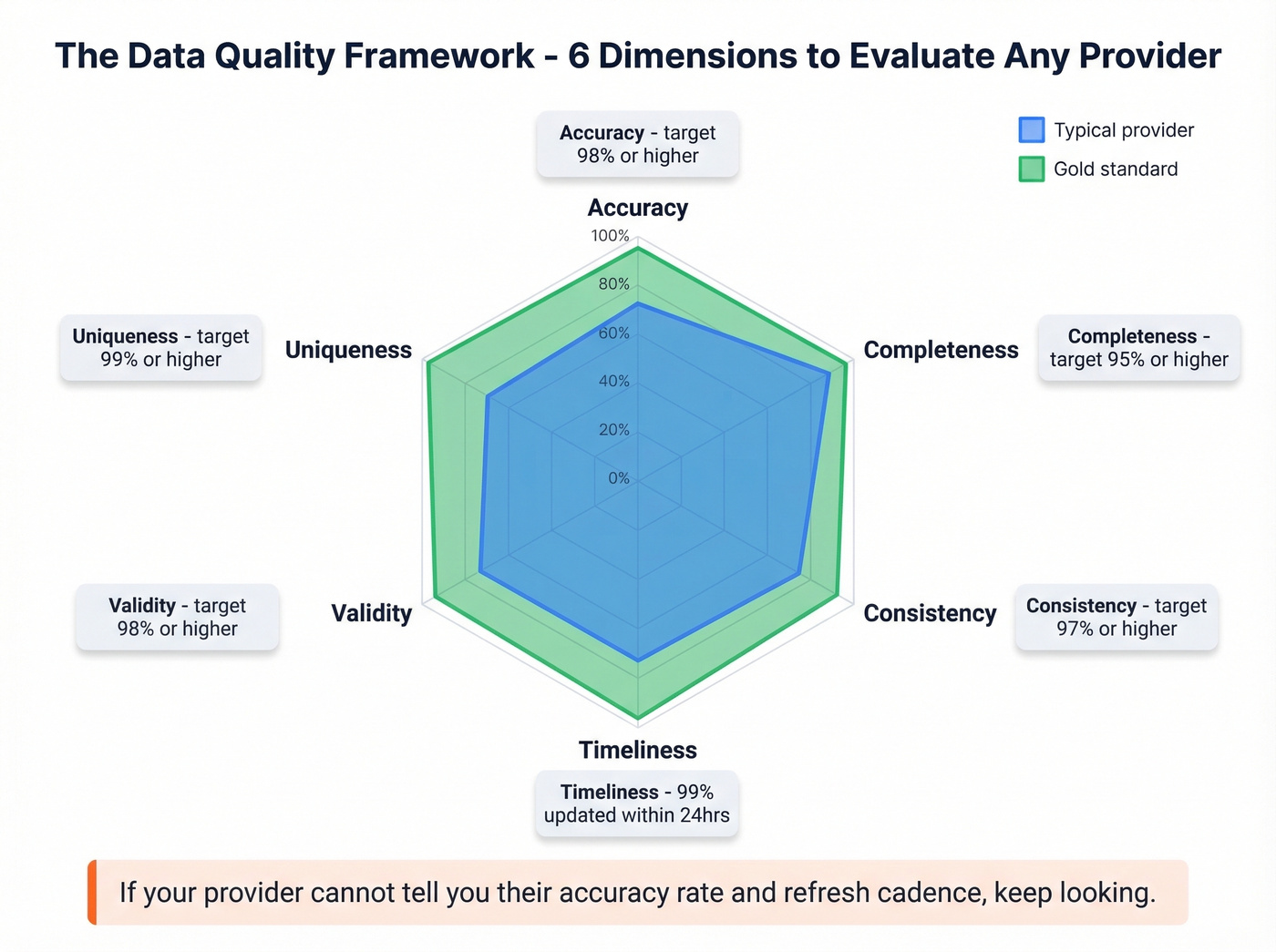
The quality framework we recommend:
| Dimension | Target | What It Means |
|---|---|---|
| Accuracy | ≥98% | Emails/phones reach real people |
| Completeness | ≥95% | Records have all key fields |
| Consistency | ≥97% | No conflicting data across records |
| Timeliness | ≥99% within 24hrs | Updates propagate fast |
| Validity | ≥98% | Data matches expected formats |
| Uniqueness | ≥99% | Minimal duplicates |
If your provider can't tell you their accuracy rate and refresh cadence, keep looking.
Top Providers by Category
B2B Contact Data
ZoomInfo remains the most comprehensive all-in-one platform. Firmographic depth, bundled intent data, and a massive workflow suite make it the default for enterprise teams with budget to match. But email accuracy at 87% means you're still bouncing roughly 1 in 8 contacts. Mid-market contracts run $15,000-$40,000/year, which is hard to justify unless your average deal size comfortably exceeds $20K.
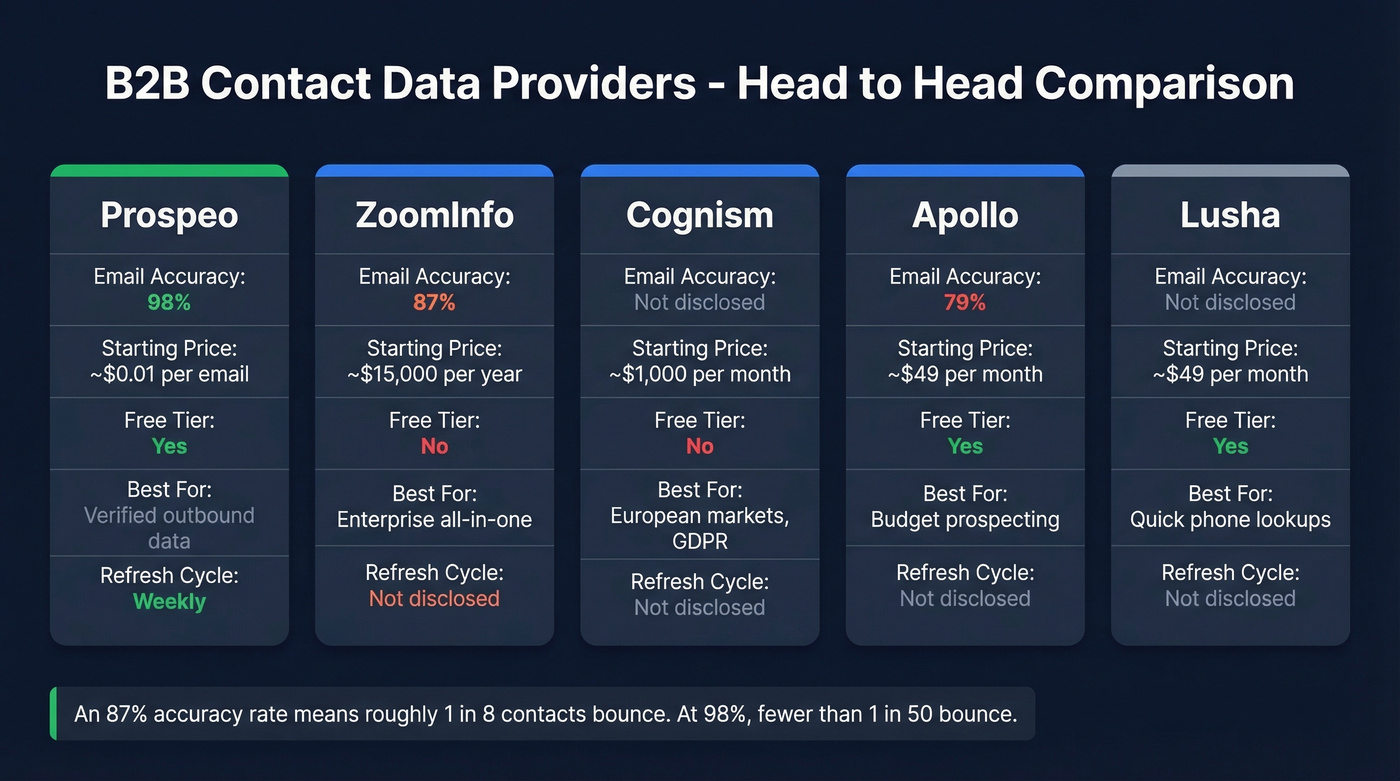
Cognism is the right call for European markets. GDPR compliance is baked in, EMEA mobile coverage is strong, and their Diamond Data verified phone numbers genuinely outperform competitors for outbound calling into the UK and DACH regions. Typically $1,000-$3,000/month on custom pricing.
Apollo gives you the most generous free tier in B2B data. Paid plans start at ~$49-$99/month per user. The trade-off: accuracy runs around 79%, which means roughly 1 in 5 emails won't land. Fine for early-stage prospecting, risky for high-stakes outbound.
Lusha works best as a quick-lookup tool for individual reps who need a phone number fast. Free tier available, paid plans from ~$49/month. Skip this one if you're building lists in bulk.
Intent Data
Bombora leads B2B intent. It tracks topic-level buying signals across a large network of B2B publishers, giving you account-level surge scores. Enterprise pricing runs $25,000-$100,000+/year depending on scale.
6sense combines account-level intent with an ABM orchestration platform. Pricing runs $30,000-$100,000+/year. Best for enterprise ABM teams that want intent, predictive scoring, and campaign orchestration in one stack. For teams that don't need the full platform, Prospeo offers intent data tracking 15,000 topics via Bombora at a fraction of the cost.
Audience & Adtech Data
LiveRamp is industry-standard data connectivity infrastructure. It supports three pricing models: standard CPM, hybrid (for The Trade Desk and Google RMN), and advertiser-direct (percent of media for social platforms). That three-model structure is why the same segment can cost wildly different amounts depending on where you activate it.
Lotame operates as a DMP plus data marketplace, suited for publishers and mid-market advertisers - expect $2,000-$10,000/month depending on data volume and activation needs. Eyeota provides global audience data across 100+ markets and is commonly activated in the $1-$5 CPM range. OnAudience offers programmatic segments that can be tested with Nielsen Digital Ad Ratings, with similar CPM pricing.
Specialized Data
BuiltWith delivers technographic data from ~$295/month - essential for selling into IT or targeting companies running a competitor's product. Foursquare provides location and mobility data for retail and QSR, typically $50,000+/year on enterprise contracts. Crunchbase covers funding rounds, leadership changes, and growth signals from ~$49/month for self-serve plans, with custom pricing for data licensing.
Experian handles consumer identity, credit, and risk data at enterprise scale, typically six figures annually.
Data Marketplaces
Snowflake Marketplace, AWS Data Exchange, and Datarade are aggregators where you browse and license datasets from multiple providers. B2B contact datasets often price per record or credit, while audience segments price in CPM - commonly $1-$5 CPM, with rare segments reaching $20 CPM. The marketplace is the shelf, not the product. You still need to evaluate each underlying provider's quality independently.
Master Comparison
| Provider | Category | Pricing Model | Starting Price | Best For |
|---|---|---|---|---|
| Prospeo | B2B Contact | Per-email | ~$0.01/email (free tier) | Verified outbound data |
| ZoomInfo | B2B Contact | Annual contract | ~$15,000/yr | Enterprise all-in-one |
| Cognism | B2B Contact | Monthly contract | ~$1,000/mo | European markets |
| Apollo | B2B Contact | Per-user/month | ~$49/mo | Budget prospecting |
| Lusha | B2B Contact | Per-user/month | ~$49/mo | Quick phone lookups |
| Bombora | Intent | Annual contract | ~$25,000/yr | Topic-level intent |
| 6sense | Intent + ABM | Annual contract | ~$30,000/yr | Enterprise ABM |
| LiveRamp | Audience/Adtech | CPM / % of media | Varies by model | Data connectivity |
| Lotame | Audience/DMP | Custom monthly | ~$2,000/mo | Mid-market audiences |
| Eyeota | Audience | CPM | ~$1 CPM | Global programmatic |
| OnAudience | Audience | CPM | ~$1 CPM | Tested segments |
| BuiltWith | Technographic | Monthly | ~$295/mo | Tech stack targeting |
| Foursquare | Location | Annual contract | ~$50,000/yr | Foot-traffic analysis |
| Crunchbase | Company Intel | Monthly | ~$49/mo | Funding/growth signals |
| Experian | Consumer/Credit | Annual contract | Not public | Enterprise risk data |

You just read that 28% of B2B emails go stale annually and most providers refresh every 6 weeks. Prospeo refreshes every 7 days, delivers 98% email accuracy, and costs roughly $0.01 per verified email - no enterprise contract required.
Stop paying for bounces. Start paying for accuracy.
How Pricing Works
Pricing models vary wildly depending on whether you're buying audience segments or B2B contact data.
For programmatic audience data, the two dominant models are CPM and percent of media spend. Standard segments run $1-$5 CPM, with rare or specialized segments reaching $20 CPM. Social platforms charge 10-20% of media spend, while DSPs and CTV/OTT platforms lean toward CPM ($1.50-$2.50 typical, $2.50 for CTV/OTT).
| Pricing Model | Typical Range | Common Platforms |
|---|---|---|
| Standard CPM | $1-$5 | DSPs, display |
| CTV/OTT CPM | ~$2.50 | Streaming platforms |
| % of Media | 10-20% | Social (FB, TikTok) |
| Per-email (B2B) | $0.01-$1.00 | B2B contact providers |
| Annual contract | $15K-$100K+ | ZoomInfo, Cognism |
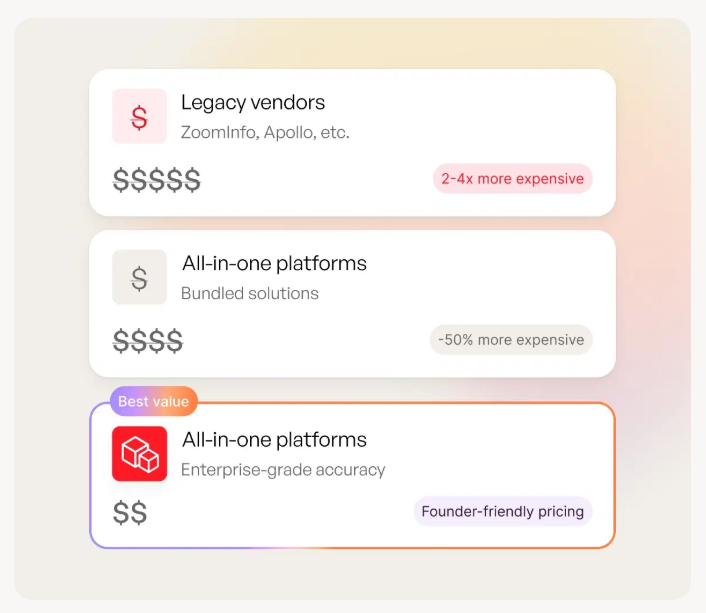
For B2B contact data, the contrast is stark. Self-serve providers charge per-email or per-user, while enterprise platforms lock you into annual contracts. That pricing gap doesn't always correlate with quality - an 87% accuracy rate at $15K/year isn't automatically better than 98% accuracy at a fraction of the cost.
If you're comparing vendors on cost per verified contact, it helps to understand data enrichment and how providers price refreshes vs net-new records.
How to Evaluate Providers
Most buyers skip evaluation entirely. They see a big logo, sit through a demo, and sign. Then they discover the data is stale six months in.
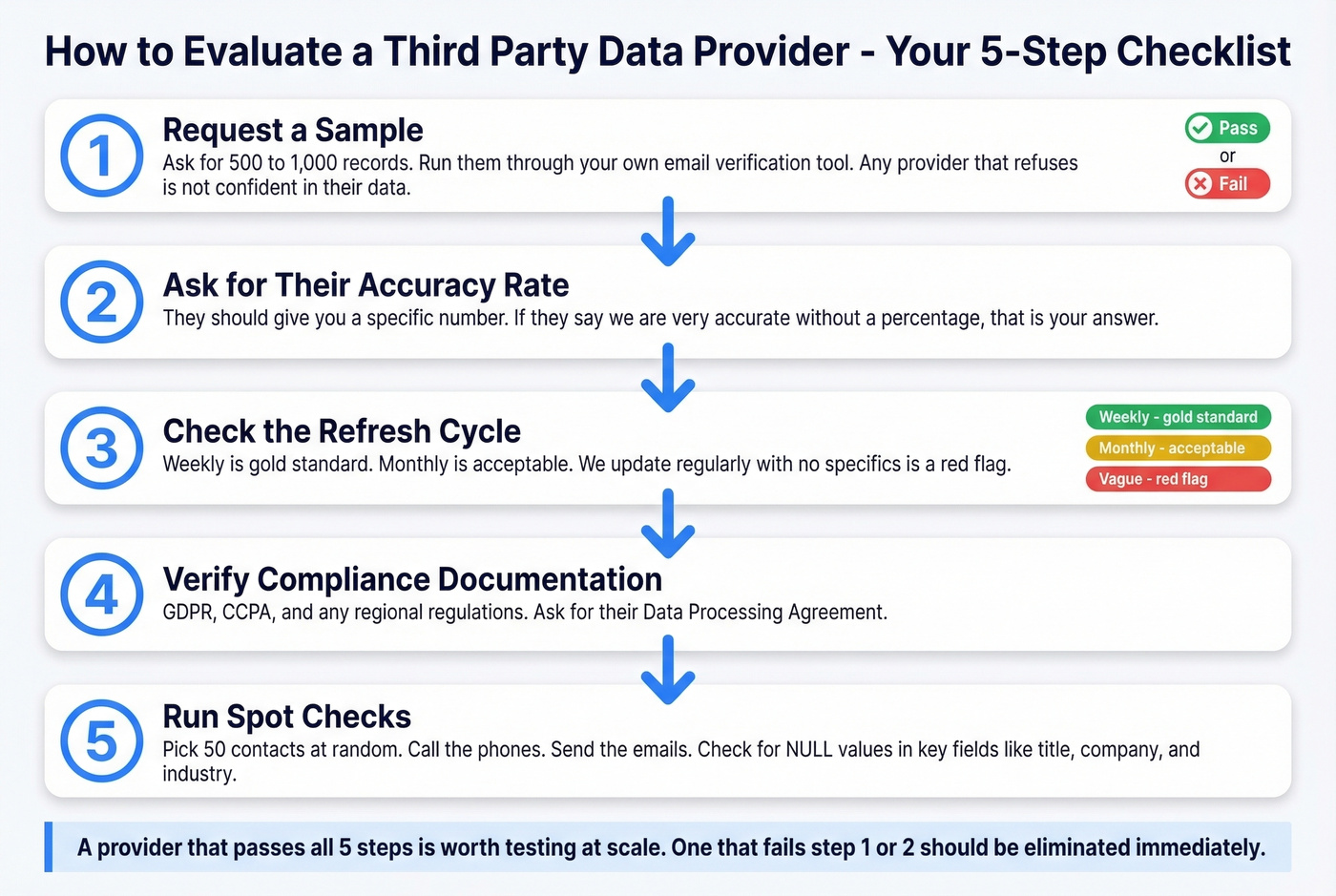
Let's be honest: we've made this mistake ourselves before building our own evaluation process. Use this checklist instead.
Request a sample. Any provider that won't give you 500-1,000 records to test isn't confident in their data. Run those records through your own verification.
Ask for their accuracy rate. If they can't tell you, that's your answer. (If you're seeing high bounces, benchmark against typical email bounce rate ranges and causes.)
Check the refresh cycle. Weekly is gold standard. Monthly is acceptable. "We update regularly" with no specifics is a red flag.
Verify compliance documentation. GDPR, CCPA, and any regional regulations that apply. Ask for their DPA.
Run spot checks. Pick 50 contacts at random. Call the phones. Send the emails. Run NULL tests on key fields and regex validation on phone number formats. Measure what bounces.
Test across your ICP. A provider that's great for US tech companies can be terrible for European manufacturing. Test the segments you actually need. (Use an Ideal Customer Profile scorecard so your sample is consistent.)
Compare multiple vendors side by side using the same sample ICP - this reveals accuracy and coverage gaps that a single-vendor demo never will. The consensus on r/sales is that most reps don't bother with this step and regret it within a quarter.
The six quality dimensions - timeliness, completeness, accuracy, validity, consistency, and uniqueness - aren't academic. Write them into your evaluation scorecard.
Five Mistakes When Buying Data
Buying without a use case. "We need more data" isn't a use case. "We need verified emails for VP+ titles at Series B-D SaaS companies in North America" is. Start with the use case, then find the provider. (If you need a system, start with proven sales prospecting techniques.)
Skipping sample testing. Every provider looks good in a demo. The data tells the truth. Always test before you commit.
Assuming more data equals better data. A billion records mean nothing if 30% are outdated. You don't need 20 providers. You need two or three that are actually accurate.
Accepting the first price. Data pricing is negotiable. Quotes vary by rep, by quarter, by how badly the vendor needs to close. Push back. (Negotiation teams often use an anchor to reset the pricing conversation.)
Ignoring data freshness. A database that updates every six weeks is selling you contacts who've already changed jobs. According to the Bureau of Labor Statistics, the average monthly quit rate in the US hovers around 2-3%, which compounds fast across a large database.
What's Replacing Cookie-Based Data
These aren't future trends - they're operational realities in 2026.
Data clean rooms let two parties collaborate on combined datasets without exposing raw records. They've moved from experimental to core infrastructure for cross-partner audience analysis. Google's Ads Data Hub and AWS Clean Rooms are two of the most widely adopted implementations.
First-party enrichment takes your existing CRM data and layers on verified third-party attributes - job titles, company size, intent signals - without relying on cookies. (This is where dedicated data enrichment services can outperform general databases.)
Server-side tagging moves tracking from the browser to your server, bypassing cookie restrictions entirely.
The shift is clear: own your first-party data, enrich it with verified third-party sources, and stop depending on browser-level tracking that users are actively rejecting. As third party data providers evolve their sourcing methods away from cookies, the ones investing in deterministic identity resolution will deliver the most reliable records. If deliverability is already shaky, fix the foundation with an email deliverability guide before scaling volume.
FAQ
What's the difference between first-party and third-party data?
First-party data comes directly from your audience - website visits, CRM records, purchase history. Third-party data is collected by an external company and sold or licensed to you. Both are valuable; the key is knowing which you're buying and how it was sourced.
Are third-party cookies dead?
Not technically - Google moved to a user-choice model instead of killing them outright. But roughly 70% of users deny cookies when prompted, and Safari and Firefox already block them by default. Cookie-dependent audience segments are shrinking fast. Plan your data strategy around deterministic sources.
How much does third-party data cost?
Programmatic audience segments typically cost $1-$5 CPM, while B2B contact data ranges from free tiers to $40,000+/year for enterprise platforms like ZoomInfo. Pricing depends on data type, volume, and licensing model.
How do I choose between providers?
Ask for their email accuracy rate, data refresh cycle, and verification methodology. Request a sample and spot-check it against real contacts. Minimum benchmarks: ≥98% accuracy, ≥95% completeness, and a refresh cycle under 30 days. Then compare pricing per verified contact - not per record in the database.
Where can I find a list of vendors to compare?
The master comparison table above covers 15 providers across B2B contact, intent, audience, technographic, and specialized categories. For a broader search, data marketplaces like Datarade and AWS Data Exchange let you browse hundreds of third party data companies filtered by category, geography, and pricing model.
Meritt tripled pipeline from $100K to $300K/week after switching. Snyk cut bounce rates from 35% to under 5% across 50 AEs. The difference wasn't strategy - it was data quality from a provider with 300M+ profiles and 5-step verification.
Compare Prospeo against your current provider in 5 minutes.