

Transactional Selling vs Relationship Selling: The Debate Is a False Binary
Your manager pulls you aside after a deal closes. "You're too transactional," they say. "You need to build relationships." Meanwhile, a rep on Reddit describes getting the same feedback - and wonders whether sending "Happy New Year" texts to prospects they barely know is really what separates good sellers from great ones. It isn't. The transactional selling vs relationship selling debate is a false binary, and your deal size - not your personality - should determine which motion you run.
The Short Version
Under $50K ACV? Run a transactional motion - speed and efficiency win. Over $50K? Invest in relationship-driven engagement with multi-threaded stakeholder access. Most modern teams need both motions running simultaneously, and both collapse without accurate contact data feeding the top of the funnel.
Definitions That Actually Matter
Transactional selling optimizes for speed and volume. Match a known problem to a clear solution, close the deal, move on. Relationship selling optimizes for trust and longevity - become a strategic partner who earns larger, recurring commitments over time.
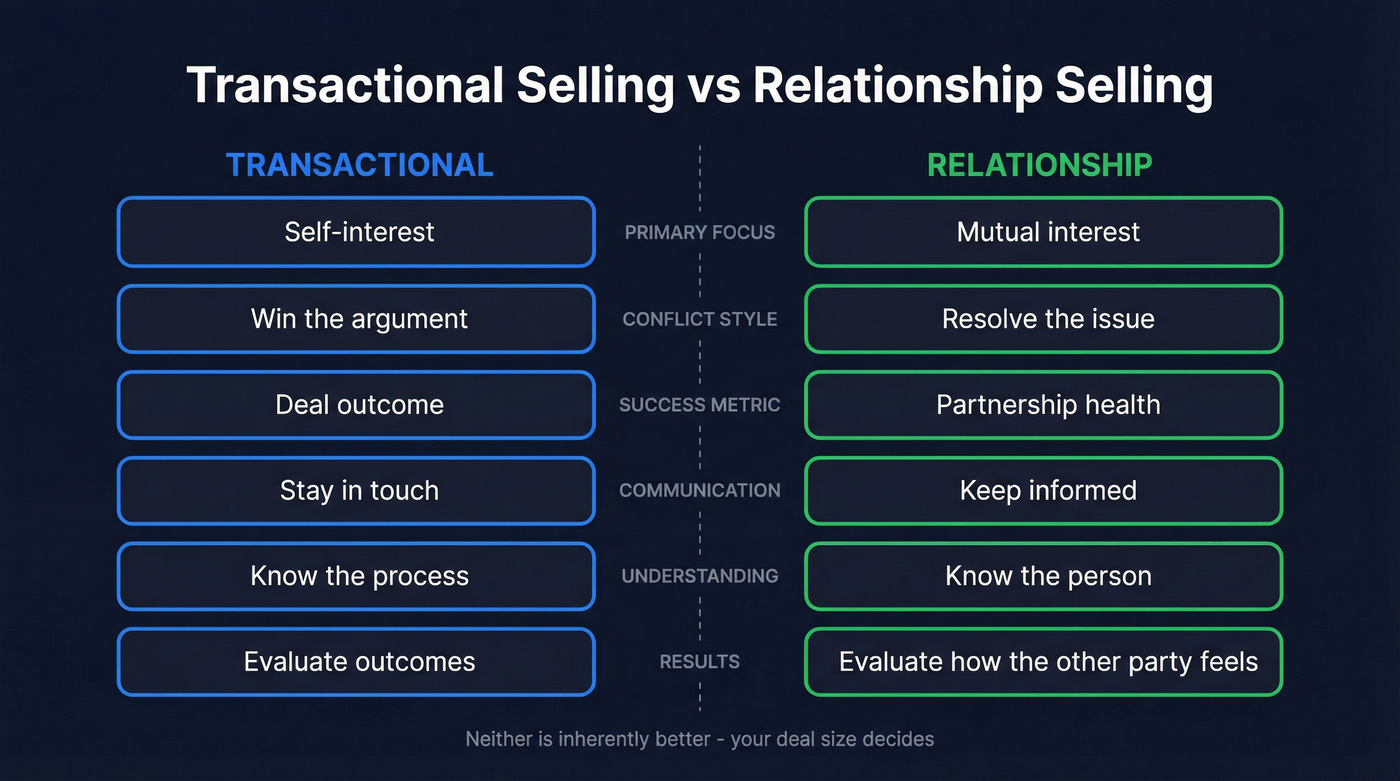
Here's how the two approaches differ across key dimensions:
| Dimension | Transactional | Relationship |
|---|---|---|
| Primary focus | Self-interest | Mutual interest |
| Conflict style | Win the argument | Resolve the issue |
| Success metric | Deal outcome | Partnership health |
| Communication | Stay in touch | Keep informed |
| Understanding | Know the process | Know the person |
| Results evaluation | Evaluate outcomes | Evaluate how the other party feels about outcomes |
Neither column is inherently better. The right choice depends on what you're selling and to whom.
When Transactional Selling Wins
If your ACV sits in the $5K-$50K range, transactional selling is your engine. These deals close in 30-90 days, involve one to three stakeholders, and don't require six months of trust-building dinners. Think project management tools, email marketing platforms, or office supply reorders - products where the buyer already understands the category.
80% of sales interactions are now fully digital. Buyers in this range don't want a trusted advisor. They want a clear pitch, a demo that respects their time, and a straightforward path to purchase. Trying to force relationship-building into a deal that should close in six weeks just extends the cycle and bloats your pipeline.
One risk worth flagging: over-indexing on transactional sales can commoditize your offering and increase churn. If every deal is a one-and-done, you leave expansion revenue on the table. The motion works - just don't let it become your only motion. If churn is creeping up, run a quick churn analysis before you blame the reps.

Transactional selling runs on speed. Every bounce and wrong number kills that speed. Prospeo delivers 98% email accuracy and 125M+ verified mobiles so your high-velocity pipeline never stalls on bad data.
Close transactional deals faster when every contact is verified.
When Relationship Selling Wins
Once ACV crosses $50K, the game changes. You're dealing with more stakeholders, more risk, and more internal alignment work. Enterprise software, consulting engagements, and multi-year platform deals live here. 57% of sales professionals say cycles are getting longer, and that trend accelerates at the enterprise tier.
72% of company revenue comes from existing customers, and those relationships don't build themselves. One B2B case study showed a 21% increase in SQLs and a 97% increase in revenue after shifting to a nurture-based, relationship-driven motion. In consulting, the shift from "solution-based" to "trusted partner" positioning is how firms win seven-figure retainers - a pattern discussed constantly in sales communities and on r/sales threads about enterprise deal strategy.
Why "Relationship Builder" Is the Worst Seller Profile
Here's the thing: the Challenger Sale framework breaks sellers into five profiles, and the "Relationship Builder" consistently underperforms. Top performers teach prospects something new, tailor the message to different stakeholders, and take control of the deal process. Being likable isn't a sales strategy. Being useful is.
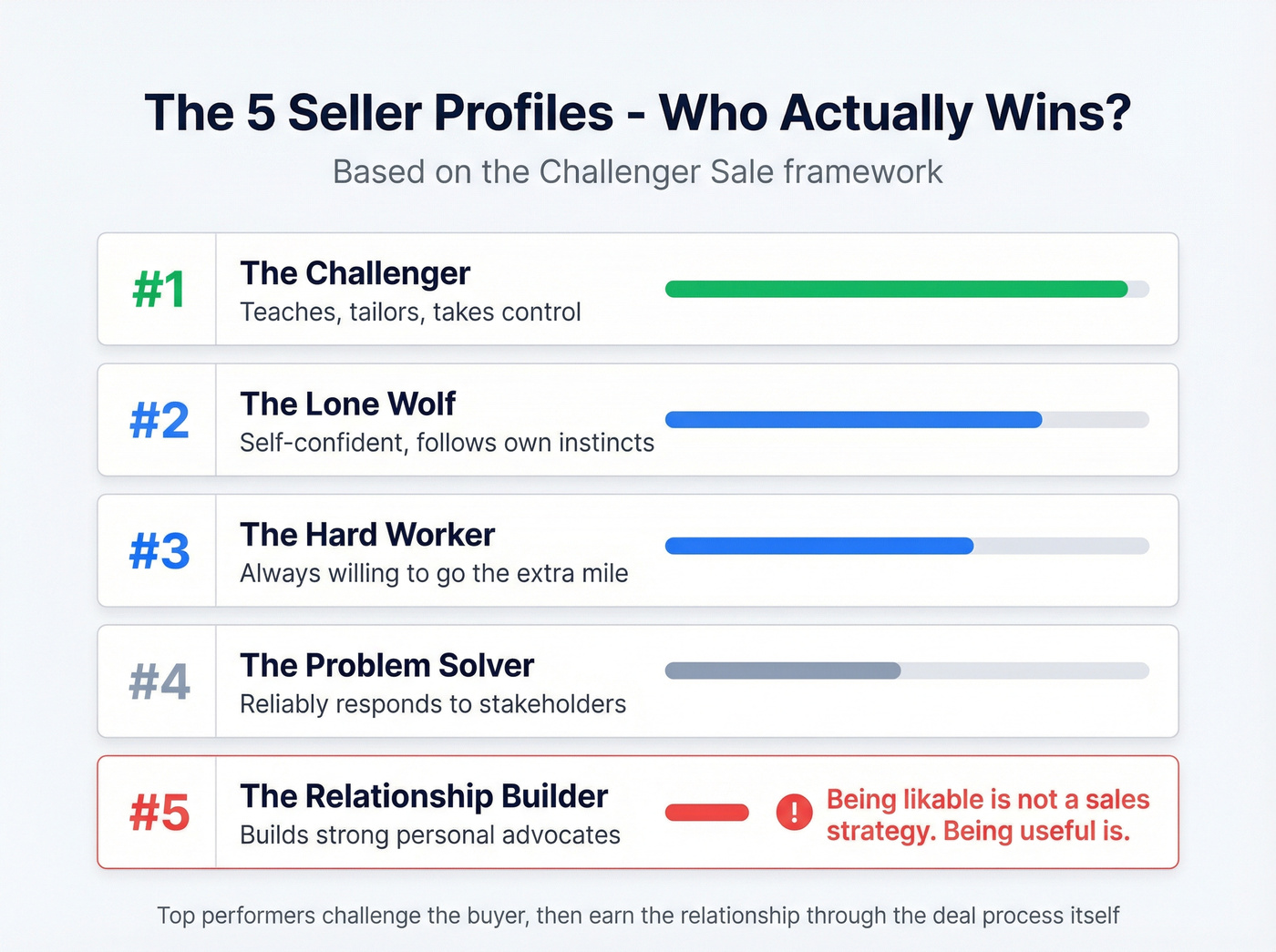
Reddit buyers say the same thing. One poster put it bluntly: "Give me your sales pitch. Tell me what problems you fix." The "I'm not trying to sell you anything, let's just chat" approach feels fake because prospects know you're selling. Real relationship selling isn't schmoozing - it's consistently delivering insight and value that makes the buyer's job easier. If your "relationship building" is just holiday texts and LinkedIn likes, you're not building a relationship. You're performing one.
Let's be honest: most reps who call themselves "relationship sellers" are actually just slow closers who've rebranded their pipeline problem as a personality trait. The best enterprise reps we've watched don't choose between transactional and relational - they challenge the buyer's thinking early, then earn the relationship through the value of the deal process itself. (If you want a practical way to do that, start with how to add value in sales.)
The ACV Framework for Choosing Your Motion
Stop debating philosophy and look at your deal size. This framework maps selling motion to ACV, and it's the most practical tool we've found for making the call - regardless of whether you sell SaaS, consulting, manufacturing, or sponsorship deals:
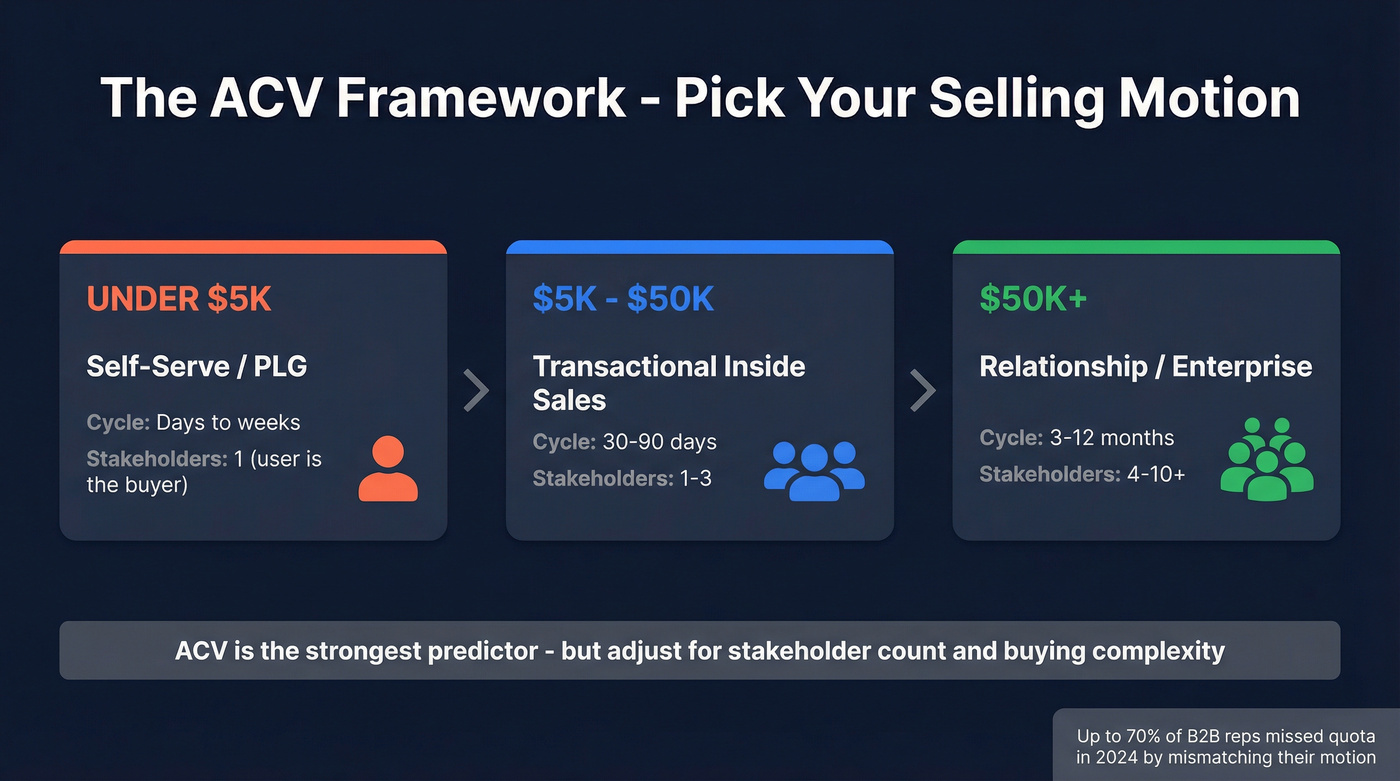
| ACV Range | Selling Motion | Typical Cycle | Stakeholders |
|---|---|---|---|
| Under $5K | Self-serve / PLG | Days to weeks | 1 (user = buyer) |
| $5K-$50K | Transactional inside sales | 30-90 days | 1-3 |
| $50K+ | Relationship / enterprise | 3-12 months | 4-10+ |
The lines aren't rigid. A $40K deal with seven stakeholders might need a relationship approach, while a $60K commodity renewal closes transactionally. But ACV is the strongest predictor of which motion works. Given that up to 70% of B2B reps missed quota in 2024 and only 2-5% of B2B leads convert, picking the right motion for each deal isn't a nice-to-have. It's survival. If you're trying to improve conversion, track your sales conversion rate by ACV band.
The Real Answer: Hybrid Selling
Most teams don't pick one motion - they run both. Digital self-serve handles reorders and simple purchases, while human-led selling tackles complex, high-value deals. In our experience, the teams that run both motions well share one thing: clean data infrastructure that feeds both pipelines without manual babysitting.
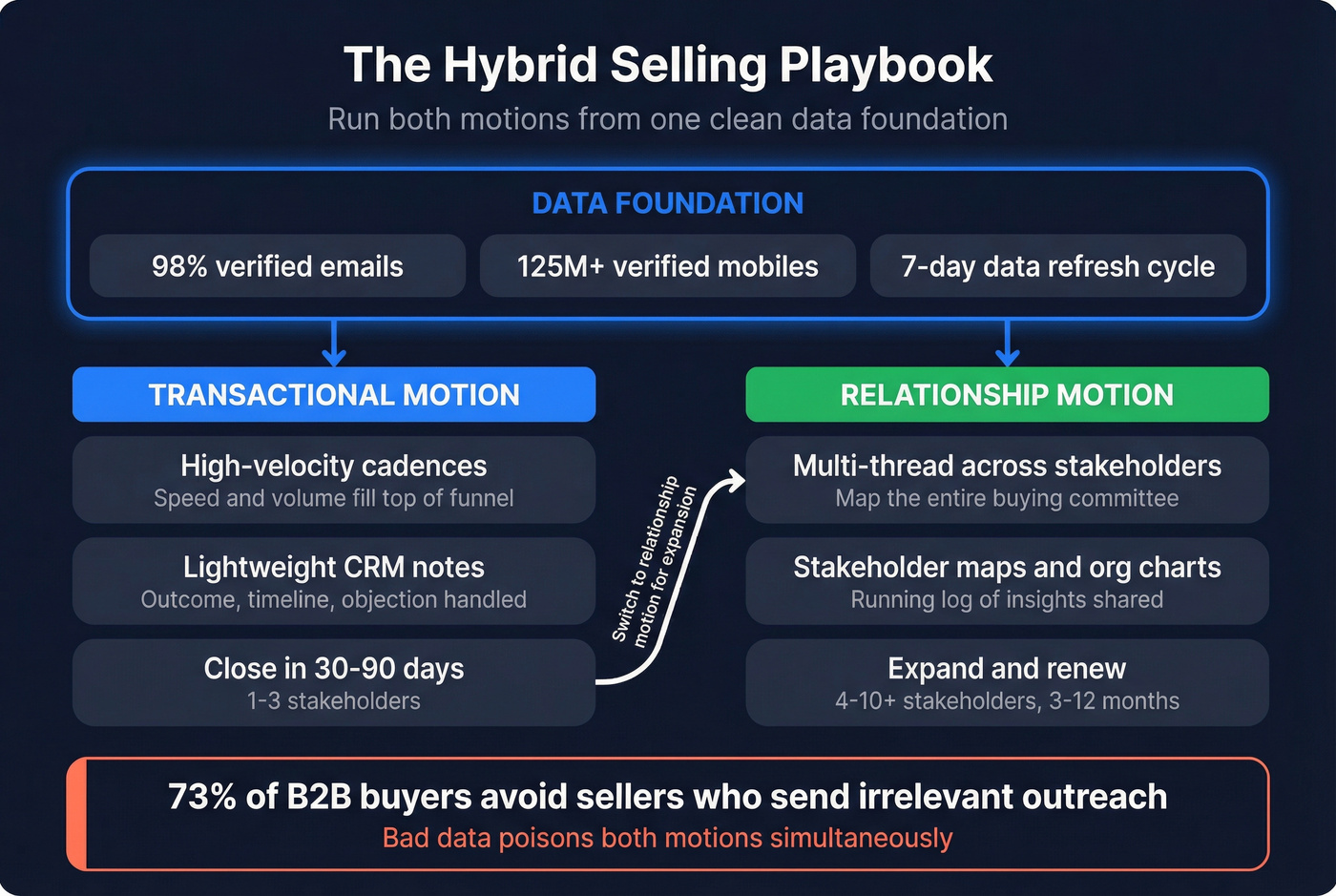
Here's the tactical playbook:
- Enrich accounts before outreach. Both motions fail when you're emailing dead addresses or calling the wrong stakeholder. Prospeo's 98% email accuracy and 7-day data refresh cycle solve this at the source - your first touch actually lands, whether you're running a high-velocity cadence or a multi-threaded enterprise play. (If you're evaluating vendors, start with data enrichment services.)
- Use transactional cadences for pipeline generation. Speed and volume fill the top of funnel. If you need fresh ideas, borrow from these sales prospecting techniques.
- Switch to relationship motion for expansion. Once a customer is in, multi-thread across stakeholders for upsells and renewals. This is where upsell vs cross-sell in SaaS becomes a real operating system, not a buzzword.
- Map stakeholders early on enterprise deals. More decision-makers means more value narratives to align. Skip this step and you'll lose to a competitor who didn't. (A structured MEDDIC sales qualification process helps here.)
- Document differently by motion. Transactional deals need lightweight CRM notes - outcome, timeline, objection handled. Relationship deals need stakeholder maps, org charts, and a running log of insights shared. If your CRM setup is messy, use these examples of a CRM to sanity-check what “good” looks like.

73% of B2B buyers avoid sellers who send irrelevant outreach, and reps spend 60% of their time on non-selling tasks. The hybrid model only works when the data underneath it is solid. Bad data doesn't just cost you one deal - it poisons both motions simultaneously. For many organizations, the real growth lever is evolving from transactional to strategic selling: using data-driven insights to identify which accounts deserve deeper investment and which should stay in a high-velocity pipeline.
Hybrid selling demands multi-threaded access to 4-10+ stakeholders per deal. Prospeo's 30+ search filters - buyer intent, job changes, department headcount - let you map entire buying committees in minutes, not weeks.
Stop guessing who's in the deal. Find every stakeholder now.
FAQ
Can you combine transactional and relationship selling?
Yes - most high-performing teams already do. Run transactional cadences for deals under $50K ACV, then shift to relationship-driven engagement for enterprise accounts. Your deal size determines the blend, not a blanket policy from your VP of Sales.
Is relationship selling always better?
No. A $15K SaaS deal doesn't need six months of trust-building - it needs a clear demo and a fast close. Transactional motions outperform on lower-ACV deals where speed matters more than stakeholder depth. Match the motion to the deal, not to a philosophy.
What tools support both selling motions?
Data enrichment and verification tools are the common denominator. Both motions depend on reaching the right person with valid contact info. We've seen teams cut bounce rates from 35%+ down to under 4% just by cleaning their data before running either motion - and that single change ripples through every metric downstream.
How do I know which motion a specific deal needs?
Start with ACV, then adjust for stakeholder count and buying complexity. A $30K deal with one decision-maker is transactional. A $30K deal with a seven-person buying committee needs relationship tactics. When in doubt, count the stakeholders - more than three usually means you need to invest in the relationship.